The 12:40 a.m. Thread That Would Not Close
At 12:40 a.m., I met Alex, a 28-year-old London product designer who could make a clean call on a Figma handoff by day and could not send one clear boundary by night. I watched them sit on the edge of their bed in a shared flat, an unsent goodbye glowing above the keyboard. The radiator clicked behind us, wet tyres whispered along the street below, and their phone had warmed the centre of their palm from too much scrolling.
Alex had known this person for just over three weeks. There had been long dates, voice notes, quick disclosures, and the dense, near-constant messaging that can make a short situationship feel like it has skipped ahead three months. I watched their restless thumb travel back to the first affectionate exchange, then watched them replace the goodbye with a softer check-in.
“I know intensity is not the same as compatibility,” Alex told me. “But it does not feel that way in my body. It was only three weeks, so why does ending it feel like deleting something huge?”
I recognised the particular shape of that reluctance: a chest pulled tight as a drawstring, hands reaching for the phone as if it were the only source of light. Alex knew the connection did not meet every present need, but their body kept answering, Do not let go. This might be rare. A friend had recently asked, “How long has it actually been?” Alex had answered, “Just over three weeks,” then privately thought, Long enough to feel rare.
I told them that a short connection can create real grief without creating a lifelong obligation. I was not there to declare whether they should stay or leave. I was there to sit beside the evidence with them, make room for the feeling, and help them draw a map through the fog.
A Compass for an Intense Situationship
I asked Alex to put both feet on the floor, take one ordinary breath, and hold the question in mind: why did these few intense weeks already feel too important to leave? Then I shuffled slowly. For me, this is not a mystical performance; it is a practical pause between the urge to react and the work of noticing.
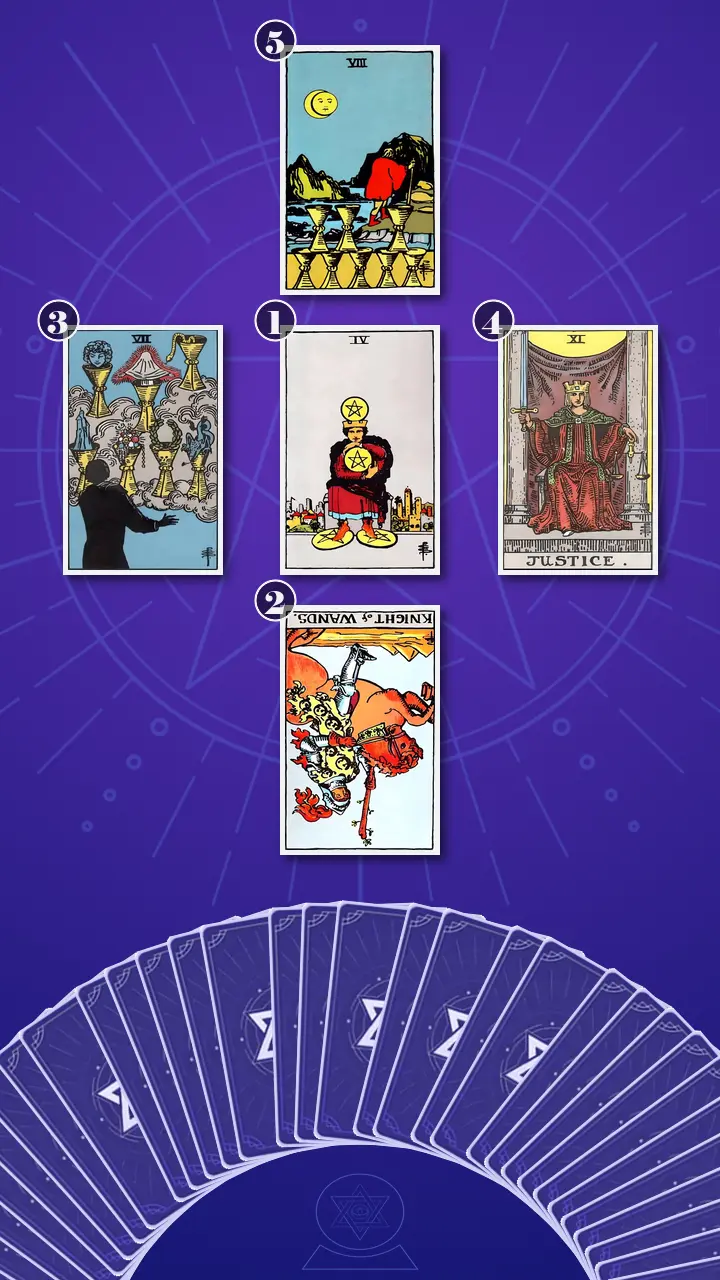
I chose the Five-card Shadow Spread, a focused tarot spread for relationship clarity. I use it when the central question is not prediction, and not a simple stay-or-leave verdict, but why a pattern has taken on so much authority. This spread is useful because it traces the visible behaviour, the charge beneath it, the story that keeps it going, the reality anchor, and the self-directed next step.
I placed the first card at the centre for the observable grip. The second went below it for the emotional acceleration under the surface. The third went to the left for the meaning-making blind spot, and the fourth to the right for the reality anchor. The final card rested above them all, pointing toward an integrated boundary. The arrangement made a cross around what Alex had been holding so tightly: a compact map for separating feelings from relationship evidence.
Holding, Racing, and Seven Open Tabs
The Phone Held Against the Chest: Four of Pentacles
Now I turned the card that represents the observable grip, the daily behaviour through which Alex preserved the connection and postponed leaving. It was the Four of Pentacles, upright.
I showed Alex the figure whose arms lock a pentacle against the chest, while two more coins are pinned beneath their feet. The image did not tell me that the connection lacked value. It showed the cost of treating access as the only way to preserve value. At 12:40 a.m., Alex had held the phone close like that pentacle, keeping the whole message history available because muting, archiving, or ending contact felt as though it might erase proof that the weeks mattered.
The Four of Pentacles is Earth energy compressed into immobility. Its holding has become excessive: every limb is assigned to protecting something, so there is no room to move. I asked Alex, “When you reopen the thread tonight, are you trying to preserve access to this person, the future you imagined, or proof that the past few weeks were real?”
Alex gave a small laugh that did not quite reach their face. Their fingers tightened around the phone, then eased. “That is painfully accurate,” they said. “If I loosen my grip on the messages, maybe I lose the proof that it mattered.”
I let that land without judgement. Preserving meaning and preserving access are different tasks. The first can honour an experience; the second can quietly prevent a present-tense choice.
The Train That Skipped the Stations: Knight of Wands Reversed
Now I turned the card representing the charge beneath the intensity, the acceleration and protective impulse maintaining the attachment loop. It was the Knight of Wands, reversed.
The knight's horse rears beneath a raised wand. Upright, the card carries pursuit, appetite, speed, and confidence. Reversed, that Fire becomes overdriven: fast starts, abrupt pauses, and a need to restore momentum before enough time has passed to test stability. Several long dates and near-constant voice notes had given Alex the emotional density of a much longer relationship. When a four-hour gap appeared, their chest read it as danger.
I told Alex that this connection had moved like a train skipping the stations where consistency would normally be observed. It had travelled quickly, but it had not stopped long enough to reveal whether the timetable was reliable. The trapped energy was not proof that the connection was wrong. It was a blockage in pacing: speed had been mistaken for sustainability.
In my mind, I returned briefly to an archaeological trench, where a dramatic layer can look decisive until patient excavation shows how little time it occupied. A vivid deposit is still real. It is simply not the whole site. Alex's shoulders had risen toward their ears as they listened, and I watched them lower slightly when I said, “Slowing down does not automatically mean something is failing. Sometimes it is the first chance to see what is actually there.”
The Futures That Had Not Happened: Seven of Cups
Now I turned the card representing the meaning-making blind spot, the story that turned a few intense weeks into proof of exceptional long-term importance. It was the Seven of Cups, upright.
I pointed to the silhouetted figure facing seven cups that float in a cloud. None sits on tested ground. This was the blockage in the spread: a handful of emotionally vivid conversations had opened seven imagined browser tabs. Shared weekends. Meeting friends. A settled partnership. The sensation of finally being chosen. The version of Alex who did not have to wonder whether they belonged.
I recalled the Overground message from Alex's friend asking how long it had actually been. I could almost hear the train brakes and feel the cold metal pole in Alex's hand as the calendar fact collided with the emotional weight. “You may be mourning seven possible futures, not one present relationship,” I said. “Leaving one current connection can feel like losing every future your mind has attached to it, even when those futures were never promised, discussed, or repeatedly demonstrated.”
Alex went quiet. Their gaze dropped to the clouded cups, and I saw the small stomach-drop recognition pass through them. “I keep picturing future weekends,” they said. “And meeting their friends. It feels absurd when I say it out loud, but losing that version hurts.”
“It is not absurd,” I replied. “It is grief doing multiplication. But a possibility is not yet an agreement, and a strong beginning is not yet a tested fit.”
When Justice Set the Phone Face Down
The Reality Anchor: Justice
The room became noticeably quieter before I turned the next card. Now I turned the card representing the reality anchor, the corrective perspective that could separate emotional truth from evidence about whether staying was aligned. It was Justice, upright.
I showed Alex the evenly balanced scales, the upright double-edged sword, and the figure looking directly ahead. The scales ask for proportion; the sword asks for a clear sentence after the weighing is done. This is the Justice tarot meaning that matters when intensity and compatibility have become tangled: feeling deeply is not coldness's opposite. It is information that deserves its own place beside consistency, mutuality, sustainability, and personal needs.
At Cambridge and on archaeological digs, I learned a practice I call Historical Crossroad Matching. I do not judge a civilisation by one spectacular ceremonial fire or one lavish room; I look for what was repaired, returned to, and made livable over time. Here, I used the same lens with Alex. My Enduring Value Assessment was simple: the early spark could be genuine, yet the question of what would endure ordinary time remained open. The issue was not whether Alex had felt something rare. It was whether the connection had built a structure capable of holding what Alex needed.
At 12:40 a.m., I said, Alex's thumb had travelled to the first tender message because the unsent ending felt like a verdict on the whole experience. They wanted to leave, but the imagined future attached to those weeks felt unbearable to lose. I could see the old equation at work: It felt this intense, therefore I must keep it alive until I can prove what it means.
You do not have to treat intensity as proof; use Justice's scales to weigh what happened against what is actually consistent, mutual, and sustainable.
I did not rush to fill the silence. First, Alex's breath caught so cleanly that I heard its small scrape in the quiet, and their thumb stopped above the rim of their mug. Then their pupils widened and their gaze loosened past my shoulder, as if Monday's four-hour gap and every late-night draft were replaying somewhere behind me. A flush rose in their cheeks. “But if I stop treating it as proof,” they said, with a brief edge of anger, “does that mean I was wrong to feel it?” Their fingers folded into the sleeve of their jumper, then slowly opened. When I told them that real feeling did not obligate a permanent choice, their shoulders lowered by a fraction and a shaky, chest-deep breath followed. The release did not look like certainty. It looked like the slight dizziness of putting down a bag their hands had carried so long that they expected its weight.
I asked, “Now, with this new perspective, can you think of a moment last week when this distinction might have helped you feel differently?” Alex remembered the quiet Monday evening at work: the absent reply, the rising shoulders, the urge to turn a gap into a defining message. “I could have asked what had been consistent,” they said, “instead of asking whether it was special enough.”
That was the turn in the reading: from contracted attachment and certainty-seeking toward grief-tolerant, evidence-based boundary clarity. I told Alex, “Intensity is emotional data, not a binding contract. It can be honoured without being given sole authority.”
The Cups That Stay Upright
The Integrated Boundary: Eight of Cups
Now I turned the card representing the integrated boundary, the self-directed next step that could honour the experience without making it an obligation. It was the Eight of Cups, upright.
I drew Alex's attention to the eight cups standing upright while the cloaked traveller walks away under the moon. Nothing has been smashed. Nothing has been declared worthless. The traveller uses their feet again. This image answered the Four of Pentacles across the spread: one figure is immobilised by holding value close; the other lets value remain while choosing movement.
“This is not a card that orders you to leave,” I said. “It shows that leaving can be values-based even while feeling remains. You can keep the meaning without keeping the connection active.” I thought of Dorothy leaving Oz: an extraordinary experience can stay transformative without becoming a permanent home.
The Eight of Cups shifted the energy from blocked Water to directed Water. Alex did not need to delete photographs, deny tenderness, or prove the three weeks were insignificant. The question became more grounded: what minimum condition would make staying feel aligned rather than driven by fear of loss? Alex looked at the card's visible gap between the cups and said, almost to themself, “Reliable follow-through. And enough calm to think.”
The Present-Evidence Reset
I gathered the spread into one story. The Four of Pentacles showed Alex preserving access because access had become confused with meaning. The reversed Knight of Wands showed how rapid intimacy made urgency feel like emotional truth. The Seven of Cups showed the many unlived futures that had inflated one possible ending into several losses. Justice restored proportion, and the Eight of Cups offered movement without contempt for what had happened.
The cognitive blind spot was not that Alex felt too much. It was that feelings, observed facts, assumptions, and personal needs had all been placed in one undifferentiated pile, where the brightest moment always outweighed repeated behaviour. The transformation direction was clear: from preserving access to preserving meaning, from imagined futures to current information, and from complete-certainty seeking to self-trust. Clarity does not require the absence of grief.
- The Justice Scale CheckOn one quiet evening this week, sit at the shared kitchen table or another neutral spot, before opening WhatsApp. Set a seven-minute timer and make a note titled Felt / Demonstrated / Needed. Add no more than three short lines: what you felt, what the other person has repeatedly done in the last seven days, and one relationship need that applies today. End with two private sentences: These weeks mattered because... and What I choose next depends on...Keep uncertain material labelled unknown. This is information gathering, not a demand to make a decision; the minimum version is one line under each heading.
- The Twenty-Four-Hour Momentum PauseFor one week, save any message intended to define, intensify, or end the connection as a draft for twenty-four hours, unless an immediate safety or logistical boundary is needed. When the urge spikes at night, write three lines: The fact is..., I feel..., and My mind says this means.... Review the draft after breakfast using my Time Stratigraphy Exercise: imagine your ten-years-from-now self looking back and ask which choice protects your dignity and attention over time, not merely tonight's relief.A pause is not consent to more contact and it does not oblige another date. If twenty-four hours feels too large, begin with twenty minutes and leave the phone in another room.

A Week Later, the Quiet Proof
A week later, I received a message from Alex. They had muted the thread for one evening, completed the Felt / Demonstrated / Needed note, and left a defining message unsent until morning. “I still miss them,” Alex wrote, “but I stopped treating the missing as an emergency.”
At 11:06 p.m., Alex sat beside a paused episode while orange streetlight crossed the sofa. The silence still made their breathing shallow for a moment. Then they put the phone face down, made tea, and let the quiet remain unfinished. It was lighter, though not painless.
I took that as the first real proof of the journey: not an erased feeling, not a perfect answer, but a person recovering the right to choose without making grief the decision-maker. The cards had not supplied Alex's boundary. They had helped Alex see the boundary they were already capable of forming.
I want to leave you with the same permission. When a few weeks have filled your phone and your imagined future, the thought of leaving can tighten your chest as though you are losing not only a person, but proof that you might finally belong somewhere. I would ask you this: if those weeks could remain meaningful without deciding what you do next, what present-tense truth might you become curious enough to notice when you set the message thread beside Justice's scales?
This story is adapted from psychological research, written so that those in a similar struggle can see their own pattern in it — and find their next step clearly.These insights are not a substitute for professional psychological, medical, legal, or financial advice.
Learn more about our Journey to Clarity.
How did this insight land for you?
🫂 This Resonates Deeply
🌀 Living This Story
✨ Now I See Clearly
🌱 Seeing New Possibilities
🧰 Useful Framework
🔮 The Confirmation I Needed
💪 Feeling Empowered
🚀 Ready for My Next Step
Author Profile
 AI
AI“Having spent a lifetime at Cambridge and on archaeological digs, I’ve witnessed the rise and fall of countless civilizations. Please know that your current struggles are not a permanent fate, but merely a necessary fracture before rebuilding. I won't lecture you; instead, I invite you to sit with me in the ruins, using a patient, historical perspective to gently dust off the true, enduring value hidden beneath your temporary doubts.”
In this Choice Tarot Reading :
Core Expertise
- Historical Crossroad Matching: Contextualizing your dilemma by comparing it to macro-historical turning points, providing an objective bird's-eye view.
- Enduring Value Assessment: Evaluating competing options based on what will survive the test of time versus what is merely a short-term impulse.
Service Features
- The Time Stratigraphy Exercise: A mental time-travel protocol evaluating your current dilemma strictly from the perspective of your 10-year future self, instantly dissolving trivial anxieties.
Also specializes in :
Explore Related Patterns:
Chemistry ChasingDuring three weeks, long dates, quick disclosures, and near-constant voice notes created the density of a much longer relationship. You then read a four-hour gap as danger, so restoring momentum could feel like protecting the connection itself. This is how chemistry becomes a pacing authority, with speed feeling like evidence before ordinary consistency has had time to appear. The issue is not whether the spark was genuine. It is that urgency can make slowing down feel like failure and make leaving feel like wasting rare energy. You regain choice when you evaluate follow-through and sustainability at the same pace as the intensity that first pulled you in.
Closure AvoidanceAt the edge of the ending, you kept an unsent goodbye glowing above the keyboard and softened it into a check-in. Muting, archiving, or ending contact felt like deleting proof that the experience mattered, so postponing the clear sentence protected you from the finality of making one choice. The thread stayed open because closure had been made to carry the meaning of the entire connection. That delay can offer immediate relief while preserving the same uncertainty that keeps your thumb returning to the thread. You do not need to turn an ending into a verdict on the past; you only need to decide what access fits the present. A pause that creates room to think is different from keeping contact alive until grief disappears.
Emotional ReasoningWhen you said, "I know intensity is not the same as compatibility," you had already identified the evidence problem, yet your body answered, "Do not let go. This might be rare." The tight chest and the four-hour gap were then treated as information about what the connection must mean, rather than information about how activated you felt in that moment. That turns a real sensation into a verdict. The aim is not to argue your body out of existence. It is to give the sensation a proper place beside demonstrated consistency, mutuality, sustainability, and your current needs. When "I feel this strongly" no longer has to become "therefore I must keep it alive," leaving or staying can become a choice instead of an emergency response.
Romantic ProjectionYour mind opened future weekends, meeting their friends, a settled partnership, and a version of finally being chosen, even though those futures had not been promised or repeatedly demonstrated. The imagined relationship then joined the actual three-week connection, so ending one could feel like losing several lives at once. That projection gives emotional weight to possibilities that have not yet become mutual plans. This does not make the hope foolish or the feeling false. It shows that a vivid beginning can become a screen onto which belonging and certainty are projected. You can let those images be possibilities rather than evidence, and return your attention to what has actually been agreed, repeated, and made reliable.
Sunk Cost FallacyAt 12:40 a.m., you kept the goodbye unsent and replaced it with a softer check-in, while holding the message history as proof that the three weeks mattered. When ending contact feels like erasing the value of what you invested, the past begins to argue that the present must continue until it can justify that investment. That is how the connection can become too important to leave even when you already know it does not meet every present need. You are not making the feeling up; you are letting preserved access carry the burden of preserving meaning. The distinction in the story is precise: the weeks can remain real and meaningful without requiring ongoing access or more evidence. A boundary becomes clearer when you ask what the connection demonstrates now, rather than what staying might finally prove about what already happened.
Anchoring BiasYour thumb travelled back to the first affectionate exchange, and the brightest moments kept outweighing the repeated behaviour that needed to be examined. The initial emotional peak became an anchor, so later information was measured against it instead of being allowed to stand on its own. That makes a short, vivid beginning feel like the most authoritative part of the relationship. The anchor is not proof that the beginning was fake. It is a bias in how evidence is weighted. You can honour the first tenderness while asking what has been repaired, returned to, and made livable over time, which lets current data have a voice equal to the opening scene.
Values-Based Decision MakingAfter the reality check entered the conversation, you separated what you felt from what had been demonstrated and named reliable follow-through and enough calm to think as minimum conditions. Later, you muted the thread for an evening, left the defining message unsent until morning, and noticed that missing the person did not have to be treated as an emergency. Those actions place your needs and observed evidence beside the feeling instead of beneath it. This is not emotional detachment and it is not a command to leave. It is a way of making a decision that can respect the three weeks without handing them permanent authority. The boundary becomes yours when the next step depends on present-tense alignment, not on proving that the loss would be painless.
Explore Related Struggles:
Accelerated Intimacy TrapThree weeks of long dates, quick disclosures, voice notes, and near-constant messages gave the connection the density of a much longer relationship. The speed created pressure to keep moving or restore momentum whenever a four-hour gap appeared, even though the connection had not paused long enough to show reliable follow-through in ordinary time. You can therefore be weighing a vivid beginning against the absence of enough longitudinal evidence, with leaving feeling like you are interrupting something before its meaning has been proven. The trap is not that the intensity was unreal; it is that compressed time makes emotional urgency stand in for the slower evidence needed to decide what can last.
Access-Belonging FusionAt 12:40 a.m., Alex keeps the phone against their chest, scrolls to the first affectionate exchange, and hesitates to mute, archive, or end contact because doing so feels like deleting proof that the weeks mattered. The message thread is carrying two jobs at once: access to the person and preservation of the experience's meaning. You can then find a boundary unusually costly because stepping back seems to threaten not only contact but also the possibility of being chosen and belonging in the future Alex imagines. Keeping the channel open may protect the record of what happened, but it can also make a present-tense choice depend on continued access.
Attraction-Compatibility SplitAlex says, "I know intensity is not the same as compatibility," yet the hand still returns to the first affectionate message and the unsent goodbye becomes a softer check-in. The feeling is treated as evidence that the connection is rare, while the connection's ability to meet present needs, remain mutual, and sustain ordinary time is still being assessed. You can hold real attraction and still lack a tested fit; the friction comes when one bright signal is asked to answer a broader relationship question. Clarity here does not dispute what you felt. It gives that feeling a place beside repeated behaviour, mutuality, sustainability, and what you need now.
Future-Proofing ParalysisSeven imagined browser tabs open from a few vivid conversations: future weekends, meeting friends, a settled partnership, and finally being chosen. When the goodbye feels like a verdict on the whole experience, the decision is no longer only about the current three-week connection; it has been made responsible for every future that was pictured but never promised or repeatedly demonstrated. You may keep the connection active until it proves what those possibilities mean, because closing one door seems to close all of them at once. That leaves present evidence competing with an imagined timeline, so a decision that could be based on today's needs is delayed until the future feels guaranteed.
Explore Related Emotions:
Anticipatory GriefAlex looks at a three-week connection and sees future weekends, meeting friends, a settled partnership, and a version of themselves who no longer has to question whether they belong. The possible ending therefore removes more than one present relationship; it appears to close several emotionally vivid futures at once. When your mind has already furnished those futures with detail, their disappearance can register as a real loss even though they were never promised or repeatedly demonstrated. Anticipatory Grief captures this multiplication of loss, allowing you to respect what those possibilities represented without treating them as evidence that the current connection must continue.
Bittersweet ReleaseA week later, Alex mutes the thread, leaves a defining message unsent until morning, and admits that they still miss the person. They put the phone face down, make tea, and allow the quiet to remain unfinished without forcing themselves to deny what the connection meant. Bittersweet Release holds movement and tenderness in the same experience. You do not have to make the past insignificant in order to recover choice; the connection can retain meaning while your attention, boundaries, and next steps return to you.
Certainty HungerAt 12:40 a.m., Alex removes the clear goodbye, replaces it with a softer check-in, and returns to the first affectionate exchange. When closing a thread starts to resemble a final judgement on whether the experience was real, you can keep seeking one more message to secure an answer the relationship has not yet demonstrated. The pressure is not simply a wish for more contact. Certainty Hunger names the inward demand to know exactly what the connection meant before allowing yourself to choose, even though meaning can remain valid while the outcome stays unresolved.
Finality DreadAn unsent goodbye glows above Alex's keyboard while ending the thread feels like deleting something huge. Because the message has become a verdict on the entire experience, one present boundary seems capable of erasing the tenderness, significance, and possibilities attached to the previous three weeks. Finality Dread names the weight carried by that imagined point of no return. You can experience a boundary as unbearably absolute when memory, meaning, and continued access have been bundled together, even though choosing what happens next does not rewrite what already happened.
Relational UrgencySeveral long dates, quick disclosures, voice notes, and near-constant messaging give Alex three weeks of contact with the density of a much longer relationship. When a four-hour gap appears, their shoulders rise and the silence is read as an immediate problem that must be solved. Relational Urgency emerges when speed becomes the body's reference point for security. You may then feel pushed to check, clarify, intensify, or restore momentum before ordinary time has revealed whether the connection can sustain consistency without constant acceleration.
Scarcity AnxietyAlex's chest tightens around the thought that the connection might be rare, and their hand returns to the phone as if loosening contact could lose an irreplaceable opportunity. The word rare changes the scale of the decision, making three weeks feel less like one developing connection and more like a singular opening that may never appear again. Scarcity Anxiety is the resulting inner weather: the possibility of loss becomes larger than the available evidence about mutuality, consistency, and fit. Naming that atmosphere gives you room to ask whether rarity is being demonstrated in the present or supplied by the pressure of potentially losing what the connection briefly made possible.
Cautious Self-TrustAlex's fingers slowly open when they hear that a real feeling does not obligate a permanent choice. A week later, they can delay the defining message, examine what has actually been demonstrated, and identify reliable follow-through and enough room to think as conditions that matter now. Cautious Self-Trust does not require complete confidence or the disappearance of missing someone. It grows through small moments in which you notice an urgent feeling, give it space, and still permit your present needs to influence what you choose.
Clarity ReliefAlex's shoulders lower when intensity, compatibility, meaning, and continued access are finally treated as separate information. The Felt, Demonstrated, and Needed note gives each part of the experience its own place, so the brightest moment no longer has to outweigh every repeated behaviour or current need. Clarity Relief is the easing that arrives when one feeling is no longer required to answer the entire relationship question. You can honour the depth of your response while allowing evidence, mutuality, sustainability, and personal needs to remain visible beside it.
Explore Related Contexts:
Accelerated Intimacy PressureSeveral long dates, quick disclosures, voice notes, and near-constant messages have compressed an unusually high volume of intimacy into just over three weeks. The connection has accumulated the social density of a longer relationship before ordinary routines, response patterns, and follow-through have had much time to become visible. That compression creates external pressure to assign long-term importance using short-term evidence. You are effectively being asked to make a high-stakes relationship decision from a period rich in contact but limited in duration, where speed has reduced the number of ordinary situations available for testing compatibility. Recognising accelerated intimacy pressure does not invalidate the quality of the early exchanges. It gives you permission to restore proportion, slow the decision timeline, and observe whether the connection continues to function when novelty and concentrated messaging are no longer doing most of the structural work.
Access as Proof PressureAlex repeatedly returns to the first affectionate exchange and says that loosening their grip on the messages might remove the proof that the connection mattered. Muting, archiving, or ending contact has therefore acquired a second meaning: a change in access appears to become a verdict on the reality of the entire experience. The persistent message archive turns relationship history into an object that can be reopened, checked, and preserved. Under access as proof pressure, you are not only deciding whether to continue contact; you are being asked to separate the value of what happened from the availability of the person and the thread in the present. That distinction creates room for a more proportionate choice. You can preserve the meaning of the three weeks as part of your own history while deciding separately whether continued access is consistent with what the relationship currently demonstrates and what you need now.
Situationship AmbiguityAlex has known this person for just over three weeks, while long dates, quick disclosures, voice notes, and near-constant messaging have given the connection the density of a much longer relationship. The current bond does not meet every present need, and the future scenes attached to it have never been promised, discussed, or repeatedly demonstrated. Relationship significance is therefore running ahead of shared status, expectations, and evidence of follow-through. In a situationship, you can be carrying the decision weight of a partnership before there is enough mutual information to establish what the relationship is, making departure feel much larger than the calendar alone would suggest. Naming the ambiguity preserves your authority to assess the connection by its present structure. The intensity can remain meaningful while you ask what has actually become consistent, mutual, and sustainable between two people.