Two Rough Files in Six Days: Putting Skill Practice Before App Streaks

The 10:47 p.m. App Streak That Kept Real Learning Waiting
If you have ever done the two-minute review at 11:54 p.m. because losing a 143-day streak felt worse than skipping the skill you actually wanted, I know the particular ache behind that choice.
At 10:47 on a wet Tuesday night, Alex appeared in my video window from a narrow desk in their Toronto condo. I could see a project lesson open behind a blank document, hear the radiator clicking, and catch the silver blur of traffic moving across rain-dark pavement several floors below.
While Alex was telling me why they had booked the reading, their phone lit up beside the laptop. I watched their fingers twitch toward it. Their jaw tightened at the blinking cursor on the blank document, but when the streak warning glowed, their thumb moved almost automatically.
“That is literally the problem,” Alex said, turning the screen toward me. “I am consistent at protecting the streak, but not at learning the thing. The app says I progressed, but I cannot point to what I can do now.”
They had spent all day in their junior UX role moving through dashboards, Slack replies, completion states, and tidy little signals that something had been handled. By evening, the skill they genuinely wanted to learn asked for a rough, uncertain first attempt. The app asked for two minutes and offered confetti. Their frustration felt like having one hand trapped on a brightly lit scoreboard while the other hovered, empty and stiff, over the actual game.
I told Alex I was not interested in calling them lazy or ordering them to delete every app. “You are not failing to be consistent,” I said. “You are being consistent at preserving visible proof while the learning you chose remains untouched. Let us use the cards to map where that handoff happens, and how you might take it back without turning your evenings into another test.”

Choosing a Map for the Learning-App Reward Loop
I invited Alex to place both feet on the floor, release one slow breath, and hold a single question in mind: “What happens between wanting to learn and opening the streak app?” I shuffled slowly. I use this pause as a transition for attention, not as a piece of mystical theatre.
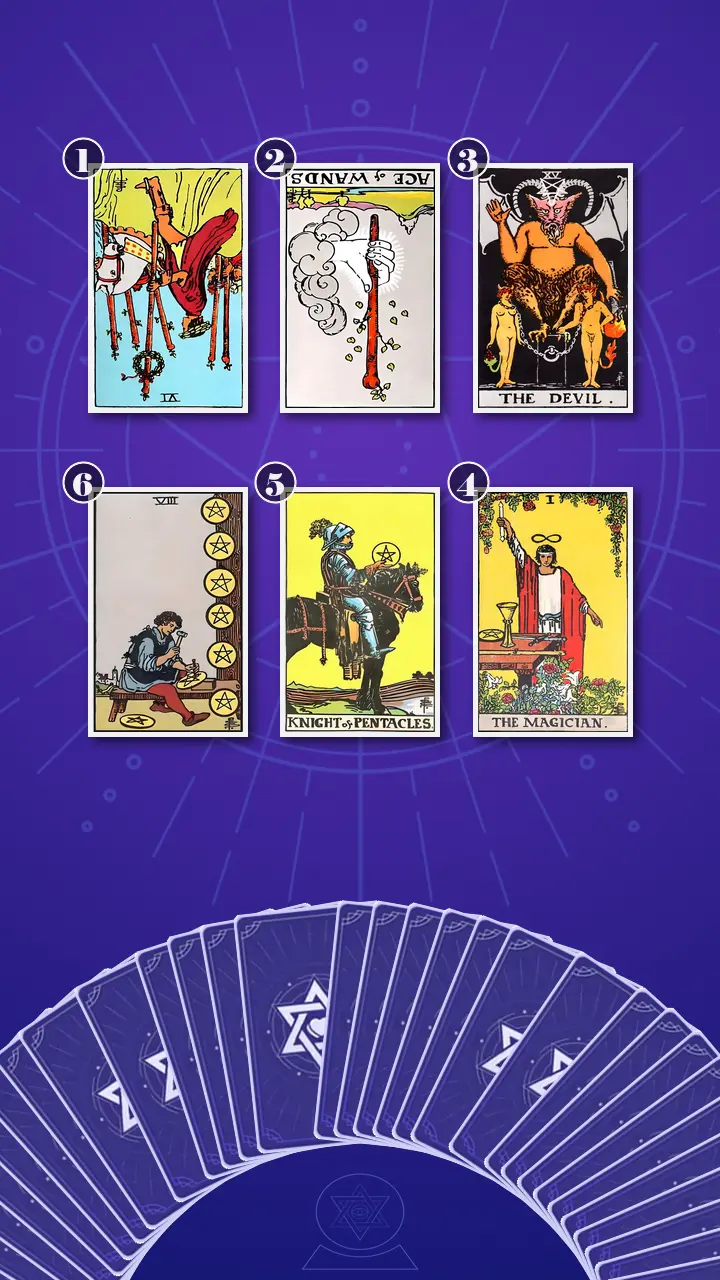
I chose the Transformation Path Grid · Context Edition, a six-card tarot spread arranged in two rows. The top row would show the visible symptom, the point where inspiration became blocked, and the reward mechanism maintaining the pattern. The lower row would identify the catalyst, a repeatable action, and a more useful definition of progress.
For anyone wondering how tarot works in a practical reading, I treat it as a structured mirror. Card meanings in context help me separate parts of a problem that feel fused together. This question did not require a prediction or a dramatic verdict. It required a current-state-to-integration map of cue, substitution, relief, consequence, choice, and practice.
The layout also created three useful comparisons: an awarded wreath against a craftsperson's finished work, a blocked spark against a steady routine, and an apparently commanding chain against deliberate agency. That architecture suited productive procrastination with learning apps because every force sustaining the loop would receive a direct counterweight.
The Bright Wreath and the Work Behind the Window
Position 1: The Badge That Received the Applause
I began with the card representing the observable symptom: preserving an app streak and reviewing its reward while the desired learning task remained unopened. I turned over the Six of Wands, reversed.
I angled the card toward the camera and pointed to the rider's laurel wreath and the surrounding crowd. Upright, those symbols can speak of victory and recognition. Reversed here, the wreath looked remarkably like a glowing achievement badge receiving more attention than the practice it was supposed to represent.
I described the familiar scene back to Alex: at 11:56 p.m., they choose the shortest review, watch the celebration animation, and reopen the completion graph while the project lesson stays hidden behind the app. The platform event is real. It proves that an exercise was completed. It cannot answer the private question, “What can I understand, make, or do now that I could not do before?”
The reversed energy showed an excess of externally supplied recognition and a deficiency of self-authored evidence. I did not read that as vanity. I read it as the reasonable desire for progress signals becoming detached from the skill those signals were meant to support. It was like polishing the scoreboard while the match remained paused.
Alex's breath stopped for a beat. Their eyes shifted from the card to the badge still visible on the phone, then they let out one small, bitter laugh. “That is so accurate it is almost cruel. I did something, so why does the thing I care about still feel untouched?”
“Because the badge is answering a different question,” I replied. “It tells you that you responded to a platform prompt. It does not get to decide whether the evening mattered to you. We can respect the small exercise without asking it to carry the entire meaning of consistency.”
Position 2: The Spark That Never Reached the Page
I next turned the card representing the immediate blockage within the inspiration-execution split: the few seconds in which genuine interest failed to become a concrete first action. It was the Ace of Wands, reversed.
The sprouting wand usually carries the first heat of a new undertaking. Reversed, I saw its energy shedding before it could take root. Alex opens a new project file. The prompt asks for a rough attempt, the cursor blinks, and no instant correctness signal appears. Their jaw tightens. Before they type one sentence or make one mark, they compare courses, rename folders, adjust a Notion page, or protect the streak.
“I want this,” Alex said quietly, “but I keep needing the first step to feel certain before I spend the evening on it.”
I named the card's energy as a blockage, not a lack of desire. The inspiration was genuine. The friction appeared at initiation, where an open-ended attempt competed with a guaranteed two-minute completion. Buying another course or building a stricter tracker could even become an overcorrection, because each new system spent more of the original spark on preparation.
I asked Alex to remember the last instruction they had escaped. Their fingers curled against the desk, their gaze lost focus as if the old screen had reopened in front of them, and then their shoulders drew inward. “It said, ‘Make a rough version before watching the walkthrough.’ I watched three other walkthroughs instead.”
“Then we have located the threshold,” I said. “The difficult moment is not the whole course. It is the first uncertain verb: make, draft, solve, speak, sketch, debug. That is a much smaller problem than ‘Why can I never follow through?’”
Position 3: The Notification Promoted to a Command
I turned the card representing the root mechanism maintaining the procrastination: the quick relief, certainty, and controllable proof supplied by the reward loop. The card was The Devil, upright.
I immediately clarified that I was not forecasting danger, moral failure, or an ominous future. The Devil often depicts an agreement that feels more binding than it is. On the card, the chains around the two figures are loose enough to remove. In Alex's life, the parallel was a notification rule that remained technically optional but had gradually been experienced as a personal obligation.
The modern scene was precise. A six-minute streak warning arrived while Alex faced an uncertain exercise. Completing it offered immediate relief and preserved an identity: I am a consistent person. Ignoring it would leave them with a harder possibility: If I begin what I chose and cannot sustain it, perhaps I will expose how little control I have over my own follow-through.
I described the energy as an excess of automatic authority given to a reward cue and a deficiency of space between notification and choice. The app was persuasive, but it was not all-powerful. The binding force was the bargain: predictable relief in exchange for postponing uncertain practice.
“An expiring metric can feel urgent without being important,” I said. “The familiar joke about the Duolingo owl works because people know the alert is optional and still feel as though it has become the highest-priority ticket in their personal queue. The algorithm has learned that urgency earns a tap. It serves that urgency at exactly the moment slower work becomes uncomfortable.”
Alex went quiet. Their restless hand settled flat on the desk. When I asked what losing the streak would seem to prove, they answered in a voice barely above the radiator: “That I cannot trust myself to keep anything going.”
I thought then of a lesson carried through seven generations of my Highland family: before accepting the mind's polished explanation, listen to the body's simpler testimony. At sixty-seven, I have lived through enough seasons to know that a tense jaw, a hand darting toward relief, and shoulders dropping after a tiny reward are not character flaws. They are information about strain, environment, and the path of least resistance.
“The chain is not your phone,” I told Alex. “It is the meaning you have been required to attach to the counter. A reset can mean that a counter reset. It does not erase your capacity to return.”
When The Magician Put Attention Back on the Table
Position 4: One Lesson, One Tool, One Finished Action
As I reached the lower-right corner of the spread, the radiator in Alex's condo stopped clicking. Even the traffic seemed to recede beneath the rain. I turned the card representing the leverage point: reclaiming authorship over tools, attention, and the definition of a valid learning action. It was The Magician, upright.
I showed Alex the raised wand, the hand pointing toward the table, and the four suit emblems already within reach. The card held balanced, deliberate energy: intention directed into material action through tools that were present now. The Magician was not waiting for another app, course, template, or burst of motivation.
I brought the image into Alex's ordinary Toronto desk. The notification closes. The phone moves across the room. One existing lesson and one working file remain open. A timer creates a boundary, and one session-sized output defines completion: an annotated page, rough flow, solved problem, short recording, or working draft.
I then used the lens I call Somatic Fatigue Diagnosis. It is not a clinical label. It is my way of letting the body's friction speak before the mind builds another productivity argument. Alex's restless hand sought the phone because it offered a rapid release. Their jaw tightened at the blank page because the task had no clear edge. Their shoulders softened after the badge because certainty had briefly arrived. The body was not saying, I do not care about learning. It was saying, After a demanding workday, do not ask me to enter an undefined task while an instant reward sits within reach.
I asked Alex to hold the threshold in mind: at 10:47 p.m., the chosen lesson is open, but the warm phone flashes a streak warning. Their hand moves before the blank page does; two minutes later, the badge glows and the lesson is still waiting.
You do not need a brighter badge to prove you are learning; place one meaningful task on The Magician's table and turn intention into a finished action.
I let the sentence rest in the sudden quiet. Then I added, “The streak proves you answered an app's prompt; the practice block proves you directed your own attention. Real consistency is not keeping every badge alive. It is leaving behind something the skill itself required. Make the first action smaller, not the scoreboard brighter.”
First, Alex became completely still. Their breath paused, their fingers hovering above the phone as if the notification had frozen with them. Then their pupils widened and their gaze slipped beyond my image on the screen; I could see them replaying late nights, saved tutorials, renamed folders, and badges checked twice. Their mouth tightened. Their eyes shone, but the release did not arrive cleanly. “But doesn't that mean all 143 days were fake?” they asked, their voice suddenly sharper. “Doesn't it mean I have been doing this wrong the whole time?” Their shoulders lifted defensively before dropping a fraction. Their fist closed, opened, and rested palm-up beside the laptop. At last they released a wavering breath that sounded partly like relief and partly like the dizziness of discovering that a clearer path also carried responsibility.
“No,” I said. “Those days may contain useful review, enjoyment, and evidence that you respond well to a clear cue. We are not erasing them. We are changing the job description of the metric. The painful part is only that the app's measure became larger than the purpose you originally gave it.”
I invited Alex back into their own experience. “Now, with this new perspective, think back: was there a moment last week when this insight might have made you feel different?”
They remembered Thursday night, when they had forty minutes free and spent thirty-two rebuilding their study dashboard. “I thought I needed a better system,” they said. “But I could have made one ugly attempt before deciding anything.”
That recognition marked the pivotal step from frustrated, guilty reliance on app-defined consistency to grounded satisfaction and trust in personal follow-through. I did not present it as a permanent transformation delivered by a card. It was the first move from consuming motivational signals to directing existing tools: one self-authored boundary, one imperfect output, and one opportunity to learn what their attention could do.
The Workbench Beneath the Scoreboard
Position 5: A Routine Built for an Ordinary Evening
I turned the card representing the repeatable behaviour that could support the shift: completing one bounded, output-based practice block before responding to streak prompts. It was the Knight of Pentacles, upright.
I pointed to the stationary dark horse and the single pentacle held carefully at eye level. The stillness was not avoidance. It was deliberate pacing. The Knight's balanced Earth energy replaced repeated negotiation with one modest promise that could survive an average workday.
In Alex's life, the card looked like two non-consecutive evenings, the same desk, the same headphones, and the same twenty-minute timer. Each session would begin with one cue: Laptop open, phone away, first rough attempt before research. Alex could stop when the timer rang rather than converting one successful night into a punishing daily system.
“The session does not need to be impressive,” I said. “It only needs to leave one honest trace of practice. Reliability belongs to returning to the work under ordinary conditions, not to feeling inspired every time.”
Alex slowly nodded, but then rubbed both hands over their face. “After work, even twenty minutes sounds like something I could fail at.”
“Then twenty minutes is not tonight's entrance,” I replied. “We use seven. A floor is an invitation, not a quota. You may stop when the timer ends, even mid-task. A routine should accommodate your nervous system, not become another machine for judging it.”
Position 6: The Evidence Made by Practice
I turned the final card, representing integration: measuring consistency through produced work and developing skill rather than app-awarded continuity. It was the Eight of Pentacles, upright.
The craftsperson was carving one pentacle while completed pieces hung beside the bench. Every object was a progress marker, but each had been shaped through contact with the craft. That was the crucial contrast with the reversed wreath. The app had displayed recognition; the workbench displayed learning.
I asked Alex to imagine opening a plain folder at the end of the week and finding two rough outputs plus a note about one mistake they now understood. Nothing needed to be posted, polished for a portfolio, or turned into a #StudyTok update. The card's balanced energy was focused repetition that left inspectable evidence: a draft, recording, annotated page, solved exercise, revision, or demonstration.
“The streak records attendance; the artefact records practice,” I said. “A rough draft can teach you; a perfect progress graph can only report you.”
Alex looked from the Six of Wands reversed at the upper left to the Eight of Pentacles below it. Their eyebrows lifted, their fingers tapped once against the desk, and then their hand became still. “I think I have been collecting proof that I opened the studio door,” they said, “instead of keeping what I made inside.”
I saw the whole grid settle into place. The Six of Wands reversed showed symbolic success detached from capability. The Ace of Wands reversed located the lost spark at the first uncertain action. The Devil named the relief loop that made an editable prompt feel compulsory. The Magician restored authorship, the Knight gave it an ordinary cadence, and the Eight of Pentacles turned that cadence into work Alex could inspect, revise, and trust.
The Output-Before-Streak Protocol
I summarised the pattern as a simple causal story. Alex's days trained them to value rapid feedback and visible completion. At night, meaningful learning presented a blank space with no guaranteed right answer. The streak app supplied certainty, relief, and a clean record, so it captured the activation energy meant for practice. Because little transferable work was produced, the chosen skill felt heavier next time, which made the quick reward even more attractive.
The blind spot was not an absence of consistency. Alex had plenty of consistency. The question was what that consistency served. They had been treating platform continuity as evidence of personal follow-through, even though the metric mainly measured responsiveness to the app's cue.
The transformation direction was therefore practical: stop asking the scoreboard to become brighter and reduce the physical and cognitive friction of the first real action. Completing one bounded, output-based practice block before opening any streak app would give Alex a self-authored definition of done. Progress could then be measured through practice artefacts, while app metrics remained optional tools rather than verdicts on identity.
I called the wider redesign Organic Routine Restructuring. Instead of obeying an artificial midnight reset, Alex would test two biologically kinder moments after food, movement, and a short decompression from work. At sixty-seven, I have no interest in prescribing a heroic 5 a.m. routine to a tired twenty-seven-year-old. I wanted a rhythm that could live through an ordinary Toronto Tuesday.
We agreed on three next steps:
- Use the Grounding Disconnect Protocol before opening anything.After work and before the next study session, Alex will place both feet on the floor for ninety seconds, look toward the sky, a tree, or a houseplant, name three physical sensations, lengthen one exhale, and shake the tension from their hands. They will then write one learning output on a sticky note beside the laptop.This is a transition cue, not a performance test. If ninety seconds feels irritating, one deliberate breath and one sensory detail are enough.
- Run The Magician's seven-minute output-before-app trial.On two ordinary, non-consecutive evenings, Alex will open one existing lesson and one creation tool, place the phone in a drawer or across the room, and work on the sticky-note output for seven minutes before deciding whether to open a streak app. Twenty minutes can become the standard block later, but it is not tonight's exam.Define the artefact before starting and stop when the timer rings if stopping feels kinder. No new course, tracker, or make-up session is required.
- Keep a private Proof-of-Practice Ledger.Alex will create one plain folder for drafts, solved problems, recordings, sketches, or annotated pages. After each block, they will add one line to a note: the date, what they made, and one question or error they noticed. On Sunday, they will spend five minutes opening the work instead of the app graph.The ledger is evidence, not a public feed or a new dashboard. A filename and one honest sentence count.
I reminded Alex that the seven-minute experiment was optional and adjustable. If it created more pressure than curiosity, they could pause it, move it earlier, or choose a gentler day. Skipping one session would not create a debt. The purpose was to recover choice, not manufacture a new streak under a different name.

A Week Later: Two Rough Files and One Reset Counter
Six days later, I received a photo from Alex: two rough practice files in a plain folder. Their 143-day app streak had reset. “That still stings,” they wrote, “but I can finally point to what I learned.”
I noticed that they did not claim to have solved productivity, escaped every reward loop, or become endlessly motivated. They had completed seven minutes on Tuesday and nineteen on Thursday. On one night, they still opened the app afterward. The difference was that the work they valued had received the first action.
That was the quiet proof I wanted from our Journey to Clarity. The tarot had not rescued Alex, predicted their success, or supplied a magical discipline they lacked. It had helped us make the loop visible. Alex supplied the choice, moved the phone, opened the file, tolerated the rough beginning, and left behind the evidence.
I have learned to recognise clarity by this modest change in ownership. It does not always arrive as certainty. Sometimes it is a counter resetting while two imperfect files remain safely in a folder. Sometimes it is the body still feeling a sting while the hand reaches for the chosen tool anyway.
When the badge glows and your shoulders finally drop, I know the relief can hurt too, because you protected proof that you are consistent while the skill you actually want is still waiting behind the window. Simply noticing that exchange means the notification no longer has the whole room to itself.
If consistency could belong to you rather than the app, what tiny artefact would you place on your own Magician's table tonight: one imperfect, sketch, recording, annotated page, or solved problem?