The 8:47 P.M. Closure Text
I met Alex, a 28-year-old junior marketing coordinator in Toronto who could move through a full day of campaign Slack threads, then reopen one muted chat the second she got home. She called it a closure text. She also knew that breaking no contact had become the quickest route back into the uncertainty she wanted closure from.
At 8:47 on a Tuesday evening, Alex sat on the edge of her bed during our video session, her phone warm in one restless hand. The radiator clicked behind her, and a streetcar bell thinned into the distance outside her small apartment. The old chat was muted but still there. On the screen, she had drafted: Hope you're doing okay.
“I keep calling it closure because saying I miss her feels too exposed,” she told me. “I know the boundary is there, but silence makes it feel like I'm the only one who remembers. One small message shouldn't reset everything, right?”
I could see the contradiction in the way her shoulders stayed lifted while her thumb hovered near the chat: she wanted contact to restore closeness, and she already knew that contact kept her stuck. Her longing felt like a hand pressed against a locked glass door, close enough to sense warmth on the other side but unable to tell whether knocking would open anything or simply make the waiting louder.
“I'm not going to shame you for wanting to reach back,” I said. “And I'm not going to predict whether she will reply. Let's slow the cycle down and make a map of what happens between the silence and the send button. Our goal is clarity, not a verdict.”
Six Cards Between the Draft and Send
I asked Alex to place both feet on the floor, let the phone rest beside her, and take one ordinary breath. I shuffled slowly while she held one question in mind: What is my closure text really asking for? The preparation was not a mystical test. It was a transition from reacting to observing.
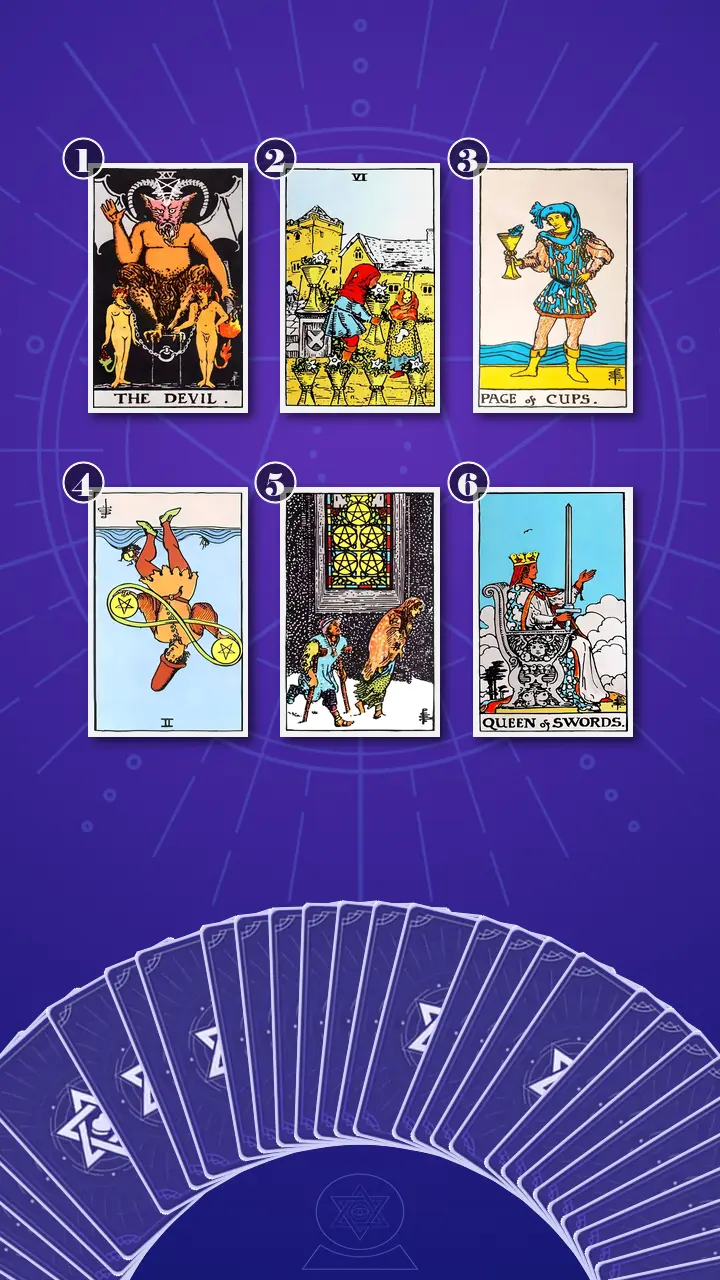
I chose the Relationship Spread · Context Edition, a contextualized six-card relationship tarot spread. I use this spread when the useful question is not “What will the other person do?” but “What interaction between longing, memory, fear, and choice keeps repeating?” A larger spread would have created more material to analyze when Alex already had decision fatigue. Six positions were enough to show the mechanism without turning the reading into another form of rumination.
I arranged the cards in a two-by-three grid. The first position would show the current relational pattern. The third would identify the need hidden inside the apparently casual message. The fourth would locate the exact point where the no-contact boundary lost stability. The fifth would reveal the fear beneath that rupture, and the sixth would offer a self-directed next step.
This is how tarot works best in my practice: not as an authority handing down a future, but as an objective cognitive tool that puts several parts of one experience on the table at the same time. Card meanings in context can make an emotional loop visible enough to examine. Alex would still decide what to do with what she saw.
Reading the Loop, Not Predicting the Reply
Position 1: The Chat That Never Quite Closes
I began with the position representing the current relational pattern: the observable cycle of reopening the chat, drafting a message, sending it, and checking the phone even while knowing that contact may preserve the stuckness.
I turned over The Devil, upright.
I pointed to the loose chains around the figures. “This card is not calling you bad, weak, or doomed,” I said. “It is filming the moment before the message. Your hand opens the muted chat while your mind says, This is only for closure. Sending brings a brief drop in the discomfort, like refreshing a page that still has the same unresolved error underneath.”
The energy here was excess: the attachment-feedback loop was running louder than Alex's stated intention. Silence triggered the thought that the connection was disappearing. Contact briefly restored closeness. Ambiguity returned. The next silence then felt sharper, reinforcing the idea that another message was needed. The card described a learned sequence, not a fate.
I used my Daily Friction Deconstruction lens and removed every dramatic accusation from the scene. What remained was almost mechanical: workday ends, structure drops, room gets quiet, phone comes within reach, chat opens, draft begins, chest loosens for a moment, monitoring starts. The chain was not an abstract weakness. It was a series of ordinary movements with several possible interruption points.
Alex gave one short, bitter laugh. “That is so accurate it feels a little brutal.”
“Accurate does not have to mean condemning,” I replied. “The loose chains matter. The reading is showing us where choice has been difficult, not claiming choice is absent.” I saw her fingers stop rubbing the edge of her phone, though her jaw remained tight.
Position 2: The Screenshot With the Edges Cropped Out
I moved to the position representing the experienced relational pull: the nostalgia and familiar emotional material that made renewed contact feel gentle, necessary, or harmless.
I turned over the Six of Cups, upright.
The flower-filled cup reminded me of a saved voice note or one warm screenshot that softens the body before the difficult context returns. Alex told me about an old exchange she reread whenever the apartment felt especially quiet. In it, her former partner had remembered a tiny detail from Alex's week. The message still made her feel known.
“The memory is real,” I said. “But memory is not the same as present-day evidence. Right now, the Six of Cups is like an Instagram Story made from the best three seconds of the relationship, with everything that made no contact necessary cropped out. The inner sentence is: I am not remembering the whole relationship right now; I am remembering the version that makes contact feel safe.”
The card's upright tenderness contained genuine warmth, but its energy had moved into excess because nostalgia was filling the entire frame. Alex was not inventing the affection. She was temporarily losing access to the rest of the picture. Missing that familiar softness did not prove that renewed communication would be workable now.
Her gaze left the cards and settled on the dark window. I watched her lips press together, then loosen. “I can feel the old version of us more clearly than I can remember why I left,” she said.
“That distinction is useful,” I replied. “Tenderness can be honored without being treated as an instruction.”
Position 3: The Fish Inside a Casual Check-In
I turned next to the position representing the need beneath the message: what Alex hoped to receive in the moment, beyond the literal wording of a two-line text.
The card was the Page of Cups, upright.
I showed her the fish rising unexpectedly from the Page's cup. “That fish is the larger emotional request inside Hope you're doing okay,” I said. “The message looks casual, but it may be carrying a request for tenderness, acknowledgment, reassurance, or proof that the bond still means something.”
The Page's sensitivity was not a problem. In its balanced expression, it offered emotional honesty and the courage to admit a soft need. In Alex's loop, however, that energy met a blockage at the point of naming. Because “I miss her and want to know I still matter” felt painfully exposed, the need went into the chat disguised as a low-stakes check-in.
“If she replied exactly as you hoped, what would you want to feel in your body afterward?” I asked. “Remembered? Chosen? Less alone? Finally certain?”
Alex's shoulders rose with a small inhale. Her eyes stayed on the fish in the cup. “Remembered,” she said quietly. “I want to know I wasn't easy to erase.”
I let that answer sit without correcting it. “Then that is the feeling we work with. Its sincerity does not require an automatic message, and it does not make another person solely responsible for settling it.”
Position 4: The Rule Rewritten by the Weather
I moved to the position representing the boundary rupture: the moment a chosen no-contact rhythm became unstable as silence, uncertainty, or an emotional reminder changed how the rule felt.
I turned over the Two of Pentacles, reversed.
The upside-down juggler, the infinity loop, and the rough water gave us an exact picture. I described Alex moving between a campaign calendar, Slack notifications, a notes-app draft, and an emotionally loaded chat while a private storm crossed the background. During the workday, the boundary held. After a familiar Spotify song or a mutual friend's Story, she archived, reopened, blocked, unblocked, drafted, and sent.
“The internal sequence sounds like this,” I said. “I made a rule. Silence changed how the rule felt. I made an exception. Now I need to analyze the exception.”
Reversed, the Two of Pentacles showed blocked balance. Alex was trying to preserve distance and restore closeness whenever distance hurt, two incompatible short-term goals that forced the decision to restart with every emotional change. She had also been treating no contact as a perfect all-or-nothing verdict. One difficult evening therefore felt like proof that the whole boundary had failed.
“So I don't need to feel certain for the entire future before I pause tonight?” she asked. Her hand opened on her knee, closed again, then opened once more.
“Exactly. A pause can be flexible without being meaningless. The 24-hour pause is a temporary hold on the send button, not a lifetime subscription to one decision. Its job is to show you whether the urge changes when it is no longer obeyed immediately.”
Position 5: The Lit Window in a Mutual Friend's Story
I turned to the position representing the underlying belonging fear: the fear that continued silence would prove final exclusion, lost significance, or removal from an emotional world where Alex once had a place.
The card was the Five of Pentacles, upright.
I pointed to the two figures outside in the snow and the illuminated stained-glass window beside them. Alex had described the modern version before I drew the card: a mutual friend's rooftop Story, her former partner's name visible for less than a second, and the sudden stomach drop that made an old chat feel like the only available doorway.
“This is why silence feels bigger than silence,” I said. “Your body reads absence as exclusion. The inner bargain becomes: If I stay silent, I may become irrelevant. If I send something, at least I still exist in her world.”
The Five carried an excess of the exclusion alarm. It compressed access to one person and the much larger question of belonging into a single conclusion. The alarm was understandable, especially when overlapping friends and familiar Toronto places kept the other person's world visible. But visibility was not proof that Alex's worth, social place, or capacity for connection had disappeared.
Her breath paused. Her eyes lost focus as if she were replaying the rooftop Story, then she released a low sound from deep in her chest. “That's the part I haven't wanted to say. It isn't only that I miss her. I feel outside everything.”
“Silence can feel like exclusion without being a verdict on your belonging,” I said. “Relational access and personal belonging are not the same thing. Contact may alter access for a moment, but it cannot safely carry the whole weight of proving that you matter.”
When the Queen Put the Send Button on Hold
Position 6: The Boundary That Could Speak First
The room seemed to grow quieter as I reached the final position, the self-directed next step: a practice for separating longing from readiness, clarifying the purpose of communication, and restoring Alex's judgment before any decision to send.
I turned over the Queen of Swords, upright.
I returned Alex to 8:47 that Tuesday evening: the chat muted but present, the phone warm in her hand, and a harmless check-in forming while she already knew contact might keep the uncertainty alive. She had been trying to make silence stop before deciding what communication was actually for.
I looked at the Queen's upright sword and open hand. The sword formed a clean visual boundary between the message draft and the send button. The open hand kept that boundary humane. The Queen did not ask Alex to become cold, erase the Cups, or punish herself for caring. Her energy was balance: emotional truth held beside clear judgment, without forcing either one to disappear.
I brought in my Emotional Clutter Sorting practice and placed three invisible trays between us. Into the first went facts: what had actually happened and what Alex currently knew. Into the second went feelings: longing, loneliness, guilt, tenderness, and grief. Into the third went the job she wanted the reply to perform: reassure me, remember me, restore my place, make the loss less final. The Queen's sword separated those trays so that one casual message no longer had to carry all three.
I said, “The message is not automatically a sign that you are ready to reconnect. Sometimes it is simply the fastest way to interrupt silence. Clarity begins when you separate missing someone from choosing contact. Missing someone is a feeling; being ready for contact is a separate question.”
The old belief that silence must be broken to preserve connection gives way to the Queen's lifted sword: pause, name the truth, and let a deliberate boundary speak before any message does.
I left a few seconds of quiet around the sentence. The radiator clicked again, this time sounding almost like a marker being placed.
I watched Alex's breath catch. Her thumb stopped above the dark phone screen, and her pupils widened before her gaze drifted past the cards, as though several old messages were replaying at once. Her mouth tightened. “But doesn't that mean I was wrong every time I reached out?” she asked, irritation briefly sharpening her voice. Then her fist loosened, her shoulders dropped, and the anger gave way to a shaky exhale. I could see relief arriving beside a more vulnerable realization: if the pause restored choice, the next decision would belong to her.
“No,” I said. “It means those messages gave you information about what silence activates. Clarity does not require retroactive self-punishment. Now, with this new perspective, can you remember a moment last week when the distinction between missing her and being ready for contact might have changed how you felt?”
Alex looked down at her hands. “Saturday, after the rooftop Story. I didn't actually have anything new to say. I wanted the panic of being left outside to stop.”
I invited her to open a private note and complete three lines: What happened is ___. What I feel is ___. What I want this message to do is ___. She wrote for less than two minutes. When she looked up, her eyes were damp, but her voice was steadier. She had not solved the relationship. She had made the first move from compulsive reassurance-seeking during silence toward self-trusting discernment and deliberately chosen relationship boundaries.
I reminded her that the cards had not decided whether future contact was right or wrong. They had clarified what needed to be distinguished before she chose. The Queen's resource was not certainty. It was the ability to tell the truth about the purpose of a message and remain present long enough to make a deliberate decision.
The 24-Hour Micro-Boundary Reset
I drew the six cards together into one practical story. The Devil showed the short-term relief loop. The Six of Cups explained its emotional fuel through a tender but selectively framed past. The Page of Cups revealed the sincere need hidden inside the casual check-in. The reversed Two of Pentacles located the structural fault line: the boundary was renegotiated whenever the emotional weather changed. The Five of Pentacles named the fear making that weather feel urgent. The Queen of Swords offered the underused resource, the ability to sort facts, feelings, and requests before assigning a reply the job of regulating all three.
The cognitive blind spot was not that Alex lacked insight. She already knew contact kept her stuck. The blind spot was her belief that a boundary should feel certain, permanent, and emotionally comfortable before she could trust it. Because no contact did not immediately remove longing, she treated the discomfort as evidence that the boundary was wrong. The reading redirected her from “Should I contact her?” to “What feeling do I want contact to relieve, and what can I learn during one deliberate pause?”
I offered two next steps. I framed them as small experiments, not moral rules and not guarantees of closure.
- The 24-Hour Micro-Boundary Reset When the urge appears this week, place the message in a private note titled Draft, Not Send, record the exact start time, and set a 24-hour timer. For the first 10 minutes, charge the phone across the room or leave it face down beyond arm's reach. When the timer ends, choose whether to send, revise, or delete. The practice is the pause and the naming, not a compulsory no-contact outcome. Start with a 10-minute timer if 24 hours feels impossible. Renew it only by choice, and do not spend the pause monitoring Stories or asking mutual friends for updates.
- The Need-Before-Message Check On the next emotionally charged evening, write three headings: What I know, What I miss, and What I want this message to change. Under the final heading, choose one need: reassurance, tenderness, certainty, belonging, distraction, or permission to grieve. Then give that need one self-directed response for 10 minutes, such as making tea, showering, walking around the block, or texting a trusted friend about the actual feeling rather than requesting information about the other person. Let the draft hold the feeling before the other person has to. If naming the need becomes overwhelming, stop after one word, close the note, and use a grounding activity instead.
I also asked Alex to mute her former partner's Stories and archive the chat for seven days, using the lightest digital setting that reduced accidental triggers. This was environmental housekeeping, not punishment. My work often comes down to clearing ordinary friction: a chat left at the top of the screen can behave like an unfinished work task, quietly asking for attention every time the phone opens.
“You can revise a boundary deliberately,” I told her. “What matters is that the mood of one sharp minute does not revise it for you. Boundary as information means noticing what happens when the automatic route to relief is unavailable. You are gathering data about your need, not proving how strong you are.”

Six Days Later: Silence Without a Verdict
Six days later, I received a message from Alex. She had seen another mutual friend's post, written the familiar check-in in Draft, Not Send, and completed the three headings. Under the final one, she had written a single word: belonging. She put her phone across the room, made tea, and texted a friend, “I feel left out tonight. Can we talk about literally anything else for ten minutes?”
Her update ended with: “I slept through the night. My first thought in the morning was still, What if I'm wrong? But I laughed, made coffee, and left the draft unsent.”
I did not read that unsent message as proof that Alex had finished grieving or that she must never make contact again. I read it as quiet evidence that the urge had stopped being an unquestionable command. The old loop had gained one new space, and inside that space she had made a choice.
That was the real Journey to Clarity: not tarot magically removing longing, but Alex using the cards to see the mechanics of her own experience. The reading provided a map; she created the change by pausing, naming what hurt, and letting her boundary carry information instead of shame.
I know that when the phone stays silent and your chest tightens, it can feel as if you must choose between reaching back for closeness and accepting that you no longer belong in someone's life. If this is where you are tonight, remember the loose chain and the Queen's open hand: noticing the pull means you are already beginning to hear yourself.
If you let one quiet day become the Queen's open hand, rather than the Five of Pentacles' locked window, what feeling might you finally name before deciding what contact means?
This story is adapted from psychological research, written so that those in a similar struggle can see their own pattern in it — and find their next step clearly.These insights are not a substitute for professional psychological, medical, legal, or financial advice.
Learn more about our Journey to Clarity.
How did this insight land for you?
🫂 This Resonates Deeply
🌀 Living This Story
✨ Now I See Clearly
🌱 Seeing New Possibilities
🧰 Useful Framework
🔮 The Confirmation I Needed
💪 Feeling Empowered
🚀 Ready for My Next Step
Author Profile
 AI
AI“For twenty years, I’ve listened to stories unfold over the warm aroma of coffee. I don’t believe life’s complexities always require grand theories to be solved; often, we just need a safe place to tidy up our reality. I don’t offer high-minded preaching—just grounded, heartfelt insights to help you regain your sense of control amidst the clutter of daily life.”
In this Love Tarot Reading :
Core Expertise
- Daily Friction Deconstruction: Stripping away dramatic accusations to locate the mundane, mechanical breakdowns in your shared daily routine.
- Emotional Clutter Sorting: Separating actual relationship incompatibility from the stress of household chores, fatigue, or external life pressure.
Service Features
- The 24-Hour Micro-Boundary Reset: A highly pragmatic exercise to establish one non-negotiable physical or time boundary in your shared space to instantly reduce friction.
Also specializes in :
Explore Related Patterns:
Boundary DiffusionAlex archives, reopens, blocks, unblocks, drafts, and sends as songs or mutual-friend posts change her emotional state. The no-contact boundary exists, but its authority repeatedly transfers to the strongest feeling in the room, so each trigger becomes an unscheduled renegotiation. When boundary diffusion operates this way, the problem is not that you have mixed feelings or might revise a decision later. The problem is that the revision happens before the trigger can be examined, making the boundary dependent on moment-to-moment relief. A deliberate review period can keep the boundary flexible while preventing one activated minute from rewriting it automatically.
Closure ChasingAlex repeatedly reopens the muted chat and calls the next message "closure" even though she already knows that contact returns her to uncertainty. The closure label gives a vulnerable bid for connection a more conclusive-sounding purpose, making the send button feel like a route toward resolution rather than another turn in the same loop. When you use contact to relieve the uncertainty that renewed contact keeps generating, closure becomes something you chase through repetition rather than something you reach through clarity. Seeing that function does not invalidate the wish to reconnect; it lets you ask whether the message contains new, deliberate communication or is being asked to make unresolved discomfort disappear.
Cognitive DissonanceAlex wants contact to restore closeness while already knowing that the same contact keeps uncertainty alive. Calling the message "closure" temporarily makes those incompatible positions feel consistent, because the action can be framed as ending the loop even while it restarts checking and waiting. When you are caught in cognitive dissonance, sending can reduce the immediate tension between what you know and what you want without resolving either side. The discomfort then returns because the underlying contradiction remains intact. Holding both truths in view allows you to choose from the full reality rather than using one more message to silence the conflict for a moment.
Emotional ReasoningAlex interprets the fact that no contact still hurts as evidence that the boundary may be wrong, and silence begins to feel like proof that she is being erased. The emotion is genuine, but it is being used as evidence about the relationship and the validity of the boundary rather than as information about what the separation activates in her. When emotional reasoning takes over, the intensity of a feeling can make one explanation seem unquestionably true. You may then act to stop the feeling before checking whether its conclusion is supported by present-day facts. Naming "I feel excluded" instead of concluding "I no longer matter" preserves the emotional truth while reopening room for reality testing and choice.
Exclusion SpiralA brief glimpse of Alex's former partner in a mutual friend's rooftop Story produces a stomach drop and makes the old chat feel like the only available doorway. The trigger rapidly expands from missing one person into feeling outside an entire social and emotional world. When an exclusion spiral takes hold, attention narrows around signs that you have lost your place while other sources of belonging become harder to access. Contact then feels urgent because it appears to solve a much larger threat than the message can realistically carry. Separating relational access from personal belonging helps you respond to the actual fear without treating one person's reply as the sole evidence that you still have a place.
Outsourced Self-SoothingAlex assigns a hoped-for reply several jobs at once, including reassuring her, remembering her, restoring her place, and making the loss feel less final. Contact briefly lowers discomfort, but the regulation remains dependent on what another person does next, so monitoring and uncertainty quickly resume. When self-soothing is outsourced in this way, the message becomes more than communication; it becomes an attempt to regulate belonging through relational access. You can still choose contact, but clarity improves when you first identify the internal job given to the reply. Meeting part of that need elsewhere reduces the pressure on one response to determine whether you matter.
Reassurance SeekingAlex's casual "Hope you're doing okay" carries a much larger request for proof that she is remembered and was not easy to erase. Because that request remains implicit, the message can look low stakes while a possible reply is quietly assigned the job of confirming tenderness, significance, and continued connection. When you seek reassurance this way, contact may briefly lower uncertainty without giving the underlying fear a durable answer. The next silence can then feel even more charged, because your sense of being remembered has become tied to receiving another signal. Naming the reassurance you want gives you a clearer basis for deciding whether contact is genuine communication or an attempt to regulate doubt.
Urgency BiasAfter the rooftop Story, Alex recognizes that she had nothing new to communicate; she wanted the panic of being left outside to stop. The emotional surge compresses the decision window, so immediate contact appears necessary before she can examine what the message is meant to accomplish. When urgency bias takes over, the urge feels like evidence that action must happen now, and waiting can feel equivalent to losing the relationship altogether. A timed pause does not predetermine the final decision. It tests the urgency itself, allowing you to see whether the need for contact remains coherent once the sharpest activation has passed.
Boundary DiscernmentAlex moves the message into a private note, separates facts from feelings and requests, and later repeats that pause after another social-media trigger. She does not force herself to stop missing her former partner or declare that contact must never happen; she creates enough distance to decide whether this particular message serves a deliberate purpose. When you practise boundary discernment, a boundary no longer has to feel permanent or comfortable to remain meaningful. The pause lets you distinguish longing from readiness and emotional activation from chosen communication. That distinction returns authority to you without turning no contact into punishment, perfection, or a test of willpower.
Compulsive CheckingAlex's workday ends, the room becomes quiet, and the same sequence begins with opening the muted chat, drafting, sending, checking, and monitoring. Each check offers a small possibility of certainty or closeness, which briefly changes the tension even when no durable answer appears. When compulsive checking becomes part of the loop, the temporary relief reinforces the search while every ambiguous cue creates another reason to look. You are not simply gathering information; you are repeatedly using information seeking to regulate uncertainty. Changing the phone's physical position or delaying the next check interrupts the reinforcement long enough for the urge to become observable rather than automatic.
Nostalgia LoopAlex rereads one warm exchange when the apartment feels quiet and notices that the old version of the relationship is easier to feel than the reasons she left. The memory itself is real, but selective attention enlarges its emotional warmth while temporarily reducing access to the context that made no contact necessary. When you enter a nostalgia loop, a remembered moment can begin functioning like present-day evidence that renewed contact is safe or needed. The loop does not require you to deny what was meaningful. It asks you to place tenderness back inside the full record so that a vivid fragment does not make the decision on behalf of your current judgment.
Explore Related Struggles:
Access-Belonging FusionAfter a mutual friend's Story briefly showed your former partner's name, the old chat felt like the only available doorway. You described silence as becoming the only one who remembers, and sending as proof that you still exist in her world. That collapses two different questions into one channel. Whether you still have access to this person is treated as evidence of whether you still belong, so a message carries the job of restoring your place rather than simply communicating. You can see the structure without arguing with the need to matter, because contact may change access for a moment but it cannot be the sole measure of belonging.
Boundary Ambiguity LockDuring the workday, the no-contact boundary can hold while you move through campaign Slack threads. After a familiar song or a mutual friend's Story changes the evening, the sequence shifts into archiving, reopening, blocking, unblocking, drafting, and sending. Because you have been asking the boundary to feel permanent and emotionally comfortable before it counts, one sharp night is allowed to rewrite the rule. The struggle is not a lack of knowledge; it is that the meaning of the rule keeps being renegotiated by the feeling it was meant to contain. A deliberate pause gives the boundary a stable unit of time in which you can gather information before deciding.
Reassurance LoopAt 8:47, you reopen a muted chat, draft a harmless check-in, send it, and feel a brief loosening before you begin monitoring again. Contact does not need to solve the relationship to become compelling; it only needs to interrupt the immediate silence for a moment. Then ambiguity returns, and the next quiet evening carries the memory of that small relief. The loop makes the send button look like a route to closure while it is also preserving the uncertainty you already recognize. Naming the sequence gives you a place to observe the urge before it becomes a command.
Sincerity-Readiness SplitYour draft says Hope you're doing okay while the sentence you avoid saying is that you miss her and want to know you were not easy to erase. The casual wording lets a sincere need travel toward her without exposing the full weight of what you want. That leaves longing and readiness sharing one send button even though they are different facts. You can genuinely miss someone and still not be ready for contact that returns you to uncertainty. Separating those truths makes room for honesty that does not have to be delivered through an ambiguous check-in.
Nostalgic Belonging LockWhen the apartment gets quiet, you reread the old exchange in which she remembered a tiny detail from your week. The warmth is real, but it can fill the frame so completely that you feel the old version of the relationship more clearly than the reasons no contact became necessary. That selective frame makes renewed contact feel gentle and safe before the full present-day evidence has been considered. The memory is not false, and honoring it does not require treating it as a current instruction. You can let the tenderness remain part of the record without asking it to decide whether the relationship is workable now.
Explore Related Emotions:
Fear of Being ForgottenAlex says that silence makes her feel like the only person who remembers, then identifies the need underneath the check-in with one word: remembered. The casual message is carrying a much larger question about whether the bond, and her significance within it, still exists for the other person. When silence starts to resemble erasure, even a small reply can seem capable of proving that you mattered. The fear explains why contact feels necessary without making the other person's response a reliable measure of your significance or the reality of what was shared.
Guarded LongingAlex calls the draft a closure text because saying that she misses her former partner feels too exposed, even as her thumb hovers over 'Hope you're doing okay.' The wish for closeness is fully present, but it reaches the surface through protective wording rather than a direct admission. When longing has to remain partly hidden, you can feel pulled toward contact while staying guarded about what you actually want from it. Naming the wish to be remembered gives that tenderness an honest voice without turning it into an instruction to send.
Nostalgia Loop AnxietyWhenever the apartment feels especially quiet, Alex rereads the exchange in which her former partner remembered a tiny detail, and the familiar warmth returns before the harder context does. A song or mutual friend's Story can then restart the sequence of reopening, drafting, and reconsidering the boundary. The anxiety lives in the repeated narrowing of the frame. When the most tender fragment becomes more emotionally available than the whole relationship, you can mistake the safety of a memory for evidence that renewed contact will be safe now.
Relational UrgencyThe workday ends, the apartment becomes quiet, and Alex reopens the muted chat with lifted shoulders and a restless hand. After a mutual friend's Story, the old conversation can feel like the only available doorway back into a world that remains visible but inaccessible. Urgency forms when silence is experienced as something that must be stopped before its meaning becomes unbearable. You may reach out even while knowing the consequences because contact promises immediate closeness, whereas waiting requires you to stay with the pressure long enough to understand what it is asking for.
Social Exclusion DreadA former partner's name appears for less than a second in a mutual friend's rooftop Story, and Alex feels the stomach drop that sends her back toward the old chat. Overlapping friends and familiar Toronto places keep that social world visible even when she no longer knows where she stands inside it. The dread intensifies when losing access to one relationship begins to feel like exclusion from everything around it. You may use contact to recover a place in that visible world, but a reply cannot safely carry the full burden of proving that you still belong.
Unresolved Outcome AnxietySending the message briefly loosens Alex's chest, but the relief is followed by monitoring, ambiguity, and a sharper silence. The action called closure therefore creates another unresolved interval in which the meaning of the relationship depends on whether, when, and how the other person replies. You can keep returning to contact because each message appears to offer a conclusion while actually reopening the question. The anxiety persists until a reply is no longer assigned the impossible job of resolving the relationship, restoring your place, and regulating the silence all at once.
Nostalgia AcheAlex rereads an old exchange in which her former partner remembered a tiny detail from her week, and the message still makes her feel known. She can access the warmth of that earlier version of the relationship more easily than the context that made distance necessary. A memory can be real and tender without serving as present-day evidence. You may ache because the remembered closeness still touches something genuine, while clarity asks you to let that memory remain meaningful without assigning it authority over what happens next.
Broken Streak AnxietyAlex treats no contact as an all-or-nothing verdict, so one difficult evening can feel like proof that the entire boundary has failed. Her later question about whether every previous message was wrong shows how quickly a single rupture expands into doubt about her judgment as a whole. When a boundary is measured as a perfect streak, breaking it once can make further contact feel inevitable and self-trust feel unavailable. You regain room to choose when an exception becomes information about what the silence activated, rather than evidence that every effort before it was meaningless.
Cautious Self-TrustSix days later, Alex writes the familiar check-in, places her phone across the room, names belonging as the need underneath it, and leaves the draft unsent. The next morning still brings 'What if I'm wrong?', but that uncertainty no longer makes the decision for her. Self-trust here is cautious because it does not depend on permanent certainty or the disappearance of longing. You begin to trust yourself when you can keep the right to reconsider while refusing to let one intense minute rewrite the boundary automatically.
Clarity ReliefAlex separates what happened, what she feels, and what she wants the message to accomplish; her shoulders drop and her voice becomes steadier. The draft no longer has to carry the facts of the relationship, the pain of missing someone, and the demand for reassurance in one overloaded sentence. Relief arrives through distinction rather than through a predicted reply. When you separate missing someone from being ready for contact, the decision becomes smaller and clearer, and your emotional truth can remain intact without controlling the action.
Exposure DreadAlex explicitly says that calling the message closure feels safer than admitting she misses her former partner. The neutral line 'Hope you're doing okay' lets her approach the relationship without openly stating that she wants reassurance that she was not easy to erase. The dread sits at the threshold of direct emotional visibility. When saying what you want feels too exposing, an indirect message can seem safer, but it also leaves the other person responding to the surface wording while the deeper need remains unspoken and unsettled.
Explore Related Contexts:
Access as Proof PressureAlex said that silence made it feel as though she were the only one who remembered, then named belonging as the need beneath the unsent draft. The words 'Hope you're doing okay' were carrying a much larger request for evidence that she had not been erased from her former partner's world. The former partner's reply had been positioned as proof of memory, significance, and continued access. That turns a private boundary decision into a repeated request for social confirmation. You can then reach toward the same channel whenever exclusion becomes visible, even though a reply can confirm contact without settling where you belong.
Breakup Closure LimboAlex called the message a closure text, yet the old chat remained open and each possible send created another period of waiting and interpretation. The warm exchange she reread gave the past a vivid presence while the current meaning of contact stayed undefined. You are left in a social in-between stage where silence does not register as a completed ending and contact does not establish a workable next step. The boundary exists, but its purpose is renegotiated whenever an old song, screenshot, or mutual friend's Story brings the former relationship back into the room.
Digital No Contact BoundaryAlex's no-contact boundary lives on a phone that also stores the old chat, delivers social reminders, and keeps the send button within reach. She muted and archived the conversation, then reopened, blocked, unblocked, drafted, and sent when a song or a mutual friend's Story shifted the evening. The digital environment makes the limit porous by placing the trigger and the response route in the same small space. You are dealing with a boundary whose practical stability depends on how access, visibility, and timing are arranged before the next emotionally charged moment.
Post-Boundary Reassurance LoopAlex repeatedly reopened a muted chat, drafted 'Hope you're doing okay,' and sent messages even while she already knew contact kept the uncertainty alive. The short exchange was being asked to restore closeness, confirm she was remembered, soften the silence, and prove that she still occupied a place in her former partner's world. That mismatch made the contact route self-reinforcing. A message could create a brief sense of access while leaving the underlying question unresolved, so each quiet evening reopened the same channel. When you break a boundary to obtain reassurance, the external reply can become a temporary gate to belonging instead of a clear conversation with a defined purpose.
Premature Reentry PressureAlex already knew that renewed contact kept her stuck, yet a quiet evening still moved her from a drafted check-in to the send button before she had anything new to say. The message became an entry point back into an unresolved relationship rather than a deliberate conversation with a defined purpose. The pressure came from the timing of reentry. Silence, nostalgia, and an overlapping social feed made immediate access feel more available than waiting for a clearer basis for contact. When you re-enter through a low-stakes text before the conditions for a clear exchange exist, the old uncertainty can resume without any actual change in the relationship.