Three Calendar Checks, One PTO Request: Choosing Before Depletion

Permission-Based Rest at 9:40 p.m.
If you can build a client coverage plan in ten minutes but spend three weeks deciding whether your own day off is defensible, permission-based rest may be running your calendar. I heard that pattern almost immediately when Maya, a 28-year-old project coordinator at a Toronto digital agency, joined my Thursday evening video call.
It was 9:40 p.m. in her narrow condo workspace. The HR portal cast blue light across her face, a packed Google Calendar sat open beside it, and her laptop fan whirred through my headphones. Her tea had gone cold. I watched her check the team calendar for the third time, hover over a Friday with no launch or major presentation, and close the PTO tab without submitting.
“I know the PTO is available,” she said. “But it still feels like I am asking to be excused. I can take the day once I have a reason nobody can question.”
Her shoulders remained lifted toward her ears even after the portal disappeared. The anticipatory guilt looked less like an idea than a too-tight backpack she had forgotten she was wearing: heavy straps across the collarbones, jaw braced, hands still typing long after the useful part of the day had ended. She wanted to use PTO early enough to preserve her capacity, but exhaustion was the only evidence she trusted to make rest feel legitimate.
“I am not going to tell you to just take the day,” I said. “Your approval process, workload, and coverage responsibilities are real. I want us to separate those real conditions from the rule that says you must be visibly depleted before you are allowed to respond to them. Let us make a map of the pattern and see where your own authority has gone missing.”
By the time rest feels defensible, it is already doing damage control.

Choosing a Six-Card Map for PTO Guilt
I asked Maya to place both feet on the floor, unclench her hands, and take one slower breath without trying to force herself into calm. I shuffled while she held one practical question in mind: “Why do I wait until I am run down to use my PTO?” The pause was not a mystical test. It was simply a transition from reacting to observing.
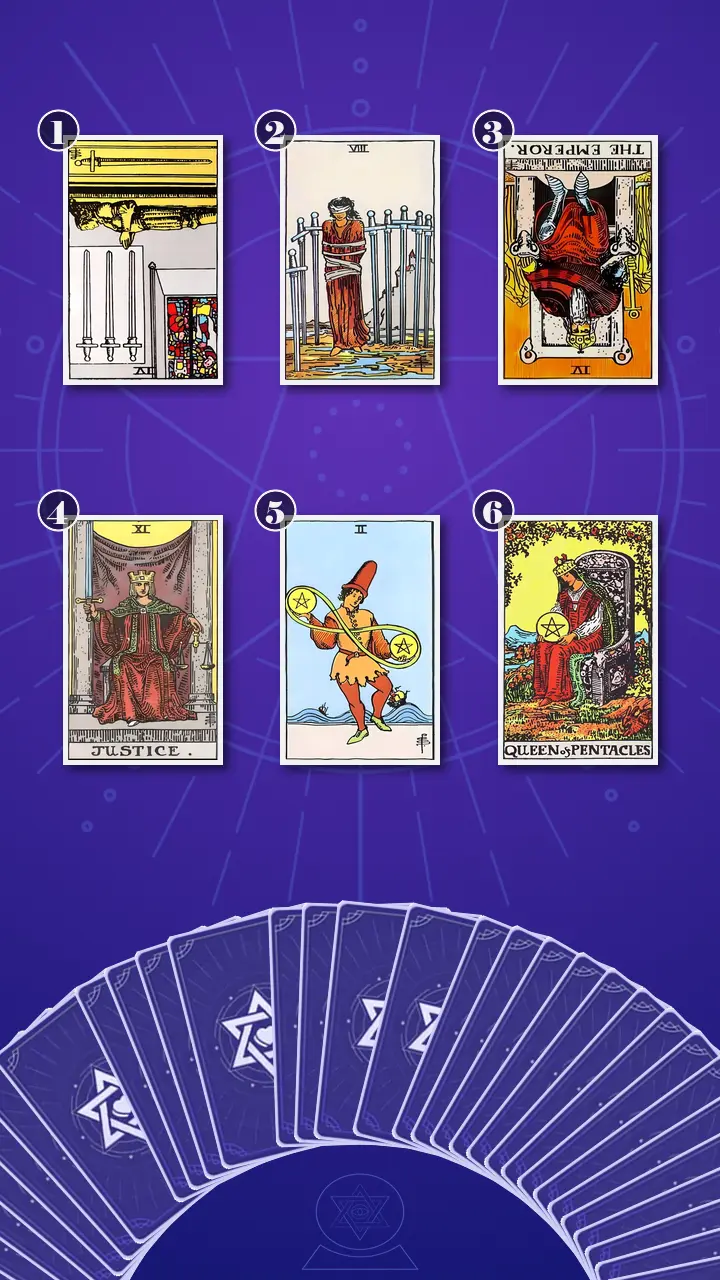
I chose the Transformation Path Grid · Context Edition, a six-card tarot spread for PTO guilt, proactive rest, and work-boundary planning. I use this spread when a problem is maintained by a repeating system rather than by one isolated decision. Maya was not merely delaying one Friday off. She was moving through a loop: she considered leave, imagined judgement, postponed the request, lost capacity, used PTO reactively, and then treated the disruption caused by late recovery as proof that planning leave earlier was irresponsible.
A shorter three-card reading would have compressed too many different forces into a vague past-present-future sequence. A larger predictive spread would have added material we did not need. This six-card grid was the smallest map that could distinguish the visible symptom, the immediate blockage, the authority structure beneath it, the leverage point, the next behavior, and the practice that could sustain change.
I placed three cards across the top and three beneath them. The first row would show why recovery kept becoming inaccessible: delayed rest, perceived restriction, and internalized authority. The second row would answer those cards directly: fair criteria, adaptive planning, and practical stewardship. Justice, in the lower-left catalyst position, would act as the hinge between diagnosis and movement.
“The cards will not predict whether your manager approves a particular date,” I told her. “They can help us externalize the rules you are already using, compare them with the facts, and identify where a different choice becomes possible. That is how tarot works here: as a mirror for cognition, behavior, and capacity, not as an authority replacing your judgement.”
The Warning Row Above the Calendar
Position One: The Resting Place That Stayed Out of Reach
“The card I am turning now represents the diagnosis-level behavior,” I said. “It shows where preventive rest becomes delayed rest, until reduced energy makes stopping feel unavoidable.”
I turned over the Four of Swords, reversed.
In the traditional image, a recumbent figure rests beneath three suspended swords, with a fourth lying below. Turned upside down, the designated place of recovery still exists, but the figure cannot settle into it voluntarily. I pointed from the suspended swords to Maya's screen. For her, they had become Slack, email, and imagined work consequences hanging over an available day off.
The modern-life scene was almost an exact replay of the previous five minutes: an available PTO balance, a Friday within six weeks with no critical deadline, three checks of the shared calendar, and one closed portal. The practical facts said the date could be considered. Then one more objection appeared: The launch is close, so I will decide after Friday. The promise of rest moved forward while her energy moved down.
The Four of Swords normally contains deliberate recovery. Reversed, that energy was blocked. Maya did not lack access to the concept of rest; she had saved TikToks about PTO guilt, listened to workplace podcasts, and advised friends to take their vacation days. What was blocked was voluntary entry into the resting space before her body made work difficult.
This was where I introduced what I call Somatic Fatigue Diagnosis. It is not a medical diagnosis. It is my practice of temporarily bypassing the mind's courtroom and listening to the body's observable capacity signals before rationalization buries them. I asked Maya what happened physically before she finally booked reactive leave.
“My shoulders go up. My legs feel heavy on the commute. I reread normal emails over and over,” she said. “But I keep telling myself I am still functioning.”
“Then raised shoulders and repeated rereading are not proof that you have failed,” I said. “They are early maintenance information. Waiting until a ten-minute task takes half an hour is like waiting for a laptop to reach one percent before looking for the charger, then calling the shutdown evidence that charging earlier would have interrupted the work.”
Maya gave one short laugh, but there was no amusement in it. Her fingers tightened around the cold mug before loosening again. “That is uncomfortably accurate. Almost rude, honestly.”
I smiled gently. “I know. The card is not accusing you of lacking discipline. It is making the cycle visible enough that we can interrupt it.”
Position Two: The Calendar Dates Inside the Swords
“The card I am turning now represents the immediate blockage,” I said. “It asks why available leave begins to feel inaccessible before anyone has actually refused it.”
I turned over the Eight of Swords, upright.
The woman in the card is blindfolded and loosely bound, surrounded by swords that appear to form a complete enclosure. They do not. There are visible gaps. I asked Maya to imagine those gaps as the three open dates she could see in her calendar but had already dismissed.
She described the sequence. The account lead might need her. A coworker could be away. Her manager might wonder why she wanted that Friday. She had not compared those predictions with policy, asked a direct coverage question, or submitted the request. No external rejection had occurred, yet every option had disappeared through anticipation.
“My manager could think it is bad timing,” she said, looking down at the card. “So I treat the request as basically impossible.”
The Eight of Swords showed an excess of Air: analysis generating more analysis, each hypothetical objection prompting another calendar check or anxious search. It worked like a recommendation algorithm trained by fear. Every time Maya searched Reddit for whether a manager could be annoyed about PTO, the next post supplied another circumstance she had not yet worried about. More information did not create clarity because the hidden rule remained unchanged.
I drew a line down the centre of my notebook and wrote Policy on one side and Prediction on the other. Managerial approval belonged under policy. Required handoff procedures belonged there too. “My manager will see me as less committed” belonged under prediction unless someone had actually communicated that standard.
“I am not saying every barrier is imaginary,” I told her. “Deadlines, staffing, and uneven workplace power can constrain a date. The card is asking whether you are treating a constraint that can be discussed as a total prohibition that must be obeyed in advance.”
Her breath caught first. Then her eyes moved away from the table as if she were replaying several unsent requests. Finally, she exhaled through her nose and pressed her palm flat against the desk. “I have been pre-rejecting myself,” she said.
Position Three: The Manager on the Stone Throne
“The card I am turning now represents the psychological root,” I said. “It shows why an ordinary coordination process has become a test of whether your need is legitimate.”
I turned over The Emperor, reversed.
The Emperor's stone throne, ram carvings, concealed armour, and barren mountains make authority look hard, defended, and immovable. Reversed, that throne did not simply represent Maya's actual manager. It represented the imagined manager Maya had already installed inside her decision process before anyone responded.
Her modern-life version of the card was painfully ordinary. She drafted a reasonable request, messaged two coworkers to ask whether the manager might be annoyed, added explanations that policy did not require, and waited for a reason that would be harder to challenge. The approval workflow had expanded into a parent-child script: I know I need a break, but someone senior must agree that my reason counts.
The Emperor's energy was distorted in two directions. There was an excess of internalized authority and a deficiency of mature self-governance. Maya treated uninterrupted availability as proof of professionalism, while her own knowledge of her capacity carried almost no weight. Yet I was careful not to turn the card into an accusation against her manager or into a command to ignore workplace structure.
“Coordination is adult and necessary,” I said. “Permission-seeking becomes different when you need the process to validate your worth, not just the timing. An approval process is not a trial of whether your need is worthy.”
Maya stared at the stone throne. Her mouth tightened, and for several seconds she said nothing. Then she looked up with a thin, rueful smile. “I write PTO requests like legal briefs. I include the weather, the project history, and probably my childhood references.”
“A coverage plan can be accountable without becoming a confession,” I replied. “Your manager may still need to discuss timing. That conversation can tell you something about the date. It does not establish whether you were morally entitled to have a need.”
When Justice Removed Exhaustion from the Scales
Position Four: The Criterion That Changed the Question
The rain against Maya's condo window softened as I reached for the lower-left card. Her laptop fan, which had been whirring through most of the reading, settled into silence. I felt the room narrow around one clean decision point.
“The card I am turning now represents the leverage point,” I said. “It replaces exhaustion-based permission with fair criteria for balance, workload, coverage, and capacity.”
I turned over Justice, upright.
Justice held evenly balanced scales in one hand and a single upright sword in the other. I placed the scales beside four visible facts: Maya's PTO balance, the next six weeks of deadlines, realistic coverage, and her current capacity. The sword represented the moment when enough relevant information had been gathered and a proportionate decision could finally be made.
This was balanced energy. Justice did not erase the agency's leave process or guarantee a perfect answer. It corrected the Emperor's arbitrary inner authority by giving Maya a stable structure for accountable self-authorization. The question changed from Do I deserve this? to Is this date workable and responsibly covered?
I also brought the Somatic Fatigue Diagnosis into the scales. Capacity could not mean waiting for collapse. It meant noticing the earliest repeatable signals: raised shoulders at the portal, a jaw that stayed clenched after logging off, routine work taking longer, or Sunday arriving with heavy limbs and no protected recovery time. The body was allowed to provide data before it became an emergency witness.
I remembered a lesson from the Highland women who raised me: living systems usually signal strain quietly before they fail loudly. Across sixty-seven lived seasons, I have never seen a garden become more responsible because it waited for the soil to crack before accepting water. Maintenance does not need collapse to justify it.
I asked Maya to picture Thursday again: 9:40 p.m., portal open, deadline-heavy calendar beside it, coverage checked for the third time. She was still functioning. Her shoulders were not. Yet the old sentence arrived on cue: I can ask once nobody can question it.
You do not have to place exhaustion on the scales to prove that rest is deserved; let Justice's upright sword turn a reasonable PTO plan into a clear decision.
I let the sentence remain between us without immediately explaining it away.
For one beat, Maya's breathing stopped. Her right hand froze above the trackpad, and her eyes widened before drifting toward the dark window as if several late-night portal sessions were replaying there. Then her brows drew together. “But does that mean I have been doing this wrong for years? That I created the whole problem?” The irritation in her voice arrived before the tears brightening her eyes. I kept my tone level. “No. It means a strategy that once helped you avoid judgement has begun charging more than it protects. Seeing that is information, not a verdict.” Her fingers slowly opened against the desk. A breath left from low in her chest, then another. Her shoulders dropped, but the relief was followed by a brief, almost dizzy stillness. “If exhaustion is not deciding,” she said quietly, “then I am.”
“Yes,” I said. “And that can feel vulnerable before it feels freeing. You do not need exhaustion as a witness. Available PTO, a workable date, and a clear coverage plan are enough to make the request valid.”
I invited her back into the recent past. “Now, with this new perspective, think about last week. Was there a moment when this insight could have made the experience feel different?”
She remembered Tuesday afternoon, when she had reread a routine client update four times while pressure gathered behind her eyes. She had told herself to finish the sprint first. “I could have treated that as a capacity signal,” she said, “not as evidence that I needed to work harder until I had a better excuse.”
I named the crossing plainly. This was not merely movement toward one day off. It was a first step from anticipatory guilt and exhaustion-based permission toward fair self-authorization. Workability is a criterion; suffering is not.
Bringing the Map Down to Earth
Position Five: The Calendar That Expected the Waves
“The card I am turning now represents the practical action,” I said. “It shows how fair criteria become a repeatable behavior before fatigue makes the decision urgent.”
I turned over the Two of Pentacles, upright.
The figure on the card holds two pentacles joined by an infinity-shaped ribbon while ships rise and fall on waves behind him. I read the ribbon as one continuous capacity system. Work commitments and recovery were not competing moral categories. They were finite resources that had to be managed together while conditions continued to move.
Maya's modern-life version was a 15-minute review on the first Friday of each month. She would open her PTO balance and the next six weeks of deadlines, identify one or two provisional recovery dates, add a two-line handoff note, and accept that meetings might change before the date arrived. The month did not need to become perfectly calm. One date needed to be workable enough to review and request.
The Two of Pentacles held balanced, adaptive Earth energy. It answered the Eight of Swords directly. Instead of mentally scanning the calendar every day, Maya would create one bounded review. Instead of demanding permanent certainty, she would make a provisional plan from current information and use the agency's process when the criteria were met.
I call this Organic Routine Restructuring: rebuilding the architecture of daily life around recurring biological needs rather than waiting for an artificial clock to announce that the body has finally earned maintenance. In Maya's case, it did not mean ignoring business rhythms. It meant placing recovery inside the planning rhythm before a deadline-heavy month consumed every visible gap.
“But what if the Friday review lands during chaos?” Maya asked. “There is always a client fire or a meeting that moves.”
“Then the review records the movement,” I said. “The ships on this card are not waiting for a flat sea. If no date is workable, name the actual constraint and schedule the next review. Do not turn one moving meeting into six weeks of permanent mental scanning.”
She reached for her phone and created the recurring event while we were still speaking. Her mouth remained slightly tense, but the action took less than a minute. That mattered more than a dramatic promise.
Position Six: The Person Inside the Resource Plan
“The card I am turning now represents the pattern to integrate,” I said. “It shows mature stewardship of work, PTO, and personal capacity without requiring a crisis to validate care.”
I turned over the Queen of Pentacles, upright.
The Queen cradles her pentacle with attention rather than displaying it as a trophy. Around her, the garden is cultivated and alive. I placed that image beside the Emperor's barren stone landscape. His reversed authority had tried to secure capacity through hard control; her balanced Earth energy maintained resources through practical, repeated care.
In Maya's life, the Queen looked like adding one capacity line to a weekly project review: steady, stretched, or depleted, followed by the next planned recovery date. Before approved leave, Maya could post a proportionate status note, direct genuinely urgent questions to the right channel, and sign out of the work apps she controlled. On the PTO day itself, she could choose one non-performative anchor, such as a late breakfast or a walk without a step goal, instead of turning recovery into another project to optimize.
The Queen did not ask Maya to care less about her work. She offered a more mature definition of competence: responsibility for what she delivered and responsibility for the condition from which she delivered it. Her own capacity belonged beside timeline, budget, and staffing because the person doing the work belongs in the capacity plan.
Maya looked from the Queen's garden to the Emperor's stone throne. “So the goal is not to become someone who never feels guilty,” she said.
“No,” I replied. “The goal is to stop appointing guilt as the final approver. You can feel discomfort, follow policy, plan coverage, and still make an adult decision before your energy reaches zero.”
The Criteria Before Crisis Plan
I drew the full reading together as one system. The Four of Swords reversed showed recovery postponed until overextension. The Eight of Swords revealed how predicted reactions became a cage before any conversation occurred. The Emperor reversed exposed the deeper authority rule: professional worth had become tied to uninterrupted availability, so Maya waited for a manager or a crisis to validate what her own body already knew.
Justice changed the basis of judgement. The Two of Pentacles translated that judgement into recurring calendar behavior. The Queen of Pentacles integrated the result into a steadier professional identity. The spread moved from congested Swords to grounded Pentacles, from mentally litigating every objection to placing a date, a coverage note, and the worker's capacity inside one visible plan.
The core metaphor was simple: Maya had been waiting for the engine warning light before scheduling maintenance. Her cognitive blind spot was the belief that more analysis made the request more responsible. In practice, the extra checks protected her from the brief discomfort of asking while making delayed recovery more likely. The transformation was not from responsibility to selfishness. It was from crisis-based permission to evidence-based stewardship.
I also made the boundary explicit. Tarot could not make an unsafe workplace safe, change written PTO policy, guarantee approval, or solve chronic understaffing. If Maya encountered retaliation, contradictory rules, or pressure outside her role, she could document the facts and seek appropriate workplace support. Fair self-authorization did not require pretending power differences were unreal. It meant refusing to add imagined moral judgement where the facts had not placed it.
A Grounding Pause Before the Portal
Before we wrote the practical steps, I taught Maya my Grounding Disconnect Protocol. I designed it for moments when accumulated work activation makes every ordinary decision feel like an emergency. She would step away from the screen, place both feet firmly on the floor or stand near an open window, press gently through her heels, and make three unforced exhales slightly longer than her inhales. Then she would name one thing she could feel, one non-screen sound she could hear, and one natural object or patch of sky she could see.
The protocol was not meant to produce perfect calm or manufacture the correct answer. Its purpose was to loosen the body's immediate brace so Maya could tell the difference between present information and stress left over from the day. If the tension increased or the workplace consequences felt genuinely unsafe, she could stop. Choice remained hers throughout.
- Run the eight-minute Criteria Before Crisis check. On Monday at 4:30 p.m., use the Grounding Disconnect Protocol, then open a blank note beside the PTO dashboard. Write four factual lines: current PTO balance, one workable date within six weeks, deadlines that affect it, and one realistic coverage option. Stop when the timer ends. Minimum version: write only the date. The exercise still counts even if you choose not to submit that day.
- Use coverage without confession. If the date meets the criteria, write one sentence in the agency's normal request form: This date is workable because of the current deadline schedule, the available coverage option, and my PTO balance. Submit it without adding private details that policy does not require. A manager may discuss timing. Treat that as scheduling information, not as a verdict on whether your need was worthy.
- Create the Six-Week Recovery Window. On the first Friday of each month, spend 15 minutes reviewing PTO balance, the next six weeks of deadlines, known coverage, and whether your capacity is steady, stretched, or depleted. Mark one provisional recovery date and attach a two-line handoff checklist. If 15 minutes feels too large, use seven. If no date works, record the specific constraint and schedule the next review instead of scanning the calendar every day.
Maya read the list twice. “The hard part will be submitting while I am still okay,” she said.
“Yes,” I replied. “That discomfort is part of the new behavior, not evidence that the behavior is wrong. Your task is not to feel perfectly permitted. It is to make one proportionate decision, follow the real process, and notice that you can remain responsible without offering exhaustion as a character reference.”

A Week Later, the Quiet Proof
A week later, Maya sent me a message: “I requested the Friday. I still woke up thinking, What if the timing is wrong? Then I checked the four facts, made coffee, and left the request alone.”
I noticed what had changed and what had not. Her manager had not yet transformed into an ideal authority figure. The agency calendar was still busy. Maya had not become immune to PTO request anxiety. She had simply stopped closing the portal long enough to let a reasonable decision exist.
She also told me that she had slept through the night after submitting. Her first thought in the morning was still, What if I made a mistake? This time, she gave a small laugh, checked the facts once rather than three times, and continued with breakfast. The clarity was real, and so was the remaining vulnerability.
That was the first proof of her Journey to Clarity: not a solved life, but a submitted date chosen before depletion. Tarot had not granted permission or controlled the outcome. The spread had helped Maya see the hidden rule, test it against reality, and return authority to the person who would live with the decision.
I have spent enough seasons holding space for people to know that self-trust rarely arrives as a grand declaration. More often, it appears as a cursor moving toward Submit while the old fear is still speaking, followed by the discovery that fear can have a voice without having the final vote.
When the PTO tab closes for the third time and your shoulders stay up around your ears, the hardest part may not be finding a date. It may be fearing that choosing one before you break will make you look less worthy of your role. Noticing that hidden rule does not solve every workplace constraint, but it means you are no longer standing at the beginning without a map.
If exhaustion no longer had to sit on Justice's scales, which small part of one workable request, the date, the coverage line, or the click on Submit, might you be willing to decide for yourself today?