"After Launch" Kept Recovery Waiting; A Reduced-Hours Trial Took Shape

The Deadline That Kept Moving: Postponing Reduced Hours While Exhausted
I recognized the scene in Jordan (name changed for privacy) before they finished saying hello: an early-career product designer in Toronto opens Google Calendar, sees another packed launch week, and decides to wait before asking for reduced hours because the next deadline feels like the only acceptable finish line.
Jordan told me about the Tuesday night that made the pattern impossible to ignore. At 8:47 p.m. in their condo kitchen near the TTC Line 1 route, they reopened a saved Slack draft to their manager after a product review. The phone felt warm in their palm. The fluorescent light buzzed above them, and their shoulders stayed lifted even after the laptop had gone dark.
They had typed only two words: "After launch." They needed recovery now, but kept moving the conversation to the next finish line because full-hour endurance still felt like proof that they were dependable. Their calendar had become like a browser with twenty tabs open: keeping everything visible did not mean the system had enough memory to work well. By the end of the week, their evenings and weekends were being used to recover just enough to repeat the same schedule. Rest kept becoming the reward they never quite reached.
I did not hear a lack of commitment in that story. I heard heavy limbs, a jaw that stayed set through the last meeting, and a body that continued wearing its work posture after work had ended. I said, "You need recovery, but the schedule stays unchanged while private rest tries to make it look manageable. We do not have to turn that into a character judgment. Let us draw a map of the loop and see where you still have a choice. That is our Journey to Clarity today."

Choosing a Map at the Career Crossroads
I invited Jordan to put both feet on the floor, take one slower breath, and name the question without trying to make it sound reasonable. Then I shuffled slowly. The small ritual was a way to move from the fluorescent kitchen and the crowded calendar into focused observation, not a request for the universe to make a workplace decision on their behalf.
I chose the Four-Layer Insight Ladder · Context Edition. This is how tarot works in a grounded consultation: I use the cards as a structured self-exploration tool, then read card meanings in context with the person's actual habits, body signals, and available choices. The spread was designed for a self-reinforcing recovery-avoidance loop, where postponing the conversation provides short-term relief but leaves the workload untouched.
That distinction mattered. A decision spread might compare two external options, but Jordan's deeper question was why every option kept getting pushed past the next launch. This six-position ladder would separate visible behavior from immediate workplace pressure, then expose the belief underneath it before moving toward a transformation, a practical experiment, and an internal integration. It gave us a way to explore feeling stuck and decision fatigue without pretending that the cards could predict a manager's response.
I told Jordan that the first position would show the visible recovery-avoidance behavior; the second would identify the immediate pressure making full hours feel safer; the third would touch the hidden belief that recovery must be earned; and the fourth, Temperance's position, would be the hinge. The fifth and sixth would translate insight into next steps and a fairer definition of sustainable commitment.
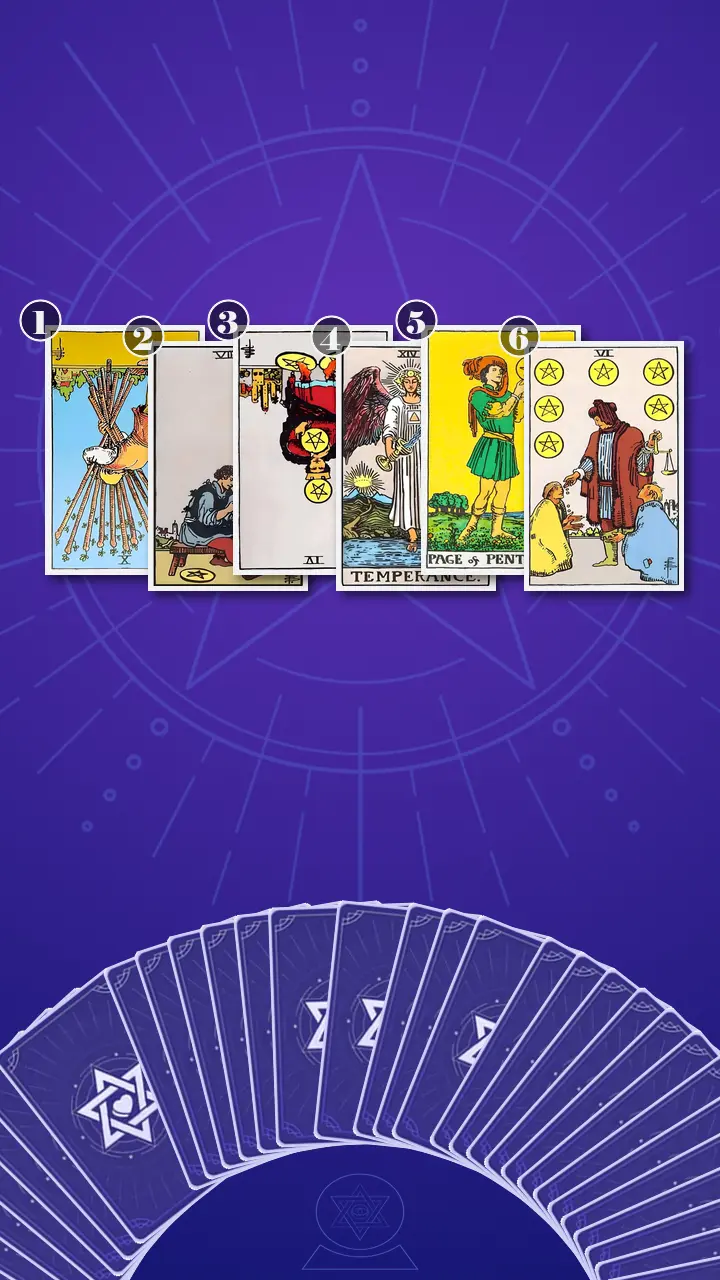
Reading the Calendar Beneath the Story
The Bundle That Blocks the Calendar
Now the card I turned was for this position: "This position reveals the visible recovery-avoidance behavior: how Jordan postpones reduced hours and keeps the standard schedule despite needing recovery."
The card was the Ten of Wands, in reversed position.
In the image, the figure's bundled wands obscure the way forward. In Jordan's life, that bundle was every launch task, recurring meeting, handoff, and after-hours revision carried toward the next deadline while the crowded calendar made it difficult to see what their energy could actually support. The reduced-hours request stayed postponed because carrying everything still looked like the most responsible way to remain trusted.
The reversed position showed blocked Fire and excess effort. The energy was not absent; it was trapped in over-carrying. Jordan had plenty of output, but no clear line of sight to their present capacity. I did not read this as a command to drop every commitment or disappear from communication. I asked which responsibility could be named, renegotiated, delegated, or removed before the next deadline, because a boundary that only appears after collapse is not yet a usable boundary.
Jordan did not nod. They gave a short, bitter laugh and said, "That is too accurate. Almost cruel." Their fingers tightened around the mug, then loosened. I said, "I hear the cruelty in the pattern, not in you. The card is showing the load that has become normal, so we can stop mistaking endurance for evidence." The laugh had opened a small gap in their defense without asking them to deny the real pride they felt in being someone people could rely on.
The Workbench That Became a Character Reference
Now the card I turned was for this position: "This position identifies the immediate pressure that makes the full schedule feel safer than asking for reduced hours, including deadlines, perceived expectations, and comparison with coworkers."
The card was the Eight of Pentacles, in upright position.
The craftsperson at the workbench looked familiar to me. Jordan treated each Figma file, critique, and handoff as another chance to prove that they were skilled and dependable. The work ethic was real. The problem began when after-hours refinement started functioning as reassurance, making a full schedule feel necessary even when it left no reliable space for recovery. A spacing adjustment that was not urgent could still feel like a tiny test of whether they belonged on the team.
Upright Earth gave Jordan genuine skill, patience, and care, but the energy had tipped into excess repetition. Practice was helping the craft only up to a point; beyond that point, it was being used to quiet the fear of judgment. I said, "The question is not whether you care about good work. It is whether constant availability has become the only proof you allow yourself to offer."
Jordan looked down at the card and rubbed one thumb over the edge of the paper. They told me that every extra pass felt easier to explain than a conversation about capacity. I could see the distinction becoming clearer: craftsmanship improved the work, while self-proving merely kept the full schedule intact.
The Hand Around the Pentacle
Now the card I turned was for this position: "This position exposes the underlying belief and fear that turn recovery into something Jordan feels must be earned."
The card was the Four of Pentacles, in reversed position.
The pentacle pressed against the figure's chest became Jordan's saved reduced-hours message and the full-time identity they were protecting from being seen as vulnerable or less committed. They kept the familiar schedule and the draft request private because changing either felt like risking control over how the team saw them. Avoiding the conversation brought a few minutes of relief, but the unchanged workload kept draining the energy that the request was meant to protect.
Reversed Earth showed a blockage around security and control. The grip was so tight that it no longer created safety. Jordan was not only avoiding a workplace conversation; they were protecting the version of themselves who was always available. I placed my hand beside the card and said, "I am not only avoiding a conversation; I am protecting the version of me who is always available." Then I added, "What does preserving that image give you for one evening, and what does it cost your body by Monday?"
First, Jordan's breath paused and their hand moved toward their chest. Then their eyes lost focus, as if the saved document, the green Slack status, and the next deadline were replaying in sequence. Finally, a low breath left them, and their jaw released by a fraction. "I keep calling it timing," they said. "But I think I am waiting for a version of work where asking will not feel like evidence against me." I let the silence hold that sentence. Naming the belief did not make it disappear, but it made the loop visible enough to interrupt.
When Temperance Rebalanced the Question
The Two Cups at the Crossroads
The room grew quiet before I turned the fourth card. This was the visual hinge of the reading, the position where the cycle could be interrupted: "This position shows the point where the cycle can be interrupted, translating insight into a different way of relating to commitment and capacity."
The card was Temperance, in upright position. Its strategic role was the antidote. The angel poured water between two cups, one foot on land and one in the water, steady without being rigid. The image did not demand that Jordan choose work over recovery or recovery over work. It suggested a measured proportion that could be tested, reviewed, and adjusted.
In practical terms, this was Jordan considering a reduced-hours trial with clear priorities, protected recovery time, and a review point. The arrangement could be approached as a schedule prototype, much like changing one proportion in Figma, inspecting the result, and revising based on evidence rather than treating the first version as permanent. Reduced hours were not a confession of lower commitment; they could be a way to make commitment sustainable.
At this point I used one of my diagnostic lenses, Macro-Cycle Phase Identification. After a decade of guiding people through their changing seasons, I use that phrase to locate a person within a recurring long-term work-and-recovery cycle. It does not mean that a low tide is destiny or that someone should passively wait for rescue. It means resistance can be information about the phase a system is in. Jordan was not failing a linear race. They were trying to produce at full speed during a depleted phase while refusing to update the conditions around the work.
I followed it with Systemic Friction Auditing, my way of stripping away the illusion that hustle can override a structural pause. I asked what friction would remain even if Jordan became more disciplined: the meeting density, the unprotected evenings, the fear attached to professional visibility, and the belief that a manager conversation had to be a final verdict. The problem was not a missing burst of motivation. The problem was that the current system kept requiring private recovery to subsidize public availability.
At 8:47 p.m. on a Tuesday, Jordan was in the Toronto kitchen, phone warm in their palm, reopening the saved message to their manager. Their shoulders were tight. They told themselves, "After launch." The promise sounded practical, but it kept recovery dependent on a finish line that kept moving.
Stop treating full-hour endurance as proof of your worth; begin testing a sustainable proportion of work and recovery, like Temperance blending two elements without sacrificing either.
First, Jordan froze. Their breath stopped halfway in, and their thumb hovered above the edge of the table. Then the sentence moved past the surface and into the old bargain: if reducing hours meant being less committed, perhaps continuing at full hours was the only way to stay safe. Their pupils widened slightly as the saved message came back into view. Finally, their shoulders dropped, their closed hand opened, and a shaky breath moved through their chest. Their eyes turned bright, not with a dramatic answer but with the strain of recognizing a choice they had been keeping outside the room. I watched relief arrive beside a brief, almost dizzying vulnerability. I did not rush to label it freedom. I asked, "Now, using this new perspective, can you recall whether there was a moment last week when this insight might have made you feel different?"
Jordan answered after a long pause. On Sunday, they had used the entire evening to become functional for Monday, then called the arrangement manageable because they had technically made it through. "A full calendar can prove availability; it cannot prove capacity," they said, testing the sentence aloud. This was the first crossing from proving commitment through full-hour endurance toward trusting a capacity-matched, sustainable contribution. It was not certainty. It was the beginning of self-trust with a shape I could see.
A Smaller Question Than Forever
The Page Studies One Proposal
Now the card I turned was for this position: "This position offers a small, observable action for the reduced-hours crossroads, such as defining a time-limited schedule conversation or experiment without making the cards decide for Jordan."
The card was the Page of Pentacles, in upright position.
The Page held one pentacle at eye level in a cultivated field. The image made the next move modest on purpose. Jordan did not need a final answer about their entire career. They could prepare a one-page capacity summary with proposed hours, essential priorities, tasks that would need to move, and a date for review. They could enter the conversation as a practical learner gathering information rather than presenting the request as a verdict on their ambition.
Upright Earth brought grounded attention, but not instant certainty. Its energy was balanced enough to begin and still humble enough to learn. I said, "A beginner is not uncommitted because they are collecting data. You can treat the request as an experiment, not a verdict." Jordan opened a note on their phone and wrote the heading, "What I can reliably contribute right now." Their posture was still careful, but the document was no longer only a place where they hid.
The Scales of a Fair Exchange
Now the card I turned was for this position: "This position describes the quality of integration Jordan can cultivate when recovery, work, and self-worth are no longer placed in a strict earn-first hierarchy."
The card was the Six of Pentacles, in upright position.
The balanced scales and measured coins offered a practical image for discussing hours, priorities, support, and reciprocal contribution. Jordan could define what they could reliably bring within reduced hours while allowing the work structure to acknowledge their current capacity. This was not a prediction that a manager would automatically agree, and it was not a moral argument that reduced hours were right for every person. It was a reminder that sustainable commitment can include receiving an adjusted structure and making the terms of contribution visible.
Balanced Earth completed the movement from carrying and clutching to blending, testing, and exchanging. I asked Jordan to imagine an ordinary workweek in which recovery was part of a fair exchange rather than a reward for finishing everything. They looked at the Six of Pentacles, then at the draft on their phone. "I could ask what the arrangement would need to protect," they said, "instead of asking whether I deserve to need it." The question belonged to them. The cards had only helped make it audible.
The One-Page Path Out of the Loop
The six cards told one coherent story. The reversed Ten of Wands showed why Jordan kept carrying every launch task toward a distant finish line. The Eight of Pentacles showed the sincere craft and care that made full availability feel like proof. The reversed Four of Pentacles revealed the tighter layer beneath it: the saved message was protecting a professional identity and a sense of control, even while the protection deepened exhaustion. Temperance introduced proportion. The Page of Pentacles made proportion testable, and the Six of Pentacles widened commitment into a reciprocal conversation about capacity, boundaries, and support.
The cognitive blind spot was treating the calendar as the final authority on capacity. A full week looked temporary because there was always another review, handoff, or launch, but the moving finish line was part of the mechanism. The deeper blind spot was believing that recovery had to be earned through complete performance. The transformation direction was clear without being compulsory: shift from proving commitment by enduring the full schedule to demonstrating responsibility by matching the schedule to current capacity and testing reduced hours deliberately.
I then introduced my communication tool, the Orbital Sync Protocol. It is a 72-hour exercise for pausing forced actions long enough to align psychological expectations with actual cyclical reality. It does not mean skipping agreed responsibilities, ignoring an urgent issue, or making a sudden career decision while depleted. It means suspending the self-imposed demand to send the perfect message tonight, while gathering honest information about energy, priorities, and what a workable proportion might be. For Jordan, the protocol turned the request from a frightening leap into a short observation window.
I wrote the actionable advice in three small steps. Each one could begin before the workplace had answered, because the first movement belonged to Jordan.
- Make the load visibleFor one current workweek, open Google Calendar and the task board for ten minutes. List recurring meetings, launch deliverables, and after-hours work. Circle one responsibility that could be deferred, reassigned, shortened, or given a clearer priority, then write: "My current hours are leaving insufficient capacity for consistent, high-quality work."Keep the inventory to one week, not your entire career. You do not need to disclose private health details, and you can stop at the inventory stage if that is the boundary you need today.
- Run the 72-hour Orbital SyncOver the next 72 hours, use one quiet ten-minute block to write two lines: "What I can reliably contribute right now" and "What recovery would make that contribution more sustainable." Add proposed hours, two or three priorities, one protected recovery block, and a possible review date to a private one-page reduced-hours proposal.Pause the pressure to force a decision or send a perfect message. A draft can remain private while you notice what changes when the finish line is no longer allowed to move every night.
- Request a conversation, not a verdictWhen the timing feels acceptable, choose one appropriate manager or workplace contact and ask for a short conversation about schedule options. Bring the proposed hours, the priorities those hours would protect, the tasks that may need to move, and the review point for a one- to four-week experiment, if a mutually workable arrangement becomes available.The proposal is not a promise that the workplace will accept a particular structure. You remain in control of what you share, when you share it, and how you revise the plan after receiving information.

The First Proof Was Smaller Than a Breakthrough
Four days later, I received a message from Jordan. They had completed the one-week capacity inventory, circled one recurring meeting to renegotiate, and sent a short calendar invitation to their manager. The message did not claim that the entire career crossroads was solved. It simply asked whether they could discuss a time-limited reduced-hours arrangement that protected the quality of their work and their ability to recover.
They sent the invitation, then sat alone in a coffee shop, relieved and a little hollow; the next morning, the thought "What if I am wrong?" still arrived, but Jordan looked at the protected recovery block and did not delete it. That was the bittersweet proof: a boundary had entered the calendar before certainty had entered the body.
I saw the Journey to Clarity in that small act. Tarot had not granted permission, predicted an employer's response, or chosen a schedule. It had helped Jordan distinguish a temporary low tide from a personal failure, identify the friction keeping the cycle in place, and make one capacity-matched experiment possible. The person holding the decision remained Jordan, and the next version of the arrangement would be shaped by their observations, boundaries, and consent.
When your shoulders stay braced through the last meeting and you keep postponing rest until you can prove your worth, needing fewer hours can feel like evidence against you instead of information about your capacity. The first moment of finding clarity may be as quiet as admitting that the finish line keeps moving.
If Temperance's two cups became a time-limited way to learn what lets you contribute steadily, rather than a verdict on your commitment, what small part of that possibility would you feel curious enough to picture this week?