A Laundry Pile Moved from Bed to Chair; One Surface Became a Rest Cue

The Bedroom That Stayed in Survival Mode
If you are a twenty-something hybrid worker renting with roommates in Toronto, and your bed keeps becoming the overflow desk after the last support ticket closes, you may know the particular rest guilt of feeling off shift but never off duty.
At 11:34 on a Tuesday night, Alex appeared on my screen from a rented bedroom near a streetcar line. Before sitting down, they lifted a warm laundry pile from the bed and transferred it to a chair already holding unopened mail. The bedside lamp cast hard yellow light across an open laptop; the radiator clicked behind them, a streetcar groaned through the wet street below, and their phone was still warm from apartment-listing videos.
I watched Alex clear exactly one body-width of duvet. Their shoulders stayed close to their ears, their jaw barely moved when they spoke, and every sound from the hallway pulled their eyes toward the door.
“I want home to feel restful,” they said. “But I keep waiting for the whole place to settle before I let myself settle. Making it nice feels pointless when it could be disrupted tomorrow.”
Their question was not about achieving an Instagram-ready room. It was the private search-bar question underneath shared-apartment clutter anxiety: Why can’t I relax when my apartment is messy, even when nothing urgent is happening?
I heard the contradiction immediately. Alex wanted to build a restful home, yet daily life remained organised around the next interruption. Their unease lived in the body like a smoke alarm with no visible smoke and no all-clear button: shoulders raised, breathing shallow, every quiet minute treated as suspicious.
“I’m not going to tell you the apartment is secretly fine,” I said. “The noise, shared surfaces, high rent, and unpredictable routines are real. I also don’t want those realities to become the only authority over when you recover. Let’s use the Energy Diagnostic Map · Context Edition to see how the environment and your survival response are reinforcing each other. We’re drawing a map of the fog, not asking the cards to issue a verdict.”
I made our purpose explicit: tarot would function as an objective reflection tool, helping Alex distinguish what was outside their control from the responses they could test and change. The cards could illuminate the pattern. Alex would remain the person deciding what was true, useful, and possible.

Choosing a Map for a Home With No All-Clear
I invited Alex to place both feet on the floor, take one unforced breath, and hold one question in mind: “Why do I keep living around chaos instead of making home restful?” I shuffled slowly, using the pause as a transition for attention rather than presenting it as a mystical performance.
I chose the seven-card Energy Diagnostic Map · Context Edition because this problem could not be reduced to clutter or mindset. A broad Celtic Cross would add more context than this focused question needed, while a Shadow Spread could place too much weight on Alex’s inner life and understate the material pressures of a shared rental. This layout was precise enough to hold both.
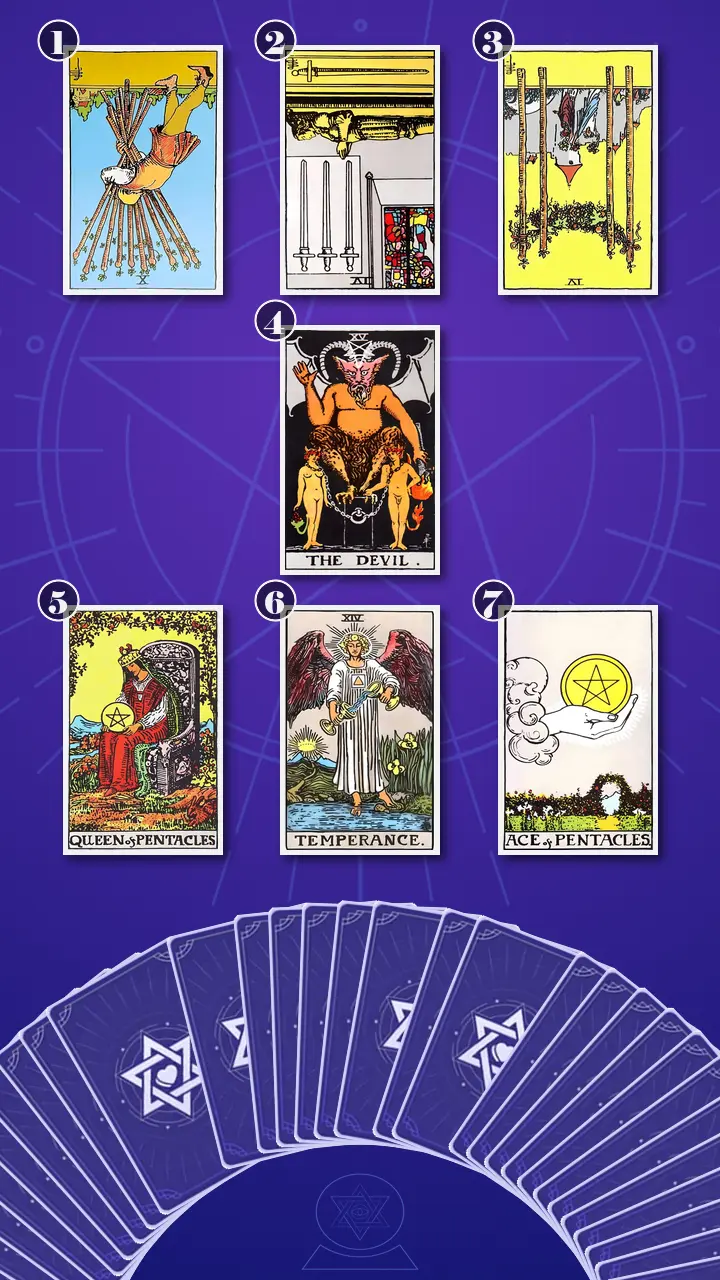
I arranged the first three cards across an upper row. They would show the visible domestic behaviour, the internal tension around rest, and the external conditions keeping the home unreliable. The fourth card sat beneath the centre as the maintaining blockage, the point where circumstances and habit converged. Three cards along the lower row would reveal an available resource, the regulating bridge, and one practical next step.
The shape resembled a funnel narrowing around a blockage and opening into a path. That structure mattered. It allowed me to explain how tarot works in context: individual card meanings were not isolated labels but parts of a causal sequence, moving from behaviour to pressure, from pressure to pattern, and from pattern to an experiment Alex could choose to run.
Ten Burdens and a Body Still on Call
Position 1: The Load That Obscured the Bed
I turned over the card representing the observable domestic behaviour: responding to urgent disruptions, moving unfinished tasks between surfaces, and failing to preserve a place for rest. It was the Ten of Wands, in reversed position.
I pointed to the figure bent under ten bundled wands. The load was not only heavy; it blocked the figure’s view of the destination. In Alex’s life, the destination was simple: a bed they could actually inhabit at the end of the day. Yet laundry, work equipment, household supplies, and unresolved decisions kept travelling together as one undifferentiated burden.
I described the modern version I saw in the card. At 11:20 p.m., already depleted, Alex would begin a full room reset. Laundry moved from bed to chair, mail moved from chair to desk, and work equipment moved from desk to floor. Three sorting categories remained open because no timer or stopping rule had ever defined completion. The reversed Ten of Wands did not accuse Alex of insufficient effort. It showed effort being released unevenly, without a conscious definition of enough.
Energy dynamic: fire was in excess and blockage at once. Alex had plenty of activation, but that activation scattered into too many open tasks. The more they carried, the less able they became to see whether any action was bringing rest closer.
Alex gave a short laugh that landed somewhere between recognition and grief. “That is so accurate it feels a little brutal.”
I did not rush to make the card sound nicer. “I can see why it lands hard,” I said. “But it isn’t calling you lazy or incapable. It is showing that your idea of responsible effort has no closing condition. The pile is not a moral failure, but it cannot be your permanent all-clear system.”
I asked what “enough for tonight” might have meant in that 11:20 scene. Alex looked at the sliver of cleared duvet and said, “The bed being usable, with the laptop out of reach.” That answer was already smaller and more workable than “finish the room.”
Position 2: Lying Down While Attention Stands Guard
I turned over the card representing the internal pull between wanting recovery and treating stillness as a loss of readiness. It was the Four of Swords, in reversed position.
The traditional image shows a recumbent figure with folded hands, three swords suspended overhead, and a fourth sword kept close below. Reversed, the protected retreat becomes interrupted recovery: the body lies down while the mind remains posted at the door.
I brought Alex back to 11:30 p.m. The body was horizontal, but the phone stayed warm. Teams remained visible beside the lamp, a podcast continued playing, apartment listings stayed open, and every footstep in the hallway became a possible reason to sit up. Alex had told themselves, “I am technically in bed, but I am still the person on call for the room.” They sometimes got up twice to move objects that were not urgent.
Energy dynamic: restorative air was blocked. Thought did not disappear; it circulated through messages, sounds, tomorrow’s planning, and negative pre-planning. Physical collapse occurred, but deliberate withdrawal remained underfunded.
Alex’s gaze dropped from the card to their hands. Their thumb pressed into the centre of their palm, their jaw shifted once, and then their shoulders lowered by less than an inch.
“Lying down is a posture; rest needs a boundary,” I said. “A podcast may be soothing on another night. Checking Teams may occasionally be necessary. The issue is not whether any single thing is bad. The issue is that nothing has to prove it deserves access to you.”
I asked what had stayed active the last time they lay down. Alex named work chat, hallway noise, and the thought that they should use the quiet to fold one more category. I separated those elements carefully. The hallway noise was real. The work chat after sign-off was a discretionary channel. The demand to improve the room before touching the bed was an internal rule. The card helped us stop treating all three as the same kind of emergency.
Position 3: The Threshold That Could Not Be Trusted
I turned over the card representing the genuinely unstable features of the home, ensuring that I did not reduce an environmental problem to personal attitude. It was the Four of Wands, in reversed position.
Four staffs and a suspended garland usually form a threshold of welcome. In reversal, the doorway becomes unreliable. Entering the apartment does not consistently signal homecoming, just as closing a customer-support ticket does not necessarily tell Alex’s body that the shift has ended.
I described a Sunday evening that Alex immediately recognised. They wiped one section of the kitchen counter while the fridge hummed and lukewarm dishwater smelled faintly of detergent and takeaway. A roommate arrived with groceries and filled the cleared space. The laundry schedule changed without warning. Evening noise crossed the bedroom wall. Alex thought, “Why make it nice if I cannot trust it to stay that way until tomorrow?” Then they abandoned their bedroom reset as well.
Energy dynamic: domestic fire and containment were blocked by real inconsistency. The reversed Four of Wands validated that the shared threshold did not reliably hold. Its warning was subtler: one disrupted communal surface had begun to define every square foot, including the personal zones Alex could influence.
Alex released a long breath and nodded. The first movement was relief, but a trace of resentment remained around their mouth. “Thank you for not making this sound like I just need a better morning routine,” they said.
“A room can be genuinely unstable without every minute becoming an emergency,” I replied. “Both truths can stay visible. Your roommates’ choices affect the apartment, and one bedside surface may still be yours to protect. Temporary calm is not fake calm. It is calm available for use.”
I briefly remembered the different homecoming thresholds I had encountered while travelling across cultures: a change of shoes, a kettle switched on, a lamp lit before conversation. The details varied, but the psychological function was consistent. A threshold told the nervous system that one mode had ended. Alex’s apartment had no reliable shared threshold, so our work would be to create a personal one without pretending it could solve the whole household.
The Contract Hidden Inside Crisis Competence
Position 4: The Loose Chain of Constant Availability
I turned over the card representing the self-reinforcing contract at the centre of the system: readiness felt protective, while the disorder produced by interrupted rest seemed to justify more readiness. It was The Devil, upright.
I am careful with this card. I never use it to imply evil, punishment, or an unavoidable fate. Through my Jungian lens, The Devil often reveals a shadow contract: an adaptive strategy that has become fused with identity and continues operating beyond the moments that originally required it.
The two figures stood beneath an imposing pedestal, but the chains around their necks were loose. That distinction mattered. Toronto housing costs, thin walls, inconsistent household routines, and a bedroom serving three functions were the pedestal. I did not ask Alex to imagine those constraints away. The loose chain represented a habitual response to a cue that had not established urgency.
I translated it into the permissions screen on a phone. Alex had effectively given every app “always allow” access. Teams stayed on, work gear remained visible, and every sound, object, or household message could enter the same crisis-response queue without receiving a severity label. The room was running a customer-support desk where a sock on the duvet and a genuine safety issue both appeared as priority tickets.
Energy dynamic: attachment was in excess, creating a blockage. Crisis competence had become proof of worth and control. The familiar contract said, “If I stay ready, I am competent. If I stand down and something goes wrong, I was careless.” Remaining active offered a brief sense of protection, but it prevented the room from developing evidence that a limited pause could be survived.
I used my Compensatory Routine Decoding lens here. Alex’s late-night apartment scrolling, CleanTok videos, and revenge bedtime procrastination were not simple discipline failures. They were coping mechanisms. Browsing another address offered temporary distance from the harder experiment of protecting one imperfect surface in the current room. Watching someone else complete a reset delivered the sensation of an ending while allowing Alex’s own shift to remain open.
Alex’s fingers went still on the mug. Their eyes moved toward the glowing Teams icon and stayed there. “So I’m doing this to myself?” they asked, their voice sharper than before.
“That conclusion would erase the environment we just validated,” I said. “You learned readiness because readiness has genuinely been useful. The question is not whether the strategy was wrong. The question is whether it needs full permissions during every quiet hour. We are looking for one non-urgent cue that no longer gets automatic access.”
Their expression changed slowly: first resistance, then a distant look as if they were replaying several nights, then a small release in the muscles around their mouth. “The work notification after my shift,” they said. “I almost never need to answer it. I just need to know it’s there.”
Position 5: The Steward of One Reachable Thing
I turned over the card representing Alex’s available resource: practical care, bounded stewardship, and the ability to support the body within the part of the environment they could touch. It was the Queen of Pentacles, upright.
The Queen looked closely at the pentacle in her lap while living growth surrounded her. I framed this archetype as a capacity available to any gender, not a domestic role Alex was expected to perform for other people. Her attention stayed with one tangible resource rather than trying to govern the whole landscape.
I translated the card into close-up actions. The work headset went into one caddy before exhaustion peaked. The chair was cleared before it became the laundry migration point. A glass of water sat beside the bed. One lamp changed to warmer light. A blanket remained within reach. The room did not become a curated renter makeover, and the roommates did not transform. The body simply received practical support.
Energy dynamic: earth was balanced and available, though underused. Alex already possessed domestic competence. Survival mode had directed it toward emergency endurance; the Queen redirected it toward maintainable care for limited space, time, and energy.
I mentioned KC Davis’s framing of care tasks as morally neutral because it matched the card so closely. A functional surface did not need to prove that Alex was organised, mature, or aesthetically accomplished. It needed to help a real body drink water, put work away, sit down, or sleep.
Alex’s breathing softened. Their eyes moved around the room and stopped at the bedside table. “The charger would have to go,” they said. “And the unopened mail. I’d keep the lamp, water, and whichever book I’m actually reading, not the aspirational stack.”
I smiled at the precision of that distinction. Care could be functional. It did not have to be expensive, photogenic, permanent, or impressive enough to post.
When Temperance Made Rest Part of the System
Position 6: One Cup for Effort, One Cup for Recovery
I turned over the card representing the key shift from all-or-nothing home management to a measured rhythm between limited action and protected recovery. It was Temperance, upright, the bridge at the centre of the reading’s transformation.
The room seemed to become quieter as I placed it beneath The Devil. Even the radiator paused between clicks. In the image, water moved deliberately between two cups. One foot rested on solid ground and the other touched moving water. I saw responsiveness without submersion: Alex could acknowledge genuine instability without living entirely inside it.
I explained the card’s everyday expression. Alex would set a ten-minute timer, clear only the bedside surface, and stop when the alarm sounded even though laundry remained unfinished. They would then mute work notifications and spend fifteen minutes using the space, instead of converting it into the launch point for another project.
Energy dynamic: Temperance brought balance, not static perfection. Its energy was measured self-regulation, patient integration, and trust in small transitions. Rest and effort no longer had to compete for the right to exist.
At 11:30 p.m., Alex usually moved laundry from the bed to the chair, left Teams glowing beside the lamp, and promised to rest once the room was handled. Yet every new category expanded the job, pushing recovery further away while making unfinished work look like proof that stopping was unsafe.
Rest is not a reward for defeating chaos; practise a measured exchange between effort and recovery, like Temperance pouring water between two cups.
I let the sentence remain between us without explaining it away.
Alex’s breath stopped first. Their fingers hovered over the laptop trackpad without touching it, and their pupils widened as if the yellow room had briefly sharpened around them. Then their gaze lost focus. I could see them mentally replaying the bed-to-chair laundry transfer, the late Teams checks, and the quiet minutes they had converted into preparation. Their brow tightened. “But doesn’t that mean I’ve been doing rest wrong this whole time?” they asked, with a flash of anger that sounded close to grief.
I kept my voice steady. “It means a strategy that once helped you feel prepared has become too expensive. That is different from saying you were wrong.” Their fist loosened against the duvet. Their shoulders dropped, followed by a trembling exhale from deep in the chest. Relief arrived, but it brought a moment of exposed stillness with it. Alex looked almost dizzy without the old rule to obey. “Then I have to choose when enough is enough,” they said quietly. The responsibility in that clarity frightened them, but it also belonged to them.
I asked immediately, “Now, using this new view, can you remember a moment last week when this insight might have changed how the evening felt?”
Alex thought about Friday. They had cleared the chair, switched on the softer lamp, and sat down while bass pulsed through the wall. Then they noticed a stack of mail and stood up because they believed they should use the quiet properly. “I could have left the mail,” they said. “The chair was already doing its job.”
This was where I brought in my Psychological Bandwidth Audit. I asked Alex to imagine their daily energy as a support queue. Before the first work ticket arrived, subconscious anxiety had already opened background tickets for hallway noise, roommate changes, unfinished chores, visible work gear, and the possibility of being caught unprepared. Unresolved stress was spending their reserve before the paid shift had even begun.
Temperance did not ask them to squeeze more productivity from the remaining bandwidth. It asked them to fund two categories on purpose: enough effort to keep one thing workable, and enough recovery to remain a person capable of inhabiting what they had made workable. Like a Pomodoro in which the break is part of the protocol, the pause could not be cancelled simply because the backlog still existed.
I named the transformation clearly. This was a first movement from guarded hypervigilance and all-or-nothing home management toward grounded calm through bounded effort, protected pauses, and repeatable rest cues. The shift was not from chaos to perfect order. It was from endless readiness to a measured exchange: one bounded task, followed by one protected pause.
Position 7: The One Place With One Job
I turned over the final card, representing the immediate physical action through which Alex could test and integrate the new rhythm. It was the Ace of Pentacles, upright.
An open hand offered one pentacle above a cultivated garden. I placed it visually against the Ten of Wands. The first card carried ten bundled objects until the destination disappeared; the last offered one object clearly enough to be received.
I translated the card into Alex’s room. For seven days, the bedside table would become recovery-only. The laptop charger and unopened mail would leave. A lamp, water, and the current book would remain. Each evening, Alex would restore the boundary with one brief action before opening apartment listings or home-reset videos.
Energy dynamic: earth appeared as a grounded opportunity, not a guaranteed outcome. The Ace did not promise that the table would stay untouched or that the apartment would become quiet. It offered one observable beginning whose usefulness could be tested through repetition.
“Give one place one job before asking the whole home to change,” I said.
Alex looked toward the table again. Their face held cautious interest rather than sudden certainty. “That feels almost too small,” they admitted.
“Notice that reaction,” I replied. “It may be the all-or-nothing system trying to reject evidence it cannot control. Small does not mean symbolic only. Small means the experiment can survive an exhausted Wednesday.”
The One-Surface Homecoming
I drew the seven cards together into one coherent story. Repeated disruptions and work spillover had taught Alex that crisis competence was useful. In the present, the reversed Ten of Wands kept every visible demand active, while the reversed Four of Swords showed a body collapsing without completing a pause. The reversed Four of Wands confirmed that the home’s shared threshold was genuinely unreliable. The Devil revealed how those realities had hardened into a contract: constant readiness meant competence, and any disorder produced by exhaustion seemed to prove that readiness could never stop.
The lower row changed the direction of the story. The Queen of Pentacles showed Alex’s existing capacity to steward limited resources without taking over the whole apartment. Temperance turned that capacity into a rhythm, and the Ace of Pentacles placed the rhythm in one physical location. The funnel opened from ten indiscriminate burdens into one deliberate material anchor.
I named the cognitive blind spot plainly: Alex had begun treating visibility as urgency and temporary calm as meaningless. A visible object could enter the same workflow as an actual problem; a calm surface did not count unless its future was guaranteed. That rule gave the most chaotic part of the apartment authority over every quieter part.
The transformation direction was equally plain. Alex did not need to wait for whole-home stability. They needed to clear one rest surface for ten minutes, stop according to a rule chosen in advance, and then use that surface for actual recovery. In this Energy Diagnostic Map · Context Edition reading, actionable advice was not an afterthought. It was how Alex would test whether the new interpretation held up in real life.
I shaped two next steps around the cards and Alex’s actual capacity:
- The Recovery-Only Anchor and Ego Unplugging Protocol On the next work-from-home day, Alex would place a tote beside the desk before the shift ended. At sign-off, the headset, laptop charger, and support notes would go inside. The bedside table would keep one purpose for seven evenings: supporting decompression with the lamp, water, and current book. After closing Teams, Alex would say, “Today’s ticket count is data, not a verdict on my worth. My home does not owe work another shift.” Tip: Success would mean restoring the boundary with one action, not preserving it perfectly. If the table was disrupted, one coaster-sized area free of work equipment would still count.
- The Ten-and-Fifteen Temperance Exchange On one evening that week, Alex would set both timers before starting: ten minutes to clear only what prevented the chosen surface from supporting rest, followed immediately by fifteen minutes with no household task in progress. Their stopping rule would be, “For tonight, enough means the bed is usable and work is out of reach.” Teams and non-urgent work email would be muted, while genuine household safety needs could remain audible. Tip: If fifteen minutes felt impossible, the minimum version was two minutes, one song, or three slow breaths beside the cleared surface. The experiment could end at any point; discomfort was information, not a command to expand the cleaning project.
I reminded Alex that the Ego Unplugging Protocol was a boundary, not another performance metric. They did not need a perfect seven-day streak, a photo-ready result, or proof that rest made them more productive. The practice existed to detach self-worth from constant availability and let one domestic cue say that effort could end.

Six Days Later, the Quiet Proof
Six days later, Alex sent me a photo: lamp, water, book, no charger. They had slept through the night. Their first thought on waking was, “What if it gets covered again?” They smiled, moved one mug, and restored the surface.
The apartment had not become silent. Laundry still existed, a roommate changed the kitchen routine again, and Alex marked one evening “not today” in their phone note. What had changed was smaller and more consequential: disruption no longer erased the experiment. The table could be restored without turning the whole room into an emergency project.
I did not read this as tarot magically fixing Alex’s home. The cards had provided a language for separating burden, interrupted recovery, external instability, habitual readiness, practical care, measured regulation, and material action. Alex created the evidence by choosing a boundary and using it.
That was the Journey to Clarity I witnessed: not certainty that nothing would go wrong, but growing trust that one pause could remain valid even when something else was unfinished. Alex was still living in a complicated home. They were no longer requiring the whole home to grant permission before they could exhale.
When every surface might be needed for the next problem, even sitting down can tighten the jaw. I know how deeply a person can want home to offer an exhale while fearing that exhaling is the exact moment control will be lost. Noticing that contract does not solve everything, but it means chaos is no longer making every decision unseen.
If one small place did not have to wait for the whole home to settle, what would you want it to hold for you tonight?