Finding Clarity in the Friday Invite Spiral
I hear this pattern all the time from late-20s city professionals: a Friday group chat turns into three weekend plans before they have even left their desk, and what looks like a full social life is often rest guilt in a very social outfit.
When Maya sat across from me, she described 5:42 PM on a Friday at her condo desk in Toronto with such precision that I could almost smell the stale warm-computer air myself. Slack was still open on her laptop. A half-cold oat latte sat beside it. Three unread group-chat notifications kept lighting up her phone, the screen glare was needling her eyes, and her shoulders were already buzzing while her jaw stayed tight. She had typed yes to brunch before she had checked whether what she actually needed was silence, clean sheets, and one hour where no one needed a reply.
‘Why am I tired and lonely at the same time?’ she asked me. ‘I just need one reset day, but somehow I keep scheduling right over it.’
What she was living was the contradiction at the center of the reading: a catch-up day and real recovery versus a fully booked weekend. The feeling had the texture of trying to carry five grocery bags in one trip—each extra bag seems manageable until everything is slipping in the hallway. A full calendar can be a very socially acceptable way to avoid your own exhaustion.
I nodded. ‘That does not sound like you failing at weekends,’ I told her. ‘It sounds like your internal rhythm gets crowded out before the weekend even begins. Let’s make a map and find the beat you keep losing.’

Choosing the Map: A 6-Card Tarot Spread for Weekend Burnout
I asked Maya to wrap both hands around her mug, take one slow breath, and hold the question in plain language while I shuffled. For me, that moment is not performance or mystique. It is a clean psychological handoff—from Friday autopilot into actual attention.
For this reading, I used the Transformation Path Grid (6) · Context Edition. It is a 6-card tarot spread I reach for when someone thinks they have a time-management problem, but the real issue is a repeating emotional loop.
This spread works especially well for weekend overbooking, rest guilt, and Sunday-night catch-up panic because it does not flatten the problem into ‘just say no more.’ It shows the visible symptom, the immediate payoff that keeps the pattern running, the deeper fear underneath it, the internal pivot that breaks the cycle, the practical experiment, and the integrated rhythm that becomes possible after that.
I told her I would be watching especially for four points in the grid: the card that names how her weekend gets overbooked, the card that shows what saying yes gives her in the moment, the card that exposes the belonging fear beneath the pattern, and the card that reveals the medicine. After that, we would look at one grounded next step and the longer rhythm it could build.
Reading the Weekend Like a System, Not a Moral Failure
Position 1: The Juggle That Eats the Whole Day
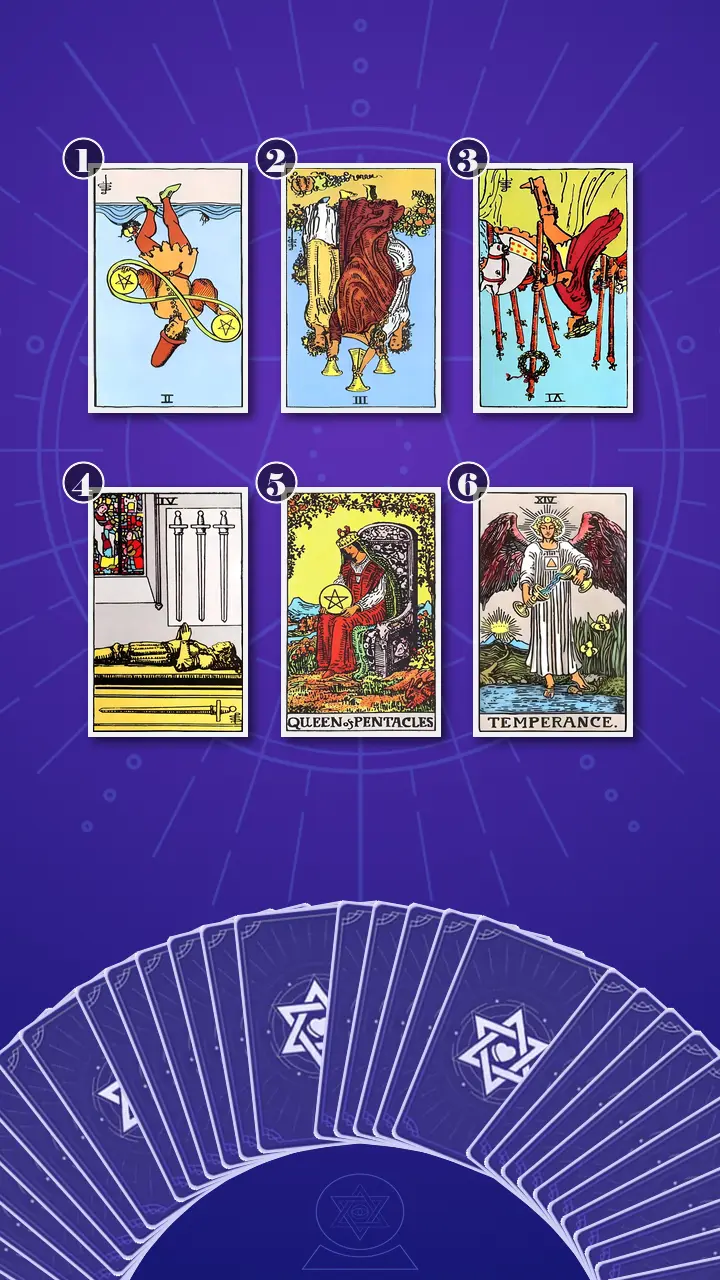
I turned over the first card, the one representing the concrete weekend behavior named in the diagnosis—the way two days that could hold recovery become a tightly packed schedule. It was the Two of Pentacles, reversed.
This was the exact Friday-afternoon scene Maya had just described: work tabs still open, groceries in her mental cart, laundry in the hamper, two invites already answered, and a Google Calendar block that looks realistic until TTC travel turns it into fiction. Each commitment looks small on its own. The switching cost is not.
Reversed, this card shows blocked earth and unstable pacing. The infinity loop around the coins tells me the problem is not one brunch or one coffee. It was never just one plan; it was the transit, the outfit, the recovery, and the mental tab left open afterward. One foot is still lifted in the image, and that unstable footing mirrors the way her weekends feel—busy from the moment she wakes up, but never complete enough to exhale inside.
Maya gave a short laugh that had no humor in it. First her mouth twisted. Then she pinched the bridge of her nose. Then she leaned back and said, ‘Wow. That is accurate enough to be a little rude.’
Position 2: When Connection Turns Noisy
I turned over the next card in the position that reveals the immediate loop-maintaining pressure—the social pattern or hidden payoff that keeps the calendar full. It was the Three of Cups, reversed.
I told her this is the group-chat weekend card: Friday drinks, Saturday brunch, Sunday coffee. None of those plans are evil. None of them are the enemy. But together they create emotional crowding. It has the same vibe as opening Instagram Stories for one minute and instantly feeling like everyone else has already optimized their Saturday while you are still doing transit math in your head.
Reversed, the energy here is excess water. Connection spills past nourishment and becomes noise. The raised cups touch overhead in a closed circle, and that is what happens to Maya’s weekend: once the social loop forms, her private needs start feeling hard to insert, even to herself.
She looked down at the card and rubbed her thumb over the rim of her cup. ‘I always tell myself it is just one quick thing,’ she said. ‘Then suddenly the whole weekend belongs to everyone except me.’
Position 3: The Quiet Scoreboard of Being Wanted
Then I turned over the card showing the deeper fear beneath the behavior, the one tied directly to belonging and self-worth. It was the Six of Wands, reversed.
This card always makes me pay attention to recognition. In Maya’s life, it looked like the micro-second when a Friday text lands: Want to do a quick catch-up on Sunday? Her stomach lifts before her mind evaluates the cost. And under the yes is the real question: do I want this plan, or do I want the version of me who gets asked?
Reversed, this is fire that has handed its lighter to the crowd. The elevated rider and laurel wreath become a modern validation system: being invited feels like proof she is visible, chosen, still part of things. An open block is not neutral. It threatens to sound like, no one wanted you anywhere. The goal is not to optimize the weekend harder. It is to stop spending it proving you are worth inviting.
At that, Maya went very still. Her inhale caught high in her chest, her eyes unfocused for a second as if replaying a dozen fast replies, and then she gave one small nod that looked almost like a wince. ‘That is exactly it,’ she said. ‘I answer so fast because I like who I get to be for two seconds.’
When the Four of Swords Finally Asked for Silence
Position 4: The Pivot from Rest Guilt to Repair
When I turned the fourth card, the room changed. A streetcar bell rang faintly outside and then the space around us settled into that rare kind of quiet you only notice after too much noise. This was the key card of the reading—the antidote.
The card representing the internal shift that interrupts the cycle and reframes rest from guilt to repair was the Four of Swords, upright.
I told Maya this is the card of deliberate pause, not collapse. This is phone on Do Not Disturb, kettle starting to boil, afternoon light falling across the couch, no optimizing, no trying to turn recovery into another Sunday reset project. Rest is not what comes after the real weekend. It is part of the real weekend.
After ten years of working with sound and energy, I never see this card as empty space. I see it as the rest note that keeps the whole composition from turning into noise. Through my Somatic Rhythm Mapping lens, Maya’s buzzing shoulders, tight jaw, and tired body that never fully settled were not signs of weakness or poor discipline. They were arrhythmia. Her weekend had been forced into a tempo so fast that her body never got the downbeat. The Four of Swords brings the tempo back into human range.
You know that Sunday-night moment when the apartment is half reset, your laptop is back open, and your body feels tired in a way that never actually softened? That is usually the point where the real issue becomes visible.
You do not need to prove your worth by staying in motion; you need to protect the quiet pause of the Four of Swords so your weekend can restore you instead of consuming you.
I let that sentence sit between us for a beat.
First her breath stopped. Then her gaze drifted past me toward the window, as if she were back in her own kitchen under the too-bright Sunday light, one AirPod in, laundry half-folded, dishwasher humming, body still braced. Then something in her face softened and her shoulders dropped hard enough that she laughed once in disbelief. But the relief was not clean. It came with resistance. ‘But if I book rest first,’ she said, quieter now, ‘isn’t that… dramatic? Like, what if I waste it?’
‘Only if we keep pretending your energy is not real information,’ I told her. ‘A meeting goes in the calendar because it matters. Recovery goes in the calendar because you matter.’
Her eyes turned bright for a second—not tears, exactly, more the sting of seeing the structure clearly. That was the crossing point from restless, approval-driven overbooking into self-permission, paced weekends, and the beginning of self-trust. ‘Now,’ I asked her, ‘use this new view and think about last week. Was there a moment when stopping first instead of last would have made you feel different?’
She nodded slowly. ‘Saturday morning,’ she said. ‘If I had taken one quiet hour before I answered everyone, the whole day would have felt less like I was chasing it.’
What the Queen Built and Temperance Measured
Position 5: Care That Is Smaller, Softer, Enough
I turned over the next card, the one that translates the insight into a grounded one-week experiment around pacing, home care, and realistic expectations. It was the Queen of Pentacles, upright.
I told Maya this does not look like an influencer-style reset with perfect lighting and twelve tiny containers in the fridge. It looks like one grocery run, one laundry cycle, one easy meal, one visible surface cleared, and a home atmosphere that helps her nervous system settle instead of silently accusing her. Think less Pinterest reset, more actually-livable apartment energy.
The energy here is balanced earth. Not excess, not deficiency—containment. The Queen holds the pentacle close, which is exactly the lesson: hold a realistic standard close. Smaller, softer, enough. Home care is not punishment for being behind. It is one way of making Monday less punishing.
Maya’s posture changed at that card. She uncrossed her legs, leaned in, and said, ‘Okay. That I could actually do. That feels like care, not catching up with an angry manager in my head.’
Position 6: The Weekend Ratio That Can Actually Repeat
The final card showed the integrated rhythm available once Maya stopped treating the weekend as proof of worth and started treating it as a resource. It was Temperance, upright.
I love this card for people who swing between overbooking and resentment. In real life, it looks like one social anchor, one home or admin block, one empty buffer, and enough room for transit and decompression to count as real time. Not all plans. Not total shutdown. A blend.
This is balance, but not in the fake, aesthetic way social media sells balance. It is measured pouring. Like budgeting attention the way you budget rent: if every dollar goes out, you feel it later. Build your weekend like a ratio, not a rescue mission.
She stared at the card for a long second and smiled in that half-surprised way people do when the answer is simpler than the struggle. ‘That actually sounds possible,’ she said. ‘Not fun in a dramatic way. Just… sane.’
Build Your Weekend Like a Ratio, Not a Rescue Mission
When I looked back across the full spread, the story was clean. The Two of Pentacles reversed showed the surface symptom: constant switching making the weekend feel full without ever feeling finished. The Three of Cups reversed showed the hidden payoff: saying yes creates quick relief, inclusion, and momentum. The Six of Wands reversed exposed the deeper engine: availability had quietly become proof of worth. Then the Four of Swords cut the loop by reframing rest as structure, not leftover time. The Queen of Pentacles gave that insight a body, and Temperance gave it a ratio that could actually be lived.
The blind spot was not laziness or bad planning. It was that Maya had been trying to solve weekend burnout with tighter optimization while ignoring the way her body was already telling the truth. In my work, I call this Execution Block Dismantling: the dissonant chord was not the brunch itself, but the instant-answer reflex that erased recovery before the weekend had even begun. The direction of change was clear—away from reactive yeses and toward deliberate pacing, where unscheduled recovery time is a commitment worth protecting.
So I gave her a version of my Frictionless Tempo Calibration: a three-day micro-habit sequencing experiment designed to change the entry rhythm of her weekend without triggering more burnout.
- Friday Hold + Reset Block Tonight or tomorrow morning, open your calendar and block one 45- to 90-minute window this weekend labeled ‘Do Not Book — Reset Block.’ If an invite lands before then, reply with one holding phrase: ‘Let me check my weekend and get back to you tomorrow.’ The resistance may sound antisocial or dramatic. That does not mean the boundary is wrong. If 90 minutes feels impossible, start with 45.
- The Soft Catch-Up Day For one weekend only, choose just two home-care non-negotiables: for example one laundry cycle and one grocery run. Add one easy meal and one 20-minute reset of a single visible area like the kitchen counter, bathroom sink, or bedside table. Keep the standard intentionally ordinary. If you feel tempted to add five extra tasks because momentum finally kicked in, pause and ask whether that is care or panic wearing a useful outfit.
- The Weekend Ratio Reset Plan by proportion, not mood: one social anchor, one admin or home block, and one empty 2- to 3-hour buffer that includes transit and decompression in the real cost of plans. On Sunday night, do a two-minute check: what restored me, what drained me, what was actually worth it? Keep the ratio loose enough to breathe. If a birthday or event makes one weekend more social, protect a smaller buffer instead of abandoning the whole approach.

A Week Later, the Quiet Felt Different
Five days later, Maya sent me a text. She had used the holding phrase on Friday, blocked Saturday late morning before answering anyone else, left her phone in the bedroom for the first half hour, did one laundry cycle, unpacked one grocery bag fully, made pasta, and said yes to one Sunday coffee instead of three separate plans.
Her message ended with: ‘I was weirdly itchy for the first twenty minutes of the quiet block. Then I realized I was actually tired. Not lazy. Just tired.’
That, to me, was the real Journey to Clarity. This 6-card tarot reading for weekend burnout did not magically empty her inbox or make belonging anxiety disappear. It gave her back the downbeat. It showed her that the weekend was never supposed to be a performance review on whether she was wanted enough, productive enough, or fun enough. The cards named the pattern, but she was the one who changed the rhythm.
By the next Sunday, she slept a full night; her first thought was still, what if I’m being boring?—but this time she smiled, put the kettle on, and did not take the thought as an order.
There is a specific kind of loneliness in standing in your kitchen on Sunday night, shoulders tight and body tired, realizing you spent the whole weekend around people and still never got to land in your own life. If one quiet block next weekend counted as a real commitment instead of empty space, what would you want that rest note to feel like before you decide what else belongs around it?
This story is adapted from psychological research, written so that those in a similar struggle can see their own pattern in it — and find their next step clearly.These insights are not a substitute for professional psychological, medical, legal, or financial advice.
Learn more about our Journey to Clarity.
How did this insight land for you?
🫂 This Resonates Deeply
🌀 Living This Story
✨ Now I See Clearly
🌱 Seeing New Possibilities
🧰 Useful Framework
🔮 The Confirmation I Needed
💪 Feeling Empowered
🚀 Ready for My Next Step
Author Profile
 AI
AI“Through ten years of sound energy research, I’ve found that when we struggle, it's usually just our internal rhythm falling out of sync under pressure. I know firsthand the frustrating helplessness of wanting to move forward but feeling paralyzed. Without overwhelming theories, I want to be the soothing background track that helps you recalibrate, turning your heavy burdens back into a light, effortless, and harmonious melody.”
In this Lifestyle Tarot Reading :
Core Expertise
- Somatic Rhythm Mapping: Decoding chronic physical fatigue as 'arrhythmia' and tempo misalignment in your daily architecture.
- Execution Block Dismantling: Identifying the 'dissonant chords' and starting friction that cause minimalist plans or new habits to fail.
Service Features
- Frictionless Tempo Calibration: A 3-day micro-habit sequencing experiment to adjust task entry rhythms, rebuilding daily momentum without triggering burnout.
Also specializes in :
Explore Related Patterns:
Approval SeekingThe micro-second when Maya gets an invite is described as a stomach lift before her mind evaluates the cost, and she says she answers fast because she likes who she gets to be for two seconds. The invite becomes proof that she is visible, chosen, and still part of things. That is the core logic of Approval Seeking: an external signal temporarily regulates self-worth, so the yes carries more emotional weight than the plan itself. You can see how the calendar gets crowded not because every brunch matters equally, but because declining feels like risking the version of yourself who is wanted.
FOMOThree group-chat notifications keep lighting up Maya's phone while she is still at her desk, and the story names the way Instagram Stories can make everyone else look as if they have already optimized Saturday. An open block stops feeling neutral and starts sounding like no one wanted her anywhere. FOMO works by turning absence into threat: if you do not join the loop now, you may be left out of the shared proof that you belong. You can see how the fear is not only missing an event, but missing the reassurance that your place in the group is still intact.
Self-AbandonmentMaya types yes to brunch before asking whether her body needs quiet, and later she names the result plainly: the whole weekend belongs to everyone except her. Her private needs do not disappear because they are unimportant; they get pushed out of the decision field once the social loop forms. Self-Abandonment is the pattern of leaving your own needs out of the room while still appearing functional, agreeable, and connected. In this case, the cost is not only tiredness; it is the Sunday-night loneliness of realizing you spent the weekend around people while never landing in your own life.
Social OverextensionMaya's Friday group chat becomes three weekend plans while Slack is still open, her jaw is tight, and she has not checked whether she needs silence, clean sheets, or an hour without replies. Each plan looks small in isolation, but the real cost includes transit, outfit decisions, recovery time, and the mental tab left open after the plan ends. Social Overextension shows up here as a coping loop where connection and momentum temporarily quiet the discomfort of tiredness and loneliness. You are not simply looking at a busy calendar; you are looking at a socially acceptable defense against recovery, where the weekend stays full enough to feel wanted but too full to actually restore you.
Guilt ConditioningWhen Maya considers booking rest first, her resistance comes out as, 'Isn't that dramatic?' and 'What if I waste it?' The quiet block is not simply empty time; it has been coded as something that must defend its legitimacy. Guilt Conditioning is the learned association between choosing yourself and feeling as if you are doing something excessive, selfish, or inefficient. In this story, overbooking protects Maya from that guilt in the short term, but it keeps teaching her that recovery is only allowed after everyone else and everything else has been served.
Urgency BiasAt 5:42 PM, Maya says yes before she checks her actual capacity, and the story later calls out the instant-answer reflex that erases recovery before the weekend has even begun. The body reacts first, the reply goes out second, and the cost assessment arrives too late. Urgency Bias is the cognitive shortcut that treats immediate relief as more trustworthy than slower self-assessment. You can see the repair in the holding phrase, because it adds a pause between the social signal and the commitment, giving your needs time to become part of the decision.
Boundary DiscernmentMaya's shift begins with a very small behavioral boundary: 'Let me check my weekend and get back to you tomorrow.' She then protects a reset block before answering everyone, leaves her phone in the bedroom, and chooses one Sunday coffee instead of three separate plans. Boundary Discernment is not isolation; it is the ability to tell the difference between connection you genuinely want and availability you are performing. You can see the new mechanism forming when the thought 'what if I am being boring?' appears, but she does not treat it as an instruction.
Energy ConservationMaya's body is giving data from the start: buzzing shoulders, tight jaw, screen glare, and a tiredness that never softens by Sunday night. The practical pivot is not a dramatic life overhaul; it is one reset block, one laundry cycle, one grocery bag fully unpacked, and a weekend ratio with room for decompression. Energy Conservation shows up as the decision to count recovery as a real resource before it is gone. You can see how the calendar changes once attention is budgeted like something finite, because a weekend that includes one social anchor and one quiet buffer can restore rather than consume you.
Explore Related Struggles:
Availability-Worth FusionThe Friday text lands while Maya is still at her desk, and her body reacts before the weekend math begins. Her stomach lifts, the yes comes fast, and the real question underneath the plan is whether she wants the event or the version of herself who gets asked. Availability-Worth Fusion is what happens when being reachable starts operating like evidence that you still belong. You overbook because the invite gives a quick hit of visibility, while an open block can start sounding like a verdict on whether you are wanted, interesting, or still included. The struggle is not that you enjoy people too much. It is that capacity gets overridden at the exact moment belonging feels available, so recovery time becomes the thing you spend to avoid the sharper discomfort of not being chosen.
Rest-Permission SplitMaya needs silence, clean sheets, and one hour where no one needs a reply, but the yes to brunch leaves her fingers before that need gets a vote. Even when the reset block becomes visible, she still has to ask whether protecting it is dramatic or whether quiet time might be wasted. Rest-Permission Split names the moment recovery is treated as something that needs a defense case before it can exist. You may know you need a catch-up day, but the unbooked space does not feel automatically valid, so your body has to keep negotiating with invites, usefulness, and the fear that rest only counts after everything else has been handled.
Social Acceleration StrainThree group-chat notifications are already lighting up Maya's phone before the workday has fully ended. By the time Friday drinks, Saturday brunch, and Sunday coffee stack together, connection has stopped arriving as one choice at a time and started moving like a current. Social Acceleration Strain captures the speed mismatch between the social field and your internal rhythm. The plans are not the enemy on their own, but the pace at which they accumulate leaves no clean checkpoint where you can ask what your body, apartment, or Monday self will actually need. When the loop is running, private needs become hard to insert because the weekend has already been organized by other people's timing. You end up chasing the day instead of entering it, and the catch-up block disappears before it ever gets a protected shape.
False Recovery LoopMaya's weekend plans are not framed as villains. Friday drinks, brunch, and coffee each look reasonable in isolation, and saying yes gives a fast sense of relief, inclusion, and momentum. False Recovery Loop appears when the substitute for restoration keeps borrowing from the same account it claims to refill. You reach for social motion because it looks more alive than stopping, but the hidden costs of transit, preparation, decompression, and emotional crowding leave you tired in a way the weekend never actually softened. The loop is especially confusing because it can contain real connection and still fail to restore you. You can spend two days around people and still arrive on Sunday night feeling like you never got to land in your own life.
Catch-Up ParalysisWork tabs are still open, groceries are already in Maya's mental cart, laundry is waiting, and two invites have been answered before the weekend has even started. The reset day exists as a need, but it keeps getting placed behind plans, transit, and the mental tabs those plans leave open. Catch-Up Paralysis forms when recovery cannot get a first foothold. You are not unaware of what would help, and the tasks are not mysterious, but the window that could hold them keeps being overwritten before it becomes real time. That is why the weekend can look full without ever feeling finished. The catch-up day stays imaginary, Sunday arrives with the same loose ends, and your body feels as if it has been chasing a moving target instead of landing in a rhythm that can actually restore you.
Productivity Shame BindWhen Maya considers booking rest before answering everyone, the resistance comes out as a question about being dramatic and wasting the time. Later, the ordinary relief of laundry, groceries, pasta, and a quiet block has to push back against the thought that tiredness might just be laziness. Productivity Shame Bind turns recovery into a trial where quiet has to prove its usefulness before it is allowed to count. You may crave a catch-up day, but the moment it is unstructured, it starts getting judged against output, efficiency, and the imaginary manager in your head. This makes overbooking feel strangely safer than resting. A packed weekend can at least be defended as social, active, or productive, while an empty block asks you to trust that your energy is real information even when nothing impressive is being produced.
Explore Related Emotions:
Approval AnxietyAt the micro-second a Friday text lands, her stomach lifts before her mind evaluates the cost. The question underneath the yes is not only whether she wants brunch or coffee; it is whether she wants the quick, bright version of herself who gets asked. Approval Anxiety names the rush of treating an invitation like evidence. Fast replies protect the two-second pulse of being visible, but they also hand the weekend to the group chat before her own needs have been checked. You can see why the pattern repeats: saying yes gives immediate social proof, while saying pause asks her to tolerate a less dramatic but more honest kind of self-regard.
Conditional Belonging FearAn open calendar block threatens to sound like no one wanted her anywhere. That one line explains why empty time can feel louder than a full schedule: the blank space becomes a referendum on whether she still has a place in the circle. Conditional Belonging Fear fits because availability has quietly become the price of staying included. The brunch, drinks, and coffee are not only plans; they become small tests of whether she is visible, chosen, and still part of things. You are not looking at simple indecision here. You are looking at a relational field where rest competes with the need to feel claimed, so the safer move in the moment is to answer before the body can object.
Performative LonelinessThe story ends with her standing in the kitchen on Sunday night, shoulders tight, realizing she spent the whole weekend around people and still never got to land in her own life. Earlier, the full social life already had the feel of a very acceptable outfit covering something more private. Performative Loneliness fits because the calendar proves she is socially present while her inner life remains unvisited. She is seen in the group chat, counted in the brunch plan, and still left without the quiet contact she actually needed with herself. You can feel the split: being wanted by others briefly answers one ache, but overbooking keeps her from the kind of solitude that would make her feel real to herself again.
Rest GuiltShe types yes to brunch before she checks whether she needs silence, clean sheets, and one hour where no one needs a reply. The body has already given information, with buzzing shoulders and a tight jaw, but the social request gets treated as more legitimate than the need to recover. Rest Guilt fits because the empty block is not experienced as neutral space. It has to justify itself against brunch, transit, laundry, and the fear of wasting time. You can see the pressure most clearly when booking rest first feels dramatic, even though the weekend has already been consuming her before it begins. The emotional logic is not that rest is unavailable. It is that rest has been made to feel less real than other people's access to her, so she schedules over the one thing that would let her catch up to herself.
Social BurnoutFriday drinks, Saturday brunch, and Sunday coffee are each reasonable on their own, but together they turn connection into noise. By Sunday night, the apartment is half reset, the laptop is open again, and the body is tired in a way that never softened. Social Burnout fits because the calendar is full without becoming nourishing. The plans keep her around people, yet every transition carries a hidden cost: transit, outfit, recovery, the mental tab left open afterward. The emotional weather is not anti-social. It is the drained aftertaste of contact that was never paced to include a landing place, so the weekend looks alive from the outside while the inside never gets quiet enough to repair.
Permission AnxietyWhen she asks whether booking rest first is dramatic, and then wonders what if she wastes it, the obstacle is no longer logistics. The open block has already been identified as necessary, but claiming it still feels like it requires a defense. Permission Anxiety fits because the inner pause has to pass an invisible approval process before it can exist. Even a week later, the thought what if I am being boring still appears, which shows how quickly rest can be put on trial. What changes is not that the thought disappears. She smiles, puts the kettle on, and does not take it as an order, which turns permission from a verdict into a practice.
Cautious Self-TrustShe uses the holding phrase instead of answering immediately: let me check my weekend and get back to you tomorrow. That small delay changes the whole entry rhythm of the weekend, because her answer now has to pass through her own body before it goes back to the group chat. Cautious Self-Trust fits because the shift is real but not flashy. The old thought still arrives, asking whether she is being boring, and the quiet block still feels strange for twenty minutes. What matters is that she no longer treats the first thought as an instruction. She tests a smaller promise to herself, keeps it, and lets that evidence become more convincing than the pressure to be instantly available.
Guilt-Free RestThe Four of Swords scene is deliberately plain: phone on Do Not Disturb, kettle starting to boil, afternoon light across the couch, no optimizing. Later, she leaves the phone in the bedroom, blocks Saturday late morning, does one laundry cycle, makes pasta, and chooses one Sunday coffee instead of three plans. Guilt-Free Rest fits because recovery stops being leftover time and becomes a protected commitment. The quiet block is still itchy at first, but then it tells the truth: she is tired, not lazy. You can see the repair in the reframe. Rest is no longer something she has to earn after being social, productive, or fun enough; it becomes part of the weekend's structure before the rest of the calendar is allowed to crowd in.
Optimization FatigueThe reading names the blind spot clearly: Maya keeps trying to solve weekend burnout with tighter optimization while ignoring the way her body is already telling the truth. Even the fantasy of a perfect reset gets scaled down into one grocery run, one laundry cycle, one easy meal, and one visible surface. Optimization Fatigue fits because the weekend has become another system to manage, not a place to recover. Every plan carries admin around it, and every reset can start sounding like an angry manager in her head. The fatigue comes from trying to make control do the work of care. A livable rhythm appears only when the standard becomes smaller, softer, and ordinary enough for the body to actually use.
Explore Related Contexts:
Conditional Belonging PressureYou can hear the status logic in the moment she says yes: being asked feels like proof that she is visible, chosen, and still part of the circle. The invitation is not just a plan request; it carries social value before she has even checked her own capacity. That is why the overbooking keeps repeating. A free slot can start to read like distance, while a packed calendar can feel like evidence that she still has a place. The pressure comes from the value assigned to being wanted, not from the brunch itself.
Social Overcommitment SpiralYou are looking at a Friday sequence where the chat moves first and the weekend calendar follows. Maya says yes to brunch before checking whether she needs silence, clean sheets, or a real catch-up day, so the time that should restore her gets booked as if it were spare capacity. That is how a weekend looks full without actually feeling complete. Each plan is small in isolation, but together they erase the buffer that would let the weekend do its job. The pressure here is the steady expansion of commitments into the space reserved for recovery.