Rebuilding the Week at 11:40—Then Making Room for Real Life

The Sunday-Night Routine Rebuild That Kept Life Waiting
If one missed Tuesday workout can send you from “resume tomorrow” to a full Notion migration, you may know the all-or-nothing routine reset more intimately than the routine itself.
Alex (name changed for privacy), a 29-year-old hybrid product designer in Toronto, brought that exact pattern into our session. At 11:40 p.m. on Sunday, they sat at their kitchen table with Google Calendar, Notion, and a habit tracker open across the laptop screen. They duplicated the coming week, recolored Monday's blocks, and dragged the same tasks into slightly different positions while pasta cooled beside a book they had meant to read.
The fridge hummed beneath the laptop fan. Blue light flattened the room, and each small click of the trackpad seemed to lift Alex's shoulders another fraction toward their ears. Their jaw looked locked around an argument they had been having with themselves for hours.
“I keep building the life dashboard instead of having the life,” they said. “I know how ridiculous that sounds, but if I start with a flawed routine, I could waste another month. I will relax once the system is stable.”
The frustration was not a vague mood. I could see it moving through them like a key being recut over and over while the unopened door waited inches away. Beneath it sat restless energy, anticipatory guilt, and a quieter longing for an ordinary evening that did not have to be earned.
“It doesn't sound ridiculous,” I told them. “Rebuilding gives you a clean beginning and a temporary sense of control. The cost is that the meal, the book, the friend, and the actual routine keep waiting outside the planning process. I am not here to tell you which perfect schedule the cards predict. I want us to understand the loop clearly enough that you can decide what happens next. Let's draw a map through the fog, then hand the map back to you.”

Choosing a Ladder Instead of Another Dashboard
I asked Alex to place both feet on the floor, let one breath run its natural length, and hold a single question in mind: “Why do I keep rebuilding my routine before I let myself live it?” I shuffled slowly, using the pause as a transition from editing the problem to observing it. There was nothing supernatural to perform correctly.
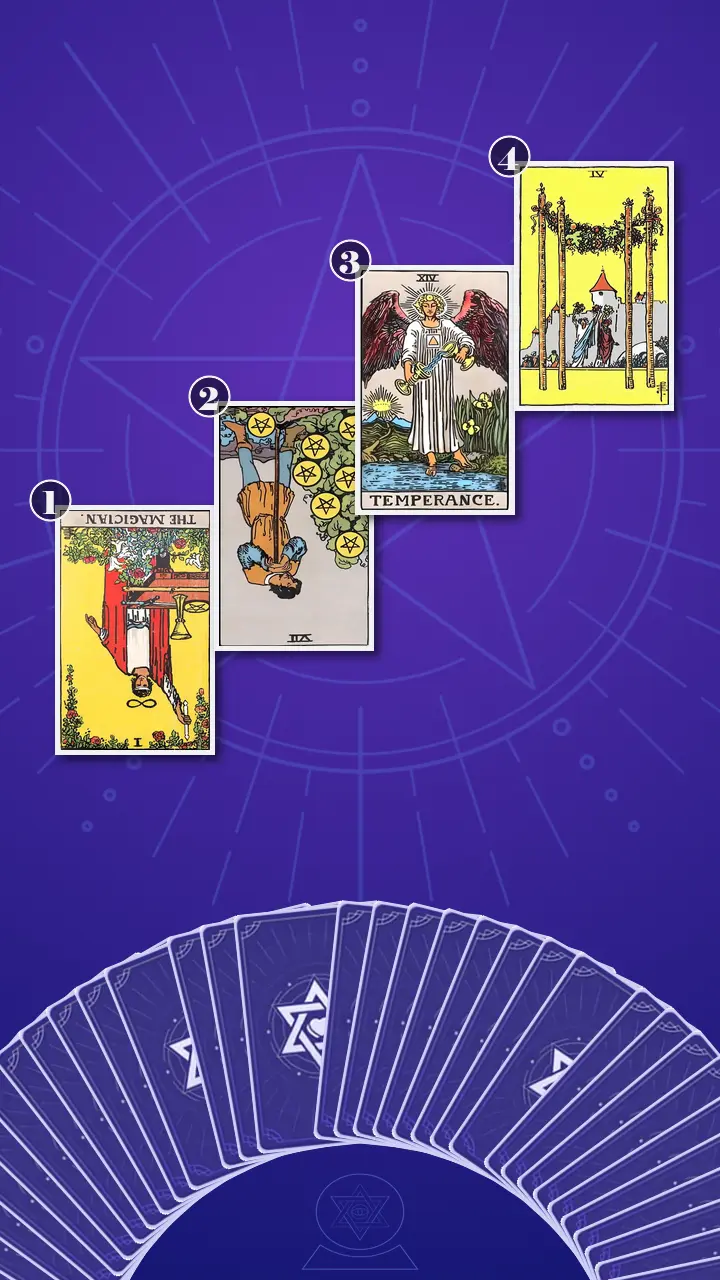
I chose the Four-Layer Insight Ladder · Context Edition, a four-card tarot spread arranged like an ascending staircase. I use it when a problem behaves less like a timeline and more like a feedback loop. A Past-Present-Future spread would have imposed a sequence on a pattern that repeats every time a meeting runs late, a workout is missed, or a habit streak breaks. A larger spread would have risked reproducing the very overbuilding we were examining.
The first position would reveal the visible redesign loop. The second would expose the belief and fear sustaining it. The third would identify the leverage point where a total reset could become patient calibration. The fourth would turn that shift into one immediate practice capable of holding focused work, rest, connection, and enjoyment.
This is how tarot works best in a routine reading: not as a verdict delivered from outside, but as a structured surface on which behavior, emotion, and choice can be seen together. The card meanings would matter only in context. Alex would remain the person with the authority to accept, adapt, or reject every suggestion.
When Readiness Became a Performance
Position 1: The Tools That Never Reach the Task
I turned over the card representing the visible redesign loop: the behavior through which Alex arranged tools and rules instead of practicing the routine long enough to experience it. It was The Magician, reversed.
In the Rider-Waite-Smith image, every suit tool is already on the table. The Magician lacks neither resources nor potential. Reversed, however, the current between intention and application becomes blocked. For Alex, the visual translation was almost literal: Google Calendar, Notion, a habit tracker, groceries, a work setup, and a movement plan were all available, yet their agency had scattered across the performance of getting ready.
At 11:40 that Sunday, the available tool was not the new template. It was the existing meal, the closed book, or one fifteen-minute task already sitting on Monday's calendar. Instead, Alex duplicated the week, renamed categories, and rewrote rules while dinner cooled. Their inner bargain sounded like this: “I already have the planner, the food, and the focus plan, but I cannot begin until I fix one more setup detail.”
Energy dynamic: blockage through dispersion. The Magician's directed will was present but divided. Each tool promised readiness, yet moving among the tools prevented any one of them from carrying intention into experience. Readiness had become a feeling Alex tried to manufacture rather than the ordinary act of using one available resource for its intended purpose.
“You have plenty of plans and almost no lived evidence,” I said. “That is not a judgment about your discipline. It is an observable gap. The system keeps returning to setup mode before a real user, meaning you, has had enough time to test it.”
Alex gave a short laugh, but there was no amusement in it. Their fingers tightened around the mug beside the laptop, then loosened. “That is painfully accurate. Honestly, it feels a little brutal seeing it on the table.”
“Accurate does not have to mean accusatory,” I replied. “Planning has been giving you temporary protection from uncertainty. We can respect why it developed while still auditing what it costs now.”
I asked them what they had reorganized after the most recent disruption. Alex described a Wednesday meeting that ran thirty-five minutes over a focus block. The next design task needed only fifteen minutes, but they spent nearly an hour renaming Notion databases and moving every remaining block in the week. Planning instead of doing had looked competent from the outside because it used the same tools as work.
Position 2: The Verdict Delivered Before the Evidence
I turned over the card representing the sustaining mechanism beneath the loop: delayed gratification, premature evaluation, and the fear that an imperfect routine would expose a lack of control. It was the Seven of Pentacles, reversed.
The upright gardener pauses beside a crop that is still developing. Reversed, that pause hardens into a premature verdict. Alex recognized the scene in three nights of sleep data, two focus sessions, or one missed workout: they would inspect the small return, decide the improvement was not fast enough, and rebuild the larger lifestyle system before the experiment had matured.
“If I cannot see meaningful progress by Thursday,” I translated, “continuing will only prove that I am wasting time.”
Alex's jaw tightened before they answered. Their eyes moved away from the cards as if replaying a tracker screen. Then their chest dropped with a quiet exhale. “Yes. Waiting feels irresponsible. What if I keep going and find out at the end of the month that it never worked?”
Energy dynamic: excessive evaluation and deficient patience. Earth energy should consolidate effort over time, but here every new root was being pulled up for inspection. It was like ending an A/B test after three users because the first results were not dramatic enough. The quick redesign produced a clean-slate high, but it also removed the evidence that could confirm what was genuinely workable.
I could see the deeper bargain then. Alex postponed rest and connection for a future payoff, yet demanded immediate proof from every routine meant to create that payoff. The system had been assigned an impossible task: it had to prove that it could survive real life before it was allowed to meet real life.
“The unfinished process is touching a real fear,” I said. “Not simply that the planner is wrong, but that lost time might mean you are not fully in control. Rebuilding relieves that exposed feeling for an evening. Then the long-term cost arrives: little evidence, less rest, and another reason to believe you still have not found a routine that works.”
Alex looked again at the growing pentacles. “So I am not really restarting because the routine failed. I am restarting because I cannot tolerate not knowing yet.”
“That is closer,” I said. “And it gives us somewhere useful to work. Friction is information, not an automatic rebuild request.”
When Temperance Let Real Life Answer Back
Position 3: Two Cups, One Living Experiment
Before I turned the third card, the refrigerator motor clicked off. The sudden quiet made the small kitchen feel wider. I turned over the card representing the leverage point that closes the manifestation gap: replacing total system resets with patient calibration based on lived feedback. It was Temperance, upright, the key card and bridge of the reading.
The figure pours water continuously between two existing cups, with one foot on stone and the other in water. Structure and variability remain in contact. Neither cup is discarded when the proportion changes. Energy dynamic: balance through circulation. Temperance does not remove disruption; it keeps enough structure in place for adjustment to become informed.
I translated it into Alex's hybrid Wednesday. A meeting overruns the focus block. Lunch shifts by thirty minutes. The weekly template stays intact. Alex keeps a fifteen-minute focus start and one meal away from the laptop as two anchors, records what happened, and changes only the lunch window at the scheduled review. The thought is no longer, “This friction proves the system is defective.” It becomes, “This friction can be information without becoming a verdict.”
At that point, my years on Wall Street came back to me in one restrained flash: models could look immaculate before the market opened, but precision without exposure to reality was still fiction. A strategy earned credibility by meeting conditions it could not fully control.
I call the lens I used next Time-Asset Valuation. I asked Alex to audit the true return on Sunday's redesign. They had invested roughly ninety minutes and received a brief rise in certainty. The hidden sunk costs were a cold meal, delayed sleep, a closed book, and no evidence about whether the existing routine could recover from an imperfect day. The reset felt productive because its emotional return arrived immediately, but its practical ROI was negative.
“The crowded table in The Magician creates the appearance of readiness,” I said, placing that card beside Temperance. “These two cups create usable knowledge through repetition. You thought control meant preventing friction. Temperance asks whether control could mean responding proportionately when friction arrives.”
I invited Alex to look once more at the cold pasta, the shut book, and Monday's immaculate blocks. Their jaw was still tight. In their mind, the week remained unlivable until the blueprint became clean enough to prevent every ordinary interruption.
“You do not need a better blueprint to earn entry into your week; you need the same imperfect structure to stay put long enough for real life to answer back.”
Stop treating an imperfect week as proof that the system has failed; practice small adjustments inside the life you already have, like Temperance moving water between two cups instead of replacing them.
For one beat, Alex stopped breathing. Their index finger hovered above the trackpad, and their pupils widened as though a second version of the previous week had appeared behind the screen. Their gaze slipped out of focus; I watched Wednesday's late meeting, Thursday's sleep chart, and Saturday's declined invitation pass across their face without hearing the details yet. Then color rose into their cheeks. “But doesn't that mean I have been doing it wrong this whole time?” they asked, their voice suddenly sharper. The resistance carried anger, but grief sat close behind it. I kept my tone steady. “It means the resets protected you from a feeling you did not yet know how to hold. That was not foolish. It was expensive, and now you can choose differently.” Their clenched hand opened against the table. The shoulders came down first, then the jaw released. A trembling breath left their chest, followed by a long blank pause. Relief was there, but so was the slight dizziness of realizing that clarity creates responsibility. I asked, “Now, with this new perspective, was there a moment last week when this insight could have made you feel different?”
“Wednesday at 3:47,” Alex said quietly. “When the meeting ended late. I could have left the calendar alone and done fifteen minutes. I thought keeping the plan would mean ignoring the problem. It could have meant giving the plan a chance to learn the problem.”
That was the key crossing in the reading: from frustrated, control-seeking resets toward patient, lived calibration. It was not complete confidence, and I did not present it as one. It was a first willingness to remain inside an unfinished week long enough to discover what was true.
“A routine cannot learn your life if you replace it before life shows up,” I said. “Stability is not the absence of disruption; it is what remains available after disruption.”
Four Posts and an Open Door
Position 4: The Life the Routine Was Meant to Hold
I turned over the card representing the immediate integration practice: using a simple routine to hold present enjoyment, connection, and ordinary life before the wider overhaul is complete. It was the Four of Wands, upright.
Four upright posts support a flowered garland. The structure is simple and open, not sealed behind an elaborate system. The figures beneath it are already participating. Energy dynamic: balanced Fire held by a sufficient foundation. Motivation is no longer burning through another overhaul; it has somewhere human to go.
I asked Alex about the ordinary plan waiting outside their current routine. They showed me a message from a friend: “Soup and a movie Saturday? Super low-key.” They had nearly replied, “Maybe next week,” because Saturday was reserved for getting organized. The Four of Wands offered a different frame: keep the two anchors in the current calendar, accept the one-hour dinner window, and allow an early exit if needed. Connection would not be a prize for a perfect tracker score. It would be one of the experiences the routine existed to support.
“Life is not the reward for finishing your routine,” I said. “A functioning routine should already have a door.”
Alex smiled, then looked down with a trace of sadness. “I have missed a lot of small things because I kept waiting to become the person who could handle them.”
“You do not need to turn that recognition into another punishment,” I replied. “The useful question is smaller: what can the structure hold now?”
Their thumb rested over the message. They did not need the card's permission, and I made that explicit. The invitation could be accepted, declined, shortened, or changed. The point was not compulsory socializing. The point was to stop treating enjoyment as downloadable content unlocked after perfect performance.
From System Architect to Responsive Inhabitant
When I read the four cards as one story, the logic was clean. The Magician reversed showed the visible behavior: available tools were being rearranged instead of used. The Seven of Pentacles reversed showed why: slow feedback felt like wasted time, so premature evaluation produced another reset and another dose of short-term control. Temperance supplied the missing principle: keep stable containers in use and adjust one proportion from experience. The Four of Wands restored the purpose of the structure: to hold a life, not delay entry into it.
Alex had been acting like an architect who redrew the same home whenever a door stuck, then postponed moving in until every future inconvenience had been eliminated. Their cognitive blind spot was treating normal friction as evidence of failed design and planning clarity as equivalent to lived proof. The transformation was not from “bad at routines” to “perfectly organized.” It was from system architect to responsive inhabitant, from trying to prevent uncertainty to learning how to make one proportionate adjustment inside it.
I gave Alex three bounded experiments. None was a new lifestyle doctrine, and none could be failed. Essential work, health, safety, access needs, caregiving, sleep, and genuine schedule changes could override any part of them.
- Open a Seven-Day No-Reset Window. That night, in the calendar already open on the kitchen table, Alex would spend no more than eight minutes writing: “No optional routine redesign until next Sunday at 6:00 p.m.” They would create one ten-minute review event for that date and make no more than one evidence-based change during it. Tip: If seven days feels too exposed, use three. A late shift, health need, or essential responsibility is adaptation, not a broken rule.
- Keep Two Minimum Viable Anchors. For the week, Alex would begin one fifteen-minute focus block after their first work drink and eat one meal away from the laptop within a flexible two-hour window. They would record only a checkmark or dash in the current tracker, with no scores, streak resets, analytics, or added categories. Tip: On a depleted day, the minimum version is two focused minutes and three bites away from the screen. The measure is participation, not improvement.
- Restructure the Energy Portfolio for 48 Hours. I asked Alex to subtract one high-friction habit for the next two evenings: no optional calendar reshuffling or template editing after a missed block. They would reinvest the recovered time exclusively in a high-yield recovery block, either the low-key soup invitation, twenty minutes with the closed book, or a meal without the laptop. The chosen plan would stay inside the current calendar. Tip: Keep the recovery block small, bounded, and easy to leave. It is part of the routine's return, not a reward that must be earned.
I called the last practice Energy Portfolio Restructuring because time was not Alex's only scarce asset. Attention, recovery, and connection were being spent to maintain the appearance of control. The 48-hour subtraction challenge would not add another improvement project; it would stop one expensive outflow and return that capacity to the life the system was supposed to finance.

A Week Later, the Calendar Stayed Still
A week later, Alex sent me a photo of two plain columns containing checkmarks and dashes. Wednesday's lunch anchor had moved by thirty minutes at the review. Nothing else had been rebuilt. The evidence was modest, which was exactly why it mattered.
They had also gone for soup and a movie. That night they slept through; in the morning, their first thought was, “What if this stops working?” They smiled, left the calendar alone, and made breakfast.
I did not read that as a miraculous cure or proof that the cards had fixed Alex's life. The cards had supplied a clear cognitive map. Alex supplied the restraint, the experiment, the dinner, and the decision not to convert one dash into another total reset. That was their Journey to Clarity: not certainty, but enough grounded permission to participate in an ordinary week while it was still unfinished.
When one missed block makes your jaw tighten and your hand reach for the calendar, rebuilding can feel safer than living through a week that might reveal you cannot control every lost hour. If you recognize that pull, remember Temperance's two cups: noticing the urge without obeying it is already one small transfer from control-seeking reset to lived calibration.
If your current week were already allowed to stand beneath those four simple posts and hold one unearned piece of life, what dinner, walk, book, call, or quiet hour would you let remain on the calendar?