When Feedback Starts Pressing Back

A grounded look at review pressure, related tarot cards, and reading insights shaped by critique, revisions, and public feedback.

Peer Review Pressure
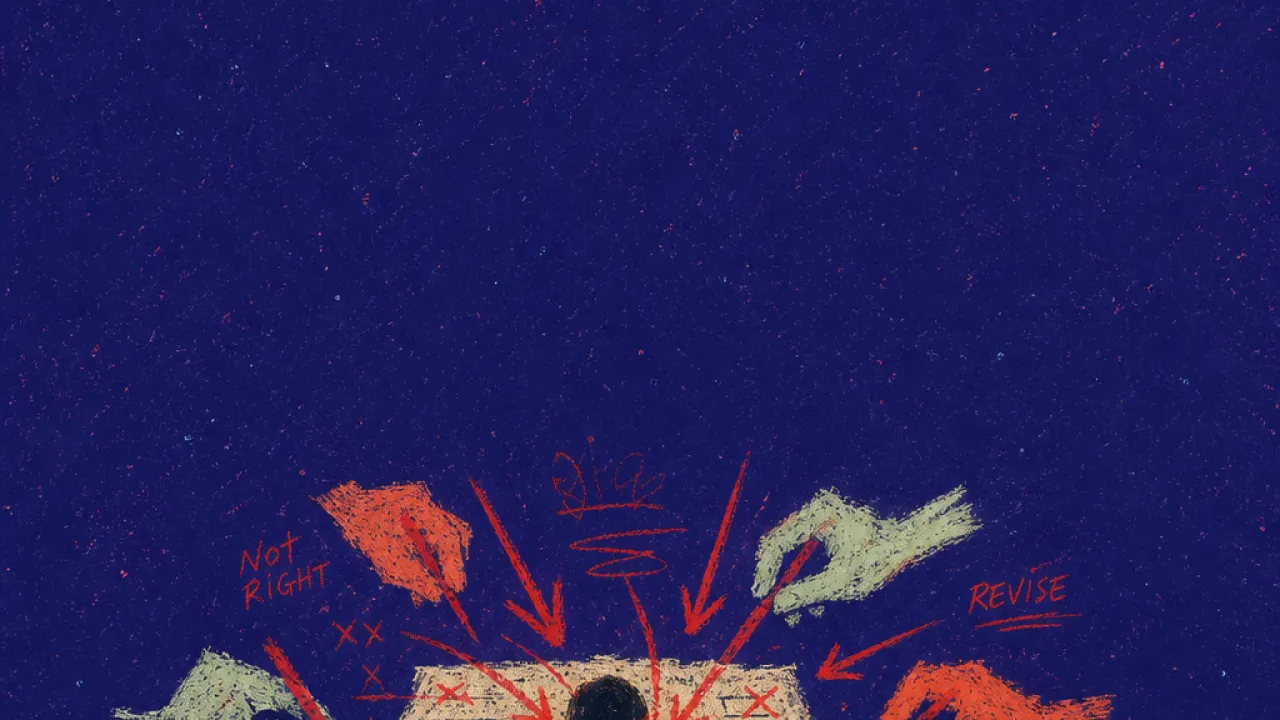
A solitary figure bent over a marked page as many hands push red revisions into the crowded surface

What is this situation?

Peer Review Pressure — you enter the review space already aware that your work is no longer just yours; it is on a shared screen, in a submission portal, inside a Google Doc full of comment bubbles, or sitting in front of classmates, colleagues, editors, reviewers, or teammates who all get to mark what should change. At first, it looks like a normal part of school, work, publishing, design, research, coding, or creative life: submit the draft, wait for notes, revise, resubmit, sit through the critique, answer the questions, keep your face steady while people talk about the thing you spent nights building. Then the pattern starts tightening. Feedback arrives in fragments, some clear and useful, some vague enough to make you rewrite whole sections just to guess what was meant; one person wants more evidence, another wants it shorter, someone else questions the premise, and the deadline does not move. You watch notifications stack up and feel your neck stiffen before you even open them. In meetings, your work can be discussed as if you are not in the room; in group projects, the loudest reviewer can reshape the direction; in academic or professional settings, the people giving notes may also hold access to grades, publication, promotion, funding, reputation, or whether the work gets accepted at all. The pressure is not only the comments themselves, but the way the review structure makes you defend, adjust, explain, and prove the value of your work under other people's timelines. Even useful critique starts to carry a charge because you have learned that one unclear comment can become another late night, another round of revisions, another moment of wondering which version of the work will finally be allowed through. By the end, the task is no longer simply improving the work; it is standing on uneven ground while multiple directions point at you at once, much like the figure on the Seven of Wands holding a staff against several others rising from below.

Why it's not you?

The problem is not that you cannot take feedback or that your work is too personal to you. The pressure comes from a setup where other people can pause, rank, redirect, or return your work while the standards keep shifting. Vague comments, uneven power, public critique, and delayed approval are features of the review environment, not proof that you are failing.

Peer Review Pressure in Tarot Cards

Peer Review Pressure is the setup where your work is placed in front of classmates, colleagues, reviewers, or teammates who can mark it, delay it, or send it back. The tight neck and forward-pulled shoulders from watching comments stack up are not random; they belong to an environmental, structural dynamic where approval sits outside your hands. The cards below do not tell you how to perform for the room. These Tarot Cards reflect the outline of what happens when review turns into pressure.

Justice
Reversed
A seated evaluator holds an upright sword and a set of scales before a formal red curtain, presenting judgment as if standards and consequences were fully aligned. Reversed, those same instruments expose a review process in which the rubric shifts, similar submissions receive different treatment, or comments cannot be traced to a consistent academic criterion. The authority of the setting can make inconsistency feel like a private failure even when the standard itself is unstable. You can distinguish criticism supported by evidence and declared criteria from evaluative power that merely looks formal, making the structural fairness of the review visible alongside the content of the feedback.
The Hanged Man
Upright
A figure hangs visibly suspended from a living wooden frame, unable to move forward in the ordinary way while a clear halo surrounds his head. The scene maps onto a submitted project held in review: the work has left your active control, yet reviewers, portals, or approval chains have not released it into the next stage. The upright suspension contains a usable interval for seeing the process from another angle, but it does not erase the external hold. You can distinguish a review pause with a defined purpose and endpoint from open-ended dependency, where delayed comments compress your later revision time while the institution treats the waiting period as costless.
Three of Pentacles
Reversed
A craftsperson displays work beneath a carved arch while two other figures inspect it with plans in hand. Read in reverse, this review triangle loses coordination: the work is visible, the evaluators still have interpretive power, but the shared plan no longer guarantees shared standards. That misalignment resembles academic feedback in which each reviewer assumes a different assignment, method, or threshold for quality. You can locate the pressure in the broken coordination between maker, criteria, and reviewers; repeated revision cannot resolve a disagreement that has never been named at the level of the review framework.
Six of Pentacles
Reversed
A standing figure controls both the scales and the distribution of coins while two lower figures wait beneath his hand. Reversed, the same arrangement exposes an evaluation system where the person applying the standard also controls access to grades, publication, funding, or academic legitimacy. The imbalance becomes sharper when feedback is vague, because you must supply the interpretation while the reviewer retains the power to accept or return the work. You can separate the usefulness of a comment from the leverage attached to its source, making visible how dependency can turn ordinary critique into compulsory rework.
Seven of Pentacles
Upright
A worker leans on his tool and studies a crop of pentacles that is visibly developed but not yet ready to be collected. The pause resembles the period after submission when substantial work already exists, yet reviewers are still assessing whether it is mature enough to accept, revise, or return. The upright field makes evaluation part of a longer production cycle rather than an endless verdict on worth. You can see the key timing distinction between feedback that arrives while revision can still improve the outcome and feedback delayed so long that it collides with other deadlines, funding windows, course milestones, or publication plans.
Eight of Pentacles
Reversed
A solitary craftsperson repeats the same pentacle across a long row, with completed versions hanging above the workbench. Reversed, the sequence stops reading as deliberate skill-building and starts resembling revision churn: each returned draft produces another version without a stable endpoint. The distance from the town reinforces how repeated academic corrections can isolate you from the wider purpose of the course or research. You can see the blocked resource as missing completion criteria, because effort and concentration remain available while the review system keeps redirecting them into increasingly marginal changes.
Two of Swords
Upright
A blindfolded figure holds two swords in a locked cross while a broken shoreline and open water sit behind her. The image reproduces the decision bind created when two credible reviewers demand incompatible revisions and neither comment comes with enough context to establish priority. The upright stillness creates a bounded pause rather than forcing an immediate, arbitrary choice. You can see that the missing resource is not effort but a decision rule: scope, evidence, ownership, rubric, and downstream purpose must mediate between the comments, because following the louder voice would only disguise the unresolved conflict.
Nine of Swords
Upright
A person sits upright in bed with face covered while nine swords hang across the dark wall above. The night setting and repeated blades mirror review comments that remain mentally active after the document is closed, especially when one vague note could generate another late rewrite or public defence. The image places the distress in a specific review afterlife rather than presenting it as an objective verdict on the work. You can identify which part belongs to unresolved external uncertainty: unopened notifications, unclear criteria, delayed decisions, and the expectation that tomorrow's response must satisfy several people at once.
Five of Wands
Upright
Five students appear to meet through crossing staffs, with each movement interrupting another and no shared target visible. That visual disorder maps directly onto an assignment or paper receiving several incompatible instructions from classmates, tutors, supervisors, or reviewers. The upright contest keeps the disagreement observable, which matters because not every clash indicates defective work. You can distinguish a genuine academic question from noise produced by competing interpretations, uneven rubric use, or reviewers trying to demonstrate their own knowledge through your submission.
Seven of Wands
Upright
A figure on rough, uneven ground uses one staff to meet six rising from below, creating the exact posture of defending a submitted argument against simultaneous challenges. The image translates easily into a viva, seminar critique, peer-marking session, or annotated draft where every comment creates another claim to answer. The upright elevation preserves access to a defensible academic position even while the workload is unequal. You can see that the paper, evidence, research question, and rubric provide a higher-order frame for sorting comments; the pressure intensifies when the review environment replaces that frame with whoever asks the next or loudest question.
Nine of Wands
Upright
A bandaged figure grips one staff while eight others stand behind him like the record of earlier rounds. His guarded posture captures the student who approaches each new comment bubble or review meeting already carrying the memory of previous rewrites, defences, and unclear requests. The upright figure remains standing and retains both a boundary and a tool, so accumulated fatigue has not erased the possibility of completion. You can recognise that bracing is being produced by repeated exposure to unpredictable review demands; clearer limits, criteria, and round ownership are structural resources, not evidence that academic criticism should stop altogether.
Ten of Wands
Upright
A bent figure carries ten staffs in one bundle toward a town that remains close but difficult to see through the load. The compressed posture and obstructed view mirror a revision cycle in which every reviewer adds another task while the deadline, commute, meals, sleep, and other daily responsibilities remain unchanged. The upright movement shows that the work can still reach a destination, but the method makes the cost physically legible. You can see the lifestyle problem as load aggregation: comments arrive individually, yet they are carried together by one schedule and one body, turning a review process into weekend work, skipped routines, and chronic time displacement.

Peer Review Pressure in Tarot Card Reading Insights

Peer Review Pressure does not stay inside one classroom, lab, team channel, or submission portal; many people bring that same exposed-work feeling into readings. The pieces below shift from card lists into readings shaped by review, feedback, revision, and public comparison. Tarot Reading Insights from sessions involving this kind of pressure.

Psychological Contexts Related to Peer Review Pressure