Rebuilding the Workday on Sabbatical: From Pressure to Curiosity

The 9 a.m. Calendar That Would Not Stay Blank
I recognized the scene before Alex said a word: she was a Toronto project coordinator on a planned career sabbatical, yet a weekday with no meetings had her building a colour-coded schedule before her coffee was finished, classic Career Pivot Anxiety disguised as responsible planning.
At nine on a Tuesday morning, Alex sat at her kitchen table with one hand on the trackpad and the other wrapped around a mug that had already gone lukewarm. The Google Calendar cursor blinked in an empty square. The fridge hummed behind her, the laptop fan whispered beneath her fingers, and her shoulders climbed higher each time she added another block for reading, reflection, exercise, and career research.
She looked at the grid, then at me. I took a sabbatical from the job, not from the job's rules. She had wanted the break to interrupt old work patterns, but every open hour was turning into a deliverable. Part of her wanted to understand and loosen the pressure; another part was afraid that releasing it would remove the structure, direction, and sense of worth it had always provided.
What she called frustration moved through her like trying to swim across a pool of grey syrup while a silent stopwatch kept counting the seconds. Her restless hands reached for Notion whenever the day became too open. A blank calendar did not feel like freedom yet. It felt like evidence waiting to be used against her.
I told Alex that I would not treat this as laziness, a personal flaw, or a warning about her future. The planning had a function, even if it was now narrowing the sabbatical she had created. I wanted to use the cards as a structured cognitive mirror, so we could see the pattern without surrendering her choices to it. Our Journey to Clarity would begin by drawing a map of the fog, not by demanding that she already know the destination.

Choosing a Map for the Open Season
I asked Alex to take one slow breath and name the question underneath the question. Then I shuffled at an unhurried pace, giving the hands something simple to do while attention moved from the glowing calendar to the room we were actually in. This was a transition into focus, not a test of whether the universe had prepared a verdict.
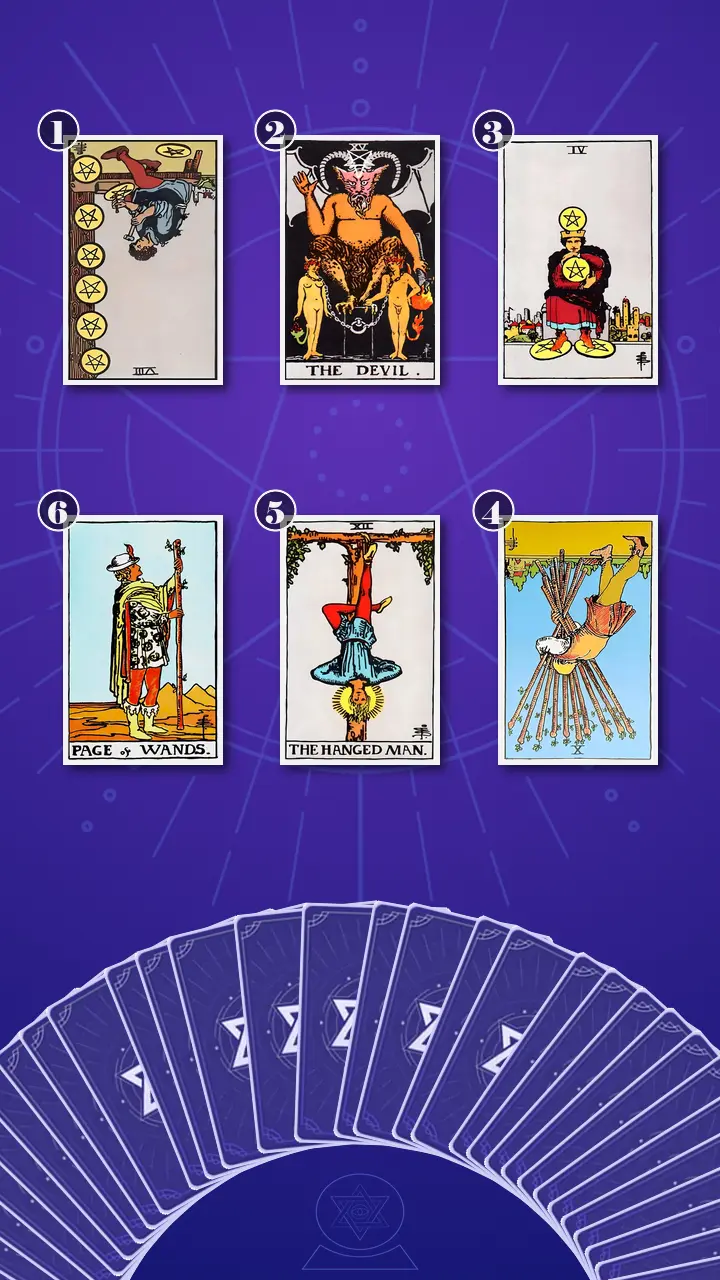
For this reading, I used the Four-Layer Insight Ladder - Context Edition, an original six-card tarot spread for recurring work patterns during a sabbatical. I chose it because Alex was not facing a single decision or asking me to predict which career she should choose. She was caught in a self-reinforcing loop, so the useful map needed to show the visible behaviour, the belief beneath it, the short-term payoff, the long-term cost, the perspective that could interrupt the loop, and one grounded experiment.
I placed the cards in two rows of three. The upper row would trace the compressed old workflow; the lower row would open a route toward a more deliberate response. The first card would reveal the Current Loop. The second would name the Belief Beneath the Loop, while the third would show the Short-Term Payoff that kept the routine attractive. The fourth would expose the Long-Term Cost. The centre card below them would be the transformative hinge, and the sixth would point to a small, self-directed experiment.
If you are wondering how tarot works in a reading like this, I am using the images as fixed symbolic prompts. Their value comes from the questions they organise and the real-life details they bring into view. The cards can help separate a habit from an identity, but Alex would decide what to keep, change, or leave unanswered.
The Workbench Hidden Inside the Break
The Loop That Looks Like Progress
Now revealed is the card representing the Current Loop: reveal the concrete sabbatical behaviour in which the querent recreates the old workday through task lists, schedules, and measurable output.
The Eight of Pentacles, in reversed position.
In the Rider-Waite-Smith image, an apprentice sits at a workbench, carving one pentacle while a row of completed pentacles hangs above him. I saw Alex at nine in the morning opening a blank calendar, creating three outcomes, then spending the first hour refining the schedule instead of following the interest that had brought her to the sabbatical. The activity looked diligent, but the repeated blocks and checked boxes were no longer connected to meaningful development.
This was earth energy in excess and in blockage: plenty of effort, very little contact with what the effort was for. The single pentacle still being worked mattered more than the completed row. I asked Alex which activity she had genuinely chosen and which one she was using to prove that the day counted. Rest becomes another assignment when every open hour needs a deliverable.
Alex gave a short, bitter laugh and rubbed the edge of her mug with her thumb. That is too accurate, almost cruel. I told her the card was not accusing her. It was making the loop visible: the plan could look like progress while keeping her at the same workbench.
The Rule No One Sent
Now revealed is the card representing the Belief Beneath the Loop: identify the limiting belief that makes unstructured time feel unsafe, unproductive, or threatening to self-worth.
The Devil, in upright position.
I placed the card beside the calendar image from the first position. In modern life, this was Alex opening Notion with no employer, client, meeting, or deadline waiting for an update, then telling herself, I have to make this sabbatical count. The loose chains around the two figures gave that sentence a visible shape. The rule felt compulsory because she repeated it, not because an outside authority had issued it.
The Devil's energy was active attachment, an internal rule wearing the costume of an external command. I asked, gently, who had actually assigned the deliverable. Alex stared at the dark pedestal on the card. No one had. The pressure promised certainty, but it narrowed the choices available to her. I mentioned Severance as a useful shorthand for the boundary she had expected between work and personal life: the workplace had ended, but its rules were still organising her attention.
Her chest tightened first. Then her eyes moved from the card to the laptop, as if checking whether some invisible manager might still be waiting there. Finally, she let out a breath and said, Maybe the have to is coming from me, but it does not feel like mine. I nodded. Seeing the chain was already different from believing the chain was fate.
The Brief Safety of a Full Calendar
Now revealed is the card representing the Short-Term Payoff: show what the repeated work pattern temporarily provides, especially the control and structure that reinforce repetition.
The Four of Pentacles, in upright position.
The figure in the card presses one pentacle to the chest, stands on two more, and balances another on the head. I translated the image into Alex colour-coding Google Calendar, checking off one task, and feeling her shoulders drop for several minutes. At least I know what I am doing, the schedule seemed to say. Then the second thought arrived: But do I actually want this?
This was not useless structure. It was a real short-term resource, an earthbound floor beneath an uncertain day. The problem was the grip. The calendar gave Alex temporary control and protected her from having to answer what she wanted, but it also kept the sabbatical from teaching her anything new. A full calendar can be control wearing the costume of direction.
Alex nodded, though her mouth stayed tense. I could see both truths landing at once: the schedule was not pointless, and it was not free. Naming the relief mattered because I did not want her to replace self-criticism with a new demand to relax perfectly.
The Load That Blocks the View
Now revealed is the card representing the Long-Term Cost: reveal how carrying the old work pattern into the sabbatical transition reduces rest, curiosity, and clarity over time.
The Ten of Wands, in reversed position.
The figure in the image bends under a bundle that blocks the face, with a distant town visible ahead. I saw the same pattern in Alex's evening routine. She woke intending to rest, felt guilt rise by midday, added one more personal project, and reached eight forty-seven with the break resembling a full workload. The invisible deadlines had become a bundle across her view.
This was fire in blockage, a release attempted only after the burden had become too heavy. The old responsibility rules were still moving through her body, even though the project-coordination role was temporarily behind her. The cost was not simply tiredness. It was that rest and curiosity were crowded out, and the resulting lack of clarity seemed to confirm that only pressure could make her function.
I asked her to consider one recurring obligation she could shrink rather than abandon. She looked toward the window, where the late Toronto light fell across the table in a narrow strip. For a moment, the distant town on the card seemed less like a destination she was failing to reach and more like a view she could not access while carrying everything at once.
When The Hanged Man Changed the Question
The room grew quieter as I moved to the centre card below the old loop. Now revealed is the card representing the Perspective That Interrupts the Pattern: identify the key internal shift that allows the querent to pause before automatically rebuilding the old workday.
The Hanged Man, in upright position.
The suspended figure, calm beneath the living tree, offered a deliberate pause rather than passive surrender. In Alex's world, the image was the moment before she opened Google Calendar, when her hand could wait long enough to learn what the urge was asking for. The sabbatical was not a failed productivity system. It could be a conscious interval for observation.
This is where I used my signature Macro-Orbital Projection. I stepped back from the pressure of one blank Tuesday and mapped it against a longer personal cycle. Alex had left a demanding role, but the old timetable was still completing an orbit around her attention. That did not mean she was destined to repeat it. It meant the familiar pattern was passing through a visible phase, and a pause could change her relationship to it.
I also used Void Phase Identification to locate the in-between space she had been treating as a problem. A void phase is the interval after an old trajectory has loosened and before the next direction has earned enough evidence to become clear. I did not use that language to make the uncertainty mystical or permanent. I used it to remove personal guilt from a transition that was still gathering information.
In ten years of readings, I have watched people mistake a low tide for a final shoreline. My professional instinct was to slow the interpretation down. The Hanged Man was not asking Alex to give up ambition or abandon all structure. He was asking her to stop converting every moment of uncertainty into proof that she needed more pressure.
At 9:00 a.m. in a Toronto apartment, the calendar is blank, the coffee is cooling, and your hand is already rebuilding a meeting grid. You promised yourself space, yet an empty hour feels like evidence against you. Then LinkedIn shows someone else's launch, and the break becomes a scorecard.
You do not have to turn the sabbatical into another performance review; let The Hanged Man's deliberate pause loosen the old work frame so you can notice what becomes possible before choosing an experiment.
For three seconds, Alex did not blink. Her fingers hovered above the card, and the breath in her throat stopped. Then her eyes went slightly unfocused, as if the nine o'clock kitchen scene had reopened in front of her. Her jaw tightened. But does that mean I have been doing the sabbatical wrong? she asked.
I told her no. The insight was not another verdict to pass or fail. Her fists slowly unclenched, her shoulders lowered, and a small tremor moved through the exhale that followed. Her eyes reddened, not with a dramatic release, but with the strain of no longer having to defend every open hour. The refrigerator hum returned to the room. She looked at the suspended figure again, this time with a wary softness, and said, There is space between the urge and the plan.
Now, use this new perspective to remember: was there a moment last week when waiting before planning might have felt different? I invited Alex to leave one calendar space open for ten minutes, write down the first genuine interest that appeared, and refuse to turn it into a goal. If the exercise became too exposed, she could close the note and return to the day. She remained the person deciding whether to continue.
Her inner sentence changed from I could make this useful right now to Before I make a plan, I can wait long enough to find out what the urge is asking for. I suggested that she leave one unanswered question unresolved for forty-eight hours before assigning it a purpose. That small delay was the bridge from pressure-based self-measurement to curiosity-led agency with greater self-trust.
The Small Spark That Does Not Need a CV
Now revealed is the card representing the Grounded Experiment: translate the transformation into a small, self-directed action that allows the querent to explore the sabbatical without turning it into a performance test.
The Page of Wands, in upright position.
The Page studies a flowering wand in an open landscape. I read the image as beginner energy, attention, and possibility before mastery. In Alex's daily life, it could be one unfamiliar class, a library book, a neighbourhood walk, a new recipe, or a local exhibit approached for one hour without a career outcome attached.
This was fire restored after the Ten of Wands, but lighter and more self-directed. The Page did not need a finished product, a six-week curriculum, or a polished explanation for what came next. The experiment was allowed to remain small and unfinished. Let curiosity be useful before you make it impressive.
Alex's fingers moved toward her phone, then stopped. She smiled at the reflex without obeying it. I asked what interest had been waiting underneath all the research tabs. She mentioned a beginner pottery class she had saved, then immediately began explaining how she should compare instructors and equipment. We both heard the old project manager arrive.
I brought her back to the Page's flowering wand. One session first. One hour. Minimum materials. No portfolio, career decision, or improvement metric. The point was not to discover the perfect purpose of the sabbatical. It was to let a chosen spark generate information before the old work identity turned it into a performance plan.
From a Performance Review to a Personal Orbit
When I placed the six cards together, the story became clear. The reversed Eight of Pentacles showed Alex producing evidence of effort without asking whether the effort served the break. The Devil named the internal rule that made pressure feel compulsory. The Four of Pentacles explained why the rule survived: a full schedule briefly gave her a floor of safety. The reversed Ten of Wands showed the price of that safety, as invisible deadlines blocked her view of the transition. The Hanged Man interrupted the loop through a chosen pause, and the Page of Wands gave the released energy somewhere gentle to go.
Alex's cognitive blind spot was not that she planned too much in every circumstance. It was that she treated the temporary relief of planning as evidence that the plan was direction. She also treated the absence of measurable output as evidence about her worth. The shift I saw was more precise than structure versus freedom: it was compulsory structure versus chosen structure, proving the day counted versus noticing what genuinely held her attention.
I told her that I was not asking her to become a spontaneous person overnight. Her project-coordination skills could remain useful. The question was whether those skills were serving her choices or automatically managing the emotional discomfort of an open season. The sabbatical could contain practical work, rest, and curiosity without turning the whole week into a performance review.
To make the next orbit observable, I offered my Cosmic Redshift Observation practice. For one week, Alex could notice what was fading from her attention, which I called redshift, and what seemed to be approaching with quiet interest, which I called blueshift. The record was not a productivity dashboard. It was a way to gather objective clues about her attention without forcing those clues to explain her future.
I kept the actions deliberately small. A helpful practice could become another have-to if I made it too elaborate, so I gave Alex permission to alter it, pause it, or stop. The aim was not perfect rest. It was a pressure-to-curiosity pivot that left the decision-making power with her.
- Pause before opening NotionOnce this week, when you notice yourself reaching for Google Calendar or Notion to remove the discomfort of an open hour, wait ten minutes before creating anything. Write one sentence beginning with I notice the urge to, name the body signal you can actually feel, and leave the original question unresolved for forty-eight hours before giving it a purpose.Use a two-minute version if ten minutes feels too exposed. Keep the note private, do not score the quality of the observation, and close it whenever you choose.
- Protect one unmeasured curiosity blockBefore the end of the week, choose one interest with no obvious career payoff, such as the beginner pottery class, a library book, a local exhibit, or a Toronto neighbourhood walk. Give it one hour at a specific place and time with no deliverable. During the same week, try Cosmic Redshift Observation by noting which interests are fading and which signals are approaching, without rating either one.Use minimum materials and avoid a major purchase or six-week plan. Afterward, record three sensory details and one thing you might explore next, then let the next step remain optional.
If Alex needed practical structure, I suggested keeping one limited block for a real sabbatical task and protecting a separate block with no outcome. The distinction mattered. She did not have to reject planning; she could decide where planning belonged and where it did not.
That was the whole map in miniature: notice the body before the app opens, question the rule behind the have to, and let one small interest remain an interest long enough to teach you something. No card promised a new career. The cards helped Alex see that the next useful choice was already hers.

The First Orbit Shift
Five days later, Alex texted me from the Toronto Reference Library: "I left ten minutes blank, noticed I wanted the pottery class, and booked one low-cost session. I still wondered if I was wasting the sabbatical, but I did not build a six-week plan to defend it." She was not certain. She had simply interrupted the reflex.
I read the message twice. The change was light but not flawless, which made it believable. The old question was still nearby, but it no longer controlled the first move. Alex had begun moving from pressure-based self-measurement toward curiosity-led agency with chosen structure, and she had done it through an action small enough to remain hers.
In my view, that is what this Journey to Clarity offered: not a prediction, not a command, and not proof that the sabbatical had succeeded. It offered a way to notice the invisible timetable, pause before obeying it, and let self-trust develop through chosen experiments. The querent, not the cards, remained the author of what came next.
When an open sabbatical hour makes your shoulders reach for the laptop, it can feel safer to prove you are useful than to risk discovering who you are without the proof. But the blank calendar is not a verdict. It can become a small piece of open sky where your attention is finally allowed to be information.
If you let one small interest stay an interest for a little longer, without asking it to explain your future, what might you notice about the way your attention moves when no invisible manager is holding the schedule?