Peer-Review Procrastination: Turning One Comment Into a Revision Task

The 10:15 p.m. Revision Loop
I have met doctoral researchers in expensive cities who can answer twelve emails, clean a Zotero library, and redesign an entire revision plan while the reviewer-named paragraph remains untouched. It is post-peer-review procrastination disguised as a productive workday.
At 10:15 p.m. in Toronto, Jordan appeared on my screen from a small apartment desk. Their laptop fan whirred through the microphone. Blue tracked changes crowded the shared screen, and when they lifted the mug beside the keyboard, they touched the cold ceramic to their lip and put it down again. The response table between the reviewer file and manuscript had immaculate color-coded headings. The criticized paragraph had not changed.
“I know what needs changing, but I cannot make myself open it properly,” Jordan told me. “I keep doing work around the paper instead of work on the paper. What if revising it seriously only proves the reviewer was right about me?”
I watched their shoulders rise as the first difficult comment came into view. The dread moved through them like a smoke alarm triggered by burnt toast: the signal concerned one specific part of the paper, but their entire system reacted as if the building had already been lost. They wanted to improve the manuscript, yet returning to the feedback felt dangerously close to testing whether they were capable of improving it.
“You are not avoiding this because you do not care,” I said. “You are doing work around the paper because work on the paper currently feels like exposure. Let us use this reading to understand that protection without shaming it, then find one place where you can choose differently. Our Journey to Clarity is not about forcing an answer from the cards. It is about drawing a map of the fog so you can decide where to place your next step.”

Choosing the Compass: The Four-Card Shadow Spread
I asked Jordan to close the inbox and place both feet on the floor. I invited one unforced breath while holding the question, “Why do I avoid revising my paper after peer review?” I shuffled slowly, using the movement as a transition from reacting to observing, not as a ritual for summoning certainty.
I chose the classic four-card Shadow Spread because Jordan was dealing with one identifiable trigger-belief-behavior loop. A longer predictive spread would have added noise. This focused layout could show the visible avoidance, the fear feeding it, the capacity hidden inside the reaction, and a practical way to return to the manuscript.
For readers wondering how tarot works in a psychological consultation, I do not use cards to announce a fixed future or diagnose someone from a distance. I use their symbols as an external cognitive map. Card meanings in context can make an automatic pattern visible enough to examine, question, and change. The person in front of me remains the authority on whether an interpretation fits.
I laid the first card on the left for the presenting knot and the fourth on the right for its integrated alternative. I placed the hidden root below the center and the transformational resource above it. The four cards formed a compass around a small area of empty table. I liked that negative space. It reminded me that we were orienting to Jordan's pattern, not filling the center with a verdict about their worth.
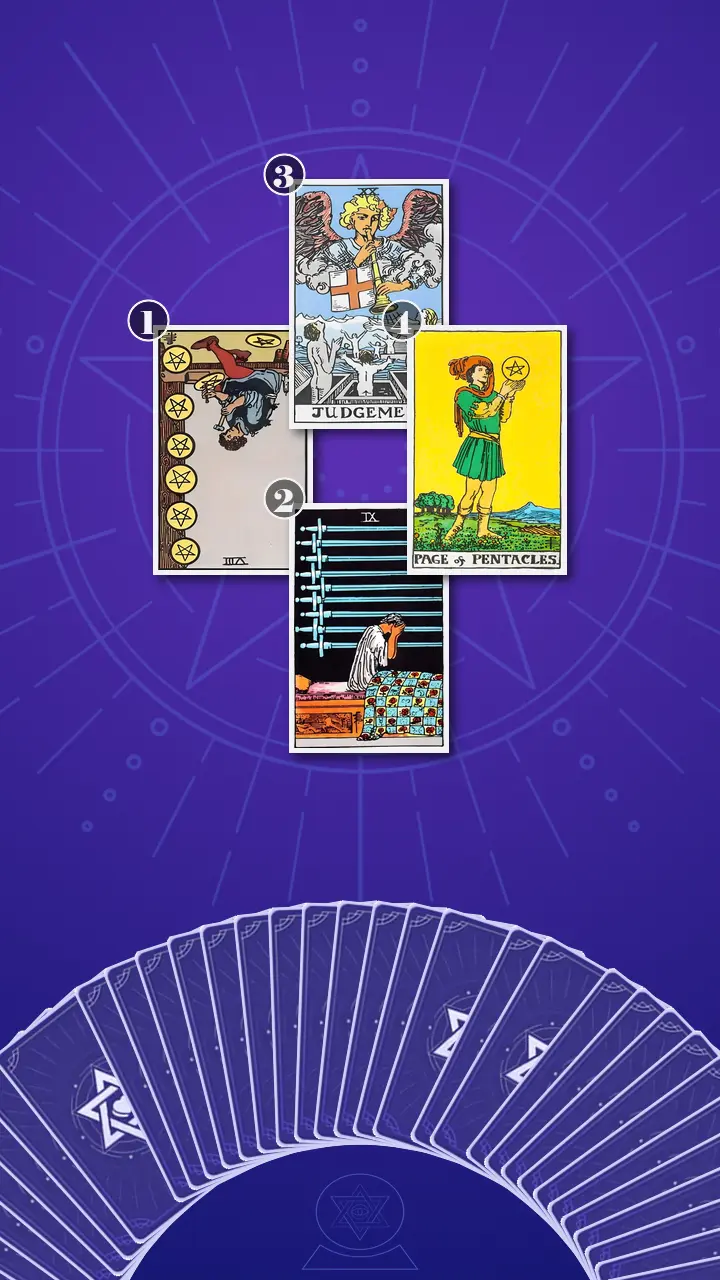
Reading the Workbench and the Night Mind
The Presenting Knot: Eight of Pentacles Reversed
I turned over the card representing the presenting knot: the observable pattern of opening the reviewer feedback, making a token change, and switching to safer tasks instead of revising the criticized material. It was the Eight of Pentacles, in reversed position.
I pointed to the artisan and the repeated pentacles. Upright, this card depicts craft developing through sustained, imperfect repetition. Reversed, I read its energy dynamic as Blockage. The tools and ability have not disappeared, but practical Earth energy is being diverted away from the workbench.
“This is your 10:15 p.m. desk,” I said. “The reviewer file is open on the left, the manuscript is open on the right, and a response table is being color-coded in the middle. You adjust a heading, fix citation punctuation, add three checklist items, and tell yourself, ‘I am working, technically, but I am not touching the sentence that scares me.’”
I asked what Jordan had done during the first ten minutes of their previous revision attempt. They looked at the shared screen and counted quietly: changed two headings, corrected a Zotero entry, checked three emails, and searched for a paper they did not immediately need. None of those actions had altered the paragraph named by the reviewer.
“That is so accurate it is kind of brutal,” they said with a short, bitter laugh.
“Then let us make sure accuracy does not become accusation,” I replied. “This is interrupted craft, not absent ability.”
I used my Draft Paralysis Deconstruction lens to show Jordan what the detour was accomplishing. Their elaborate planning and cosmetic editing were not proof of laziness. Perfectionism was operating as a subconscious defense: if they never made a substantive change, they never had to see an imperfect attempt exposed to further academic criticism. The defense lowered the pressure for a few minutes, but it also prevented the repeated contact through which revision skill could return.
“The card is not telling you to rewrite the whole section tonight,” I said. “That would be the same perfectionism wearing a productivity costume. It is asking whether one substantive change could count as practice before it counts as proof.”
The Underlying Root: Nine of Swords Upright
I turned over the card representing the underlying root: the fear that criticism proves inadequate personal worth and the mental rehearsal that sustains procrastination after peer review. It was the Nine of Swords, upright.
I read its energy dynamic as Excess, specifically an excess of Air. Analysis, anticipation, and imagined implications had become louder than the material request on the page. In the card, the swords hang across the dark wall without physically touching the figure, yet the body is already folded inward beneath them. I told Jordan this did not mean their distress was imaginary or trivial. It meant remembered language could produce a real bodily response before the document was even opened.
Jordan had mentioned waking at 1:08 a.m. with streetlight leaking through the blinds and the radiator clicking. Their laptop was closed across the room, but the phrase “substantial clarification is required” kept looping. I asked them to say what happened next in their mind.
“They wrote that the theoretical contribution needs substantial clarification,” Jordan said. Their fingers tightened around the mug. “My mind translated it into, ‘Maybe there was never a contribution.’ Then it became, ‘Maybe I am not competent enough to recover this.’”
I saw their breathing pause. Their gaze slipped away from the card as if they were rereading the comment on an invisible screen, and their shoulders drew closer to their ears before slowly dropping again.
“That translation is the hidden root,” I said. “The reviewer requested stronger evidence or a clearer argument. Your mind added, ‘What if fixing it is hard because the reviewer is right about me?’ A local Google Docs comment has become an algorithm that keeps recommending the harshest possible interpretation of your competence.”
I placed one finger beside the Eight of Pentacles reversed and another beside the Nine of Swords. Excessive Air was interrupting grounded Earth. Jordan was completing hours of exhausting mental work while the manuscript remained materially untouched.
“A comment can be accurate about the draft without being final about you,” I said. “I am not asking you to enjoy the criticism or assume every reviewer is correct. I am asking us to separate what the comment can reasonably evaluate from the authority your fear has handed to it.”
When Judgement Changed the Meaning of the Call
The Transformational Resource: Judgement Upright
A calendar notification sounded from Jordan's laptop just as I reached for the card above the center. The single chime cut through the radiator's soft clicking, then the room went still. I turned over the card representing the transformational resource: the capacity to receive evaluation as information and a call to respond rather than as a final verdict on identity. It was Judgement, upright, the key card of the reading.
I read Judgement's energy as Balance: honest appraisal held together with renewal, accountability held together with agency. The figures do not hide from the trumpet, but neither are they shown arguing for their worth. They rise because a call has been heard and a response is now possible.
Looking at their open posture, I remembered conversations I had held across different cultures, where the same phrase could carry a radically different emotional weight after translation. I had learned that translation is not submission. It is the pause that allows meaning to be examined before it is obeyed. Peer-review feedback needed that same pause.
I brought in my Performance Anxiety Decoupling framework. I drew three small circles on a sheet of paper: core self-worth, developing research competence, and the current state of the manuscript. A reviewer comment has direct jurisdiction over the third circle. It may offer useful evidence about a skill in the second. It has no valid instrument for measuring the first.
“Right now, those circles are fused,” I explained. “When the manuscript needs substantial revision, your nervous system hears that your research capacity is permanently inadequate and your worth is on trial. Decoupling does not mean pretending the paper is already strong. It means placing each piece of information inside the circle where it actually belongs.”
I named the 10:15 p.m. pattern again: the review was open, Jordan's shoulders were tight, and heading colors suddenly felt urgent. They knew which paragraph needed work, yet their hand moved toward the inbox because they were trying to resolve a threat to identity before changing a sentence.
“The review is evaluating a manuscript, not issuing a verdict on your worth,” I said. “Revision begins when you answer the information on the page instead of defending your entire identity. Peer review is information to answer, not an identity test to pass.”
Reviewer comments are not a final sentence on your ability; answering one comment at a time turns Judgement's trumpet from a verdict into a call to return to the work.
I let the sentence remain between us. Jordan's breath stopped first, and their fingers hovered above the trackpad without touching it. Then their eyes lost focus as though the last several weeks were replaying at speed: the midnight searches, the polished Notion dashboard, the strategically urgent references. Their pupils widened and their mouth tightened.
“But if that is true, does it mean I have been doing this to myself?” they asked, suddenly sharper. “Have I just wasted three weeks because I could not separate a paper from my ego?”
I did not rush to smooth away the anger. “It means you found a protective strategy when evaluation felt dangerous,” I said. “The strategy had a cost. Seeing that cost is not the same as convicting yourself for paying it.” Their jaw loosened. Their eyes reddened slightly, then they gave a long, unsteady exhale. Their shoulders sank against the chair, but the release was followed by a few seconds of almost dizzy blankness, the vulnerable pause that comes when an old defense loosens and choice becomes real.
“Now, using this new perspective, can you think of a moment last week when this insight might have made the experience feel different?” I asked.
Jordan returned to Tuesday night. They said they might have underlined the action word “clarify” before their mind expanded it into “prove you belong here.” I started a seven-minute timer. In a blank note, we copied one reviewer sentence. Under “What the comment literally asks,” Jordan wrote, “State the boundary of the theoretical claim more clearly.” Under “What my mind adds,” they wrote, “There was never a worthwhile argument.” Under “One visible change to test,” they wrote, “Add two provisional sentences defining what the claim does and does not cover.”
The timer ended before Jordan could improve the wording. I asked them to stop anyway. The point was not to manufacture confidence in seven minutes. It was to prove that a comment and a conclusion about the self could occupy different lines on the page.
I told Jordan that this was the first movement from contracted dread and shame-driven avoidance toward non-punitive self-evaluation. The transformation was not certainty. It was availability: they could remain present long enough to hear, assess, and answer.
The Integration Practice: Page of Pentacles Upright
I turned over the card representing the integration practice: a bounded, learnable way to answer one reviewer comment and restore practical contact with the manuscript. It was the Page of Pentacles, upright.
I read its energy dynamic as Balance restored to Earth. The Page studies one pentacle while the cultivated field and distant mountains remain visible. The whole revision has not vanished, but it no longer has to occupy the foreground all at once.
“This is one reviewer comment placed beside one relevant paragraph,” I said. “You set a 25-minute timer and define one visible deliverable, such as, ‘Add two sentences that clarify the boundary of this claim.’ You test that change without demanding a perfect paragraph or a recovered professional identity. Before you close the file, you leave one line telling your future self where to resume.”
I watched Jordan move the response table to the side and place the difficult comment beside the paragraph it named. The rest of the review remained open in another tab, but they no longer needed to survey it.
“Not the whole revision,” I said. “Only the relationship between this request and this paragraph. Reducing the scope is not lowering the standard; it is rebuilding contact with the work.”
Jordan looked from the many tracked comments to the single paragraph. Their hand settled flat on the desk, and their breathing became slower. I did not read that as a promise that future sessions would feel easy. I read it as evidence that the scale had become voluntary enough for practical curiosity to return.
The Comment-Verdict Split
I gathered the four cards into one coherent story. The Eight of Pentacles reversed showed blocked craft: Jordan approached the workbench but redirected their hands toward safer, productive-looking tasks. The Nine of Swords revealed why: a comment about the manuscript was being rehearsed as a verdict about competence and worth. Judgement reclaimed discernment, allowing evaluation to become something Jordan could hear and answer. The Page of Pentacles returned that insight to Earth through one small, observable revision experiment.
I also noted what the spread did not contain. There were no Cups, so the emotional sting had been analyzed more than directly acknowledged. There were no Wands, so initiative could not be assumed to appear once Jordan had understood the pattern. It needed a deliberate, bounded ignition. The reading moved from a courtroom in the mind back to a workshop on the page.
I named the cognitive blind spot plainly: Jordan had been waiting for confidence to make revision possible, even though confidence was more likely to grow after repeated, survivable contact with the manuscript. They had also treated the need for major revision as evidence that competence was absent, rather than recognizing revision as one of the ways professional competence is practiced.
The transformation direction was therefore specific. Jordan did not need to wait until the review felt harmless. They needed to answer one clearly bounded comment in a timed session while labeling it as information about the paper, not proof about the self. They could agree, partly agree, clarify, or decline with reasons. Reviewer feedback could matter without becoming unquestionable authority.
“The next step does not need to restore your confidence,” I said. “It needs to leave one visible change on the page.”
Jordan frowned. “But if I stop after 25 minutes while the paragraph is still unfinished, will I not make the uncertainty worse?”
“Then the stop needs a bridge, not an extension,” I replied. “Leave one restart note. A time boundary is not a reward you earn by finishing; it is part of making contact feel chosen and repeatable.” I wrote down two practices for their next available work periods.
- Run the seven-minute Inner-Critic Mute Protocol.At your desk, before opening email, copy one reviewer sentence into a blank note. Create three headings: “Literal request,” “Meaning my mind adds,” and “Possible paper response.” Keep each answer to one or two sentences, then label the response “agree,” “partly agree,” “clarify,” or “decline with reasons.” Muting does not erase the inner critic; it temporarily removes its authority to narrate the evidence.Tip: Stop when the timer ends, even mid-thought. If the hardest comment feels too activating, choose the gentlest actionable one or ask a trusted collaborator to translate it into neutral language.
- Try one comment-one paragraph re-entry.During the next workable 25-minute window, place one reviewer comment beside the exact paragraph it concerns. Write a visible deliverable at the top, such as “Add two provisional sentences defining the limit of this claim.” Make only the first substantive change. Put citations, formatting, and newly discovered issues in a “not this session” note. End by writing one restart line inside the manuscript.Tip: Scope creep is expected. The minimum version is one changed sentence and one restart note; finishing the whole comment is not required.
I reminded Jordan that these were experiments, not new standards with which to judge them. Tarot had helped us make the loop observable and formulate actionable next steps. Jordan would decide when to begin, which comment deserved agreement or challenge, and how much energy was available. The cards were a map. They were not the driver.

A Week Later: Two Sentences in Winter Light
Six days later, I received a message from Jordan at 9:35 a.m. Pale Toronto winter light lay across their keyboard in the photo they sent. One reviewer comment sat beside one paragraph, and beneath the comment were the three headings from our seven-minute check.
“Literal request: define the boundary of the claim,” they had written. “Meaning my mind adds: the argument was never good enough. Possible response: partly agree, clarify scope, add evidence note.”
Jordan told me they had set the 25-minute timer, written two provisional sentences, and stopped with a restart note: “Next, compare this revised claim with the evidence in paragraph four.” The paper was not fixed. The full review still waited in another tab. But the paragraph named by the reviewer was no longer untouched.
They added that they had slept through the night. Their first thought on waking was still, “What if I get it wrong?” This time, they smiled at the thought, opened the restart note, and let uncertainty sit beside the work.
I saw that as the quiet proof of our Journey to Clarity: movement from revision dread toward grounded engagement, built through one completed contact rather than a dramatic recovery of confidence. The cards had not revised the manuscript. Jordan had used their own discernment, boundaries, and capacity to learn.
When a reviewer comment makes your chest tighten before you have changed a single word, I hope you remember how hard it can be to hold the wish to improve your paper beside the fear that needing revision says something final about you. Noticing that those two things have become fused is already the beginning of separating them.
If your next return did not have to prove your competence, which one comment could you place beside one paragraph and hold like the Page's single pentacle, just long enough to ask what the work needs?