The 9:38 p.m. Report Card Spiral
If you’ve ever found an old report card or awards folder and instantly started mentally re-ranking your whole adult life as “ahead/behind” (hello, comparison fatigue), this is for you.
Jordan showed up to our session from a Toronto condo, camera angled slightly too low—the classic “laptop on the kitchen counter” setup. It was 9:38 p.m. on a Wednesday, and the light from their screen made everything look a little sterile: the pale countertop, the mug of tea gone lukewarm, the faint reflection of their own face in the black border of the monitor. Somewhere through the wall, a neighbour’s bass thumped on a steady loop, like a heartbeat that wasn’t theirs.
“I was just organizing old folders,” they said, like they didn’t want to admit it out loud. “And I opened this scanned report card.”
I watched their throat work as they swallowed. Their shoulders were lifted almost imperceptibly, like their body was bracing for impact. The nostalgia hit first—warm, dusty-sweet, the way paper can smell like a different version of you—and then the drop: chest tightening, jaw locking, that restless I should be doing more energy that keeps you upright long after your body wants to lie down.
Jordan’s voice got sharper, more efficient, like they were presenting a slide deck to an invisible panel. “It’s weird. I don’t miss school. I miss knowing exactly how I was doing. I read that report card and suddenly my Notes app turned into… a syllabus. New goals, new metrics, new rules. And then I just bounce between polishing and procrastinating. I keep upgrading the plan instead of doing the thing.”
The contradiction sat between us as plainly as a glass of water: they craved reassurance they were still the “top student” through measurable wins, and they feared that if they stopped achieving, they’d discover they weren’t actually enough.
“Okay,” I said gently. “First—nothing about this is dramatic or silly. It’s human. And it’s also very fixable.”
I leaned in, not to intensify it, but to keep them company inside it. “Let’s make this a Journey to Clarity. Not a journey to a perfect answer—just clarity. We’re going to figure out what story that old report card is still trying to make you live inside, and we’ll choose one next step that’s small enough to complete this week.”

Choosing the Compass: The Celtic Cross Spread
I asked Jordan to put their phone face down for thirty seconds. “Before we name the story,” I said, “we name the sensation. Is your jaw clenched? Chest tight? Shoulders up?”
They exhaled, surprised by the question. “Jaw. Definitely.”
That’s where my family’s work always begins—what I call Body Signal Interpretation. In the Highlands where I was raised, we didn’t argue with weather; we noticed it. Your body is weather, too. A clenched jaw is a kind of inner frost: the moment you start preparing to be evaluated.
I had them take one slow breath, hand lightly resting at the hinge of their jaw, not to “fix” it—just to make contact with it.
Then I shuffled my deck, slow and steady, not as a performance, but as a transition. A small ritual that tells the mind, We’re leaving the loop and entering a map.
“For this question,” I told them, “I’m going to use the Celtic Cross.”
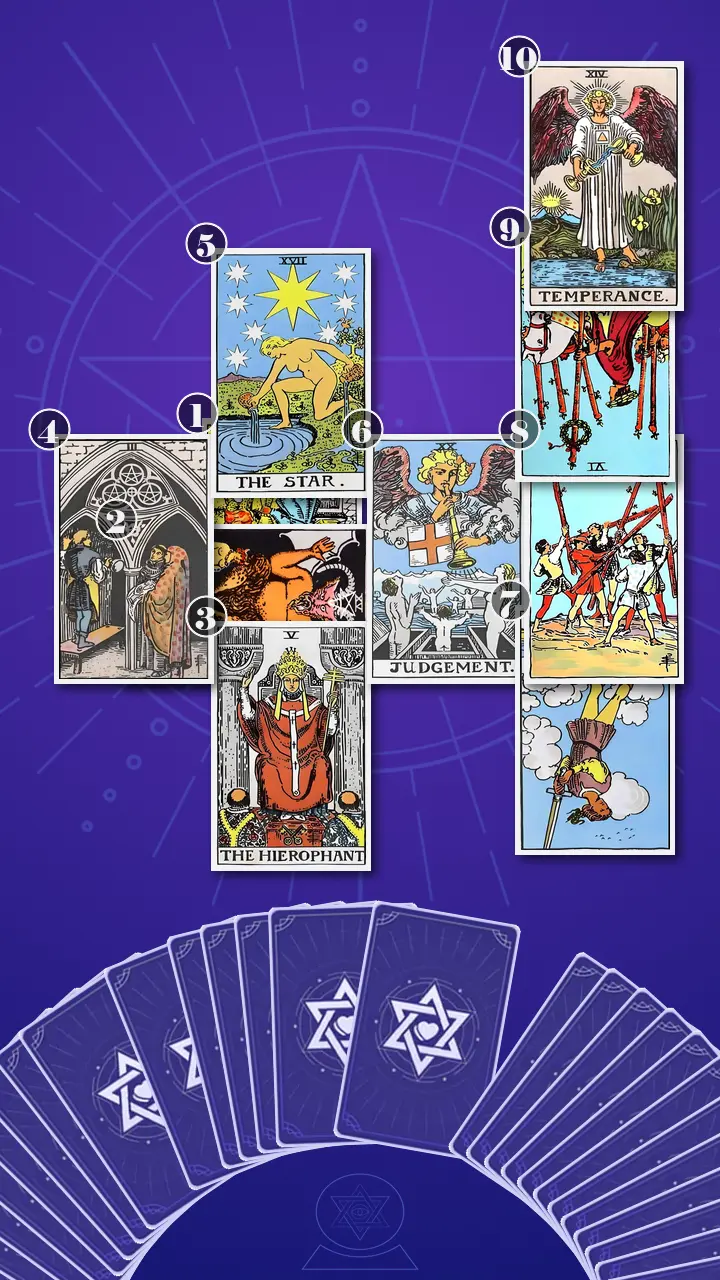
And for you, reading along: the Celtic Cross is one of the most practical spreads for this exact kind of problem—when you’re not asking for a prediction, but for a clear psychological chain. It shows (1) what’s happening right now, (2) what blocks you, (3) where the pattern was installed, (4) what recently reactivated it, and (10) the most supportive direction forward. It’s structured enough to hold anxiety, but roomy enough to hold complexity.
“We’ll read the center first,” I said, “then we’ll climb the right-hand staff like a ladder—from your current self-talk up toward integration.”
The Cards That Named the Loop (and Why It Feels So Personal)
Position 1: The present moment — the spiral you run on autopilot
“Now turning over is the card that represents the present moment: how the old report-card story is showing up right now in daily thoughts and behavior,” I said.
Six of Cups, reversed.
I didn’t need to dramatize it. The image did that on its own: the quiet courtyard, the child offering a cup with a flower—sweetness that can become obligation when it’s turned into a token you owe.
“That old report card isn’t a memory—it’s a measuring stick,” I said, and I saw Jordan’s eyes flick to the side like they’d been caught. “This is exactly like finding that scan and suddenly treating it as the ‘real’ evaluation. Then you try to bring that grading system into your job, your relationships, your body, your sleep.”
Reversed, the Six of Cups isn’t saying the past is bad. It’s saying memory is in an excess state—too strong, too loud, pulling you backward. Nostalgia becomes a rubric. Childhood praise becomes a contract.
Jordan let out a small laugh—quick, sharp, and a little bitter. “That’s… so accurate it’s kind of rude,” they said.
“I know,” I replied softly. “But accuracy is a form of kindness when it gives you options.”
Their hand drifted up again toward their jaw without them noticing. I clocked it and filed it away. Their body was already telling the truth their mind was still negotiating.
Position 2: The central block — what makes the next step feel like a verdict
“Now turning over is the card that represents the central block: what keeps the overachiever pattern gripping your choices and making the next step feel loaded,” I said.
The Devil, upright.
People hear that name and panic. I don’t. The Devil is mechanics. Attachment. The part of you that thinks safety comes from control.
“Look at the loose chains,” I said. “They could step away. But the chain feels tight because of the agreement underneath it.”
I translated it the only way it matters: “This is like when your deliverable is ready, but you keep adding ‘one more improvement’ because submitting it feels like risking your identity.”
The Devil here is a blockage state—your worth is outsourced to a metric, and the metric demands more payment every week: more polish, more proof, less rest.
Jordan’s eyes narrowed, not in disagreement, but in recognition that stung. They nodded once, stiffly.
“And I want you to hear this clearly,” I added. “You’re not trapped by the metric. You’re negotiating with it.”
Position 3: The root imprint — where the rubric voice came from
“Now turning over is the card that represents the root imprint: the early conditioning that taught you what ‘good enough’ means and why you still chase it,” I said.
The Hierophant, upright.
The pillars. The formal blessing. The keys. School energy, institutional approval, the comfort of clear rules—and the cost of letting those rules become your inner religion.
“This is the inner authority voice,” I said. “Not a villain. A teacher. It taught you: there is a correct way to be good, and proof is safety.”
In an excess state, the Hierophant becomes rigid. It turns adulthood into a classroom you never graduate from.
Jordan’s gaze dropped. When they spoke, it was quieter. “I was praised early for being… responsible. Smart. The kind of kid teachers loved. It felt like… being safe.”
“Of course it did,” I said. “Belonging is a nervous-system event. It lands in the body. Which is why, years later, your jaw still clamps when you sense evaluation.”
Position 4: Recent past — the last evaluation cycle that reactivated the pattern
“Now turning over is the card that represents the recent past reinforcement: the last cycle of evaluation or comparison that reactivated the pattern,” I said.
Three of Pentacles, upright.
Work on display. Observers. A blueprint in hand. The modern translation is painfully simple: performance reviews, portfolio culture, being seen by “the right people.”
“This is like only feeling calm after someone senior praises your work,” I said, “and until then, you keep editing as if you’re trying to secure a guaranteed grade.”
In a balanced state, this card is mastery and collaboration. Here, it’s showing you how easily mastery gets tangled with approval—because they look similar from the outside, but they feel different inside.
Jordan’s foot bounced off-screen. I could hear it through the faint vibration in the laptop mic, the way anxiety finds a rhythm if you don’t give it one on purpose.
Position 5: Conscious aim — what you want beyond grades
“Now turning over is the card that represents the conscious aim: what you say you want now beyond grades, and what you’re reaching for emotionally,” I said.
The Star, upright.
The Star is one of my favourite cards to read for overachievers because it never shames ambition. It just asks for honesty. It’s a clean night sky after too much fluorescent lighting.
“This is you wanting a career that still grows,” I said, “but the growth feels nourishing and honest instead of like a constant audition.”
The Star is balance—water poured onto land and into the pool. Real-world life, inner life. It says: you’re not trying to win harder. You’re trying to heal.
Jordan’s face softened in a way they didn’t seem to allow themselves often. “Yes,” they said. “I don’t want to become less… capable. I just want to stop feeling like I’m… being graded in my own living room.”
Position 6: Near future — the next developmental move
“Now turning over is the card that represents the next developmental move: the kind of self-assessment that helps you release the old story and choose a next step,” I said.
Judgement, upright.
This is where people assume the card is punishment. It isn’t. It’s awakening. It’s a signal that cuts through noise.
“Picture this,” I said, following the card’s echo the way it wanted to be spoken. “Your calendar invite is the trumpet. Short, clear, unavoidable. It cuts through thirty-seven open tabs.”
Jordan’s mouth twitched, almost a smile. The recognition was there.
“This isn’t a sentence,” I told them. “It’s a signal.”
Judgement is a rebalancing—a re-evaluation that liberates. It hints that you can change the standard without changing your ambition. You can write a new rubric that fits adult life: values-based instead of grade-based.
I saw their shoulders drop a fraction. Not relief exactly—more like the first millimetre of space in a place that’s been clenched for years.
Position 7: Self-position — how your mind tries to stay safe
“Now turning over is the card that represents your inner stance, self-talk, and the way you’re currently trying to stay safe,” I said.
Page of Swords, reversed.
Windy sky. Raised sword. The Page is curiosity in motion—until it flips into vigilance.
“Curiosity becomes self-surveillance when you’re trying to pre-empt judgement,” I said, and I watched the phrase land in their body before it landed in their mind.
Modern translation: rereading messages, turning feedback into a case file, drafting Slack updates like legal documents because you’re trying to control the verdict.
This is an excess of Air—too much scanning, too much interpretation. It’s smart, but it’s exhausting.
Echo moment—Devil + Page reversed. I painted the micro-scene in plain daylight detail: “Cursor hovering over ‘Send.’ Slack open on the side. And your brain running a legal defense: If I can predict every objection, I can’t be judged. Visibility versus safety. Competence versus worth.”
Jordan froze—breath held for half a beat, fingers hovering mid-air like they were about to close a tab. Then their eyes unfocused as if a memory replayed. Then: an exhale, long and embarrassed.
“Oh,” they said, quietly. “I do that.”
“Yes,” I said. “And you’re not broken. You’re negotiating with an old metric using the only tools you were taught.”
Position 8: Environment — the pressure field around you
“Now turning over is the card that represents the social and workplace atmosphere that intensifies comparison, FOMO, or performance pressure,” I said.
Five of Wands, upright.
I let it turn cinematic, because that’s how it feels: “TTC escalator. LinkedIn notifications. Office chatter about comp bands. Everyone swinging their own stick—lots of motion, no direction.”
This is Fire in a scattered state—ambient competition. Even when nobody is attacking you, the noise makes your nervous system act like it’s defending a thesis.
Jordan nodded hard. “It’s like… even rest feels irresponsible. Like I’ll fall behind.”
“Exactly,” I said. “This card reduces shame. It’s not all in your head. The system is loud.”
Position 9: Hopes and fears — what recognition means to you
“Now turning over is the card that represents your hope/fear engine: what recognition means to you, and what you’re afraid will happen if you stop overachieving,” I said.
Six of Wands, reversed.
Victory wreath, crowd behind—then reversed: the wobble. Craving applause, distrusting it, fearing it won’t arrive, fearing it will trap you on the stage if it does.
“This is like getting a compliment,” I said, “and immediately searching for the ‘real grade’ behind it.”
Reversed, it’s a deficiency of nourishment from recognition. Praise doesn’t sink in. The goalposts move. The treadmill keeps running.
Jordan’s jaw flexed again, like a muscle remembering its job. “If I stop pushing,” they admitted, “I’m scared I’ll disappear into average.”
“Thank you for saying that out loud,” I said. “That fear is the engine. Now we can work with it.”
When Temperance Poured Between Two Cups
Position 10: Integration and next step — the most supportive direction
I turned the final card slowly. The room felt quieter, even through a screen. Outside Jordan’s window, the city glow blurred against the glass—winter air turning every streetlight into a soft halo. It was the kind of Toronto night that makes you feel like you’re living inside a snow globe.
“Now turning over is the card that represents integration and next step: the most supportive direction when you act from self-trust rather than grades,” I said.
Temperance, upright.
The angel pours water between two cups—steady, patient, not dramatic. One foot on land, one in water. A path toward the sun that doesn’t look like a sprint; it looks like a rhythm.
“This is the antidote,” I said. “Not quitting excellence. Maturing it.”
Setup: I named the moment I knew they’d recognize. “You find the old report card, and within five minutes your Notes app turns into a midnight rubric: new goals, new metrics, new rules—anything except the one small thing you could actually finish and share this week.”
Stop chasing a perfect grade and start mixing your effort with care, like Temperance pouring between two cups until it becomes a sustainable ‘enough.’
I let it sit for a beat. The neighbour’s bass faded between songs, and in that thin quiet I could almost hear Jordan’s mind trying to object—and failing to find the words.
Reinforcement: “Let’s make this physical,” I said. “Set a 10-minute timer. Open the one deliverable you’ve been over-editing. Do a Temperance Pass: (1) pick one tiny improvement that changes clarity—not polish, (2) make it, (3) save and send, or schedule-send.”
“When the timer ends, you stop—even if it’s imperfect,” I continued. “And if your chest tightens or your brain starts bargaining—‘just one more tweak’—pause and put a hand on your jaw for one slow breath. You’re allowed to stop mid-urge.”
Jordan’s reaction came in three layers, like a tide changing direction.
First: stillness. Their breath caught. Their eyes widened slightly—an involuntary, animal moment, like the body saying, Wait, you’re telling me I can stop?
Second: seep. Their gaze drifted off-camera, unfocused, as if their brain replayed a dozen nights of cursor-hovering and self-made deadlines. Their shoulders began to lower, millimetre by millimetre, as if gravity was finally allowed back in.
Third: release—with complexity. They exhaled, but it wasn’t pure relief. There was a flash of irritation, too, their voice suddenly tight. “But if I do it that small… doesn’t that mean I’ve been doing it wrong? Like—this whole time?”
I didn’t rush to soothe. I respected the anger. It was part of the thaw.
“No,” I said, calm and steady. “It means you were doing what worked in a school system designed around grades and scarcity. You were running an outdated operating system because it kept you safe once.”
“Temperance isn’t calling you out,” I added. “It’s calling you forward. Into a rhythm your nervous system can survive.”
This is where I brought in my other lens—Elemental Balance—because this spread was practically teaching it. “Notice how your cards move,” I said. “Water-heavy memory (Six of Cups reversed), Earth-based evaluation (Three of Pentacles), then Air turbulence (Page of Swords reversed) and Fire noise (Five of Wands). Temperance brings Water and Earth back into harmony: feelings and real-world action calibrated together.”
“Now,” I asked, “with this new lens—can you remember a moment last week when this insight would’ve changed how you felt?”
Jordan swallowed. Their jaw unclenched slightly, like a fist opening. “Yesterday,” they said. “I had a Slack update drafted. It was fine. And I just… kept rewriting because I imagined someone replying with a question and me looking stupid.”
“That’s it,” I said. “That’s the pivot point.”
Temperance is the shift from decision fatigue and scorekeeping to self-trust through small, finished experiments. Not a new report card. A repeatable rhythm.
From Scorekeeping to a Repeatable Rhythm: Actionable Next Steps
I set the cards in a simple line so Jordan could see the story without the overwhelm.
“Here’s the chain,” I said. “Six of Cups reversed shows the trigger: the past grading the present. The Hierophant shows why it hooks you: an internal school rubric that equates approval with safety. The Three of Pentacles shows how it got reinforced recently: work being assessed, and your body learning to wait for a ‘grade’ before relaxing. The Devil shows the current bind: worth chained to results. The Page of Swords reversed shows the coping: self-surveillance, over-explaining, mental legal briefs. The Five of Wands shows the environment: constant comparison noise. But The Star shows your real desire: healing, spaciousness, integrity. Judgement shows the next move: a liberating re-evaluation. And Temperance shows the method: blend output with recovery until it’s sustainable.”
“The blind spot,” I told them, “is that planning feels like progress because school rewarded planning. But in adult life, planning can be a form of hiding when visibility feels like a test.”
“The direction,” I said, “is your key shift: from proving your worth with perfect metrics to practicing self-trust through small, finished experiments you can actually complete this week.”
Then I gave them a path that didn’t require a personality transplant—just a new rhythm.
- The 10-Minute “Temperance Pass” (Draft → One Review → Ship)Set a 10-minute timer. Open the one deliverable you’ve been over-editing (Slack update, one-page memo, deck cleanup). Choose ONE clarity edit (not polish), make it, then send—or schedule-send for 9:12 a.m.—and close the tab.Expect the thought: “This is too small to matter.” That’s the old rubric talking. You’re not allowed to add new requirements after the timer starts—only edits that improve clarity.
- The “New Rubric” Sticky Note (3 values, not grades)Write a tiny rubric for your next step with three criteria: (1) useful to someone, (2) aligned with what I actually care about, (3) finishable this week. Before you start working, ask: “Which of these three am I prioritizing right now?” and pick just one.If it becomes a full Notion page, you’re back in avoidance mode. Reduce it until it fits on one sticky note.
- Recovery as Part of the System (my Water-Flow Reset)Right after you ship, do a 5-minute recovery cue on purpose. My favourite is the shower water-flow meditation: stand under the water and let your shoulders drop on each exhale, like you’re rinsing “being graded” out of your muscles.If you can’t shower, do the 5-minute balcony energy awakening practice: step outside, feel the air on your face, and name three neutral sensations (temperature, sound, light). Completion needs a body signal, not just a checkmark.
Jordan blinked at the list like it was suspiciously simple. “But what if I do that,” they asked, “and it’s not… impressive?”
“Then it’s finished,” I said, kindly. “And finished is a valid standard. A repeatable rhythm beats a perfect grade.”

A Week Later: Quiet Proof, Not a Perfect Grade
Five days later, Jordan emailed me a screenshot. It wasn’t a promotion announcement. It wasn’t a new certification badge. It was a scheduled Slack message—set for 9:12 a.m.—with two short lines and no defensive paragraph underneath.
“I did the Temperance Pass,” they wrote. “My jaw freaked out for like 30 seconds. Then I stopped anyway. I showered right after like you said. It felt… weirdly grown-up.”
They added one more sentence: “I didn’t feel amazing. But I felt done.”
That’s the kind of clarity I trust—the kind that shows up as a small, completed action, not a grand identity rewrite.
Bittersweet proof, in under fifty words: they shipped, then sat alone in a coffee shop near Union with their laptop closed, hands still restless for a minute. The city moved around them. The urge to “do more” rose—then passed. They took one real sip of tea while it was still hot.
When you’ve spent years being lovable in measurable ways, it can feel physically unsafe to stop grading yourself—like if you loosen your grip for even one day, you’ll slide straight into “average” and disappear.
If you didn’t need to prove anything this week—just practice trusting yourself—what’s one small, finishable thing you’d be willing to ship and then let be done?
This story is adapted from psychological research, written so that those in a similar struggle can see their own pattern in it — and find their next step clearly.These insights are not a substitute for professional psychological, medical, legal, or financial advice.
Learn more about our Journey to Clarity.
How did this insight land for you?
🫂 This Resonates Deeply
🌀 Living This Story
✨ Now I See Clearly
🌱 Seeing New Possibilities
🧰 Useful Framework
🔮 The Confirmation I Needed
💪 Feeling Empowered
🚀 Ready for My Next Step
Author Profile
 AI
AI“As the seventh generation of a Highland healing family, I see modern anxieties as a simple, temporary disconnection from nature's rhythm. I bring 67 years of lived seasons not to instruct you, but to hold space for you. Using tarot as a mirror, I want to gently guide you out of the chaos, helping you breathe deeply and rediscover the organic, steady heartbeat of your own life.”
In this Introspection Tarot Reading :
Core Expertise
- Somatic Shadow Sensing: Identifying where chronic mental fatigue and unexpressed emotions are physically trapped within your body's architecture.
- Ecosystem Bandwidth Restoration: Using the metaphor of nature's self-cleansing cycles to diagnose and clear the 'mental static' of an overstimulated nervous system.
Service Features
- The Grounding Transmutation Ritual: A sensory, physical practice designed to literally discharge excessive mental rumination into the earth, instantly restoring bodily presence.
Also specializes in :
Explore Related Patterns:
Achievement FusionJordan finding the scanned report card does not stay in the past; within minutes it becomes a live adult scoring system, with new goals, new metrics, and new rules appearing in the Notes app. The body response matters here too: the clenched jaw, tight chest, and lifted shoulders show that this is not just nostalgia, but an evaluation reflex getting reactivated. The core mechanism is that achievement has become fused with safety and self-worth. Being the responsible, smart, teacher-approved kid once worked as a clear route to belonging, so the adult nervous system still looks for measurable wins before it allows rest. You can see the fusion when a ready deliverable still feels unsafe to send, because the work is no longer just work; it has become evidence for or against the self. Achievement Fusion fits because Jordan is not simply ambitious. The story shows a repeated attempt to answer an identity question with performance data: Am I still enough if I am not visibly ahead? The next step is therefore not to stop caring about excellence, but to separate competence from worth through small, finished experiments that let completion be real without turning it into a personal verdict.
External ValidationJordan only feeling calm after someone senior praises the work shows how external approval has become a body-level safety cue. Even a compliment is unstable, because they immediately search for the real grade behind it. External Validation fits because recognition does not simply feel good; it is asked to settle the question of worth. The trouble is that it cannot hold that job for long. Praise does not fully sink in, the goalposts move, and the treadmill keeps running. This is why the next step has to be small, finishable, and internally defined. Jordan is not being asked to reject feedback or stop valuing quality. The shift is to stop making outside recognition the only permission slip for rest, completion, or self-trust.
Control CopingJordan says they do not miss school; they miss knowing exactly how they were doing. That sentence turns the whole story: the old report card gives them a clean scoreboard, and the adult mind tries to recreate that certainty through rubrics, metrics, edits, and pre-emptive standards. Control Coping fits because the controlling behavior is doing emotional labor. The rules are not just productivity tools; they are a defense against ambiguity. If every next step can be graded in advance, then Jordan does not have to sit with the uncertainty of being visible, imperfect, or only partially understood. The problem is that control starts expanding beyond its useful function. A deliverable that could be finished becomes another site for risk management, and a Slack update becomes a legal brief. You can keep the useful part of structure while dropping the part that turns every action into a verdict.
Defensive OverexplainingJordan drafting Slack updates like legal documents gives this pattern a very concrete shape. The message is not just written to communicate; it is written to pre-defend the self against questions, objections, or the possibility of looking stupid. Defensive Overexplaining fits because the extra detail is functioning like armor. The mind tries to reduce judgment risk by answering every imagined critique before anyone has even replied. That makes the communication heavier, but it temporarily soothes the fear of being exposed as unprepared. The pattern is especially tied to the old report-card story because overexplaining tries to secure a guaranteed grade before the work enters the room. You can see the shift in the later screenshot: two short lines, no defensive paragraph underneath. That is not just cleaner communication; it is Jordan practicing visibility without building a courtroom around it.
Nostalgia LoopThe scanned report card does not simply make Jordan sentimental; it becomes a measuring stick for adult life. The warm hit of memory quickly turns into chest tightness, jaw tension, and the thought that they should be doing more. Nostalgia Loop fits because the past is being used as a current operating system. Childhood praise, school structure, and the clean logic of grades keep pulling Jordan back into a version of selfhood where being good is measurable and safety comes from approval. The loop is not about hating the past. It is about memory becoming too loud, too authoritative, and too easy to obey. Once the old report card becomes a rubric, the adult next step gets buried under inherited standards that no longer fit the life Jordan is actually trying to build.
Productive ProcrastinationJordan’s Notes app turning into a syllabus is the giveaway: the mind creates goals, metrics, and rules, then keeps upgrading the plan instead of completing the exposed action. The same pattern appears in the Slack update that was already fine, but kept getting rewritten because a possible question from someone else felt like a threat. Productive Procrastination fits because the avoidance is dressed as high standards. The behavior looks responsible from the outside, but psychologically it functions as delay: polishing, planning, and one more improvement keep Jordan close to the safety of preparation and away from the vulnerability of being seen. The loop is powerful because it gives a short-term sense of control while preserving the deeper fear of judgment. You are not looking at laziness here; you are looking at a coping ritual where motion substitutes for completion. The 10-minute Temperance Pass directly interrupts that mechanism by allowing one clarity edit, then forcing the nervous system to practice stopping before the old rubric adds another requirement.
Visibility AvoidanceJordan’s cursor hovering over Send captures the pattern in one physical image. The work is close to visible, but the body and mind treat that visibility like a judgment event rather than a normal completion step. Visibility Avoidance fits because Jordan does not avoid work itself; they avoid the exposed moment when the work leaves private control and enters other people’s perception. Rewriting, polishing, and adding defensive explanation keep them in the safer zone of preparation. This is why the later screenshot matters: two short lines, scheduled, with no defensive paragraph underneath. That small action shows a new relationship to visibility. You can be seen without turning every send button into a trial of worth.
Comparison TrapJordan’s old report card reactivates the ahead-behind scoreboard, and the wider environment keeps feeding it: LinkedIn notifications, office chatter about compensation bands, portfolio culture, and the ambient feeling that everyone is being measured. Even rest starts to feel irresponsible because the comparison field makes stillness look like falling behind. Comparison Trap fits because the story shows self-assessment being outsourced to relative ranking. Jordan is not asking, Is this aligned, useful, and finishable? The old loop asks, Am I still ahead, still impressive, still safe from average? That shift turns other people’s signals into pressure on the self. This pattern matters because comparison makes the old rubric feel socially confirmed. The system is loud, so Jordan’s nervous system treats ordinary workplace visibility like a competition stage. The new rubric interrupts that by replacing relative status with values-based criteria that can actually guide a next step.
Mind ReadingJordan’s Slack draft becomes stuck because they imagine someone replying with a question and them looking stupid. Before anyone has actually responded, the mind has already treated the imagined reaction as evidence. Mind Reading fits because Jordan is filling in other people’s thoughts and then adapting behavior around that assumed verdict. The cognitive bias narrows attention toward possible objections, hidden grades, and signs of disapproval, even when the actual situation is only a normal workplace update. This matters because the imagined audience becomes more powerful than the real task. A two-line update turns into a defensive document because the mind is trying to control a reaction it cannot actually know. The antidote is not pretending people will always approve; it is separating real feedback from projected judgment before the projection takes over the whole action.
PerfectionismJordan’s deliverable can be ready and still feel impossible to release. The mind keeps asking for one more improvement, one more review, one more pass, because stopping would mean letting the work exist without the fantasy of a perfect grade. Perfectionism fits because the high standard is not only about quality; it is about protection. If the work is impressive enough, polished enough, and objection-proof enough, then Jordan does not have to face the deeper fear of being average, inadequate, or no longer special. The story does not shame excellence. It shows what happens when excellence becomes fused with threat management. Temperance offers a more mature version: keep capability, but pair output with care, recovery, and a stopping point the nervous system can survive.
Explore Related Struggles:
Approval-Safety FusionJordan remembers being praised early for being responsible, smart, the kind of kid teachers loved, and their body still braces when evaluation enters the room. Senior praise at work gives temporary calm because approval has become the signal that the ground is safe. The pressure is not a simple wish to be liked. Approval and safety have been wired into the same circuit, so a missing compliment can feel like missing protection, while a compliment has to be inspected for the real grade underneath. You do not have to throw away ambition to loosen this bind. The work is to let approval become information instead of shelter, so your nervous system can stop outsourcing safety to someone else's reaction.
Visibility-Execution SplitJordan's cursor hovers over Send while the work is already good enough to share. The next visible step carries two signals at once: move forward, and protect the self from being graded. That split makes execution feel heavier than the task itself. You are not only sending a Slack update or a memo; you are stepping into being seen by people whose response has been given too much authority over your worth. The small finished experiment matters because it separates visibility from a total identity verdict. You can let the work be seen as a piece of work, then close the laptop before the old scoreboard drafts a new sentence.
Grade-Identity FusionJordan opens the scanned report card and within minutes adult life turns into an ahead-or-behind scoreboard. The old paper is no longer just a memory; it becomes the scale used to weigh work, relationships, body, and sleep. That is the bind of Grade-Identity Fusion: the self is asked to keep producing evidence that it is still the top student. You can move through adult choices, but each choice starts carrying the old classroom verdict of good enough or falling behind. The next step begins when the grade stops being treated as proof of identity. A small finished action gives you evidence of agency without asking your whole self to sit for another exam.
Metric-Compass FusionJordan's Notes app turns into a syllabus after the report card appears: new goals, new metrics, new rules. The tool that should help them choose a direction starts acting like the direction itself. That is where the compass gets fused to the metric. You keep asking the measurable thing to answer a values question, so planning feels productive while the small finishable step keeps moving further away. A values-based rubric breaks the loop because it asks what matters before it asks how impressive it looks. The next step becomes a calibration, not another scoreboard.
Perfect Readiness TrapThe deliverable is ready, but Jordan keeps adding one more improvement, rewriting the Slack update and upgrading the plan instead of sending the thing. Readiness keeps expanding at the exact moment action is available. The trap is not laziness or lack of skill. The closer the work gets to visibility, the more perfection is used as a buffer against being judged, so preparation becomes a hiding place with professional-looking walls. A ten-minute pass works because it narrows the contract: one clarity edit, then send or schedule-send. You practice ending the readiness phase before it consumes the action it was supposed to support.
Monitoring-Safety FusionJordan drafts Slack updates like legal documents, rereads messages, and treats imagined objections as if they have already arrived. Their mind tries to build a defense before anyone has asked a question. Monitoring becomes safety when every gap in prediction feels like exposure. You are not simply thinking carefully; you are using vigilance to negotiate with a verdict that has not happened yet. The hinge point is noticing the body before the brief gets longer: jaw clench, breath hold, cursor hover. One breath does not solve the whole pattern, but it gives you a pause where action can happen without another round of surveillance.
Explore Related Emotions:
Approval AnxietyJordan says they were praised early for being responsible, smart, the kind of kid teachers loved. The important detail is not the praise itself; it is how that praise became a body-level signal of safety, clear enough that years later the jaw still clamps when evaluation is nearby. Approval Anxiety forms when recognition becomes the thing that lets you relax, but only briefly. You can receive praise and still search for the 'real grade' behind it, because the nervous system has learned to treat external approval as a checkpoint rather than nourishment. In this story, the old report card reactivates that checkpoint system. You are chasing the feeling of knowing exactly how you are doing, yet the moment someone else gets to decide the grade, calm becomes conditional and temporary.
Completion AnxietyJordan has a deliverable that is ready, yet the hand keeps reaching for one more improvement. The work is no longer just work at that point; finishing it would remove the protective cover of editing and place the result in the open. Completion Anxiety lives in the moment when stopping feels more threatening than continuing. Planning and polishing can feel productive because they delay the exposed state of being done, where the piece has to stand without another layer of refinement. That is why the 10-minute pass lands so strongly. You are not being asked to lower your standards into carelessness. You are being asked to survive the feeling of ending the loop, sending the thing, and letting completion count without turning it into another test.
Self-Audit AnxietyJordan's Notes app turning into a syllabus is the cleanest signal: new goals, new metrics, new rules, all generated in the moment the old report card wakes up. The mind tries to create safety by building another evaluative system before anyone else can evaluate them. Self-Audit Anxiety is the pressure of becoming your own review board. You keep checking, interpreting, revising, and pre-defending, not because the task truly needs that much work, but because the audit feels like protection from being caught unprepared. The story shows this in the Slack update drafted like a legal document and in the loop of upgrading the plan instead of doing the thing. You are trying to get ahead of criticism by criticizing yourself first, which gives the appearance of control while quietly draining the ability to move.
Verdict DreadJordan opens a scanned report card and the room changes: the lukewarm tea, the sterile laptop light, the lifted shoulders, the locked jaw. A school document becomes more than an old file; it becomes a private hearing where adult life gets re-ranked as ahead or behind. That is the emotional logic of Verdict Dread. You are not just worried about doing well. The next step starts to feel like it will announce something final about who you are: still impressive, still safe, still the kind of person who earns approval, or suddenly exposed as ordinary. The story keeps returning to moments where sharing work feels bigger than the work itself: the cursor over Send, the Slack update rewritten, the deliverable made ready and then made safer through one more improvement. The dread lives in that gap between completion and visibility, where a simple action starts carrying the weight of a verdict.
Comparison FatigueThe report card does not stay in the past. It instantly turns adult life into an ahead-or-behind ranking system, and the outside world keeps feeding that system through LinkedIn notifications, office chatter, comp bands, and performance visibility. Comparison Fatigue is what happens when the scoreboard follows you from school into the condo, the laptop, the job, the body, and even rest. You are not only measuring progress; you are absorbing a constant atmosphere of other people's motion and treating it as evidence that you should be doing more. The fatigue shows up in the line that even rest feels irresponsible. That is the cost of living beside an invisible leaderboard: the body wants to stop, but the mind keeps checking whether stopping will make you fall behind.
Explore Related Contexts:
Evaluation Pressure LoopJordan's deliverables, Slack updates, performance reviews, senior praise, and even compliments all become moments of assessment. The story keeps returning to the same mechanism: work is not simply completed; it has to survive a verdict. That loop is reinforced by workplace and social signals around portfolio culture, comp bands, and being seen by the right people. You are not facing one difficult task; you are inside a repeated evaluation field where each next step can feel like evidence for or against your worth. The practical break in the loop is not avoiding evaluation altogether. It is choosing one standard for the task before the task expands into another courtroom.
Model Student Performance TrapJordan finds the scanned report card and immediately starts ranking adult life as ahead or behind. The memory is not just nostalgic; it gives work, relationships, body, and sleep a school-style scoring system, so the old top-student role becomes the standard that keeps asking for proof. That makes the overachieving story external and structured, not random self-criticism. You are dealing with a performance environment learned through grades, teacher praise, and measurable wins, then imported into adult work where there is no final report card. The pressure point is the chase for a version of safety that once came from being visibly excellent. The next step has to update the rubric, because more effort inside the old school story only gives the old story more authority.
Performance Defense ModeJordan has a Slack update drafted, knows it is fine, and keeps rewriting because a possible question from someone else starts to look like public failure. The cursor hovering over Send becomes the whole pressure system in miniature. The external stage here is workplace visibility under imagined scrutiny: messages, updates, and deliverables are prepared as if they need a legal defense. You are not only trying to communicate; you are trying to remove every possible opening for judgement before anyone has even responded. That is why a tiny send becomes a serious next step. It asks you to let a normal work message be normal, instead of turning it into a courtroom where competence has to prove its right to exist.
Safe Visibility TrialJordan's week-later proof is a scheduled Slack message with two short lines and no defensive paragraph underneath. The task is small, public enough to count, and bounded enough that it does not become another midnight rubric. That is the real next-step context: a trial of safe visibility. You are practicing being seen through a normal, finishable action rather than waiting until the work feels impossible to question. The point is not to produce a perfectly impressive moment. It is to create one repeatable experience where you ship, recover, and learn that visibility can be survived without adding a new stack of requirements.
Hustle Culture TrapThe metric in the story keeps demanding more polish, more proof, and less rest, while Jordan says rest feels irresponsible because they might fall behind. Achievement is no longer a project with an endpoint; it has become a standing demand for extra output. That pressure belongs to a broader hustle culture trap where capability is measured by constant availability and visible effort. You are being asked to keep proving seriousness through exhaustion, even when the actual task only needs one clear improvement. The way out is not becoming less capable. It is refusing to let every ordinary deliverable become a referendum on whether you are ambitious enough.
Work Life Boundary CreepJordan is sitting in a Toronto condo at 9:38 p.m., but the old grading system has followed them into the kitchen, the body, sleep, and the Notes app. They say they want to stop feeling graded in their own living room, which makes the boundary problem concrete. Work-style measurement has leaked beyond work hours. You are not just managing ambition; you are trying to recover a home space where a task can end, a Slack message can stay short, and rest does not need to earn permission. The next step works because it rebuilds a boundary around completion. Send the bounded update, close the tab, and give the body a recovery cue so the evening is not absorbed by another unpaid review cycle.
LinkedIn Performance LoopThe environment names LinkedIn notifications, office chatter about comp bands, TTC escalator noise, and comparison fatigue around being ahead or behind. Jordan's pressure is not happening in a sealed private room; the professional city around them keeps broadcasting rank. That makes the context a performance loop rather than a simple confidence issue. You are surrounded by feeds and workplace signals that turn career growth into visible positioning, where rest can look like losing ground because everyone else appears to be moving. The useful move is to treat those signals as ambient pressure, not as instructions. They may explain why the old report-card story gets louder, but they do not get to set the next standard for what is finishable this week.