Sending a Couples Therapy Enquiry: Choosing Practice Over Performance

When Shame Makes Couples Therapy Feel Like Failure
I recognized the pattern before Alex (name changed for privacy) finished saying hello: she could present unfinished UX work to a room of colleagues, yet opening a couples therapy booking page made her chest tighten as if her entire ability to love were being peer-reviewed.
At 11:40 p.m. on a Tuesday, she had been sitting at the kitchen table in her Toronto condo with a Psychology Today enquiry form glowing on her laptop and an attachment article open on her warm phone. The refrigerator clicked behind her. Streetcar brakes squealed below the window. She rewrote the sentence describing the latest conflict for the fourth time, then deleted it while her jaw tightened.
She told me she had opened several therapist profiles, compared credentials, fees, evening appointments, CAD insurance details, and virtual-session options, and drafted a message to her partner about booking a consultation. Then she closed every tab. She wanted couples therapy as shared support for repairing love, but making support real felt like admitting personal defeat.
"I know therapy is supposed to be normal," Alex said, looking down at her hands, "but part of me still hears it as a verdict. If we need a professional, what does that say about me? Shouldn't I know how to do this by now?"
I let the question have its full weight without agreeing with the verdict hidden inside it. The shame was not a sign that she was shallow or unwilling to try. It was more like a tight band pulled around every attempt to ask for care. I said, "Love is not a closed-book test. We can look at what keeps happening between you without deciding that either of you is the problem. Today, we can try to draw a map through the fog."

Choosing the Relationship Spread - Context Edition
I asked Alex to take one slower breath and name the question she wanted the cards to examine. I shuffled at an ordinary pace, giving the movement a practical purpose: it marked the transition from spiralling alone to looking at the same issue from several angles. Nothing in the ritual was meant to overrule her judgment.
For this consultation, I used the Relationship Spread - Context Edition, a focused six-card relationship tarot spread for a couples therapy crossroads. This is one way I explain how tarot works when the question carries shame: the cards provide a structured language for noticing assumptions, patterns, resources, and choices. They do not read Alex's partner's private mind, guarantee an outcome, or decide whether the relationship should continue.
The first card would show the presenting knot: the emotional stance Alex brought to the decision. The second would examine the judgment she imagined coming from her partner, separating observable words from an inner accusation. The third would show the attachment pattern currently operating between them. Then I would move to the relationship's existing resource, the central binding belief, and finally an integration practice rather than a prediction.
I explained the rationale to Alex and to anyone reading along: a Celtic Cross would bring more positions than this focused question needed, while a purely inward shadow spread would underrepresent the shared context. The six-card structure kept the bridge visible. Alex's shame mattered, but so did the conversation, the mutual pattern, the possible support, and the next consent-based step.
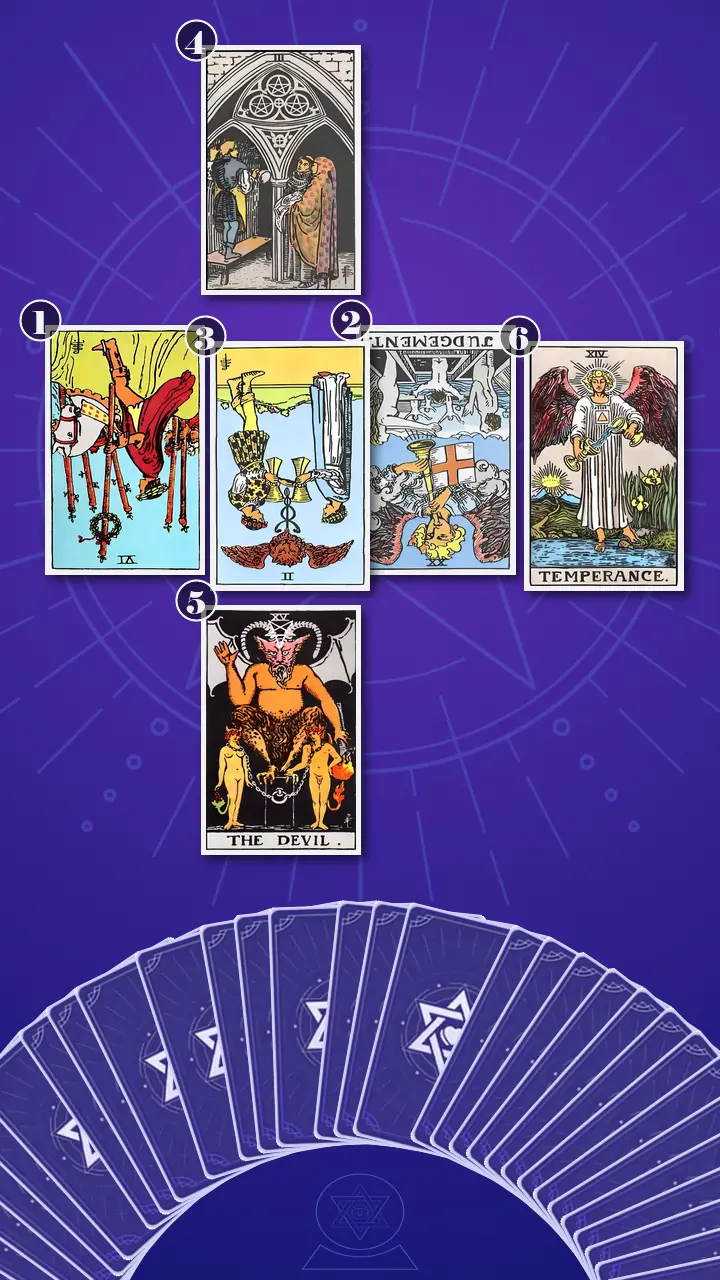
The Invisible Scoreboard
The Public Win That Never Felt Private: Six of Wands Reversed
Now I turn over the card for position 1, which shows the presenting knot: Alex interprets the possibility of couples therapy as a public and private loss of romantic competence, leading her to delay asking for help.
The card is the Six of Wands, in reversed position. I saw the laurel wreath, the raised wand, and the surrounding crowd as an imagined audience standing around her private life. In the reversed position, the fire was blocked and overdependent on recognition. Action had not disappeared; it had become trapped inside the question of how the relationship would look if someone else knew it needed help.
The modern scene arrived immediately. The morning after a difficult conversation, Alex had been riding the TTC when she saw an anniversary carousel captioned "my easiest yes." The train braked sharply. Coffee and damp winter coats filled the carriage. Heat rose into her face as she thought, "Other people seem to know how to do this without turning love into a project." By the time she reached work, booking therapy felt like publicly losing an invisible award for being the woman who should know how to sustain love without assistance.
I told her that this card did not say the relationship was failing. It showed how relationship performance had become a measuring device. She was comparing a difficult private process with a polished public image, then using the comparison as evidence against herself. I said, "Effortless is an image. Repair is a practice."
Alex did not nod. She gave a short laugh with a bitter edge. "That is exactly what I do," she said. "I call it research, but I am really trying to avoid the moment when someone might see that I do not know how to fix this alone."
I heard recognition in the laugh, along with grief for the version of love she had expected to perform naturally. I asked her whose approval would count as proof that she was competent at intimacy. She glanced toward the dark window and said, "Everyone's, apparently. My friends, social media, my partner, me." Her shoulders lowered by a fraction, as if naming the audience had made it less invisible.
The Verdict Before the Conversation: Judgement Reversed
Now I turn over the card for position 2, which examines Alex's assumptions about how her partner will judge the need for therapy, separating projected self-condemnation from what has actually been said or observed.
The card is Judgement, in reversed position. The reversal showed a call to awareness becoming a prosecution. Instead of hearing a suggestion as an invitation to gather information, Alex was preparing to answer an accusation that had not yet been made. The energy was blocked at the point where a difficult truth could become useful reflection.
The living version of the card was a Sunday afternoon message. Alex drafted, "Would you still be open to trying couples therapy?" Her partner was in the next room making coffee. Nothing critical had been said, yet Alex imagined a long pause, a disappointed expression, and the words, "So you think we're broken." She began defending herself against that imagined response and deleted the message before any real answer could exist.
I placed two blank sheets beside the spread. On the first, I wrote, "What Was Actually Said." On the second, I wrote, "What My Inner Judge Predicted." Then I said, "Your inner judge can borrow your partner's voice without borrowing their facts." The point was not to insist that her fear was irrational or that her partner would always respond perfectly. The point was to keep a prediction from becoming evidence before the conversation began.
Her fingers stopped moving. Her gaze rested on the two columns, then drifted past them toward the coffee cup she had not touched. A long breath left her chest. "I keep asking whether I am a good partner," she said, "when the actual question is whether we want help with one repeating thing."
I agreed, but I did not rush to call the insight a solution. Self-judgment can loosen and return several times in one conversation. I asked Alex to write down one exact sentence her partner had used and one sentence her inner judge had supplied. Her jaw released slightly when the two lines remained separate.
Two Cups, Slightly Out of Sync: Two of Cups Reversed
Now I turn over the card for position 3, which reveals the current attachment dynamic between closeness and disconnection, including how attempts at reassurance or repair lose reciprocity under pressure.
The card is the Two of Cups, in reversed position. I read the water here as disrupted rather than absent. The desire for connection remained visible, but the exchange had become uneven and conditional. Both partners could want reassurance while waiting for proof that it was safe to offer it. Under pressure, care became something to measure instead of something to keep moving.
At 9:15 p.m. after another circular disagreement, Alex had noticed that she apologised first. She waited for her partner to match the gesture before admitting that she felt scared. The dishwasher droned. The room smelled faintly of detergent. Her shoulders stayed raised while her mind calculated, "If I ask for closeness before they prove they care, I am giving more again."
I used my Dialogue Loop Auditing lens at this point. I do not use it to score who won an argument. I listen for the phrases and pauses that turn a repair attempt into a dead end. With Alex, the loop sounded like two conditional bids: "I will be vulnerable when you prove it is safe," and "I will move closer when you stop testing me." Neither sentence had to be treated as a permanent identity. They described the timing of the pattern.
The two cups were still extended, but they were no longer level. I told Alex that disrupted reciprocity could coexist with care. A couple could both want repair and still fail to exchange reassurance because each person was waiting for the other to move first. A twenty-minute conversation about one shared goal could be more useful than trying to settle the entire conflict and decide the future of the relationship in the same emotional hour.
Alex went quiet. Her thumb pressed into the edge of her phone case, then released it. "We both want the other person to make the first move," she said. "Then we call the waiting proof that they do not care." The admission sounded painful, but it also gave the two of us something observable to work with.
When the Workshop Replaced the Courtroom
The Unfinished Plan: Three of Pentacles Upright
When I reached position 4, the room seemed to narrow around the card. Even the refrigerator click disappeared for a moment, and the streetcar noise below softened into a distant vibration.
Now I turn over the card for position 4, which identifies the relationship resource capable of reframing therapy: the willingness to work together, accept useful expertise, and build relational skills through practice.
The card is the Three of Pentacles, in upright position. Its earth energy was available and practical. I saw the craftsperson, the unfinished stonework, and the figures gathered around a shared plan. The building mattered precisely because it was still being worked on. An unfinished structure was not disqualified from becoming sound.
The modern-life scene was clear: Alex and her partner could enter one consultation carrying different versions of the same recurring interaction. A trained third person could help them slow the sequence down, identify where each person lost contact, and create one shared experiment. The need for guidance would then show participation, teachability, and practical trust rather than failed love.
Alex understood collaboration at work. She could bring an unfinished prototype to a design critique, receive questions from three colleagues, revise the flow, and call the process responsible. At home, feedback about communication felt like proof that the relationship should be abandoned. I said, "What if collaboration counts as competence in love too?"
At this point I reached for my signature diagnostic lens, Toxic Script Identification. I use that phrase to notice repetitive roles that people are pulled into under pressure, not to label either person as toxic. In Alex's story, the script was assigning one person the role of solitary fixer and the other the role of imagined evaluator. Once the argument started, she tried to play both roles at once: repairing everything privately while prosecuting herself for not repairing it perfectly.
As an artist, I know the difference between an unfinished work and a failed work. The first is still receiving attention, feedback, and form. I thought of the many studio walls where a rough sketch looked awkward until the next mark gave it structure. I did not see a guarantee in the Three of Pentacles. I saw a credible method: lived experience, skilled guidance, and a shared objective becoming one workable map.
Still, Alex was not ready to trust the workshop image. At 11:40 p.m., the enquiry form was still open in her memory; her jaw was clenched; describing the problem felt like submitting evidence about her worth. She was trying to find a perfect explanation before allowing anyone to witness an unfinished relationship.
Needing support is not proof that you failed at love; choosing to practise repair together is relational competence made visible.
For several seconds, Alex's body froze. Her breath stopped midway, and her fingers hovered above the edge of the card. Then her eyes lost focus as if she were replaying the last year of conversations, one unfinished ending after another. Her brow tightened. "But doesn't this mean I should have known how to do it already?" The question carried irritation, grief, and the wish to be told that she had not wasted time. I stayed with the silence instead of filling it too quickly. Her clenched hand opened. Her shoulders dropped, not dramatically, but enough for her sweater to settle against her back. She swallowed, exhaled with a small tremor, and looked from the card to the blank page. I said, "It means the skill is real enough to learn. It does not turn every hard conversation into your fault." The breath that followed sounded almost like a laugh, but gentler.
Now, use this new perspective to revisit last week: was there a moment when this insight might have made you feel differently? Alex looked at the two blank columns and said that she might have asked what her partner hoped therapy could help them practise instead of trying to prove that she could already solve the problem.
This was the first clear movement from shame-based self-sufficiency and imagined partner judgment toward collaborative competence, cautious openness, and steadier self-respect. The Three of Pentacles did not hand Alex a finished relationship. It showed her that willingness to learn with another person was already a form of love in action.
The Rule With Loose Chains: The Devil Upright
Now I turn over the card for position 5, which names the central psychological obstacle: Intimacy-Competence Fusion, in which needing help becomes bound to shame, worth, and fear of relational failure.
The card is The Devil, in upright position. I did not read it as a threat, a supernatural warning, or a prediction about the relationship. I read it as a binding belief with enough emotional force to organise behaviour. The energy was excessive attachment to a rule that had begun to sound like common sense.
The modern scene returned us to the six open therapist tabs and the cursor blinking in the enquiry box. Alex understood intellectually that couples therapy was common, yet an internal rule still controlled her: "If we were good at love, we would not need this." She obeyed the rule by researching alone, hiding the strain, and postponing support. Then the resulting distance appeared to confirm that she was incapable of intimacy.
The Devil's chains looked tight, but the detail I wanted Alex to notice was that they were loose. That did not mean changing the pattern would be easy. It meant the belief was powerful without being an objective law. I asked her to complete the sentence, "If we need couples therapy, it means I am..." She wrote, "not enough," then crossed it out and wrote, "someone who should have known better."
I told her that the second sentence was still a rule, not a fact. The belief had been learned through comparison, professional perfectionism, and attachment fear. It could be examined. She did not have to replace it with a bright slogan. She only had to stop treating it as the sole authority in the room.
Alex's hand moved toward the laptop and paused above the trackpad. I saw the familiar urge to research one more framework. This time, she named it before obeying it. "The tab is offering me another escape hatch," she said. She closed one profile, not all six, and left the remaining decision for the next agreed conversation.
Water Between Two Cups: Temperance Upright
Now I turn over the card for position 6, which translates the reading into a chosen integration practice: approaching therapy as a measured process of communication and repair rather than predicting what the relationship will become.
The card is Temperance, in upright position. Water moved carefully between two cups. One foot stood on land and one in water, holding practical logistics beside vulnerable feeling. I read the energy as balance through adjustment, not balance as a permanent state. This was guidance, not a promise.
The modern-life scenario was a first consultation treated as a measured experiment. Alex and her partner could slow one recurring conversation, translate what each person heard, and try one different response. No session had to decide the relationship's future. The work could be keeping information and care moving at a pace both people could consent to.
I said, "A first consultation can be a conversation, not a verdict." They could evaluate whether the therapist's approach, schedule, cost, and presence fit. They could pause, change providers, reconsider timing, or decide that the process was not right for them. The card's wisdom was not compulsory treatment. It was permission to replace pass-or-fail thinking with paced participation.
Alex drew a slow line down the middle of the page. "We do not have to settle what our relationship means tonight," she said. "We can learn what happens in one interaction and decide what to do with that information." Her voice still carried uncertainty, but the uncertainty no longer sounded like a final judgment.
From Insight to Shared Repair
When I connected the six cards, I saw a coherent story rather than six separate meanings. The Six of Wands reversed showed the old influence of polished couple images and professional performance standards turning private difficulty into public shame. Judgement reversed showed Alex answering an accusation her partner had not necessarily made. The Two of Cups reversed gathered those fears into a cycle where both people wanted closeness but waited for proof before offering it.
The Three of Pentacles revealed the resource that shame had hidden: Alex and her partner already knew how to approach a shared problem through different perspectives, feedback, and practical planning. The Devil named the rule that blocked access to that resource: capable partners should repair love without help. Temperance offered the direction forward, not as a fixed outcome but as a practice of pacing, translation, consent, and repeated adjustment.
The cognitive blind spot was treating self-sufficiency as evidence of romantic competence while treating delayed support as neutral. Delay did provide a brief escape from exposure, but it also left the repeating pattern untouched. The shift was not from failure to perfection. It was from using self-sufficiency as proof of worth to evaluating competence by the willingness to communicate, collaborate, and practise repair.
I told Alex that the cards had helped us make the hidden equation visible, but she remained the person who decided what to do with it. Tarot could offer a pattern, a question, and a clearer frame. It could not consent on her behalf, pay the fee, choose a therapist, or define the relationship. The next steps needed to be small enough to test and flexible enough to stop.
A Small Practice Plan for the Next 48 Hours
- The 20-minute shared-goal check-inDuring one calm evening with her partner this week, Alex can set a 20-minute timer and ask, "What is one thing we would want a first couples therapy consultation to help us practise?" Each person can add one sentence to a note titled "What We Want Help Practising." The meeting is for choosing one shared goal, not resolving the original argument.Stop when the timer rings. The minimum version is one shared sentence, and neither person has to book a therapist that night.
- The Inner Verdict CheckBefore the next conversation about couples therapy, Alex can spend five minutes making two columns: "What Was Actually Said" and "What My Inner Judge Predicted." She can add no more than three bullet points to each, then ask her partner one concrete question: "When you suggested therapy, what were you hoping it could help us do?"Use exact words where possible and do not turn the exercise into a case against either person. The smallest version is one fact and one prediction.
- The Pattern Interruption ScriptIf the familiar pursue-and-withdraw loop begins during a therapy-related conversation, Alex and her partner can agree in advance to role-play a different response: "I can feel the old loop starting. I want us to stay on the same side, so let's pause and come back tomorrow." When both are ready, they can choose one therapist profile using only three criteria: relevant couples training, workable availability, and fee or insurance fit. The first consultation remains information gathering.Either person can pause the process or decline a provider without defending that choice. Define success as learning one useful thing, not feeling perfectly calm or certain.
That was the practical meaning of the Relationship Spread - Context Edition for a couples therapy crossroads: not a verdict, but a shared map. The map could be revised. The relationship could be approached as an unfinished project without turning unfinishedness into shame.

A Small Proof, Not a Final Verdict
Four days later, Alex texted me that they had sent one enquiry. She slept through the night, then woke with the old thought, "What if we are wrong?" She smiled, made coffee, and opened the reply anyway.
I held onto that small change because it was honest. Alex had not solved the relationship, erased her fear, or become suddenly certain that therapy would be the perfect answer. She had moved one sentence from the private courtroom into a shared conversation. That was her first evidence of collaborative competence, and it belonged to her, not to the cards.
When your chest tightens over a half-written therapy enquiry, I want to honour what may be happening: the painful part is not only that love feels difficult; it is the fear that letting anyone see the difficulty will confirm you never deserved to feel competent or secure in it. I saw that fear in Alex, and I also saw the moment she stopped allowing it to write the whole script.
If asking for support could be one small act of practising love rather than proving it, what might you become willing to name next on the unfinished plan you and another person are still learning to build?