The 10:06 a.m. Slack Vent DM Spiral
If you’re a hybrid office worker in a city like Toronto and your coworker uses Slack DMs like a daily vent diary, you know the “emotional labor creep” feeling—your focus disappears the moment their name pops up.
Taylor sat down across from me with her laptop half-closed, as if the screen itself might interrupt us. She was 28, a marketing specialist, the kind of person teams quietly rely on because she’s competent and calm. The trouble was: her calm had become a public utility.
She described a Wednesday morning in her Toronto apartment: 10:06 a.m., campaign deck open, Slack glowing on a second monitor. The fluorescent kitchen light had that faint electrical hum you don’t notice until you’re stressed. Her phone screen felt warm in her palm. Then the DM preview: “I’m losing it…”
“My shoulders just… jump,” she said, lifting them toward her ears without meaning to. “And I start writing the perfect reply like I’m defusing a bomb. I’m not trying to be cold. I just can’t be someone’s daily processing space.”
What she didn’t call it—what her body called it—was a reflexive bracing: jaw set, breath shallow, stomach dropping as if the floor had shifted a few centimeters. Overwhelm isn’t always loud. Sometimes it’s the feeling of trying to do deep work while wearing a too-tight winter scarf you can’t loosen in public.
“You want to be kind and professional,” I reflected, “but you’re afraid that if you set a limit you’ll be seen as cold, dramatic, or… unsafe to be around at work.”
She gave a small, tired nod. “Exactly. It’s work, not group therapy, and I hate that I have to say that.”
I leaned in the way I do when I’m about to ask someone to stop surviving on reflex and start choosing on purpose. “Let’s make this practical,” I told her. “No moralizing. No diagnosing your coworker. Just a map. We’re aiming for clarity you can actually use: how to set boundaries with a coworker who vents in DMs without making it awkward—or blowing anything up.”

Choosing the Compass: A Relationship Spread for Workplace Boundaries
I asked Taylor to take one slow breath in, and an even slower breath out—not as ceremony, but as a physiological reset. Then I shuffled. The sound of cards sliding is oddly grounding; it’s the opposite of a notification ping. It has weight. It has an ending.
“For this,” I said, “I’m using the Relationship Spread.”
And for you reading this: the reason is straightforward. This isn’t a timing question, and it’s not primarily a multi-option career tree. It’s a relationship-and-communication dynamic inside a workplace—two people, two roles, and one messy channel (Slack DMs) that’s become an always-on support line. The Relationship Spread separates your lane, their lane, and the shared dynamic, then ends with advice you can act on.
I gestured to the layout: two vertical columns of three cards, like two parallel lanes in a chat thread—your inbox and theirs, side by side. “The first card shows your lived experience of this DM pattern,” I said. “One of the middle cards will name the reciprocity—where the exchange has gotten uneven. And the final card will show the healthiest, boundary-forward stance: what you can say and repeat without drama.”
Taylor exhaled through her nose, that tiny sound people make when they’re hoping the solution isn’t going to require a personality transplant.
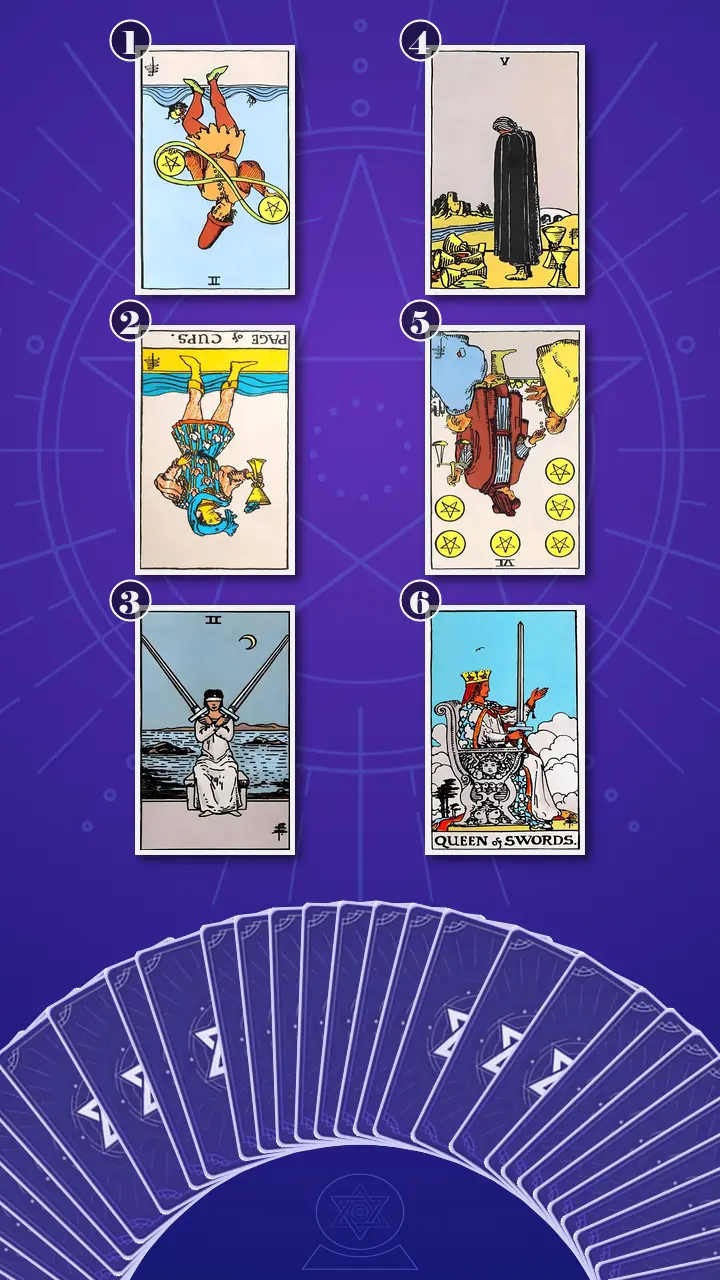
Two Inboxes, Six Cards: Reading the Pattern
As I turned the cards, I noticed something that always makes me trust a spread: a coherent visual argument. Hands kept appearing—hands juggling, hands giving, hands holding a blade. In archaeology, we look for repeated motifs in the soil: the same pottery fabric in different trenches, the same tool marks across layers. It tells you the story is consistent.
This spread did the same. It moved from overloaded Earth (time, attention, capacity) into Water (feelings, venting, rumination), and then into Air (words, boundaries, clean structure). In other words: the solution isn’t “be nicer.” It’s build a container.
Position 1: Your current lived experience — Two of Pentacles (reversed)
“Now we turn over the card representing your current lived experience with the daily DMs—the observable drain and disruption pattern,” I said.
The Two of Pentacles, reversed.
I pointed to the infinity-shaped ribbon and the choppy sea behind the figure. “This is the card of juggling,” I told her. “Reversed, it’s not ‘busy.’ It’s unsustainable. It’s the feeling that you’re never done, never caught up, because something keeps forcing a priority switch.”
And I used the scene it demands: “It’s 10:00 a.m., you’ve blocked off 90 minutes for deep work. Their DM pops up, and you do the ‘just one quick reply’ move—except you keep the thread half-open, alt-tab back and forth, and end up working in fragments. By lunchtime you’re behind, slightly sweaty with stress, and you’re already planning to catch up after hours.”
I described it as a split-screen, because that’s how it lives in the body: left side, a Google Calendar focus block you meant to respect; right side, a DM thread that acts like customer support with no posted hours. In the middle: your nervous system, yanked back and forth. Shoulders creeping up. Jaw tightening. Fingers typing, deleting, typing again.
“Energy-wise,” I said, “this is blockage—your attention can’t flow in a single direction long enough to make anything feel complete.”
Taylor let out a tight laugh—more like air escaping than amusement. “That’s… too accurate. Like, almost rude.” She shook her head once. “I lose an hour without noticing.”
“That laugh makes sense,” I said gently. “It’s the moment you realize you’re not ‘bad at focus.’ You’re trying to work with every app notification on, then blaming yourself for not concentrating.”
Position 4: Their underlying driver — Five of Cups (upright)
“Now we turn over the card representing their underlying emotional driver—what the venting is trying to accomplish for them,” I said.
The Five of Cups, upright.
The figure mourns the spilled cups while two full cups stand behind them. “This card is rumination,” I explained. “Selective attention to what hurts. A filter that keeps returning to the same disappointments.”
I translated it into Taylor’s life: “Their DMs orbit the same few frustrations—same unfairness, same ‘can you believe this?’ tone. Even when there are practical options, the thread stays in replay mode. What they’re seeking is a witness to the disappointment more than a solution.”
“Notice what that does,” I added. “It depersonalizes the behavior. It doesn’t make it your job. But it explains why the messages feel urgent and repetitive: they’re trying to offload an emotional weight, not request a work deliverable.”
Taylor’s eyes softened—not into sympathy exactly, but into comprehension. Her shoulders dropped a few millimeters, as if her body had stopped treating the coworker’s mood as a fire alarm she was required to answer.
Position 2: Their communication style — Page of Cups (reversed)
“Now we turn over the card representing the coworker’s communication style—how they’re showing up in the DM pattern,” I said.
The Page of Cups, reversed.
“This is the messenger of feelings,” I told her. “Reversed, the cup becomes spillable. It’s emotional spillover, impulsive messaging, poor timing—seeking reassurance without much self-regulation.”
I kept it firmly non-pathologizing. “Not malice,” I said. “More like… Slack is their immediate mood outlet.”
Then I anchored it in the exact modern scenario: “They send a ‘quick rant’ that turns into a long thread with multiple follow-ups. You notice they DM at the moments you’re busiest, and your warm replies unintentionally make you the fastest route to relief.”
“Energy-wise,” I added, “this is a deficiency of containment on their side—so the feelings come out raw. And it creates a temptation on your side to become the container.”
Taylor’s mouth pressed into a line, not angry, more like she’d been given permission to stop interpreting their behavior as a personal referendum on her kindness.
“So when I respond like… super soothing,” she said, “I’m training it.”
“Exactly,” I replied. “Not because you’re foolish. Because you’re trying to keep work from feeling tense. You’re trying to prevent discomfort by paying for it immediately.”
Position 5: The reciprocity dynamic — Six of Pentacles (reversed)
“Now we turn over the card representing the reciprocity and boundary dynamic between you—where the exchange has become uneven,” I said.
The Six of Pentacles, reversed.
The scales in the giver’s hand—tilted, failing the fairness check. “This is the card that names the core dynamic,” I told her. “An uneven exchange. Your attention and emotional labor are going out more than what’s coming back in a healthy way.”
I framed it the way I often do when I’m teaching students how to read an excavation ledger: not moral, measurable. “Think of it as an attention budget audit,” I said. “The scale tips when you donate prime focus to their processing and then pay for it at 6:30 p.m., catching up after hours.”
As an archaeologist, I’ve handled ancient weights—stone and bronze—designed to make trade fair when trust was imperfect. A market could be friendly, even warm, and still require a scale. That inner memory surfaced, uninvited but useful: fairness isn’t a feeling; it’s a structure.
“If it’s always in your DMs,” I added, letting the words land, “it’s not ‘just a quick rant’—it’s a recurring task.”
Taylor went very still for a moment—breath held, fingers hovering near her mug as if she’d forgotten what she was reaching for. Then her gaze drifted slightly to the side, like she was mentally replaying a week’s worth of notifications. Finally, a soft, surprised sound: “Oh.”
“I’m not mad,” she said, almost to herself, “so why do I feel resentful?”
“Because resentment is often just information,” I answered. “It’s your body’s way of saying: the terms of this exchange were never negotiated.”
Position 3: Your inner need — Two of Swords (upright)
“Now we turn over the card representing your inner need and the decision you’re postponing—the peace-keeping stance that blocks boundary-setting,” I said.
The Two of Swords, upright.
The blindfold. The crossed swords. The calm water that looks peaceful until you realize it’s stagnant. “This is your strategy: stay neutral, delay the decision, hope the discomfort resolves itself,” I told her.
Then I used the exact lived scenario: “You open the message, feel your chest tighten, and spend the next hour rehearsing five possible replies in your head—most start with apologies, none clearly name the boundary. You stay ‘neutral’ in the moment, then later feel quietly resentful and avoid them in the hallway.”
“Here’s the line I want you to keep,” I said, and I kept my voice calm because this is where people tend to self-blame. “Not choosing is still choosing. It’s choosing to keep paying the cost.”
Taylor looked down at the card and then up at me with a kind of resigned honesty. “I keep waiting for the perfect phrase,” she said. “Something that won’t make me look cold.”
“You don’t need the perfect tone,” I said. “You need a repeatable line.”
When the Queen of Swords Drew a Two-Sentence Line
I paused before the final card—not for drama, but because I could feel Taylor’s whole system bracing for it. The way people brace for a difficult email: shoulders up, breath shallow, mind already arguing with an imaginary response.
“Now we turn over the card representing the healthiest boundary-forward way to respond—a clear, sustainable communication stance you can practice,” I said.
The Queen of Swords, upright.
The card’s sky is clear. The sword is upright. The Queen’s gaze is steady, not cruel. “This is professional directness,” I told her. “Firmness without theatrics. Structure that protects kindness from turning into depletion.”
I translated it into her modern life immediately: “You send a short message that doesn’t debate or over-apologize: ‘That sounds stressful. I can’t do vent DMs during the day—I’m in focus blocks. If you want to debrief, I can do 10 minutes after lunch.’ Then the next day, you repeat it without re-litigating your reason.”
At this point I brought in my own analytical habit—what I call Skill Archaeology. “Taylor,” I said, “you’re a marketer. You already have an overlooked talent you’re not using here: you know how to write clean copy. Two sentences that mean something. You’re treating this like a fragile artifact you have to wrap in twelve layers of bubble wrap so nobody gets upset. But the Queen of Swords is asking you to use your actual skill: clarity.”
She swallowed, and I saw the shift: not from fear to bravery in one leap, but from fear to coherence.
And then I followed the arc of the aha moment exactly, because this is the pivot where “how tarot works” stops being abstract and becomes actionable advice.
First, the setup—the moment that traps her: mid-morning, finally trying to get a real focus block in, DM preview appears. Shoulders jump. Jaw locks. She writes like she’s defusing a bomb because she believes one wrong tone could make work weird.
Not endless soft replies—one clean line, like the Queen of Swords’ raised blade, turns daily DMs into a boundary you can actually hold.
The sentence hung in the air the way a cleanly drawn line on a site plan hangs over messy ground: simple, undeniable, and suddenly everything organizes itself around it.
Taylor’s reaction came in layers—three small movements that told me more than any speech. First, a brief freeze: her breath caught, and her eyes widened just slightly, as if she’d been handed a possibility her body didn’t quite trust yet. Second, the cognition seeped in: her gaze unfocused for a beat, replaying a memory of last week’s Slack thread and the way she’d added apology after apology like sandbags against a flood. Third, the release: her shoulders sank, and she let out a long, shaky exhale that sounded like someone putting down a bag they didn’t realize they’d been carrying.
“But—” she began, and there it was, the reflexive protest. Her brow tightened. “If I’m that direct… won’t they think I’m mad?”
I kept my tone steady, almost academic in its calm. “This is where people get it backward,” I said. “You don’t prevent a blow-up by being endlessly available—you prevent it by being clear early, then staying consistent. Clarity early prevents drama later.”
Then I gave her the permission that the Queen always gives, if you let her: “Kind doesn’t have to mean constantly accessible.”
I watched her face shift again—relief, yes, but also that odd dizziness that comes when you realize the next step is simple and therefore unavoidable. When you’ve been tone-policing yourself for months, a clean sentence can feel like stepping into brighter light.
I asked her, exactly as I always do at this point: “Now, with this new lens, can you think back over last week—was there a moment when this would have changed how you felt? Even if the external situation didn’t change?”
Taylor nodded slowly. “Tuesday. I was in a meeting and saw the typing bubble. I sent three separate ‘omg’ replies during the meeting just to keep them… calm. I felt my face get hot. And then I stayed late.” She looked down at the Queen again. “I could’ve just… let it sit.”
“Yes,” I said. “And this is the emotional transformation in one sentence: from on-call guilt and tone-policing anxiety to calm, professional clarity with sustainable workplace boundaries. Not because you become colder. Because you become clearer.”
From Insight to Action: Your 7-Day “Business Hours” Experiment
I summarized what the cards had said in plain language, weaving them into a single story: your day is being split into fragments (Two of Pentacles reversed). Your coworker’s feelings spill into the easiest container available (Page of Cups reversed), driven by a disappointment loop that keeps replaying (Five of Cups). The exchange has become uneven—default access to your attention (Six of Pentacles reversed). You keep the peace by postponing the line (Two of Swords). The remedy is not a grand confrontation; it’s a clean, repeatable boundary (Queen of Swords).
“Here’s the blind spot,” I said. “You’ve been acting as if perfect softness is what prevents workplace tension. The spread says the opposite: structure prevents tension. Consistency prevents tension. A boundary isn’t a breakup. It’s business hours.”
This is where I brought in one of my intervention frameworks—something I call Megalith Transport. When ancient builders moved stones that seemed impossible to move, they didn’t rely on heroics; they relied on increments: rollers, ropes, coordinated steps. Boundaries work the same way. Not one dramatic push—many small, repeatable moves.
Taylor hesitated, then offered the kind of practical objection that tells me we’re finally in the real world. “But I can’t even find ten minutes,” she said. “I’m slammed. And if I don’t reply fast, I’m scared it’ll get weird.”
“Good,” I said—warmly, not sharply. “That’s not failure. That’s data. So we lower the bar without changing the meaning. Five minutes counts. One Focus block counts. The goal is a sustainable container, not a flawless performance.”
- Draft the Two-Sentence Blade (once)Open Notes (or create a Slack snippet) and write a 2-sentence template you can reuse: one line of validation, one line stating your access rule + a specific window. Example: “That sounds frustrating. I’m heads-down during the day—if you still want to debrief, I can do 10 minutes after lunch (12:40–12:50).”If you start rewriting to not sound rude, stop at two sentences. Extra paragraphs often read like an opening for negotiation.
- Post your Business Hours (7-day experiment)Choose one daily “reply window” you can actually keep (even 5–10 minutes) and put it on your calendar like a meeting: “DM check-in.” Outside that window, you don’t engage with vent threads in real time.Treat it like customer support hours: consistent beats generous. You can reassess after 7 days.
- Run Focus Mode + Send OnceDuring your next deep-work block, turn off Slack previews or enable Do Not Disturb / iPhone Focus for 25 minutes. Let their next DM sit. When the timer ends, send your template once—no drip-feeding attention across the hour.If your body spikes (tight jaw/chest), do one slow exhale before you hit send. Calm is a physical skill, not a personality trait.
I added one more piece—my Relic Authentication check, because workplaces differ. “If you set the boundary and they respond normally—maybe a little awkward, but fine—you keep going,” I said. “If they get retaliatory, guilt-trippy, or start escalating in ways that affect your job security, you don’t keep negotiating in DMs. You route it to appropriate channels: manager, HR, EAP—whatever is safest in your company. Your wellbeing and employment come first.”
Taylor nodded, and for the first time in our conversation her nod didn’t look like surrender. It looked like consent—to her own limits.

A Week Later: The Quiet Proof
Six days later, Taylor sent me a brief update. “I used the snippet,” she wrote. “My stomach flipped when I hit send. And then… nothing exploded. They said ‘ok’ and vented less. I got my focus block back.”
She added something small and honest that I appreciated: “I still felt guilty for like, ten minutes.”
That, to me, is the most believable kind of progress. Clear but not invincible. She slept a full night, then woke up and briefly thought, What if I did it wrong?—and this time she didn’t spiral. She made coffee, opened her campaign deck, and let the question pass like streetcar lights sliding over a window.
I thought about the spread again—the way it ended in Air. In my work, whether I’m lecturing at Cambridge or kneeling in a trench with a brush, clarity is rarely a thunderclap. More often it’s the moment the outline appears: the edge of a wall, the clean line between layers. You don’t argue with it. You work with it.
When a coworker’s name pops up and your body braces like you’re about to get graded on your kindness, it makes sense you’d rather stay available than risk being seen as “difficult”—even if it’s draining you.
If you trusted that one clear, repeatable line could keep things calmer than a hundred perfectly softened replies, what boundary would you want to try for the next seven days—just as an experiment?
This story is adapted from psychological research, written so that those in a similar struggle can see their own pattern in it — and find their next step clearly.These insights are not a substitute for professional psychological, medical, legal, or financial advice.
Learn more about our Journey to Clarity.
How did this insight land for you?
🫂 This Resonates Deeply
🌀 Living This Story
✨ Now I See Clearly
🌱 Seeing New Possibilities
🧰 Useful Framework
🔮 The Confirmation I Needed
💪 Feeling Empowered
🚀 Ready for My Next Step
Author Profile
 AI
AI“Having spent a lifetime at Cambridge and on archaeological digs, I’ve witnessed the rise and fall of countless civilizations. Please know that your current struggles are not a permanent fate, but merely a necessary fracture before rebuilding. I won't lecture you; instead, I invite you to sit with me in the ruins, using a patient, historical perspective to gently dust off the true, enduring value hidden beneath your temporary doubts.”
In this Career Tarot Reading :
Core Expertise
- Core Competency Excavation: Digging through the 'strata' of your past roles to uncover undervalued, highly transferable foundational skills.
- Career Epoch Analogies: Contextualizing your career plateau as the end of one professional era and the necessary foundation for the next.
Service Features
- The Resume Stratigraphy Review: A structured framework to rewrite your professional narrative, highlighting immutable assets over obsolete job titles.
Also specializes in :
Explore Related Patterns:
Assertive CommunicationTaylor's proposed Slack line is short: it validates the stress, states she cannot do vent DMs during focus blocks, and offers a specific window. Nothing in the line attacks the coworker, and nothing in it opens a debate about whether her focus is allowed to matter. Assertive Communication fits because the repair is not a grand confrontation; it is calm structure delivered early and repeated consistently. You can be warm without being endlessly available. The power of the line is that it makes the boundary observable, repeatable, and boring enough to hold.
Boundary DiffusionSlack has become an always-on support line, and Taylor's focus block is treated as available until she proves otherwise. The blurred channel is not just a calendar problem; it turns her attention, calm, and responsiveness into shared property. Boundary Diffusion fits because the story keeps showing unspoken access rules replacing explicit ones. You can care about a coworker's stress without letting their mood become the default organizer of your workday. The pattern starts to loosen when the channel gets clear hours, limits, and repeatable terms.
Boundary DiscernmentThe reading separates Taylor's lane, the coworker's lane, and the shared Slack dynamic. That separation matters because the coworker's distress can be real while still not becoming Taylor's all-day assignment. Boundary Discernment fits because the healthiest move is not emotional withdrawal; it is role clarity. You can acknowledge someone else's stress, choose when you are available, and let a message sit without treating the delay as cruelty. The pattern gives you a clean distinction between compassion and constant access.
Co-ruminationThe coworker's quick rant turns into a long thread, and the same frustrations keep circling back through Slack. Taylor's warm replies make her the fastest route to relief, so the conversation becomes less like a work exchange and more like a recurring emotional processing ritual. Co-rumination fits because the loop keeps disappointment active through repeated witnessing rather than practical resolution. You are not responsible for being the live container for every replay. A bounded debrief turns empathy from an open-ended cycle into a defined exchange.
Conflict AvoidanceTaylor opens the message, feels her chest tighten, and spends the next hour rehearsing replies that never plainly name the boundary. Staying neutral looks peaceful in the moment, but it quietly chooses the cost: resentment, hallway avoidance, and after-hours catch-up. Conflict Avoidance fits because the threat she is managing is not only the DM; it is the imagined social fallout of being direct. You do not prevent a blow-up by staying endlessly available. In this story, the cleaner move is early clarity that gives the relationship less room to accumulate unspoken tension.
People-PleasingTaylor's shoulders jump at the 10:06 a.m. Slack preview, and she starts writing the perfect reply as if she is defusing a bomb. That reflex turns kindness into emotional risk management: you scan for the tone that will keep the coworker calm, even while your own focus block disappears. People-Pleasing fits because the core move is not simple helpfulness; it is using warmth, apologies, and instant availability to prevent tension. You are not being asked to care less. The pattern audit shows where caring has quietly become a rule that your comfort and capacity come second.
Defensive OverexplainingTaylor keeps waiting for a phrase soft enough to make the boundary impossible to misread. The story shows her adding imagined apologies and tone adjustments until the message becomes less about access and more about proving she is not cold. Defensive Overexplaining fits because extra explanation becomes a shield against anticipated disapproval. You try to make the limit emotionally airtight, but the added cushioning can turn a clear boundary into an invitation to negotiate. The two-sentence line works because it protects the point from being buried under reassurance.
Energy ConservationTaylor loses an hour because the thread stays half-open while she alt-tabs between the campaign deck and the coworker's emotions. By the time she catches up after hours, the cost is no longer theoretical; her best attention has been spent in fragments. Energy Conservation fits because the story treats focus as psychological capacity, not just productivity. You protect that capacity by turning off previews, using one reply window, and sending one bounded response instead of drip-feeding attention across the day. The boundary works because it preserves the energy needed to stay clear.
Explore Related Struggles:
Approval-Safety FusionTaylor's fear is specific: if the line is too direct, the coworker might think she is mad, cold, dramatic, or unsafe to be around at work. That fear makes her search for a perfect phrase, one soft enough to prevent any awkwardness before the boundary even exists. Approval-Safety Fusion is the point where being liked and being safe start using the same internal switch. You keep editing the sentence because the real risk does not feel like the coworker disliking a boundary; it feels like losing the basic ease of being at work without being judged as difficult.
Boundary CollapseTaylor keeps the Slack thread half-open while her campaign deck sits waiting, because the DM has quietly stopped being just a message and started acting like a standing access point. She can name the problem in one clean sentence: 'I just can't be someone's daily processing space,' yet the channel still pulls her into drafting, apologizing, and keeping the coworker soothed. That is the structure of Boundary Collapse: the work lane and the emotional support lane have lost their edge, so your attention becomes available by default unless you actively redraw the line. The struggle is not that you lack kindness; it is that kindness has been routed through unlimited accessibility, and your system pays for that blur with fragmented work, resentment, and after-hours repair.
Emotional Containment StrainThe coworker's messages keep circling the same disappointments, with a 'can you believe this?' tone that asks for a witness more than a solution. Taylor answers with careful softness, trying to keep the workplace atmosphere from tightening while her own body is already bracing. Emotional Containment Strain lives in that pressured middle space: someone else's raw reaction arrives without a container, and you become tempted to supply one with your own tone, time, and steadiness. The struggle is the load of staying professional while not becoming the private room where every work frustration gets processed.
Real-Time Care BindDuring Tuesday's meeting, Taylor sees the typing bubble and sends three separate 'omg' replies just to keep the coworker calm. The response is not a work deliverable; it is a real-time stabilizing move, made while her face gets hot and her own meeting keeps going. Real-Time Care Bind shows up when care starts to feel valid only if it happens immediately. You are not simply choosing whether to reply; you are trying to prove, in the moment, that your boundary will not harm the relationship, and that turns every notification into a timed test of your goodness.
Reciprocity DeficitThe spread names the exchange as uneven when Taylor donates prime focus to the coworker's processing and then pays for it at 6:30 p.m. by catching up after hours. The resentment makes sense because the terms of the exchange were never negotiated; the coworker gets a recurring support slot, while Taylor absorbs the cost silently. Reciprocity Deficit is not about keeping score over one message. It is the moment a 'quick rant' becomes a recurring task without consent, and your body starts registering the imbalance before the relationship has language for it.
Energy Distribution StrainTaylor's morning becomes a split-screen: the campaign deck on one side, the DM thread on the other, and her attention pulled back and forth until the work happens in fragments. By lunchtime she has lost an hour without noticing and is already planning how to recover the time after hours. Energy Distribution Strain captures the fight over where your usable capacity goes. The issue is not a weak focus muscle; it is that deep work, emotional monitoring, and tone management are all trying to spend the same limited morning energy at once.
Explore Related Emotions:
Approval AnxietyDuring a meeting, Taylor sees the typing bubble and sends three separate "omg" replies just to keep the coworker calm. She is not only responding to the message; she is trying to control how her response will be judged. Approval Anxiety sits underneath the perfect-reply loop. You start treating tone as if it has to prevent every possible awkward reaction, so a simple limit becomes a performance of being acceptable, warm, and impossible to misread. That is why the boundary feels bigger than two sentences. The real pressure is not the Slack wording; it is the fear that being direct will cost you your reputation as the calm, safe, easy person at work.
Boundary GuiltTaylor says she cannot be someone's daily processing space, then immediately worries that setting a limit will make her seem cold, dramatic, or unsafe at work. The boundary is reasonable, but her nervous system reads it as a social risk. Boundary Guilt shows up in the gap between what you know you need and what you feel allowed to ask for. You are not confused about the practical issue; you are carrying the aftershock of believing that less access to you might be interpreted as less kindness from you. The most revealing detail is that the guilt remains even after the boundary works. The coworker says "ok," nothing explodes, and Taylor still feels guilty for ten minutes. That makes the emotion real, but it also shows it is not a command. It is a sensation she can notice without handing her calendar back to it.
Cautious AutonomyTaylor looks back at the meeting where she sent three quick replies and realizes she could have let the message sit. That recognition is small, but it changes the ownership of the moment. Cautious Autonomy captures the way her independence returns with some wobble still attached. You are not suddenly immune to guilt, and you do not need to be. You can feel the old reflex and still let the timer finish before you respond. The strongest sign is that she feels guilty for ten minutes after using the snippet, then does not spiral. Autonomy here is cautious because it is being practiced in a real workplace, with real stakes, through limits that are simple enough to repeat.
Clarity ReliefAfter the clean boundary is named, Taylor's shoulders sink and she lets out a long, shaky exhale. The relief arrives through precision: fewer words, less over-explaining, a clearer line. Clarity Relief is not the relief of everyone instantly approving. It is the relief of seeing the shape of the problem clearly enough to stop treating every DM like a fresh emergency. You know what the line is, when you are available, and what you will repeat. The week-later update strengthens that feeling. The coworker says "ok," vents less, and Taylor gets her focus block back. The situation becomes calmer because the boundary becomes legible.
Contained OverwhelmThe practical shift is not to erase every intense feeling from the workday. Taylor creates a reply window, uses Focus Mode, and sends the boundary once instead of feeding attention across the hour. Contained Overwhelm names the version of pressure that can be held without running the whole system. You may still feel the stomach flip when you hit send, but the container tells the feeling where it can go and when the conversation can happen. That is why the advice becomes "business hours" rather than a grand confrontation. The overwhelm does not need to disappear for Taylor to act clearly; it needs edges strong enough to keep it from taking over her focus, tone, and evening.
Grounded AgencyTaylor's eventual line is short: one sentence of validation, one sentence that names her access rule and a specific window. It does not debate her right to focus, and it does not try to pre-apologize its way out of being a boundary. Grounded Agency is the feeling of having a handle on your own next move. You are not waiting for the coworker to stop venting, and you are not relying on a perfect mood to become direct. You choose a structure you can repeat. The proof is quiet: she sends the snippet, nothing explodes, and she gets her focus block back. Agency here is not a dramatic personality change. It is the return of choice to the part of the day that had been hijacked by reflex.
Message DreadThe coworker's name appears on Slack and Taylor's shoulders jump before she has even chosen a reply. Her body is treating the message preview like an interruption with consequences, not like a normal workplace notification. That instant bracing turns the DM into a test of how quickly and carefully she can manage another person's state. You can feel the dread in the way her jaw locks, her breath shortens, and her mind starts drafting the safest possible response. Message Dread fits because the message itself has become emotionally loaded. The notification does not just ask for attention; it pulls you into the fear that one delayed or imperfect answer could make the whole work atmosphere harder to inhabit.
Resentful ExhaustionTaylor gives the coworker prime focus during the day, then catches up after hours because the vent thread has taken time the work still demands. The exchange looks small each time, but the cost keeps landing on the same person. Resentful Exhaustion emerges when generosity stops feeling freely chosen and starts feeling like an invisible assignment. You can still care about the coworker and still register that the terms of access to you were never actually negotiated. Her question, "I'm not mad, so why do I feel resentful?" is the emotional audit point. The resentment is not proof that she is unkind; it is information that the current exchange is draining more capacity than it returns.
Scattered OverwhelmTaylor blocks off ninety minutes for deep work, then the DM thread stays half-open while she alt-tabs between the campaign deck and the coworker's venting. By lunch, the work is not truly done and the conversation is not truly closed. That split-screen rhythm creates Scattered Overwhelm: not one giant crisis, but too many partial obligations pulling on the same attention span. You are trying to stay competent, responsive, kind, and productive while every lane keeps interrupting every other lane. The overwhelm is scattered because there is no clean beginning or ending to the exchange. The coworker's venting leaks across the workday, and Taylor pays for that leakage later with after-hours catch-up and a sense that her own focus no longer belongs fully to her.
Fairness FatigueThe vent DMs are framed as "just a quick rant," but Taylor repeatedly loses prime focus and makes up the work later. The scale is not tilted because either person is evil; it is tilted because the arrangement has no agreed structure. Fairness Fatigue fits the moment when your system gets tired of being asked to absorb an imbalance politely. You are not demanding perfect reciprocity for every message, but you can feel when access to your attention has become assumed rather than asked for. That fatigue matters because a boundary is not a punishment here. It is the missing scale. Once the exchange has hours, limits, and a repeatable line, Taylor no longer has to rely on resentment to tell her that something is uneven.
Performative WarmthTaylor is described as competent and calm, the kind of person teams quietly rely on. Over time, that calm becomes less like a personal quality and more like something other people assume they can plug into whenever they need relief. Performative Warmth names the strain of having to sound endlessly soft while you are internally bracing. You are still being kind, but the kindness has been shaped into a workplace role: smooth the tension, reassure quickly, add another apology, make sure nobody feels pushed away. The cost is subtle because the performance can look socially polished from the outside. Inside, it turns warmth into labor, and Taylor's boundary has to protect the real person underneath the useful, soothing version everyone has learned to expect.
Explore Related Contexts:
Always On AvailabilityThe coworker DMs at the moments Taylor is busiest, and Taylor feels pulled to answer fast so the situation does not get weird. The issue is reinforced by the workplace fear that a limit will be read as cold, dramatic, or difficult. Always On Availability fits because the repeated DM pattern turns responsiveness into an unspoken job expectation. There is no explicit rule saying Taylor must be available, but the channel behavior trains her to act as if she is on call. For You, the key move is to replace implied access with stated access. A reply window does not reject the coworker; it ends the invisible rule that your attention is available whenever a notification arrives.
Emotional Labor ImbalanceTaylor is valued at work partly because she is competent and calm, but that calm has become treated like shared infrastructure. Her prime attention goes into soothing replies, and the repayment comes later as lost time, physical tension, and after-hours catch-up. Emotional Labor Imbalance names the uneven exchange at the center of the story. Taylor is not simply being nice; she is providing regulation, reassurance, and careful tone management in a pattern that is not being reciprocated or formally recognized. For You, this label helps separate kindness from unlimited access. A fair exchange can still include care, but it needs structure so your attention is not quietly converted into an unpaid support function.
Slack Scope CreepTaylor starts the workday with a campaign deck open and a protected focus block in mind, but one Slack preview turns the channel into something much larger than a work tool. The thread stays half-open, the campaign work gets fragmented, and the cost shows up later as catch-up time after the day should have been finished. Slack Scope Creep fits because the problem is not one message or one difficult coworker. A workplace channel has silently expanded into an informal processing space with no hours, no scope, and no shared agreement about what Taylor is supposed to provide. For You, the useful clarity is that a channel can need boundaries even when the person using it is not doing anything dramatic. Once the channel has become an always-on access point to your attention, the next move is not to become colder; it is to define what the channel is for and when you are available inside it.
Work Chat FirehoseTaylor does not receive a single clear work request; she receives a stream. A preview appears during deep work, the thread grows through follow-ups, and even a typing bubble in a meeting is enough to pull her back into response mode. Work Chat Firehose names the external pressure of volume, timing, and recurrence. The drain comes from being repeatedly re-entered into the conversation, not from one isolated notification. For You, this context matters because boundaries have to be designed for the flow, not just the individual message. A repeatable reply window, Focus Mode, and a single response can turn the firehose back into a channel you choose to check rather than a stream that chooses for you.
Work Life Boundary CreepThe scene starts in Taylor's Toronto apartment, with the campaign deck open and Slack glowing on a second monitor. A coworker's vent thread enters that home workspace, follows her into meetings, and pushes unfinished work into the evening. Work Life Boundary Creep fits because the boundary being crossed is both digital and temporal. A coworker conversation is not staying inside a contained work interaction; it is leaking across focus blocks, home space, and the edge of the workday. For You, the practical insight is that hybrid work boundaries often need to be made visible before other people respect them. Calendar blocks, notification settings, and business-hour language give your workday a perimeter that Slack alone will not create.
Direct Communication TrialTaylor eventually uses a short Slack snippet instead of rewriting around the coworker's possible reaction. The message validates once, states the access rule, and offers a specific debrief window rather than leaving the thread open all day. Direct Communication Trial fits because the solution is not a dramatic confrontation; it is a practiced communication container. The seven-day experiment lets Taylor test whether clarity, timing, and repetition can hold the boundary better than endless soft replies. For You, this is the constructive edge of the story. A direct line can be kind, professional, and sustainable at the same time, especially when it is paired with a concrete window you can actually keep.
Tone PolicingTaylor opens the message and spends the next hour rehearsing replies, most of them padded with apologies and none of them clearly naming the limit. She is trying to prevent work from feeling tense by making the boundary sound impossibly soft. Tone Policing fits because the external workplace risk is not just what she says; it is how she believes the tone will be judged. The fear of sounding cold becomes a gatekeeper that delays the actual boundary. For You, the way through is not a perfect sentence that removes every possible reaction. It is a clean sentence you can repeat, because clarity gives the relationship a structure that excessive softness cannot hold.