Testing Care from an Empty Poll to a Direct Request and a 6:31 Call

Six Hearts, No Time: Performative Care in a Toronto Group Chat
I recognized the pattern before Jordan finished their first sentence: they asked their care circle for something concrete, the chat answered with warmth, and they translated the absence of a plan into proof that everyone still cared.
It was 9:40 on a Sunday evening in Toronto. Jordan sat close to their phone during our video session, an untouched mug of tea cooling beside them. The radiator clicked behind their chair, the screen warmed their palm, and the availability poll showed six heart reactions but no selected time.
At 28, Jordan coordinated community programs for a small nonprofit. They could assign owners in a Notion board, untangle a hybrid meeting, and make a shared Google Calendar behave. Yet with their friends, their fingers were already adding three more dates.
“We care about each other, even if nobody is actually available,” they said. Then their throat tightened. “I keep getting reassurance when what I need is a person who will commit. What keeps me calling this circle caring when nobody shows up?”
The disillusionment had the physical quality of breathing a fragrance labelled welcome, only to discover that its drydown was an empty room: sweetness in the air, a hollow stomach underneath it.
I told Jordan that wanting a usable answer was not the same as demanding unlimited access to other people. I was not there to declare the group good or bad, predict whether it would survive, or tell them whom to leave. I wanted us to examine a narrower question: what could this circle reliably hold, and what evidence was Jordan already overriding to preserve its name?
“Let us give the fog a structure,” I said. “Not a verdict. A map.”

Choosing the Grid for a Friendship Reciprocity Reading
I invited Jordan to put both feet on the floor, let one breath reach the bottom of their ribs, and hold the question without editing it into something easier. I shuffled slowly. The pause was a way to move from reacting to observing, not a performance of mystery.
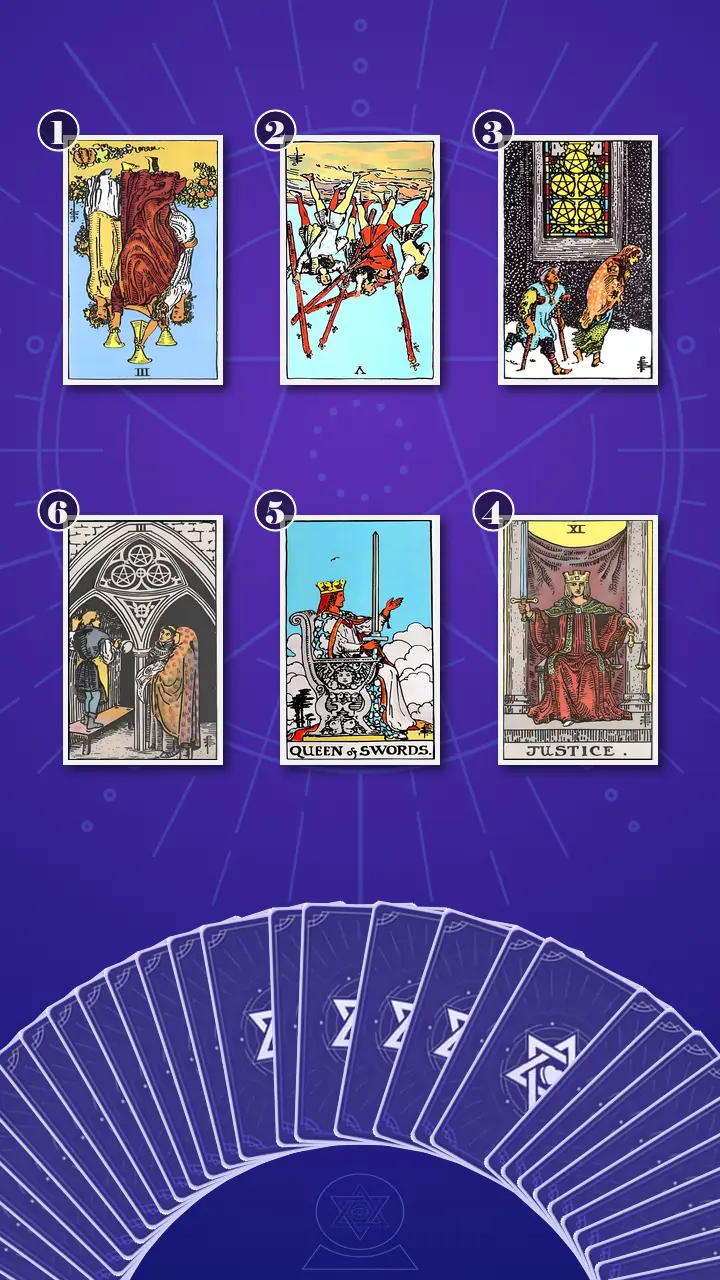
I chose the Transformation Path Grid · Context Edition, a six-card tarot spread for assessing friendship reciprocity and performative care. I arranged the cards in two rows of three, with a folded reading path: across the top from symptom to blockage to root, then down to a leverage point and back across the lower row toward action and integration.
I chose this spread because Jordan's problem was larger than a disagreement between two people. It was a self-reinforcing social system: a caring label, repeated no-shows, suppressed disagreement, fear of exclusion, and another round of excuse-making. A conventional relationship spread would have shown different perspectives without fully exposing that loop. A ten-card Celtic Cross would have widened the inquiry beyond what we needed. This grid kept the causal chain visible.
I explained the three positions that would matter most. The first would show what the caring label produced when practical support was requested. The third would reveal why naming the mismatch felt so socially expensive. The fourth, placed directly beneath it, would supply the insight capable of changing the pattern. The remaining cards would turn that insight into communication and observable cooperation.
This is how tarot works best in a question like this: not as a supernatural ruling on anyone's heart, but as an objective cognitive tool. The symbols separate experiences that have become emotionally fused. Their card meanings in context help me ask cleaner questions; Jordan still decides what those answers mean for their life.
The Circle Turned Upside Down
Position 1: The Celebration That Could Not Circulate
The card I turned first represented the observable symptom: Jordan continued calling the circle caring even when reactions, vague apologies, and repeated no-shows failed to produce practical support. It was the Three of Cups, in reversed position.
Three figures normally raise their cups inside a closed dance of shared abundance. Reversed, the image looked less like mutual support and more like Jordan's familiar chat montage: a request for a twenty-minute check-in, six hearts, three sending-love messages, and no person naming a time. The group still felt affection. The affection simply was not circulating into participation.
I described the reversal as an excess of water at the level of display and a deficiency at the level of exchange. Warm language arrived quickly, but time, labour, and presence did not. Jordan then overcorrected by volunteering for other people's needs, as though usefulness might prove the circle was reciprocal while making the absence of reciprocity harder to see.
“A heart reaction is like tapping Like on a calendar invite,” I said. “It acknowledges the feeling without reserving a seat. Think of your last request for a ride, a check-in, or a specific block of time. After the reactions arrived, what did anyone actually do?”
Jordan gave a short laugh, but no amusement reached their eyes. “That is so accurate it feels kind of brutal.” Their fingers closed around the untouched mug, then loosened when they noticed the tea had gone cold.
I slowed down. “Accuracy is not an accusation. This card is not saying the affection is fake. It is asking whether affection alone performs the function you have been assigning to care.”
Jordan looked again at the overturned cups. “So the group might mean what it says and still not be able to do what I need.”
“Exactly. Capacity and character are different questions.”
Where Harmony Ate the Question
Position 2: The Sentence Deleted Before Anyone Could Answer
The next card represented the maintaining blockage: conflict suppression and consensus-seeking prevented the group's caring story from being tested. I turned the Five of Wands, in reversed position.
The crossed staffs looked like five people editing the same Slack thread until the direct question disappeared beneath polite phrasing. In Jordan's life, the card appeared whenever they typed, “Can we talk about why nobody committed?” and replaced it with a joke about everyone being allergic to calendars.
The card held blocked fire. Friction existed, but Jordan redirected it inward before it could become useful disagreement. They wanted a clear answer, yet felt responsible for preserving the group's comfortable mood. Their inner operating system ran a familiar script: If I ask directly, I create conflict. If I soften it, I stay included.
I asked, “When nobody commits, what sentence do you usually delete before pressing send?”
Jordan opened the poll, drafted a line, and held the phone where I could see it: “Does anyone actually intend to come?” Their thumb hovered over the words. Their breathing paused; their gaze drifted as though scanning several previous chats; then they exhaled and locked the screen without deleting the sentence.
“I would normally add, no pressure, I know everyone is exhausted, sorry for making this a whole thing,” they said.
“That disclaimer answers on their behalf,” I replied. “It turns your need into a joke before anyone has to state a capacity. A calm disagreement would not automatically damage the group. It might give the group its first chance to define what showing up means.”
I also named the opposite risk. After staying quiet for months, Jordan might eventually post that nobody had ever cared, and the conversation would collapse into a debate about tone. The Five of Wands reversed was not asking for an explosion. It was asking Jordan to let one clean sentence survive.
The Warm Window Across the Snow
Position 3: The Belonging Fear Beneath the Flexibility
The third card represented the root fear: that naming the lack of reciprocity could lead to exclusion and the loss of belonging. I turned the Five of Pentacles, upright.
I pointed to the two figures moving through snow beneath an illuminated window. The image matched a specific kind of Toronto cold: Jordan watching an Instagram Story about chosen family and mutual support while their private request sat unanswered, or seeing friends at brunch near Queen Street West after nobody had offered to help carry a small table upstairs.
This was not a prediction that the group would cast Jordan out. It showed access to support constrained by scarcity. Symbolic shelter remained visible, but Jordan did not experience its practical protection when they needed it. Membership in the group chat had become a keycard to the lobby, not proof that anyone would meet them at the door.
“If you admitted that this arrangement does not work for some of your needs,” I asked, “what are you afraid you would lose?”
Jordan's hand moved instinctively to their stomach. “Not just one friendship. The chat, weekend invitations, knowing what people are doing. Most of my social life overlaps with them. If I say the circle is not caring, and everyone disagrees, I am the dramatic one standing outside.”
I heard the deeper sentence beneath that answer: If I admit this does not work, what will I have left? I did not treat it as a forecast. Fear often protects against a possibility before reality has tested which individual relationships can tolerate honesty.
“You do not have to call the circle cruel to admit it is not currently reliable,” I said. “And you do not have to erase every friendship to describe one pattern accurately. Belonging should not require you to translate silence into support.”
Jordan's jaw tightened before their shoulders moved down by a fraction. The card had touched the actual cost: not merely a missed check-in, but the terror that accurate language might remove the last sign saying they were already inside.
When Justice Put the Group Chat on the Scales
Position 4: The Fair Witness Takes the Seat
The radiator clicked once and then went quiet. In that small pocket of silence, I turned the card representing the leverage point: a fair comparison of caring language with specific commitments, impact, and follow-through. It was Justice, upright.
Justice held scales at eye level and an unswerving sword between two pillars. I did not read the card as punishment, karma arriving to expose bad friends, or permission for a prosecution. I read it as evidence-based discernment. Jordan could separate supportive language, concrete commitments, completed follow-through, and actual impact without converting the result into a judgment of anyone's total character.
I asked Jordan to return to the Sunday poll: six reactions, no selected time, cold tea, and their fingers adding three more dates. They had been trapped in the question, “Do they care deep down?” Each excuse protected a hopeful answer while replacing the practical support they had requested.
Seeing Justice, my mind did not go to cosmic punishment. It went to the formula sheets from my fifteen years as a perfumer. A beautiful description cannot rescue a fragrance whose structure disappears on skin. The opening note matters, but so does the drydown: what remains after time, heat, and ordinary life test the composition.
I call this lens my Aura Permeability Diagnosis. I use scent as a metaphor to notice where a group's emotional atmosphere crosses a person's boundary and begins speaking as if it were objective fact. Jordan's circle had a warm ambient accord: chosen family, mutual care, we have got you. That atmosphere had permeated their self-assessment so thoroughly that they treated the group's description as stronger evidence than their own repeated experience.
Justice did not ask Jordan to seal themselves away or declare the air poisoned. It asked them to compare the social top note with the relational drydown: warmth on arrival versus what remained when care required a named person, a time, and an action.
Stop balancing the circle with excuses; place its words and follow-through on Justice's scales, then name the relationship their actual weight supports.
I let the sentence rest between us before giving Jordan the quieter permission beneath it.
A caring label is not proof of care. Let repeated behavior, clear commitments, and follow-through tell you what this circle can honestly hold, without turning that truth into a verdict on your worth.
Jordan went completely still. Their next inhale stopped halfway, and their thumb remained suspended above the warm phone screen. Their pupils widened; then their gaze slipped past me as though the previous five requests were replaying in order. One corner of their mouth tightened. Their eyes shone, but their shoulders did not drop yet. Then came the unexpected turn: anger sharpened their voice. “But does that mean I was wrong this entire time? That I made all of it up because I wanted somewhere to belong?” Their fingers curled around the mug and slowly released. I watched the question penetrate before I answered. The anger thinned into a tremulous breath; their throat worked once; finally, their shoulders sank. Relief arrived with a brief, almost dizzy blankness, the vulnerable pause that follows when an old explanation no longer carries the weight.
“No,” I said. “You used the best available story to protect something important. The story helped you remain connected, and it also kept you from using the information in front of you. Recognizing the cost now does not make your earlier self foolish.”
Jordan wiped beneath one eye and gave a quieter, more complicated laugh. “So I can be fair without pretending the evidence says more than it does.”
“Yes. A reaction is acknowledgment; a commitment is care in motion. Neither has to impersonate the other.”
I invited them to test the insight against lived memory. “Now, with this new perspective, think back to last week. Was there a moment when separating warmth from commitment would have changed what you felt or did?”
Jordan returned to the Sunday poll. “I would have stopped after the first set of dates. I could have said, I am seeing reactions but no selected time, so I am going to assume this check-in is not happening. That would have hurt, but I would not have spent another hour trying to make it real.”
I kept the next move private and proportionate. I suggested a ten-minute timer and three columns for the most recent two support requests: warm reactions, concrete commitments, and follow-through. Jordan did not have to send the record, confront the group, or finish it while flooded. They could close the note and return only if and when they chose.
This was the central emotional shift of the reading: from lonely disillusionment and protective excuse-making toward grounded trust based on observable reciprocity. It did not settle the future of the circle. It changed the question from “Am I worthy enough for them to care?” to “What did they commit to, what happened next, and what can I responsibly trust?”
The Message That Survived Editing
Position 5: The Queen of Swords Leaves Room for a Real Answer
The fifth card represented the immediate relational practice: making a direct request, inviting an explicit answer, and communicating a boundary without deciding for other people. I turned the Queen of Swords, upright.
Her sword stood vertical while her other hand remained open. I read that combination as firm information paired with genuine choice. In Jordan's life, she was one message naming a task, date, time, and response deadline without a paragraph that made the need disappear.
“Could you call me Wednesday at 6:30 for twenty minutes after my meeting? A clear yes or no by Tuesday noon would help me plan.”
The Queen's air was balanced: enough precision to prevent guessing, enough openness to allow an honest limit. A no would not become a moral failure. A yes would not count as care until it became follow-through. Silence would remain silence rather than a blank Jordan had to fill with explanations.
“I hate how exposed that message makes me feel,” Jordan said. Their index finger traced the edge of Justice. “I want to add no pressure, and I know you are busy, and sorry this is so specific.”
“Specific is not the same as coercive,” I said. “The open hand gives the other person a real choice. The sword protects the information you need. You are not forcing attendance; you are refusing to negotiate against your own request before anyone answers.”
I asked what would be realistically reciprocal, and Jordan did not promise unlimited availability in return. They named one thing they could genuinely offer: a twenty-minute call on a weekday evening with advance notice. The boundary stayed open, but it stopped functioning like an all-hours help desk.
From Raised Cups to Something Built
Position 6: The Quiet Architecture of Reciprocity
The final card represented integration: defining care through realistic coordination and investing trust according to demonstrated reciprocity. I turned the Three of Pentacles, upright.
The craftsperson and two collaborators stood around a visible plan. Unlike the reversed Three of Cups, this card did not need a large declaration. It looked like three people confirming who would call, who would bring what, and when they would follow up. It was a small Notion board with named owners and realistic dates, not a manifesto about how collaborative everyone was.
The earth energy here was balanced and available. Care became tangible enough to inspect without becoming transactional. Each person could state a capacity. Different contributions were allowed. Trust could grow around what participants repeatedly helped build and sustain, whether those people came from the existing circle or from relationships Jordan had previously treated as peripheral.
I placed the two Threes where Jordan could see them together. On one side, the reversed Three of Cups held a crowded chat full of reactions. On the other, the Three of Pentacles held a modest shared task with visible contribution.
“You do not need less connection,” I said. “You need connection whose emotional meaning is supported by practical participation. Let the label be a question; let the pattern answer.”
Jordan studied the two cards. Their expression carried grief for the community they had been describing and curiosity about the relationships they had not yet assessed individually. “The second card looks quieter,” they said. “But I trust it more.”
I asked what one modest collaboration might look like. Jordan imagined a twenty-minute check-in with one confirmed time, one person initiating the call, and a simple follow-up the next day. Nothing cinematic. Nothing that required the whole group to share one definition of care. Just a structure small enough for reality to enter.
Care in Practice: Two Next Moves
I gathered the cards into one causal story. The reversed Three of Cups showed the visible friendship reciprocity gap: emotional language without dependable circulation. The reversed Five of Wands explained how the gap survived because Jordan edited out disagreement. The Five of Pentacles revealed why that editing felt necessary: the group was a warmly branded waiting room, and questioning the sign on the wall seemed to risk losing even the lobby. Justice separated atmosphere from evidence. The Queen of Swords turned evidence into a clear request. The Three of Pentacles grounded care in something people could actually coordinate and complete.
Jordan's cognitive blind spot was not simply believing that everyone had good intentions. It was treating the group's shared label, and their continued membership under it, as proof that their silence was necessary. Each reassuring follow-up preserved immediate inclusion while preventing the relationship from producing new information.
The transformation direction was precise: Jordan would move from using consensus as evidence to tracking specific requests, commitments, and follow-through. They could then name each relationship according to the capacity its behaviour supported. Some people might remain warm social friends. Some might prove dependable in specific ways. Some limits might become clearer. None of those observations required demonizing anyone or abandoning Jordan's need for belonging.
Before we shaped the actions, I introduced my Scent Bubble Protocol. I asked Jordan to touch the inside of their wrist, where fragrance is traditionally tested, feel both feet against the floor, and picture a clean perimeter of air at arm's length. The group's urgency, disappointment, or reassuring language could remain outside for one full breath before Jordan chose a response.
I explained that the bubble was not a magical shield or a wall against intimacy. It was a somatic pause between atmosphere and action. Other people's capacity belonged to them; Jordan's need did not have to evaporate upon contact with the chat. The protocol would help them enter a draining social ecosystem without absorbing its mood as an instruction.
- The Three-Column Reciprocity CheckThis week, open a private note titled Care in Practice. Set a ten-minute timer and review the two most recent support requests. Record only observable behaviour under warm response, concrete commitment, and follow-through; add one line for the support you actually had afterward.Start with one request if two feels loaded. Do not use the note as a prosecution, and stop if your body begins to spiral. The purpose is clarity, not self-surveillance.
- The Scent-Bubble Clear-Yes-or-No RequestChoose one person and one small practical need. Take two minutes for the Scent Bubble Protocol, then send one task, one time, and one deadline: Could you do X at Y time? A clear yes or no by Z would help me plan.Do not add an apology or explain why the other person is allowed to decline. A clear no is usable information. Wait to send until the message feels steady enough, and offer only what you can realistically reciprocate.
I reminded Jordan that these were experiments, not loyalty tests. A single response could provide information, but repeated behaviour would deserve more weight. The cards had not issued an instruction to stay or leave. They had given Jordan a fairer way to notice where care was already moving and where a label had been doing all the work.

The Quiet Proof at 6:31
Six days later, I received a message from Jordan. They had completed the reciprocity check using two requests. Seeing the columns had hurt: the warm-response column was crowded, while follow-through held one entry. Yet the page also felt cleaner than another night spent asking whether they had phrased everything incorrectly.
They had then used the Scent Bubble Protocol before messaging one friend: “Could you call me Wednesday at 6:30 for twenty minutes after my meeting? A clear yes or no by Tuesday noon would help me plan.” The friend replied yes without fanfare and called at 6:31.
Jordan did not announce that the care circle was repaired. They did not use one call to erase the previous pattern. They simply let one person's follow-through become evidence about that particular relationship. The rest of the group could remain emotionally warm while Jordan assessed its practical capacity more carefully.
They slept through the night. In the morning, their first thought was, “What if I made this a whole thing?” Then they smiled, because the thought no longer erased what had happened.
I thought back to the cold mug beside the glowing poll. The light in Jordan's apartment had not become brighter through tarot magic. Jordan had made the change by allowing a direct request to remain intact, letting another adult name their own capacity, and trusting observable reciprocity more than an inherited group description.
That was the real Journey to Clarity: not certainty about every friendship, but movement from explaining away no-shows toward grounded trust in realistic commitments, honest limits, and completed acts of care. I had held the cards and offered the language. Jordan had placed the evidence on the scales.
If your throat tightens over a message full of hearts while no one has named a time, I hope you remember what Justice made visible: you may be trying to keep belonging intact by calling absence care. Noticing that does not make you cynical. It is the first clean breath inside a boundary that belongs to you.
Then let the label remain a question and let one small pattern answer: what shared task, with one named person, one honest commitment, and one visible follow-through, would feel quietly possible enough to place on your side of the scales this week?