Leaving One Group Plan Unfilled: Letting Old Friends Share the Load

The 10:45 p.m. Voice Note That Followed Work Home
I recognized the pattern as soon as Casey appeared on my screen: they could coordinate six stakeholders at their Toronto project job, but the task that truly followed them home was managing an old friend group’s moods whenever one late-night message activated their caretaker role.
Casey described the previous Tuesday at 10:45 p.m. Their film was paused mid-scene, the radiator clicked against the apartment wall, and cold popcorn sat untouched beside them. An old friend’s distressed voice note had played twice. The phone felt warm in Casey’s palm as they opened the group calendar and started rearranging Saturday.
Nobody had asked Casey to fix anything yet, but their body was already preparing to. Their chest felt as if a drawstring had been pulled tight behind the sternum; restless energy rushed into their fingers, while the weight of the responsibility was already settling across their shoulders.
“I know nobody asked me,” Casey said, “but if I don’t sort it out, who will? I can’t tell whether I’m being generous or making myself indispensable.”
I heard the real consultation question underneath that sentence: What keeps me stuck as the caretaker around old friends? Casey wanted equal, adult friendship, yet setting even a modest limit felt capable of erasing fifteen years of belonging.
“You’re not confused about whether you care,” I told them. “You’re trying to find out whether care is allowed to have a limit. We’re not going to use tarot to predict which friends stay or to tell you what you must do. We’re going to use it as an objective map of the pattern, so you can decide what belongs to you and what does not.”
I have spent a decade helping people read the cycles of their lives. A low tide is not a personal failure, and relational anxiety is not proof that disaster is approaching. Sometimes the first movement toward clarity is simply learning to distinguish a painful alarm from an accurate signal.

Choosing the Bridge, the Buried Anchor, and the Signpost
I asked Casey to put both feet on the floor, take one unforced breath, and hold a single question in mind: “What role am I maintaining, and what would make care feel chosen again?” I shuffled slowly. The pause was not a mystical performance; it gave Casey’s nervous system time to move from reacting to observing.
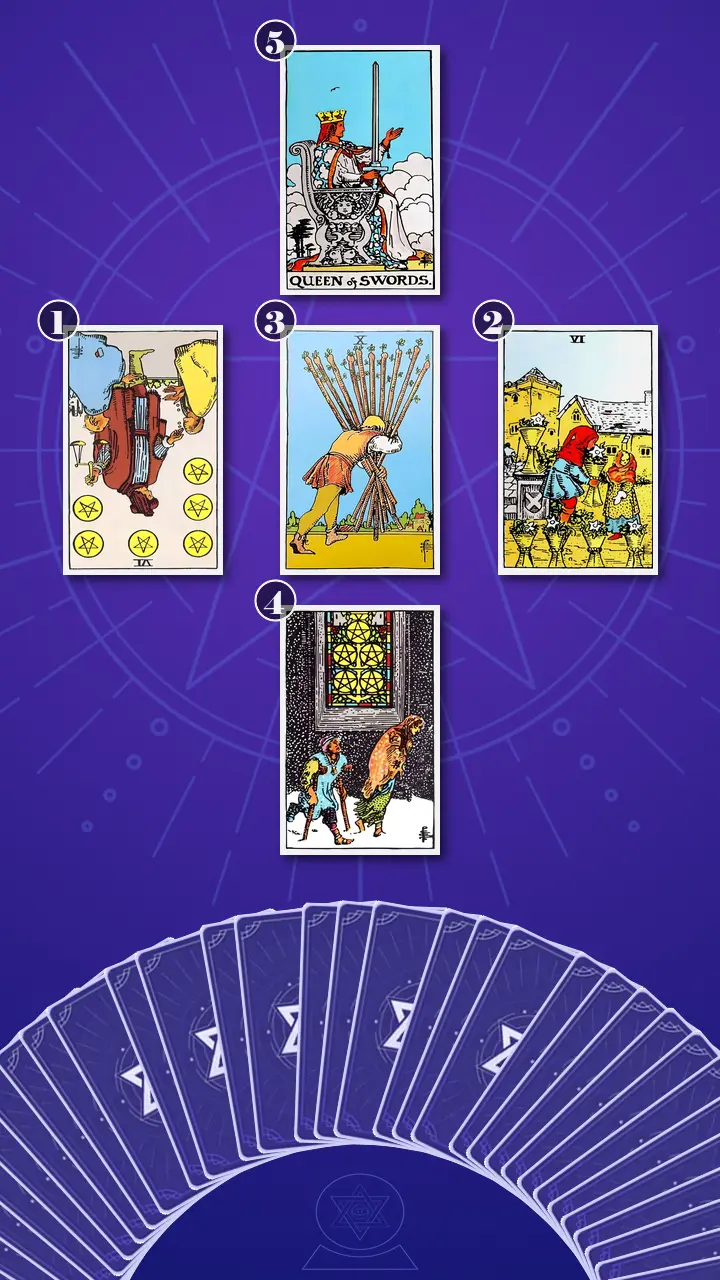
I chose the Relationship Spread · Context Edition, a five-card relationship tarot spread adapted for friendship boundaries and group dynamics. For anyone wondering how tarot works in a situation like this, I treat the cards as structured prompts. Their value comes from placing behavior, history, fear, and available choices where we can examine them together. The cards do not grant me access to anyone else’s private motives.
The first card would reveal Casey’s observable caretaker behavior. The second would show how the old group and its shared history reinforce familiar roles, without assuming that anyone is doing so deliberately. The center card would identify the system created between them. Beneath it, the fourth card would expose the fear anchoring that system. Above it, the fifth would offer self-directed guidance.
I placed the cards in a cross: Casey on the left, the group on the right, the shared dynamic between them, the blockage below, and the guidance above. To me, the layout resembled a bridge with a buried anchor and a clear signpost. It was enough structure to explore emotional labor, reciprocity, and boundary guilt without turning a complex friendship into a simplistic verdict.
Reading the Map of Invisible Friendship Labor
Position 1: When the Scales Forget Your Capacity
Now I turned over the card representing Casey’s observable caretaker behavior and the habit of giving before checking capacity. It was the Six of Pentacles, reversed.
I pointed to the scales held above the exchange. “You’re constantly measuring what everyone might need,” I said. “A call for this person. A ride for that person. A new plan for Saturday. A private message to prevent two friends from misunderstanding each other. But your time, money, and nervous system are missing from the calculation.”
The modern-life version of this card was the scene Casey had already described. A distressed message arrived, and Casey immediately assumed a managerial position over the entire situation. Before the friend named what support they wanted, Casey was deciding who needed a call, how the weekend should change, and how every person could be kept comfortable.
The generosity was real. I made that distinction carefully. I did not read the reversed card as evidence that Casey was secretly manipulative or that their help had never been sincere. I read its Earth energy as distorted: an excess of giving, a deficiency of receiving, and a blockage around mutual negotiation. Help had become the quickest available route to reassurance.
“The thought is, ‘I know nobody asked me, but if I don’t sort it out, who will?’” I said. “The task lowers the uncertainty for a moment. That relief trains you to take the next task even faster. It’s like an algorithm learning one signal: caretaking produces reassurance, so the system recommends more caretaking.”
Casey let out one short, bitter laugh. Their fingers tightened around the mug, then loosened. “That is painfully accurate,” they said. “Almost rude.”
I smiled gently. “The card is describing a loop, not accusing you of causing everything. But it does ask one precise question: before you offered the last favor, where was your own capacity on the spreadsheet?”
Casey looked back at the card. “It wasn’t on there.”
“That’s the imbalance,” I said. “Usefulness can produce reassurance without producing mutuality.”
Position 2: The Old Joke That Reloads an Old Role
Now I turned over the card representing how the old friend group and its shared history reinforce familiar roles. It was the Six of Cups, upright.
The card showed one flower-filled cup being offered within a sheltered courtyard. I asked Casey about the last time an old school photo, nickname, or recurring joke appeared in the chat.
“Last Thursday,” they said. “Someone posted our graduation photo. I laughed, and about thirty seconds later I volunteered to organize a reunion dinner.”
That was the Six of Cups in context. The affection was genuine. Being known across fifteen years could feel like warmth returning to the room. Yet that same memory acted like restoring a phone from an old backup: the treasured photos came back, but so did settings that no longer fitted the current user.
The card’s Water energy was open and flowing, but the group relied heavily on one familiar channel. Nostalgia could carry Casey backward into the dependable organizer role before they noticed the transition. What had once been a loving gesture had gradually become a script.
“Shared history explains the role,” I said. “It does not have to keep assigning it.”
This was where I used one of my core diagnostic tools, Orbital Drift Recognition. I asked Casey to imagine each person in the group as someone whose values, capacity, communication style, and adult life had continued moving since school. Cognitive growth naturally changes an orbit. A role learned at sixteen can become misaligned with the person inhabiting it at twenty-nine, and noticing that drift does not make anyone disloyal.
“Orbital drift doesn’t automatically mean a friendship must end,” I explained. “It means an old form of closeness may need updating. You can keep the warmth of the Six of Cups without allowing the past to write today’s job description.”
Casey’s expression softened, then tightened at the edges. I watched warmth and grief pass across their face almost together.
“Saying no feels much bigger with people who knew me before I knew myself,” they said quietly.
“Of course it does,” I replied. “You’re not only changing a plan. You’re testing whether they can know the person you are now.”
Position 3: The Project Board Nobody Else Can See
Now I turned over the card representing the shared relational pattern created when Casey’s over-functioning meets the group’s reliance on that familiar role. It was the Ten of Wands, upright.
The figure on the card carried ten bundled wands so tightly that the load blocked the road ahead. I described Casey closing a project tracker at work, only to open an invisible friendship tracker in their mind: restaurant bookings, payment reminders, birthdays, transport, emotional updates, unresolved side chats, backup plans, and the friend who might be upset but had not said so.
“No wonder your view is blocked,” I said.
The Ten of Wands carried Fire in excess. Casey’s competence kept producing movement, but the movement had become overcommitment. Friends saw that dinner happened and the disagreement settled. Casey saw every dependency that might have failed. The group was functioning, but that did not mean it was being mutually maintained.
I compared the pattern to the crisis-management rhythm of The Bear: solve the immediate problem, keep the system moving, and postpone feeling the cost because another task is already burning. Casey’s professional skill had followed them home and acquired administrator permissions for the friendship. Every social glitch appeared on their dashboard, so every repair felt like their assignment.
I did not claim that the group consciously wanted Casey depleted. The structure could persist precisely because Casey’s labor was so effective that much of it remained invisible. When one person always fills the gap, everyone else receives fewer chances to notice it, volunteer, fail, adapt, or become more reliable.
Casey’s shoulders dropped by nearly an inch. They exhaled as if I had finally named the individual objects inside a weight they had previously experienced as one solid block.
“I want them to check on me without needing me to fall apart first,” they said. “But I’m usually too busy making sure they’re okay to tell them I’m not.”
“Then the question is no longer whether you can carry the bundle,” I said. “You clearly can. The question is what carrying it prevents you from seeing about the friendship itself.”
The Twenty Minutes Outside the Lit Window
Position 4: When Silence Becomes a Verdict
Now I turned over the card representing the deeper fear that keeps Casey participating in an exhausting arrangement despite resentment. It was the Five of Pentacles, upright.
The card showed two figures moving through snow beside an illuminated stained-glass window. Connection appeared close enough to see, yet psychologically inaccessible. Its Earth energy was contracted into scarcity: a blockage in which an ordinary boundary could feel like evidence that belonging was about to be removed.
I asked Casey to reconstruct the last time they had declined a favor. They remembered standing in their apartment kitchen at 6:26 p.m. The kettle clicked off. Steam fogged the window, and a streetcar bell sounded below. Casey had written, “I can’t drive across town tonight, but I can check in tomorrow.” Then they placed the phone face down.
The typing indicator appeared and vanished. Twenty minutes passed without a reply. Casey’s mind moved through the same sequence: They’re disappointed. They’ll stop asking. They’ll stop inviting me. Their fingers kept reaching for the screen as though one more check could prevent social exile.
“The feeling of being outside arrives before anyone has actually excluded you,” I said. “That doesn’t make the feeling fake. It means the feeling and the evidence are not yet the same thing.”
As I looked at the illuminated window in the card, I thought of the eclipses I had watched and studied over the years. A shadow can alter what is visible without proving that the source of light has disappeared. The association was immediate, but I kept the interpretation grounded.
“I’m not reading this as a prediction that your friends will reject you,” I told Casey. “I’m reading it as the older scarcity story that makes over-functioning feel safer than waiting for present-day information. The evidence question is: what has actually happened, what did you predict, and what remains unknown?”
Casey’s breath paused. Their gaze drifted past the screen as if replaying several quiet group chats at once. Then their eyes returned to the card, bright with a sadness they had been converting into tasks for years.
“What if I test it and find out I was right?” they asked.
“Then you will have information,” I said. “Information can hurt, but it also ends the exhausting job of trying to control every possible answer in advance. And one person’s disappointed reaction will still not define your worth, or necessarily define the entire friendship.”
When the Queen Raised Her Sword and Kept Her Hand Open
Position 5: The Boundary That Leaves the Relationship in the Room
The radiator behind Casey clicked once and fell quiet. I turned over the card representing the self-directed way to separate genuine care from automatic responsibility and test the friendship’s capacity for mutuality. This was the key card: the Queen of Swords, upright.
Her sword stood vertical and visible. Her other hand remained extended. I read that combination as balanced Air: clear discernment, honest language, and a boundary that does not require emotional disappearance.
In modern life, the Queen sounded like Casey replying, “I can listen for fifteen minutes, but I cannot reorganize the weekend.” No apology paragraph. No invented excuse. No hidden plan to fix everything later. Capacity became visible, care remained available, and the friend’s response stayed with the friend.
I used my Gravity De-linking Analysis to clarify why such a simple sentence could feel so difficult. In Casey’s current pattern, every friend’s disappointment exerted gravitational force on Casey’s choices. Casey responded by firing emotional and practical thrusters, trying to keep the whole constellation in its familiar alignment. The Queen’s sword did not sever connection; it de-linked responsibilities. One person could have a feeling without Casey becoming responsible for removing it.
“This is not a forecast of separation,” I said. “It is a way to stop forcing alignment between adults who may be moving through different life phases. You can stay relationally present without managing everyone back into comfort.”
I watched Casey trace the familiar sequence again: pause the film, replay the voice note, open the calendar, move Saturday. Solving the unnamed task had brought a burst of relief, yet their tight chest and heavy shoulders had recorded the cost before their mind admitted it.
You do not have to earn belonging by carrying everyone's feelings; name one clean boundary and let the Queen's raised sword separate chosen care from automatic obligation.
I left a full beat of silence around the sentence.
A boundary does not make your care smaller; it makes care voluntary enough to reveal whether the friendship can meet you back.
Casey’s inhale stopped first. One fingertip remained suspended above the mug while their eyes lost focus, as if old voice notes, bookings, rides, and side-chat apologies were replaying behind them. Then their mouth hardened.
“But doesn’t that mean I’ve been doing friendship wrong for fifteen years?” they asked, their voice suddenly sharper.
“No,” I said. “It means a strategy that once helped you feel connected is now costing more than it can honestly give. We can respect why you learned it without requiring you to keep living inside it.”
The anger held for a moment. Then Casey’s jaw shifted, their eyes reddened, and the hand around the mug slowly opened. Their shoulders lowered on a trembling exhale. Relief arrived, followed by a brief, exposed stillness: the slight dizziness of realizing that clarity also creates responsibility.
“So I have to let them respond for themselves,” they said. The words were quiet, nervous, and steadier than before.
“Now, using this new perspective, think back to last week,” I invited. “Was there a moment when this insight could have made you feel different?”
Casey returned to the Sunday kitchen. “I might still have hated the silence,” they said, “but I wouldn’t have treated it as a final answer.”
I set a ten-minute timer and asked them to draft two lines: “I can offer...” and “I cannot offer....” I asked them not to add an apology or a promise to compensate later. They did not have to send the message that day; if the exercise became too activating, they could stop after noticing which line was harder to complete.
Casey wrote: “I can listen for fifteen minutes. I cannot reorganize the weekend.” They stared at the sentence and said, “It looks so normal.”
“It is normal,” I replied. “The intensity is in what the sentence asks you to stop controlling.”
That was the breakthrough: not instant certainty, and not a promise that every friendship would respond perfectly. It was the first movement from hyper-vigilant over-functioning and boundary guilt toward chosen care, visible reciprocity, and steadier belonging. The Queen did not offer Casey a colder heart. She offered a cleaner distinction.
Finding Clarity by Leaving One Space Unfilled
The Blind Spot Hidden Inside Reliability
I gathered the spread into one story. The reversed Six of Pentacles showed Casey measuring everyone’s needs while excluding their own capacity. The Six of Cups explained why the role felt loving, familiar, and morally difficult to question. The Ten of Wands revealed what that repeated gesture had become: invisible friendship project management. The Five of Pentacles exposed the buried anchor, the fear that usefulness was the price of admission. The Queen of Swords introduced the missing element: language clear enough to separate care from responsibility.
Casey’s blind spot was not that they cared too much. It was the assumption that solving quickly protected the relationship without affecting it. Immediate rescue reduced uncertainty, but it also hid Casey’s limits and removed opportunities for friends to initiate, repair, organize, or reciprocate. The caretaker role was like an unofficial on-call schedule with only one name on it, even though Casey had never consciously agreed to every shift.
The key shift was practical: instead of automatically solving each friend’s problem, Casey could ask what support was wanted, name what they could realistically offer, and allow other adults to manage their own feelings and responsibilities.
I framed the next steps through my Constellation Release Protocol. The protocol does not mean ghosting people, punishing them, or deciding in advance that a friendship must fade. It means naming the present orbit, separating each person’s gravity, and releasing the attempt to force every relationship into its old formation. Casey could offer one honest point of light without holding the whole constellation in place.
“But what if it’s actually serious?” Casey asked. “I can’t always wait thirty minutes.”
“Correct,” I said. “A genuine emergency may call for a different response. The pause is not a rigid rule or a test of toughness. It is a small interruption for non-emergency requests, and even five minutes counts. Discomfort is information, not an order.”
Two Small Tests of Mutuality
- The Capacity-First Reply For one non-emergency message from an old friend this week, mute the chat and set a 30-minute timer before answering. When the timer ends, ask, “Do you want listening, practical help, or company right now?” Then write two lines in your Notes app: “I can offer...” and “I cannot offer....” Use those lines to send one clear reply. Start with a five-minute pause or draft the message without sending it if the full version feels too activating. The purpose is to restore choice, not to perform a perfect boundary.
- The One Unfilled Space Experiment Choose one upcoming group task, such as selecting the venue, collecting payments, or sending reminders. Post, “I’m not able to coordinate this one. Who wants to take it?” Leave the task unclaimed for 24 hours without privately recruiting someone or building a backup plan. Afterwards, record only observable actions: who initiated, followed through, adapted, or left it undone. Decide beforehand what imperfect outcome you can tolerate, such as a later booking or a less polished plan. Skip any experiment involving your safety, money, or a firm commitment you have already made.
“Leave one space unfilled and watch who steps into it,” I told Casey. “The result is information, not a verdict on whether you deserve friendship. You are testing the structure, not testing your worth.”
A Week Later, the Quiet Proof
Six days later, Casey sent me a message. They had told the group, “I can join Saturday, but I can’t coordinate this one.” For three hours, nobody claimed the task. Casey opened a restaurant tab twice, closed it twice, and used the Constellation Release Protocol: present fact, separate responsibility, release the outcome.
The next morning, one friend chose a venue and another created the booking poll. The plan was later and less tidy than Casey would have made it. It still happened. More importantly, one friend messaged Casey privately, not to ask for help, but to ask how their week had been.
Casey had slept through the night, but their first morning thought was still, What if they stop inviting me? This time, they noticed it, smiled once, and did not open the group chat before breakfast.
I did not call that a solved life. I called it evidence. The tarot had not made Casey’s friends reciprocate, and it had not removed every spike of boundary guilt. It had helped Casey see the hidden structure clearly enough to make one different choice. Casey created the proof by leaving a space open.
That was our Journey to Clarity: from endlessly reading the group’s emotional weather to stating one honest capacity; from trying to guarantee belonging through usefulness to allowing belonging to be tested through mutual presence. The cards provided the map. Casey remained the person choosing the route.
When a familiar name lights up your phone and your chest tightens before you have even listened, the hardest part may not be the favor itself. It may be the fear that the people who have known you longest will love you less if you stop making everything work. Noticing that fear does not mean you have failed at boundaries. It means you have finally found the buried anchor.
If your place in your own constellation did not need to be proved tonight, what small piece of chosen care would you place in the Queen’s open hand, and what responsibility would you allow to remain in someone else’s orbit?