The 9:40 p.m. Shift Into Caretaker Mode
I know the therapist-friend reflex by its speed: someone can spend all day anticipating users' needs, then miss their own capacity check when an old friend texts, “Can I vent?” At 9:40 p.m. on a wet Toronto Tuesday, Sam, a 29-year-old UX designer, joined my video session from a small condo kitchen, halfway through reheated curry.
The radiator clicked behind them, and traffic hissed over wet pavement below. Their phone had grown warm in one hand. In the other, they held open the Notes app beneath a list of three possible solutions to a voice note that had ended with, “I don't know what to do.” Their dinner was cooling while they checked whether the next morning's plans could be moved.
“They didn't actually ask me to fix anything,” Sam said. “But I can already see what needs doing. If I wait, they'll think I don't care. I want to be their friend, not their emergency plan, but if I stop being the reliable one, I honestly don't know what my place is.”
I watched their torso lean toward the phone even after they put it down. Obligation seemed to sit behind their sternum like a second device stuck on vibrate, demanding a response before the rest of their body could vote. Tenderness was present, but so were guilt, a locked chest, and the quiet resentment of watching another evening disappear into help nobody had clearly requested.
“Nothing about this makes you broken or uncaring,” I told them. “A familiar role can reactivate before your adult self has time to choose. After a decade of reading people's cycles, I have learned not to mistake a relational low tide for a permanent verdict. We are not going to ask the cards to predict what your friends secretly think. We are going to use them as an objective map of the pattern, so you can find the exact moment where choice becomes possible again.”

A Bridge with a Buried Weight: The Five-Card Relationship Spread
I asked Sam to place both feet on the floor and take one unforced breath before I shuffled. I treat this pause as a transition, not a mystical performance. It gives the mind a chance to stop rehearsing an answer long enough to look at the question.
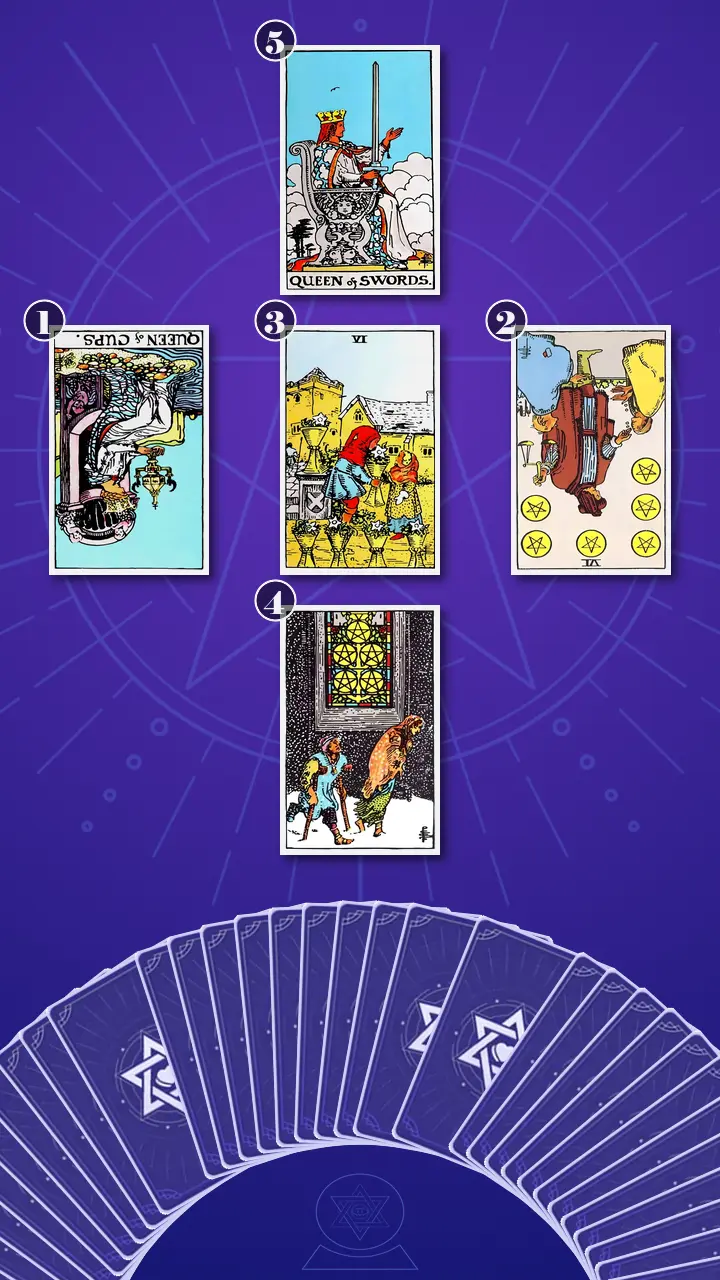
I chose the Relationship Spread · Context Edition, a five-card relationship tarot spread designed for patterns involving self, observable relational cues, shared history, a central blockage, and a constructive direction. This is how tarot works best in my practice: not as surveillance of another person's motives and not as fate, but as a structured way to see card meanings in context.
The layout formed a relational cross. Position one would show Sam's current overfunctioning stance. Position two would examine what friends had literally requested, what remained ambiguous, and what Sam added without mind-reading anyone. Position three would hold the real affection and old roles beneath the friendship. Position four would expose why one ordinary limit felt capable of costing Sam their place. Position five would rise above the centre as an actionable route toward warm boundaries and more reciprocal care.
On the table, the shape resembled a bridge: two people at opposite ends, a shared span between them, a buried weight below, and a lookout above. It was the smallest map I could use without turning a focused friendship-boundary question into an audit of every relationship Sam had ever had.
Reading the Old Friendship Map
Position 1: The Cup That Took Over the Kitchen
I turned the card representing Sam's current stance and the diagnosis-level symptom: immediate emotional monitoring, unsolicited problem-solving, and the disappearance of their own needs. It was the Queen of Cups, in reversed position.
The Queen's attention is fixed on an ornate, sealed cup while water reaches the edge of her throne. In Sam's life, that became the 9:40 p.m. scene in front of me: replaying a flat tone, opening Notes, drafting three solutions, offering a call, and moving tomorrow before checking whether advice had even been requested.
I read the reversal as both Excess and Blockage. Sam did not have too little compassion. Their compassion was arriving faster than it could find a container. Another person's discomfort flooded the full field of attention, while hunger, fatigue, calendar commitments, and personal capacity fell outside the frame.
“Your sensitivity is not the problem,” I said. “The problem appears in the few seconds when sensitivity becomes ownership. Your mind says, ‘I know they didn't ask, but if I can already see the answer, how can I not help?’ That is the moment care turns into emotional management.”
I also pointed out how easily Sam's professional strength had followed them home after Figma closed, almost like Severance in reverse. At work, detecting friction before someone names it can make an excellent UX designer. In friendship, redesigning another adult's experience before asking what they want can erase both people's agency.
Sam's breath stopped for a beat. Their eyes moved from the card to the open Notes screen, then they let out a brief, bitter laugh. “That's so accurate it feels a little brutal,” they said.
“Then we will be precise without being cruel,” I replied. “This card is not accusing you of caring too much. It is showing where care loses its boundary. Recognition is useful because it gives you somewhere specific to intervene.”
Position 2: The Project with No Brief
I turned the card representing the requests, expectations, and ambiguous signals coming from the other side of the friendship, while keeping their friends' private intentions outside the reading. It was the Six of Pentacles, reversed.
The card's scales made the structure of support visible. An old friend says, “I don't know what to do,” and Sam nearly converts that disclosure into a plan, a call, and next-day follow-up. It resembles accepting a calendar invite with no agenda, then discovering that you have silently become the facilitator, note-taker, and owner of every deliverable.
Here, Earth was in Blockage: time, attention, scheduling, and practical labour were moving without agreed terms. The reversal did not prove Sam's friends were exploiting them. It showed that vague disclosures became unpaid assignments because nobody had paused to clarify what, if anything, was being requested.
“Care is not the same as taking the assignment,” I said. “What if the first reply was not a solution, but a support menu: ‘Do you want listening, ideas, or practical help?’”
Sam read the sentence twice. Their thumb hovered over Notes, their expression turned inward, and then they copied it beneath the abandoned action plan. “That sounds almost embarrassingly simple,” they said.
“Simple is useful here,” I replied. “The question does not force you to provide whichever option they choose. It only stops disclosure from becoming responsibility before consent and capacity have entered the conversation.”
Position 3: The Courtyard Where Everyone Knows Your Role
I turned the card representing the shared history, affection, and familiar identities that formed the foundation of these friendships. It was the Six of Cups, upright.
I saw genuine warmth in the flower-filled cups and sheltered courtyard. I asked Sam about their last old-friends meetup. They described a Saturday near Ossington: glasses knocking against a sticky brewery table, citrus from a spilled drink in the warm air, and someone laughing, “Sam will know what to do,” when the group could not decide where to go next. Everyone had sounded fond. Sam had smiled and opened the calendar automatically.
Unlike the first two cards, this Water energy held a degree of Balance. The friendship was not an illusion, and the memories were not evidence against boundaries. The Six of Cups showed why changing the pattern carried grief: the role was wrapped in inside jokes, shared history, and years of real care.
“An old role can feel like loyalty even when it no longer feels mutual,” I said. “The affection is real. The question is whether yesterday's loving gesture has become today's permanent job description.”
Sam pressed their lips together. Their fingers tightened around the mug beside them, then loosened. “This is who I've always been with them,” they said quietly. “Changing it feels like changing the friendship.”
“It will change what the friendship is allowed to know about you,” I said. “That is not the same as discarding its history. It means present-day consent and capacity get a place beside the past.”
Position 4: The Quiet Chat Beneath the Lit Window
I turned the card representing the psychological mechanism beneath the pattern: the fear that reducing care work could lead to exclusion or loss of belonging. It was the Five of Pentacles, upright.
The image showed two figures moving through snow beneath an illuminated window. I asked Sam about the last time they had declined a call. They remembered lying in bed at 10:56 p.m., the blue light of WhatsApp on the ceiling and a streetcar grinding around the corner. They had written, “I can't call tonight, but I can check in tomorrow.” Then the group chat stayed quiet for forty minutes.
“I reopened it six times,” they admitted. “I knew people could be busy, but my body was already telling me I'd changed in the wrong way.”
Earth had contracted into Excess scarcity and Blockage. One unavailable evening felt like social eviction. Sam described the escalation clearly: no reply meant their friends had noticed; being noticed meant they had disappointed everyone; disappointing everyone meant they were outside.
“A quiet group chat is data-free space, not proof of rejection,” I said. “The fear is real, but the conclusion has arrived before the evidence. The lit window matters because it separates felt abandonment from confirmed abandonment. It does not promise a particular outcome. It reminds you that the friendship has not yet been allowed to respond to the version of you who can care and have a limit at the same time.”
Sam's jaw tightened just as they had described. Their gaze dropped, and for several seconds the radiator was the only sound between us. Then they said, “If I solve the problem, I don't have to sit in that uncertainty.”
“Exactly,” I said. “Immediate usefulness calms the fear for a moment, but it keeps mutuality untested. You supply the answer before the friendship is ever asked the question.”
When the Queen of Swords Cleared the Air
Position 5: An Open Hand and a Precise Line
The room seemed to become quieter as I turned the card representing the actionable path toward compassionate boundaries, explicit support agreements, and reciprocal friendship. It was the key card of the reading: the Queen of Swords, upright.
Her sword stood vertically in one hand while the other remained open toward connection. I did not read the blade as coldness. I read it as distinction: this feeling belongs to my friend; this portion of support is mine to choose; the outcome remains in their hands.
In modern terms, this was Sam replying, “I care about what's happening. I can listen for fifteen minutes tonight, but I can't take on the planning. Would that help?” Tomorrow's appointment stayed in place. Contact remained available, but access to Sam's time, logistics, and emotional bandwidth was no longer unlimited.
Air arrived in Balance. The Queen did not ask Sam to produce more care. She gave existing care language, scope, and choice. The lack of Wands in the spread reinforced that this did not need to become a dramatic group-chat manifesto or abrupt cutoff. A measured sentence was enough for the first experiment.
For a moment, the two Queens took me back to the planetary charts I had studied across years of guiding people through change. An orbit can shift without either body becoming wrong. I used the analytical lens I call Orbital Drift Recognition: a way of mapping how internal growth can move someone's present-day needs out of alignment with an old social role.
Sam's awareness and capacity had changed, while familiar friends still activated the coordinates of the reliable organiser. That mismatch did not prove Sam had outgrown the people or that the friendships were doomed. It suggested they had outgrown an automatic job. By supplying extra gravitational effort through constant rescue, they had been forcing an old alignment to continue. The Queen's sword interrupted that effort; her open hand allowed the relationship to find a new orbit, if both people chose to participate.
I brought us back to 9:40 p.m.: dinner cooling, the voice note replaying, Notes open, tomorrow already being rearranged. Sam was caught inside one demand: produce the right response immediately, or risk becoming less important to people who had known them for years.
I said, “Care can stay warm without becoming an assignment. The limit is not proof that the bond is failing; it is how you find out whether the friendship has room for the rest of you.”
You do not have to earn closeness by carrying everyone; choose an honest limit, and let the Queen's upright sword separate genuine care from automatic responsibility.
I let the sentence sit. The radiator stopped clicking, and a streetcar bell sounded cleanly through the wet night. For a beat, Sam stopped breathing. Their fingers remained suspended above the phone; then their gaze slipped past the screen, unfocused, as though the Sunday-night group chat were replaying behind their eyes. Their pupils widened. The muscles along their jaw tightened, and a flush rose beneath their eyes. One hand slowly opened against the counter. Their shoulders dropped by a fraction, and a shaky breath left them. Relief had arrived, but it had not arrived alone.
“But doesn't that mean I was wrong all those years?” they asked, their voice suddenly sharper. “That I made this whole dynamic?”
“It means an old strategy protected something important until its cost became visible,” I told them. “Clarity is not a retroactive conviction. You were trying to preserve belonging with the tools you had. Now you have enough information to choose a different tool.”
Their face softened, then went briefly blank, like someone whose heavy bag has been taken away and who suddenly has to decide what to do with both hands. “So I have to let them respond without managing the response,” they said.
“Yes,” I said. “And you can begin with a small enough boundary that you remain inside your window of tolerance.”
I asked, “Now, using this new perspective, think back to last week. Was there a moment when this distinction could have made the experience feel different?”
Sam named the morning they had moved a dental appointment to make room for a call nobody had explicitly requested. They looked at the Queen's open hand and said, “I could have offered ten minutes without reorganising the day. I could have left the next step with them.”
I invited them to set a ten-minute timer and draft, without sending, a three-part reply: “I care about what's happening. Do you want listening, ideas, or practical help? I can offer ten minutes tonight, but I can't take on the planning.” I reminded them that sending was optional. The smallest version was simply noticing what they wanted to offer before checking their energy.
I named the shift I had witnessed. This was not instant confidence. It was the first movement from compelled responsibility, guilt, and fear-based overfunctioning toward warm, reciprocal friendship grounded in explicit support preferences and honest capacity limits. Sam was not becoming less caring. They were beginning to separate empathy from responsibility.
One Honest Offer, One Honest Limit
I gathered the five cards into one story. The reversed Queen of Cups showed the present symptom: sensitivity absorbing another person's distress until Sam's needs disappeared. The reversed Six of Pentacles showed how an ambiguous disclosure became an unequal transfer of time and responsibility. The upright Six of Cups explained why the role felt loving and loyal: it had been built inside real affection and shared history. The Five of Pentacles revealed the buried weight beneath the bridge, where one limit felt like exclusion. The Queen of Swords offered the unused resource: direct language that could keep the hand open while drawing a clear line.
The cognitive blind spot was not simply that Sam gave too much. It was that they treated their own rapid rescue as evidence that rescue was required. By solving, scheduling, and following up before anyone clarified the request, they prevented the friendship from revealing whether listening was enough, whether the friend could accept a limit, or whether Sam could be supported in return. Mutuality remained untested because Sam kept doing both sides of the care work in advance.
The transformation direction was therefore specific: move from automatic rescue to chosen care. Ask what support is wanted. Check actual capacity. Name one offer and one limit. Then leave the outcome with the other adult instead of expanding the offer to make guilt disappear.
- The 10-Minute Capacity Pause When the next non-urgent problem message arrives, keep the existing dinner, rest, or calendar plan in place and set a ten-minute timer on the phone. In the same app, ask, “Do you want listening, ideas, or practical help?” Wait for the answer before opening Notes, offering a call, changing plans, or contacting anyone else. Afterward, record two neutral lines: “What was requested?” and “What did I add?” Tip: Save the question as a text replacement. If three options feel too formal, use, “Want company or ideas?” The question clarifies the request; it does not obligate you to provide the chosen option.
- The One Offer, One Limit Reply Draft one reusable message in Notes now: “I care about this. I can listen for fifteen minutes tonight, but I can't take on the planning. Would that help?” Use it once this week in a low-stakes exchange, and keep one existing calendar commitment protected while the message stands. Tip: Treat guilt as a feeling to notice, not an instruction to enlarge the offer. A five-minute version, a brief text, or no support at that moment can all be honest. You may revise or stop the experiment if it feels too exposing.
I made one final distinction for Sam: the boundary was not a loyalty test. A warm reply, an awkward reply, a delayed reply, or disappointment would each be information from one interaction, not a total verdict on Sam's worth or the entire friendship. The cards had supplied actionable advice, but Sam remained the authority on what felt safe, sustainable, and true.
A Week Later, Dinner Stayed Warm
A week later, Sam sent me a short message. Another voice note had arrived during dinner. They had felt the familiar pressure behind the sternum, set the ten-minute timer, and asked, “Listening, ideas, or practical help?” Their friend replied, “Honestly, just listening.”
Sam offered ten minutes. They did not open Notes, move the next morning's appointment, or send a follow-up plan. The friend thanked them, and the conversation ended without Sam becoming responsible for what happened next. Sam finished dinner while it was still warm.
That night they slept through. At dawn, their first thought was still, “What if I got it wrong?” They told me they smiled anyway, made coffee, and left the appointment in the calendar.
I did not read that as a solved life or a guaranteed future for every friendship. I read it as quiet proof of agency. The spread had made an invisible reflex visible; Sam had chosen what to do with that information. That was the real journey to clarity: not certainty, but enough discernment to remain present without disappearing into the caretaker role.
When the group chat goes quiet after one honest limit and your chest braces as if you have already been left outside, it can be hard to remember that you wanted a place in the friendship, not a permanent job keeping it together. You are allowed to arrive in the friendship without carrying a solution.
If the next voice note could receive one honest offer and one honest limit, what might that open-hand, clear-line reply leave room for in you?
This story is adapted from psychological research, written so that those in a similar struggle can see their own pattern in it — and find their next step clearly.These insights are not a substitute for professional psychological, medical, legal, or financial advice.
Learn more about our Journey to Clarity.
How did this insight land for you?
🫂 This Resonates Deeply
🌀 Living This Story
✨ Now I See Clearly
🌱 Seeing New Possibilities
🧰 Useful Framework
🔮 The Confirmation I Needed
💪 Feeling Empowered
🚀 Ready for My Next Step
Author Profile
 AI
AI“After a decade of guiding people through the stars, I’ve come to see life much like the orbits of planets: everything has its inevitable cycles. When you feel lost, please don't blame yourself; you might just be in a natural low tide. I’m here to sit under the night sky with you, offering a gentle cosmic perspective to distinguish temporary pain from the beautiful breakthroughs just around the corner.”
In this Friendship Tarot Reading :
Core Expertise
- Orbital Drift Recognition: Objectively mapping how personal cognitive upgrades naturally lead to mismatched frequencies with old friends, removing the guilt of outgrowing them.
- Gravity De-linking Analysis: Identifying the painful friction that occurs when two friends try to force an alignment despite moving into completely different life phases.
Service Features
- The Constellation Release Protocol: A psychological closure technique to peacefully accept the natural fading of a friendship, leaving them in their orbit while you transition to your next.
Also specializes in :
Explore Related Patterns:
Boundary DiffusionYour friend said, "I don't know what to do," but there was no agreed brief, time frame, or request for you to take over. You supplied the plan, the possible call, and the follow-up anyway, then moved a dental appointment for another conversation that nobody had explicitly assigned to you. The boundary problem is not that your friends were proven to be exploiting you. It is that an ambiguous disclosure became a full responsibility inside your own interpretation before consent and capacity entered the conversation. Boundary Diffusion makes the line between what belongs to your friend and what you are willing to offer too porous, so a small act of care expands into planning, logistics, and emotional labour. Asking what kind of support is wanted restores separation without closing the door.
Emotional Hyper-ResponsibilityWhen your friend's discomfort appeared in the voice note, your attention moved straight to solutions while dinner cooled, your body tightened, and your own capacity check disappeared. You did not need an explicit request to begin managing the situation because waiting already felt like evidence that you did not care enough. That response turns empathy into an assignment by placing another adult's discomfort, decisions, and outcome inside your own responsibility system. Emotional Hyper-Responsibility can make immediate usefulness feel morally necessary while keeping the other person from saying whether they want listening, ideas, or practical help. The later exchange showed a different operating point: you stayed present, offered ten minutes, and left the next step with the person who owned the problem.
Friendship Role RegressionWhen an old friend texted "Can I vent?" you opened Notes, drafted three solutions, considered moving the next morning's plans, and later moved a dental appointment for a call no one had requested. At the brewery, "Sam will know what to do" made your hand reach for the calendar before you checked your own capacity. Those repetitions show an earlier relational role reactivating before your adult self has time to choose. The role offers continuity through usefulness, so caring starts to feel like proof that you still belong and a limit feels like changing the friendship itself. Friendship Role Regression keeps pulling you toward an old job description even though your present-day capacity and needs have changed. The ten-minute reply gives you a way to remain warm while allowing the friendship to meet the person you are now.
Rescuer IdentityWhen the voice note ended with "I don't know what to do," you felt the answer become yours before your friend had asked for one. You replayed the tone, drafted three solutions, offered a call, and started rearranging the next day, repeating the same impulse that opened your calendar when someone said you would know what to do. Solving gives the rescuer role a clear function and temporarily quiets the uncertainty of waiting for another adult to respond. But when your place in the friendship becomes tied to being the person with the answer, usefulness starts carrying more than practical support. Rescuer Identity can make care feel compulsory and mutuality impossible to test because you have already supplied both the problem-solving and the emotional follow-up. A chosen ten-minute offer interrupts the role without requiring you to become detached.
Rejection SensitivityWhen you wrote, "I can't call tonight, but I can check in tomorrow," the group chat stayed quiet for forty minutes and you reopened it six times. Your body had already translated the silence into a verdict that you had changed in the wrong way, even though no one had confirmed disappointment or rejection. Rejection Sensitivity makes ambiguous social data feel urgent and personally meaningful, so a limit can appear more dangerous than the evidence supports. The mind then reaches for caretaking as a way to repair belonging before the friendship has had a chance to respond to your boundary. Holding the quiet chat as incomplete information gives you room to observe what actually happens instead of using extra care to pre-empt a feared exclusion.
Boundary DiscernmentA week later, another voice note arrived during dinner and you asked, "Listening, ideas, or practical help?" Your friend chose listening, and you offered ten minutes without opening Notes, moving the next morning's appointment, or sending a follow-up plan. That sequence shows Boundary Discernment in action because care, capacity, and responsibility were separated into different decisions. You did not have to become cold or withdraw from the friendship; you named one honest offer and one honest limit, then let the other adult decide what happened next. The fact that dinner stayed warm gives you a concrete reference point for the next old-friend trigger, while still leaving room to adjust the boundary to what is sustainable for you.
Cognitive DissonanceYou said, "I want to be their friend, not their emergency plan," and in the same conversation said that stopping being the reliable one made you unsure of your place. After one honest limit, you asked whether that meant you had been wrong all those years, showing how quickly the old role and the present boundary collided. That contradiction creates pressure to restore one coherent self-story, and immediate rescuing offers the fastest explanation because it makes you feel useful again. Cognitive Dissonance here is not proof that your past care was false; it is the friction between wanting reciprocal friendship and relying on constant responsibility to feel secure in it. The practical task is to tolerate the unfinished feeling long enough for your current values and the relationship's actual response to become visible.
Explore Related Struggles:
Boundary CollapseAnother person's flat tone leads Sam to replay the message, open Notes, draft solutions, offer a call, and begin changing plans. A skill that serves them at work, detecting friction before a user names it, crosses into friendship and starts redesigning another adult's experience before that person has chosen what kind of support they want. When sensitivity becomes ownership this quickly, the line between witnessing a friend's difficulty and becoming responsible for its outcome stops functioning. You can end up doing both sides of the care process in advance: deciding what the other person needs while also removing your own needs from consideration. The struggle is not that empathy exists; it is that empathy has no stable point at which your responsibility ends and the other person's agency begins.
Capacity-Obligation FusionSam's phone grows warm while dinner cools, three possible solutions fill the Notes app, and tomorrow's plans are already being reconsidered. In another instance, a dental appointment is moved to create space for a call that nobody explicitly requested. The obligation takes shape before hunger, fatigue, existing commitments, or an actual capacity check can influence the offer. When you experience available capacity as something that must expand to meet another person's discomfort, care and obligation become difficult to separate. The problem is larger than scheduling: saying “I care” can feel incomplete unless it is followed by immediate access to your time, attention, and practical labor. That fusion leaves little room for a finite offer to count as genuine care, even when a finite offer is the most honest one available.
Caretaker Role LockAt 9:40 p.m., Sam opens Notes, drafts three solutions, and starts reconsidering the next morning before the friend has asked for anything beyond space to vent. The same position appears at the brewery when someone jokes that “Sam will know what to do” and Sam opens the calendar automatically, and again when a dental appointment is moved for a call nobody explicitly requested. When you have occupied the reliable organiser position for years, the role can begin acting before your present-day preferences enter the room. Care becomes less like an offer you choose and more like a job that starts automatically, while dinner, rest, and existing commitments wait outside. The lock lies in needing to remain inside that role to recognise your place in the friendship, even as the role prevents the friendship from making room for the rest of you.
Guilt-Evidence FusionAt 10:56 p.m., Sam sends a measured limit and then reopens the silent group chat six times. Within forty minutes, no reply becomes a sequence of conclusions: the friends noticed, everyone was disappointed, and Sam was now outside. Even after the later ten-minute listening experiment ends warmly, dawn brings the thought, “What if I got it wrong?” When guilt and bodily alarm are treated as evidence, a data-free pause can acquire the force of a social verdict. You may then solve, schedule, or enlarge an offer to make the uncertainty disappear, not because the friendship has confirmed a demand but because usefulness provides immediate relief from not knowing. The fusion keeps the feared conclusion intact by removing the very space in which the relationship could provide different evidence.
Utility-Belonging FusionSam says the conflict plainly: they want to be a friend rather than an emergency plan, yet they do not know what their place would be if they stopped being the reliable one. After one late-night call is declined, forty minutes of group-chat silence feels capable of turning an ordinary limit into exclusion. When you rely on usefulness to secure belonging, two needs remain active at the same time. You want connection that can include your limits, but producing a solution offers faster evidence that you still matter. Each rescue can settle that uncertainty for a moment while preventing the deeper question from being answered: whether the friendship values your presence when you are not carrying its practical or emotional load.
Nostalgic Belonging LockAt the old-friends meetup near Ossington, “Sam will know what to do” is delivered as a fond joke, and Sam smiles before opening the calendar automatically. The role is embedded in a decade of memories and real care, which is why Sam can say, “This is who I've always been with them,” and experience changing the role as changing the friendship. When you have expressed loyalty through the same form of usefulness for years, a present-day limit can feel as though it rewrites the meaning of the past. The bind contains two valid realities: the affection is genuine, and the inherited job description no longer fits your current capacity. Recognising both allows shared history to remain meaningful without requiring every old gesture of care to continue as a permanent condition of belonging.
Explore Related Emotions:
Boundary GuiltAt 9:40 p.m., Sam's dinner is cooling while they draft solutions and consider moving the next morning's plans for help nobody has requested. The possibility of waiting immediately raises the concern that their friend will think they do not care. A limit therefore carries an emotional cost before it has even been expressed. You may know that protecting your time is reasonable while still experiencing the boundary as evidence of selfishness or disloyalty, creating pressure to enlarge the offer until the guilt becomes quieter.
Mutuality HungerSam says plainly that they want to be a friend, not an emergency plan. Their repeated effort to solve, schedule, and follow up has kept the relationship from revealing whether simple listening is enough or whether care could ever move back toward them. Beneath the overfunctioning is a desire for closeness that does not have to be earned through constant usefulness. You are not necessarily seeking less connection; you may be longing for a form of connection spacious enough to include your needs, limits, uncertainty, and capacity to receive.
Obligation DreadEven after Sam puts the phone down, their torso remains angled toward it and the pressure behind their sternum continues demanding a response. Waiting is immediately connected to the possibility that the friend will interpret the delay as indifference. The message therefore arrives as more than a request for contact; it feels like an obligation with relational consequences already attached. You can experience the next few minutes as a narrowing corridor in which immediate usefulness appears to be the only option that will prevent something important from going wrong.
Usefulness-Based Belonging FearSam says that if they stop being the reliable one, they honestly do not know what their place is. When one declined call is followed by forty minutes of silence, their mind rapidly converts an unanswered chat into a warning that they may no longer belong. Usefulness has become more than something Sam offers; it has become evidence that their place in the friendship is secure. You can experience this as a persistent fear that closeness will weaken the moment you stop solving, organising, or anticipating, which explains why the caretaker role reactivates before present-day choice has time to enter.
Emotional FloodingThe voice note ends with, "I don't know what to do," and Sam's attention immediately fills with tone analysis, possible solutions, a call, and calendar changes. Their torso keeps leaning toward the phone while hunger, fatigue, and the cooling meal drop outside awareness. Another person's unresolved feeling has occupied the entire internal field before Sam can establish its scope. You may experience this as being mentally and physically overtaken by someone else's urgency, with your own signals becoming faint until the first wave of caretaking has already turned into action.
Enmeshed ResentmentSam opens Notes, produces three solutions, moves appointments, and watches another evening disappear even though the friend never asked them to fix the problem. Care has crossed into practical ownership before either person has agreed on what support should involve. When your own participation feels compulsory, genuine tenderness can coexist with irritation that has nowhere safe to go. The resentment becomes entangled because naming it seems capable of threatening the caring identity that protects the bond, so you continue helping while privately registering the cost.
Nostalgia AcheAt the old-friends meetup near Ossington, laughter, inside jokes, and the fond claim that "Sam will know what to do" make the reliable role feel woven into the friendship's warmest memories. Sam does not experience the history as false; they experience it as something real that might change shape. That warmth gives the boundary work an ache rather than a clean sense of release. You can value who you were in a relationship and still feel the tenderness of admitting that yesterday's loving gesture can no longer function as today's permanent role.
Self-Betrayal AcheSam moves a dental appointment to make room for a call nobody explicitly requested, just as they consider moving tomorrow while dinner cools in front of them. Their body and calendar provide clear information, but neither receives a vote before the rescue plan begins. The ache comes from witnessing your own needs disappear inside a decision that is supposedly an expression of care. Each individual sacrifice may look small, yet the repeated experience can feel like leaving yourself behind to preserve a place with someone else.
Reciprocal WarmthA week later, Sam asks whether their friend wants listening, ideas, or practical help, and the friend answers, "Honestly, just listening." Sam offers ten minutes, receives thanks, and finishes dinner without taking responsibility for what happens next. The connection remains warm because both people are allowed to participate in defining it. You can experience care as reciprocal when your openness is met by respect for scope, allowing closeness to feel shared rather than produced through unlimited access to your time and labour.
Cautious Self-TrustSam sets a ten-minute timer, asks what kind of support is wanted, and leaves the next appointment untouched. Even after waking with the familiar concern that they may have got it wrong, they make coffee and continue with the day they had chosen. Self-trust appears here as a measured willingness to treat your capacity as valid information while doubt is still speaking. It does not require certainty or perfect confidence; it is the quieter experience of discovering that you can make a bounded choice and remain present for what follows.
Explore Related Contexts:
Emotional Labor ImbalanceSam replays the friend's tone, drafts possible solutions, considers a call, moves appointments, and plans follow-up while the friend has only shared a problem. The practical cost lands in Sam's cooling dinner, disappearing evening, and exposed calendar. The imbalance does not require proof that the friend intended to exploit the exchange; it is visible in where attention, interpretation, and responsibility end up. You can audit this structure by separating the support another person requested from the additional labor you assumed before they had a chance to participate.
Old Friend Role Lock-InAt the old-friends meetup near Ossington, someone laughs that Sam will know what to do, and Sam opens the calendar automatically. The same position returns when a late-night voice note arrives: Sam becomes the organiser, solver, and emergency plan before anyone has assigned those responsibilities. Years of affection have given that role social legitimacy, so entering the old group also means entering a familiar division of labor. You may keep slipping back because the friendship already has a well-rehearsed place prepared for the reliable one; seeing that role as a social arrangement gives you something concrete to renegotiate.
Care Work SpilloverAfter Figma closes, Sam continues doing the same anticipatory work that serves them professionally: detecting friction before it is named, designing solutions, and preparing the next step. At home, that skill reaches into dinner, rest, and the following day's calendar when an old friend sends an uncertain message. The work role has crossed into a friendship environment where there is no brief, scope, or stopping point. You may be encountering care work spillover when a useful professional strength keeps operating off the clock and converts ordinary contact into another service assignment.
Fixer Friend DynamicThe voice note ends with uncertainty, while Sam already has three solutions in Notes, a possible call in mind, and plans to rearrange the next morning. A disclosure has become a project even though the friend never asked Sam to solve it. This dynamic assigns Sam the external function of turning other people's discomfort into action plans. You can locate its activation point in the gap between what was actually requested and the extra ownership you begin supplying, which makes the role visible before it consumes the rest of the interaction.
Unspoken Expectations GapThe friend asks to vent and says they do not know what to do, but never specifies whether they want listening, ideas, a call, planning, or follow-up. Sam fills that empty space with an extensive support brief before either person has agreed to its terms. The resulting gap sits between the literal request and the unwritten assignment that takes over Sam's time. You can recover choice by treating ambiguity as a reason to clarify the exchange, rather than as evidence that the largest possible version of care is expected.