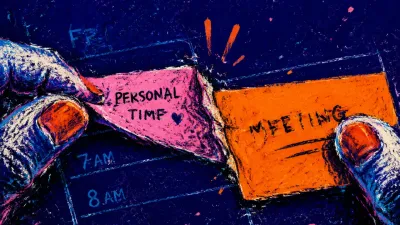
The 4:52 p.m. Yes to Friends While Exhausted: Let Capacity Speak

The 4:52 p.m. Yes
Alex, a 27-year-old non-binary junior UX designer in Toronto, came to me with a question that sounded simple until I heard the weight underneath it: “Why do I keep saying yes to friends when I desperately need rest?” They could spend an entire workday answering Slack threads and Figma comments, yet the Friday group-chat invitation was always the message they answered fastest.
They took me back to 4:52 p.m. on a wet Thursday. They had just left a draining Figma critique and were standing on a packed King streetcar beneath buzzing fluorescent lights. Damp coats brushed their arms. Their phone felt warm in one hand, while their legs felt packed with sand.
The group chat flashed: “Friday drinks?”
“I typed, ‘Yes, I’m in,’ before I even opened my calendar,” Alex told me. “For about five minutes, I felt relieved. Then I remembered I’d blocked Friday off to do absolutely nothing, and suddenly I was dreading the plan I’d just agreed to.”
The exhaustion they described was not ordinary sleepiness. It felt more like keeping a phone at one percent while every app retained permission to send real-time notifications. Their limbs wanted stillness, but their attention remained on call, scanning for disappointment before anyone had expressed it.
“I genuinely love my friends,” Alex said. “I’m not trying to avoid them. I just want to be a good friend without being available every minute. But if I say no, I worry they’ll stop asking.”
I let both truths stay on the table. Wanting connection did not cancel the need for solitude, and needing rest did not make their affection less real. “I’m not going to tell you what your friends secretly think or predict whether they’ll react perfectly,” I said. “I want us to map the moment when your need becomes invisible to you. Let’s find out what happens between the notification and the automatic yes, then put the pen back in your hand.”

Choosing a Bridge, Not a Verdict
I invited Alex to take one slow breath and hold the question in mind while I shuffled. I treat this small ritual as a transition into focused attention, not as a performance of mystery. The cards give us visible symbols around which thoughts, memories, and contradictions can be arranged. That is how tarot works best in a situation like this: as an external pattern map, not an authority that replaces personal judgment.
I chose the Relationship Spread · Context Edition. A shorter spread could have named exhaustion, but it would have flattened the relational layers maintaining it. Alex’s automatic yes existed inside a social field: genuine friendship, assumed expectations, an uneven exchange of time, and a fear that temporary absence might become permanent exclusion.
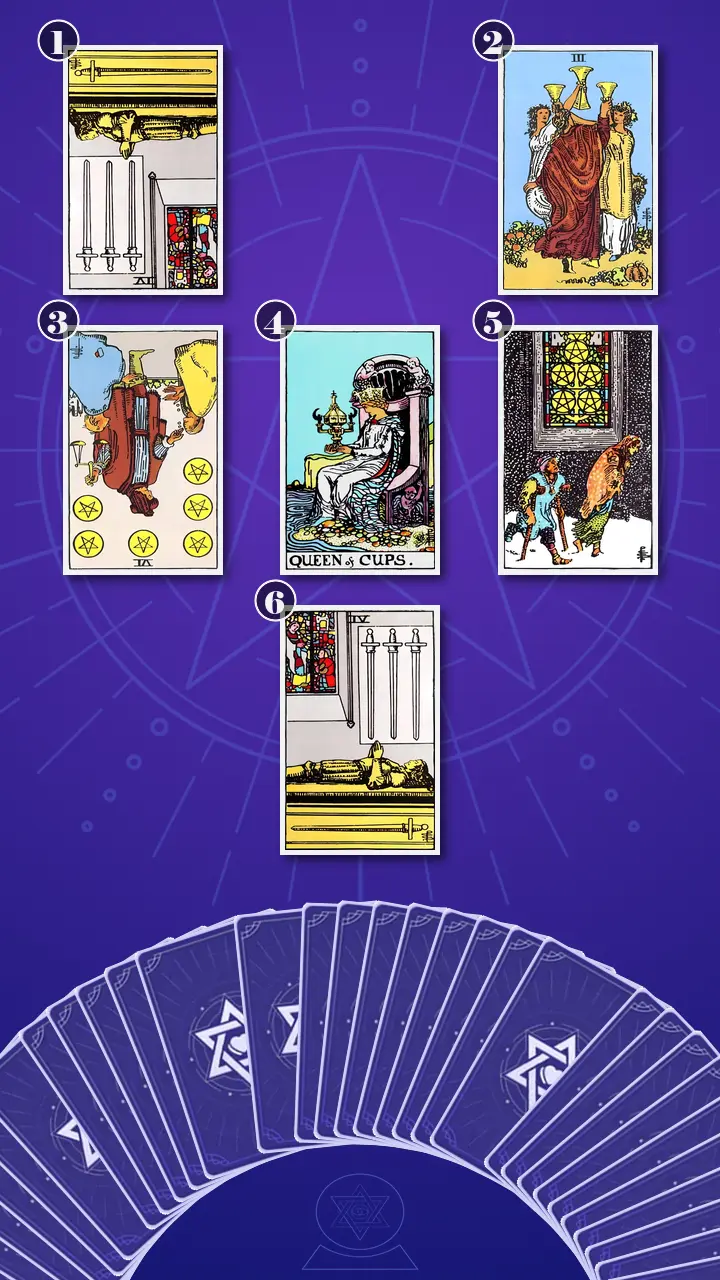
I placed six cards like a small bridge. The first would show Alex’s presenting behavior and immediate stance. The second would examine the social expectations Alex perceived, without pretending to read anyone else’s private motives. The third would reveal how time, care, and flexibility were being exchanged. At the center, the fourth would identify a relational resource. The fifth would expose the hidden fear, and the sixth would translate the reading into a practical friendship boundary Alex could test within one week.
I explained that card meanings in context matter more than isolated definitions. A card about community can describe real love and social pressure at the same time. A card about rest can show either restorative quiet or a pause repeatedly interrupted. The spread was not going to decide whether Alex should attend a particular event. It was designed to help them notice what information had been missing whenever they answered.
Reading the Social Map
Position 1: The Rest That Never Begins
“The card I’m turning now represents your presenting behavior and immediate self-stance,” I said. “It shows how saying yes has been overriding the need for rest.”
I revealed the Four of Swords, reversed.
In the card, a reclining figure should be still, yet the swords suspended overhead make the quiet feel mentally occupied. Reversed, the energy of rest is blocked. Recovery is technically available, but response mode keeps breaking into it before the body has had a chance to settle.
I returned Alex to the King streetcar. Their legs were already heavy after the day’s Figma revisions, but the group chat asked about Friday drinks and their thumb typed yes before they checked the calendar. The quiet evening still existed as a colored block on a screen, yet notifications and anticipated guilt had already interrupted it. Rest had become another task deferred until every social request was handled.
“The sequence sounds like this,” I said. “I only need to send one reply. Yes is easier. I can rest later.”
Alex gave a short, bitter laugh. Their fingers tightened around the cuff of their sleeve, then released it. “That’s so accurate it’s almost rude,” they said. “I don’t even notice I’m tired until after the plan has three reaction emojis.”
“The card isn’t calling you foolish,” I replied. “It’s slowing down a sequence that currently happens too quickly to examine. You are not confused about needing rest; you are afraid of what rest might seem to mean.”
The distinction landed differently. I watched Alex’s gaze move from the reversed card to their own hands. The visible problem was scheduling, but the emotional engine was rapid guilt forecasting: saying yes removed the imagined risk of disappointing someone, at least for the next five minutes.
Position 2: The Table Alex Truly Loves
“The next card represents the perceived social field,” I said. “This is what friendship participation feels as though it requires from you. It is not evidence of what your friends privately believe.”
I turned over the Three of Cups, upright.
The three raised cups met above fertile ground. This was relational Water in balance: shared pleasure, mutual recognition, and the warmth of being known. I described a crowded table on Ossington, cold glasses in warm hands, overlapping jokes, and the easy shorthand that develops between people who have lived through one another’s bad dates, job searches, and chaotic moves.
Alex smiled before I finished. “That’s the annoying part,” they said. “I actually want this connection. So why does every invitation feel compulsory?”
That was exactly the card’s tension in this position. Alex’s desire to attend was genuine. The pressure began when shared joy was interpreted as something that had to be visibly renewed every time. An invitation stopped being an option and became a small referendum on whether the friendship still counted.
I pointed to the three figures. “No single person is carrying the whole circle,” I said. “The card celebrates participation, but it does not say attendance at every gathering is the admission fee.”
Alex’s shoulders lowered slightly. By honoring the love first, I could see their defensiveness loosen. This was not a story in which friendship was the enemy. It was a story about genuine connection being forced to carry the additional job of constantly reassuring Alex that they belonged.
Position 3: The Cost Missing from the Poll
“The card I’m turning now represents the shared exchange pattern,” I said. “It asks how time, flexibility, care, and recovery are distributed, including costs that other people cannot see because they have never been named.”
I revealed the Six of Pentacles, reversed.
The scales should measure what can be given and what must be retained. Reversed, generosity has moved into excess while honest reciprocity is blocked. Alex was not simply offering time. They were handing over time before counting how much was available, then privately absorbing the lost sleep, late TTC ride, takeaway dinner, and next-day recovery.
I described a scheduling poll arriving while they ate reheated noodles at the kitchen counter. Alex clicked every available option, including the only free Saturday evening, and typed, “Whatever works for everyone.” Their private calendar block disappeared. Part of them hoped someone might recognize how accommodating they were, while another part already resented that nobody could see a limit Alex had not shown.
“Availability is not the admission fee for belonging,” I said. “And if the cost stays off the social ledger, nobody else has enough information to include it.”
Here I used one of my signature lenses, Clique Power Dynamics. I do not use it to accuse a tight-knit group of secret hostility, jealousy, or manipulation when the evidence is not there. I use it to examine observable micro-patterns: who names a preferred neighborhood, who chooses the time, whose no can stand without an essay, and who repeatedly becomes the person expected to “make it work.” Informal hierarchies often hide inside logistics because logistics look neutral.
I could also see what I call Sidekick Syndrome. Alex had gradually been cast as the low-maintenance, always-flexible friend. The role may not have been consciously assigned by anyone, but Alex had rehearsed it so consistently that the group had little opportunity to meet the version of them who had preferences, limits, and a leaving time.
Alex’s jaw tightened. “So I’ve trained everyone not to notice what I need?”
“You have made your limits difficult to see,” I said, “but that does not make the entire dynamic your fault, and it does not mean your friends are incapable of adjusting. It means you have found a point where your choices can alter the pattern. You cannot control their responses, but you can stop submitting an availability form with every box checked.”
Their expression held recognition and grief at once. They looked at the scales again, as though replaying every “whatever works” they had sent while secretly hoping someone would choose the least exhausting option.
Position 4: The Cup That Does Not Need to Be Poured Out
“The card at the center represents your relational resource,” I said. “It shows the inner quality capable of holding care for your friends and care for yourself at the same time.”
I turned over the Queen of Cups, upright.
The Queen held an ornate closed cup carefully in both hands beside calm water. Her Water energy was balanced: receptive without being endlessly available, compassionate without pouring herself away. She did not rush to make one feeling defeat another. She made room to understand what the feelings were saying.
I placed Alex’s phone face down beside their glass of water. “Imagine the next invitation remaining unanswered for five minutes,” I said. “You notice affection for the friend. You also notice heaviness behind your eyes, a tight jaw, and the wish to be alone. None of those signals has to be prosecuted or dismissed. They can all inform the reply.”
Alex exhaled and looked at the dark phone screen. “I can care about them and still listen to what’s happening in me,” they said quietly.
“Yes. The most honest yes includes the part of you that has to live through it. Before you offer your time, the Queen asks: What can I give without abandoning myself?”
I saw Alex’s fingers uncurl beside the glass. The change was small, but it mattered. For the first time in the reading, the notification was not positioned as a command. It was simply information waiting beside other information.
Position 5: The Warm Story in the Dark Room
“The next card represents the challenge and hidden fear,” I said. “It shows the imagined consequence that makes protecting a quiet night feel dangerous.”
I revealed the Five of Pentacles, upright.
Two figures moved through snow while a lit stained-glass window glowed nearby. In Alex’s pattern, threat-scanning was in excess and wider context was in deficiency. The card did not tell me that Alex’s friends intended to exclude them. It showed how quickly one missed event could become the only evidence their mind allowed into the case.
I described the familiar post-decline scene. Alex was under a grey blanket in a dark apartment while rain tapped the window and the radiator clicked. An Instagram Story filled the phone with warm restaurant light. Their friends raised glasses and laughed through fifteen edited seconds. Alex’s stomach dropped.
The inner sequence came fast: “They look fine without me. Maybe they prefer it that way. Maybe I won’t be asked next time.” One evening outside an event had been translated into being outside the friendship itself.
Alex went still. Their eyes lost focus for a moment, and I could tell the scene had found a memory. “Last month,” they said, “I stayed home and watched the same Story twice. I was relieved to be on the sofa, but I also felt like I’d vanished.”
“Instagram can show you the warmth of one room while hiding the wider relationship around it,” I said. “What evidence did you have that night that you had missed an event? And what evidence did you have that you had lost your place?”
Alex thought for several seconds. “I had evidence that they went out,” they said. “I didn’t actually have evidence that anyone was angry. One of them sent me a meme the next morning like normal.”
I nodded. “The stomach drop was real. The conclusion was still a conclusion.”
I did not ask Alex to replace fear with certainty. A boundary can be received warmly, awkwardly, or somewhere in between. The useful shift was more grounded: discomfort after saying no was not, by itself, proof of rejection.
When the Four of Swords Finally Lay Still
Position 6: The Pause with a Return
The rain against my window softened as I reached the final card. The room seemed to become quieter around the small bridge we had built.
“The card I’m turning now represents guidance for an actionable boundary,” I said. “It is not a prediction about your group. It shows a practice you can test and revise.”
I revealed the Four of Swords, upright.
The same figure from the opening card had returned, but now the stillness held. The swords were ordered around the resting body rather than pressing rest into reversal. Air had moved from blockage into balance: messages and anticipated reactions could exist without requiring immediate action.
I thought of a match cut in a film edit: the same composition repeated, but one crucial choice had changed the meaning of the entire scene. At the beginning, Alex’s quiet was interrupted by response mode. Here, quiet was deliberate, time-bounded, and followed by a chosen return.
At 4:52 p.m. on the King streetcar, Alex’s phone had lit with Friday plans. Before their heavy legs and tight jaw received a vote, their thumb was typing yes, and the quiet night on the calendar had begun to feel selfish.
Stop treating every invitation as a test of belonging; choose a deliberate pause that protects your capacity, like the figure laying down his swords in the quiet of the Four of Swords.
I let the sentence remain between us for a beat, then added:
Rest is not proof that you care less. It is the boundary that keeps friendship chosen instead of turning it into an attendance requirement.
I watched Alex’s breath stop first. Their thumb hovered above the edge of the face-down phone, perfectly still, and their pupils widened as though the streetcar scene had begun replaying behind their eyes. Then their brow tightened. The insight had reached them, but relief was not the first feeling through the door.
“But doesn’t that mean I’ve been doing friendship wrong this whole time?” they asked. The words came out sharper than anything they had said before. I heard anger, but I also heard the new vulnerability beneath it: if constant availability was no longer required, Alex would have to tolerate not knowing how every honest limit would land.
“No,” I said. “It means you found a strategy that ended uncertainty quickly, and now you can see its cost. We are not putting your past self on trial. We are giving your present self another option.”
The tension in Alex’s face shifted. Their fingers closed once, loosened, and settled flat on the table. Their eyes shone slightly. A long breath left their chest, followed by a quieter, almost disoriented laugh, the kind that comes when a burden drops and the hands are not yet sure what to do without it.
“Now, using this new perspective, can you remember a moment last week when this insight might have changed how you felt?” I asked.
Alex returned to the Thursday streetcar. “I could have let the message wait until I got home,” they said. “I could have checked whether I wanted drinks, one hour of drinks, or no drinks. I wasn’t disappearing. I was just answering later.”
That was the first movement from immediate reassurance-seeking and rest-boundary guilt toward self-attuned boundaries, rested connection, and stronger self-trust. It did not eliminate uncertainty. It changed who received a vote before the answer was sent.
I framed the shift through my Role Resignation Act. Alex did not need to quit the friendship ensemble, make a dramatic announcement, or cut anyone off. They could simply resign from playing the always-available character on cue. The rewritten line was ordinary enough to use in a live group chat: “I want to check my energy before I answer. I’ll reply by seven.”
“A pause is not a disappearance when it has a boundary and a return,” I said. “You’re still in the film. You’re just no longer letting the group-chat notification write your next scene before you’ve read the page.”
The Role Resignation Act in Real Life
I gathered the cards into one coherent story. The reversed Four of Swords showed a rehearsed pattern of interrupted recovery. The Three of Cups confirmed that Alex’s friendships and enjoyment were real. The reversed Six of Pentacles revealed the main blockage: time had become social currency, offered before capacity was counted. The Queen of Cups supplied the inner resource of compassionate self-attunement. The Five of Pentacles named the fear that one absence could become exile. The upright Four of Swords turned the entire sequence toward a deliberate pause.
The spread contained no Wands. I found that absence useful. Alex did not need more motivation, more effort, or a more optimized social calendar. They needed to change how attention, affection, and practical capacity entered the decision.
The cognitive blind spot was subtle: Alex hoped friends would notice the cost of flexibility while keeping that cost invisible, then felt unseen when nobody responded to information they did not have. The transformation was not from generous to selfish or social to isolated. It was from reflexive availability to chosen participation.
As an artist, I could see the old sequence like a scene that had been filmed too many times: notification, guilt forecast, automatic yes, five minutes of relief, depletion, resentment, withdrawal. Our actionable advice had to interrupt the scene early, before the answer became a commitment.
A One-Week Rewrite
- Create a body-before-reply pause. Pin a phone note titled “Before I Reply” with three prompts: “What is my body saying?”, “Do I want this plan?”, and “What can I honestly offer?” When the next invitation arrives, send: “This sounds lovely. Let me check my energy and calendar, and I’ll get back to you by 7.” Set a five-minute timer, place the phone face down, and check your jaw, shoulders, stomach, and overall energy before drafting the real answer in Notes. If five minutes feels too exposed, begin with three slow breaths. “Let me check” is enough; tiredness does not require a defense brief.
- Protect one Four of Swords rest window. Choose one evening this week and place a 90-minute calendar block called “Offline rest: no decisions.” Turn on Do Not Disturb and schedule it to switch off automatically. During the block, choose one low-demand form of rest: a shower, takeaway with a familiar show, lying down with music, or sitting by the window without multitasking. This is a bounded pause, not a disappearance. The ten-minute version counts, and the automatic end time gives the quiet a visible return point.
- Perform the Role Resignation Act once. During the next group interaction, decline the role of the endlessly flexible friend with one warm, specific limit. Try: “I’d love to come for an hour, then I’m heading home for a quiet night.” If the honest answer is no, use: “Thanks for thinking of me. I need a quiet night, so I’m sitting this one out. I’d still love to hear about it.” Choose only one boundary variable, such as duration, location, cost, or frequency. Keep the message warm and skip the apology essay.
I reminded Alex that these were experiments, not moral tests. A friend might respond immediately, later, awkwardly, or with complete ease. The purpose was not to manufacture a guaranteed reaction. It was to collect new evidence about what happened when Alex allowed affection and capacity into the same reply.

A Week Later: The Quiet Proof
Six days later, I received a message from Alex. Another Friday invitation had arrived while they were finishing work. Their first impulse was still to type yes, but they sent the holding reply instead, placed the phone face down, and noticed the ache behind their eyes.
After ten minutes, they wrote: “I’m wiped, so I’m sitting this one out tonight. I’d be up for coffee near mine on Sunday.” Then they turned on Do Not Disturb and left the chat unopened until the end of the rest block.
They protected the evening. The chat kept moving without them. They slept through the night, then woke with the old thought, “What if they stop asking?” This time, Alex smiled at the thought, put the phone down, and made coffee before answering it.
I did not call that a solved life. I called it proof of authorship. The cards had not created Alex’s boundary or guaranteed belonging. They had helped make an old script visible; Alex had chosen to write and deliver a different line.
That was the quiet promise of this Journey to Clarity and of the Relationship Spread · Context Edition: not perfect certainty, but a clearer sense of capacity. Rest could occupy legitimate space inside friendship. Connection could be offered freely instead of paid for with invisible exhaustion.
When your limbs are heavy but your hand still reaches for the fastest possible yes, it can feel as though one quiet night might cost you your place with the people you love. Simply noticing that fear does not mean you have failed at boundaries. It means you have reached the moment when the old character can pause, look toward the camera, and ask whether this is still the scene you want to play.
When the next invitation lights your phone, what might your own 4:52 p.m. pause let you notice before you choose your reply?