After "Let's Revisit It," One Shared Practice Replaced Future Plans

The Future Only One Person Was Editing
I met Alex, a 29-year-old UX designer in Toronto who could turn a messy product problem into a clean user flow. Yet one vague “let’s revisit it” from her partner could send her into planning a whole relationship future before either of them had tested the next practical step.
She gave me a timestamp: 11:43 p.m. on a Tuesday. She had been sitting upright in bed near Toronto’s west end, her laptop fan running beside her and her phone warm in one hand. The radiator clicked. A streetcar bell sounded below. On the screen, a note titled “Possible Next Two Years” held cities, leases, budgets, travel plans, and a tentative engagement window that kept moving whenever a conversation ended without a firm answer.
“When the timeline finally looks coherent, my jaw loosens,” she told me. “Then I remember we still haven’t figured out how we come back to a difficult conversation when one of us needs more time. I want a shared life, but I keep rehearsing it alone.”
I could see the central contradiction in the way she held her shoulders: she wanted the freedom and intimacy of a genuinely mutual future, but she feared that testing their real readiness might reveal different capacities, different timing, or a direction she could not control. Her anxiety felt less like an abstract emotion and more like a streetcar trapped between signals inside her chest, humming with stored momentum while her jaw held the brakes.
I told her, “You’re not planning because you feel certain. You’re planning because one unanswered question in the present feels harder to hold than an entire imagined future. The future looks shared, but right now only one person is editing it.”
She looked down at her hands. I kept my voice gentle. “Wanting commitment isn’t the problem, and I’m not going to ask you to pretend you care less. I’d like us to separate hope from assumption, and temporary relief from actual relationship evidence. Let’s make a map of the fog without treating the map as fate.”

Four Stepping Stones Across the Stream
I invited Alex to place both feet on the floor and take one slow breath while holding the question: “Why do I plan our whole future before we’ve tested real readiness?” I shuffled slowly, using the small ritual as a transition from mental rehearsal into focused observation. Nothing supernatural had to be performed. The pause simply gave her nervous system time to arrive in the same room as the question.
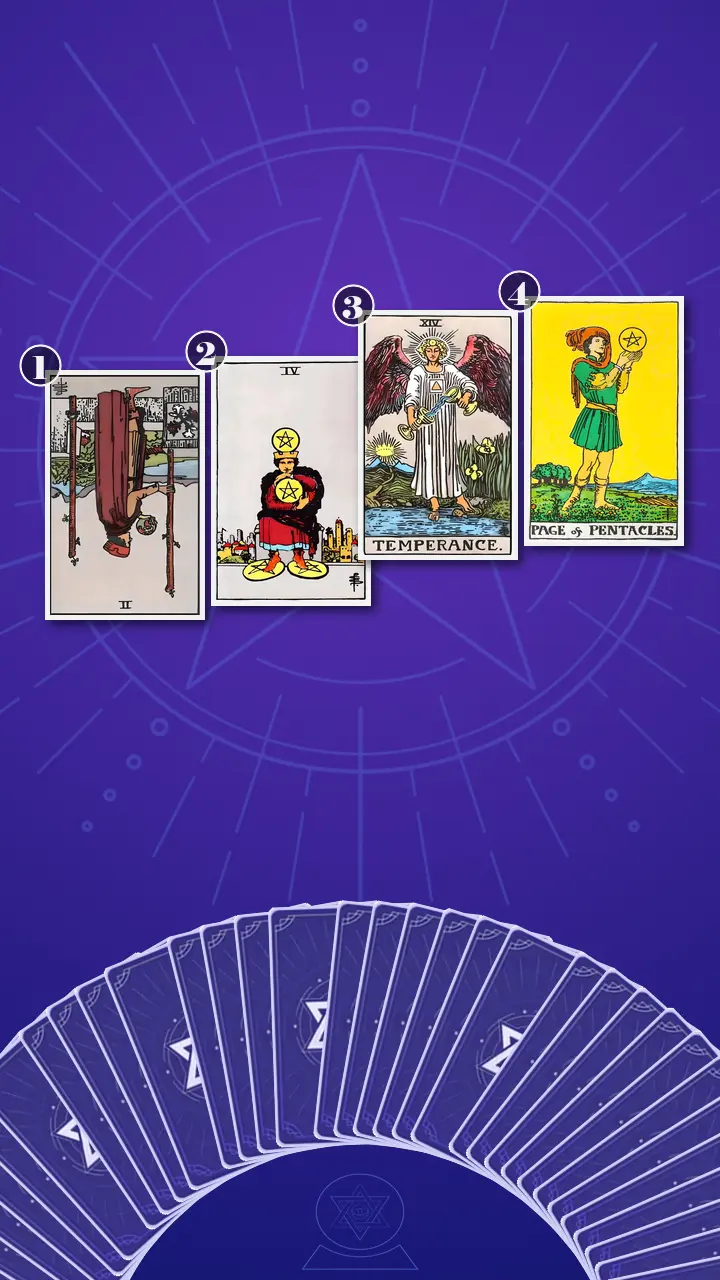
I chose the Four-Layer Insight Ladder · Context Edition, a four-card relationship readiness spread. I chose it because Alex was not asking me to predict whether the relationship would succeed. She was asking why uncertainty triggered solo future mapping, what fear kept that pattern active, and how she could test relationship readiness without forcing a timeline.
I considered broader spreads, but a ten-card Celtic Cross would have introduced more history and possibility than this question needed. A Past-Present-Future spread could have made the reading sound predictive while missing the mechanism underneath the planning. The Four-Layer Insight Ladder was the smallest complete tool for the job.
I explained the route I would follow. The first position would show the visible current pattern. The second would uncover the underlying fear and control strategy maintaining it. The third, raised slightly between the others, would reveal the key transformation. The fourth would turn that insight into one grounded, mutually chosen experiment. I laid the cards like four stepping stones, moving from imagined certainty toward observable readiness.
This is how I understand how tarot works at its most useful: the cards do not issue a verdict from outside a person’s life. Their symbols place competing patterns on the table where I can examine them with the querent. Card meanings in context become a structured mirror, helping intuition and evidence enter the same conversation.
Reading the Map Behind the Map
Position 1: The Globe That Never Left the Bedroom
I turned the card representing Alex’s current pattern: the concrete habit of planning a complete shared future before present readiness had been tested. It was the Two of Wands, reversed.
The figure held a globe while remaining behind a parapet. The vision was expansive, but the body had not crossed the threshold. Reversed, the Wands energy was in Blockage: imagination could travel years ahead while shared experience stayed at the starting point. The map had become a substitute for contact with the road.
I connected the image directly to Alex’s life. After an inconclusive conversation, she sat in bed editing a multi-year note containing possible cities, leases, budgets, and milestones. Each revision made the imagined future more polished, but no new shared experience had occurred. The smaller question, how they handled uncertainty together, remained untouched.
“The inner sentence sounds something like this,” I said. “If I can map the next five years, then I won’t have to feel how little we know tonight.”
Her breathing paused. Her thumb hovered over the edge of her phone as if a familiar note were still open there. Her gaze slipped past the table for a second, replaying some private sequence, and then she gave a short, bitter laugh.
“That’s so accurate it’s almost cruel,” she said.
I did not rush to make the discomfort disappear. “Accurate doesn’t have to mean condemning. Your capacity to envision a shared life is real. This card is asking whether that skill has become overextended because uncertainty hurts. It is showing us a coping sequence, not defining your character.”
I asked which present-tense conversation would teach her more than another hour of planning. She answered quickly: “Whether we can return to something unresolved without me chasing and without them disappearing into ‘later.’”
That answer mattered. Beneath all the questions about cities and move-in dates, she was not only asking where the relationship was going. She was asking whether difficult conversations had a reliable return route.
Position 2: The Timeline Held Against the Chest
I turned the card representing the underlying fear and maintaining mechanism: the control strategy that made future planning feel protective. It was the Four of Pentacles, upright.
The figure held one pentacle against the chest, balanced another over the crown, and pinned two beneath both feet. I read the card here as an Excess of security-making. The wish for stability was legitimate, but it had expanded until it occupied thought, emotional protection, and movement at once. Nothing could shift without feeling dangerous.
I asked Alex to picture the tabs she kept open after a delayed reply: Notes, Calendar, Realtor.ca, sometimes a Reddit search about when serious couples should discuss moving in. Every future decision received a provisional slot so that no variable could escape. Her jaw relaxed when the system looked controlled, yet the relief depended on keeping timing, meaning, and movement tightly held.
“Planning can calm the body without answering the relationship,” I said. “Your nervous system receives a few minutes of structure, but the relationship receives no new evidence about repair, pacing, reliability, or mutual capacity.”
Her fingers closed around the sleeve of her sweater. First her chest lifted and stayed there. Then her eyes narrowed at the card, as if she were checking its logic for an escape clause. Finally, her hand loosened and she released a long breath.
“If I leave something unanswered,” she said quietly, “I feel like I could lose control of where we’re going.”
I used my Attachment Loop Diagnosis to make the pattern visible without assigning either partner a fixed label. I drew four small boxes on a sheet of paper. An ambiguous answer triggered Alex’s alarm. The alarm produced future questions, reassurance-seeking, and more detailed plans. Those questions could make an exploratory conversation feel like an exam, which might lead the other person to request more time. That pause then looked like danger, restarting the cycle.
“I’m not declaring your partner avoidant or calling you an anxious person,” I clarified. “An anxious-avoidant choreography can appear between two people without becoming either person’s identity. I’m diagnosing the loop because loops can be interrupted. A label would tell you who to blame. A loop shows us where choice can re-enter.”
I also brought in a restrained form of Shadow Projection Analysis. The observable event was that her partner had said, “Let’s revisit it.” The triggered narrative was, “If they were serious, they would know now.” Underneath that narrative sat an unmet need: “I need evidence that difficult conversations will not be abandoned.”
I explained that the shadow was not something sinister. In a Jungian sense, it was the fear operating outside full awareness, writing meaning into an incomplete moment. Once Alex could name the need, she no longer had to disguise it as a five-year logistics problem.
When Temperance Poured Between Two Cups
Position 3: The Middle Pace Neither Fear Nor Fantasy Could See
The rain against the window softened as I reached the slightly raised central card. A thin trail of water moved down the glass between our reflections, quietly echoing the image I was about to reveal. I turned the card representing the key transformation: the shift from blueprint-driven certainty to paced, mutual discovery.
It was Temperance, upright.
The angel poured water between two cups, with one foot on land and one in water. I read the energy as Balance: emotional openness remained in contact with practical reality. Temperance did not ask Alex to mute her longing, and it did not turn certainty up to maximum. It offered a sustainable middle pace where possibility and evidence could influence each other.
I translated the cups into a real conversation: “I can imagine us sharing a home, and I also want to learn how we handle ordinary changes before we plan it.” One cup held a future hope. The other held a present-tense readiness question. Water moved both ways through reciprocal choice rather than being poured by one person into a plan for two.
“A detailed future can calm uncertainty,” I said, “but only present-day reciprocity can tell you whether the future is mutual.”
In that moment, I remembered something years of moving across cultures had taught me: two people can use the same word, commitment, while carrying entirely different private scripts for timing, money, space, and responsibility. The answer is rarely to decide which script is morally superior. The work is to bring both scripts into the open and see whether the people holding them can respond to each other.
I returned to the attachment loop I had drawn. I placed Temperance over the arrow between alarm and future projection. This was the interruption point. Instead of letting uncertainty automatically trigger a full roadmap, Alex could route it into a two-part exchange: name one honest hope, then ask one observable question. My diagnostic metaphor became practical at the exact place the loop had previously felt inevitable.
“Your internal algorithm has been trained on imagined futures,” I told her. “When uncertainty arrives, it recommends more imagined futures because no new real-world data has entered the system. Temperance does not delete the algorithm. It introduces a different input: paced mutual experience.”
I asked Alex to return to 11:43 p.m., when “let’s revisit it” had sent her into rearranging cities, leases, and milestones. On-screen, the plan looked mutual, although she was the only person editing it. She had been caught between demanding certainty and pretending not to care.
Do not use a complete blueprint to manufacture certainty; like Temperance blending water between two cups, let mutual readiness emerge through paced, observable experiments.
I let the sentence rest in the room.
Alex’s breath stopped halfway in. Her fingers became still against the sweater cuff, and her pupils widened before her gaze dropped to the two cups. A line appeared between her brows. Her eyes shone, but her shoulders did not immediately relax; they rose first, as if her body were bracing against a conclusion it had not chosen. Then she sat back. One hand opened slowly on her knee, followed by the other. The tension left her jaw in small increments rather than all at once.
“But doesn’t that mean I was wrong this whole time?” she asked. The question came out sharper than anything she had said before. Anger flickered through the vulnerability. “I thought planning meant I was taking the relationship seriously.”
I answered without trying to talk her out of the reaction. “It means planning protected you when incomplete information felt unbearable. That protection was intelligent, and now it is costing you access to the evidence you actually want. You were not wrong to desire a future. You were asking a solo plan to perform a mutual function.”
Her shoulders finally lowered. She exhaled with a slight tremor and gave a small, disoriented smile, the expression of someone who had put down a heavy bag and had not yet remembered how to stand without it. Relief was there, but so was a new vulnerability: if the plan could not decide for her, she would have to observe what the relationship actually offered.
I asked, “Now, using this new perspective, can you think of a moment last week when this insight might have made you feel different?”
She recalled a crowded Line 1 train approaching Bloor-Yonge. Her message about next summer had been read but not answered. While the rails shrieked and a damp coat pressed against her sleeve, she had opened Realtor.ca and compared two-bedroom rents.
“I could have noticed that I wanted reassurance,” she said. “Then I could have waited and asked whether we can reliably come back to the conversation. I didn’t need to solve housing on the TTC.”
I named the movement plainly: this was a first step from anxiety-driven future projection and control to paced mutuality grounded in present evidence. It was not certainty about the relationship. It was self-trust becoming strong enough to tolerate incomplete information while gathering something real.
Position 4: One Pentacle, Not the Whole Mountain
I turned the final card, representing grounded integration: one small action that could reveal present readiness without making a single result responsible for the entire future. It was the Page of Pentacles, upright.
The Page held one pentacle carefully in both hands while cultivated fields and distant mountains remained visible. I read this Earth energy as Balance becoming practice. The horizon had not disappeared, but it was no longer today’s assignment. The Page studied one tangible piece of reality before claiming to understand the whole landscape.
I asked Alex what one shared capacity she genuinely wanted to observe. She chose how they handled changed plans. Rather than keeping an unspoken score, she could ask her partner to try a one-week practice: if either person needed to change a plan, they would say so directly, suggest a next step, and return to any disappointment instead of leaving it suspended.
At the end of the week, they could spend fifteen minutes discussing what each person actually did, what felt mutual, and what they would adjust. Alex would record observable behavior before interpretation. She would not turn a good result into proof of forever or a difficult moment into proof of failure.
“One experience is data, not destiny,” I said. “The Page is an apprentice, not a judge. This result can teach you something without deciding everything.”
Alex looked from the Page’s pentacle back to Temperance’s cups. She nodded once, then paused. “I can do a week,” she said. “I’m scared I’ll secretly make it a test anyway.”
“That is a useful concern,” I replied. “So we make the experiment explicit, mutual, and low stakes. Either person can renegotiate it. You are observing a pattern together, not hiding a pass mark from your partner.”
A Seven-Minute Exit from the Five-Year Plan
I drew the four cards into one coherent story. There was no formal past position, so I did not invent a childhood event or claim the cards had discovered one. The relevant prior influence was something Alex herself recognized: at work, ambiguity often became manageable once she turned it into a prototype. In her relationship, that useful skill had crossed into a different domain, where another person’s readiness could not be prototyped alone.
The reversed Two of Wands showed the planner standing at the threshold, using a wide vision without lived movement. The Four of Pentacles revealed why she stayed there: detailed planning gave her something to grip when the relationship’s direction felt exposed. Temperance opened the grip without dismissing her need for security, blending hope with present evidence. The Page of Pentacles then reduced the distant mountain to one learnable next step.
The core metaphor was simple: Alex had been designing an entire bridge on a map before checking whether both people were willing and able to cross the first span. Her cognitive blind spot was confusing nervous-system relief with relational evidence. A shared future was not more mutual because she had planned it in greater detail.
The transformation direction was equally specific. She did not need to stop wanting a future or accept endless vagueness. She needed to replace the complete future blueprint with one present-tense, mutually agreed experiment that could reveal communication, reliability, pacing, and adaptability. The future could remain a possibility rather than a promise while observed reciprocity informed her next choice.
I turned the Four-Layer Insight Ladder tarot spread, using the reversed Two of Wands, Four of Pentacles, Temperance, and Page of Pentacles for relationship readiness, into three small actions. I wanted the advice to be usable on an ordinary evening, including an evening when seven minutes felt like a lot.
- The 7-Minute Projection Detachment Note On one evening at home, set a seven-minute timer. Divide a note into “What actually happened” and “What my trigger predicted.” Record one observable fact, such as “My partner said they wanted to revisit the topic,” and one projected narrative, such as “If they were serious, they would know now.” Beneath those lines, add one future hope and one present-evidence question. Tip: Stop when the timer ends. If your chest tightens or the exercise becomes another planning project, write only one fact and one triggered story. That still counts.
- The 20-Minute Two-Cup Conversation During a walk or a quiet conversation at home, name one future hope without presenting it as an agreed plan. Then ask one bounded readiness question, such as, “How would you like us to handle it when one of us needs more time to answer?” Listen to the response without expanding the conversation into the next five years. Tip: Agree on the twenty-minute boundary beforehand. A hope is not a demand, and either person can answer honestly, ask for clarification, or request a specific time to continue.
- The One-Week Readiness Pilot Choose one low-pressure shared practice together, such as communicating a changed plan directly and suggesting a repair. Put a fifteen-minute debrief on both calendars. Ask, “What felt mutual, what felt difficult, and what would we adjust next time?” Tip: Keep the experiment explicit rather than turning it into a secret test. Record behavior before interpretation, allow “I don’t know yet” as a valid result, and remember that one experience is data, not destiny.
I described the first action as my Projection Detachment Exercise because its purpose was not to suppress Alex’s intuition. It was to remove the triggered story from the observable event long enough for both to be examined. Sometimes the story points toward a legitimate unmet need. Sometimes it repeats an old fear. The separation gives discernment room to work before projection becomes a verdict.
I also made the limit clear: no journaling exercise or tarot card should be used to rationalize indefinite avoidance, dismiss a partner’s stated boundary, or pressure someone into commitment. If the evidence repeatedly showed that conversations were not revisited or agreements were not honored, Alex would be free to treat that pattern as meaningful. Self-trust included the capacity to leave, renegotiate, wait, or move forward. The decision remained hers.

A Week Later, the Notes App Stayed Closed
Six days later, I received a message from Alex. She and her partner had tried the changed-plans practice. When a Saturday dinner had to move, her partner told her directly, proposed Sunday afternoon, and asked whether the change had caused any stress. Alex felt the familiar rise in her chest, but she did not open the five-year timeline.
Instead, she used the Projection Detachment Exercise. The fact was that one plan had changed and a replacement had been offered. The triggered story was that flexibility meant the relationship had no stable direction. The remaining question was whether they could acknowledge disappointment without turning it into blame or withdrawal.
During their debrief, Alex named that question. Her partner did not give her a guarantee about the future. They did stay in the conversation, listen, and agree on how they would communicate the next change. That was one observable readiness signal, neither a promise nor nothing.
That night, she slept through until morning. Her first thought was still, “What if this isn’t enough?” She told me she smiled, put both feet on the floor, and let the question remain unanswered while she made coffee.
I did not see the reading as proof that the relationship would reach a particular milestone. The cards predicted nothing. Alex created the change by noticing her loop, asking a bounded question, respecting both people’s autonomy, and allowing behavior to inform her next decision.
For me, that was the quiet proof of her Journey to Clarity. She had not solved her life in a week. She had moved from rehearsing mutuality alone to participating in one real exchange, with enough self-trust to let the mountains remain on the horizon.
When an open-ended conversation leaves your chest buzzing and your jaw tight, I know it can feel safer to build five years alone than to risk learning whether both of you are ready for the next honest step. Merely noticing that your private blueprint is trying to protect you means you are no longer standing at the exact beginning.
If the future could remain a possibility for one week, what single Page-of-Pentacles practice would you be curious to place between Temperance’s two cups and observe together?