Finding Clarity on the L Train: When “Private” Starts to Feel Like a Trap
If you can ship product roadmaps at a NYC tech job but can’t bring yourself to ask one simple DTR question because you’re terrified of sounding needy—this is for you.
I met Maya on a Tuesday evening when the city felt like it had been turned up half a notch too loud. She’d messaged me asking for a reading about one sentence—“Let’s keep it private.” Not because she wanted a big announcement. Because her body didn’t believe the reassurance she kept giving herself.
When she arrived, she told me what it had looked like that night on the L train: 8:47 PM, harsh fluorescent lights, the car screeching around a curve, her phone warm in her palm as she re-read the text for the fifth time. The glow hit her face like an interrogation lamp. Her shoulders had crept up by her ears. Her chest stayed tight in that specific way that feels less like emotion and more like a physical warning.
“I don’t need a post,” she said, almost like she was trying to convince someone. “I just need to not feel like I’m being hidden.”
And then the confession that lived underneath everything: she craved clarity and some basic public acknowledgment—yet she feared that asking for it would make her seem “too much,” and she’d push them away.
Insecurity, in Maya’s body, wasn’t a vague mood. It was like trying to breathe through a sweater collar that’s suddenly too tight—while your mind keeps insisting you’re fine.
I nodded, slow and steady. “We’re not here to force a hard launch,” I said. “We’re here to find the kind of clarity that lets your nervous system unclench. Let’s make a map through the fog.”

Choosing the Compass: The Celtic Cross · Context Edition
I don’t treat Tarot like a mystical verdict. I treat it like a structured conversation with the parts of you that already know what’s happening—especially the parts you’ve been overriding in the name of being ‘chill.’
I asked Maya to take one breath that went all the way down—hands on her thighs, feet on the floor—then to hold the question in plain language: “When someone says ‘let’s keep it private,’ what’s my next step to feel secure?” I shuffled slowly, not for drama, but because the pace helps the mind stop sprinting.
Today, I told her, we’d use the Celtic Cross · Context Edition.
For you reading this: Celtic Cross works so well for a “private vs secret relationship” spiral because it doesn’t just answer what to do. It shows the whole diagnosis chain—what’s happening now, what’s blocking security, what old wound is getting touched, and what specific next step creates real stability. And in this version, Position 10 isn’t treated as fate. It’s treated as the most self-respecting move you can make—because “how Tarot works” at its best is: it turns vague dread into actionable advice.
I previewed the map out loud. “The center will show your current emotional reality, and what’s crossing it. The foundation will show what ‘private’ is hitting beneath the surface. And the final card—the top of the right-hand column—will give us your next step toward feeling secure.”
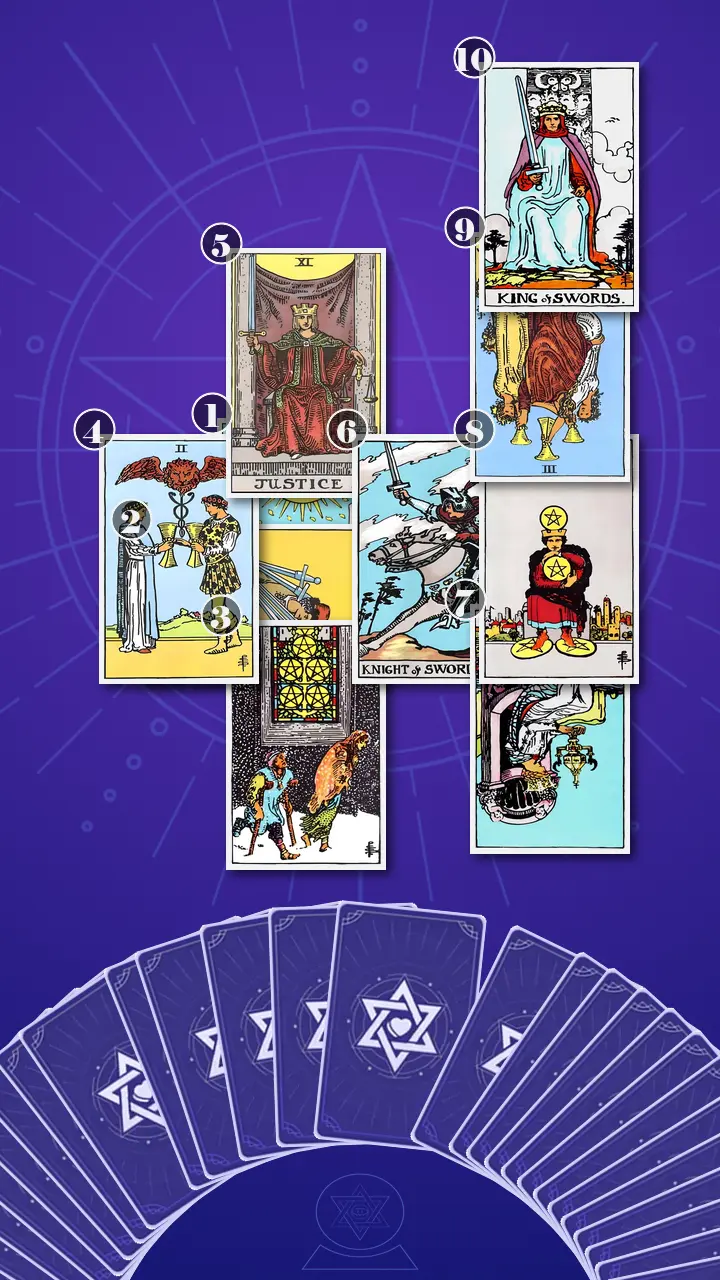
Reading the Map: Card Meanings in Context, Not in Theory
Position 1 — The Fog You’re Living In
“Now, what we turn over is the card representing your current emotional reality of the ‘keep it private’ situation—what feels unclear and destabilizing right now,” I said.
The Moon, upright.
I didn’t have to reach far to translate it into Maya’s actual week. “This is the Sunday-night spiral,” I told her. “It’s re-reading one phrase—‘let’s keep it private’—until it becomes ten different stories, because no one has named the terms.”
The Moon isn’t ‘bad.’ It’s fog. And fog does one specific thing to the nervous system: it makes your instincts split. One part of you is the dog—domesticated, trying to trust. The other part is the wolf—wild, on alert. The energy here is blocked clarity: not enough information, so your mind manufactures meaning.
I leaned in a little. “This is where you start doing emotional forensics,” I said. “Tabs open: texts, IG, timestamps. Like you’re building a case file. The inner monologue goes, ‘If I can just find one more clue, I’ll feel calm.’ And then your body answers with that tight chest and stomach drop.”
Maya let out a quiet laugh that had no joy in it. “That’s… actually kind of brutal,” she said. Then she nodded, slow. “Yep. That’s exactly what I’m doing.”
Position 2 — The Immediate Challenge (What “Private” Is Functionally Doing)
“Now, what we turn over is the card representing the immediate challenge—what the privacy request is functionally doing in the dynamic and why it blocks felt security,” I said.
Seven of Swords, upright.
I kept my voice calm, because this card can trigger panic if it’s delivered like a tabloid headline. “This doesn’t automatically mean cheating,” I said, and watched Maya’s shoulders lower a fraction. “But it does mean information is being managed.”
Her modern-life translation was painfully precise: affectionate private time, couple-coded weekends, and then—nothing definable when the world enters the room. You’re left holding fragments instead of a whole story.
The energy here is strategic withholding. Too much is unsaid. And your brain—especially a product manager brain trained to close gaps—tries to fill in the missing context.
I said one sentence slowly, because it matters: “Privacy is a choice you both define. Secrecy is a rule you live under.”
Maya’s jaw flexed, then released. “It’s like… I’m following rules I never agreed to,” she said.
“Exactly,” I replied. “And you’ve been paying for that vagueness with your nervous system.”
Position 3 — The Root Fear Underneath Insecurity
“Now, what we turn over is the card representing the root fear underneath insecurity—what ‘private’ touches in your self-worth and belonging needs,” I said.
Five of Pentacles, upright.
The image on this card always stops me for a second—the stained-glass window glowing warm, and the figures outside in the cold. Maya swallowed as she looked at it.
“This,” I told her, “is the part of you that doesn’t just hear ‘private.’ It hears ‘outside.’ It hears ‘not chosen.’”
As a Jungian psychologist, I often use what I call Stained Glass Decoding: the mind projects a story onto a bright symbol, and that projection reveals the archetype driving the fear. The stained glass isn’t just a window—it’s the archetype of belonging. When your nervous system is already sensitized, ‘private’ can start to feel like a verdict.
The energy here is scarcity—not money-scarcity, but belonging-scarcity. “Like there’s a warm room where other people get to be included,” Maya said quietly, “and I’m… waiting outside.”
“That’s the wound,” I said, soft but direct. “And the work is separating your worth from someone else’s willingness to be visible.”
Position 4 — What Set the Hook
“Now, what we turn over is the card representing what set the hook—the earlier bond or context that made you accept ambiguity in the first place,” I said.
Two of Cups, upright.
Maya’s face changed in the smallest way—like she remembered a version of herself that wasn’t bracing. “We did feel close,” she said. “It wasn’t fake.”
“This card agrees,” I told her. “Two of Cups is real mutuality. It’s reciprocity. It’s why you stayed open even when the fog rolled in. The problem isn’t that there’s no connection. The problem is connection without aligned visibility.”
The energy here is balanced intimacy—but it’s being asked to survive without an agreement, like a project with no scope and no deadline: you can work nonstop and still never know if you’re doing it right.
Position 5 — What You Consciously Need (The Terms Check)
“Now, what we turn over is the card representing what you consciously need to feel secure—your values around fairness, visibility, and clarity,” I said.
Justice, upright.
It felt like the room got a little sharper, as if the lighting changed. Justice does that. It’s Air energy used correctly: clean, specific, accountable.
“This is the part of you that knows security doesn’t come from guessing,” I said. “It comes from stated terms. Justice is basically a relationship terms of service: what’s in scope, what’s out of scope, what timeline exists, what trade-offs are real.”
I grabbed a notepad and wrote three bullets, like I was reviewing a product spec—because in Maya’s world, that’s what makes something real.
“Try these as questions,” I said. “
• What does ‘private’ mean to you?
• What does it include and exclude?
• Is there a timeline?”
Maya exhaled—visible, like permission. “I feel dramatic for even wanting that,” she admitted.
“Justice disagrees,” I said gently. “Balanced terms aren’t romance-killers. They’re what lets your body unclench.”
Position 6 — The Near-Term Push Toward Truth
“Now, what we turn over is the card representing the near-term energy shift—what’s likely to surface next inside you, and what you’ll feel compelled to do,” I said.
Knight of Swords, upright.
Maya laughed again, this time with a little heat. “That’s me drafting the message,” she said. “And then deleting it.”
“Yes,” I replied. “The Knight is the urge to finally ask. To stop waiting for reassurance. It’s the antidote to weeks of silent interpretation.”
The energy here is excess urgency: if you’ve been holding everything in, the truth can come out like a sprint. “We’ll use this energy,” I told her, “but we’ll mature it. We’re not charging into a fight. We’re scheduling a calm terms check.”
Position 7 — Your Coping Style (Where Your Boundaries Get Porous)
“Now, what we turn over is the card representing your inner stance and coping style—how you’re managing feelings and where your boundaries are porous or strong,” I said.
Queen of Cups, reversed.
“This is the ‘cool-girl performance’ split-screen,” I said, and I watched Maya’s eyes widen because she knew exactly what I meant. “Outwardly: ‘No worries!’ Inwardly: 1:13 AM doom-scroll. Phone warm in your hand, jaw clenched, re-reading the thread like it’s a riddle you can solve with enough effort.”
The reversed Queen is flooded empathy turned inward. Your sensitivity is real. But without a container, it becomes rumination, self-silencing, and nervous-system bargaining.
Maya’s voice went smaller. “I keep telling myself it’s fine,” she said. “But my body doesn’t believe me.”
“I’m not here to shame that,” I told her. “It’s how you’ve been trying to stay connected. We’re just going to give your feelings a structure that doesn’t erase you.”
Position 8 — The External Holding Pattern
“Now, what we turn over is the card representing the external context—the other person’s holding pattern, practical constraints, or social factors shaping the ‘private’ request,” I said.
Four of Pentacles, upright.
“This is guardedness,” I said. “Control. Reputation. Comfort. It can be fear-based, it can be practical, it can be habit—but it’s tight.”
The energy here is constriction. Even if they care about you, their instinct is to hold the coin to their chest: to keep things contained. “Notice where their holding back becomes the rule you’re living under,” I said. “That’s where your security leaks out.”
Position 9 — Hopes and Fears (The Inclusion Ache)
“Now, what we turn over is the card representing your hopes and fears—what you’re afraid ‘private’ really means, and what kind of inclusion you secretly hope for,” I said.
Three of Cups, reversed.
I described a micro-moment, because this card lives in micro-moments: standing in a loud bar, sticky floor, bass thumping through the wall, and hearing yourself introduced as “a friend.” Not as a punchline—just as a fact. And feeling the word land like a small bruise.
Maya’s eyes glistened, but she didn’t cry. It was more like sadness sharpened into clarity. “I don’t need a post,” she whispered. “But I do need basic inclusion.”
The energy here is deficiency of social belonging. And the work is turning a vague ache into one verifiable inclusion signal—so you’re not negotiating against a feeling you can’t name.
When the King of Swords Spoke: The Boundary That Isn’t a Fight
Position 10 — Best Next Step to Feel Secure
The room went very quiet—not dramatic quiet, just the kind where you can hear the radiator tick and the distant hum of traffic like a steady baseline. “Now,” I said, “we turn over the card representing the best next step to feel secure—the most self-respecting, actionable move to create clarity and emotional safety.”
King of Swords, upright.
There’s something about this card that always reminds me of navigation at sea. I used to train cruise staff to read intuition the way you read weather: you don’t argue with fog, you adjust your route. In Venice, where I grew up, bridges and corridors decide whether you can reach someone—or whether you just keep seeing them across water.
This is where I use my Bridge-Corridor Theory. In relationships, a “bridge” is a shared agreement that connects two inner worlds—clear, walkable, with railings. A “corridor” is what you get when you’re allowed closeness only under dim, shifting rules—narrow passageways where you keep checking if you’re allowed to be there.
“Maya,” I said, “you’ve been trying to build security inside a corridor. The King of Swords builds a bridge. He doesn’t beg for access. He defines the structure.”
Setup. I watched her face as the meaning landed. She was stuck in that subway-home moment—re-reading ‘let’s keep it private’ like it was a puzzle—trying to turn a vibe into something that finally felt safe, because asking directly felt like it might cost her the relationship.
Delivery.
Stop trying to read the fog and start setting terms—hold your truth like the King of Swords holds his upright blade.
And I let it sit there for a beat.
Reinforcement. Maya’s body did a three-part reaction chain that I’ve seen in a thousand variations: first, a tiny freeze—her breath paused, her fingers hovering above the edge of my table like she didn’t know what to do with her hands. Second, the cognitive seep—her eyes unfocused, like she was replaying every time she’d rewritten a text to sound “low-maintenance.” Third, the emotional release—an exhale that sounded almost like a laugh, except it carried relief and grief at the same time.
“But if I say it that clearly,” she said, and her voice shook once, “doesn’t that mean I wasn’t being… cool? Doesn’t that mean I did it wrong?”
There was anger in it too—brief, honest. Like the part of her that had worked so hard to be easygoing didn’t want to be told it had been self-erasure.
I kept my tone steady. “It means you adapted,” I said. “You tried the strategy that kept you connected. The King of Swords isn’t here to judge you. He’s here to upgrade the strategy.”
I slid a glass of water a little closer to her, simple and practical, like setting a prop for a steadier scene. “Now,” I asked, “use this new lens and look back at last week. Was there a moment—one specific moment—where you were living on clues, and this could have made you feel different?”
Maya blinked, fast. “Wednesday,” she said. “I checked if they watched my Story. And I felt… stupid. If I’d had terms, I wouldn’t have needed that.”
“That’s the shift,” I told her. “This isn’t just about one conversation. It’s a step from vigilant unease—living on hints—to calm clarity: agreements you can name, and a boundary you can respect.”
Terms, Not Vibes: Actionable Next Steps That Don’t Require a Personality Transplant
I pulled the whole spread into one thread for her, the way I’d tie together a loose set of meanings into a usable plan.
The story was clear: The Moon showed the fog—ambiguity turning your mind into a detective. Seven of Swords showed why the fog stuck—managed information, partial disclosure. Five of Pentacles revealed why it hurt so much—an exclusion wound that makes “private” translate to “outside.” Two of Cups confirmed the bond was real—so you’re not crazy for caring. Justice and Knight of Swords were your turning point—your system pushing you toward truth. And the King of Swords was the destination: security through explicit agreements and self-respecting boundaries.
Your cognitive blind spot, Maya, was the one so many smart people have in dating: trying to manufacture security from ambiguity by interpreting signals instead of creating terms.
“You can do low-key,” I told her. “You can’t do vague.”
Then I offered her a few small, concrete moves—because finding clarity only matters if it changes what happens next.
- The 10-Minute “Terms, Not Vibes” CheckOpen your Notes app. Set a 10-minute timer. Write three bullets: (1) Private means: 2–3 observable behaviors (how you’re introduced, whether one friend knows, what public mentions are off-limits). (2) Private does NOT mean: one line that names what would feel like secrecy to you. (3) If my minimum isn’t met, I will: one action you control (pause plans, slow intimacy, or step back).If you start feeling flooded, stop early. This isn’t about forcing bravery—it’s about giving your feelings a container.
- The 3-Sentence King of Swords Script (Out Loud, Once)In your apartment, practice this one time: (1) “I like you, and I want to understand what ‘private’ means for you.” (2) “What does it include/exclude, and is there a timeline?” (3) “I can do low-key, but I can’t do secret—so I need ____ to feel secure.”Use my Burano-inspired Lace Communication Method: one sentence at a time, no extra threading. Say it. Stop. Let them answer before you add more.
- One Inclusion Signal Request (Not a Whole Rebrand)Pick one concrete inclusion signal and ask only for that this week: “Next time we run into someone you know, can you introduce me as the person you’re dating?”Keep it specific and testable. You’re checking compatibility, not forcing a hard launch.

A Week Later: Ownership, Not Certainty
Six days later, Maya sent me a screenshot—not of Instagram, not of a like, not of a Story view. A text she’d sent: “Can we talk for 15 minutes tomorrow? I want to define what ‘private’ means so I can feel good here.”
She followed it with one line: “My hands were shaking, but I did it anyway.”
And then, a quieter proof—bittersweet in the way real change usually is: she said she slept through the night after the conversation, then woke up and her first thought was, What if I did it wrong? Only this time, she noticed the thought… and didn’t obey it. She made coffee. She felt her feet on the kitchen floor. She kept her own terms.
That’s the Journey to Clarity I trust: not certainty as a fantasy, but ownership as a practice. Feelings are real data. Decisions still need terms.
When someone says “let’s keep it private,” and your chest tightens anyway, it’s often because you’re trying to stay easygoing while a deeper part of you is begging not to be erased.
If you didn’t have to earn safety by being “chill,” what’s one small term you’d want to name this week—one bridge-plank you’d place—just so you can finally stop living on clues?
This story is adapted from psychological research, written so that those in a similar struggle can see their own pattern in it — and find their next step clearly.These insights are not a substitute for professional psychological, medical, legal, or financial advice.
Learn more about our Journey to Clarity.
How did this insight land for you?
🫂 This Resonates Deeply
🌀 Living This Story
✨ Now I See Clearly
🌱 Seeing New Possibilities
🧰 Useful Framework
🔮 The Confirmation I Needed
💪 Feeling Empowered
🚀 Ready for My Next Step
Author Profile
 AI
AI“Having traveled across cultures... I've learned that what we often lack isn't a simple answer, but a moment of being truly understood. I use a Jungian psychological lens to help you deconstruct your subconscious patterns—not to prove anything, but to be the gentle companion who helps you unravel your knots, free of judgment, so you can reconnect with your inner wisdom.”
In this Love Tarot Reading :
Core Expertise
- Attachment Loop Diagnosis: Logically decoding whether your relationship friction is driven by an anxious-avoidant trap or deep-seated insecurity.
- Shadow Projection Analysis: Identifying the unacknowledged fears or unmet childhood needs you are unconsciously projecting onto your partner.
Service Features
- The Projection Detachment Exercise: A structured psychological journaling prompt to separate your partner's actual behavior from your triggered internal narrative.
Also specializes in :
Explore Related Patterns:
Boundary DiffusionMaya describes a dynamic where "private" has become something she lives under, not something both people have defined together. The issue is not privacy itself; it is that the boundary line between low-key, hidden, respectful discretion, and secrecy has never been drawn in shared language. Boundary Diffusion appears when discomfort is real but the terms are blurry. You can sense that something leaks your security, yet without a clear definition you end up adapting to someone else's holding pattern instead of knowing where your own yes and no actually sit. The next step is not a fight for public performance. It is a boundary audit: what private includes, what it excludes, what timeline exists, and what you will do if the minimum condition for feeling secure is not met.
Certainty SeekingMaya rereads "Let's keep it private" on the L train, then keeps returning to texts, IG cues, timestamps, and Story views as if one more data point could finally make her body unclench. The behavior is not random checking; it is a nervous-system strategy for trying to turn ambiguity into safety without risking the direct DTR question. That is the core mechanism of Certainty Seeking: when the relationship terms are unclear, the mind starts treating partial signals like evidence in a case file. You are not asking for clarity because you are dramatic; you are trying to regulate anxiety by collecting clues in a situation where the real missing piece is an explicit agreement. The trap is that each new clue briefly feels useful, but it keeps the power outside you. The secure next step is not to gather better signals, but to replace signal-reading with stated terms: what private means, what it does not mean, and what minimum visibility lets your body feel safe.
Rejection SensitivityMaya does not hear "private" as a neutral logistics preference once her body is activated; she hears "outside," "not chosen," and possibly hidden. Even a small imagined public moment, like being introduced as "a friend," lands with disproportionate emotional weight because the relationship has not given her a reliable inclusion signal. Rejection Sensitivity is the pattern where ambiguous cues get processed through the threat of being unwanted. You are not inventing the pain from nowhere; the lack of defined visibility gives your mind just enough blank space to project exclusion into it. The useful audit is to separate evidence from activation. Instead of arguing with the ache, the next step is to turn it into one verifiable request: a specific way of being acknowledged that is low-key enough to respect privacy but clear enough to stop making your nervous system live outside the room.
RuminationMaya does not just think about the privacy request once; she circles it through the body, the phone, and the timeline. She rereads the text, checks whether they watched her Story, rewrites messages to sound low-maintenance, and still ends up with the same tight chest and unsettled sleep. Rumination shows up here as a closed cognitive loop: the mind keeps returning to the same unresolved question because the relationship has not provided enough structure to metabolize it. You are not simply overthinking; you are trying to solve a relational gap with private mental labor. The cost is that analysis starts replacing agency. The same intelligence that helps you manage complexity at work gets pulled into decoding a vague dynamic, when what your system actually needs is a container: a short terms check, a specific inclusion signal, and a boundary you can keep even if the answer is uncomfortable.
Secure VisibilityMaya's clearest need is not a hard launch or a public performance; it is a basic form of inclusion that does not make her feel erased. The story keeps distinguishing privacy that both people define from secrecy that one person quietly absorbs. Secure Visibility names the adaptive pattern available here: being low-key without being undefined. You can respect privacy while still asking for observable terms, such as how you are introduced, whether one trusted friend knows, or what kind of public acknowledgment feels reasonable at this stage. This pattern matters because it gives security a shape that is neither clingy nor performative. The next step is to ask for one concrete visibility signal and watch whether the relationship can hold your need without turning it into a threat.
Self-SilencingMaya says she does not need a post, but she does need not to feel hidden; then she immediately worries that asking for that will make her seem "too much." The visible behavior is restraint, but the psychological move underneath is self-editing: shrinking a legitimate need until it can pass as being chill. Self-Silencing fits because the story keeps showing a split between what Maya knows she needs and what she permits herself to say. You can see the defense in the low-maintenance performance: if you stay easygoing enough, maybe the connection stays intact and the other person never has to confront your discomfort. The problem is that silence does not make the need disappear; it turns the need inward. Security begins when the feeling gets a structure that does not erase you, such as naming one clear term, one timeline question, or one inclusion signal instead of pretending ambiguity is fine.
Explore Related Struggles:
Ambiguity DependenceMaya keeps treating fragments like they might eventually become an answer: the text reread for the fifth time, the Story view, the timestamps, the thread examined like a case file. Each clue promises relief, but the relief never lasts because the actual terms remain unnamed. Ambiguity Dependence is the trap of trying to get security from the same vagueness that is destabilizing you. You keep gathering data because direct terms feel risky, and the more data you gather, the more the relationship trains you to live on hints instead of agreements. The shift is practical and emotional at the same time. You do not need one more sign to decode before you are allowed to ask a clear question. You need a structure that moves you from interpreting the fog to naming the bridge you can actually stand on.
Boundary Ambiguity LockMaya keeps trying to be easygoing while the arrangement keeps getting harder to inhabit. The line between low-key and secret, patience and self-erasure, privacy and exclusion has become blurred enough that she starts wondering whether wanting clarity means she did something wrong. Boundary Ambiguity Lock is the structure that forms when you cannot tell which boundary belongs to you, which rule belongs to the other person, and which part of the relationship was never actually agreed upon. You keep adapting to a setup that has no clean edges, so even a reasonable request starts to feel like overstepping. The way out begins with definition before decision. You do not have to know the whole future to locate the boundary: what “private” includes, what it excludes, what minimum inclusion you need, and what action you control if that minimum is not met.
Clarity-Exposure SplitMaya keeps returning to the same sentence, “Let’s keep it private,” while her body reacts as if the words have created a risk she cannot quite name. She wants a simple terms check, not a public spectacle, but the act of asking feels loaded because it could make her need for security visible. That is the pressure point inside Clarity-Exposure Split. The thing that would help her breathe, a clear conversation about what privacy means, is also the thing that makes her fear being seen as too needy or too much. You can feel the split in the message she drafts and deletes: action is available, but exposure makes it feel dangerous. The next step, then, is not about forcing certainty from the other person. It is about separating clarity from performance. You are allowed to ask for terms without turning your need for emotional safety into evidence against yourself.
Emotional Secrecy SpiralThe relationship gives Maya enough closeness to keep her invested, but not enough acknowledgment to let her feel located. Private affection keeps happening, while public definition stays suspended, so the missing piece becomes easier to minimize than to confront. Emotional Secrecy Spiral appears when secrecy does not arrive as a dramatic betrayal, but as a gradual narrowing of what you allow yourself to ask for. You start by respecting privacy, then find yourself shrinking your own need for inclusion so the bond can remain undisturbed. The cost is subtle but real: your security gets negotiated downward inside your own head. Naming this struggle helps you stop treating basic visibility as a luxury request and start asking whether the privacy structure still protects both people, or only protects the relationship from being seen.
Privacy-Consent SplitMaya says it plainly: it feels like she is following rules she never agreed to. “Private” has become a working condition in the relationship, but its meaning, limits, and timeline have not been mutually defined. Privacy-Consent Split is the struggle underneath that sentence. Privacy can be a shared choice, but in this story it functions more like an implied rule that Maya has to live under while guessing what counts as acceptable. You can feel the imbalance because her need for fairness is not excessive; it is asking for the missing agreement. The next step to feel secure is therefore a consent reset around the term itself. You are not asking for control over the other person’s image or timeline; you are asking whether the arrangement you are participating in is one you actually understand and can choose with full information.
Visibility-Connection SplitMaya is not reacting to emptiness. The story makes it clear that the connection has warmth, private closeness, and couple-coded weekends, which is exactly why the lack of public legibility cuts so sharply. The bond feels real in one room and undefined the moment the outside world enters. Visibility-Connection Split names that specific fracture. You are connected enough to care, but not visible enough to settle. The relationship offers intimacy in private while withholding the small public signals that would let your body understand where you stand. This struggle matters because the question is not whether you need a dramatic announcement. It is whether connection can remain emotionally safe when acknowledgment is selectively missing. A secure next step has to test for one concrete inclusion signal, because private affection without shared visibility keeps turning closeness into guesswork.
Rumination EntrapmentMaya’s attention keeps getting pulled back to the same digital evidence: the phrase, the thread, the Story view, the timestamps. The checking does something in the moment, but it does not settle the larger question, so the loop has to restart. Rumination Entrapment names the point where analysis stops being a bridge and becomes the room you are stuck inside. You are working hard to reduce uncertainty, yet the work itself keeps you attached to uncertainty because every clue needs another clue to explain it. This is why the next step cannot be more interpretation. A secure move has to interrupt the loop with terms you can hear, write down, and evaluate, because your energy is being spent on decoding a structure that has not been defined.
Explore Related Emotions:
Ambiguity DreadMaya rereads "Let's keep it private" on the L train until one sentence becomes a full case file: texts, timestamps, Instagram clues, and a chest that tightens before her mind can explain why. The lack of defined terms turns privacy from a shared choice into a foggy rule she has to interpret alone. That is the emotional logic of Ambiguity Dread. You are not simply afraid of a private relationship; you are reacting to a structure where closeness exists, but the boundaries of that closeness are unnamed. When no one says what privacy includes, excludes, or protects, your mind starts manufacturing possible meanings to fill the silence. The dread becomes physical because the relationship asks you to feel secure inside incomplete information. Your next step is not to prove the fear wrong by decoding harder; it is to replace the fog with terms clear enough that your body no longer has to treat every missing detail like a warning signal.
Clarity HungerMaya's attention keeps returning to one practical absence: no one has named what "private" actually means. She is not asking to control the relationship; she is asking for language precise enough to stop turning every text, Story view, and pause into evidence. Clarity Hunger is the pull toward clean terms after too much time spent interpreting vibes. You want something observable: what is included, what is excluded, what timeline exists, and what minimum would let you feel good here. That hunger is a sign that your inner system is ready to stop outsourcing safety to guesswork. The next step becomes clearer when you treat clarity as a container, not a confrontation. A calm terms check gives your feelings a place to go, so they no longer have to flood the relationship through surveillance, self-silencing, or late-night analysis.
Clarity ReliefWhen Maya sends the text asking to define "private," her hands are shaking, but the move changes the emotional pressure in the room. After the conversation, she still hears the old thought, "What if I did it wrong?" but this time she notices it and does not obey it. Clarity Relief is the release that comes when safety stops depending on perfect interpretation. You may not have certainty, but you have ownership: a question asked, a term named, a boundary brought into language. The body can soften because it is no longer carrying the entire job of decoding the relationship alone. This relief is quiet and a little bittersweet because it arrives alongside the realization of how long you were living on clues. It does not erase the uncertainty; it gives you a sturdier place to stand inside it.
Performative CalmMaya's split-screen is precise: outwardly, "No worries," while inwardly she is awake at 1:13 AM, rereading the thread like a riddle and trying to make her need sound smaller. The calm presentation is not fake in a shallow way; it is a strategy she has used to keep the connection intact. Performative Calm appears when being easygoing starts to cost too much. You keep the surface smooth while your body is collecting evidence that something does not feel secure. The more you try to sound chill, the more your real need for clarity gets pushed into private monitoring, rewriting, and second-guessing. This feeling matters because it shows where the next step cannot be more self-containment. The secure move is to let your outer language catch up with your inner data, calmly enough to stay self-respecting and clearly enough that you no longer have to disappear to remain desirable.
Rulebook ShameMaya names the trap directly when she says it feels like she is following rules she never agreed to. She rewrites texts to sound low-maintenance, worries that directness means she was not being cool, and keeps asking whether wanting clarity means she did the relationship wrong. Rulebook Shame is the inner sting of measuring your needs against an invisible dating script. You start treating basic security as something you have to earn by being effortless, undemanding, and endlessly interpretable. The shame does not come from having needs; it comes from believing those needs violate a rule everyone else somehow knows. The useful move is to separate your actual boundary from the performance standard around it. You can do low-key without doing vague, and you can ask for terms without apologizing for having a body that needs structure to feel safe.
Security HungerMaya says she does not need a post; she needs to not feel like she is being hidden. That distinction matters because the story is not asking for spectacle, status, or a hard launch. It is asking for enough shared structure that her need for safety stops being treated like an overreaction. Security Hunger shows up where the body keeps asking for proof that the connection has a real place to stand. You want privacy that is mutually defined, not secrecy you have to quietly endure. You want a bridge with railings, not a corridor where the rules shift every time the outside world enters the room. The hunger is legitimate because it points toward a practical emotional need: observable terms, basic inclusion, and a boundary you can respect. Naming those needs does not make you demanding; it gives your security something concrete to attach to besides hints.
Social Exclusion DreadThe stained-glass image lands because Maya does not only hear "private." She hears "outside," "not chosen," and the possibility of being close in the dark while other people get to be included in the warm room. Even the imagined bar introduction as "a friend" carries the sting of being socially reduced. Social Exclusion Dread is the fear that the relationship has intimacy without belonging. You can feel wanted in private and still feel erased when there is no visible place for you in the other person's world. That split is what makes the ache sharper than a normal request for reassurance. The next step toward security has to address inclusion in a specific, testable way. A single agreed signal, such as how you are introduced or who knows you are dating, can turn a vague fear of being hidden into a clear boundary you can evaluate.
Self-Betrayal AcheMaya realizes that the strategy keeping her connected has also been erasing her. She has been telling herself it is fine, editing her needs into smaller sentences, and living under vague rules because asking directly felt like it might cost her the relationship. Self-Betrayal Ache is the pain that surfaces when you notice how much of yourself you have had to mute to remain acceptable. It is not self-blame; it is the grief of recognizing that your own clarity kept being postponed in order to preserve closeness. This ache can become useful when it points you back toward ownership. The next step is not to punish yourself for adapting, but to stop making your security depend on abandoning the part of you that already knows what feels too vague.
Explore Related Contexts:
Commitment Criteria Black BoxMaya keeps circling the same missing data points: what does private mean, what does it include or exclude, and is there a timeline. Without those criteria, every text, Story view, and public introduction becomes evidence she has to interpret because the standard itself is invisible. A black box forms when commitment is not refused openly but also not defined clearly. You can stop auditioning for unstated requirements by asking for the criteria directly, then measuring the answer against your minimum need for clarity.
Relationship Privacy NegotiationMaya is not asking for a public launch; she is asking what "private" includes, excludes, and whether there is a timeline. The story keeps returning to observable terms: how she is introduced, whether one friend knows, and what would cross into secrecy. Security becomes a negotiation about shared rules, not a demand for performance. You can do low-key when both people define it together. The pressure point is that Maya has been living under a privacy rule she never co-authored, so the secure next move is a calm terms check that turns a vibe into an agreement you can choose, respect, or step back from.
Safe Visibility TrialThe most concrete ask in the story is small: next time they run into someone, can she be introduced as the person they are dating. Maya repeats that she does not need a post or a hard launch; she needs one verifiable inclusion signal that shows she is not being hidden. That makes this a visibility trial rather than a branding campaign. You are testing whether the connection can tolerate a modest public marker, and the result gives you real data about compatibility instead of making you keep building security from clues.
Situationship AmbiguityPrivate dates, couple-coded weekends, and no definable status when the world enters the room create the exact social haze Maya keeps trying to decode. She is close enough for intimacy but not anchored enough to know what the relationship is allowed to be outside private space. You get pulled into a situationship structure when affection is present but the terms are missing. The next step is not to solve the haze with more interpretation; it is to ask whether the connection has a name, a boundary, and a timeline that can hold both people in the same reality.