Finding Clarity in the “Read” Receipt Spiral
If you see “Read” with no reply and your brain immediately opens a full tab called “I’m about to be replaced,” welcome to read receipts anxiety.
Jordan showed up to my Friday evening consult in Toronto with that specific kind of tired you can’t nap off. They sat on the edge of the chair like it was angled downhill, phone already in hand, screen still glowing. Outside my window, the street was wet with that half-melted snow Toronto does in late winter, and every few minutes a streetcar bell cut through the hush like punctuation.
“I know people are allowed to need space,” Jordan said, voice trying to sound casual, “but my brain treats it like a breakup.”
They described Tuesday at 8:47 p.m. on Line 1 heading north: one hand on the pole, the other overheating their phone from unlocking it too long. Fluorescent lights flickering. Damp coats. The typing bubble appears… disappears. Their chest tightens. Their foot starts bouncing. They want to respect the space, but their body treats the pause like a warning.
I could almost see the whole sequence on their face as they spoke—like their mind was building a detective board out of tiny pixels: last active, Story views, punctuation, the vibe of a period versus an exclamation point. Then the compulsion: reread the thread, draft an apology, delete it, send “just checking in” anyway.
“It’s like…” Jordan swallowed. “Like I can’t settle until I get a clear signal back.”
The panic wasn’t abstract. It was a tight chest and restless limbs, a feeling like trying to fall asleep with a smoke alarm chirping somewhere in the walls—quiet enough to doubt, loud enough to keep you awake.
“You’re not broken,” I told them, keeping my voice simple. “Your brain isn’t ‘too much’—it’s scanning for belonging with the volume turned all the way up. Let’s try to turn all this into a map. Not a verdict—just clarity, and a next move that doesn’t cost you your dignity.”

Choosing the Compass: The Celtic Cross · Context Edition
I asked Jordan to take one slow breath that was longer on the exhale than the inhale—nothing mystical, just a signal to the nervous system that we weren’t in an emergency. While they breathed, I shuffled. I’m careful with ritual: I use it like a doorway, not a performance.
“Today,” I said, “we’ll use the Celtic Cross · Context Edition.”
For readers who are new to how tarot works: I choose spreads the way I choose structure in perfume—based on what the situation needs. Jordan’s question wasn’t a yes/no. It needed a chain: what’s happening now → what intensifies it → where it started → what recently reopened it → what you’re aiming for → what opens next → your role → the external reality → what you hope/fear → the integration lesson.
This Context Edition matters because Position 10 isn’t treated as fate. It’s treated as practice. That keeps the reading ethical and useful—especially with relationship anxiety, where you’re already craving certainty.
I told Jordan what to expect: “The first card will mirror what your panic looks like in real life. The crossing card shows what kind of uncertainty lights the fuse. And the final card—our integration—will give you a grounded lesson you can actually try the next time someone asks for space.”
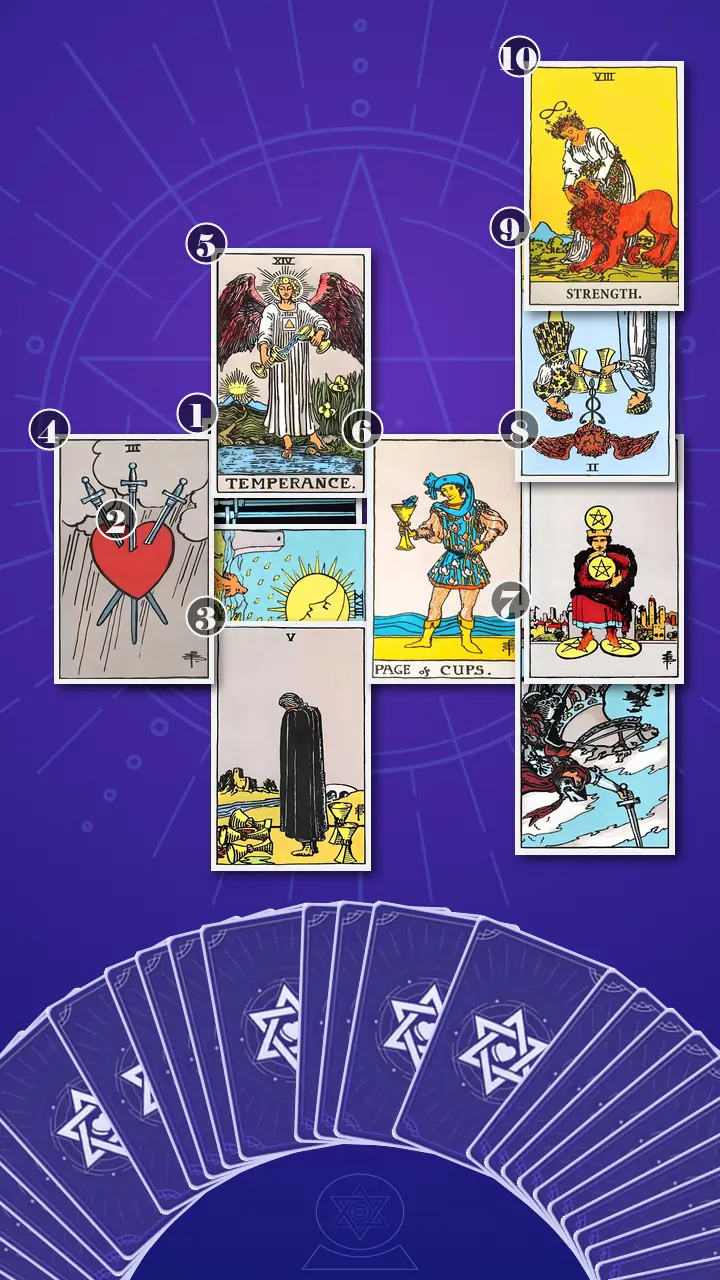
Reading the Map: A Tarot Reading for Friendship Anxiety
Position 1: Your present experience of panic when a friend needs space
“Now flipping over,” I said, “is the card that represents your present experience of panic when a friend needs space—the most visible mental and emotional pattern.”
Nine of Swords, upright.
The image is stark: a figure sitting up in bed, nine swords lined above them like a weapon rack, a dark room that feels too small for how loud the mind is.
“This is the 3 a.m. brain,” I said. “The part of you that treats uncertainty like an emergency.”
I used the modern translation that fit Jordan so cleanly it felt like it had been printed on their lock screen: the nights you can’t fall asleep because you keep replaying a friend’s last message and refreshing the chat, trying to make uncertainty stop.
I let the scene-mirror land the way it always does in Toronto: phone screen lighting up the ceiling, TTC hum faint outside, the warmth of the device in your palm. Then I gave Jordan the two-voice structure I hear in so many clients who panic when a friend needs space.
Voice 1 (Alarm): “Fix it. Fix it now.”
Voice 2 (Observer): “I want certainty, not connection.”
“That’s the contradiction,” I said gently. “You want closeness and reassurance. But the fear interprets distance as rejection, so it pushes you toward control—refreshing, rereading, the second follow-up text that’s ‘to clarify tone’ but is really to pull them back.”
Jordan gave a short laugh that wasn’t amused—more like a wince with sound. “That’s… honestly kind of cruel,” they said. “Like you’ve literally been in my phone.”
I nodded. “It’s accurate, not cruel. And accuracy is useful. It gives us a lever.”
Position 2: What makes the panic intensify—uncertainty and projection
“Now,” I said, “this is the crossing energy: what makes the panic intensify. The specific kind of ambiguity you struggle to tolerate.”
The Moon, upright.
The Moon is not ‘bad news.’ It’s the card of missing information—of the mind trying to create certainty out of shadow.
“See the dogs and the wolf howling?” I asked. “That’s instinct. Not logic. And the winding path between the towers? That’s what it feels like to walk forward when you can’t see clearly.”
I translated it into Jordan’s actual life: when you see a friend’s short reply and immediately search for hidden meaning, as if the message contains a secret verdict.
“The Moon turns ‘I need space’ into a horror trailer,” I said. “Your nervous system reacts to shadows, not necessarily reality. Uncertainty isn’t a problem to solve; it’s a sensation to survive.”
Jordan’s eyes flicked down toward their phone, then away, like even seeing it on the table was an itch. That was the Moon too—the pull of the screen as an oracle that never gives clean answers.
Position 3: Where it started—the underlying emotional root
“This next card,” I said, “represents where it started: the deeper emotional root and early relational learning that the trigger taps into.”
Five of Cups, upright.
A cloaked figure stares at three spilled cups, unable to look at the two still standing behind them. A bridge in the distance, a path to somewhere else, if they’d turn their head.
“This is old grief coloring the present,” I said. “It’s the part of you that learned: connection can vanish. And the brain, trying to prevent pain, starts focusing on what’s missing.”
I used the modern translation that fit Jordan’s history: friendships that faded without explanation, and now today’s silence gets forced into that old script—even if this friend has shown up consistently before.
Jordan’s shoulders pulled up toward their ears, then dropped a millimeter—like a truth landed without blame. “I’ve had… a couple friendships just… evaporate,” they said. “No fight. No closure. Just… gone.”
“That bruise makes sense,” I said. “And it’s not irrational that your system tries to prevent it. It’s just not effective.”
Position 4: A recent wound that primed your nervous system
“Now we’re looking at the recent past,” I said. “A relational sting that primed your nervous system to react strongly to distance.”
Three of Swords, upright.
A heart pierced cleanly, rain falling behind it. No shelter in the image. It’s a card that doesn’t overcomplicate pain—it just names it.
“This suggests there’s a recent moment your body still remembers,” I said. “A misunderstanding, a rejection, a rupture. When someone asks for space now, your nervous system reacts like that old pain is about to replay.”
I kept it street-level: you get a vague message and instantly flash back to the last time someone said ‘I need space’ and then disappeared.
Jordan pressed their tongue to the inside of their cheek—tiny self-containment. “Last year,” they said quietly, “someone I was close with pulled away and never explained. I keep telling myself I’m over it. But clearly…”
“Clearly you adapted,” I said. “The question is whether that adaptation still serves you.”
Position 5: What you consciously want instead—balance without self-abandoning
“Now,” I said, “this card represents what you consciously want instead: the regulated, balanced way you’re trying to handle space and closeness.”
Temperance, upright.
The angel pours water between two cups, one foot on land, one in water. It’s patience. Pacing. Mixing, not forcing.
As a Paris-trained perfumer, I can’t help but see Temperance as the art of blending: you don’t slam raw materials together and pray. You titrate. You adjust drop by drop until the whole thing becomes wearable.
“You want a middle path,” I told Jordan. “A way to be caring without being urgent. Warm without chasing.”
I used the modern translation: pausing before replying, aiming for a message that’s caring and clear without asking for immediate reassurance.
Jordan nodded, then grimaced. “Except I rewrite it five times,” they admitted. “Like… I’m trying to control how it lands.”
“That’s smart self-awareness,” I said. “Temperance is the goal. We’ll need a method so it doesn’t turn into perfectionism.”
Position 6: The next opening—a softer way to reconnect
“Now flipping over,” I said, “is the near future: the next opening. The most likely near-term shift in how you can communicate without pressure.”
Page of Cups, upright.
The Page holds a cup with a fish popping out—an unexpected emotion, a message that arrives when you’re receptive rather than forceful.
I offered Jordan the micro-alternative scene exactly as it tends to happen in real life: the kettle boiling, the soft rush of water, thumbs hovering but not sprinting. Not drafting an essay. Not interrogating silence. Just one line.
“The spiral script is: apology + explanation + three questions + a hidden test,” I said. “The Page script is: one feeling, and one consent cue.”
I used the modern translation: sending one warm line—‘Hope you’re okay; no rush to reply’—and then actually letting the space be real.
Jordan exhaled like their body had been waiting for permission to choose simple. Their shoulders dropped. “I could actually do that,” they said, surprised.
Position 7: Your part in the cycle—the reactive lever you can change
“Now,” I said, “this card represents your stance in the situation—your default move when discomfort hits.”
Knight of Swords, reversed.
Upright, the Knight is speed and sharpness. Reversed, that speed turns into words outrunning wisdom—send first, think later.
I used the modern translation: sending a long ‘I just want to make sure we’re okay’ paragraph, then editing your story in real time based on every minute without a reply.
“A fast text can feel like relief—and still create pressure,” I said. “Reversed Knight energy isn’t ‘you’re bad.’ It’s your nervous system trying to end uncertainty by forcing clarity.”
Jordan’s hand tightened around their phone, then loosened. “I do the Slack version too,” they said. “Double-ping, then add ‘sorry to bug’ so it seems polite, and then I feel… exposed.”
“Same mechanism,” I said. “Different platform.”
Position 8: The external reality—capacity, boundaries, and what “space” might mean
“Now,” I said, “this card represents the environment: the external reality around the situation. Boundaries, bandwidth, what ‘space’ may practically mean.”
Four of Pentacles, upright.
The figure holds tightly to what they have—pentacle to the chest, another at the crown. It’s protective. It’s limit-setting.
I used the bandwidth analogy that almost always changes the temperature in the room: “This is Low Power Mode. Your friend is on 2% battery. Not refusing you—conserving.”
And I translated it into Jordan’s life: your friend is tapped out from work and life and needs quiet time, even though the friendship is still intact.
“Your mind’s translation is: ‘They’re pulling away,’” I said. “The capacity translation is: ‘They’re protecting energy.’ Those are not the same.”
Jordan frowned, then softened. “They do still react in the group chat sometimes,” they admitted. “Even when they’re quiet one-on-one.”
“Exactly,” I said. “Activity isn’t availability. A group chat is a dashboard with unreliable metrics.”
Position 9: Hopes and fears—the emotional stake underneath the texts
“Now,” I said, “this card represents the emotional stake: what you’re hoping to secure and what you fear losing when closeness isn’t immediate.”
Two of Cups, reversed.
Upright, it’s mutuality—the sense that the exchange is flowing both ways. Reversed, the exchange feels interrupted, and the mind panics: is it still mutual?
I used the modern translation: seeing your friend be warm with others and assuming ‘So it’s me,’ instead of considering timing, capacity, context.
“This is where the fear of being quietly replaced lives,” I said. “And it’s why you start scorekeeping—reply times as a KPI, initiation as a scoreboard.”
Jordan’s eyes got shiny, then they blinked hard like they were trying to keep the feeling from becoming a scene. “I hate that I do that,” they said. “It makes me feel… petty.”
“It makes you human,” I said. “And we can give your humanity a better strategy than surveillance.”
Position 10: When Strength Spoke—the antidote that changes your next move
I let my hands pause on the deck for a second. The room felt quieter—not dramatic, just focused, like the moment right before a perfume blotter reveals its heart notes.
“We’re turning over the integration card now,” I said. “Not a fixed prediction. The most grounded internal lesson to practice so you can stay connected without self-abandoning.”
Strength, upright.
In the image, the figure doesn’t wrestle the lion. They steady it. Gentle hands. Calm presence. Power through restraint.
Setup (the moment you know too well): You know that moment: your friend says “I need some space,” and suddenly you’re refreshing iMessage, watching “Read” sit there, then checking their Instagram like it’s a crime scene. Your finger hovers over Send because doing something feels safer than sitting in the not-knowing.
Delivery:
Not every pause is a threat; choose gentle restraint over urgent pursuit, like the calm hand that steadies the lion in Strength.
I let that line sit between us. Outside, a car hissed through slush. Jordan didn’t move.
Reinforcement: Their body did the three-step reaction I see when someone feels seen without being shamed: first a tiny freeze—breath caught, finger still as if it were still hovering over an invisible Send button; then the cognitive seep-in—eyes unfocused for a second, like their mind was replaying every time a typing bubble disappeared; then the release—an exhale that came from the chest, shoulders dropping in a way that looked almost unfamiliar on them. “So… it’s not that I need to become unbothered,” Jordan said, voice quieter. “It’s that I need… a hand on the steering wheel while the alarm is blaring.”
“Exactly,” I said. “Strength isn’t ‘chill.’ Strength is leadership.”
I brought in my signature lens—Social Pattern Analysis, the way I diagnose hidden interaction barriers. “When you lead with urgency,” I said, “the other person often feels pressure, even if your words are polite. The hidden barrier is that your reassurance-seeking can read like a demand. Strength is you keeping the friendship breathable.”
“The next time you feel the urge to ‘just check in,’” I continued, “do a 7-minute Steady-First loop. Stop anytime if it spikes you:
1) Set a timer for 2 minutes. Put your phone face-down.
2) Name the thought as a thought: ‘I’m having the ‘I’m being replaced’ story.’
3) One hand on chest, one on belly. Take 6 slow breaths (longer exhale than inhale).
4) Open Notes and draft the message you want to send, but don’t send it yet.
5) When the timer ends, ask: ‘Is this message warm and simple—or urgency in disguise?’
If it’s urgency, you’re allowed to wait another 20 minutes. If you choose to send, keep it to one clean line (no hidden tests).”
Jordan stared at the card again, then looked at me. “But if I wait,” they said, a flash of anger under the fear, “doesn’t that mean… I was wrong all those times? Like I made it worse?”
I didn’t rush to comfort that away. “It means you were doing the best you could with the tools you had,” I said. “And now you’re getting a better tool. That’s not shame. That’s growth.”
“Now,” I asked, “with this new lens—Strength as the calm hand—think back to last week. Was there a moment where a 7-minute loop would have changed how you felt by even 1%?”
Jordan nodded slowly. “Wednesday night,” they said. “I sent the second follow-up. The one that was supposed to be ‘casual.’ That’s when I felt… gross afterward.”
“That’s the exact moment Strength wants,” I said. “This is the shift from chasing reassurance in real time to practicing one concrete self-soothing step before you reach out.”
In plain terms, this was Jordan moving from acute alarm and spiraling toward steadier self-soothing and clearer boundaries—warm reconnection without self-abandoning.
The One-Page Plan: Steadiness First, Message Second
I pulled the whole spread together for Jordan like a short, honest story.
“Here’s the arc,” I said. “You’re in a Nine of Swords loop—your mind turns silence into catastrophe. The Moon pours gasoline on it because you can’t see clearly, so you fill the blank with old fears. Under that is Five of Cups grief—friendships that faded without closure—and Three of Swords pain that taught your body to brace. Consciously, you want Temperance: balance. The Page of Cups shows the next opening is simple warmth. But your default lever is Knight of Swords reversed—speed. The environment is Four of Pentacles: capacity and boundaries. And the lesson is Strength: gentle restraint as intimacy-protecting.”
“Your cognitive blind spot,” I added, “is that your brain treats a boundary as a verdict. It hears ‘later’ as ‘you don’t belong.’ The transformation direction is the opposite: treat a pause as neutral data, soothe first, then communicate from steadiness.”
Because I work with sensory psychology, I also made this concrete in a way Jordan could feel. “In perfumery,” I told them, “we talk about sillage—how far a scent travels. Texts have sillage too. If your emotional sillage is too strong in a moment of panic, it fills the other person’s space. Strength is learning sillage control: still present, not overwhelming.”
Then I gave them small experiments—actionable advice, not a personality makeover. I also folded in my strategy tools, because Jordan needed something to do with their hands besides refresh the chat.
- The 20-Minute Text BufferOnce this week, when you feel the impulse to send a follow-up text, set a 20-minute timer. Draft the message in Notes instead of sending. When the timer ends, send only if it reads warm and simple—not urgency in disguise.If 20 minutes feels impossible, do 5. Your brain will call it “cringe” or “pointless”—that’s the Knight of Swords craving speed. Tiny is the point.
- A One-Line Warm-Without-Chasing ScriptSave one line you can copy/paste when a friend needs space: “Totally hear you—take the space you need. I’m here, no rush to reply.” Use it once, then stop negotiating with the screen.If you notice yourself adding a second question, that’s your cue to stop. The Page of Cups works because it’s human, not a courtroom brief.
- Capacity-Clarity Ask (Consent-Based)One time (only once), try: “When you say space, do you mean tonight or a few days? It helps my brain not invent a story—either is okay.”This isn’t demanding access—it’s reducing ambiguity respectfully. If they’re overwhelmed, offer options (tonight vs this week) instead of a whole conversation.
Jordan hesitated, then offered the most real obstacle of all: “But what if I literally can’t handle even those 20 minutes? Like my body feels… electric.”
“Then we don’t start with 20,” I said. “We start with the first two minutes of the Steady-First loop. And I’ll add one more support—because you’re allowed to use your senses.”
I handed them a blotter strip with a quiet woody accord—cedar and something gently resinous. “This is my professional presence enhancement with woody accords strategy,” I said, translating it for real life. “Not for someone else’s impression. For your own steadiness. Smell it when the urge spikes. Let it be your ‘hand on the steering wheel.’”
“And if you get stuck in the screen,” I added, “use a cleansing citrus spray—literally one mist into the air away from your face. It’s a pattern interrupt. It tells your body: we’re not trapped in this thought-loop.”

A Week Later: Ownership, Not Certainty
Six days later, Jordan messaged me—not with a paragraph, but with a screenshot.
It was their friend’s text: “Hey, I’m overwhelmed—need a couple days.” And underneath it, Jordan’s reply: “Totally hear you—take the space you need. I’m here, no rush to reply.”
Then Jordan wrote: “I did the 7-minute loop. I still felt anxious. But I didn’t send the second text. I made tea and left my phone on the counter. It felt… weirdly grown-up?”
The bittersweet part was in their next line: “I slept through the night, but in the morning my first thought was still, ‘What if I’m wrong?’—and then I did the breathing anyway.”
That’s the quiet proof I look for in a Journey to Clarity: not perfect calm, but ownership. The move from panic-driven pursuit to steadiness-led connection. The understanding that a friend’s distance can be neutral information, not a verdict on your worth.
When someone asks for space, it can feel like your chest is bracing for impact—because part of you isn’t just hearing “later,” it’s hearing “you don’t belong.”
If you didn’t need a reply to prove you’re safe, what’s one small way you’d want to show up—warm, clear, and un-rushed—just for today?
This story is adapted from psychological research, written so that those in a similar struggle can see their own pattern in it — and find their next step clearly.These insights are not a substitute for professional psychological, medical, legal, or financial advice.
Learn more about our Journey to Clarity.
How did this insight land for you?
🫂 This Resonates Deeply
🌀 Living This Story
✨ Now I See Clearly
🌱 Seeing New Possibilities
🧰 Useful Framework
🔮 The Confirmation I Needed
💪 Feeling Empowered
🚀 Ready for My Next Step
Author Profile
 AI
AI“As a perfumer for fifteen years, I’ve learned to perceive human boundaries through the delicate metaphor of scent. Relationships need the right amount of space to breathe, and I've seen too many kind souls exhaust themselves trying to please everyone. I’m here with warmth and understanding—not to teach you to be guarded, but to help you gently clear the air and rediscover the comforting, safe boundaries that are rightfully yours.”
In this Friendship Tarot Reading :
Core Expertise
- Boundary Permeability Diagnosis: Identifying friends whose lack of limits is metaphorically 'bleeding into your space' and causing emotional suffocation.
- Vibe Contamination Auditing: Recognizing when a highly sensitive or negative friend is unconsciously polluting your personal psychological atmosphere.
Service Features
- The Space Calibration Ritual: A behavioral directive to implement specific 'digital and physical blank spaces', preventing enmeshment and restoring breathable boundaries.
Also specializes in :
Explore Related Patterns:
Anxious AttachmentJordan's panic begins the moment a friend creates distance: a read receipt sits without a reply, a typing bubble disappears, or someone says they need space. The body response is immediate and concrete, with a tight chest, restless limbs, and the urge to reread the thread, draft an apology, or send a follow-up that pulls the friend back into contact. The mechanism underneath is an attachment alarm. Your system is not simply noticing silence; it is translating silence into possible abandonment, then using reassurance-seeking as a way to restore safety. That is why the story keeps returning to clear signals, response timing, and the fear of being quietly replaced. The mind wants connection, but the alarm pushes toward control. Anxious Attachment fits because the core loop is relational distance becoming an emergency. The pattern is not that you care too much; it is that uncertainty in a friendship gets processed as a threat to belonging, especially after friendships have faded without closure before. Seeing the pattern gives you a lever: soothe the alarm first, then choose contact that protects both your dignity and the other person's space.
Boundary DiscernmentJordan's steadier reply gives the friend room without disappearing from the relationship: 'Take the space you need. I'm here, no rush to reply.' That one line holds warmth and boundary at the same time. Boundary Discernment is the ability to tell the difference between someone else's capacity limit and your own fear story. The story repeatedly makes that distinction: activity is not availability, group chat presence is not one-on-one readiness, and a pause is not automatically a verdict on your worth. This pattern matters because it preserves both connection and self-respect. You do not have to flood the friendship with urgency to prove you care, and you do not have to shut down your needs to seem chill. The work is to recognize what belongs to the friend, what belongs to your alarm, and what can be communicated cleanly.
Certainty SeekingJordan says they cannot settle until they get a clear signal back. That line is the center of the pattern: the problem is not only the friend's silence, but the way unresolved ambiguity becomes physically unbearable. Certainty Seeking turns reassurance into an anxiety-management tool. The follow-up text, the apology draft, the capacity question, and the search for tone are all attempts to convert emotional uncertainty into a definite answer. The mind is trying to ask, 'Are we okay?' but the body is asking, 'Am I safe yet?' This explains why respecting space can feel so hard even when you intellectually believe people are allowed to need it. The craving for clarity competes with the value of giving room. Once that mechanism is visible, the next move becomes cleaner: soothe first, then communicate only if the message is warm, simple, and not urgency in disguise.
Rejection SensitivityJordan hears a friend's 'I need space' as something much sharper than a boundary. A delayed reply, a short message, a period, or visible warmth in a group chat starts to feel like evidence that the friend has already moved on or chosen someone else. That is the cognitive mechanism of Rejection Sensitivity: ambiguous social data gets filtered through the expectation of exclusion. Your attention becomes hyper-attuned to possible signs of being downgraded, so neutral cues stop feeling neutral. A friend's limited capacity becomes personally charged, and 'later' starts sounding like 'you don't belong.' This pattern also answers where the panic started in the story. Friendships that faded without explanation taught Jordan's system to treat silence as an early warning signal. The current friend may be conserving energy, but the old relational bruise makes the present pause feel like the beginning of another disappearance.
Self-SoothingJordan's change shows up in a small but concrete moment: the friend says they are overwhelmed and need a couple days, and Jordan replies with one warm line instead of sending the second text. The anxiety is still there, but it no longer gets full control of the behavior. Self-Soothing is the practice of giving the nervous system a regulating cue before asking another person to regulate it for you. The 7-minute loop, the phone face down, the breath, the Notes draft, and the question 'Is this urgency in disguise?' all create a pause between alarm and action. This is the upright integration of the story because it does not require you to become detached or unbothered. You can still care, still feel the spike, and still choose a move that keeps the friendship breathable. The pattern shifts from chasing reassurance in real time to leading yourself through the first wave of panic.
CatastrophizingJordan sees 'Read' with no reply and the mind jumps straight to 'I'm about to be replaced.' A friend's need for space becomes a breakup-shaped story before there is enough evidence to know what the pause actually means. Catastrophizing is the thought pattern that turns uncertainty into the worst plausible outcome. The nervous system reacts to shadows as if they are facts, so a missing reply feels less like missing information and more like a threat that must be solved immediately. That is why the body gets involved: tight chest, bouncing foot, restless checking, and the need to fix it now. The pattern matters because catastrophe thinking creates pressure disguised as urgency. You are not responding to the friend's actual words anymore; you are responding to the feared ending your mind has already screened. Naming that jump helps separate real relational data from the alarm story.
Compulsive CheckingJordan's phone becomes the place where the friendship is constantly re-audited: read receipts, typing bubbles, last active status, Story views, punctuation, and group chat reactions all get scanned for a verdict. The checking is not random; it is an attempt to locate safety in a situation that feels emotionally unfinished. Compulsive Checking works as a short-term regulation strategy. Each refresh offers the possibility of relief, but when the screen gives ambiguous data, the mind needs another scan. The behavior promises control while feeding the same uncertainty it is trying to end. That is why the loop spreads across platforms. iMessage, Instagram, and Slack become different versions of the same reassurance machine. The work is not to shame the checking, but to see what job it is doing: trying to calm an attachment alarm with data that was never designed to provide emotional certainty.
Mind ReadingJordan reads tiny signals as if they reveal the friend's private verdict: a short reply, a period, a Story view, or warmth in the group chat. The mind does not just notice these details; it assigns motive to them. Mind Reading is the cognitive shortcut where incomplete information gets treated as if it proves what someone else thinks or feels. In the story, 'They're protecting energy' becomes 'They're pulling away,' and seeing the friend active elsewhere becomes 'So it's me.' The missing step is reality testing: capacity, timing, and context are possible explanations too. This matters because the imagined motive drives the next behavior. If you believe the friend is quietly rejecting you, checking and follow-up texts feel necessary. If you can hold the signal as incomplete data, you get enough space to respond from steadiness instead of from a story your mind filled in too fast.
Protest BehaviorJordan wants to respect the space, but the discomfort builds until 'just checking in' goes out anyway. The message may look casual on the surface, yet the story makes clear that it is carrying a hidden emotional task: pull the friend close enough for the alarm to stop. Protest Behavior describes that reactive bid for contact when distance feels threatening. It is not aggression in this story; it is urgency dressed in polite language. The second follow-up, the Slack double-ping, and the 'sorry to bug' add-on all try to reduce uncertainty by reactivating the other person. The cost is relational pressure. A reassurance-seeking message can still read like a demand if the other person has already asked for space. Seeing this pattern gives you a more precise choice: connection does not have to mean pursuit, and restraint can be a way of protecting the friendship rather than abandoning it.
Relational ScorekeepingJordan starts measuring the friendship through reply times, initiation, group chat warmth, and visible online activity. The scoreboard makes the relationship feel assessable, as if mutuality can be proven through metrics. Relational Scorekeeping turns emotional security into a tracking system. The mind is trying to answer a vulnerable question, 'Do I still matter here?' by counting observable signals. But the metrics are unstable: activity is not availability, a group chat is not a one-on-one capacity readout, and response speed is not the same as care. This pattern keeps the panic alive because every data point can become evidence for or against belonging. The audit feels protective, but it narrows the friendship into performance indicators. Naming the scorekeeping helps return the relationship to context instead of letting the dashboard decide your worth.
RuminationJordan keeps returning to the same evidence: the last message, the read receipt, the typing bubble, the punctuation, the missing reply. The mind builds a detective board out of tiny pixels, but the investigation does not produce more clarity. Rumination is the loop of reprocessing the same material without a meaningful update. It can feel like problem-solving because the mind is active, but it keeps the nervous system inside the threat state. Every reread makes the silence feel more loaded, even when no new information has arrived. The pattern is especially strong because the question is relational and unresolved. You are not just thinking about a text; you are trying to metabolize the possibility of being left. The practical shift is to notice when review has stopped being insight and started becoming alarm maintenance.
Emotional RegulationJordan practices putting the phone face down, naming the thought as 'the I'm being replaced story,' and taking slow breaths before deciding whether to send. The body still feels electric, but the action no longer has to happen at the speed of the alarm. Emotional Regulation is the mechanism that turns panic from a command into a signal. Instead of treating the chest tightness and urgency as proof that something is wrong, Jordan learns to give the nervous system a few minutes of containment and then reassess the message. This pattern supports the whole friendship arc. It does not solve the friend's availability or erase the fear of being wrong; it creates enough internal space to choose a cleaner response. That is the difference between being driven by the spike and using the spike as information.
Explore Related Struggles:
All-or-Nothing BelongingJordan's mind makes a fast leap from 'my friend needs space' to 'I am being replaced.' The leap is not presented as a vague insecurity; it shows up through concrete proof seeking, scorekeeping, and the feeling that one unread silence can decide the whole relationship. All-or-Nothing Belonging describes that binary flip. You are either secure or excluded, chosen or replaced, okay or about to lose the bond. There is very little middle space where a friend can be overwhelmed, distracted, conserving energy, or slow to reply while still caring. That is why the story's integration lesson matters so much. Treating a pause as neutral data does not erase the need for connection; it gives the relationship more than two possible meanings. Belonging becomes less dependent on immediate proof and more able to survive ordinary distance.
Certainty-Safety FusionJordan says the key sentence out loud: they cannot settle until they get a clear signal back. A friend needing space does not land as ordinary ambiguity; it lands like a missing safety cue, the kind the body keeps demanding until the alarm quiets. Certainty-Safety Fusion names the lock underneath that reaction. You are not only wanting information; you are needing information to feel relationally safe. The reply, the timeframe, the tone marker, or the clean reassurance becomes the thing your system uses to decide whether the bond still exists. That fusion explains why respectful waiting feels so hard. If uncertainty is coded as danger, then patience feels less like maturity and more like exposure. The work in the story is not becoming detached; it is slowly separating safety from instant confirmation so connection can remain intact without forcing the other person to answer on alarm time.
Read Receipt Worth LockJordan keeps returning to the same tiny digital artifacts: the Read receipt, the typing bubble that appears and disappears, the Story view, the group chat reaction, the punctuation that suddenly feels loaded. The screen is not just a communication tool in this story; it becomes the place where Jordan tries to measure whether they still matter. That is why Read Receipt Worth Lock fits so tightly. A delayed reply starts carrying the emotional weight of being chosen, kept, or quietly replaced. You are not simply waiting for a message; you are watching a symbol and asking it to confirm your place in the relationship. The struggle becomes sharper because the signal never has enough information to do the job Jordan gives it. A read receipt can show that a message was seen, but it cannot show capacity, care, timing, or intention. When worth gets routed through that thin data point, every pause becomes a trial your nervous system feels forced to attend.
Relational Pacing CollapseJordan knows the friendship needs space, yet the body keeps reaching for the next text: the apology draft, the 'just checking in,' the second follow-up that is supposed to sound casual. The action is small, but the pressure behind it is not. Relational Pacing Collapse names the moment when the relationship loses its breathable rhythm. You want to stay warm and connected, but urgency starts setting the tempo. The friend's boundary needs time; your alarm demands contact now; the friendship gets squeezed between those two clocks. This struggle is especially visible because Jordan does not lack care or insight. They consciously want Temperance: warm without chasing, caring without being urgent. The collapse happens when alarm takes over the pacing system and turns closeness into a deadline.
Vigilance-Connection SplitJordan builds a whole detective board out of tiny pixels: last active, Story views, punctuation, reply speed, and whether the friend is visible somewhere else online. Each check promises relief, but the relief never holds for long enough to let the friendship feel stable. Vigilance-Connection Split captures that painful contradiction. The scanning is meant to protect connection, yet it turns connection into something constantly audited. You reach for closeness through observation, but observation keeps you outside the actual relationship, reading signs instead of inhabiting trust. The split matters because Jordan's monitoring is not random curiosity. It appears when the body is trying to prevent another disappearance. But the more the system scans, the more every ordinary delay becomes evidence to process, and the less room there is for a friend to have bandwidth, privacy, or a quiet day without becoming a threat.
Wound-Compass FusionJordan names the origin in plain language: a couple of friendships evaporated with no fight, no closure, just gone. Later, someone close pulled away and never explained. Those endings did not give the mind a clean place to file the loss. Wound-Compass Fusion is the deeper structure that grows from that kind of unfinished relational history. The old hurt becomes a navigation system. You are trying to respond to the friend in front of you, but the compass keeps pointing back to the person who disappeared. That is why today's silence gets forced into an old script, even when this friend has shown up before. The present pause is not being read only as present information; it is being filtered through the memory of vanishing without repair. Seeing that distinction gives you back a little choice: this pause may deserve attention, but it does not automatically deserve the authority of the old wound.
Explore Related Emotions:
Certainty HungerJordan says they cannot settle until they get a clear signal back. The need is not abstract; it lives in the tight chest, the restless limbs, the glowing phone, and the repeated reach for some detail that will make the ambiguity stop. The problem is that the signal they crave is being asked to do too much. A reply is not only a reply; it has become evidence of safety, proof of mutuality, and protection against being replaced. You can feel how the mind keeps trying to turn a living relationship into a clean data point. Certainty Hunger fits because Jordan is not simply curious about what the friend means. They are craving relief from the not-knowing, and the body keeps insisting that only a clear answer will make the alarm quiet enough to breathe.
Friendship Drift GriefJordan describes friendships that simply evaporated: no fight, no closure, just gone. That absence matters because it left the mind with no clean ending to file away, only an unfinished ache that can be reopened by a new silence. When a current friend asks for space, the present is no longer only present. It touches the memory of fading connections, and the body responds before the rational mind can separate then from now. You can feel how a delayed reply becomes heavy with old loss. Friendship Drift Grief fits because the emotional root is not only panic about being ignored. It is the lingering sadness of connections that slipped away without explanation, still coloring how Jordan experiences distance today.
Friendship Rupture GriefJordan quietly names last year: someone close pulled away and never explained. The story does not turn that moment into a diagnosis or a verdict; it shows how a recent relational sting can stay alive in the body's timing. Now, when someone says they need space, Jordan's system reacts as if that earlier rupture is about to replay. The checking, the bracing, and the urge to send one more message are attempts to prevent the same ending from happening twice. Friendship Rupture Grief fits because the panic has a fresh wound underneath it. The distress is shaped by the memory of a bond that broke without enough explanation to let the nervous system fully stand down.
Hard-Won ComposureA week later, Jordan still feels anxious after the friend asks for a couple days. The difference is concrete: they do the 7-minute loop, do not send the second text, make tea, and leave the phone on the counter. That steadiness is not presented as perfect calm. In the morning, the first thought is still what if I am wrong, and Jordan does the breathing anyway. You can feel the new capacity forming inside the old alarm rather than replacing it overnight. Hard-Won Composure fits because the emotional shift has effort in it. Jordan is not suddenly unbothered; they are practicing the strength to stay connected without letting panic dictate the next move.
Hypervigilant AnxietyJordan sits forward with the phone already glowing, then describes a subway ride where a disappearing typing bubble tightens their chest and sends their foot into motion. The body is not waiting neutrally; it is scanning the silence as if a threat has entered the room. The panic becomes a monitoring system built from small digital cues: last active, Story views, punctuation, reread threads, deleted apologies, and one more check-in sent for relief. You are watching Jordan's attention narrow until belonging feels dependent on the next signal. Hypervigilant Anxiety fits because the distress is not just worry about one text. It is a full-body state of alertness where uncertainty keeps getting treated as danger, and the nervous system keeps searching for proof that the connection is still safe.
Mixed Signal DreadThe typing bubble appears, disappears, and leaves Jordan suspended in the gap. A short reply, a period, a Story view, or a group chat reaction can suddenly feel like evidence in a case they never meant to open. The uncertainty intensifies because Jordan is not reading only the present moment. Their mind is also reading the memory of people who pulled away without explaining, so ambiguity arrives with emotional residue already attached. You can see the message becoming less like communication and more like a shadow Jordan has to interpret. Mixed Signal Dread names the fear that grows when the cues are visible but the meaning is not. It is the feeling of standing in front of incomplete data and sensing danger in every possible interpretation.
Mutuality HungerJordan watches the friendship for signs that the exchange still goes both ways. A quiet one-on-one thread beside visible group chat activity creates a painful question: is this still mutual, or am I the only one reaching? That question makes ordinary timing feel loaded. The reply is not just a reply; it becomes a test of whether care is still circulating. You can feel Jordan trying to measure warmth because feeling it directly has become difficult. Mutuality Hunger fits because the ache is for reciprocal presence. Under the checking and scorekeeping is a desire to know that the friendship is still alive on both sides, not held together by Jordan's pursuit alone.
Relational Catastrophe DreadJordan says they know people are allowed to need space, but their brain treats it like a breakup. That single sentence carries the whole emotional distortion: a temporary boundary becomes the opening scene of a relational ending. The story gives that dread a history. Friendships have faded without explanation, someone close pulled away last year, and now a vague message can make the body brace as if the same disappearance is starting again. You can see how present silence gets dragged into an older script before the current friend has had a chance to respond. Relational Catastrophe Dread names the feeling that distance will not stay ordinary. It captures the way Jordan experiences a pause as the beginning of rejection, replacement, or loss, even when the actual facts remain incomplete.
Relational FogJordan's mind builds a detective board out of tiny pixels: last active, Story views, punctuation, and the difference between a period and an exclamation point. There is plenty to look at, but none of it gives the clean answer Jordan is trying to extract. The screen becomes a place where data and projection blur together. A friend may be conserving energy, responding in a group chat, or simply unavailable, but the fog makes every signal feel unstable. You can see Jordan gathering evidence while becoming less clear. Relational Fog fits because the inner weather is not pure panic alone. It is the confusion of having too many partial cues and not enough grounded trust, where the mind keeps reading shadows as if they could finally explain the relationship.
Relational FreefallWhen the friend needs space, Jordan's chest braces for impact. The pause is not felt as a small gap in communication; it opens underneath them like the relationship has lost its floor. That freefall is shaped by earlier disappearances. Friendships evaporated, someone close pulled away last year, and now the body has learned to react quickly before another bond can vanish without warning. You can feel why neutral distance takes practice to believe. Relational Freefall fits because Jordan's panic carries a falling sensation: no stable middle ground between closeness and loss, no reliable landing between later and gone. The work of the reading is to help them build that middle ground from the inside.
Relational UrgencyJordan's finger hovers over Send because doing something feels safer than sitting in the not-knowing. The second follow-up, the long reassurance paragraph, and the Slack double-ping all carry the same emotional velocity. The urgency is not random impatience. It grows from the way a boundary gets translated as a verdict, so waiting starts to feel like agreeing to be left. You can see how action becomes the body's attempt to stop uncertainty from expanding. Relational Urgency fits because the central pressure is immediate: reach now, clarify now, repair now, pull them back now. Naming it gives Jordan a place to intervene before urgency disguises itself as care.
Replaceability DreadJordan names the tab that opens in their head: I am about to be replaced. Later, seeing the friend be warm with others turns the fear sharper, as if another person's ease means Jordan's place has been quietly downgraded. The mind starts building measurements because the fear wants proof. Reply times become a KPI, initiation becomes a scoreboard, and group chat activity becomes a dashboard with unreliable metrics. You can see how the friendship gets translated into a ranking system when belonging feels unstable. Replaceability Dread fits because the pain is not only about distance. It is the fear that closeness is transferable, that someone else can step into the warm place Jordan thought they held, and that silence may be the first sign of being swapped out.
Cautious VulnerabilityJordan wants a middle path: caring without urgency, warm without chasing. Even the repeated rewriting shows that the goal is not cold distance; the goal is to stay connected without making the other person responsible for calming the whole alarm. The warmer version of the story appears in the wish to send one clean line instead of an essay, one feeling instead of a hidden test. You can see vulnerability trying to become breathable, shaped by pacing rather than pressure. Cautious Vulnerability fits because Jordan is not trying to stop caring. They are learning how to let care remain visible while giving it enough restraint to respect both their own dignity and the friend's space.
Quiet ShameJordan remembers the second follow-up, the one that was supposed to be casual, and describes feeling gross afterward. The Slack version has the same texture: double-ping, soften it with sorry to bug, then sit in the exposure after the message leaves. The shame is quiet because it arrives after the alarm has already spent itself. First comes the urge to repair, then the message, then the private judgment that they were too much, too needy, or petty for wanting reassurance. Quiet Shame fits because the story shows a painful aftertaste rather than a loud collapse. You can feel Jordan judging the need itself, even while the reading keeps redirecting them toward ownership without self-attack.
Explore Related Contexts:
Digital Intimacy Boundary ConfusionJordan says they know people are allowed to need space, but their brain treats it like a breakup. The story keeps returning to the same collision: one person is trying to set a practical boundary around bandwidth, while the other is trying to read that boundary through a screen that cannot explain tone, intent, or relational meaning. Digital intimacy makes the boundary harder to locate. A friend can still react in a group chat, still view a Story, or still be online while not being available for a direct emotional exchange. Those partial signs blur the difference between access, care, capacity, and avoidance, so the friendship becomes harder to navigate than it would be in a clearer face-to-face setting. Digital Intimacy Boundary Confusion names the external stage accurately because the pain point lives in the screen-mediated relationship structure. You are not simply dealing with silence; You are dealing with a digital social environment where boundaries are visible enough to trigger interpretation but not clear enough to provide orientation.
Read Receipt PressureJordan sees “Read” with no reply, watches typing bubbles appear and disappear, checks Story views, and starts treating punctuation and reply timing as evidence about whether the friendship is still secure. The phone is not just a device in this story; it becomes the public-facing dashboard through which silence, delay, and partial visibility are converted into social pressure. That pressure is structural because digital platforms offer fragments of access without giving context. A friend can be overwhelmed, active in a group chat, quiet one-on-one, or simply conserving energy, but the interface displays all of those states as incomplete signals. You are left staring at traces of activity that look like answers but do not actually explain availability, care, or intention. Read Receipt Pressure fits because the central conflict is not ordinary waiting. It is the way read receipts and message-status cues turn a friendship pause into a live evaluation loop, pulling You toward refreshing, rereading, apologizing, and following up before the situation has had room to breathe.
Access as Proof PressureJordan says they cannot settle until they get a clear signal back, and the story later names the core translation: “later” gets heard as “you don’t belong.” Fast access to the friend becomes more than convenience; it becomes proof that the bond is still intact. The pressure comes from treating availability as a belonging metric. When the friend is visible in a group chat but quiet one-on-one, or when “Read” sits without a reply, the social meaning of access becomes overloaded. Ordinary bandwidth differences start carrying the weight of replacement, exclusion, and relational ranking. Access as Proof Pressure fits because the story keeps showing contact being used as evidence. You are not simply wanting a message; You are trying to use access to stabilize Your place in the friendship, which makes every pause feel larger than the pause itself.
Friendship Boundary ResetJordan's friend says they are overwhelmed and need a couple days, and Jordan practices replying with one clean line: “Totally hear you—take the space you need. I’m here, no rush to reply.” That moment gives the friendship a different structure from the earlier chase for immediate reassurance. The reset is external because it changes the rules of contact between two people. Space becomes a legitimate boundary around capacity rather than a social verdict, and the reply offers warmth without demanding instant access. The friendship is being reorganized around breathable pacing, consent, and realistic bandwidth. Friendship Boundary Reset fits as the constructive context in the story because the near-term path is not to erase the need for closeness. It is to create a clearer relational container where You can stay connected while allowing the other person’s limits to be real.