The 11:40 p.m. Loyalty Dashboard
I have watched someone handle stakeholder feedback all day, revise a Figma prototype without flinching, and still lose an hour at midnight to one mutual friend saying, “I care about both of you.” Friendship rejection sensitivity hits differently when most of a social life lives inside a group chat and every pause, reaction emoji, and Instagram like can be mistaken for a loyalty score.
Maya, a 27-year-old junior product designer, appeared in my video window from the edge of her bed in a rented Toronto apartment. Blue light sharpened the dark room; I could hear the radiator clicking through her microphone. She rubbed the palm that had been holding her warm phone, reopened two screenshots, and sent them to her roommate with the message, “Be honest. Does this sound cold to you?”
The mutual friend had written, “I care about both of you, and I don't want to take sides.” Maya's mind translated it as, “They don't believe me.” Her chest tightened; her stomach seemed to drop a floor; her thumb moved from the message to the friend's recent Instagram likes. She wanted to respect someone's right to remain neutral, but a quieter part of her heard neutrality as the opening line of abandonment.
“I know I'm filling in blanks,” she told me, her jaw held so still that the words barely seemed to pass through it. “But the blanks feel like an answer. Why do I keep reading mutual friends' neutrality as rejection?”
I heard fear in the question, but I also heard loneliness and the bitter wish to be chosen so unmistakably that no decoding would be necessary. The feeling was like a smoke alarm treating shower steam as a house fire: the alarm was genuinely sounding, and her body genuinely wanted protection, but the source had not yet been identified accurately.
“I'm not going to tell you that your fear is silly,” I said. “I'm also not going to claim the cards can reveal what your friends secretly think. What we can do is map where their observable message ends, where your alarm begins, and what choice becomes available in the space between them. Let's find clarity without forcing a verdict.”
Choosing a Map for the Space Between
I asked Maya to place her phone facedown, set both feet on the floor, and take one unforced breath. I shuffled slowly while she held the consultation question in mind. I use this brief pause as an attentional threshold, not a supernatural performance: it helps the nervous system recognise that checking has stopped and reflection has begun.
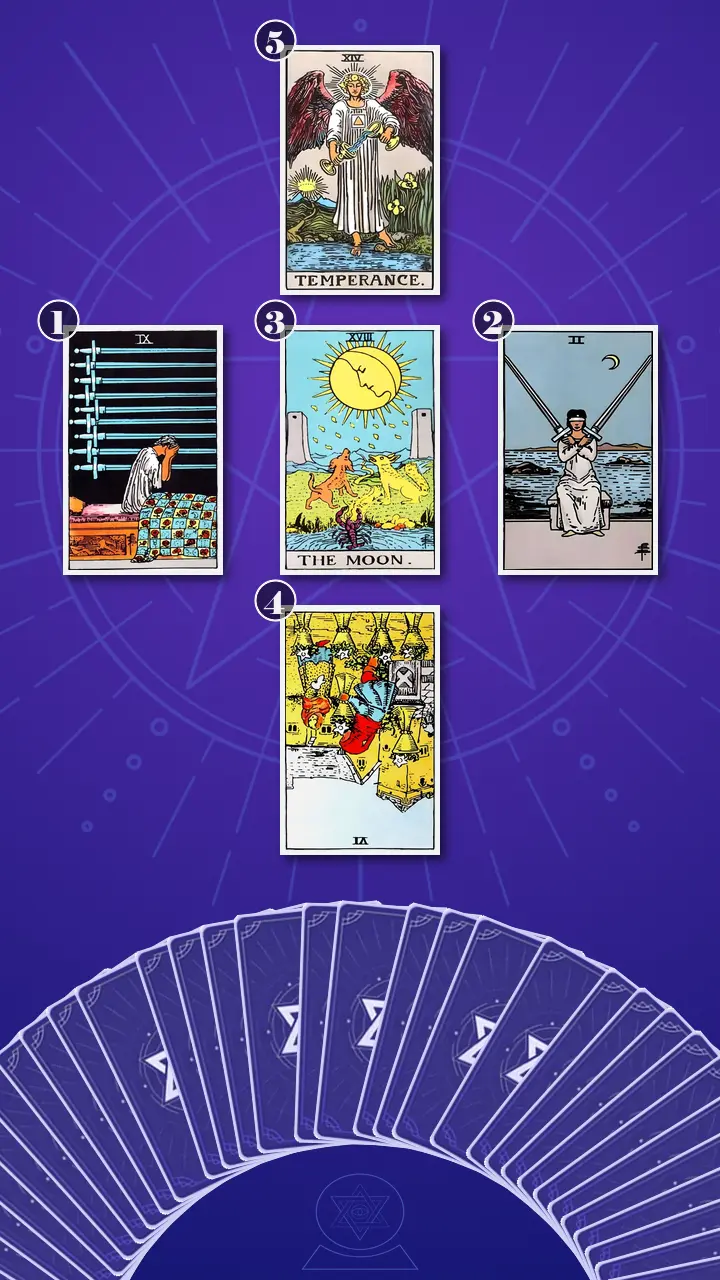
I chose the Relationship Spread · Context Edition, a five-card relationship tarot spread designed for situations where mutual friends will not take sides. A larger Celtic Cross could have produced more material, but more material was already part of Maya's problem. This focused spread gave us the minimum useful structure: her response, the friends' observable signals, the ambiguity between them, the older belonging pattern underneath, and a self-led way forward.
I laid the cards in a cross. The first would show how Maya reacted after neutrality landed. The second would examine only what her mutual friends had actually said or done, without pretending I could access their private motives. The central card would show where incomplete information became a rejection narrative. Beneath it, the fourth would identify the older attachment-based root; above it, the fifth would offer an integration practice.
The layout resembled a bridge crossing a deep channel, with a submerged anchor below and a lookout above. This is how tarot works at its most useful in my practice: card positions slow down meaning collapse. They separate information that fear has compressed into one verdict, allowing card meanings in context to become an objective cognitive map rather than a prediction.
Reading the Message Before the Alarm
Position 1: The Bedside Prosecution
The first card I turned over represented the current observable symptom: how Maya mentally and behaviourally reacted when mutual friends remained neutral. It was the Nine of Swords, upright.
I pointed to the figure sitting upright in bed, face covered, while nine swords lined the dark wall. The image did not accuse Maya of inventing pain. It reflected the private enclosure of the pain: one person, one dark room, and a row of thoughts that looked solid enough to touch even though none of them had established a direct rejection.
In Maya's life, those swords were the reopened thread, the punctuation comparison, the read receipt, the Story-view order, and the two screenshots sent for another interpretation. At 11:40 p.m., the loop sounded like this: “If I reread it once more, maybe I'll finally know. If I stop checking, I might miss the moment they leave.” Checking offered a brief hit of control, but it kept her inside the same unanswered conversation.
I read the upright card as an excess of mental air: analysis was moving faster than evidence. Her tight chest made the thought urgent; urgency made it feel accurate; the apparent accuracy sent her back to the phone. The loop maintained itself without any new interpersonal fact entering it.
Maya gave one short laugh, but there was no amusement in it. “That's so accurate it feels a little brutal.” Her fingers tightened around the sleeve of her sweatshirt, then released it.
“The card isn't calling you irrational,” I said. “It is showing the cost of trying to think your way out of a question that currently lacks enough data. The intensity of a thought is not evidence of its accuracy.”
Position 2: The Boundary That Wasn't a Verdict
The next card represented only the mutual friends' observable signals and stated boundaries, helping Maya separate available evidence from assumptions about private motives. I turned over the Two of Swords, upright.
The seated figure held two swords at equal height. A blindfold limited visibility, but the water behind her remained calm. I placed the friend's exact words beside Maya's interpretation: “I care about both of you, and I'm not taking sides” sat on one side; “They don't believe me” sat on the other. The first sentence was available evidence. The second was the meaning her alarm had added.
For this position, the card held an unusual combination of balance and blockage. The mutual friend appeared to be maintaining two relationships without publicly ranking them. That was balanced nonalignment. The unresolved discomfort was the blockage: Maya could not see the person's full motives, and the friend would not provide the decisive allegiance signal her body wanted.
After a decade of studying cycles, I often think of planets at opposition when I see this card. Two bodies can occupy different sides of a relational sky without one erasing the other. Their distance is information, but it is not automatically exile.
“What was actually said,” I asked, “and what did your alarm add?”
Maya read the message once more, this time without opening Instagram. Her shoulders lowered by perhaps half an inch. “They said they weren't taking sides. They didn't say they were done with me.”
“Exactly. Neutrality is incomplete information, not a hidden verdict. That does not mean neutrality proves the friendship is safe or trustworthy, either. It means one boundary cannot honestly be promoted into either conclusion yet.”
Position 3: The Algorithm of the Moon
The central card represented how ambiguity was operating between Maya and the wider group, including the point where incomplete information became a rejection narrative. I turned over The Moon, upright.
I traced the winding path between the two towers. It continued through night terrain but did not reveal the destination from its starting point. The dog and wolf suggested two simultaneous responses: the socially composed part of Maya that could type, “Totally understand,” and the instinctive part already bracing for expulsion.
In ordinary life, that moonlit path began with one neutral text and ran through Instagram likes, Story viewers, response times, and vividly imagined private conversations. Maya could picture the friend discussing her elsewhere, a hidden consensus forming, and future invitations excluding her. She could not verify those scenes, but their vividness made them feel like information.
I described The Moon here as insufficient visibility combined with excess projection. It did not confirm deception. It showed what happened when instinctive alarm was asked to complete a picture the available light could not finish.
“Your attention has started behaving like an algorithm trained by anxious clicks,” I told her. “Every time you inspect a like for danger, the system serves you more material related to danger. Soon the size of the feed feels like proof, even though the original conclusion trained the feed.”
Maya's breathing caught. Her eyes moved away from the card and lost focus, as though she were scrolling through an invisible sequence of old checks. Then she exhaled through her nose and pressed her feet more firmly into the floor.
“I can't verify the private chats,” she said slowly. “But I can picture them so clearly that I treat them like I saw them.”
“At which clue does uncertainty usually become certainty?” I asked.
“The first like on the other person's post,” she said. Naming the threshold did not make it comfortable, but it changed the imagined network into one identifiable moment where she could choose whether to keep walking.
Position 4: The Cached Ending
The fourth card represented the underlying attachment-based challenge that made present neutrality resemble an earlier threat to belonging. I turned over the Six of Cups, reversed.
I focused on the flower-filled cup offered inside an enclosed old courtyard. Upright, the image can hold familiarity and memory. Reversed in this position, the old setting had tilted into the foreground. A current message was arriving through the emotional scale of a friendship that had once faded without explanation.
Maya told me about an earlier group that had gradually stopped including her. There had been no direct ending, only shorter replies, plans learned about afterward, and an old thread that went quiet. When today's friend wrote, “I see both sides,” Maya's body retrieved that ending before her mind had evaluated what was different now.
“This message is happening now,” I said, “but your body recognises an older ending.” The reversal showed blocked updating: memory was valid data about what had hurt before, but it was loading like a cached version of a friendship over the live page.
Her fingers curled beneath her palms. Her gaze stayed on the reversed courtyard while the old sequence seemed to pass behind her eyes. Then her jaw loosened, and she said, “I've been responding to both groups at once.”
This was where I used a lens I call Orbital Drift Recognition. I asked her to map the old friendship by observable changes in contact, reciprocity, invitations, life phase, and follow-through. The earlier group had shown a repeated pattern of genuine distance. Then I asked her to map the current group. These friends still invited her, replied one-to-one, and maintained contact while refusing to become judges.
Orbital Drift Recognition does not romanticise every fading friendship as personal growth, and it does not require anyone to preserve a bond that no longer fits. It removes guilt by distinguishing an actual change of orbit from the fear that one is already happening. Maya's body had detected a familiar constellation; the present evidence had not yet drawn the same shape.
When Temperance Kept the Cups Apart
Before I turned the final card, the radiator released one last metallic click and fell quiet. The room seemed to widen around the silence, as if the environment itself had stopped supplying punctuation for Maya to interpret.
Position 5: Two Open Cups, One Chosen Question
The final card represented a self-led integration practice for distinguishing fear from fact and choosing proportionate communication without demanding allegiance. I turned over Temperance, upright, the key card and bridge of the reading.
I pointed to the continuous stream passing between two cups, then to the figure with one foot in water and one on land. Water held emotional truth: “I am afraid I could lose this friendship.” Land held observable reality: “This friend has stated a boundary and has not directly rejected me.” Temperance did not mute either track. It kept them separately audible until Maya had enough information to combine them responsibly.
I then applied my Gravity De-linking Analysis. I map two different forces: evidence of actual relational drift, such as sustained non-reciprocity or repeated exclusion, and friction created when people are pressured into an alignment their current roles or boundaries do not support. Maya did not yet have enough repeated evidence to declare orbital separation. However, asking friends to prove loyalty by cutting someone off could create the very friction she feared.
This did not make her responsible for anyone else's choices. It gave her a cleaner diagnostic question: “Am I observing a pattern of withdrawal, or am I trying to force alignment because uncertainty feels unbearable?” That distinction protected her right to evaluate the friendship while also protecting each friend's autonomy.
I brought her back to 11:40 p.m.: sitting on the edge of the bed, phone warm in her hand, moving between one careful group-chat reply and Instagram likes, trying to make a neutral sentence confess. She had been trapped inside, “I must decode this now or be blindsided later.”
I said, “The fear of rejection may be real, but it is not the same fact as your friend's neutrality. Let each remain true in its own cup until present evidence tells you what can honestly be combined.”
You do not have to pour every silence into the cup marked rejection; keep fact and fear in separate cups, then combine only what present evidence and a direct conversation support.
I let the sentence remain between us. The dark phone screen beside Maya reflected two small rectangles of light, almost like the two open vessels on the card.
At first, Maya did not exhale. Her thumb froze above the edge of the phone, and her pupils widened while the rest of her face held perfectly still. Then her eyebrows pulled together. “But doesn't that mean I was wrong all week?” she asked, a flash of anger sharpening her voice. “Like I did this to myself?” I told her no: the alarm had been real, the information incomplete, and the checking an understandable attempt to avoid being surprised. Responsibility was not a retroactive conviction; it was the return of choice. Her gaze drifted past the screen as if she were replaying the week with new subtitles. Her eyes reddened. The fist in her sweatshirt slowly opened, her shoulders dropped, and a long breath left her with a slight tremor. Relief arrived, but so did a brief, almost dizzy blankness. “So I still have to decide what I ask,” she said softly. The clarity had not removed responsibility; it had made responsibility visible.
“Now, with this new perspective, think back to last week,” I invited her. “Was there a moment when this distinction could have made you feel different?”
She remembered the Sunday group invitation. She had typed, “Can't make it, have fun,” before anyone had treated her as unwanted. “I could have written down that I was afraid,” she said, “without calling the invitation a trap. Then I could have decided whether I actually wanted to go.”
I showed her how Temperance could become a Notes-app practice: one heading for the observable fact, one for the feared interpretation, and one for two other plausible explanations. After that, if she chose, she could ask one calm question about the present friendship. She did not have to prove an optimistic story. She only had to stop appointing fear as the sole interpreter.
That was the first crossing from rejection-driven hypervigilance and preemptive withdrawal toward ambiguity tolerance, proportionate interpretation, and measured direct communication. The card had not made the crossing for her. It had simply made the bridge easier to see.
Fact, Fear, and the Next Daylight Question
The Story the Five Cards Told
I gathered the spread into one sequence. The Nine of Swords showed Maya's private mental prosecution after a neutral message. The Two of Swords showed that the external signal itself was balanced, guarded, and incomplete rather than openly rejecting. The Moon revealed how partial visibility became a vivid digital trail of imagined loyalties. The reversed Six of Cups identified the older social ending lending today's message its disproportionate weight. Temperance restored circulation between emotion and evidence, then directed that energy toward one measured choice.
I also noticed the absence of Wands and Pentacles. Dramatic confrontation and definitive proof were not the remedy this spread suggested. The missing fire and earth needed to arrive through a small action with a timer, a physical pause, and one clear sentence.
Maya's cognitive blind spot was not simply “overthinking.” It was treating the absence of public allegiance as evidence of absent care, then treating the strength of her physical reaction as confirmation. Updated evidence, such as current invitations and one-to-one contact, could not compete with the familiar feeling that distance was coming.
The transformation direction was precise: when neutrality triggered rejection, she would separate the observable fact, the feared interpretation, and two plausible alternatives before deciding whether to ask one direct question. This was actionable advice, not an instruction to trust everyone, ignore patterns, attend every group event, or stay connected to someone who repeatedly behaved without respect.
The Two-Cup Practice for the Next 48 Hours
I gave Maya two deliberately small next steps. Both were optional, and neither required her to contact anyone while activated.
- The Five-Minute Fact-Fear-Two-Alternatives NoteTonight, choose one neutral message and make three headings in your phone: “Observable fact,” “Feared interpretation,” and “Two other plausible explanations.” Copy the exact words under the first heading, write one sentence and a confidence rating from 0 to 100 under the second, and add two explanations that could reasonably fit under the third. Stop when five minutes ends.The alternatives do not have to be comforting or correct; they only have to remain plausible while information is incomplete. Close the note and the social apps when the timer ends. If your body becomes more activated, stop earlier and return only if you choose.
- The Daylight Friendship ClarifierDuring the day, draft: “I respect that you don't want to take sides. I noticed I got worried about where we stand; are you still comfortable staying connected one-to-one?” Remove any clause asking the friend to stop seeing someone, prove loyalty, or defend the boundary. Sending is optional; drafting the question is a complete first attempt.Give yourself five minutes, then revisit the draft the next morning. Ask only if the relationship feels respectful enough for direct conversation. You can ask for clarity without asking someone to choose a side.
I added one guardrail. Temperance was not code for staying calm and accepting whatever happened. If a sustained pattern eventually revealed real distance, I could help Maya use my Constellation Release Protocol: name what the friendship genuinely gave, name what had observably changed, choose the boundary that protected her next phase, and release the demand for a public loyalty verdict. Leaving someone peacefully in their orbit can be self-respect. But Maya did not need to pre-grieve a loss that current evidence had not established.
One Week Later: Finding Clarity Without a Verdict
A week later, I received a message from Maya shortly after eight in the morning. She had tried the five-minute note on the original text. Under “Observable fact,” she copied the friend's refusal to take sides and added that the same friend had recently invited her for coffee. Under “Feared interpretation,” she wrote, “They are preparing to leave,” with 92 percent confidence. Her alternatives were not cheerful: the friend might dislike conflict, or might need a boundary to preserve both relationships. After rereading only the observable facts, she rated the feared conclusion at 61 percent.
That number did not prove the friendship was secure. It proved that Maya could create interpretive room without lying to herself. She drafted the daylight clarifier and sent it the next morning. The friend replied that they did want to remain connected one-to-one while still declining to choose a side. Maya did not receive the public allegiance her alarm had wanted, but she did receive a direct answer to the question she had actually asked.
She later accepted one group invitation with a planned one-hour exit, because she wanted to go, not because attendance was a moral test. When the urge to scan the room for a hidden hierarchy arrived, she put both feet on the floor and named it: “Fear, not proof.” She still left after an hour. Agency included the right to leave.
That night she slept through. Her first thought in the morning was still, “What if I'm wrong?” She told me she almost laughed. The fear had not vanished; it had simply lost its admin access.
I did not see tarot solve Maya's friendship or disclose anyone's motives. I saw it reorganise information that fear had compressed. The images gave us a shared language; Maya supplied the evidence, asked the question, chose her boundary, and remained the author of what happened next. That was her Journey to Clarity: ownership rather than certainty.
If a mutual friend says, “I care about both of you,” and your chest tightens before the sentence is over, I want you to remember the two cups. One can hold the boundary you actually received; the other can hold the quiet exit your alarm fears. Noticing both means you are no longer at the beginning.
If you let fact and fear rest in Temperance's separate cups for five minutes, what small, present-tense question might you become curious enough to ask, without turning it into a loyalty test?
This story is adapted from psychological research, written so that those in a similar struggle can see their own pattern in it — and find their next step clearly.These insights are not a substitute for professional psychological, medical, legal, or financial advice.
Learn more about our Journey to Clarity.
How did this insight land for you?
🫂 This Resonates Deeply
🌀 Living This Story
✨ Now I See Clearly
🌱 Seeing New Possibilities
🧰 Useful Framework
🔮 The Confirmation I Needed
💪 Feeling Empowered
🚀 Ready for My Next Step
Author Profile
 AI
AI“After a decade of guiding people through the stars, I’ve come to see life much like the orbits of planets: everything has its inevitable cycles. When you feel lost, please don't blame yourself; you might just be in a natural low tide. I’m here to sit under the night sky with you, offering a gentle cosmic perspective to distinguish temporary pain from the beautiful breakthroughs just around the corner.”
In this Friendship Tarot Reading :
Core Expertise
- Orbital Drift Recognition: Objectively mapping how personal cognitive upgrades naturally lead to mismatched frequencies with old friends, removing the guilt of outgrowing them.
- Gravity De-linking Analysis: Identifying the painful friction that occurs when two friends try to force an alignment despite moving into completely different life phases.
Service Features
- The Constellation Release Protocol: A psychological closure technique to peacefully accept the natural fading of a friendship, leaving them in their orbit while you transition to your next.
Also specializes in :
Explore Related Patterns:
Rejection SensitivityA mutual friend says, "I care about both of you," and Maya's body responds before the sentence can remain neutral: her chest tightens, her stomach drops, and the message becomes "They don't believe me." The earlier friendship that faded without a direct ending supplies a familiar destination for the current ambiguity. Her social alarm is trying to protect her from being surprised again, but it activates before present evidence has established rejection. When you carry this pattern, an unclear signal can feel less like missing information and more like an early warning that belonging is already being withdrawn. The pattern does not make your fear fake; it explains why the threshold for detecting rejection has become so low. Recognising the alarm as a protective prediction gives you room to ask what is observable now before allowing an older ending to decide what the current friendship means.
Uncertainty ToleranceMaya places the friend's exact boundary in one column, her feared interpretation in another, and two plausible alternatives beside them. She does not have to declare the friendship safe; she only delays the verdict long enough to ask a present-tense question. A week later, she can attend the group event with a planned exit because participation is her choice rather than a test of whether she belongs. When you tolerate uncertainty, you stop requiring incomplete information to become either reassurance or rejection immediately. Fear can remain real without receiving exclusive authority over the meaning of the relationship. This capacity protects both sides of the boundary: you can evaluate sustained patterns and leave if necessary, while giving current evidence and direct communication enough space to show whether the feared ending is actually occurring.
Anxious AttachmentMaya wants to respect her friend's right not to take sides, yet a quieter part of her hears that same boundary as the beginning of abandonment. Her wish to be chosen unmistakably turns public allegiance into a potential guarantee that the friendship is still secure. Scanning likes and asking for another interpretation are attempts to restore proximity when the bond suddenly feels uncertain. When you rely on unmistakable choosing to feel relationally safe, another person's autonomy can register as distance even when contact continues. The attachment strategy tries to protect connection by obtaining stronger proof, but proof based on allegiance is difficult to satisfy for long. The deeper shift is not forcing yourself to trust; it is learning that you can ask about the actual bond while allowing the other person to maintain boundaries that are not organised around calming your alarm.
Emotional ReasoningMaya's chest tightens and her stomach drops as she reads the neutral message. That physical urgency makes the rejection interpretation feel accurate, and the apparent accuracy sends her back to the phone. The story names the resulting blind spot directly: the strength of her reaction begins functioning as confirmation that the friendship is moving away. When you use emotional intensity as evidence, "I feel rejected" can silently become "I have been rejected." This does not invalidate the feeling or reduce it to imagination; the body is accurately reporting that a threat template has activated. The distortion occurs when activation is asked to verify another person's motive. Separating "my alarm is sounding" from "the feared event is established" restores a choice point without demanding that you suppress the alarm.
Mind ReadingOne neutral sentence becomes a detailed private narrative in Maya's mind: the friend does not believe her, hidden conversations are taking place, a consensus is forming, and future invitations may exclude her. None of those scenes is observable, but she can picture them so clearly that she begins treating them as though she witnessed them. Vividness fills the evidentiary gap. When you infer private motives under social threat, the mind can produce a coherent story faster than the relationship can provide facts. Coherence then feels like access to what other people secretly think. Naming this mechanism does not require an optimistic counter-story; it asks you to mark the difference between what someone said, what you inferred, and what question could actually test the inference.
Relational Baggage LoopA present message arrives through the emotional scale of Maya's earlier friendship loss: shorter replies, plans discovered afterward, and a group thread that quietly died. Before she evaluates what is different now, her body retrieves that ending and overlays it on the current group. Her statement that she has been responding to both groups at once identifies the temporal overlap precisely. When you carry an unresolved relational template forward, familiarity can outweigh updated evidence. Current invitations and one-to-one contact may feel less convincing than the old sensation that exclusion is beginning again. The task is not to erase the earlier experience or assume history cannot repeat. It is to compare the old and current patterns by reciprocity, contact, invitations, and follow-through so memory can inform the present without impersonating it.
Zero-Sum ThinkingThe phrase "I care about both of you" reaches Maya as evidence that she has not been chosen. A friend maintaining two relationships is converted into a ranking in which support for the other person must reduce support for her. The absence of public allegiance then becomes evidence of absent care, even though the friend continues to invite her and maintain one-to-one contact. When you organise belonging as a zero-sum loyalty test, neutrality cannot remain a boundary; it must become a loss. This narrows the available relational outcomes to "with me" or "against me" and makes ordinary autonomy feel threatening. Seeing the binary structure gives you a more precise question: whether the person is showing sustained care and reciprocity toward you, not whether they have erased another relationship to prove it.
CatastrophizingA neutral message expands into a hidden consensus, future exclusions, and the expectation that Maya is about to be left. Her internal rule becomes, "I must decode this now or be blindsided later," and she initially rates "They are preparing to leave" at 92 percent confidence. A possible relational change is accelerated into an imminent social ending. When you catastrophize, the mind treats the most threatening continuation of an ambiguous event as the sequence you must prepare for now. This creates urgency before the intermediate evidence exists and makes repeated checking feel preventive. Returning to the next observable step does not deny that friendships can change; it prevents a feared final chapter from taking control of your behaviour while the current page remains incomplete.
Compulsive CheckingAt 11:40 p.m., Maya reopens the thread, compares punctuation, checks read receipts and Instagram likes, and sends screenshots to her roommate for another interpretation. Each action turns an unanswerable question into something concrete she can do. The checking ritual offers a brief sense of control, which is why it remains compelling even though no new interpersonal fact enters the conversation. When you check again to prevent being blindsided, short-term relief can train the mind to treat further checking as necessary protection. The next pause or like then becomes another item requiring inspection, and stopping begins to feel riskier than continuing. The pattern is maintained not because checking produces clarity, but because it briefly reduces the discomfort of not knowing while preserving the belief that certainty may be one more click away.
Confirmation BiasMaya moves from the neutral text to likes, Story viewers, response times, and punctuation, looking for cues that fit the possibility of rejection. She identifies the first like on the other person's post as the point where uncertainty usually becomes certainty. Meanwhile, current invitations and one-to-one replies initially carry less weight because they do not match the danger hypothesis already organising her attention. When you begin with "they are preparing to leave," the social feed can become a search engine for evidence supporting that conclusion. Every matching cue increases confidence, while contradictory information is treated as inconclusive or temporary. The loop feels evidence-based because it contains real observations, but the selection process is not neutral. Broadening the evidence set interrupts the bias without requiring you to dismiss genuinely concerning patterns.
RuminationThe reopened thread, punctuation comparison, read receipt, Story-view order, and screenshots all return Maya to the same unanswered conversation. The loop promises that one more pass might reveal what the friend really meant. Instead, each pass increases the volume and urgency of thought while adding no new interpersonal data. When you ruminate, analysis stops functioning as investigation and becomes an attempt to eliminate uncertainty internally. Because the missing information belongs to another person, more private thinking cannot reliably produce it. The mind nevertheless keeps working because stopping feels like dropping your guard. Recognising that the loop has ceased generating evidence allows you to choose a time limit, pause, or direct question without treating disengagement as negligence.
Explore Related Struggles:
All-or-Nothing BelongingThe mutual friend says, “I care about both of you,” continues making contact, and declines only the role of taking sides. Yet the available middle position collapses, leaving you with two apparent outcomes: you are visibly chosen, or you are already being rejected. This makes belonging depend on an unmistakable loyalty signal that the friendship may never be designed to provide. Recognizing the missing middle allows you to evaluate care through present contact, reciprocity, and direct answers without pretending that neutrality proves either safety or abandonment.
Certainty-Safety FusionAt 11:40 p.m., Maya reopens the thread and moves from its wording to read receipts, response times, and Instagram likes because stopping could mean missing the moment someone leaves. When the friendship remains undefined, you can experience a final verdict as the only protection against being blindsided. Certainty then carries more weight than the available evidence can support. The struggle is not merely wanting an answer; it is needing that answer to make the social ground feel stable. Separating what is known from what still requires a direct question lets you pursue clarity without forcing uncertainty to confess prematurely.
Triangulated BelongingThe mutual friend maintains contact with Maya while also preserving another relationship, but their position between the two people becomes a measure of where Maya stands. You are no longer evaluating the friendship only through what happens between you and that friend; their connection to someone else starts determining whether your own place feels secure. This routes belonging through a third person's allegiance and turns ordinary group activity into evidence of rank. The core tension lies between wanting an autonomous friendship and needing that friendship to be validated through someone else's exclusion. Returning attention to one-to-one reciprocity gives the direct bond its own evidence again.
Social Collapse ImprintAn earlier group stopped including Maya through shorter replies, missed plans, and a thread that gradually went quiet without a direct ending. When a current friend refuses to take sides, you can find that old sequence arriving before the present friendship has been evaluated on its own conduct. The previous ending becomes a template that current invitations and one-to-one replies struggle to update. Memory is carrying valid information about what once happened, but it is also supplying an outcome that today's evidence has not established. Naming the old sequence and the current sequence separately restores your ability to compare them rather than living inside both at once.
Vigilance-Connection SplitMaya scans for signs of exclusion and then declines a Sunday invitation before anyone has treated her as unwanted. You may be trying to preserve connection by detecting distance early, yet the protective response can remove you from the very contact that would provide clearer evidence. The system locks when vigilance is assigned the job of keeping a friendship intact but begins producing withdrawal or pressure for allegiance. This does not make you responsible for another person's choices; it shows where your own movement remains available. You can notice the warning, test it against repeated conduct, and choose participation or distance from present evidence rather than anticipated rejection.
Monitoring-Safety FusionThe reopened thread, punctuation comparisons, Story-view order, and Instagram likes keep Maya's attention moving long after the friend has stopped supplying new information. Each check briefly appears to protect you from surprise, but the material being checked remains too ambiguous to establish whether the relationship is changing. Monitoring becomes locked into the role of safety while steadily producing more uncertainty to monitor. The phone can show activity, proximity, and timing, but it cannot reliably reveal loyalty or private intent. Seeing that functional limit makes room for a bounded check, a physical pause, or one direct present-tense question.
Explore Related Emotions:
Ambiguity DreadAt 11:40 p.m., Maya reopens the thread, compares punctuation, checks Instagram likes, and searches for a definitive answer that the neutral message does not contain. Each additional clue increases the amount of material available for interpretation without increasing the amount of reliable information. When an unresolved relationship feels impossible to leave unresolved, you can experience the unknown as an approaching verdict. Ambiguity Dread names the inner pressure created when incomplete information feels more dangerous than an honest lack of certainty, making continued decoding seem necessary even when it cannot settle the question.
Certainty HungerMaya wishes to be chosen so unmistakably that no decoding would be necessary, then rereads the message as though one more pass might reveal a final answer. Likes, response times, and Story-view order are asked to settle a question they were never capable of settling. When uncertainty feels physically unbearable, you can crave a verdict more than a nuanced relationship. Certainty Hunger captures the longing for one decisive signal that would end interpretation, while also showing why neutral boundaries become difficult to accept: they preserve complexity instead of delivering the absolute assurance your system is seeking.
Conditional Belonging FearThe friend says, 'I care about both of you,' continues one-to-one contact, and later invites Maya for coffee, yet the refusal to take sides is translated into, 'They don't believe me.' Care only feels secure when it arrives with an unmistakable public choice. When belonging seems dependent on someone proving allegiance, you may experience a reasonable boundary as notice that your place is becoming unstable. Conditional Belonging Fear captures the feeling that care can be withdrawn unless you are visibly prioritised, even while current behaviour still shows connection.
Retroactive Rejection DreadMaya's earlier group faded through shorter replies, plans discovered afterward, and a thread that went quiet without a direct ending. When a current friend says, 'I see both sides,' her body retrieves that earlier sequence before she compares it with today's invitations, replies, and one-to-one contact. When an old social ending supplies the emotional scale for a new ambiguous moment, you can experience present neutrality as the first stage of a rejection that has effectively happened before. Retroactive Rejection Dread names the feeling of the past arriving early and lending current uncertainty more finality than present evidence can support.
Social Exclusion DreadOne like on the other person's post becomes the threshold at which Maya pictures private conversations, a hidden consensus, and future invitations that no longer include her. On Sunday, she types, 'Can't make it, have fun,' before anyone has treated her as unwanted. When a possible loss of place feels vivid enough to act on, you may begin protecting yourself from an exclusion that current evidence has not established. Social Exclusion Dread describes the inner forecast of being pushed outside the group, especially when that forecast starts shaping participation before the group has made such a decision.
Liberating UncertaintyIn the five-minute note, Maya copies the exact message, records the feared interpretation, and adds two alternatives that are plausible rather than comforting. The friendship remains unresolved, yet the feared conclusion loses some authority before she asks one direct, present-tense question. When you stop requiring uncertainty to become either reassurance or rejection, the unknown can create interpretive room instead of closing it. Liberating Uncertainty names the spaciousness of having several honest possibilities available while retaining the freedom to ask, observe, participate, set a limit, or leave according to what the relationship actually shows.
Cautious ReliefMaya's shoulders lower when she distinguishes the friend's stated boundary from the rejection her alarm added, and they lower again when the friend confirms a wish to stay connected one-to-one. Her feared conclusion drops from 92 percent to 61 percent, but she does not turn that change into proof that the friendship is permanently secure. When you receive enough present evidence to stop bracing without pretending every risk has disappeared, ease can arrive in a careful form. Cautious Relief describes that measured release: your body has room to settle, while your judgment remains available to notice what the relationship actually does next.
Defensive LonelinessMaya wants to remain connected, yet she checks the relationship indirectly and declines a group invitation before anyone has excluded her. The move protects her from arriving somewhere she might feel unwanted, but it also prevents the invitation from becoming evidence that she still has a place. When distance is created to avoid being surprised by someone else's distance, you can end up alone with the very interpretation you were trying to verify. Defensive Loneliness names that enclosed feeling: connection is deeply wanted, but self-protection keeps direct contact far enough away that the feared story remains untested.
Agency ReliefMaya asks whether the friend still wants one-to-one contact, attends a group event because she wants to go, and leaves after her planned hour. None of those choices requires her to declare the friendship safe, ignore future evidence, or secure a public display of loyalty. When interpretation no longer dictates your next move, choice can return as a palpable easing of pressure. Agency Relief captures the feeling of recovering authorship: you can respect another person's boundary while still asking for clarity, evaluating reciprocity, protecting your limits, and deciding what level of connection works for you.
Friendship Screenshot AnxietyMaya reopens two screenshots, sends them to her roommate, and asks whether the message sounds cold before moving from the text to Instagram likes. The friendship is reduced to portable fragments that can be enlarged, forwarded, and repeatedly examined, but none of those actions reveals the friend's private motives. When screenshots become containers for relational certainty, you can feel briefly closer to an answer while remaining trapped inside the same ambiguous evidence. Friendship Screenshot Anxiety names the digital unease of repeatedly outsourcing interpretation because the captured message never feels complete enough to trust on its own.
Explore Related Contexts:
Friend Group TriangulationThe original conflict now sits inside a shared network: mutual friends know both people, group invitations continue, and online interactions with the other person remain visible. Maya consequently tries to determine the status of one friendship by examining how third parties behave across the wider group. This structure routes a direct relational question through people who cannot provide a clean answer without changing their own roles. You can reduce the triangle by returning each question to the relationship it belongs to: mutual friends may define their participation, while the friend in question can answer directly about continued one-to-one contact.
Friendship Loyalty TestAt 11:40 p.m., Maya moves from the neutral message to reaction emojis, response timing, Instagram likes, and Story-view order. These visible traces turn the friendship network into an unofficial scorecard where every interaction appears capable of proving who has chosen whom. A loyalty test makes public alignment the admission price for secure belonging. You can question that scorecard by defining stronger evidence for the present friendship: whether contact continues, whether invitations remain open, whether direct questions receive direct answers, and whether boundaries are applied consistently over time.
Mutual Friend Neutrality TrapThe mutual friend says, "I care about both of you, and I don't want to take sides," while continuing to invite Maya and maintain one-to-one contact. The external arrangement therefore supplies two observable facts at once: the friendship remains active, and the friend will not publicly rank the two relationships. That unresolved position is the trap. You receive a firm boundary without the allegiance signal that would immediately settle your place in the group, leaving digital traces to carry more meaning than they can support. Your agency lies in evaluating the friendship through direct contact, reciprocity, and repeated conduct instead of requiring neutrality to function as a hidden verdict.
Silent Group Chat ExclusionMaya's earlier group stopped including her through shorter replies, plans discovered afterward, and a thread that gradually went quiet. No one supplied a direct ending, so the external loss became visible through an accumulating pattern of reduced contact and exclusion. That history gives indirect digital signals real social weight because they once accompanied an actual change in belonging. You can use the earlier episode as a concrete benchmark without treating it as a universal script: look for sustained changes in reciprocity, invitations, and follow-through before concluding that another silent exclusion is underway.