Oversharing with New Friends After Moving: Choosing a Slower Pace

The TTC Ride Home After Oversharing with New Friends After Moving
I know this scene: you leave a warm meetup near Queen Street, send a long voice note before you reach the streetcar stop, and watch the chat until bedtime for proof that the other person feels the same.
Jordan, a 28-year-old junior communications coordinator, sat across from me with both hands wrapped around her coffee. She had recently moved to Toronto, where friendly colleagues and community-class acquaintances had not yet become the layered, dependable circle she had left behind. I use the phrase “oversharing with new friends after moving” carefully. I do not use it as a character judgment. I use it to name a pattern that was costing her sleep.
Jordan brought one precise frame into the reading: 8:47 p.m. on a Tuesday, riding north on TTC Line 1 after a second coffee. The fluorescent lights buzzed above wet coats that smelled faintly of rain. Her phone grew hot in her palm as a simple follow-up expanded in Notes into the full story of why she had moved, how unsteady Toronto still felt, and how badly she wanted to know whether the friendship was going anywhere.
“I don't know how to be new somewhere without explaining myself,” she told me. “If I keep things casual, I feel like they'll forget me. Then I tell them everything, and I spend the ride home wishing I could pull half of it back.”
I heard the contradiction clearly. Jordan wanted honest closeness, but she feared connection would not form unless she accelerated intimacy. The loneliness moved through her like carrying a spare key in a city where none of the doors felt like hers yet. Before initiating contact, her chest tightened. While talking, her cheeks warmed and her hands would not settle. Afterward, her stomach felt as if it were holding a stone.
“You are not asking for too much connection,” I said. “You may be asking one new conversation to carry the weight of a whole missing social history. We are not going to shame the part of you that wants to be known. We are going to find out when that longing starts making decisions on your behalf, then draw a map back to choice.”

Choosing the Compass: A Five-Card Friendship Reflection
I invited Jordan to place both feet on the floor, take one slower breath, and hold one question in mind: “What am I trying to secure when I reveal so much so soon?” I shuffled slowly. The pause was not a mystical performance; it was a practical transition from replaying old conversations to observing the pattern in front of us.
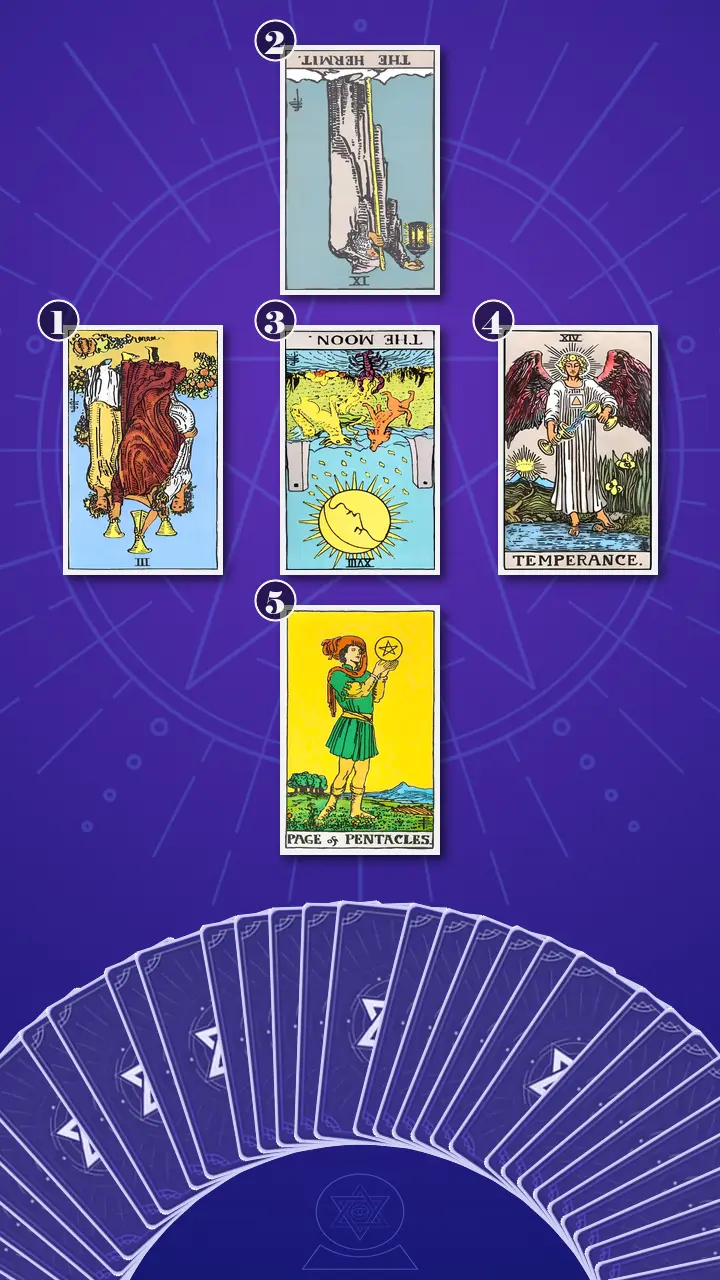
I chose the five-card Relationship Spread · Context Edition. For anyone wondering how tarot works in a consultation like this, I do not use the cards to read another person's private thoughts or predict whether a new friend will stay. I use card meanings in context to make an invisible emotional process visible enough to examine.
This spread suited Jordan's question because it kept the focus on relationships without pretending that her new acquaintances were available for psychic inspection. The first position would show her observable stance after relocating. The second would act as a social mirror, revealing what she was asking other people's responses to confirm. The center would expose the disclosure-and-monitoring loop. The fourth would identify the regulating skill she needed, and the fifth would turn that skill into a grounded next step.
I arranged the cards in a cross. The shape mattered less than the logic: present behavior on the left, the connection pattern in the center, a regulating influence on the right, the belonging question above, and practical guidance below. Together, they could trace the movement from friendship anxiety in a new city toward paced reciprocity.
Reading the Social Weather Without Calling It Fate
Position 1: The Circle Jordan Was Trying to Enter
Now I turned over the card representing Jordan's present stance: the post-relocation loneliness, social urgency, and early disclosure visible in her new friendships. It was the Three of Cups, reversed.
In the Rider-Waite-Smith image, three figures lift their cups inside a shared circle. Upright, the card often carries the ease of communal rhythm. Reversed here, I read its energy as a blockage: Jordan wanted community, but she did not yet have enough repeated contact to feel held by one. The need was healthy. The social container was still under construction.
I connected the card to a Thursday community event near Queen Street. Jordan had noticed three people already laughing together. Instead of staying with the shared activity, asking how they knew one another, and allowing familiarity to build, she had felt an urge to explain the hardest part of her move. Later, a long voice note tried to recreate the group-level belonging that one evening had not yet had time to establish.
“What if casual conversation is not a failure to connect?” I asked. “What if it is the first plank of the bridge?”
Jordan gave a short, bitter laugh. Her thumb pressed hard against the paper cup before releasing it. “That is so accurate it's almost rude,” she said. “I see people who already have a group, and I feel like I need to upload my entire personal history so their social algorithm understands me.”
I let the humor soften the shame without letting it erase the pattern. “Exactly. But an information dump cannot manufacture shared history. The risk is not that you are too much. The risk is that you treat intensity as the only available route into the circle. Then, when you feel exposed, you overcorrect by cancelling the next low-pressure plan or answering with one word. That blocks the ordinary repetition the friendship actually needs.”
Position 2: The Lantern in the Phone Screen
Now I turned over the card representing the social mirror: what Jordan was asking new friends to confirm about her belonging and inner direction. It was The Hermit, reversed.
I emphasized that this position did not tell me what a new friend secretly thought. It showed me the work Jordan was asking the interaction to do. The Hermit's lantern normally represents patient inner guidance. Reversed, I saw a deficiency of trusted inner orientation and a blockage in restorative solitude. Time alone was not refilling Jordan; it was turning into a dark room where every external signal looked like a possible exit sign.
I described the scene she had already lived: 9:30 p.m. in her small apartment near the transit line, lights low, a new acquaintance's profile open on her phone while old group chats from home sat quiet. The lantern had become the glow of a screen. The private sentence beneath the scrolling was, “Maybe if they understand the whole story, I will finally know I am doing this move right.”
Jordan's breath paused. Her gaze moved away from the card and stayed unfocused for several seconds, as though she were replaying a series of nearly identical evenings. Her fingers tightened around the cup, then gradually opened. When she spoke, her voice had dropped.
“I thought I was trying to be authentic,” she said. “But sometimes I am asking them to tell me Toronto was not a mistake.”
“That distinction matters,” I replied. “You can share because you genuinely want this person to know something. You can also share because you need their next response to settle your place in the city. The same story can serve either purpose, but the second purpose gives a near-stranger an impossible job.”
After twenty years of listening to lives unfold over coffee, I have learned that silence does not always ask to be filled. Sometimes it is simply the relational equivalent of a blank line. I remembered countless consultations in which the longest pause was the first moment a person could hear what they had been asking somebody else to decide.
Position 3: Two Stories Inside One Short Reply
Now I turned over the card representing the connection pattern: how vulnerable disclosure became a fast test of closeness and how Jordan interpreted the response afterward. It was The Moon, reversed.
The image offered a precise translation. The dog and wolf became two competing interpretations of the same message. The path between the towers became the gap between what a new friend actually said and what Jordan imagined it proved. Reversed, the Moon's uncertainty was beginning to surface, but its energy still showed an excess of projection operating on a deficiency of evidence.
I gave Jordan the phone-screen version. A new acquaintance replies, “That makes sense!” six hours after a long personal message. One internal voice says the friendship is secure. Another says the disclosure made the other person uncomfortable and the friendship is over. Jordan then adds context, apologizes, asks whether she was too much, or disappears before the other person can reject her.
“Here is the inner-OS check,” I said. “I noticed they answered six hours later, so I am telling myself I made them uncomfortable; another ordinary explanation could be that they were working, commuting, tired, or simply using a different texting style.”
A streetcar passed outside, and its light moved across the Moon card before sliding off the table. I watched Jordan look from the winding path on the card to her phone, which she had placed face down beside her coffee.
“Silence after a message is missing data, not a verdict,” I said. “A warm reply is a moment of contact, not yet a map of the whole friendship.”
Jordan exhaled through her nose, slowly enough that I saw her shoulders descend. “My phone has become a tiny relationship tribunal,” she said. “Every delay is evidence, and somehow I'm always the defendant.”
“Then we separate the evidence from the prosecution's story,” I replied. “You do not have to force a positive interpretation. Two neutral explanations are enough to interrupt the false certainty. The goal is not to decide that everything is fine. The goal is to stop making a ruling while the information is incomplete.”
When Temperance Made Room for a Third Option
Position 4: One Honest Detail, One Curious Question
The room became unusually still when I reached for the card on the right. Even the soft hiss from the coffee maker stopped. Now I turned over the card representing the regulating challenge: the boundary between authentic openness and urgency-driven oversharing. It was Temperance, upright, the bridge of the spread.
I pointed to the angel pouring water between two cups, with one foot on land and one in water. This was not a demand for emotional restraint or polished small talk. Temperance held balance: honesty and boundaries, feeling and observation, self-expression and curiosity. Jordan did not have to choose between total exposure and becoming distant.
I returned us to the second-coffee scene. I pictured Jordan saying, “The move has felt more unsettled than I expected,” then asking, “What made you choose Toronto?” I pictured her feeling the pause without treating it as a social emergency. Both feet stayed on the floor. The rest of her history remained true and available, but it did not have to arrive all at once.
This was also the right moment for a diagnostic tool I call Social Clutter Sorting. I drew two columns on a sheet of paper: core nourishing and energy draining. I explained that I was classifying patterns of contact, not declaring human worth after one coffee. Reciprocal questions, remembered details, mutual initiative, and room for boundaries create core-nourishing evidence. Guilt-driven plans, one-sided emotional labor, and the feeling that Jordan must continually audition for a place create energy-draining evidence.
New acquaintances did not yet belong in either final category. They needed time and ordinary data. That was the insight lever: Jordan had been offering core-circle access before reciprocity could be observed, then treating every ambiguous response as a final classification. Temperance restored an evidence-gathering middle. She could remain open while allowing the relationship to reveal its actual rhythm.
I asked Jordan to picture the Tuesday TTC ride home: her phone warm in her hand, a new friend's brief reply open on the screen, and a second explanation already forming before she had taken off her coat. She had wanted one conversation to make Toronto feel less temporary.
Stop treating immediate disclosure as proof that you belong; practice Temperance by blending one honest detail with one curious question and letting trust develop over repeated contact.
I left the sentence alone for a moment.
Jordan's inhale stopped halfway. Her fingers hovered above the cup without touching it. Then her eyes moved rapidly across the table, not really reading the cards, as though she were replaying every second coffee, voice note, and delayed reply at once. A flush rose from her neck into her cheeks. Her jaw tightened before her face shifted into something sharper than relief.
“But doesn't that mean I've been doing friendship wrong?” she asked. The anger in her voice was brief but real. Beneath it, I heard grief for every interaction she had tried to secure by working harder than the relationship required.
“It means you found a strategy that produced a few minutes of closeness when you were lonely,” I said. “It also produced exposure panic afterward. We can respect why it appeared without hiring it for another year. This card is not an indictment of your past. It is evidence that you now have a third option.”
Her fist slowly opened against her thigh. Her shoulders lowered, but the release brought a moment of almost weightless uncertainty. She blinked hard, her eyes bright, and let out a trembling breath. “Oh,” she said quietly. “I can be real without making this conversation carry my entire belonging.”
I added, “A new friendship does not become real because you hand over your entire story in one sitting. It becomes knowable through mutual questions, repeated ordinary contact, and your freedom to choose what comes next.”
“Now, using that new view, think back to last week,” I invited. “Was there a moment when this insight might have changed how the interaction felt?”
Jordan remembered a silence at the cafe after her acquaintance had asked why she moved. She had interpreted two quiet seconds as fading interest and immediately added the most private part of her relocation story. With Temperance in view, she could imagine naming one true detail, asking a question, and thinking, “I can leave this part for later and see whether contact keeps moving in both directions.”
I gave her a low-pressure way to rehearse that choice: set a ten-minute timer before the next meetup and open a blank note. Write three lines only: one personal detail she might share, one question she genuinely wanted to ask, and one part of her story she was not ready to share. Nothing had to be sent or disclosed. If the exercise made her body tighten, she could stop and switch to a neutral topic.
I named the emotional crossing directly. This was one step from post-relocation loneliness, social urgency, and exposure shame to measured openness, self-trust, and grounded belonging. It did not guarantee that every friendship would deepen. It returned control over pace, access, and meaning to Jordan.
Position 5: The Friendship Beginner's Practice
Now I turned over the card representing the grounded next step: a small experiment in consistent contact, manageable disclosure, curiosity, and self-observed boundaries. It was the Page of Pentacles, upright.
The Page studies one pentacle with complete attention. The figure is not trying to hold the whole landscape at once. I read this as balanced but underused Earth energy: practical learning, patience, and one observable investment. Temperance had created the relational rhythm; the Page made it repeatable.
I translated the card into a Monday-morning message: “I liked talking with you. Want to grab coffee near the studio next Saturday?” Two sentences. One specific invitation. No complete account of why the plan mattered, no apology for wanting company, and no demand that the invitation become a whole friendship immediately.
“Belonging can be built in small, repeatable exchanges,” I said. “It does not have to be proved in one emotional display. Think of learning Toronto one TTC stop at a time. A recurring class, the same cafe, or a regular waterfront walk can gather shared history without requiring you to perform intimacy.”
Jordan looked at the Page for a long moment, then picked up her phone without opening a chat. She created a note titled “One thing, one question, one next time.” The gesture was small enough to be credible. That was precisely why it mattered.
Turning the Cards Into a Plank-by-Plank Plan
I gathered the five cards into one coherent story. The move had removed Jordan's familiar social scaffolding, making the reversed Three of Cups feel like a daily absence rather than a temporary rebuilding period. The Hermit reversed showed why that absence became an identity question: Jordan was asking new friends to confirm that she could make a life in Toronto. The Moon reversed turned incomplete information into competing verdicts. Temperance offered the missing resource, a proportionate exchange between openness and boundaries, and the Page of Pentacles placed that resource inside one modest action.
The pattern was like trying to build a bridge from the middle by throwing personal stories across the gap. Each story briefly seemed to shorten the distance, but none could replace actual planks. Repeated contact, mutual questions, remembered details, plain invitations, and freely chosen boundaries were the planks.
I named Jordan's cognitive blind spot: she had been confusing emotional intensity with evidence of mutual trust. Ordinary conversation felt forgettable, so urgency disguised itself as authenticity. The shift was not from openness to guardedness. It was from using disclosure to secure immediate closeness toward pacing disclosure and observing whether trust was reciprocated over time.
I also introduced Obligation Decoupling. A declined invitation did not mean Jordan was rejecting a person, failing at city life, or surrendering her chance to belong. It could simply mean that a plan would consume energy she wanted to reserve for rest or more reciprocal relationships. Removing guilt from a “no” would help her stop swinging between saying yes to every possible contact and then having no capacity for the connections she genuinely wanted to cultivate.
These were the actionable next steps I drew from the five-card Relationship Spread · Context Edition for paced reciprocity:
- The Ten-Minute Temperance Note Before the next coffee, class, or work lunch, set a ten-minute timer and write three lines in Notes: one personal detail you may share, one genuine question you want to ask, and one topic you prefer to keep private. During the meetup, share the detail, ask the question, and allow one full pause before adding anything else. Tip: Treat the note as a menu, not a script. If choosing feels heavy, use a low-stakes detail about the neighborhood, work, or the class.
- The Missing-Data Pause When a new friend sends a brief or delayed reply, put the phone face down for ten minutes. Write two neutral explanations for the delay before drafting anything. Read the original message once the next day and decide whether a response is actually needed. Tip: During the pause, do not search the person's social media for more evidence. If ten minutes feels difficult, begin with two and wait until your body has settled before reopening the chat.
- The VIP Section Strategy: One Reservation-Only Week For seven days, give personal time a reservation-only policy. Protect two small windows for rest or chosen social contact. Use one window to send a two-sentence invitation to a specific person or return to the same low-pressure Toronto activity. Decline one guilt-driven plan that would leave no energy for either. Tip: A “no” to a plan is not a verdict on the person. Keep the experiment to one week, then use Social Clutter Sorting to notice which interactions felt reciprocal and which required you to perform.
I told Jordan that none of these practices could control another person's availability, texting style, or desire for friendship. That was not their job. Their purpose was to stop outsourcing her worth to the next reply. The cards had supplied a structure for finding clarity; Jordan's choices would supply the movement.

A Week Later: The Quiet Proof
A week later, Jordan messaged me: she had sent the two-sentence coffee invitation, and the acquaintance answered after work and suggested Saturday. Jordan slept through the night. Her first thought in the morning was still, “What if I got it wrong?” She smiled, made coffee, and checked her phone after breakfast.
I did not read that message as proof that the cards had delivered a friendship. Tarot does not own that outcome. I read it as proof that Jordan had interrupted the old sequence: disclose, monitor, explain, withdraw. She had allowed one invitation to be one invitation and had kept enough of herself in reserve to choose what came next.
I have learned that a Journey to Clarity rarely ends with total certainty. More often, it ends with a person recognizing the exact moment when fear stops being the only voice at the table. Jordan still wanted belonging. She simply no longer needed one conversation to settle whether the unedited version of her deserved a place in the city.
If you know the warm rush of finally talking, followed by the tight chest, hot cheeks, and heavy stomach of realizing that one new friendship has been asked to carry a whole missing social history, I hope you remember this: noticing that burden already means you are no longer standing at the first stop.
If one honest detail could be enough for today, what curious question or ordinary next stop might you leave open for another conversation?