From Posting About Loneliness to One Useful Exchange in Toronto

The Coat That Stayed Home: When Online Vulnerability Replaces Community
I met Jordan, a 27-year-old remote junior product designer who had recently moved to Toronto. They could present a Figma file to a screen full of colleagues and write a painfully honest post about loneliness, but an Eventbrite button asking them to confirm one seat made their stomach lock.
At 8:40 on the previous Thursday evening, Jordan had sat in their small apartment wearing the coat meant for a neighbourhood meetup. The registration page waited behind a carefully edited Instagram Story about having no local friends. The radiator clicked, the phone warmed their palm, and each new heart reaction briefly loosened the weight across their chest.
"I know how to tell people I am lonely," Jordan told me, pulling at one cuff. "I just do not know how to arrive alone."
I could see the feeling in the height of their shoulders. Their loneliness was not an empty room so much as a wet wool coat pressed against the sternum: heavy, close, and difficult to take off without exposing whatever was underneath.
"You know how to be seen when you control the frame," I said. "You do not yet know whether you can bear being seen entering alone."
Jordan looked down at the screenshot on their phone.
"The post is not fake vulnerability; it is vulnerability with an exit button," I continued. "The replies are real care. The problem is that they cannot create a local routine, learn your name in a nearby room, or ask whether you want coffee after work. Let us use the cards to map what happens between wanting that connection and closing the RSVP tab."

Choosing the Doorway Map: The Shadow Spread for Loneliness
I asked Jordan to put both feet on the floor, take one unforced breath, and hold a single question in mind: "Why do I post about loneliness instead of joining my new community?" I shuffled slowly, using the movement as a transition from rehearsing explanations to observing the pattern.
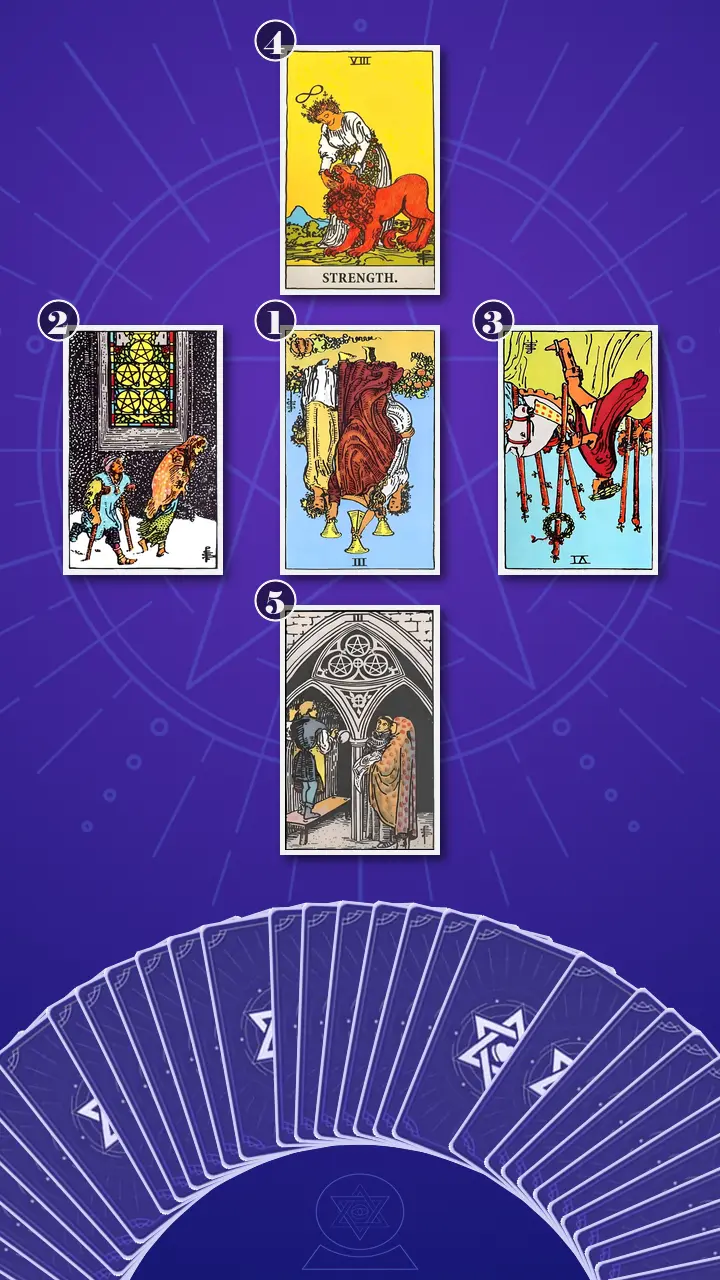
I chose the classic five-card Shadow Spread. I do not use a tarot spread as a verdict or a prediction about who will accept someone. I use it as an external pattern map. For Jordan, the visible behaviour, the hidden belonging fear, the validation loop, the capacity for tolerating newcomer discomfort, and the next grounded action formed one precise sequence. A larger spread would have added detail without making that mechanism clearer.
I arranged the cards like a doorway. The first sat at the centre as the visible lock. The second went to the left to reveal the fear beneath it, and the third to the right to show what kept the cycle running. Above them, the fourth card would identify an inner resource. Below them, the fifth would become the threshold: the practical act through which Jordan could move from describing disconnection to testing reciprocal local contact.
The Circle, the Window, and the Applause Track
Position One: The Circle Seen From Outside
I turned over the card representing the presenting symptom: communicating loneliness publicly while remaining outside the new community's shared activity. It was the Three of Cups, reversed.
Three people normally raise their cups inside a shared circle. Reversed, the water does not circulate cleanly. I read that as a blockage rather than an absence of feeling. Jordan's emotion was genuine, and familiar people genuinely cared, but the exchange ended at the screen.
I returned to the Thursday night scene. Jordan was still in the meetup coat. Their candid Story was gathering warm replies while the registration page disappeared behind it. The card showed real vulnerability moving through an established online audience at the exact moment reciprocal neighbourhood participation was being postponed.
"It is like publishing an excellent product case study without ever putting the prototype in front of a real user," I said. "The insight can be completely honest, but it cannot create the lived feedback loop you need."
I asked Jordan to recall the thought that arrived after the first heart reaction.
"It was basically, At least somebody knows how I feel," they said. Then they gave one short, bitter laugh. "That is so accurate it feels a little brutal. I am telling the truth, so why am I still avoiding the thing I say I want?"
I let the question settle before answering. "Because sincerity and protection can exist in the same action. We are not putting your post on trial. We are noticing the job it performs. It lets you reveal the loneliness without having to watch an unfamiliar person respond in real time."
Their fingers stopped worrying the cuff. The first card had not accused them of being performative. It had made the substitution visible: controlled visibility was standing in for reciprocal participation.
Position Two: The Light Behind the Queen Street Window
I turned over the card representing the deeper belonging fear that made arriving alone feel like a test of Jordan's worth. It was the Five of Pentacles, upright.
The card showed two injured figures moving through snow outside an illuminated window. Its Earth energy appeared in deficiency: not imaginary deprivation, because Jordan truly lacked a nearby social routine, but a scarcity state in which temporary isolation had begun to harden into a conclusion about personal belonging.
I asked Jordan about a community arts space they had walked past on Queen Street West. They remembered wet pavement reflecting the streetcar lights, laughter leaking through the glass, and two people inside hugging hello. Their stomach had gone hollow. Their shoulders had risen toward their ears. Before touching the door, Jordan had translated one observable fact, They arrived before I did, into a verdict: They already have each other, so there is no place for me.
"Feeling outside is real. It is not proof that every entrance is closed," I said. "The light in this card is not a promise that every room will be welcoming. It is a reminder that the sensation of exclusion cannot tell you what an untested entrance contains."
I asked what Jordan feared an awkward first ten minutes would prove.
Their breath paused. Their gaze shifted beyond the table as if the window had appeared there. Then their mouth tightened before the answer came.
"That people can tell I do not have anyone," they said quietly. "And that once they can tell, they will understand why."
I heard the wound beneath the polished captions. Jordan was not simply afraid of standing alone. They were afraid the room would convert newcomer status into evidence of a permanent defect.
"Being new is a timeline," I said. "It is not a failed performance review."
Their shoulders dropped by a fraction. Nothing about the sentence guaranteed acceptance, but it separated an observed circumstance from the harsher meaning Jordan had assigned to it.
Position Three: When the Viewer List Becomes a Verdict
I turned over the card representing the mechanism maintaining the pattern: controlled online recognition exchanged for the risk of direct participation. It was the Six of Wands, reversed.
Here, Fire was not absent. It had bent away from initiative and toward unstable recognition. The rider who normally receives public acclaim had been overturned, turning every reaction into provisional evidence that could expire with the next silence.
I described Jordan in bed at 10:07 p.m., refreshing their Story viewer list for the ninth time. The room was blue-white with screen light. The radiator clicked by the window. One long-distance friend had written, "I wish I lived closer," while a hoped-for viewer had watched without replying. The internal analytics began immediately: Who viewed? Who replied? Who did not? Was the post too much? What does the silence mean? Meanwhile, the local volunteer coordinator's direct message remained unopened.
"Visibility can soothe loneliness without building a local relationship," I said. "The viewer list is being asked to function as a live dashboard for social worth, but impressions cannot measure whether anyone nearby knows how you take your coffee."
This was where I used what I call an Aura Permeability Diagnosis. I use aura here as shorthand for the boundary around attention and emotional interpretation, not as a supernatural claim. In perfumery, blotter paper is designed to absorb every volatile note in the air. Human attention should not have to behave like blotter paper.
Looking at the tipped laurel, I remembered years spent evaluating fragrance strips in rooms dense with competing materials. Without a disciplined pause between samples, the nose stops distinguishing one note from the entire atmosphere. Jordan's attention had become similarly porous. A view, a delayed reply, and an absent reaction all diffused straight into their sense of worth before any observable context could be considered.
"The online crowd is not necessarily hostile," I told them. "But your boundary around its signals has become too permeable. Every notification gets inside and changes the emotional weather. Then you wait for that weather to become perfect before leaving home."
Jordan's jaw tightened. They glanced at their phone, turned it face down, and pressed both palms against their thighs.
"If the reactions could make arriving alone completely safe," I asked, "would they not have done so by now?"
"Yes," Jordan said after a long pause. The word came out flat, followed by a fuller exhale. "They work for maybe twenty minutes. Then I need to check again."
I nodded. The card was not condemning reassurance. It was showing why reassurance without reciprocal local contact could not complete the task Jordan had assigned to it.
Position Four: Strength at the Lobby Door
I turned over the card representing the inner resource Jordan could use to remain present through awkwardness, uncertainty, and the absence of immediate reassurance. It was Strength, upright.
The figure on the card does not attack the lion or pretend it is harmless. Her hands meet its jaws with calm, sustained contact. I read this as balanced Fire: protective instinct remains available, but it no longer controls the whole evening.
I brought Jordan to another precise moment. It was 6:52 p.m. in their apartment lobby. The TTC route was open on their phone. Wind rattled the glass door, dampness gathered in their palms, and the wool collar scratched their neck. The cancellation impulse arrived with a persuasive sentence: If I were actually ready, this would not feel so hard.
"Courage is not a calm body; it is a body with choices," I said. "You do not have to defeat the alarm or obey it. You can give it a ten-minute container."
I introduced the first version of my Scent Bubble Protocol. I asked Jordan to imagine a clean perimeter at arm's length, as distinct as the edge of a fragrance cloud around a freshly sprayed blotter. Inside that perimeter were their breath, their pace, their right to decline questions, and their route home. Outside it were other people's existing friendships, facial expressions, and moods. Jordan could notice those things without absorbing them as instructions about personal worth.
"The bubble is not a wall against connection," I explained. "It protects enough interior space for you to choose connection. You can keep one hand on the exit and still step through the door."
Jordan's first response was practical resistance rather than relief. "But what if I get there and ten minutes feels like an hour?"
"Then you leave after ten minutes," I said. "Leaving after gathering real information is different from staying home because fear supplied the entire forecast. You do not owe a group a full evening, personal disclosure, unpaid labour, or a second visit. Strength preserves your boundaries while keeping the decision in your hands."
Jordan inhaled, held the breath for a beat, and released it slowly. Their shoulders lowered. The discomfort had not disappeared, but it had acquired edges, a duration, and an exit route.
When Three People Bent Over the Same Plan
Before I revealed the final card, the ventilation fan in my studio settled into a lower hum. The strips of cedar, iris, and clean musk on the shelf no longer competed for my attention. The room felt quieter, as though the spread itself had moved from the noise outside the doorway to the question of what Jordan could actually do inside it.
Position Five: The Threshold of the Three of Pentacles
I turned over the card representing grounded integration: one concrete form of community participation based on contribution, learning, and repeated contact. It was the Three of Pentacles, upright, the key card of the reading.
Three people stood inside a stone building, looking at the same plans. No one was elevated above a crowd. No one was demanding instant intimacy. Their attention was distributed across shared work. The Earth energy was balanced and constructive: practical reciprocity, beginner humility, shared effort, and trust that familiarity can accumulate.
Jordan had been trapped inside a requirement that sounded sensible but could never be satisfied: I must know that I will be welcomed before I enter. At 8:40 p.m., the coat was still on, kind replies were arriving, and the nearby room remained full of people who still did not know Jordan's name.
Belonging is not proof you collect before entering; it is familiarity you build through one useful, imperfect exchange.
I left the sentence alone for a moment. A heating pipe clicked once behind the wall, then the room returned to stillness.
You do not have to earn belonging from an audience; build it through one imperfect contribution, as the Three of Pentacles turns separate people into collaborators.
Jordan's breath stopped first. Their fingertips hovered above the edge of the table, motionless, while their eyes stayed on the three figures. Then their focus went distant. I could almost see the remembered scenes passing behind it: the unanswered organizer message, the bright Queen Street window, the coat worn nowhere, the viewer list pulled down again and again. Their pupils widened, and a flush rose along their cheeks.
Their jaw tightened next. "But does that not mean I caused this?" they asked, the words arriving sharper than anything they had said before. "Does it mean I have been doing loneliness wrong?"
"No," I said. "It means you found a way to receive care while limiting exposure. That strategy protected you during a major transition. We are only noticing that it cannot perform the second job you need now. Protection is not failure, and it does not have to become permanent."
The tension left their face unevenly. Their fist opened. Their eyes reddened without spilling over, and one unsteady breath escaped from somewhere deep in the chest. Their shoulders sank, but the release was followed by a brief blankness, the slight disorientation that can come when a familiar explanation is gone and choice has returned.
"Now, with this new perspective, think back to last week: was there a moment when this insight could have made you feel different?" I asked.
Jordan remembered a beginner workshop they had saved. It was not a mixer and did not require clever conversation. Participants would be learning bookbinding at long tables. The event page even invited first-timers to help arrange paper and thread before the session.
"I kept thinking it was not social enough to count," they said. "Like, if I did not come out with a friend, it would have failed."
"That is the old metric," I replied. "The Three of Pentacles uses a different one. Did you enter? Did you learn one name? Did you ask one useful question? Did another person have a reason to recognize you if you returned?"
I asked Jordan to take ten minutes and open the saved event. We checked whether it included a structured task, and Jordan drafted one practical question to the organizer. Sending it remained optional. When the full message felt too exposing, I suggested the minimum version: "Hi, I am new to the area. Is this beginner-friendly, and what usually happens in the first ten minutes?"
For fifteen years as a perfumer, I have watched separate materials become an accord only after they share structure, proportion, and time. A single note does not have to prove it deserves the formula before entering it. The Three of Pentacles offered Jordan the social equivalent: one task, one exchange, and enough repetition for separate people to become familiar.
I named the transformation plainly. This was not a leap from loneliness to guaranteed acceptance. It was one step from lonely self-consciousness and approval-dependent reassurance toward cautious presence, reciprocal exchange, and grounded hope built through repeated contact.
The One-Useful-Exchange Practice
I placed the opening and closing cards side by side. Both were Threes, but the reversed Three of Cups showed a social circle whose connection could be seen without being entered, while the upright Three of Pentacles showed three people inside a structure, facing the same task. Between them, the Five of Pentacles exposed the fear of permanent exclusion, the reversed Six of Wands revealed the exhausting search for audience proof, and Strength returned authority to Jordan's regulated, bounded body.
No Swords appeared in the spread. I found that significant. Jordan did not need a sharper caption, a better explanation, or another beautifully organized Notion page titled "Toronto Things to Try." More analysis was not the missing resource. The movement came from embodied choice and practical Earth: entering, asking, helping, learning, and deciding whether to return.
I described the cognitive blind spot I saw. Jordan had been waiting for evidence of belonging while postponing the repeated contact through which that evidence could realistically develop. The blind spot was not believing that online care was false. It was asking distant witnesses to provide local proof and treating the discomfort of being new as a prediction of permanent exclusion.
The direction of change was small but exact: turn one polished description of disconnection into one direct request, one bounded arrival, or one useful contribution. I gave Jordan three experiments rather than a demand to transform their social life.
- The Vulnerability-to-Invitation Switch When the urge to post about loneliness appears this week, pause the draft for ten minutes and name the request underneath it: witness, company, information, or reassurance. If the need is contact, send one nearby person a specific message such as, "I am thinking of trying the Saturday workshop and feel strange about going alone. Would you like to come, or text with me while I head over?" Jordan can still publish the post afterward. Tip: Keep the request to one person, one activity, and one easy way to decline. A response gives information about that person's availability, not a universal judgment of worth.
- The Shared-Task Belonging Experiment By Wednesday evening, choose one Toronto event built around doing something together, such as a Toronto Public Library workshop, community garden shift, beginner craft class, or volunteer orientation. Register for one session and send the organizer: "Hi, I am new to the area and may come alone. Is there anything I should bring, and what usually happens in the first ten minutes?" Put a 30-minute attendance window and the route home in the calendar. Tip: Treat the event as one contact point, not a friendship audition. The minimum version is sending the question. The next-smallest version is entering, learning one name, and leaving after 15 minutes.
- The Scent Bubble and Ten-Minute Threshold Before leaving, type three lines in the Notes app: "My body is expecting social risk. I only need to enter, not impress. I can reassess after ten minutes." At the entrance, press thumb and forefinger together, imagine the clear perimeter of the Scent Bubble Protocol, name two visible objects and one sound, then say: "Hey, I am Jordan. It is my first time here. Where should I start?" Set a silent ten-minute timer and make a fresh choice when it ends. Tip: The exercise does not need to remove discomfort. Stand near an exit, skip alcohol, decline personal questions, and leave if the environment feels disrespectful or unsafe. The bubble protects choice; it does not obligate participation.
I reminded Jordan that none of these actions guaranteed friendship. That was precisely why they restored agency. Jordan was no longer waiting for a screen, a crowd, or a tarot card to certify that the next room would accept them. They were choosing a small enough experiment to gather real information while keeping their boundaries intact.

A Week Later, One Name Was Familiar
Six days later, I received a message from Jordan. They had sent the bookbinding organizer the beginner question, received a plain reply about where to put their coat, and taken the streetcar to the workshop. At the entrance, they used the prepared line before their mind could produce a more polished one.
Jordan helped stack paper, learned the facilitator's name, and stood beside another first-timer while they both tried to thread the same kind of needle. When the ten-minute timer ended, Jordan stayed for twenty more minutes. No instant friendship appeared, and one pause in conversation still made their stomach dip. It simply stopped deciding the whole evening.
They rode the 501 home alone, but their phone held one new name and the date of the next session. The solitude had not vanished; it had stopped feeling like a verdict.
I thought again of the two Threes. The cards had not opened the community door, predicted acceptance, or manufactured belonging. They had made the lock visible. Jordan supplied the hand, the question, the boundary, and the imperfect contribution.
That was the quiet proof of this Journey to Clarity: not certainty, but ownership. Jordan had moved from standing outside a lit room while posting about the cold to spending thirty ordinary minutes inside, helping someone arrange paper.
If tonight you are still in your coat with an RSVP open and your chest turning heavy, remember that it can make perfect sense to seek understanding from people far away when one nearby room seems capable of judging whether you belong. Noticing that protective exchange already means you are no longer fully inside it.
If belonging could begin as one useful, imperfect exchange instead of a verdict delivered at the doorway, what tiny role inside the room would you be curious to try?