Why Copying Family on Email Starts Fights: Choosing a Smaller Audience

The 11:12 p.m. Reply-All Spiral
I often meet people who can run a clean Slack thread at work, then become the family operations person at night, moving relatives in and out of Gmail's CC field as if one omitted name could destabilize the whole record. Jordan (name changed for privacy), a 28-year-old operations coordinator in Toronto, joined my video call from their kitchen at exactly 11:12 p.m.
The dishwasher hummed behind them. Blue screen light caught the rim of a half-empty glass, and their phone looked warm from being held too long. Jordan dragged one relative out of the CC field, paused, then put the name back.
“If everyone sees the same email, nobody can rewrite what happened,” they said. “I only want everyone to have the same information. So why does copying my family always start a fight?”
They were trying to settle a shared expense, but their shoulders had already lifted toward their ears. Their chest seemed to hold dread like a notification stuck permanently on vibrate: every new reply promised impact before they had even opened it. They told me that one blunt response could send them into an old screenshot folder, building a point-by-point timeline while the practical question disappeared underneath the evidence.
“I don't think this means you're bad at communicating,” I said. “You communicate clearly at work. The difference is that a family email can carry two jobs at once: solving today's logistics and defending your place in a much older story. Let's give those jobs separate names and draw a map through the fog.”

Choosing the Compass: A Six-Card Relationship Tarot Spread
I asked Jordan to close Gmail, put both feet on the floor, and take one slow breath while holding the immediate question in mind. I shuffled at an unhurried pace. I use this pause as a psychological threshold, not a mystical performance: it gives the nervous system a chance to stop replying long enough for us to examine the pattern.
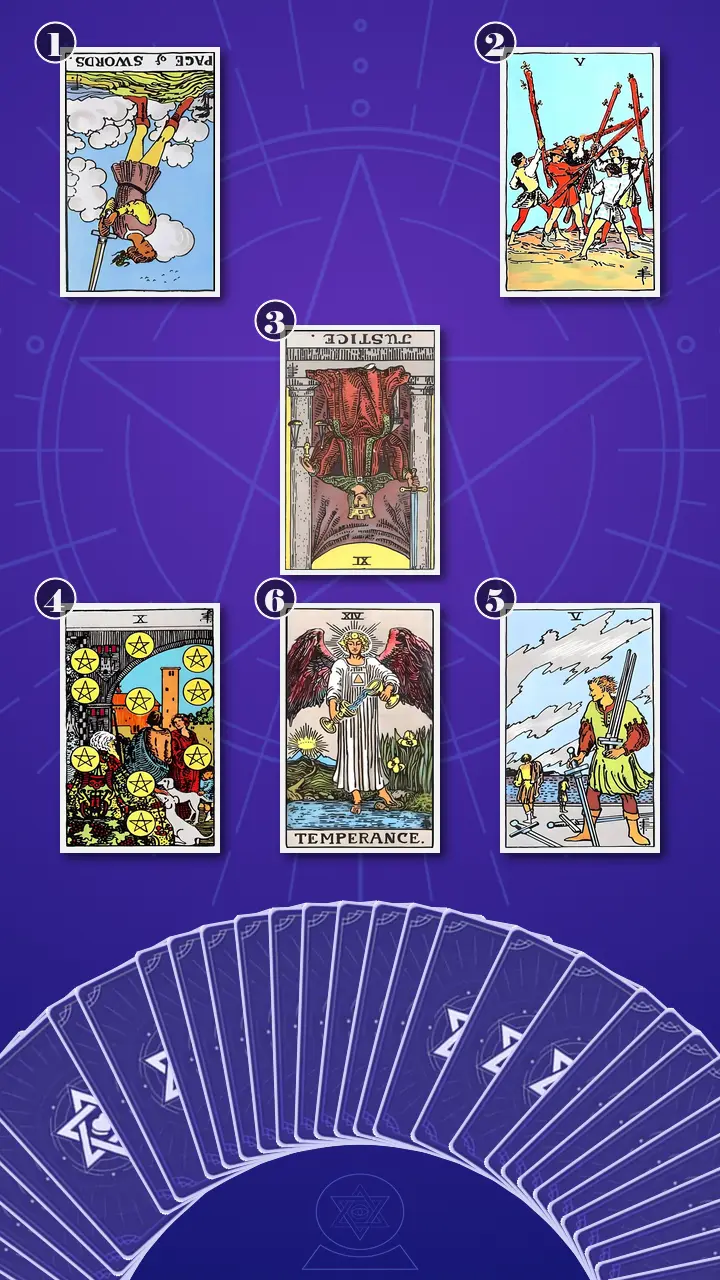
I chose a six-card Relationship Spread because the question concerned a recurring interaction, not a prediction or a hidden verdict about anyone's motives. For readers wondering how tarot works in family conflict, this spread functions as a structured reflection tool. It separates Jordan's observable contribution, the family audience as Jordan experiences it, the rule operating between them, the bond underneath the conflict, the mechanism that divides them, and the next action Jordan can control.
I explained that the first card would show what Jordan did when the CC field began to feel protective. The third would expose why a visible record kept turning into a public fairness trial. The final card would offer a measured communication experiment. The cards would not decide who was right. They would help Jordan distinguish facts, feelings, requests, audience, and boundaries.
Reading the Crowded Inbox
Position 1: The Cursor as a Raised Sword
“The card now opening for your observable contribution to this email pattern is the Page of Swords, reversed,” I said. Its Air energy was not absent; it was blocked through overactivity. The alert messenger had become so watchful that precision was functioning as armor.
I connected the image directly to Jordan's kitchen table: a three-sentence update open on screen, relatives moving in and out of CC, and a point-by-point response beginning before the incoming message had even been fully read. The cursor hovering over Send was the Page's raised sword. Useful attention had tipped into threat-scanning, giving every punctuation mark and reply delay more authority than it deserved.
Jordan gave one short, bitter laugh. “That's so accurate it feels a little brutal.” Their fingers tightened around the phone, then loosened. I let the reaction land before asking, “What information are you trying to clarify, and what part of your identity are you trying to defend? Those are both real concerns, but they may not belong in the same email.”
Position 2: Five Voices, No Owner
I named the next role first: “This card represents the family audience as you experience it once everyone is copied.” I turned over the Five of Wands, upright. Its Fire was active but uncontained, an excess of movement without a shared process.
I described the inbox Jordan knew: one relative answered the plan, another disputed the timeline, a third corrected a detail, and someone else reacted to the tone. It was like a Slack channel with five people typing, no agreed owner, and nobody answering the original ticket. Each person might be responding to a different part of the issue, but Jordan experienced the overlap as one coordinated fight.
“More witnesses do not automatically create more clarity,” I said. Jordan's eyes moved from the five crossing wands to their closed laptop. Their shoulders remained high, but the urge to reopen Gmail seemed to pause.
Position 3: When the CC List Becomes a Jury
“This card represents the rule operating in the shared field, the point where information becomes a public trial,” I said. Justice appeared reversed. The energy of fairness was blocked because no single standard could cleanly separate fact, responsibility, tone, and years of family history.
The card translated almost literally into Jordan's modern-life scenario. The scales became the CC list; the sword became a screenshot-backed timeline. Jordan had added more relatives because visibility felt safer than a private exchange, only to discover that each person brought a different idea of what counted as fair or relevant. Evidence intended to settle a shared expense became testimony about who was reasonable.
Looking at the scales, I flashed back to my Wall Street years. A trade confirmation can settle terms because the parties have accepted the same framework. A family CC thread has no neutral exchange rule, no agreed judge, and no closing bell. Asking it to deliver an impartial verdict creates more material to contest.
“If I don't correct it now, their version becomes the official one,” Jordan said. Their breath caught, their gaze went unfocused as if an earlier thread were replaying, and then they released a low, tired exhale. I pointed to the distinction in front of us: the detail needed to answer today's request was not the same as the evidence Jordan wanted everyone to review before judging them.
“You can keep the record without turning the record into a courtroom,” I said. “Justice reversed is not declaring you unfair. It is showing that the venue cannot perform the job you've assigned to it.”
Position 4: Belonging Beneath the Paper Trail
“This card represents what still connects and supports the relationship,” I said as I revealed the Ten of Pentacles, upright. Its Earth energy was balanced and grounding. The different generations beneath the pentacle arch showed the genuine value under Jordan's CC impulse: continuity, shared context, and a recognized place in the family structure.
In everyday terms, the card resembled a shared family Google Drive. Inclusion can preserve useful context, but not every document needs every collaborator. Jordan was not simply creating drama. They wanted nobody excluded from an important arrangement and nobody able to claim later that information had been hidden.
Because money and family structure can conceal a different mechanism, I applied my Family Power Dynamic Decoding lens. I asked whether any elder was tying money, housing, inheritance, or practical support to obedience. Jordan shook their head. “Not in this thread. I'm mostly afraid they'll say I controlled the story.”
That distinction mattered. I did not invent coercion where Jordan had not reported it. The active issue was belonging, not a proven resource threat. The Ten of Pentacles showed that Jordan could remain part of the larger family structure without asking the entire structure to enter every dispute.
Position 5: The Screenshot That Wins for Three Seconds
“This card identifies what divides the parties after the original request has been displaced,” I said. The Five of Swords appeared upright. Its Air energy had moved into excess: communication was being collected as ammunition, producing a win-lose exchange instead of a workable answer.
I described Jordan finally finding the old screenshot that proved one detail. Relief lasted three seconds. Then the practical request remained unanswered, two relatives stopped engaging, and another conversation moved into private messages. Like the foreground figure gathering swords while others walked away, Jordan held the strongest argument in a colder room.
Jordan's mouth tightened, then softened. “I hate the idea of letting something false stand.” I nodded. “You do not have to call it true. The question is whether correcting it in front of everyone serves today's decision. What would you stop proving if your goal were one clear boundary and one usable next step?”
When Temperance Made the Message Smaller
Position 6: Two Cups, One Measured Boundary
The dishwasher on Jordan's side clicked into silence just as I reached the final card, and the sudden quiet changed the room. “This position offers the self-directed action that can interrupt the escalation loop,” I said. I turned over Temperance, upright.
Temperance carried balanced, integrating energy. The two cups became separate containers for practical facts and emotional history. The controlled stream between them represented a short message that could acknowledge what mattered without pouring the entire family case into every recipient's inbox. This was not silence versus confrontation. It was proportion versus overflow.
I asked Jordan to picture the same Toronto kitchen at 11:12 p.m.: the warm phone, the dishwasher hum, and names moving in and out of CC while a practical request began to feel like evidence. The relief of being witnessed was already carrying the fear of being judged.
The family CC does not have to function as a courtroom: let Temperance's two cups represent separating the practical request from the old emotional case, then choose one measured message and one clear boundary.
Jordan's breath stopped. Their fingers stayed suspended above the phone, and their pupils widened slightly as they looked from one cup to the other. For a few seconds, I watched their attention move somewhere beyond the cards, replaying a recent thread. Their eyebrows pulled together. “But doesn't that mean I was wrong to copy everyone before?” they asked, with a flash of anger under the hurt. I did not rush to smooth it away. “No. It means you used the best protection you could see at the time, and now you're measuring its cost. Tarot is not grading your past. It is showing you another available move.” Jordan pressed a palm against their sternum, exhaled with a slight tremor, and let their shoulders drop. The relief was followed by a brief, exposed blankness: if the audience could not certify their legitimacy, they would have to trust their own boundary. I asked, “Now, with this new perspective, think back: was there a moment last week when this insight could have made you feel different?”
Jordan thought of a Thursday thread about the shared expense. “I thought I needed everyone to see the whole story,” they said slowly, “but what I actually needed to communicate was: who can confirm the payment by Friday?”
“Exactly. A wider CC can document your position; it cannot certify your belonging. The email is asking for a next step, not a verdict on your place in the family.”
I added one more Temperance lens from my own toolkit: Guilt-Debt Neutralization. In commercial terms, a guilt claim is not a booked liability merely because it arrives with emotional force. If a parent or elder introduces a line such as “after everything we've done,” Jordan can audit it before paying it with compliance or a reply-all defense. Is there a concrete obligation? Is it relevant to today's request? What boundary protects Jordan's well-being? Unverified psychological bad debt does not belong in the practical cup. This audit does not erase genuine commitments or presume bad motives; it keeps emotional pressure from silently rewriting the terms.
I named the transformation plainly. Jordan had moved one step from anticipatory dread and courtroom-style self-defense toward measured clarity, proportionate communication, and self-trust. The family response was still outside their control. The size, purpose, and boundary of Jordan's message were not.
The Inbox, Not the Courtroom
I gathered the six cards into one coherent sequence. The reversed Page showed vigilance turning language into armor. The Five of Wands showed a wider audience multiplying active interpretations. Reversed Justice exposed the central blind spot: Jordan expected the CC list to operate as an impartial jury. The Ten of Pentacles protected the legitimate wish for belonging, while the Five of Swords revealed the relational cost of proving each point. Temperance redirected all that energy into a smaller audience, a bounded request, and one action Jordan could choose.
The blind spot was not Jordan's desire for transparency. It was the belief that shared visibility could establish legitimacy. The key shift was from coalition-building to communication design: identify the practical purpose, include only the people needed for it, and state the response or limit being requested.
I translated Temperance into my Strategic Disengagement Plan. Disengagement here did not mean disappearing or punishing anyone. It meant deliberately reducing the interaction's leverage points by defining the audience, topic, response window, and exit line before the next notification arrived.
- Use the Three-Line Temperance Draft.Before the next family email, open a private note and spend no more than 10 minutes writing exactly three lines: one sentence of relevant context, one specific request with a deadline or next step, and one boundary about how you will continue the conversation.If three lines feel too exposed, write the request alone first. Keep the longer history in the private note.
- Run the Proportionate CC Check.List every proposed recipient under “Who needs this?” Give each person one concrete role: they can answer, act, witness a necessary decision, or receive essential information. Send the practical request only to people with a defined role.If auditing the full list makes your hands buzz, remove just one unnecessary recipient. Belonging and total involvement are not the same thing.
- Reply to the Next Step.When a terse response arrives, close Gmail or place the phone face down for 10 minutes. In a separate note, write the one part of the reply that changes the plan. Answer only that part, then use a boundary such as, “I have the information I need for now; I am not continuing the history discussion by email.”A boundary tells people what you will do next; it does not require everyone to agree. If the exchange feels unsafe or coercive, use the channel and outside support that best protect you.
None of these steps promised a warm reply or a conflict-free family. They gave Jordan something more reliable: a way to evaluate a response for its content and next action instead of automatically treating it as a verdict on character, fairness, or belonging.

A Week Later: The Quiet Proof
Six days later, Jordan sent me a message. They had drafted the expense email in Notes, reduced the CC list from five people to two, and asked one direct question with a Friday deadline. They kept the screenshot timeline private. When one relative answered bluntly, Jordan replied only to the part that changed the payment plan.
The response was not magically harmonious. No one delivered a grand apology, and some family history remained unresolved. That night, however, Jordan slept through. Their first thought the next morning was still, “What if I was wrong?” They smiled at the question, muted the thread until lunch, and left the screenshot folder closed.
I considered that the honest proof of our journey to clarity. The six-position Relationship tarot spread had not taken control of Jordan's story or predicted what their family would do. It had made the recurring family communication pattern visible enough for Jordan to choose a different move. The agency belonged to them.
When you add everyone so nobody can rewrite what happened, your chest may tighten because a request for clarity has quietly become a test of whether you still belong. Noticing that second job does not mean you have failed. It means you are no longer standing at the beginning of the pattern without a map.
If one email could stay in Temperance's practical cup instead of carrying the whole courtroom case for your belonging, what would you quietly choose to leave in the private note?