A Family Boundary Sent at First Strain—Before Anger Could Write Back

The Second Inbox at 8:47 P.M.
When you are good at making difficult work emails sound calm but cannot send one short family limit without deleting it six times, the trigger may be the fear that a clear no will cost you belonging—not a lack of communication skill.
Jordan, a twenty-eight-year-old junior communications coordinator in Toronto, was sitting in the narrow kitchen of her rented apartment when our video consultation began. It was 8:47 on a Tuesday evening. I heard the kettle click off behind her and the low hum of the fridge beneath the fluorescent light; in her hand, a warm phone displayed a half-written reply to the family group chat.
She had already said that Sunday would not work. Then the typing bubble had reappeared, followed by: “So is that a no?” Her shoulders rose. Her jaw tightened. She showed me the message she had sent back: “I already said I can’t, why is this such a big deal?”
“I can write a calm work email in thirty seconds,” she said. “But with my family, I either explain for an hour or sound furious. Why does a normal limit feel like an attack?”
I heard the pattern beneath the wording. You tell yourself one more yes will keep things easy, then a second request arrives and the reply turns sharp, and afterward you question the anger instead of the pressure that preceded it. Jordan wanted closeness, privacy, and the right to make adult plans; she also feared that stating those needs clearly would make her disloyal or turn her into someone she did not recognize.
The anger had the physical force of a metal latch heating inside her jaw: face hot, chest compressed, restless fingers already reaching either to type or to leave. Shame arrived afterward like cold water over the same skin.
“The anger may be late, not random,” I told her. “I’m not going to use tarot to decide whether you are a good daughter, predict how your relatives will behave, or tell you whether to stay close or step back. Let’s use it as an objective map of the pressure: where the limit gets delayed, what older role may be entering the conversation, and what a fairer response could look like.”

Choosing a Map That Would Not Predict the Family
I invited Jordan to put both feet on the floor, take one unforced breath, and hold one question in mind: “What happens between the first sign of strain and the anger that comes later?” I shuffled slowly. The small ritual was not about summoning certainty; it was a transition from reacting inside the pattern to observing its structure.
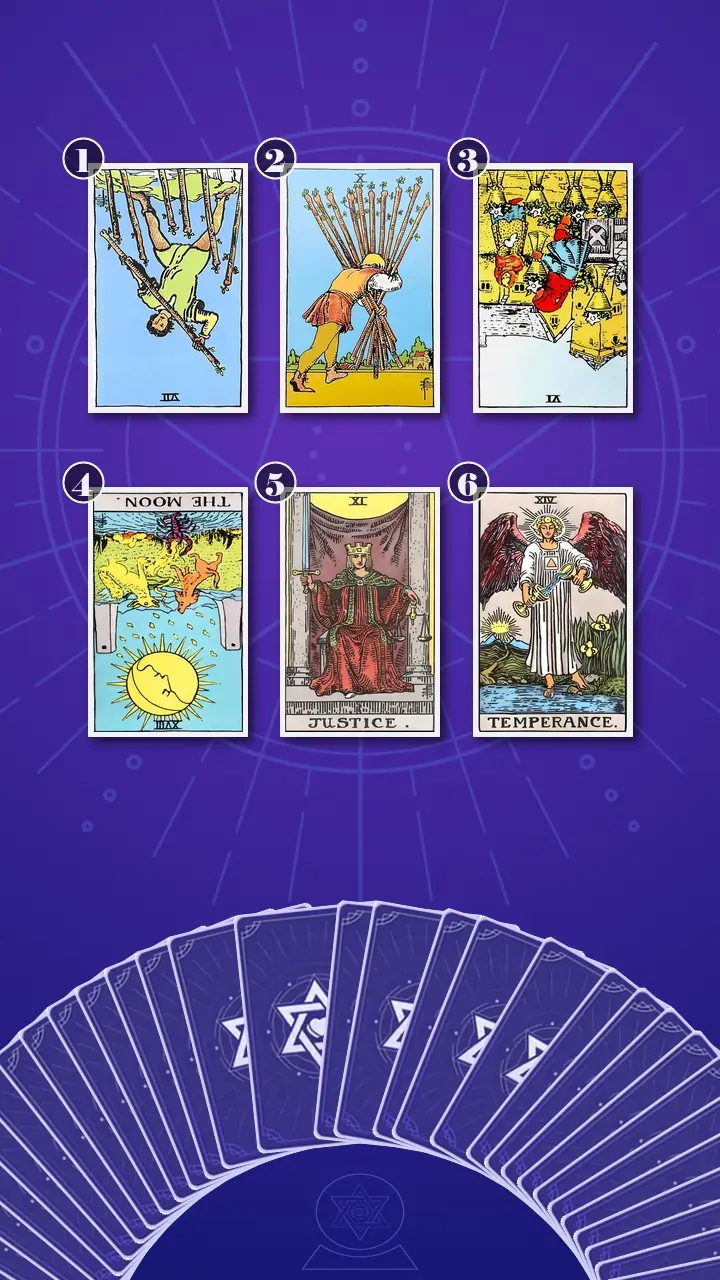
I chose the Relationship Spread · Context Edition, a six-position relationship tarot spread designed for family boundary dynamics and hidden anger. For anyone wondering how tarot works in a question like this, the spread is useful because it stays with the relationship field instead of wandering into unrelated parts of life. It does not assign secret motives to a relative or predict the future of the family. It organizes what Jordan can actually examine and choose.
I placed three cards across the upper row to show the visible pressure line: Jordan’s current boundary reaction, the family-system burden she experiences, and the repeating interaction pattern. Beneath them, I placed three cards for inward clarification: the hidden emotional charge, the boundary reframe, and a self-led practice for holding care and autonomy together. The fifth position would sit at the center of the lower row as the turning point.
“Think of this as a cross-section rather than a verdict,” I said. “We’re going to look at the layers in context. The cards can help us form better questions, but you remain the person who decides what is accurate, what is useful, and what you do next.”
Across the Pressure Line
Position One: Defending the Hill After the Notifications Pile Up
I turned over the card representing the current boundary moment: the observable pattern of delaying a limit, then communicating it with unexpected sharpness or withdrawal.
It was the Seven of Wands, reversed.
I pointed to the figure trying to defend uneven ground against six wands rising from below. “This is the moment when you have already accommodated several requests, you are trying to make dinner or decompress after work, and one more notification appears. The six wands become unread messages, anticipated objections, and every explanation you are preparing before anyone has even asked for one.”
The emotional physics resembled a family-group-chat version of The Bear: a small operational question suddenly carrying the volume of every pressure that came before it. Instead of saying a small no at the first strain, Jordan waited until the request felt like a challenge to her entire adulthood. Then the boundary had to do the work of a full protest.
I read the reversed Fire as a blockage in early self-assertion and a resulting excess of last-minute defense. The card was not saying her limit was wrong. It was showing that the energy needed to state it had been held back until it could no longer arrive at conversational volume.
“What did your body do after the first request, before the follow-up?” I asked.
Jordan did not nod politely. She let out a brief, bitter laugh and looked away from the screen. “That is accurate enough to feel a little rude,” she said. “My chest tightened at the first message. I knew then. I just decided I could handle it.”
“Then that first tightening matters,” I replied. “Not because your body is always delivering a complete interpretation, but because it may be marking the moment when a smaller boundary is still available.”
Position Two: The Load That Hides the Person Carrying It
I turned over the card representing the family system’s experienced pressure: the role and responsibility Jordan felt she had to carry in order to preserve belonging. I was careful to frame this as her experienced burden, not as a claim about any one relative’s intention.
It was the Ten of Wands, upright.
The figure’s face was almost lost behind the bundle. I translated the image into Jordan’s actual week: work deadlines, a laptop bag, groceries from the streetcar stop, evenings kept technically blank in Google Calendar, and the expectation that she would remain reachable, flexible, emotionally prepared, and responsible for everyone else’s disappointment.
“The visible request may be one Sunday visit,” I said. “The invisible load is everything you believe must be managed around it.”
The upright energy was an excess of responsibility. Responsibility itself was not the problem; Jordan was clearly capable and caring. The imbalance came from accepting a task before checking whether it was hers, then treating capacity as a moral test. Her own preference disappeared behind the bundle.
I traced the familiar inner sequence aloud: “I can handle one more request. Then: Why am I the only one carrying this? Then: If I put it down, I’m letting people down.”
Jordan’s breath caught. Her eyes dropped to the work badge still lying beside the kettle, and one hand moved to the opposite shoulder as if she had only just noticed its weight.
“You should not need a courtroom brief to say you are unavailable,” I told her. “Before you add another explanation, ask: Which part of this responsibility is actually mine, and which part am I carrying because another person’s disappointment feels more urgent than my capacity?”
“That’s the part I don’t know how to put down,” she said. “If someone is upset, I immediately assume I caused a problem I’m supposed to fix.”
I nodded. “That assumption is important. It is also an assumption we can examine—not a lifelong contract.”
Position Three: The Adult Request That Arrives Wearing an Older Voice
I turned over the card representing the interaction pattern: the way a present family exchange could pull Jordan into suppressing the first no, storing resentment, and then treating the rupture as proof that boundaries were dangerous.
It was the Six of Cups, reversed.
I held the card so she could see the child offering a cup filled with white flowers. “There is real affection in this image,” I said. “This does not reduce every invitation or check-in to manipulation. But reversed, the card asks whether affection has become fused with automatic availability.”
In modern life, this was the message “Are you free this weekend?” landing not only as a present-day question, but as an old-role notification. Jordan heard it as the agreeable child who should comply first and explain her independent plans later. The adult request became emotionally larger than its literal wording.
The reversed Cups energy showed blocked differentiation: memory and present contact were flowing into the same container. Its constructive possibility was not rejection of the family past. It was the ability to keep what felt loving while declining to perform a role that no longer fit.
“What belongs to this conversation,” I asked, “and what belongs to the version of you who learned that being easy to accommodate was the safest way to stay connected?”
Jordan rubbed her thumb along the edge of her phone. “The request was just about Sunday,” she said slowly. “But I heard, ‘Are you still the person we can count on?’”
This was where I used a framework I call Generational Trauma Excavation. Despite the name, I never use it as permission to diagnose relatives, invent ancestral facts, or blame an entire lineage. I use it to trace a repeated behavioural loop as far as the available evidence allows, so the person in front of me does not mistake an inherited reflex for a private character defect.
I asked Jordan three questions: “What family rule seems to repeat? What might that rule once have protected? Does it still fit your adult circumstances?” We marked the rule as “availability proves loyalty.” We left its exact origin as unknown. Years on archaeological digs taught me that unknown provenance is more honest than a dramatic story unsupported by evidence.
“So the card is not proving where the rule began,” I said. “It is helping us notice that the rule may be older than this Sunday request. You can understand why it exists without granting it permanent authority.”
Position Four: The Algorithm Behind a One-Word “Okay”
I turned over the card representing the hidden emotional charge: the old association, unspoken fear, or interpretive confusion that entered a boundary moment before Jordan had separated present facts from inherited emotional meaning.
It was The Moon, reversed.
I asked Jordan about the one-word reply she had reread at 11:36 on Sunday night. She described lying in bed with blue phone light across the duvet while the radiator ticked. The message said only: “Okay.” Her hands had become restless, her chest had tightened, and she had opened and closed the keyboard while searching the thread for proof that someone was angry.
I pointed to the dog and wolf facing the Moon and the crayfish emerging from dark water. “The dog and wolf are the competing interpretations. The crayfish is the old emotional charge surfacing before you have language for it. The winding path runs between what happened, what it reminds you of, and what you fear it means.”
I laid out the three columns in plain language. The observable fact: the reply said “Okay.” The story added by memory: another person’s disappointment is Jordan’s responsibility to repair. The unanswered question: whether the sender was actually angry, simply acknowledging the message, or feeling something else entirely.
The reversed energy was a blockage beginning to loosen. I did not dismiss Jordan’s instinct; bodies often detect meaningful patterns. But an emotional reaction can be real while its interpretation remains unfinished. The feeling deserved attention without being promoted automatically to evidence about another person’s motives.
“It is like an algorithm filling missing context with the most threatening result in its old training data,” I said. “Your family-alert system is fast, but speed is not the same as accuracy. We are not deleting the alarm. We are updating what happens between the alert and the reply.”
Jordan went still. First her breath paused; then her eyes lost focus as though she were rereading the old thread; finally, she released a quiet breath from deep in her chest. “My body has an answer before I have evidence,” she said.
“Exactly,” I replied. “Anger is information about pressure, not a verdict on your character. It can tell you to investigate a crossed line without supplying a complete account of why another person did what they did.”
When Justice Put the Anger on the Scales
Position Five: A Boundary Without a Prosecution
The room seemed to quiet before I turned over the card representing the boundary reframe: the shift from treating a limit as disloyal to treating it as a clear, proportionate expression of responsibility and self-respect.
It was Justice, upright.
I centred the card between us. The upright sword gave language to the limit. The balanced scales separated what Jordan had agreed to, what she could realistically do now, and what she was declining. The red robe held seriousness without aggression.
Justice carried balanced Air: discernment, accurate language, accountability, and proportion. It did not ask Jordan to suppress anger, win a case, or make another person approve of the verdict. It asked whether her response belonged to today’s request or was trying to settle every earlier grievance at once.
In practical terms, Justice looked like a note with three lines: “I agreed to,” “I can do now,” and “I am declining.” It sounded like Jordan saying, “I am not making a case for why I deserve a life; I am stating the conditions under which I can participate.”
Justice was not asking Jordan to become perfectly calm before she earned the right to say no. She had been trying to make one message prove that she was reasonable, loving, and still belonged, so anger entered the case as evidence against her before the request itself was heard.
At that moment, I reached for another archaeological framework I use: Inherited Belief Stratigraphy. I pictured a trench wall from an old excavation, where a later household had reused an earlier foundation. An inherited structure can remain beneath a new life without retaining the right to govern it.
I drew three layers on paper. At the surface was the present fact: Sunday conflicted with plans Jordan had already made. Beneath it was the inherited rule: a good family member remains available and manages disappointment. Running through both was Jordan’s authentic value: she genuinely wanted care, closeness, and adult-to-adult contact.
Justice’s sword became the clean vertical section through those layers; its scales became the test of what still deserved active weight. Jordan did not have to choose between loving her family and having a life. She could preserve care, retire automatic access, and negotiate availability in the present.
I put the central insight plainly. “The point is not to prove that you are calm enough to deserve a boundary. A fair limit can be stated while anger is present, then checked for proportion. Anger tells you to examine the pressure; it does not get to decide the entire conversation.”
You do not have to treat anger as proof that your boundary is wrong; use Justice's upright sword to name the limit clearly and its balanced scales to keep the response proportionate.
Jordan’s breath stopped halfway in. Her fingertips hovered above the warm phone, and her pupils widened before her gaze slipped past my screen, as if she were replaying the unsent drafts. For several seconds her jaw stayed set. Then the first feeling out was not relief but anger. “But doesn’t that mean I’ve been wrong every time I tried to keep the peace?” Her voice sharpened on wrong, then thinned. Her eyes brightened. One hand closed into a fist against the counter, loosened finger by finger, and finally lay flat. Her shoulders dropped on a long exhale, yet she looked briefly unsteady—the small dizziness that can follow when a burden is put down and choice becomes visible. I told her, “No. The old strategy was trying to protect belonging. We can respect why it formed without letting it run every adult conversation.” She nodded once, with relief and grief sharing the same expression.
I gave the insight a moment to settle, then asked, “Now, using this new perspective, think back to last week. Was there a moment when this insight could have made the situation feel different?”
“The first message,” Jordan said. “Before I started imagining the whole argument. I could have said Sunday didn’t work when my chest first tightened. I didn’t have to wait until I was furious enough to prove I meant it.”
That answer marked the real crossing in the reading. It was not instant serenity. It was a first movement from pressure-driven appeasement, hyper-analysis, and unfamiliar anger toward measured family boundary-setting with clearer self-trust and less shame. Clarity had made responsibility visible too: Jordan could not control whether someone disliked her limit, but she could choose its timing, wording, channel, and proportion.
Position Six: What the Two Cups Refused to Cancel
I turned over the final card, representing self-led integration: a relational practice Jordan could try without predicting what her family would do or deciding the relationship’s future for her.
It was Temperance, upright.
I showed her the angel pouring water between two cups, with one foot on land and one in water. “These cups can hold anger and care without forcing either one to cancel the other,” I said. “The land is the practical limit. The water is the emotional truth. The pouring is the pause that lets you choose how they meet.”
Temperance carried the energy of balance and paced integration. Where the Seven of Wands had shown a boundary arriving at full volume, Temperance made room for a shorter message, a calmer channel, or a defined pause. It did not demand endless calmness, forced forgiveness, or reconciliation on schedule. It simply prevented stored resentment from becoming the only available voice.
I offered a concrete translation: “I am not available for a call tonight. I care about staying in touch, and I can talk for twenty minutes on Saturday afternoon.” One clear limit. One truthful point of connection. One chosen time or channel for continuing.
“And if they keep pushing?” Jordan asked.
“Then the pause remains part of the boundary,” I said. “You can write, ‘I have answered what I can answer today. I am pausing this conversation and will decide when to return to it.’ A limit can keep the relationship honest without making it smaller. It also does not obligate you to remain in an exchange that becomes insulting or coercive.”
Jordan looked at the two cups for a long moment. “That feels different from either exploding or disappearing,” she said.
“That is Temperance,” I replied. “Not emotional numbness. More available choices.”
The Artifacts That Stay and the Rules That Go
Looking across the complete spread, I told Jordan the cards formed one coherent story. The Seven of Wands reversed showed the late, full-volume defense. The Ten of Wands explained why it arrived late: too much responsibility had already been accepted. The Six of Cups reversed revealed how an adult request could wake an older role, and The Moon reversed showed the nervous system filling ambiguous gaps before the facts were sorted. Justice supplied clear, proportionate language. Temperance supplied pacing so firmness would not become punishment and care would not require self-erasure.
The spread did not describe a broken personality. It described a pressure cooker: the first no was suppressed, immediate conflict was avoided, resentment accumulated, and the eventual release was judged more harshly than the pressure that preceded it. The anger after saying yes too many times felt disproportionate because one present request had become the release valve for many earlier accommodations.
I named the cognitive blind spot directly. Jordan believed that if she found a perfect explanation, she could prevent another person’s disappointment and therefore protect belonging. But that made the other person’s possible reaction the hidden author of her boundary. It encouraged her to apologize for the tone while leaving the actual limit unclear.
The transformation was smaller and more demanding than finding flawless words: state the limit at the first sign of strain, separate the present request from the old role it awakens, and treat anger as information about pressure rather than proof that the boundary is wrong.
Before choosing the actionable next steps, I guided Jordan through The Lineage Artifact Review. We placed the belief “care requires constant availability” on an imaginary conservation table. We chose what to preserve: affection, reliability when freely offered, and meaningful family contact. We chose what to bury: automatic access, moral judgment based on availability, and responsibility for managing every reaction. We chose what to rebuild: specific agreements between adults, made according to real capacity.
“An artifact can tell you where you came from,” I said. “It does not have to run the house you live in now.”
- The Proportionate No: Ten Minutes, Sent Within Twenty-Four Hours At the first tight chest, hot face, or clenched jaw after a family request, open a note titled “Three Facts.” Write what was asked, what you already agreed to, and what you can realistically offer. Then send the relevant person no more than two sentences: “I cannot do [specific request] on [specific day]. I can offer [specific alternative], but I am not available for more than that.” Mute the conversation for thirty minutes after sending. Tip: Draft in Apple Notes or Google Keep so the typing bubble does not become another source of pressure. If two sentences feel impossible, begin with the smallest accurate limit: “I cannot answer this tonight; I will reply tomorrow.”
- The Fact–Story–Question Check: A Twenty-Minute Clarity Pause When a message feels loaded, write three lines: “Observable fact,” “Story my mind is adding,” and “Question still unanswered.” Set a twenty-minute timer. During that pause, do not search the family thread or ask a friend to decode the tone. When the timer ends, respond only to the observable request or ask one direct question, such as, “Are you asking me to attend, or checking whether I am free?” Tip: A defined pause is not punishment or abandonment. Choose the channel that gives you room to stay clear, and use your own judgment for genuinely urgent logistics or safety concerns. You may mute, leave, or postpone an exchange that is becoming less safe or less workable.
I emphasized that these were experiments, not commandments. Jordan did not owe anyone a perfectly regulated performance, and she did not owe the cards obedience. She could test one small boundary, observe what changed inside her, and revise the practice according to her values and circumstances.
“Answer the request in front of you,” I told her, “not every old role it wakes up.”

Six Days Later: A Sentence That Stayed Put
Six days later, I received a message from Jordan. A family request had arrived while she already had Sunday plans. She noticed her chest tighten, opened “Three Facts,” and sent: “I can’t come on Sunday. I can call for twenty minutes on Saturday afternoon, but I’m keeping my Sunday plans.”
She muted the thread for thirty minutes and walked around the block. The eventual reply was another “Okay.” She told me the period still bothered her, but this time she did not turn four letters into a prophecy about the whole relationship.
That night, she slept through without reopening the thread. Her first morning thought was, What if I got it wrong? Then she noticed her jaw was loose, smiled once, and made coffee before checking her phone.
That was the quiet proof of our Journey to Clarity. The family relationship had not been magically resolved, and the grief attached to changing an old form of closeness had not vanished. But Jordan had stated a present-day limit before resentment had to shout it for her.
The tarot had not given her permission, controlled another person’s reaction, or made the choice. It had held the pattern still long enough for her to see its layers. Jordan supplied the courage, the sentence, the pause, and the decision to let the boundary stand.
If a simple no leaves your face hot, your jaw locked, and your thumb hovering over an apology, it can feel safer to abandon your own limit than risk looking disloyal. That is why the anger can feel so unfamiliar: it may be carrying both your wish to stay connected and your fear that belonging requires constant availability. Merely recognizing those two layers means you are no longer standing at the beginning of the excavation.
If you let one small, present-day limit stand beside Justice’s scales—without making it rewrite your whole family history—what would you want that limit to sound like in your own voice?