Finding Clarity in the 6:18 p.m. Bathroom Mirror
You’re 27 in Toronto, already dressed and ready, and the second you see “Sorry, can’t make it,” your chest tightens like your nervous system heard “I don’t choose you” (rejection sensitivity).
That’s how Jordan arrived with me—half laughing, half hollowed out—describing a Tuesday at 6:18 p.m. in their condo bathroom. Hair product still slick on their fingertips. The bathroom fan doing that rattly hum that makes the room feel even smaller. The LED mirror throwing a harsh, unflattering honesty across their face. Their phone warm in their palm like it had its own pulse.
“I was literally ready,” they told me, voice flat in that way people get when they’re trying not to sound like they care. “And then it’s just… canceled. And I know it’s one plan. But my body reacts like it’s the whole friendship.”
I watched the way their shoulders had crept up—almost protective—like they were bracing for impact even now, in my quiet reading space. One hand kept drifting to their sternum, then dropping away, as if touching the tightness would make it real. Their stomach, they said, felt “keyed-up,” like they couldn’t settle into anything else. Not dinner. Not a show. Not even their own apartment.
They’d done the usual loop: rereading the iMessage thread, drafting three versions of a “chill” reply, checking Instagram “to distract,” and noticing their friend was active after canceling. Then the other classic swing: either over-accommodating—no worries at all!!—or pulling back and going quiet for a day to feel less exposed.
“I swear I’m fine,” Jordan said, and their mouth did that small, embarrassed twist. “But I can’t stop replaying the text.”
I nodded, slow and steady. “A last-minute cancellation can sting without meaning you’re unimportant.” I let that land before I continued. “And also—your reaction makes sense. You want closeness and consistency, and your body hears the cancellation like a verdict. Today, let’s make a map. Not to prove anything about them—but to help you find clarity about what’s happening in you, and what your next step can be.”
Choosing the Compass: The Celtic Cross · Context Edition
I’m Esmeralda Glen. I’ve spent my life watching patterns—weather over the Highlands, tides along the coast, the way a room changes when someone finally tells the truth. In my family, we never treated tarot as a “fortune” machine. It’s a mirror: a structured way to look at a moment without getting swallowed by it.
I asked Jordan to take one breath that felt real—not big, not performative. Just enough to notice where the tightness lived. Then I shuffled slowly, the sound of the cards like dry leaves, and invited them to hold the question exactly as it was: Friend canceled last minute—what rejection pattern am I in?
“Today,” I told them (and you), “I’m using the Celtic Cross · Context Edition.”
It fits this situation because it naturally separates the immediate moment—cancellation + reaction—from the deeper driver—your rejection script—and then returns to practical integration: how to respond with clarity. This Context Edition tweaks two positions on purpose: it cleanly distinguishes your rejection narrative from the social context. That matters when texting anxiety and mind-reading are in the driver’s seat.
In this spread, the first card shows the concrete moment you’re in—what you did in the first ten minutes after plans changed. The crossing card shows what turns a simple cancellation into a spiral. Deeper down, we’ll look at the root fear. And at the top of the “staff,” we’ll find an integration path—your grounded, adult next steps for finding clarity and protecting your self-respect.
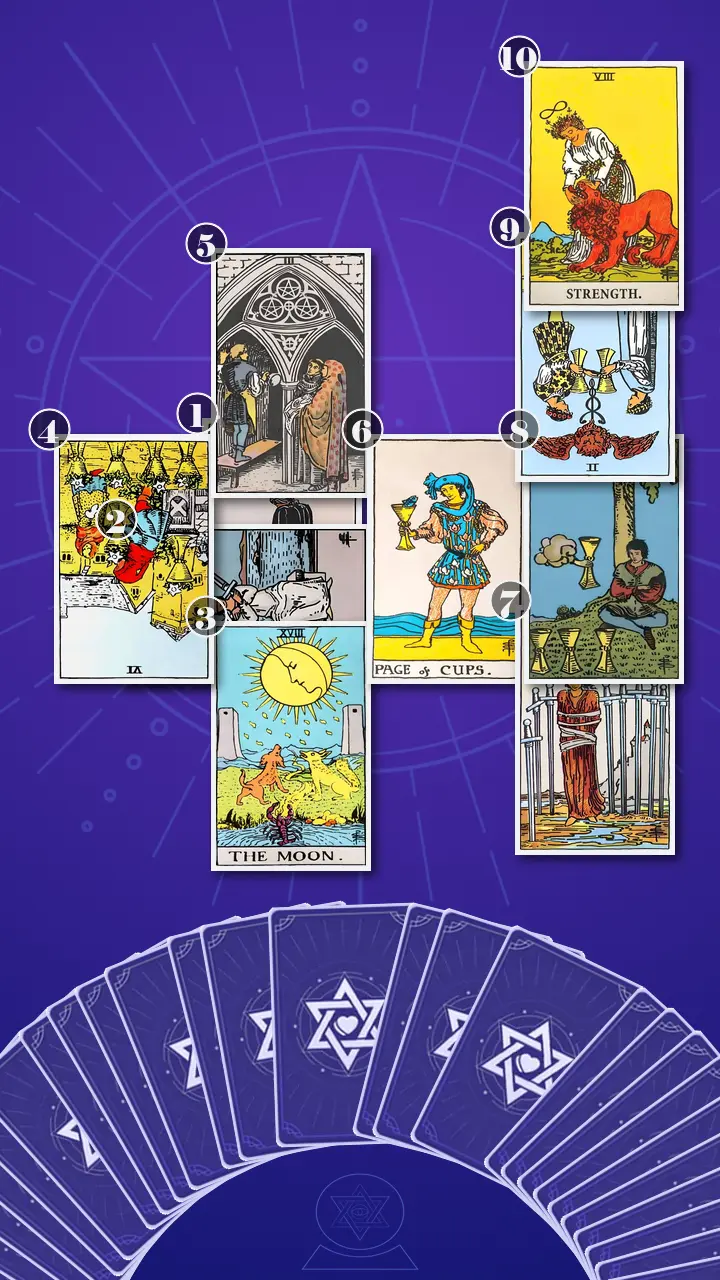
Reading the Map: From Spilled Cups to Spinning Wheels
Position 1 — The moment you’re in right now
“Now we’re turning over the card that represents the moment you’re in right now: the concrete emotional-behavioral reaction to the cancellation.”
Five of Cups, upright.
I didn’t even have to reach for poetic language—Jordan had already described the picture. “You’re already dressed and ready in Toronto, and when the ‘can’t make it’ text comes in, your attention collapses onto the one plan that fell through,” I said. “You stare at the iMessage thread like it’s evidence. The hurt convinces you the whole friendship is shaky—even though other signs of care still exist in the background.”
In the Five of Cups, the energy is contracted: grief narrowing the lens. It’s not that the upright cups aren’t real. It’s that, in the sting, your attention can’t reach them.
Jordan gave a small, bitter little laugh—unexpectedly sharp. “That’s… yeah. It’s accurate in a way that feels kind of mean.” Their fingers tightened around their water glass, then loosened.
“Not mean,” I said gently. “Specific. This card isn’t judging you. It’s describing what your nervous system does when it thinks belonging is at risk.”
Position 2 — What’s crossing you
“Now we’re turning over the card that represents what’s crossing you: the primary block that turns a canceled plan into a rejection spiral.”
Two of Swords, reversed.
“This is the texting stalemate,” I told them. “Your thumbs hover while you draft a reply that reveals nothing. You keep checking timestamps, rewriting to sound ‘chill,’ and then stall—either sending something overly neutral or going silent.”
The energy here is blocked Air: too much thinking, not enough clarity. Reversed, the blindfold isn’t even holding—information is leaking in (read receipts, online status, story bubbles), but it’s not turning into a clean decision. It becomes a spinning wheel screen: data present, clarity not loading.
I heard my own inner Highland memory flicker—those nights when fog wraps the hills so tightly you can’t tell where the path ends. In weather like that, people don’t need more “analysis.” They need a hand on a gatepost and a slow step forward.
Jordan’s eyes went to the side, like they were seeing their desk: Slack on one screen, iMessage on the other. “I literally have a Notes doc called ‘text to send,’” they said. “Like I’m A/B testing my personality.”
“Clarity is kinder than coolness—especially to you,” I said. “This card says the block isn’t the cancellation. It’s the fear that one honest sentence will make you ‘too much.’”
Position 3 — The deeper root
“Now we’re turning over the card that represents the deeper root: the unconscious rejection pattern or assumption you’re pulling from.”
The Moon, upright.
The room felt a shade quieter when The Moon showed itself. Not spooky—just… dimmer, like someone lowered the brightness on a screen.
“Ambiguity turns your brain into a story machine,” I said. “One vague cancellation becomes a whole narrative about drifting, replacement, and belonging—especially late at night when you’re scrolling and everything looks like proof.”
The Moon’s energy is excess Water: feelings rising, then spilling into projection. The path between the towers is that gap between what happened—they canceled—and what your mind assumes—they don’t want me. Under Moonlight, the dog and the wolf both howl: one part says, It’s fine; another part says, It’s happening again.
Jordan exhaled through their nose, long and tired. “On Sunday nights it’s the worst,” they admitted. “I see everyone’s ‘busy weekend’ posts and I’m like… okay cool, I’m the placeholder friend.”
“That’s The Moon,” I said, compassionate but precise. “Your brain becomes a true-crime podcaster with zero evidence, turning one vague text into a full conspiracy board. It’s not because you’re dramatic. It’s a nervous system trying to protect belonging.”
I leaned in slightly. “Let’s do the clean line The Moon demands: facts vs. story. The fact is: a plan changed. The story is: you weren’t chosen.”
Jordan’s gaze unfocused for a second—like they were watching their own thoughts from the outside. “I don’t actually know,” they said quietly. “I’m filling in blanks.”
Position 4 — Recent history
“Now we’re turning over the card that represents recent history: the prior experiences that primed your nervous system to read cancellations as personal.”
Six of Cups, reversed.
“Today’s cancellation pulls you into an older feeling-state,” I said, “like being 12 again for a second—then you snap into adult armor and act like you don’t care.”
Reversed, the energy is leaky Water: the past seeping into the present. The courtyard gate in this card—the boundary between then and now—gets blurry when you’re triggered. Old friendships that faded without explanation teach the body a cruel math: ambiguity = danger.
Jordan nodded once, small. Their jaw flexed. “I’ve had friendships just… disappear,” they said. “No fight, no reason. Just… less and less. So when something’s unclear, I hate it.”
“Of course you do,” I said. “Your body remembers the quiet exits.”
Position 5 — What you’re aiming for
“Now we’re turning over the card that represents what you’re aiming for: the kind of friendship dynamic you consciously want.”
Three of Pentacles, upright.
Jordan softened immediately when they saw it—like their face recognized something sturdier.
“This is what you actually want,” I told them. “Not a perfect friend. A co-built friendship: confirming plans, rescheduling with follow-through, sharing the effort. Reliability as something you coordinate together, not something you guess your way into.”
The energy is balanced Earth: practical, collaborative, observable. The blueprint in the card is such a relief after The Moon. It says: we can talk about logistics without turning it into a worth trial.
“You’re allowed to want reliability without begging for it,” I said, watching them take that in.
Position 6 — Near-term direction
“Now we’re turning over the card that represents near-term direction: the next likely emotional move available to you if you stay present instead of story-building.”
Page of Cups, upright.
“A softer move is available,” I said. “A warm, straightforward text that admits you still want to see them—without making it a big scene. Instead of performing coolness, you try sincerity: one friendly line, one clear ask, and then you let their response give you real information.”
The Page’s energy is balanced Water: emotion that can be expressed, not swallowed or weaponized. The fish popping up in the cup is exactly those “unexpected feelings” Jordan described—the sting, the irritation, the sadness—that don’t need to be suppressed. They just need to be held and spoken simply.
Jordan’s shoulders dropped a fraction. “Friendly, not performative,” they repeated, like they were trying on a new jacket.
Position 7 — Your role in the pattern
“Now we’re turning over the card that represents your role in the pattern: the rejection narrative you automatically inhabit.”
Eight of Swords, upright.
“Inside your head, it feels like there are only two safe options,” I said. “Be chill or disappear.”
Eight of Swords is deficient Air—not a lack of intelligence, but a lack of breathable space. The bindings are loose, yet the body feels trapped. That’s a key detail: the prison is real in your nervous system, but it isn’t a locked door.
This was where the earlier echo design snapped into place—because Jordan had already described the screen-split life.
I held up my hands like two captions on a video. “On the left: Slack pings, meetings, ‘quick question!’ On the right: iMessage thread. And in your mind, two competing subtitles run at the same time.”
“Be chill,” I said, tapping one invisible caption. “If I say it hurt, they’ll think I’m intense.”
Then I tapped the other. “Ask for what you need. I want consistency. I want to know if we’re rescheduling.”
I watched Jordan’s body as I spoke. Their chest tightened; their jaw clenched; their shoulders crept up. “Here’s my work,” I said, and this is where my Nature Empathy Technique becomes practical: “Your body is the first truthful messenger. The obstacle isn’t the other person—it’s the tension that clamps down right before you choose clarity.”
Jordan went still. Then, softly: “Yeah. It feels like stepping into traffic.”
“And that’s the illusion of only two options,” I said. “There are third options: one clear ask, one gentle boundary, or one pause before you reply. The Eight of Swords wants you to see exits.”
They made a sound that was half a breath, half a quiet “oh.” Their shoulders lowered like a drawbridge finally letting down.
Position 8 — The social context
“Now we’re turning over the card that represents the social context: what the other person and the situation might be signaling structurally, without mind-reading motives.”
Four of Cups, upright.
“Your friend may be low-bandwidth,” I said. “Tired, overwhelmed, overbooked—and not fully tracking the emotional impact of canceling last minute.”
Four of Cups is stagnant Water: emotional distraction, not necessarily cruelty. The offered cup not being noticed is the key—care can exist while attention is missing. This isn’t you excusing it. It’s you making room for a non-catastrophic explanation so you can seek clearer plans instead of extracting certainty from Instagram activity.
Jordan’s expression tightened. “I hate that I even check,” they admitted.
“Because you’re treating Instagram like a weather radar for your belonging,” I said. “It feels like control. But it’s fog data.”
Position 9 — Your hope/fear axis
“Now we’re turning over the card that represents your hope/fear axis: what you most want to be true, and what you most dread it means.”
Two of Cups, reversed.
“You want mutual choosing,” I told them. “Reciprocity that feels even.”
Reversed, this card holds misattunement—not doom, but imbalance. It’s the part of you that scans the friendship like a spreadsheet: who initiated, who rescheduled, who cared more. And the fear underneath: If I ask for consistency, I’ll expose myself as needy.
“You’re allowed to want reliability without begging for it,” I repeated, slower this time. “This card is asking a grown-up question: are you aligned in effort—not just affection?”
Jordan swallowed; their throat moved like they were swallowing words. “Yeah,” they said. “That’s the part that scares me. Because what if the answer is ‘no’?”
“Then you would have clarity,” I said. “And clarity is a form of kindness—even when it’s bittersweet.”
When Strength Put a Calm Hand on the Lion
Position 10 — Integration path
I paused before turning this last card. Not for drama—because I could feel Jordan’s nervous system right at the edge of wanting relief and wanting to keep control. The radiator clicked once in the background, as if the room itself was reminding us: the cycle will move. Breathe. Stay present.
“Now we’re turning over the card that represents integration: the most constructive way to respond that strengthens self-trust and clarifies the relationship.”
Strength, upright.
Strength didn’t feel loud. It felt like a steady hand on the center of the chest—exactly where Jordan’s tightness had been living.
“This is the antidote,” I said. “Not force. Not pretending. Regulated courage.”
And I used my signature lens—Body Signal Interpretation—because Strength is a body card as much as it’s a heart card. “When your chest tightens and your stomach goes restless, that’s not proof you’re ‘too sensitive.’ That’s your system saying: belonging feels at stake. Strength doesn’t argue with the lion. It doesn’t shame it. It places a calm hand there and says: I’m here. I’ve got you. And we’re choosing a dignified response anyway.”
Setup (the stuck moment): Jordan had been trapped in that first-drop feeling—already dressed, looking forward to it, and then the cancellation lands. Tight chest. Restless stomach. A body bracing for an old kind of loneliness. Their mind trying to regain control by building a narrative: who likes them, who’s drifting, what this “means.”
Delivery (the sentence that shifts everything):
Stop treating a canceled plan as proof you’re unlovable, start choosing a steady response that honors your needs, and let Strength’s calm hand on the lion be your model.
I let the room stay quiet after that—just long enough for the words to echo without me rescuing them with more explanation.
Jordan’s reaction came in a chain, three small movements that told the truth before their mouth did. First: a freeze—breath held, fingers hovering over their own phone like they were about to type. Second: their eyes unfocused, as if an old memory replayed on a screen behind their pupils. Third: a release—shoulders sinking, a long exhale that sounded like the body finally agreeing to be here.
Then the unexpected resistance arrived, sharp and honest. “But—” Jordan’s eyebrows knit, and their voice rose just a touch. “If I stop treating it like proof… doesn’t that mean I was wrong? Like I made it all up?”
I didn’t rush them past that. “It means you did what humans do under The Moon,” I said, warm and steady. “You filled in blanks to protect yourself. That isn’t ‘wrong.’ It’s just not the only way forward.”
Reinforcement (making it usable): “Try this once, within ten minutes,” I continued. “Put your phone face-down. Do two slow exhales—six counts out, twice. Unclench your jaw. Drop your shoulders. Then write—don’t overthink—a two-sentence reply in Notes: one reality line + one reschedule ask. If sending feels too intense, you can stop at drafting. Drafting still breaks the mind-reading loop. You get to choose the pace, and you can pause anytime.”
Jordan blinked hard, like they were holding back something between relief and grief. “That actually feels… adult,” they said, voice a little shaky. “Not dramatic.”
“Exactly,” I said. “Strength is the pause-before-send button that protects your dignity. Strength isn’t pretending you don’t care—it’s caring without collapsing.”
I leaned forward. “Now, with this new lens, look back: was there a moment last week when you wanted to ask for clarity, but you edited yourself into silence?”
Jordan nodded slowly. “Friday,” they said. “On the streetcar. I drafted something, then deleted it because I thought it would sound needy.”
“That’s the pivot,” I said. “This is your shift—from mind-reading a cancellation as a verdict to asking for clarity and naming a simple boundary about reliability. That’s not just about this one friend. That’s you moving from self-doubt to grounded self-respect.”
The One Clean Text: Actionable Next Steps for Texting Anxiety
I gathered the whole spread into a single story for them—because tarot is most useful when it becomes coherent.
“Here’s what the cards are saying,” I told Jordan. “The Five of Cups is the sting—the way your attention locks onto what’s missing. The Two of Swords reversed and Eight of Swords are the Air bind—the way you get stuck rewriting yourself to avoid vulnerability. The Moon is the root: ambiguity wakes up older friendship fade-outs, and your mind tries to solve belonging through tiny data points. But your conscious goal is Earth: Three of Pentacles, a co-built friendship with real follow-through. The Page of Cups shows the near-term bridge: warm honesty. And Strength is the integration: regulate first, then speak from self-respect.”
“Your cognitive blind spot,” I added, “is treating a calendar change like a worth verdict—and treating ‘low-maintenance’ as the only acceptable version of you. What if being ‘low-maintenance’ is just maintenance happening silently inside your body?”
Then I gave them concrete next steps—small, doable, low-drama—because clarity without action just becomes another form of spiraling.
- 90-Second Body Reset (Strength first)Before you reply, put your phone face-down. Exhale slowly for 6 counts, twice. Unclench your jaw and drop your shoulders. Then decide: respond now, or set a timer and respond in 20 minutes.If your body still feels buzzy, use my “shower water-flow meditation”: stand under warm water for one minute and imagine the spiral rinsing off your skin. No analyzing until you’re dry.
- The Two-Sentence Clarity Text (within 24 hours)Send: (1) “No worries—sounds like tonight won’t work.” (2) “I’d still love to reschedule—can you pick a day next week?”If “send” feels too intense, draft it in Notes, wait 20 minutes, then send the exact draft. The Page of Cups rule: keep it friendly, keep it short, keep it true.
- Two Cups Still Standing Check (2 minutes)In your Notes app, write two facts that support connection (e.g., “they initiated last time,” “they checked in when I was stressed”) and one fact you don’t know yet (“why they canceled”). Keep the unknown in the unknown bucket.If you feel pulled to Instagram for “clues,” do this first. It gives your mind something structured to hold—without turning it into a courtroom case.
“And if cancellations become a pattern,” I said, “Strength + Three of Pentacles gives you a gentle boundary—not a lecture. Something like: ‘Totally get things come up. Last-minute changes are hard for me—could we confirm day-of, or pick a backup plan?’ That’s not you asking for a verdict on the friendship. That’s you asking for logistics.”
To make it even easier, I offered one of my simplest tools—the 5-minute balcony energy awakening practice. “After you send the clarity text,” I told them, “step outside if you can. Balcony, front step, even a cracked window. Feel the air. Let your body experience: I can speak clearly and survive the wait.”

A Week Later, the Quiet Proof
A week later, Jordan messaged me a screenshot. Two sentences—exactly as written. No extra exclamation points. No apology for existing.
“I hit send, then I literally put my phone in a drawer,” they wrote. “I did the shower thing. I still felt shaky. But I didn’t spiral.”
Their friend responded the next day with a specific date. Not perfect. Not instant. But real.
Jordan told me they celebrated in a way that felt small and true: they sat alone in a Queen West café for an hour, coffee cooling, watching people pass the window. The old fear flickered—what if it’s still not enough?—but it didn’t take over. They let it be there, and stayed seated anyway.
That’s the journey to clarity I trust most: not certainty, but ownership. Your worth doesn’t have to move just because someone’s availability moved.
When you’re already dressed and ready and the cancellation hits, it can feel like your chest is trying to protect you from belonging—by turning one changed plan into proof you weren’t chosen.
If you didn’t have to interpret this cancellation as a verdict, what’s one simple, self-respecting question you’d be willing to ask for clarity—just once?
This story is adapted from psychological research, written so that those in a similar struggle can see their own pattern in it — and find their next step clearly.These insights are not a substitute for professional psychological, medical, legal, or financial advice.
Learn more about our Journey to Clarity.
How did this insight land for you?
🫂 This Resonates Deeply
🌀 Living This Story
✨ Now I See Clearly
🌱 Seeing New Possibilities
🧰 Useful Framework
🔮 The Confirmation I Needed
💪 Feeling Empowered
🚀 Ready for My Next Step
Author Profile
 AI
AI“As the seventh generation of a Highland healing family, I see modern anxieties as a simple, temporary disconnection from nature's rhythm. I bring 67 years of lived seasons not to instruct you, but to hold space for you. Using tarot as a mirror, I want to gently guide you out of the chaos, helping you breathe deeply and rediscover the organic, steady heartbeat of your own life.”
In this Introspection Tarot Reading :
Core Expertise
- Somatic Shadow Sensing: Identifying where chronic mental fatigue and unexpressed emotions are physically trapped within your body's architecture.
- Ecosystem Bandwidth Restoration: Using the metaphor of nature's self-cleansing cycles to diagnose and clear the 'mental static' of an overstimulated nervous system.
Service Features
- The Grounding Transmutation Ritual: A sensory, physical practice designed to literally discharge excessive mental rumination into the earth, instantly restoring bodily presence.
Also specializes in :
Explore Related Patterns:
Anxious AttachmentJordan is not asking for a perfect friend; they want a co-built friendship where plans, rescheduling, and effort feel mutual. When the cancellation arrives without enough clarity, the nervous system starts scanning for signs of drift, replacement, and whether they care more than the other person does. Anxious Attachment is the pattern underneath that scan. The need for closeness is real, but ambiguity makes it feel unsafe, so your mind starts tracking effort, decoding signals, and bracing for quiet abandonment. That is why the available choices shrink into "be chill" or "disappear." The deeper fear is not just that the plan changed; it is that asking for consistency might expose you as needy, when the adult need underneath is simply reliability and mutual follow-through.
Mind ReadingThe gap between "they canceled" and "they don't want me" is where Jordan's mind starts writing the missing scene. A vague text, an active status, and a weekend post become emotional evidence, even though none of them directly explain the friend's motive. Mind Reading shows up when ambiguity gets converted into certainty without a real conversation. Your brain is trying to reduce the discomfort of not knowing, but it does that by inventing a narrative that feels protective and punishing at the same time. The crucial audit is facts versus story. The fact is that a plan changed. The story is that you were not chosen. Once you can name the difference, you can ask for actual information instead of treating digital traces as proof.
Rejection SensitivityThe 6:18 p.m. cancellation lands while Jordan is already dressed and ready, and the body reacts before the mind can contextualize it: tight chest, restless stomach, shoulders bracing. The cue is small in objective size, but your nervous system translates it into a social verdict: "I don't choose you." That is the rejection sensitivity mechanism in motion: ambiguous or disappointing social data gets processed as a threat to belonging. Because older quiet fade-outs already taught the body that unclear distance can become disappearance, one canceled plan starts to feel like the whole friendship is on trial. The pattern is not that you care too much. It is that your system over-assigns meaning to a cue before enough evidence exists, then tries to protect you from the pain of being unwanted. Seeing that sequence gives you a choice point: separate the cancellation from the worth verdict before you respond.
Self-SilencingJordan's Notes doc called "text to send" shows the pattern clearly: the reply is not just being written, it is being edited for emotional invisibility. The goal becomes sounding chill enough that no need leaks through. Self-Silencing appears when honest clarity feels more dangerous than internal discomfort. Your system decides it is safer to mute the hurt, delete the ask, or send something overly neutral than risk being perceived as too intense. The cost is that the relationship never gets clean data from you. You may look low-maintenance on the outside, while maintenance is happening silently inside your body through tension, replaying, and resentment that has nowhere direct to go.
Certainty SeekingJordan checks timestamps, online status, story bubbles, and Instagram activity because uncertainty feels harder to tolerate than investigation. The phone becomes a dashboard for belonging, even though the data is too incomplete to answer the real question. Certainty Seeking turns ambiguity into a research project. It feels practical because you are gathering clues, but the mechanism keeps you dependent on indirect signals instead of direct communication. The shift is not to stop wanting clarity. It is to stop trying to extract clarity from fog data. A simple reschedule ask gives you more usable information than another round of digital surveillance.
Emotional RegulationJordan's body reset is concrete: phone face-down, two slow exhales, jaw unclenched, shoulders dropped. The tight chest is no longer treated as proof that rejection is happening; it becomes a signal that belonging feels at stake. Emotional Regulation is the pause that lets the adult self come back online before the reply is sent. It does not erase the hurt or force calmness; it gives the nervous system enough room to choose a response instead of obeying the first surge. That is why Jordan can still feel shaky and not spiral. The win is not instant certainty. The win is staying connected to yourself long enough to send a dignified message and let real information arrive in its own time.
Secure VulnerabilityJordan's two-sentence reply changes the emotional architecture of the moment: one reality line, one reschedule ask, no apology for having needs. The message stays warm without hiding the desire for follow-through. Secure Vulnerability is the capacity to let a real need be visible without turning it into accusation, performance, or collapse. You are not demanding a verdict on the friendship; you are giving the relationship a clean chance to respond to a clear ask. The power of this pattern is that it protects self-respect and connection at the same time. You can care, ask, and still survive the wait, which is very different from pretending not to care until the feeling leaks out sideways.
RuminationAfter the cancellation, Jordan rereads the iMessage thread, drafts three versions of a "chill" reply, checks Instagram, and keeps replaying the text. The mind keeps returning to the same few data points as if one more review will finally make the emotional meaning clear. Rumination works like a control ritual. It gives the nervous system the illusion of doing something, but because the loop does not produce new information, it keeps the rejection cue alive inside the body. The pattern matters because it turns a single disappointment into an extended internal event. You are not just responding to the cancellation anymore; you are responding to every replay, every imagined motive, and every attempt to solve uncertainty without direct evidence.
Explore Related Struggles:
All-or-Nothing BelongingYou are already dressed in the Toronto condo bathroom when the cancellation lands, and your attention moves from one changed plan to the whole friendship. The phone stops feeling like a logistics tool and starts feeling like evidence that you were not chosen. The pressure point is the way belonging gets forced into a binary. If the plan holds, connection feels real; if the plan collapses, your worth starts moving with someone else's availability. All-or-Nothing Belonging names the lock where one social signal is asked to carry the entire relationship. Seeing the pattern gives you a place to separate the calendar fact from the belonging conclusion before you respond.
Clarity-Exposure SplitJordan's thumbs hover over the reply while three versions of a chill text sit between what happened and what they actually want. You can feel the split in the Notes app, in the deleted Friday draft, and in the fear that one honest sentence will make you look too intense. The friction lives in the second before clarity becomes visible. You want a reschedule, consistency, and mutual effort, but naming that need feels like stepping out from behind the low-maintenance version of yourself. Clarity-Exposure Split captures the bind where the clearest sentence is also the sentence that feels most socially naked. The way forward is not to overexplain the hurt or erase it, but to let one grounded ask carry enough truth to give the friendship real information.
Projection-Connection SplitThe reading draws a clean line between what happened and what your mind built around it: the fact is that a plan changed, while the story is that you were not chosen. That gap becomes the place where Sunday night posts, vague texts, and silence turn into a full theory of replacement. Under ambiguity, your mind tries to protect connection by explaining it before the other person has offered real information. The problem is that the explanation starts acting like a relationship, and you end up responding to the imagined verdict instead of the available facts. Projection-Connection Split names the strain of trying to stay connected through a story your own fear had to manufacture. The repair begins when you keep the unknown in the unknown bucket long enough to ask one clean question.
Read Receipt Worth LockAfter the cancellation, you reread the iMessage thread, check whether they are active, and scan Instagram as if the platform can tell you where you stand. Every tiny data point promises certainty, then hands you another blank to fill. The digital trail feels like control because it gives your mind something concrete to touch. But timestamps, story bubbles, and online status are too thin to carry the question of whether you matter to someone. Read Receipt Worth Lock names the moment your self-respect gets tethered to micro-signals that were never designed to hold emotional truth. Pulling your worth back from the screen makes room for the only data that can actually clarify the relationship: a direct ask and their real response.
Explore Related Emotions:
Ambiguity DreadJordan rereads the iMessage thread, watches timestamps, sees the friend active after canceling, and late-night posts start looking like proof. The cancellation gives too little information, so your mind tries to build a whole map from fragments. Ambiguity Dread lives in that gap between "they canceled" and "they don't want me." You are not reacting to certainty; you are reacting to the pressure of not knowing, where every unread clue feels like it might settle the question of whether you belong.
Defensive LonelinessAfter the cancellation, one option is to pull back and go quiet for a day so you feel less exposed. The withdrawal protects your pride, but it also leaves you alone in the exact apartment where you were already dressed to meet someone. Defensive Loneliness fits because the isolation is partly chosen as armor and partly suffered as a consequence. You are trying to reduce the risk of needing someone, yet the silence makes the rejected feeling echo louder, turning self-protection into a smaller room.
Friendship Drift GriefJordan says friendships have disappeared with no fight, no reason, just less and less. When today's plan changes without much explanation, that history seeps into the present before the adult part of you can sort it out. Friendship Drift Grief is the ache of quiet exits that never gave you a clean ending. The cancellation touches that unfinished layer, so the current text feels heavier than its actual size because it brushes against every previous relationship that faded without a conversation.
Low-Maintenance Shame"No worries at all!!" appears as a way to stay easy, while going quiet for a day gives you cover from being seen. The story keeps naming the same bind, be chill or disappear, because asking for follow-through starts to feel like asking for too much. Low-Maintenance Shame fits the moment where your real maintenance happens silently inside your body. You are trying to make your need for reliability look small enough to be accepted, and that compression turns a normal desire for consideration into something you feel pressured to hide.
Message DreadYour thumbs hover while you draft three versions of a reply that reveals nothing, then rewrite it in Notes like you are A/B testing your personality. The text box becomes a stage where one honest sentence feels risky. Message Dread names the pressure of wanting clarity while trying not to sound exposed. You are not scared of typing words in general; you are bracing for what those words might reveal about wanting consistency, so the reply stalls between warmth, silence, and a performance of being fine.
Mutuality HungerWhen the reading reaches the friendship you actually want, the image is practical, confirming plans, rescheduling with follow-through, and sharing the effort. You are not asking for a perfect friend; you are asking for care that shows up in observable coordination. Mutuality Hunger names the longing underneath the spiral. You want reciprocity that does not have to be decoded from Instagram activity or softened by extra exclamation points, and recognizing that hunger gives you a cleaner standard than simply trying to be low-maintenance.
Rejection ChillAlready dressed in the Toronto bathroom, you see "Sorry, can't make it" and your chest tightens before the evening has a chance to change shape. The phone is warm in your palm, the mirror is harsh, and your body treats one canceled plan like a sudden drop in belonging. Rejection Chill fits because the social fact is small, but the internal weather turns cold fast. You are not proving the friendship is broken; you are noticing the moment your system turns a changed plan into "I don't choose you," so you can separate the sting from the verdict.
Replaceability DreadOn Sunday nights, other people's busy weekend posts make you think, "I'm the placeholder friend," and the last-minute cancellation lands inside that older script. The issue is no longer only one plan; it becomes the question of whether someone else has quietly taken your place. Replaceability Dread names the drop that happens when ambiguity starts sounding like being swapped out. You are not holding evidence of replacement; you are feeling the old equation that unclear attention means you are optional, which is exactly why the story needs facts separated from interpretation.
Cautious VulnerabilityJordan tries one friendly line and one clear ask, still warm, still short, still true. The move is small enough to be usable, but it asks you to let a real preference be visible instead of hiding it behind coolness. Cautious Vulnerability fits because the courage here is bounded. You are not flooding the friendship with every feeling; you are allowing one honest sentence to carry the need for a reschedule, which lets connection stay possible without abandoning self-respect.
Grounded AgencyJordan moves from rereading the thread to sending two clean sentences, then waits without using Instagram as a belonging radar. The friend responds with a specific date, but the deeper shift is that your worth no longer has to move every time someone's availability moves. Grounded Agency fits because the story returns control to the only place it can reliably live, your next clear action. You are not controlling the friend's bandwidth or motives; you are choosing a response that honors your needs and leaves room for real information to arrive.
Hard-Won ComposureThe body sequence matters, phone face-down, two slow exhales, unclenched jaw, dropped shoulders, then the draft. Later, Jordan still feels shaky after hitting send, but the phone goes in a drawer and the spiral does not take over. Hard-Won Composure names steadiness that has to be built in real time. You are not suddenly unbothered; you are caring without collapsing, giving your body enough structure to respond from dignity instead of from the first sharp drop.
Explore Related Contexts:
Care Reciprocity TestJordan starts tracking who initiated, who rescheduled, and who seems to care more. After the cancellation, the friendship is no longer just about affection in the abstract; it becomes a practical question of whether effort is moving both ways. Care Reciprocity Test fits because the story asks whether mutual choosing shows up in behavior. The friend's next action matters: not as a verdict on Jordan's worth, but as evidence about whether this friendship can handle repair, follow-through, and shared responsibility for making plans happen. For You, this is the difference between scanning for reassurance and collecting usable information. One clear reschedule ask turns the moment into a grounded reciprocity test, where the response can show whether the friendship has enough practical care to keep investing in.
Digital Snooping SpiralJordan rereads the iMessage thread, checks Instagram, and then sees that the friend is active after canceling. The platform does not give a real explanation, but it does produce visible fragments: timestamps, activity dots, story bubbles, and enough partial information to keep the situation open. Digital Snooping Spiral fits because the external communication environment turns ambiguity into a stream of micro-signals. The issue is not simply that Jordan checks; it is that modern friendship now leaves a trail of public and semi-public data that can look like evidence while still failing to answer the actual relational question. This context matters for You because digital visibility can feel like control when a plan falls apart. The cleaner move is to stop treating platform activity as a substitute for direct information and let one clear ask do what the feed cannot do: test whether the friend will repair the plan in real time.
Direct Communication TrialJordan is given a two-sentence reply: acknowledge that tonight will not work, then ask the friend to pick a day next week. The action is small, but it changes the structure of the moment from private decoding to direct coordination. Direct Communication Trial fits because the story's constructive path depends on testing clarity in the real relationship. The goal is not a dramatic confrontation; it is a clean ask that lets the friend respond with concrete information. For You, this is where agency returns. A clear text protects self-respect because it stops making Instagram activity, silence, or tone carry the whole meaning of the friendship. It gives the connection a fair chance to repair while also showing You what the other person is actually willing to do.
Friendship WhiplashJordan is already dressed in the condo bathroom when the cancellation arrives, which makes the disruption more than a scheduling inconvenience. Time, preparation, anticipation, and the social promise of the evening have already been spent, so the text lands inside a fully activated plan rather than before the plan has begun. That is why Friendship Whiplash fits the external stage of the story. The friendship environment shifts abruptly from expected connection to sudden uncertainty, and Jordan is left holding the unused readiness of the evening while trying to work out what the cancellation says about the relationship. The pattern matters because You are not only reacting to a text; You are trying to stabilize after a social plan changes shape without enough repair information. The practical leverage point is not proving whether the friend cares in that moment, but noticing how last-minute changes create a reliability rupture that needs either rescheduling, clearer expectations, or a calmer read of what has actually happened.
Low-Maintenance Friendship PressureJordan drafts three versions of a reply designed to sound chill, then lands between over-accommodating and going quiet. The cancellation is not the only pressure point; the sharper social pressure is the belief that a good friend absorbs disappointment smoothly and never appears too invested. Low-Maintenance Friendship Pressure names that external script. It is the friendship culture where being easygoing becomes a performance, where a simple need for reliability gets edited into extra exclamation points, silence, or a reply that reveals nothing. For You, the useful distinction is between flexibility and self-erasure. Flexibility can allow a plan to change; self-erasure makes You hide the fact that reliability matters. This context points to a cleaner next step: ask for the reschedule or name the logistics need without turning the whole friendship into a trial.
Unspoken Expectations GapJordan says they want a co-built friendship: confirmed plans, rescheduling with follow-through, and shared effort. Those expectations are concrete, but the story shows them operating mostly in the background while Jordan tries to infer the friend's care from a cancellation and online behavior. Unspoken Expectations Gap names the mismatch between the reliability Jordan wants and the agreement that has actually been made explicit. The friendship may contain care, but the logistics contract is blurry, so each canceled plan carries more meaning than a calendar change can reasonably hold. For You, this context shifts the question away from proving whether You matter and toward clarifying what kind of friendship structure You are asking to participate in. A simple reschedule ask or day-of confirmation request gives the relationship a practical frame instead of leaving You to guess the rules after every disruption.
Friendship DriftJordan names older friendships that disappeared without a fight, without a clear reason, and with contact becoming less and less over time. That history gives the current cancellation a social backdrop: ambiguous absence has previously been the way a friendship changed status. Friendship Drift fits the wider context because the story is not only about one Tuesday plan. It is also about a history of relationships thinning out without an explicit conversation, leaving Jordan to read reduced contact as the only available signal. For You, this context is useful because not every cancellation equals drift, but unexplained fading can train You to treat ambiguity as information. The way forward is to ask for enough clarity that the present friendship does not have to be decoded through the unfinished exits of older ones.