A Three-Hour Reply Turned Role Overload Into a Capacity Boundary

The Yes Sent Before the Calendar Check
I recognized the pattern before Jordan (name changed for privacy) finished describing it: a promising freelance email had arrived during an already crowded workday, and they had typed, “Absolutely, I’d love to,” before checking whether their calendar contained a single honest hour to give.
At 8:47 p.m., Jordan joined our call from the table in their Toronto apartment, which also served as their office. The kitchen light buzzed above them. Google Calendar, a Notion project board, and the half-written reply were still open on their laptop, while their phone looked warm from being held too long. Every few seconds, a notification brightened the screen and pulled their eyes sideways.
Their shoulders sat close to their ears. Their fingers moved between the phone, trackpad, and the edge of a mug that had gone cold. The weight behind their eyes looked like the strain of trying to read a street sign while holding every possible route directly in front of their face.
“I keep calling it flexibility,” Jordan told me, “but my calendar feels like evidence against me.”
They had a full-time communications strategy role, occasional freelance creative work, and community invitations that genuinely mattered to them. None of those interests was fake. The problem was that each opportunity arrived wearing an identity: strategist, creator, advocate, leader, collaborator. Saying no to the opportunity felt less like declining a commitment and more like deleting a possible self.
“What if this is the role that finally makes everything make sense?” they asked. “I don’t want fewer possibilities. I want to know which ones are actually mine.”
I heard the central contradiction clearly. Jordan wanted one reliable guide for choosing opportunities, yet every new invitation pulled them toward another role before that guide could be heard. Keeping every door open had become a way of carrying all the doors.
“I’m not going to tell you which identity you’re meant to become,” I said. “That would turn this reading into another external demand. I want us to understand what happens between the moment an opportunity excites you and the moment it takes possession of your calendar. Then we can look for a guide that belongs to you.”
I told Jordan that our Journey to Clarity did not need to solve their entire career. It only needed to make the next honest choice more visible.

Choosing a Compass for the Opportunity Pile-On
I invited Jordan to put their phone face down and take two slow breaths. I shuffled while they held one question in mind: “What should guide me when every opportunity adds another role?” The pause was not a mystical test. It was a practical transition from reacting to observing.
I chose the Decision Cross · Context Edition, a five-card tarot spread for career choices, role overload, and hidden trade-offs. I use this spread when the real need is not a prediction about which opportunity will “win,” but a clear picture of the decision system operating underneath the options.
For anyone wondering how tarot works in a situation like this, I treat the cards as structured prompts. Their symbols help me separate observable behavior, emotional pressure, hidden assumptions, inner guidance, and practical advice. The cards do not remove responsibility or announce a fixed future. They create enough distance for card meanings in context to reveal patterns that are difficult to see from inside a crowded week.
I placed the first card at the center to show the role overload Jordan was carrying. The second crossed it, representing the opportunity pile-on that kept intensifying the burden. The third sat above them as the inner guide Jordan consciously wanted. The fourth went below, where it could expose the fear maintaining the stalemate. The fifth rested to the right, translating insight into a capacity boundary Jordan could actually communicate.
The layout resembled a compass crossed by a crowded path. It was designed to move from “What am I carrying?” through “Why can’t I choose?” toward “What can I say and do next?”
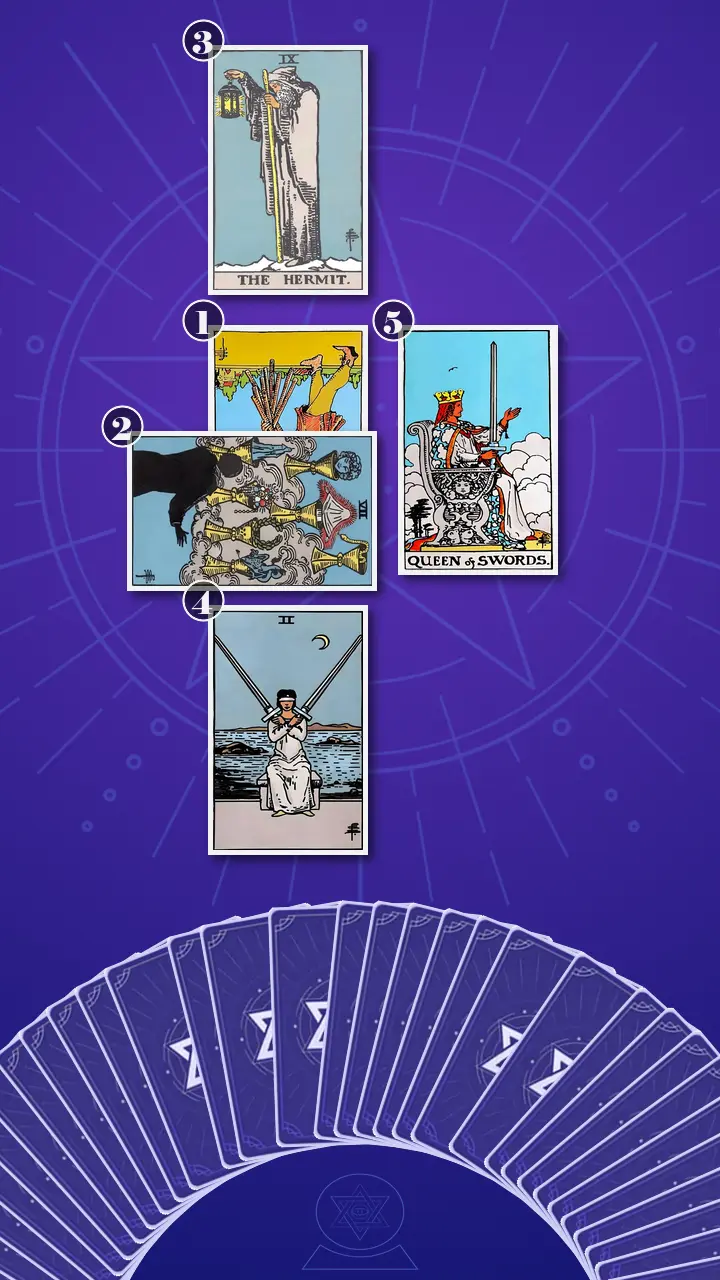
The View Blocked by What You Are Carrying
Position One: The Bundle Across the Calendar
Now I turned over the card representing the observable role overload: how Jordan was carrying too many commitments after treating each opportunity as another identity-bearing responsibility.
It was the Ten of Wands, reversed.
I pointed to the figure bent beneath the tightly bundled wands. Even before interpreting the card, I asked Jordan to notice that the carrier’s view was obstructed. The destination still existed, but the act of carrying everything made it almost impossible to see.
“This is the center of your week,” I said. “You carry a full communications workload, a freelance request, and a community role from one room to another, then answer the next invitation with an automatic yes. Moving the work around has begun to replace deciding where you are going.”
The reversed Fire energy showed both excess and blockage. There was plenty of drive, responsiveness, and ambition, but it had been compressed into strain. Jordan’s action energy was no longer moving cleanly toward a chosen purpose; it was being spent preserving every commitment and reorganizing the same impossible load.
I was careful not to turn the reversal into a command to abandon everything. “Laying down one wand does not mean setting fire to the whole bundle,” I said. “A smaller scope can be a choice, not a failure. This card asks which responsibility can be paused, delegated, or reduced without erasing the value of what you have already done.”
Jordan gave a short laugh, but there was no amusement in it. Their eyes dropped to the open calendar. “That’s so accurate it’s almost rude.”
I let the laugh settle before answering. “Then we won’t use the accuracy against you. This pattern was trying to protect something. We need to understand what, so releasing a responsibility doesn’t feel like losing part of yourself.”
Their fingers stopped tapping for a moment. I asked which commitment they were carrying mainly because letting it go would make the effort already invested feel wasted. Jordan named a volunteer planning role that had expanded far beyond its original scope. Saying it aloud did not produce instant relief. Their mouth tightened first, as if even identifying the burden risked betraying the person who had once wanted it.
Position Two: Seven Futures in the Same Five Minutes
Now I turned over the card representing the Opportunity Pile-On: the appealing possibilities crossing Jordan’s path and making their real capacity harder to assess.
It was the Seven of Cups, upright.
The silhouetted figure faced seven separate cups suspended in a cloud, each offering a different promise. I connected the image to Jordan’s LinkedIn feed: one former colleague announcing a founder role, one friend launching a creative project, and another person joining an advocacy organization. Within five minutes, three different identities could feel equally urgent and attainable.
“After that scroll, you have three saved opportunities, three imagined selves, and no shared unit of measurement,” I said. “Leadership promises recognition. Creative work promises aliveness. Community work promises belonging. The emotion attached to each role feels meaningful, so the mind quietly concludes that all three must remain active.”
The card’s upright Water energy was abundant but temporarily excessive. Imagination was not the enemy. Jordan’s ability to see many possible futures was a genuine strength. The difficulty was that emotional charge had become a substitute for practical fit. The opportunity that produced the strongest rush could seem like the truest path, even when its hours, support, and trade-offs remained invisible.
“A LinkedIn post is a highlight, not a workload disclosure,” I said. “It shows the title, not the evenings, recovery time, financial cushion, or help behind it. Your brain is comparing your full calendar with someone else’s public headline.”
Jordan leaned back and rubbed the space between their eyebrows. “So I’m not actually comparing opportunities. I’m comparing versions of myself.”
“Yes,” I said, “and that is why more research keeps expanding the field instead of narrowing it. Before asking whether an option looks exciting, we need to ask what it would actually require from your attention, rest, and existing commitments.”
I watched their gaze move from the Seven of Cups to the reversed Ten of Wands. The visual logic was plain: each floating cup could become another wand in the bundle. Possibility itself was not creating the burden. The untested assumption that every possibility needed to stay alive was.
When the Hermit Lowered the Searchlight
Position Three: One Lantern, One Value, One Current Season
Now I turned over the card representing the inner guide Jordan was consciously seeking: a self-chosen principle for deciding which role fits, rather than another demand to accept every possibility.
It was The Hermit, upright, the key card of the reading.
The room seemed to become quieter around the card. Even the kitchen light behind Jordan stopped buzzing for a few seconds, leaving only the low refrigerator hum and the distant sound of traffic moving through wet Toronto streets.
I placed my finger near the lantern held close to the figure’s chest. Its light did not illuminate the whole mountain or reveal a complete five-year plan. It created a small circle in which the next step could be examined honestly.
“The modern version of this card is simple,” I said. “You turn off Slack and phone notifications, sit with one page of your calendar, and ask what would still matter if nobody saw this opportunity. The Hermit is not another identity for your portfolio. It is a short, device-free pause in which one tested value becomes audible beneath comparison and invitation noise.”
The Hermit’s energy was balanced: reflection without disappearing, solitude without isolation, and discernment without demanding total certainty. Jordan did not need to suppress curiosity or select a permanent professional identity. They needed a smaller field of attention.
This was where I used a lens I call Macro-Orbital Projection. After years of observing how people move through personal cycles, I have learned to map a crowded present against a longer arc. I do not use that map to claim that any career path is cosmically inevitable. I use it to distinguish a temporary transition from a personal defect.
I asked Jordan to imagine their current commitments as objects occupying different orbits. Some were close to the center because they supported financial steadiness or sustained creative depth. Others had entered through momentum, flattery, or fear of becoming irrelevant. Every incoming opportunity was being treated as though it deserved a permanent orbit, so the whole system appeared chaotic.
“Your confusion is not proof that you lack a core,” I said. “It may be the predictable result of trying to give every passing object equal gravitational authority. The solution is not to become a more efficient solar system. It is to choose what sits at the center for this season.”
I also named what I call a Void Phase: the uncomfortable interval after an old way of organizing identity stops working but before a new direction has accumulated visible proof. Jordan had been filling that interval with roles because open space felt dangerously similar to irrelevance.
“A void phase is not a verdict, and it does not promise that a breakthrough will arrive on schedule,” I said. “It simply gives us a less punishing explanation for the pause. You may be between organizing principles. If so, the quiet is not evidence that you have failed to become someone. It is where you can test what deserves the next orbit.”
I asked Jordan to picture Tuesday at 8:47 p.m. again: laptop open, phone warm, one more invitation waiting, and three role-tracking tabs already crowded. They wanted a guide, but their old pattern kept treating each possible role as proof that it had to be preserved.
A guide is not another role to perform. It is a self-chosen criterion that helps you decide what deserves your capacity, even while other possibilities remain possible.
You do not need to embody every role an opportunity offers; let The Hermit's lantern illuminate one value you can test, then use it to decide what deserves your time and attention.
I stopped speaking. Jordan’s breath froze halfway in, and one fingertip remained suspended above their trackpad. Then their gaze lost focus, as if they were replaying every quick yes, every rewritten bio, and every evening converted into another planning session. Their jaw tightened before any relief arrived.
“But doesn’t that mean I’ve been doing this wrong?” they asked. The words came out sharper than anything they had said so far. “I’ve spent years trying to prove I can hold all of it.”
“It means the strategy protected your sense of possibility until its cost became too high,” I said. “That is information, not an indictment. You do not have to shame the version of you who kept the doors open in order to let the current version choose.”
Their eyes reddened slightly. Their raised shoulders descended, then stopped halfway, as though relief had exposed a new vulnerability: if no external role could make the choice for them, they would have to participate in choosing. Their hand opened against the table. A long breath left their chest, followed by a quieter, unsteady “Okay.”
“Now, using this new perspective, can you recall a moment last week when this insight might have made you feel different?” I asked.
Jordan looked toward the dark window. “The community committee asked me to take on communications too. I wanted the work, but not that version of it. I thought those had to mean the same thing.”
That distinction was the first real movement from role-stacked overwhelm toward self-trust and focused discernment. Jordan did not yet have a final answer. They had something more useful: permission to separate genuine interest from unlimited availability.
The Blindfold Beneath the Planning
Position Four: The Trade-Off Left Unnamed
Now I turned over the card representing the underlying influence: the hidden fear that postponed a clear criterion and kept openness and self-protection suspended.
It was the Two of Swords, upright.
I focused on the blindfold and the two swords crossed over the figure’s chest. I did not treat them as a warning about an unavoidable event. I read them as a protective posture that had become a decision-making habit.
I described the scene already familiar to Jordan: two versions of an email drafted, both organizations researched again, and both replies left unsent because accepting one role might expose that the other could not fit in the same week.
“The internal script sounds like this,” I said. “‘If I choose this, I lose that. If I lose that, what does it say about me?’ Staying open then feels like safety. But the actual result is a calendar that cannot hold everything and a nervous system that never receives a completed decision.”
The Air energy of the Two of Swords was blocked. Jordan had plenty of analysis, language, and comparative information, but those tools were arranged defensively. Research had become a way to postpone the emotional trade-off. More facts could clarify an opportunity’s terms; they could not manufacture more hours or guarantee continued belonging.
I asked, “Are you still gathering information because the choice needs it, or because knowing enough would make the trade-off harder to avoid?”
Jordan’s lips parted, but no answer came immediately. Their hands went still first. Their eyes moved away from the cards as recognition worked its way in, and only then did they whisper, “I’m not waiting for more information. I’m waiting to stop caring about what I lose.”
“That may not happen before the choice,” I said. “A clear decision can still contain disappointment. Clarity is not emotional anesthesia. It lets you name the loss without asking your calendar to prevent it.”
Their face softened and saddened at the same time. I saw the defense loosen, but I did not rush to fill the space with optimism. Jordan was recognizing that choosing a value would narrow access to some roles, at least for now. The sadness was not evidence that the criterion was wrong. It was evidence that the options had mattered.
Position Five: The Sentence With an End Date
Now I turned over the card representing the practical direction: the boundary and communication practice Jordan could use before accepting another role.
It was the Queen of Swords, upright.
The Queen held her sword upright beneath an open sky. Her posture was still, her gaze direct, and her free hand remained open. I read that combination as clarity without hostility: a person could be receptive to an opportunity while remaining exact about what it would receive from them.
“This is the email where interest becomes a defined commitment,” I said. “You name the role you are accepting, the maximum hours available, the date the arrangement ends, and the responsibility you cannot carry. You move from ‘I am interested’ to ‘I am available for this exact version.’”
The Queen’s Air energy was balanced and outward-facing. The Hermit had made a private value audible; the Queen turned that value into observable language. Her boundary did not judge the opportunity, and it did not make Jordan less ambitious. It prevented ambiguity from quietly expanding a task into another unlimited identity obligation.
I thought of the many charts I had watched change meaning when a single reference point was corrected. The data had not suddenly become kinder or harsher; the relationship between the elements had become legible. Jordan’s calendar needed that same precision. “Interest is not the same as capacity,” I said. “A boundary is the coordinate that lets both be true.”
I offered a sample reply: “I’m interested in supporting the campaign strategy, and I can offer three hours a week through the end of May. I’m not able to take on event logistics.”
Jordan read the sentence twice. Their shoulders loosened by a fraction. “That sounds so normal,” they said.
“It is normal,” I replied. “The identity fear makes it feel dramatic, but the recipient receives useful project information. You can stay open without being available to everything.”
I also noted what the spread did not contain: there were no Pentacles. Insight and language were present, but practical grounding could not be assumed. The reading would only become useful when Jordan placed a real limit in Google Calendar, estimated actual hours, or sent a scope-bound reply. Tarot could reveal the pattern; Jordan would decide whether and how to change it.
The Lantern-and-Limit Filter
I drew the five cards into one coherent story. Jordan’s past habit of answering quickly had turned adaptability into accumulated weight. The Ten of Wands showed the visible consequence: action without enough direction. The Seven of Cups explained why the burden kept growing: each attractive option carried a promise of identity, relevance, or belonging. The Two of Swords revealed the hidden engine beneath the pattern: keeping every role technically possible delayed the grief and responsibility of choosing. The Hermit introduced one quiet, self-chosen value, and the Queen of Swords gave that value a scope, a limit, and a sentence another person could understand.
The cognitive blind spot was not simply “I have too many options.” It was the belief that enough research could remove the emotional cost of choosing, and that closing one current role would erase access to a future self. The transformation was more precise: Jordan could stop treating every opportunity as an identity requirement and start using values and capacity limits to decide what deserved attention now.
I called the practical framework the Lantern-and-Limit Filter. The lantern asks what matters without an audience. The limit checks what the current calendar and nervous system can responsibly carry. Neither requires a permanent identity.
- Make a One-Value Opportunity Pause. Before replying to one work, freelance, or community invitation this week, sit at the apartment table, switch off notifications, and set a 10-minute timer. Write: “For this season, I am protecting ___.” Choose one current value, such as sustained attention, financial steadiness, creative depth, or meaningful community. Then ask what would still matter if nobody saw or praised the role. If 10 minutes feels exposing, do the two-minute version and leave the invitation unanswered until a chosen review time. The sentence is a temporary criterion, not a permanent identity.
- Use the Capacity Before Identity Check. Create a three-line note beside one open opportunity: actual hours, emotional cost, and purpose now. Mark each low, medium, or high without doing more research. If the opportunity fails two checks, pause it, delegate part of it, or ask for a smaller scope. Put any temporary review date directly in Google Calendar. A rough estimate is enough. The check is not designed to guarantee the perfect decision; it is designed to make the trade-off visible.
- Run a One-Week Cosmic Redshift Observation. For two minutes each evening, record one interest that felt more distant or draining that day, your “redshift,” and one signal that felt quietly closer or more sustaining, your “blueshift.” At the end of seven days, compare those signals with actual energy and calendar use, then apply the pattern to one invitation. Track observations, not cosmic verdicts. A fading interest can be temporary, and an approaching signal is only something to test, not a command to reorganize your life.
- Send One Scope-Before-Yes Reply. Choose one invitation and name four details: the exact contribution, the maximum hours, the start or end date, and one responsibility you cannot take on. Use: “I’m interested in helping with X, and I can offer Y hours through Z date; I’m not able to take on A.” Place the agreed scope beside the project title in your calendar. If the other person pushes beyond the limit, repeat the scope once or decline. No explanation about your ambition, generosity, or worth is required.
I reminded Jordan that the Decision Cross was not asking them to become less curious. It was offering a values-and-capacity filter strong enough to protect curiosity from being converted into unlimited labor. One paused role would be data. One defined scope would be practice. One honest no would not settle their identity forever.

A Week Later: The Quiet Proof
Six days later, I received a message from Jordan. They had used the Capacity Before Identity Check on the community invitation. The work still mattered, but its expanded scope failed the hours and emotional-cost checks. Jordan replied that they could contribute to campaign messaging for three hours a week through May, but could not take on event logistics.
The organizer accepted the boundary without argument. Jordan told me they stared at the newly open calendar block for three minutes, feeling both lighter and oddly lonely. That night they slept through, but their first thought in the morning was still, “What if I’m becoming less relevant?” This time, they noticed the thought and did not reopen the email.
I did not see that as tarot predicting a successful outcome. I saw Jordan create the outcome that the cards had helped them conceptualize. Their progress was not a completed career identity. It was the first observable movement from role-stacked overwhelm and identity-protective indecision toward self-trust, focused discernment, and a clear capacity boundary.
When every invitation makes the shoulders tighten because choosing one role feels like losing the others, I understand why carrying them all can feel safer than discovering what personal capacity actually wants. I also know that noticing the difference between interest and availability means the old pattern is no longer invisible.
If one small value became the Hermit’s lantern for the next invitation in your life, what would its light reveal first: a calendar block that needs protection, a role moving out of your current orbit, or the place in your body that already knows the scope you can honestly carry?