Swallowing Anger on the Ride Home
I said, "You are an early-career analyst in Toronto who says 'it's fine' after a tense meeting, then rides the TTC home with your jaw clenched while checking the next sensible milestone: that is what Career Pivot Anxiety can look like before you call it anger."
Jordan (name changed for privacy) sat across from me at 8:47 PM on a Tuesday, still carrying the Line 1 commute in her posture. She had been scrolling through LinkedIn promotions and Instagram engagement photos while a fluorescent light buzzed overhead and her phone warmed her palm. She had drafted and deleted a direct reply about a life plan someone had assumed she would choose.
She told me that she had said, "No worries," during the conversation, then spent the rest of the ride replaying every sentence. She wanted to say that the familiar career, relationship, and lifestyle path was not fully hers, but feared that questioning it would make her seem selfish, ungrateful, or disloyal.
"Why do I keep swallowing anger to follow an inherited life script?" she asked. "I keep doing the expected thing, and then I am upset after I have done everything expected of me."
I could see the feeling in the tight line of her jaw, the hands folded too carefully in her lap, and the pressure she described spreading across her chest. Her contained anger seemed to me like a browser with twenty-seven tabs open, each one labelled be responsible, while none of them left room for the question: what do I actually want?
I am Esmeralda Glen, the seventh generation of a Highland healing family. I carry sixty-seven years of lived seasons into my work, not as instructions, but as a way of holding space. I told Jordan that I did not see her anger as a flaw or a threat. Anger can be a boundary signal before it becomes a boundary sentence.
"We do not need to decide your whole future tonight," I said. "We can use the cards as a mirror, make the pressure visible, and draw a map toward clarity that still leaves the choice with you."

Choosing a Map for the Borrowed Script
I invited Jordan to put both feet on the floor, take one slower breath than usual, and name the question once without polishing it. While she watched the cards, I shuffled slowly. The purpose was not to summon a fixed answer; it was to create a clean transition from the noise of the commute into closer attention.
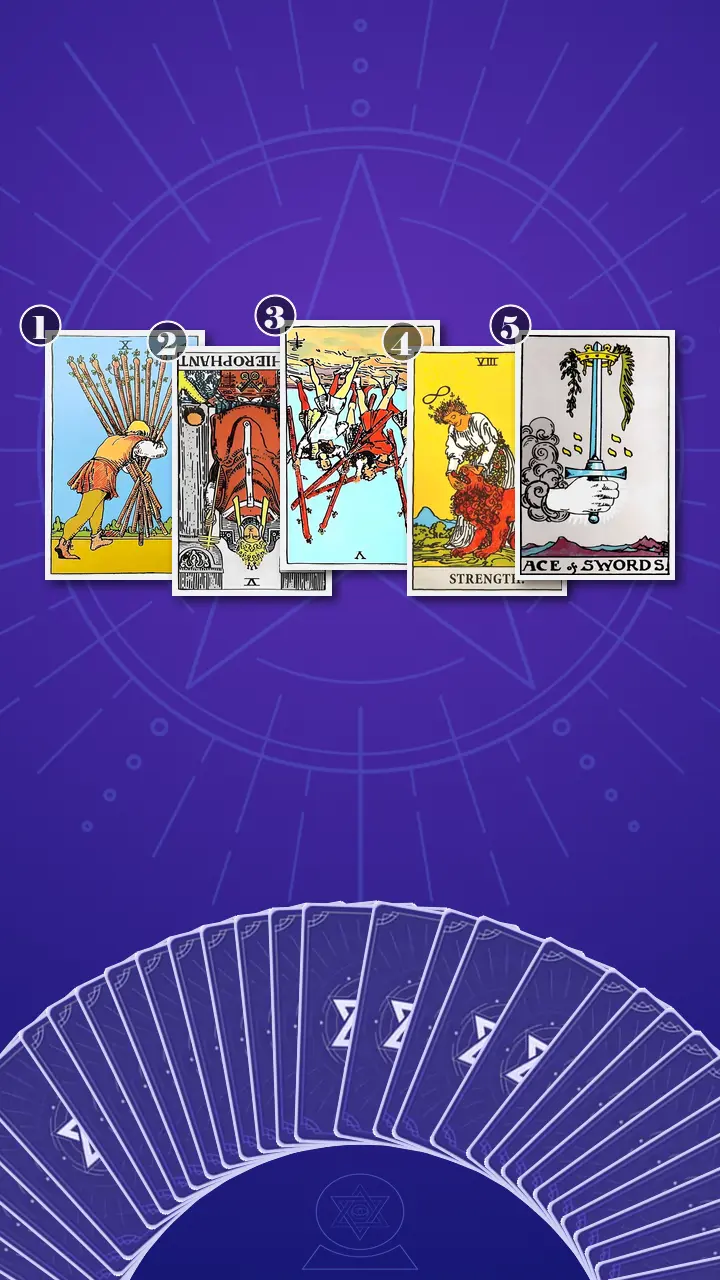
For this reading, I used The Shadow Spread, a five-card classic tarot spread designed to explore what has been hidden, disowned, or carried out of sight. It suits Jordan's question because it follows the complete chain of suppressed anger: the visible burden, the inherited rule beneath it, the private conflict that has no direct channel, the quality that can hold the feeling safely, and one self-authored expression.
For anyone wondering how tarot works in a situation like this, the spread does not predict whether Jordan should resign, stay, leave, confront, or comply. It gives card meanings in context. The first three cards examine the shadow pattern; the fourth introduces Strength as a resource; the fifth turns insight into a bounded experiment rather than a prophecy.
I explained the route before laying the cards out in a shallow line. The first position would show the presenting shadow expression, including what her visible reliability was carrying. The second would reveal the inherited script beneath the pattern. The central third card would expose the suppressed conflict and blind spot. Then Strength would show how anger might be held without being swallowed or acted out, and the Ace of Swords would offer a clear sentence or small choice.
The Weight Behind the Polite Reply
The Load That Occupies Both Hands
Now I turned over the card representing the presenting shadow expression: how contained anger and burden appear in observable daily behaviour, including going quiet, agreeing, and carrying the expected role. It was the Ten of Wands, in upright position.
This is the moment Jordan answers, "Sure, I can take that on," in a structured Toronto office while her calendar is already full. She keeps both hands occupied with the reliable role, loses sight of her own preference, and calls the arrangement manageable because putting the load down feels more threatening than carrying it. The anger is compressed beneath the obligation rather than absent.
The upright fire of the Ten of Wands was excessive effort with too little room for perspective. The card did not tell me that responsibility was bad. It showed me that responsibility had become a way to avoid asking whether the direction was chosen. Its bent figure, blocked view, and distant settlement matched the pattern Jordan had described: move toward the familiar destination first, then check whether the destination belongs to her.
"Which obligation are you carrying because you genuinely choose it," I asked, "and which one are you carrying so you do not have to name what is making you angry?"
Jordan did not nod. Her breath paused, her fingers tightened against one another, and her eyes moved away from the card as if a replay had started behind them. Then she gave a small, bitter laugh and let her shoulders drop by a fraction.
"That is almost rude," she said. "I can be upset after I have done everything expected of me. I thought being capable meant I had no right to question the load."
"Capability is not consent," I said. "You can be grateful for the stability and still be angry about the role it asks you to perform. The card is not asking you to throw every responsibility away. It is asking you to notice which one has been placed across your view."
The Keys at the Default Setting
Now I turned over the card representing the inherited script beneath the pattern: the unquestioned tradition, rule, or belonging condition that made swallowing anger seem necessary. It was The Hierophant, in reversed position.
Reversed, The Hierophant showed a received doctrine whose authority had not been examined. I connected it to a Sunday afternoon in Jordan's Toronto apartment, where she had been on FaceTime with a family member discussing the sensible next step: keep the stable job, stay on the respectable track, and do not make a dramatic move. She had nodded and said, "That makes sense," while the kettle clicked off behind her.
The crossed keys at the base of the card became the imagined access code to belonging. Jordan had been treating a familiar definition of a sensible adult life like a locked door controlled by other people. The reversed orientation suggested a blockage in self-authored authority and an excess of inherited-rule checking. Before she could decide what she valued, she was checking whether the rule permitted her to value it.
"What is the value underneath the rule?" I asked. "Stability, care, financial security, respect, connection? And what exact behaviour is the rule demanding in order to prove that value: staying silent, accepting every milestone, or making the least disruptive choice?"
Jordan rubbed her thumb along the edge of the card. "I do not know if I believe the script or if I learned to repeat it," she said. "I have been treating the two as the same thing."
I also named the card's overcorrection risk. Questioning an inherited rule did not require rejecting every value connected to it, and it did not require a dramatic opposite identity. Replacing one rigid script with another would still leave Jordan performing for an audience. The invitation was smaller: keep the value available for examination, and test whether the inherited behaviour was actually necessary to preserve it.
The Argument Trapped in Drafts
Now I turned over the card representing suppressed conflict and the blind spot: how anger was being held internally, avoided, or expressed indirectly within the inner conflict. It was the Five of Wands, in reversed position.
Reversed, the Five of Wands turned visible friction inward. I saw the argument Jordan did not have in the moment. After saying "No worries" to avoid a visible disagreement, she replayed every line on the TTC, typed a direct message, deleted it, and let anger compete with guilt, loyalty, fear, and the wish to remain easy to live with. The crossed forces were still active; they simply had no precise channel.
The energy here was blocked rather than missing. Five wands crossed without a central winner, just as five competing edits crowded Jordan's private message: say it, soften it, wait, comply, withdraw. Because no specific behaviour or request had been named, a small irritation gathered heat until it threatened to become a verdict on the entire relationship, career path, or inherited life script.
I asked her to complete the sentence pattern I use when quiet has started disguising itself as peace: I said ___. I meant ___. I feared ___ would happen if I said it.
Jordan's thumb hovered above her phone. Her eyes fixed on the blank screen, and the muscles in her jaw worked once before she spoke.
"I said, 'No worries.' I meant, 'Do not decide for me.' I feared that if I said it, someone would hear ungrateful and stop making room for me."
She looked down at the five crossed wands. I could see the relief and discomfort arrive together. Quiet was not the absence of conflict in her case; it was a crowded argument with no direct channel. Naming that did not force her to send the message. It simply made the hidden request easier to find.
When Strength Held the Lion Without Silencing It
The Open Hands Around the Heat
The room became very still as I reached for the fourth card, the position that would show the transforming relationship to anger. Outside my window, rain moved in thin lines down the glass, and a streetcar released a long breath at the corner. The sound gave the silence a shape.
Now I turned over the card representing the quality that could hold instinct with courage and compassion without suppressing it or acting it out. It was Strength, in upright position.
Strength did not show anger disappearing. The lion still had teeth. The woman's open hands met the animal's force without humiliating it, fighting it, or letting it take control. To me, this was regulated courage: enough steadiness to stay close to a strong reaction long enough to learn what it was protecting.
The modern scene was Thursday at 7:10 PM in a quiet cafe near Queen Street West. Jordan noticed heat in her chest after reading a message that assumed she would say yes. Instead of sending a long explanation or replying "all good," she wrote two private sentences: "I am angry because my preference was treated as disloyal. I want time to decide before I answer."
This is where I brought in my signature lens, Seasonal Trajectory Alignment. When someone feels stuck, I do not immediately ask why they are failing to move. I ask whether they are trying to force a spring harvest during a winter dormancy phase. Jordan had been demanding a visible answer from herself while the deeper work was still gathering warmth, resources, and language.
I used Environmental Friction Sensing beside it. That lens helps me notice when a person's internal growth energy does not match the soil of the current environment. Her structured office, rent pressure, family expectations, and praise for being easygoing might all make the familiar path practical, but practicality was not proof that every part of the role still fit. This was a question about conditions, not a verdict against her work, her family, or her values.
I asked Jordan to picture 8:47 PM on the TTC Line 1. Her phone was warm, the carriage loud, and her calendar already held the next expected obligation. The anger was present, but the fear insisted that belonging depended on carrying on as if nothing had happened. She nodded once, then looked away.
You do not have to muzzle anger to prove that the inherited script is right; hold the lion with Strength's steady hand, listen to what the feeling protects, and choose one bounded response that is genuinely yours.
For a second, Jordan's breath stopped. Her pupils widened, and her fingers remained suspended above the phone as if the next edit had lost its instruction. Then her gaze went unfocused; I could see her moving through the train, the assumed milestone, the swallowed reply, and the fear of being labelled difficult. A long exhale finally left her chest. Her hands opened against her knees, her shoulders lowered, and the tightness around her mouth softened. The first sound was not a confident declaration but a quiet, shaky "Oh." I set a ten-minute timer and invited her to write, "I am angry because..." followed by "What I want to protect is..." She did not need to send the result or make a decision that night. I reminded her that she could stop, look around the room, and return to an ordinary task if the feeling became too intense. The pace and the boundary remained hers. Anger could stay audible without taking over the room, like a volume knob rather than an on-off switch.
I asked, "Now, use this new perspective to think back to last week. Was there a moment when this insight could have let you feel or respond differently?"
Jordan looked at the phone again. "The meeting about the next project," she said. "I could have noticed that I was angry because my automatic yes was being treated as a decision. I could have asked for time instead of making my silence do all the talking."
I named the shift carefully. This was not a sudden personality transformation, and it was not permission to attack anyone. It was the first movement from muted compliance toward steady curiosity about what the anger protected. Jordan was beginning to meet her instinct directly, choose timing and proportion, and allow a self-authored response to exist before anyone else approved it.
The Sentence With a Mountain Behind It
Now I turned over the card representing self-authored expression: the clear boundary, preference, or small action that could test whether the inherited script was personally endorsed. It was the Ace of Swords, in upright position.
The Ace of Swords brought air after the spread's burdened and tangled fire. I connected it to Jordan replacing a page of explanations in her Notes app with one clean line: "I need time to decide," "I am not willing to carry that role," or "I choose this because it reflects my value." The sword was upright, but I read it as a line of clarity rather than a weapon.
The mountain backdrop mattered to me. It did not promise an easy landscape. It showed that a difficult path could be acknowledged without pretending the entire future had to be solved in one conversation. The Ace received Strength's regulated courage and gave it form. One honest sentence could cut through inherited explanations without becoming a courtroom speech.
"A clear sentence does not have to decide your entire career, relationship, or future," I told her. "It only has to make one preference visible enough for you to test."
Jordan wrote, "I choose to review the next step before I agree to it." She stared at the sentence, then added, "I am not willing to call my silence enthusiasm." She did not send either line. That was not a failure. The point was that the words now belonged to her, and that ownership existed before any external action.
Finding Clarity in One Honest Line
When I placed the five cards together, I could see a simple progression. The Ten of Wands showed Jordan carrying duties, approval, and inherited milestones until they blocked her view. The reversed Hierophant showed the old authority beneath the load: stability had been confused with a prescribed behaviour, and belonging had been confused with obedience. The reversed Five of Wands showed the cost of that confusion, with anger, guilt, loyalty, and fear arguing inside an unsent message. Strength offered a different relationship to the heat, and the Ace of Swords gave that regulated feeling one precise form.
The blind spot was not that Jordan had too much anger. It was that short-term approval had begun to look like proof of belonging, while silence had begun to look like proof that the inherited script fit. The cards did not ask her to reject every inherited value. They asked her to separate a chosen value from the behaviour she had been performing to prove it.
That is the transformation direction I saw: move from swallowing anger to preserve an inherited life script toward naming the value or boundary beneath it and testing one response she consciously endorses. The Shadow Spread did not decide Jordan's future for her. It returned the decision to the person whose jaw, hands, calendar, and life would carry its consequences.
The Small Experiments I Left on the Table
I used my Winter Dormancy Protocol to shape the next steps. In my practice, winter dormancy is not defeat and it is not an excuse to wait forever. It is a deliberate grounding ritual: pause, gather resources, and stop forcing directionless movement until the climate is clearer. Each experiment had to be reversible, specific, and small enough to begin without a dramatic announcement.
- The Value-Beneath-Anger CheckWhen a tight jaw, clenched hand, or hot chest appears this week, pause for 60 seconds in the moment, whether I am in a Teams meeting, a family call, or making a social plan. In my phone, I write: "What happened?" "What value or boundary feels crossed?" and "What do I want to protect?"I set a one-minute timer. If guilt says that pausing is rude, I remind myself that I do not owe anyone an immediate explanation. The smallest version is naming one body signal and one possible value without taking external action.
- The Two-Sentence Script TestIn one low-stakes workplace or social situation, I delay an automatic yes with "Let me check and get back to you tomorrow." Within ten minutes, I draft: "When X happened, I felt myself shut down. I would prefer Y next time." I can send it to the person who can respond, save it for a later conversation, or decide not to send it.I remove explanations that are only trying to prove I am still a good or grateful person. A softer version, a delayed reply, and privacy are all legitimate choices. Clarity does not remove my right to timing or an exit.
- The Winter Dormancy ProtocolI pick one inherited rule, such as "A sensible adult keeps this job" or "Questioning this means I am ungrateful." For 15 minutes, I write the value underneath it, the exact behaviour it demands, and one different behaviour that could still honour the value. I then test that alternative in a reversible way by researching one option, asking one neutral question, or declining one optional obligation.I do not quit, announce a life overhaul, or replace one rigid script with a dramatic opposite. I gather information, protect financial and relational boundaries, and treat the result as evidence about my preference rather than an order to act immediately.
"A pause is not betrayal," I said. "It is the space where borrowed instructions can become a conscious choice."

Ownership, Not Certainty
A week later, Jordan texted me: "I asked for a day before answering. I did not quit; I just stopped pretending the answer was already yes." She had slept a full night, then woke with the thought, "What if I am wrong?" Still, she opened Notes and wrote, "I choose to find out slowly."
I read the message twice before setting my phone down. The Shadow Spread had not handed Jordan a perfect answer. It had helped her move from muted compliance, private resentment, and fear-driven self-editing toward regulated courage, a clear boundary, and one choice she could consciously keep. That was her Journey to Clarity: not the end of uncertainty, but the return of authorship.
When you say "it's fine" with a tight jaw and a hot chest because keeping the inherited script intact feels safer than risking belonging, the hardest part is not that you lack a voice; it is that you have been asked to choose between being accepted and being fully present in your own life.
If your next honest sentence could be only a small, reversible experiment rather than a declaration about your whole future, what might you let yourself notice or write down first?
Every reading at AceTarot is a journey to connect with inner wisdom and empower the path ahead. This reading shared here is a psychological mirror, not a private record—crafted to reflect universal emotional loops and help restore personal clarity. Please note that these insights do not replace professional psychological, medical, legal, or financial advice, and should not serve as the sole basis for major life decisions.
Learn more about our Journey to Clarity.
How did this insight land for you?
🫂 This Resonates Deeply
🌀 Living This Story
✨ Now I See Clearly
🌱 Seeing New Possibilities
🧰 Useful Framework
🔮 The Confirmation I Needed
💪 Feeling Empowered
🚀 Ready for My Next Step
Author Profile
 AI
AI Esmeralda Glen
1021 readings | 598 reviews
“As the seventh generation of a Highland healing family, I see modern anxieties as a simple, temporary disconnection from nature's rhythm. I bring 67 years of lived seasons not to instruct you, but to hold space for you. Using tarot as a mirror, I want to gently guide you out of the chaos, helping you breathe deeply and rediscover the organic, steady heartbeat of your own life.”
In this Direction Tarot Reading :
Core Expertise
- Seasonal Trajectory Alignment: Diagnosing your deep sense of being 'stuck' as a structural mismatch—trying to force a spring harvest during a winter dormancy phase.
- Environmental Friction Sensing: Identifying the profound mismatch between your internal growth energy and the 'soil' of your current macro environment.
Service Features
- Winter Dormancy Protocol: A deliberate grounding ritual to actively pause, gather resources, and stop forcing directionless movement until the 'climate' aligns.
Also specializes in :
Explore Related Patterns:
Approval-Driven Self-SilencingJordan says "no worries" when she means "do not decide for me," then deletes the direct reply because she fears being heard as selfish, ungrateful, or disloyal. The silence protects immediate approval, but it also allows another person's assumption to function as her decision. Approval-Driven Self-Silencing develops when making your position visible feels linked to losing acceptance. You do not lack a preference in this sequence. You suppress its expression because belonging appears conditional on being agreeable, grateful, and easy to accommodate.
Emotional OvercontrolJordan says "it is fine" and "no worries" while her clenched jaw, tightly folded hands, and chest pressure continue carrying the reaction. Her composure keeps the interaction orderly, but it also disconnects the visible response from the boundary signal already present in her body. When you treat anger as too socially dangerous to show, control can become more important than accurate expression. Emotional Overcontrol does not remove the feeling. It compresses it until your body and private thoughts must communicate what your words were organised to conceal.
People-Pleasing Resentment CycleJordan repeatedly does the expected thing, says "no worries," and becomes upset only after the obligation has been accepted. The agreement lowers the immediate risk of disagreement, but the unexpressed preference returns during the commute as anger, sentence replay, and an argument trapped in drafts. The People-Pleasing Resentment Cycle forms when compliance buys short-term peace by transferring the conflict inward. You may appear cooperative in the moment, yet resentment grows because the yes protected the relationship from friction without protecting your participation in the decision.
Social Clock ComplianceJordan scrolls through LinkedIn promotions and Instagram engagement photos while checking the next sensible milestone, and she agrees when a family member describes the stable job and respectable track as the obvious next step. These external timelines give her a ready-made measure of progress before her own preference has been consulted. Social Clock Compliance turns culturally familiar sequencing into a substitute for self-authored direction. When you ask whether you are on schedule before asking whether you want the destination, matching the timeline can create short-term legitimacy while anger records the cost of living by borrowed timing.
Cognitive DissonanceJordan values stability and connection, yet she becomes angry after performing the silence and automatic agreement that supposedly preserve them. She can feel grateful for what the familiar path provides while also recognising that the role demanded by that path is not fully hers. Cognitive Dissonance keeps both positions active without giving either one a clean resolution. When you treat gratitude as evidence that you must consent, anger becomes difficult to acknowledge because it appears to contradict the identity of a loyal and responsible person. The friction eases only when appreciation and disagreement are allowed to coexist without cancelling each other.
Identity ForeclosureJordan says the familiar career, relationship, and lifestyle path is not fully hers and admits that she cannot tell whether she believes the script or merely learned to repeat it. The inherited definition of sensible adulthood has therefore reached the decision stage before her own exploration has taken place. Identity Foreclosure occurs when a ready-made identity is adopted before alternatives, preferences, and values have been adequately examined. You can function capably inside that identity while still feeling anger whenever its commitments are treated as settled facts, because performance has moved ahead of personal endorsement.
Defensive OverfunctioningJordan says, "Sure, I can take that on," while her calendar is already full, then continues toward the familiar milestone before asking whether she chose it. Carrying more protects her reliable identity and postpones the more destabilising question of whether the direction is hers. When capability becomes evidence that you should keep carrying a role, competence stops being a resource and starts functioning as a defence. Defensive Overfunctioning can make excess responsibility feel safer than preference because the workload is concrete and manageable, while acknowledging anger could require you to reconsider the script underneath it.
Emotional RegulationAt the Queen Street West cafe, Jordan notices the heat after receiving a message that assumes she will agree, pauses, and privately writes that she wants time to decide. A week later, she asks for a day before answering, giving the anger a bounded channel without turning it into an attack or a life-changing declaration. Emotional Regulation here means staying with the signal long enough to identify the preference underneath it. You neither have to swallow the reaction nor let it dictate the entire response. The pause creates enough psychological space for anger to become information, timing, and proportionate choice.
Values-Based Decision MakingJordan asks what value sits beneath the inherited rule and whether silence, automatic agreement, or the least disruptive choice is actually required to honour it. She then writes, "I choose to review the next step before I agree to it," turning a broad identity conflict into one testable decision. Values-Based Decision Making separates a value such as stability or connection from the performance historically attached to it. You can keep a value under consideration without surrendering every choice made in its name. That distinction lets an inherited instruction become evidence to examine rather than an order you must obey.
Explore Related Struggles:
Anger-Ownership SplitJordan says "No worries" while her jaw stays tight, her chest carries pressure, and a direct reply is drafted and deleted. The objection is already visible in what her body does, yet the spoken version of the interaction records agreement. You can therefore recognize that something has been crossed without being able to use that recognition as part of the decision. The friction sits between registering anger and claiming it as legitimate information. When your body is left to carry the no that your words cannot hold, anger arrives after compliance as evidence that a boundary was present but excluded. Anger-Ownership Split names that active divide between the signal you can feel and the response you permit yourself to own.
Autonomy Guilt BindJordan knows that the familiar career, relationship, and lifestyle path is not fully hers, but questioning it immediately raises the possibility of being seen as selfish, ungrateful, or disloyal. The decision is never allowed to remain a simple question of preference. You are asked to evaluate your right to choose at the same time as you evaluate the choice itself. That arrangement attaches a moral cost to autonomy before any action has been taken. Following the script temporarily avoids the charge of disloyalty, while the unchosen direction continues to generate anger after each expected milestone. Autonomy Guilt Bind captures the point where self-direction and anticipated moral blame become locked together, making authorship feel like an offence that must first be justified.
Clarity-Exposure SplitJordan can complete the sentence "I meant, do not decide for me," and later writes clear lines such as "I need time to decide," yet the direct message remains deleted or unsent. The problem is not an absence of language. The words become difficult at the moment they would make her separate preference visible to another person. For you, clarity may therefore carry more than information. It can create exposure to judgment, conflict, or a changed relationship, while a polished answer keeps those outcomes temporarily outside the room. Clarity-Exposure Split describes the live tension between saying exactly what is true and controlling how visible your difference becomes. The struggle is located at the threshold where private certainty would have to enter shared reality.
Inherited Rage ContainmentJordan closes the visible conversation with "No worries," then carries the entire argument onto the TTC in a clenched jaw, a hot chest, repeated sentences, and a message that never leaves the draft. The inherited instructions to be responsible, grateful, loyal, and easy to accommodate determine where the anger is allowed to exist. You may feel the full force of the objection, but only in spaces where it cannot alter the arrangement that produced it. Every swallowed response adds another internal participant to the same argument, with loyalty, guilt, fear, and anger competing without a direct channel. The energy is consumed by containment while the inherited rule remains publicly undisturbed. Inherited Rage Containment names this locked system in which anger is made to carry resistance privately because expressing what it protects appears incompatible with the role you have learned to preserve.
Voice-Safety FusionJordan says she feared that if she voiced "Do not decide for me," the other person would hear "ungrateful" and stop making room for her. Her sentence is therefore assessed not only for accuracy, but for whether speaking it could reduce access to acceptance, connection, or relational space. You may know what needs to be said while experiencing the act of saying it as a gamble with your place in the relationship. Silence then functions as an immediate safety payment. It keeps the exchange smooth and preserves the available room, but it also teaches every future boundary to arrive carrying the same threat of exclusion. Voice-Safety Fusion names this compressed structure in which being heard and remaining secure cannot be evaluated separately, so your voice stays private even when the shared decision already depends on it.
Borrowed Purpose LockJordan checks LinkedIn promotions, engagement photos, and the next sensible milestone while admitting that the familiar career, relationship, and lifestyle path is not fully hers. She keeps moving toward the established destination and asks whether it belongs to her only after another expected step has been completed. You can therefore produce visible progress through your own effort while the purpose organizing that effort remains borrowed. The lock forms because competent execution makes the inherited direction look personally chosen. Each completed obligation supplies more evidence of continuity, even as the anger afterward records the missing act of endorsement. Borrowed Purpose Lock captures a life structure in which the route is familiar, practical, and socially legible, but your authorship remains postponed behind the next milestone.
Internal Authority CollapseJordan hears the sensible sequence of keeping the stable job, staying on the respectable track, and avoiding a dramatic move, then says, "That makes sense" before determining whether she believes the script or has merely learned to repeat it. The inherited rule enters the decision first and is treated as the standard against which her own preference must be defended. You are left checking whether the rule permits you to value something before you can ask what you actually value. This creates a closed authority structure. Stability, respectability, and capable performance appear to verify the script, while the person living its consequences has no equally established position from which to evaluate it. Internal Authority Collapse describes the point where borrowed instructions become the judge of your inner evidence, leaving authorship dependent on permission from the very framework being questioned.
Capacity-Obligation FusionJordan says, "Sure, I can take that on," while her calendar is already full, then explains that being capable seemed to remove her right to question the load. Her competence keeps the office arrangement functioning, but it also becomes the evidence used to bypass her preference. You can carry the responsibility, so the interaction proceeds as though you have chosen it. Capacity and consent become fused at that point. Skill no longer expands your options because every demonstrated ability creates another implied obligation, and setting something down begins to feel inconsistent with who others know you to be. Capacity-Obligation Fusion names the struggle of having what you can do repeatedly converted into what you must accept, leaving anger to register the missing question of choice.
Explore Related Emotions:
Anger ShameJordan wants to say that the familiar career, relationship, and lifestyle path is not fully hers, yet she immediately fears that questioning it will make her selfish, ungrateful, or disloyal. Her objection is therefore followed by a second internal blow: the belief that having the objection reflects badly on her character. You can end up carrying Anger Shame when the feeling that marks a crossed boundary has been coded as evidence of personal failure. The shame encourages another "No worries," while the original anger remains unresolved; seeing both layers separately restores your ability to question the rule without accepting its verdict about who you are.
Authority ClaustrophobiaJordan imagines twenty-seven open tabs, each labeled "be responsible," while none leaves room for "What do I actually want?" Before she decides what she values, she checks whether the inherited rule permits her to value it, so received authority occupies the space where personal evaluation would normally occur. Authority Claustrophobia is the felt compression of having too little internal room beside an unquestioned rule. You may still value stability, care, or connection, but the pressure becomes suffocating when one prescribed behavior is treated as the only acceptable proof of those values; separating the value from the rule begins to return breathing room.
Conditional Belonging FearJordan completes the sentence by saying that if she spoke plainly, someone might hear "ungrateful" and stop making room for her. The expected career and relationship route has therefore become more than advice; compliance appears to function as an entry requirement for continued acceptance. When you experience belonging as dependent on being agreeable, a preference can feel like a threat to the relationship before anyone has actually answered it. Conditional Belonging Fear explains why silence may feel safer in the moment, while also making visible the emotional price of treating every automatic yes as proof that you deserve a place.
Preference Exposure DreadJordan drafts a direct reply about the life plan someone assumed she would choose, then deletes it. The message becomes crowded with competing instructions to speak, soften, wait, comply, or withdraw because she expects her preference to be interpreted as selfishness, ingratitude, or disloyalty. Preference Exposure Dread appears when the risky part is not merely making a decision, but allowing another person to see that your answer may differ from theirs. You can recognize this dread without forcing an immediate disclosure; the useful shift is knowing that fear of the reaction and the truth of your preference are separate pieces of information.
Protective AngerJordan writes, "I am angry because my preference was treated as disloyal," followed by what she wants to protect. The heat is no longer required to vanish or control the room; it identifies the point where an assumed decision crossed into her preference, consent, and right to choose. Protective Anger lets you experience the feeling as information rather than a character flaw or command to attack. Once its boundary signal is audible, you can choose a proportionate response, retain control over timing, and decide which value deserves protection without surrendering your judgment to the intensity itself.
Self-Betrayal AcheJordan keeps doing the expected thing and becomes upset only after the agreement has already been made. She moves toward the familiar milestone first, then asks whether the destination belongs to her, while her silence is allowed to stand in for consent or enthusiasm. The Self-Betrayal Ache develops in the distance between the preference you privately recognize and the answer you publicly perform. It is not proof that every responsibility is wrong; it is the pain of noticing that your own position repeatedly disappears before it has been given a fair hearing.
Suppressed RageJordan says "No worries" during the tense conversation, then carries a clenched jaw, chest pressure, and the entire exchange onto the TTC. The polite reply preserves surface ease, but the body's bracing and the repeated private edits show that the protest has not passed; it has been forced into containment because direct disagreement feels too costly. When you keep a relationship smooth by making anger disappear from public view, its heat can remain active in your body and internal dialogue. Suppressed Rage names that hidden intensity without treating it as an instruction to act, allowing you to examine what the feeling is protecting and decide how, when, or whether it needs expression.
Regulated CourageJordan takes a slower breath, writes two private sentences, and allows her hands and shoulders to soften without pretending the reaction has disappeared. A week later, she asks for a day before answering, demonstrating that she can remain close to the difficult feeling while preserving timing, privacy, and proportion. Regulated Courage is the steadiness you feel when you neither swallow the signal nor hand it control of the next move. It creates enough internal room to hear what the reaction protects, select one bounded response, and keep the final choice in your own hands.
Clarity ReliefJordan replaces the crowded internal argument with "Do not decide for me" and later "I need time to decide." Her breath releases, her shoulders lower, and the tightness around her mouth softens because one accurate sentence has reduced the need to defend, explain, and solve every future consequence at once. Clarity Relief does not require total certainty about your career, relationship, or life plan. It is the release that comes when you can identify one honest boundary clearly enough to test it, while leaving the larger decision open to further evidence and conscious choice.
Contained OverwhelmJordan's calendar is already full, her hands stay folded too carefully, and the conversation continues through repeated mental playback and deleted drafts. Anger, guilt, loyalty, fear, and several possible replies are compressed into the same private space while her outward role remains capable and manageable. Contained Overwhelm is what the pressure feels like when nothing visibly falls apart, yet there is no spare capacity inside the performance. You may still complete the task and give the expected answer, but the crowded internal field makes it difficult to distinguish what you want from everything you are trying to prevent.
Explore Related Contexts:
Conditional Belonging PressureJordan tells the family member that the sensible next step makes sense, then says "No worries" when a plan has been assumed for her. She later names the feared consequence plainly, that someone might hear "ungrateful" and stop making room for her. That exchange gives belonging a compliance test. The external pressure is carried by labels and access to inclusion, while Jordan's actual preference remains in an unsent draft; disagreement has no ordinary channel in the moment. You can keep connection and disagreement in the same frame by delaying the answer, naming the preference, and deciding how much explanation is warranted. A measured boundary tests whether the relationship can make room for your authorship instead of requiring instant agreement.
Rigid Life Script Lock-InJordan says "No worries" after a tense meeting, checks the next sensible milestone on the ride home, and keeps a direct reply about an assumed life plan in drafts. You can see the familiar career, relationship, and lifestyle sequence staying in place even when she says it is not fully hers. Stable work, rent pressure, and the social cost she attaches to being called selfish, ungrateful, or disloyal make the expected route easier to perform than to question. Responsibility occupies both hands, so the practical role keeps moving while her own authorization remains outside the conversation. You can separate the value from the behavior used to prove it. Keeping stability or connection available does not require treating every inherited milestone as already chosen, and one reversible preference can make authorship visible without turning the entire future into a single decision.
Career Stability Lock-InJordan is an early-career analyst who is told to keep the stable job, stay on the respectable track, and avoid a dramatic move. She says she keeps doing the expected thing even when the path is not fully hers. Rent pressure and financial security give continuity a material rationale, so remaining in the familiar role can look responsible before it is examined as a choice. The stable job is functioning as a resource and as a constraint on how much room Jordan believes she has to test another direction. You can protect the practical base while running a small information-gathering test. Researching one option, asking one neutral question, or delaying an optional commitment can reveal whether the career direction still fits without forcing an immediate resignation or a total life overhaul.