When a Teammate Claimed the Code, Frozen Silence Became One Sentence
The 10:06 a.m. Moment Someone Else Claimed the Code
If you are the engineer whose name is all over the pull request but disappears the moment someone says “I built this” in a demo, you may know workplace credit invisibility before you have language for it.
Jordan (name changed for privacy), a 28-year-old software engineer in Toronto, joined my video call from a small apartment desk. When they described the previous Tuesday's hybrid stand-up, I could picture the meeting tiles filling one monitor and the merged pull request open on the other. Their laptop fan whined, yesterday's coffee smelled bitter, and the trackpad felt warm beneath a hand frozen over Unmute.
“They said, 'I built the new flow,'” Jordan told me. “I wrote most of it. I had the PR right there, but I kept rewriting the correction in my head. By the time I found wording that didn't sound petty, the meeting had moved on.”
I heard the resignation in their voice as something physical: the weight of holding a timestamped receipt in a closed fist while watching somebody else write their name on the project. Jordan wanted accurate recognition for their code, but when credit was assigned in real time, their throat tightened, their shoulders rose, and silence offered five minutes of safety at the cost of another inaccurate entry in the team's memory.
“I don't want to turn collaboration into a fight,” they said. “But I'm tired of disappearing from my own work.”
“Then we won't make today's reading about becoming louder or forcing a confrontation,” I said. “We'll separate what is documented, what is being predicted, and what remains within your choice. Let's make a map through this fog, with enough clarity to find one proportionate next move.”

Choosing a Bridge, Not a Verdict
I asked Jordan to place both feet on the floor and take one unforced breath while holding the question in mind: “Why do I stay silent when teammates keep taking credit for my code?” I shuffled slowly. The pause was not a mystical performance; it was a way to move from replaying the meeting into observing the pattern.
I chose the five-card Relationship Spread · Context Edition. For anyone wondering how tarot works in a workplace reading, I use the cards as a structured reflection tool, not as proof of anyone's motives and not as a prediction of what a team will do. The images help me place behaviour, evidence, fear, and choice where we can examine them separately.
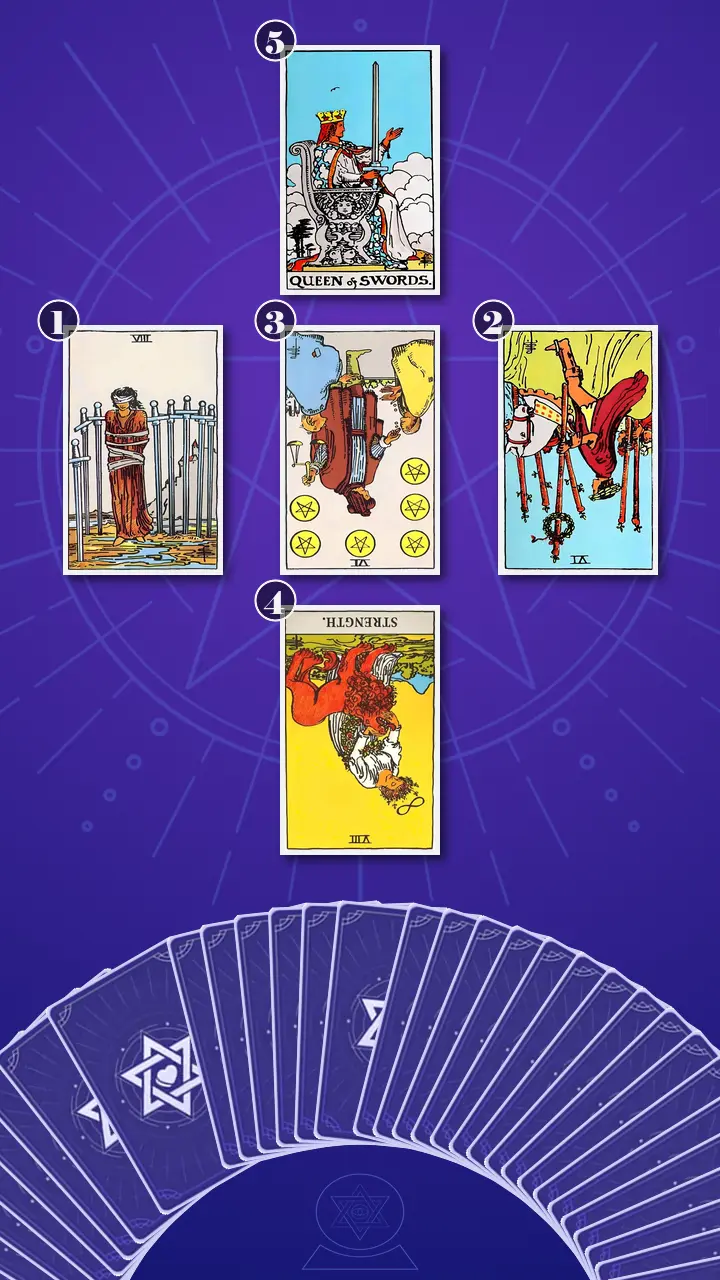
This was the smallest spread that could hold the whole credit dynamic without turning a focused question into an elaborate ten-card forecast. The first position would show Jordan's current stance at the moment authorship could be clarified. The second would examine observable team-side attribution behaviour, including who spoke, which ownership verbs were used, and whose name entered the recap. The centre would reveal the exchange those two sides were creating together.
The lower card would identify the blockage beneath the repeated silence. The upper card would serve as a bridge toward integration: not a promise that colleagues would become fair, but a self-directed boundary Jordan could choose according to the power and safety context of their workplace. This was a workplace relationship spread for finding clarity, not a verdict about character or destiny.
The Cards Inside the Credit Loop
Position One: Eight of Swords Upright and the Frozen Cursor
I turned over the card representing Jordan's current stance: observable silence, anticipatory defeat, and a narrowed sense of available responses. It was the Eight of Swords, upright.
I showed Jordan the blindfolded figure, the loose red bindings, and the visible opening between the planted swords. Then I brought the image directly into their Tuesday stand-up. Their teammate was presenting the flow Jordan had implemented. The authored pull request remained open on the second monitor. Jordan's hand hovered over Unmute while their mind simulated being dismissed, judged as territorial, or blamed for making the call awkward. Nobody had responded because Jordan had not spoken, but every imagined response already felt final.
“This is Air energy in excess and blockage at the same time,” I explained. “Thought is running at full capacity, but speech cannot move. The blindfold does not mean you are foolish or unaware. It means you are working with incomplete information while fear presents its forecasts as confirmed results. The bindings are real constraints, including hierarchy and workplace consequences, but they are not shown as an airtight enclosure.”
I pointed to the gap in the swords. “A live correction, a meeting-chat sentence, a written recap, or a private manager conversation may not all be equally safe or useful. But they are different options. Right now, your mind is closing them together before you can evaluate them.”
Jordan gave one brief, bitter laugh. “That's so accurate it feels a little cruel.”
“I hear that,” I said. “And I don't read this card as blame. Staying muted protected you from immediate scrutiny. It made sense as a short-term defence. The cost is that the presenter's version entered the public record while your evidence stayed private.”
I asked which feared reaction had already been observable before they chose silence. Jordan looked at the pull-request link they had pasted into our chat, then shook their head. “None of it. I was treating the worst response like it had already happened.”
“Exactly,” I said. “A predicted dismissal is not the same as an observed response.”
Position Two: Six of Wands Reversed and the Demo Visibility Algorithm
I turned over the card representing the observable team-side credit pattern: public language, visibility, and attribution behaviour, without speculation about private motives. It was the Six of Wands, reversed.
The elevated rider and laurel wreath usually evoke visible recognition. Reversed here, that recognition had become detached from the work beneath it. A teammate gave the release demo, used singular “I built” language, and received the Slack applause afterward. Jordan's commits, debugging notes, and implementation ownership remained available in the repository, yet cross-functional colleagues remembered the face and voice from the presentation.
“The demo is acting like an algorithm that ranks presentation visibility above implementation depth,” I said. “Once it associates a feature with the presenter, the next recap recommends the same person as the owner. That does not prove malicious intent. It does give us observable data: singular ownership language, public reactions, missing author names, and a recap that repeats the same account.”
Reversed Fire was unstable here. Recognition was not absent; it was flowing toward the most visible narrator. Jordan's silence did not create that workplace habit, but it removed one piece of information that might have complicated the easy story.
Jordan's jaw shifted. I watched anger rise into their face before they looked down at the card. “They presented it, so everyone remembers that they built it. Even though that's not what the record says.”
“Yes,” I replied. “Visibility is not authorship, even when the meeting confuses the two. We can validate that mismatch without deciding what anyone secretly intended. We also don't need to correct every vague use of 'we' or attach your name to every shared task. We are looking for specific moments when a public claim materially misrepresents ownership.”
Position Three: Six of Pentacles Reversed and the Two-Tab Ledger
I turned over the card representing the shared working dynamic: how Jordan's technical contribution and the team's distribution of recognition combined into code ownership erosion. It was the Six of Pentacles, reversed.
I asked Jordan to imagine the card's scales as two browser tabs. In one tab sat the pull request, Jira history, design notes, review comments, and dozens of commits showing sustained technical ownership. In the other sat the public meeting recap naming only the teammate who presented. Implementation, debugging help, and review labour had moved outward from Jordan, while specific recognition had not returned in proportion.
Looking at the scales, my mind went not to cosmic justice but to a code review: place the two versions beside each other and examine the diff. The mismatch was measurable. It did not need to be reduced to Jordan being oversensitive, and it did not require me to label a teammate's character.
“This is Earth energy in blockage,” I said. “The material record exists, but the exchange between contribution and recognition is unequal. Technical access to contribute is not the same as influence over how that contribution is narrated. The work can be documented and still be socially invisible.”
Jordan's breath caught. Their thumb pressed into the edge of their mug while their gaze moved as if switching between those two remembered tabs. After several seconds, their jaw tightened and then released.
“I keep supplying the work,” they said quietly, “but the visible return goes somewhere else. And then I use the private evidence to reassure myself instead of putting any of it where people are actually forming the story.”
“That is the loop,” I said. “The team's visibility habits create a distorted record, and silence allows that record to stabilise. Naming your part will not make the whole system fair by itself. It can stop private documentation from being the only place where your authorship exists.”
Position Four: Strength Reversed and the Anger That Arrived on the TTC
I turned over the card representing the central challenge beneath the imbalance: learned helplessness, self-doubt, and the prediction that speaking will have no effect. It was Strength, reversed.
I focused on the woman's calm hands beside the lion. Strength is not an image of domination; it is a relationship with protective force. Reversed, that relationship feels inaccessible. Jordan had been suppressing anger during meetings because any use of it seemed dangerously close to aggression.
They described the train ride home after the last demo. At 6:18 p.m. on the southbound TTC, the brakes squealed and their phone reflected against the dark window. They drafted, “Small clarification: I implemented the backend changes.” Then they softened it, expanded it, anticipated objections, and turned two factual clauses into a courtroom brief. By their stop, the useful posting window felt closed, so they deleted everything.
“This is blocked Fire,” I said. “Your anger contains information: something you contributed is being represented inaccurately. But because assertion has become fused with aggression, the only options your nervous system can see are total silence or a dramatic confrontation.”
Through a Jungian lens, I saw the lion as protective energy Jordan had exiled from their professional identity. They wanted to be collaborative, so any forceful feeling appeared incompatible with being a good teammate. The result was not the disappearance of anger. It was delayed anger with no useful channel.
“Calm correction is not a declaration of war,” I said. “Courage can be one proportionate sentence: 'For clarity, I implemented the backend changes, and Casey handled the demo integration.' You do not have to solve the team culture while your cursor is over Unmute. You can clarify one fact.”
Jordan inhaled, held the breath high in their chest, and slowly lowered both shoulders. “I thought speaking up meant being ready for an argument,” they said. “I didn't think of a correction as something ordinary.”
“That ordinary middle option is Strength becoming available,” I replied. “Not louder. Not fearless. Regulated enough to choose.”
When the Queen of Swords Separated Evidence from Fear
Position Five: The Self-Directed Bridge
Through my headphones, I could hear rain ticking against Jordan's Toronto window. Then their apartment radiator clicked off, and the quiet widened around the final card. I turned over the position representing Jordan's self-directed bridge: a concrete boundary and evidence-based communication practice, not a prediction about whether teammates would change.
It was the Queen of Swords, upright.
I held the card close enough for Jordan to see the upright blade in one hand and the open palm in the other. The sword separated evidence from fearful prediction. The open hand preserved direct exchange and acknowledged genuine collaboration. This was balanced Air, thought no longer functioning as an enclosure but becoming concise professional language.
I translated the image into a project update: “For clarity, I implemented the service layer, Morgan completed the interface work, and we reviewed the integration together.” One sentence named Jordan's work, credited a genuine collaborator, and made no accusation about intent. A linked internal pull request could support it without turning the message into a prosecution.
At this point I used one of my core diagnostic tools, Imposter Syndrome Auditing. I divided a note into two columns: objective professional competence and subconscious fear of exposure. The competence column held the authored pull request, merged code, debugging record, review comments, and shipped result. The fear column held predictions that naming any of those facts would expose Jordan as petty, difficult, or less capable than colleagues who claimed space more easily.
The audit revealed a subtle burden. Jordan had been asking one factual sentence to do four impossible jobs: prove their competence, secure everyone's approval, prevent retaliation, and guarantee fair recognition. The facts could only name the scope of their work. This did not turn a structural credit imbalance into a personal mindset problem. It stopped that real imbalance from borrowing the voice of self-doubt.
“You do not need a courtroom case to name a commit,” I said. “You can name what is true without prosecuting anyone.”
I asked Jordan to picture Tuesday again: the pull request open, the cursor resting over Unmute, and their throat tightening while they searched for wording so perfect that nobody could call it petty. I watched the old demand for certainty return to their face before anyone in that remembered meeting had answered.
I distilled the bridge into one sentence: “You do not need proof that speaking will fix the team. You need one factual sentence that stops silence from being the only version entered into the record.”
You do not need a flawless case or guaranteed outcome; name your contribution clearly and let the Queen of Swords' raised blade separate evidence from the fear that speaking is pointless.
For one beat, I saw Jordan's breath stop. Their fingers, which had been worrying the cuff of their sleeve, went completely still. Their pupils widened, and their gaze slipped past the camera as if Tuesday's meeting were replaying on a second monitor. Then their mouth tightened.
“But doesn't that mean I let this happen?” they asked, the words sharper than anything they had said so far. “Doesn't it mean I was wrong every time I stayed quiet?”
“No,” I said. “The unequal recognition shown by the reversed Six of Pentacles remains real. A freeze response is not consent, and recovering a choice now does not make you responsible for other people's inaccurate language then. Agency is not retroactive blame. It is the ability to test a different response from this point forward.”
Jordan's eyes reddened slightly. Their shoulders descended, their hand slowly uncurled, and a long breath left them with a faint tremor. Relief came first, followed by a brief, almost dizzy blankness. I recognised the complexity in it: when a path becomes visible, the old burden can lift while the responsibility of choosing suddenly feels more real.
“Now, with this new perspective, think back to last week,” I invited. “Was there a moment when this insight could have made you feel different?”
Jordan returned to Friday's Slack recap. “I couldn't have controlled whether anyone cared,” they said, their voice quieter but steadier. “But I could have added, 'I implemented the service changes; here's the PR.' Then the inaccurate post wouldn't have been the only record.”
I named the shift clearly. This was not a leap from silence to guaranteed fairness. It was movement from anticipatory defeat and self-silencing to cautious self-trust and grounded professional agency. The Queen of Swords did not promise Jordan control over the team's reaction. She returned control over whether Jordan's own factual voice entered the record.
The Attribution Record Reset
I drew the five cards together into one coherent story. Repeated public omissions had taught Jordan that strong work would not reliably become visible on its own. The Eight of Swords showed the current result: evidence in hand, but predicted dismissal enclosing the available choices. The two reversed Sixes confirmed that the problem was not merely confidence; presentation visibility and recognition distribution were genuinely misaligned. Strength reversed showed how that external pattern had been internalised as distrust in Jordan's ability to affect the record. The Queen of Swords revealed the available resource: precise language joined to evidence, used without apology or accusation.
The team's social search engine had been indexing the loudest demo voice while leaving Jordan's technical authorship below the fold. Jordan's cognitive blind spot was not a failure to collect evidence. It was treating private evidence as though it automatically populated the public account, while treating guaranteed fairness as the admission price for speaking.
The transformation direction was therefore specific: move from waiting for a clean moment and a guaranteed response to making one calm, evidence-based ownership statement when credit is assigned. Jordan could still acknowledge shared effort. They could still choose a private channel when hierarchy or retaliation made a public correction unwise. The change was accurate self-attribution as an ordinary part of collaboration.
- The One-Sentence Ownership Test Before the next stand-up, Jordan will set a timer for no more than 10 minutes in an approved company notes tool and complete: “For clarity, I implemented ___, ___ handled ___, and we collaborated on ___.” They will add one internal pull-request or ticket link. If authorship is stated inaccurately, they can say it aloud, paste it into the meeting chat, or post a two-sentence recap in the existing project channel within one working day. Afterward, they will record “What I predicted” and “What occurred,” using only observable facts in the second column. Tip: Stop after one sentence and one link. If the full version makes the throat or shoulders contract, use the minimum clause, “I implemented the service-layer changes.” A private manager channel is valid when the public option feels unsafe.
- The Competence Anchoring Exercise For five minutes on Friday, Jordan will create one row in an approved internal contribution log with three fields: “Outcome,” “My contribution,” and “Evidence link.” They will use a direct verb such as “implemented,” “designed,” “debugged,” or “reviewed.” Once two entries exist, Jordan will bring them to the next one-to-one and ask for those specific outcomes to appear in the written performance record. Tip: Give the log a destination so it does not become another private evidence archive. One feature and five minutes are enough to begin; keep confidential work inside approved systems and access controls.
I reminded Jordan that neither practice required them to correct every imprecise phrase or take a high-risk stand in a large meeting. Small-step testing is not passivity. It is how they could gather real information about channels, responses, and bodily reactions without turning one attempt into a verdict on their entire career.

Six Days Later, the Sentence Was Still There
Six days later, I received a short message from Jordan. They had not managed to unmute during the next demo. When the familiar freeze arrived, they chose the lowest step on their boundary ladder and pasted a prepared line into the project chat: “For clarity, I implemented the service layer, Morgan handled the interface updates, and we reviewed the integration together. PR linked here.”
The original presenter replied, “Yep, thanks for clarifying,” and Jordan's manager carried the contribution map into the weekly written update. That response was useful, but I did not treat it as proof that every future attribution problem was solved. The more important evidence was that Jordan had interrupted the old sequence: trigger, prediction, silence, private anger, resignation.
Jordan told me their stomach still dropped after they pressed Send. They slept through the night, but their first thought the next morning was still, “What if they think I'm difficult?” This time, they smiled at the thought, opened the project thread, and saw their factual sentence still there.
I saw that as the first quiet proof of the journey to clarity. Tarot had not spoken for Jordan or changed the team by magic. It had made the loop visible, separated structural inequity from self-doubt, and helped Jordan identify a response small enough to test. Jordan supplied the courage, the judgment, and the sentence.
When your throat closes over one factual statement while the pull request proving your work sits open beside the meeting, the hardest part may not be losing credit alone. It may be fearing that speaking and still being ignored would confirm that you never had influence over the record. I hope you remember that noticing this fear already begins to separate it from fact.
If you did not need to guarantee anyone's reaction, what is the smallest true Queen of Swords sentence you might allow into the record next time?