Career Learned Helplessness: From Prediction to One Small Test

Seven Tabs and the Weight of Career Learned Helplessness
If your Indeed or LinkedIn Saved Jobs page is full of roles that expired before you applied, the trigger may not be a lack of ambition. It may be the moment one familiar requirement makes disappointment feel pre-confirmed.
Jordan (name changed for privacy) was 29 and working in customer operations when they joined my video call from a shared west-end Toronto apartment at 9:40 on a Tuesday night. Seven job tabs sat open beside an unfinished resume. I could hear the radiator ticking through their microphone, and when Jordan lifted a cold mug, smelled it, and winced, I knew the coffee had been sitting there almost as long as the applications.
The laptop fan pushed warm air across their wrists. Then one listing offered the familiar line, “thrives in a fast-paced environment.” I watched Jordan's shoulders sink and their jaw set. One by one, they closed the tabs and reopened the queue for the next day's shift.
“Every job looks different until you're trapped inside it,” they said. “I know this role is going nowhere, but applying somewhere else feels like volunteering to be disappointed again. Why do I keep staying in dead-end jobs when change feels pointless?”
I recognized a pattern often described as career learned helplessness, but I did not treat that phrase as a diagnosis or a verdict. I saw it in the observable loop: Jordan opened a possibility, predicted its ending from previous disappointments, withdrew before gathering evidence, and then used the absence of new evidence to confirm that nothing could change.
Their resignation did not look like laziness. It looked like wet concrete slowly setting across their shoulders, heavy enough to make even a browser tab feel like a door requiring both hands to open. They wanted a working life with growth, but the moment a familiar phrase appeared, the worst month of an old job became a rule about every future role. For that night, predictable disappointment felt safer than another uncertain attempt.
“I am not going to tell you to just quit, take a reckless risk, or believe that a perfect job is waiting,” I said. “Your rent and financial boundaries are real. What we can do is separate what is structurally fixed from what has only been predicted. Let's draw a map through the fog and look for one place where your choices can create information.”

Choosing the Switchback Map
I asked Jordan to place both feet on the floor, take one unforced breath, and hold the question without trying to make it sound more optimistic. I shuffled slowly. I use that pause as a change of cognitive gear, not as a performance of mystery: it marks the point where scattered thoughts become one question we can examine.
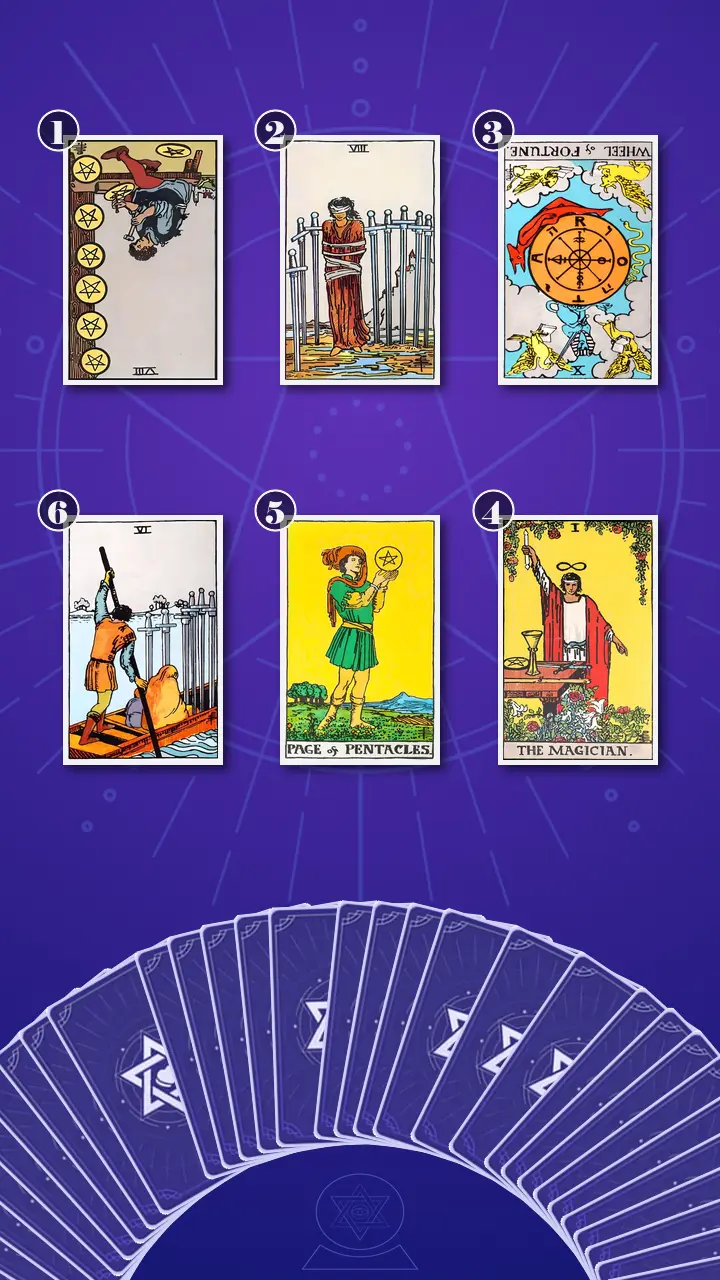
I chose the Transformation Path Grid · Context Edition, a six-card career tarot spread arranged in a 2x3 grid. I tilted my camera so Jordan could see the top row forming the diagnostic path and the bottom row forming the intervention and integration path.
I chose this spread because Jordan's problem was not simply a choice between Job A and Job B. It was a feedback loop. Repetitive work had produced a belief that effort could not change the outcome; that belief prevented experiments; and the absence of experiments preserved the belief. A broad spread could have wandered into unrelated areas, while a short linear reading might have made the problem look simpler than it was. This grid gave me six distinct functions: visible repetition, immediate restriction, the root cycle, an agency lever, a practical test, and a way to integrate the result.
I explained the switchback route. The first card would show the observable dead-end job pattern. The second would identify the belief blocking movement. The third would expose what kept the cycle turning. Directly beneath that root, the fourth card would reveal the smallest point of influence capable of changing direction. The fifth would translate that influence into one bounded career experiment, and the sixth would show how to navigate a gradual transition without pretending uncertainty had disappeared.
This is how I understand tarot at its most useful: the cards do not decide which employer will hire Jordan or predict that every risk will work out. They externalize a pattern so I can compare symbols with behavior, assumptions with evidence, and fear with the choices still available. The reading offers a map. Jordan retains the steering wheel.
Reading the Loop Before Trying to Escape It
Position 1: Productivity Without Progress
The first card I turned represented the present state: the observable pattern of repeated output continuing without meaningful learning, ownership, or progression. It was the Eight of Pentacles, reversed.
I pointed to the row of nearly identical pentacles and the solitary craftsperson at the bench. Upright, this card can depict skill deepening through intentional practice. Reversed, the rhythm had become mechanical. I read both an excess and a deficiency in its Earth energy: an excess of measurable output, but a deficiency of growth-directed attention.
I linked it to the scene Jordan had described from 5:38 the previous Thursday. They had cleared their eighty-sixth customer case, watched the green completion counter rise, and closed the laptop without recording the escalation pattern they had spotted or the colleague they had helped. Plenty of labor had occurred. So had pattern recognition, de-escalation, prioritization, and informal coaching. None of it had been collected as transferable career evidence.
“It is like completing the same level of a game all day without unlocking a new skill,” I said. “The dashboard can prove you worked, but it cannot tell you whether the work is developing you. Then the inner line becomes, 'I worked all day, so why do I have nothing I can name?'”
Jordan gave one short laugh, but there was no amusement in it. Their fingers tightened around the mug before loosening again. “That is too accurate,” they said. “Kind of brutal.”
“The situation may be brutal,” I replied, “but the card is not accusing you. You are not short on effort; your effort has been trapped in repetition. That distinction matters because it means the problem is not a character flaw. Some of the evidence you need may already exist inside work you have been trained to dismiss as meaningless.”
I asked what they had done that week that required judgment rather than repetition. Jordan looked away from the screen, then mentioned noticing that one category of complaint kept escalating after the same confusing template was sent. They had flagged it to a team lead. I wrote that down. The first card had not created a new skill; it had made an overlooked one visible.
Position 2: The Tab That Closed Before the Question Was Asked
The next card I turned represented the immediate blockage: the learned-helplessness belief that anticipated disappointment was enough reason not to test another option. It was the Eight of Swords, upright.
I drew Jordan's attention to the blindfold, the loose bindings, and the incomplete enclosure of swords. I did not tell them that every career option was secretly open. That would have ignored rent, hiring conditions, exhaustion, and genuine red flags. I told them the card was asking a more precise question: which constraint had been documented, and which ending had been supplied by negative forecasting?
Jordan had opened an operations coordinator listing, seen “reporting experience preferred,” and immediately imagined rejection followed by another disguised service queue. Their jaw had tightened before they reached the training section. Closing the tab brought immediate relief, which made withdrawal feel like realism rather than avoidance.
I read the card as Air in excess and movement in deficiency. Thought had stopped functioning as inquiry and become an enclosure. Past experience was acting like a recommendation algorithm trained only on roles Jordan already distrusted. Every pre-emptive rejection told that private algorithm, “Show me more evidence that nothing is different.”
This was where I used my Shadow Path Analysis. I traced the fear-based logic without judging the protection it had once offered: “If I reject the role first, the employer cannot reject me. If I never test whether it is different, I cannot discover that my effort failed again. If I stay with the known disappointment, I do not have to face the more frightening possibility that I cannot control the outcome.”
Jordan's breathing became shallow enough that I could see the pause between their sentences. I slowed my voice. “Prediction can feel like protection when disappointment has become familiar. I am not asking you to ignore warning signs. I am asking whether a prediction deserves to be labeled as evidence before you have asked one question.”
I asked Jordan to name one fixed restriction and one untested conclusion. They answered quickly: “I cannot afford an employment gap. That is fixed. The idea that an application means I will end up in the same job again... I guess that is a conclusion.” Their chest rose in a longer breath. The opening between the swords was not an impulsive resignation letter. It was the right to investigate without committing.
Position 3: Different Logos, the Same Wheel
The third card I turned represented the underlying root: the repeated selection pattern that had turned several similar work experiences into a conclusion about all future work. It was the Wheel of Fortune, reversed.
I asked Jordan to picture the last three employers as a Groundhog Day montage: different logos, onboarding portals, Slack workspaces, and job titles, followed by the same queue metrics, scripted workflows, vague training, and unclear progression. The recurrence was real. I would not insult Jordan by pretending otherwise. The question was whether recurrence had to function as a verdict.
The reversed Wheel showed cyclical energy in blockage. Jordan had changed employers, but predictability, immediate competence, and familiar duties had remained the safest selection filters. Those filters made sense for someone with little financial buffer and depleted energy. They also kept supplying the wheel with similar structural inputs.
Looking at the card, I remembered transit maps I had studied while traveling across cultures. A station name can change, but if I keep boarding by the rule “take only the line I already know,” my range remains narrow. In Jungian terms, the persona of the dependable, immediately competent worker had protected Jordan. It had also made beginnerhood feel dangerously close to failure.
“A repeated outcome is data about a pattern, not a law about your future,” I said. “If we compare the roles by autonomy, learning, manager support, and progression, the repetition can give you selection criteria. It does not have to sentence you to another repetition.”
Jordan stopped moving. Their gaze shifted beyond the laptop as if three old contracts had appeared on the wall. After several seconds, they said, “I kept choosing jobs where I already knew I could hit the numbers. I thought that was being sensible. But none of them could explain what growth actually meant.”
I heard both recognition and grief in that sentence. I did not rush to turn it into a triumph. The old strategy had protected Jordan from unemployment and the discomfort of starting over. It simply could not provide the growth they were now asking it to produce.
When the Magician Put Agency Back on the Table
Position 4: One Tool That Can Change the Evidence
The radiator clicked off on Jordan's side of the call, and the room became unexpectedly quiet. I turned the card positioned directly beneath the reversed Wheel. It represented the transformative trigger: the smallest point of personal agency capable of interrupting the cycle. It was The Magician, upright, the key card of the reading.
I emphasized the four suit tools arranged on the Magician's table and the gesture connecting intention with practical action. I translated the table into Jordan's apartment: a current resume, a note of transferable skills, four growth criteria, and one 20-minute calendar block. The card brought Fire, Water, Air, and Earth into balance: initiative, authentic desire, a better question, and a concrete action.
I then used my Authentic Desire Decoding lens. I asked Jordan to strip away the borrowed career expectations that had gathered around the problem: the LinkedIn-shaped belief that they should already have an impressive title at 29, the internet fantasy that a valid pivot must look dramatic, and the defensive demand that a new role must appear completely different before it deserves investigation.
“Under those 'shoulds,' what do you actually desire from work in observable terms?” I asked.
Jordan answered more slowly than before. “I want to own a problem instead of only clearing it. I want to learn something I can still use in two years. I want a manager who can show me what progression has looked like for a real person. And I do not want to blow up my income to prove I am brave.”
I brought us back to 9:40 p.m.: seven tabs beside the unfinished resume, one phrase making every role look pre-disappointing, shoulders dropping as tomorrow's familiar queue felt safer. Jordan had been demanding knowledge of the entire ending before permitting one test to begin.
You do not need proof that the whole career path will work; place one existing skill on the Magician's table and use it in one test that can produce new evidence.
I let the sentence remain between us without explaining it away.
Jordan's breath stopped first. Their fingers hovered over the trackpad, motionless, while their eyes lost focus as if the last several months of expired listings were replaying behind the screen. Then their brows pulled together. “But doesn't that mean I have been wrong this whole time?” they asked, sharper than they had spoken all evening. Their anger arrived before relief, and I respected it. I told them no: the withdrawal had been an understandable attempt to prevent another disappointment, not proof of foolishness. It had become costly because it was still using old evidence to decide which new evidence could exist. Jordan looked down. Their fist slowly opened against the table; their shoulders lowered, and moisture gathered at the edge of one eye before they released a trembling breath. The relief was visible, but so was the brief dizziness of responsibility that came with discovering a choice where they had expected a verdict.
“Now, with this new perspective, think back to last week,” I said. “Was there a moment when this insight might have made you feel different?”
Jordan remembered the operations coordinator listing. “I could have asked whether reporting was taught in the role instead of deciding 'preferred' meant 'do not apply,'” they said. “That would not have guaranteed anything. It just would have given me an answer.”
I set a timer for 10 minutes and asked Jordan to open one blank note. I gave them a single unfinished sentence: “One thing I do at work that another team could use is...” I asked them not to polish it, rewrite the full resume, or open a course catalogue. Saving one rough line would count, and they could stop earlier if the exercise became too heavy.
Jordan typed: “I identify repeat escalation patterns and flag process changes before they affect more customers.” Seven browser tabs had collapsed into one document and one better question: could that pattern-spotting experience transfer into operations analysis?
“Agency is not a guaranteed result; it is the ability to design the next test,” I said. The shift was small but unmistakable. I was watching numb resignation loosen into cautious curiosity, not because The Magician had promised an outcome, but because Jordan had used an existing resource to create evidence their old conclusion did not contain.
One Pentacle, Then One TTC Connection
Position 5: The One-Application Evidence Test
The fifth card I turned represented practical action: one bounded career experiment that could create information without requiring an irreversible leap. It was the Page of Pentacles, upright.
I showed Jordan how the Page studied one pentacle with sustained attention. That single object contrasted with the repeated pentacles in the first card. The answer was not more frantic scrolling, seven simultaneous applications, or a stack of courses selected in one burst of frustration. Earth energy was now balanced through deliberate focus.
I translated the image into one adjacent role, one transferable skill, and one controlled test. Jordan could tailor one resume bullet for a junior workforce analyst or operations coordinator role, submit one application or ask one former colleague a focused question, and then record what the attempt revealed. The experiment would succeed if it produced practice, clearer criteria, or a more accurate question. An offer was one possible result, not the only valid one.
“One application can be an experiment without becoming a verdict,” I said. “You are not applying to prove your worth or rescue your whole career. You are testing whether a skill you already use has value in an adjacent context.”
Jordan nodded, then caught themselves. “I can feel myself wanting to research ten job families before I pick one.”
“That is the old protection changing outfits,” I replied. “Choose one role hypothesis. Cap the test. Let one result teach you what the next test needs.” Their mouth tilted into a tired, slightly reluctant smile. The Page did not ask them to perform as someone with a perfect career plan. It gave them permission to become a practical beginner.
Position 6: Doubt Becomes Cargo, Not the Captain
The final card I turned represented integration: the capacity for a gradual, criteria-led transition to replace both passive staying and impulsive escape. It was the Six of Swords, upright.
I pointed to the boat crossing between two shores, the person steering, and the six swords still carried upright inside the vessel. Previous disappointments had not vanished. Neither had Jordan's financial boundaries or fear of another repetitive role. The card's promise was more modest and more useful: those experiences could travel as organized information without controlling the destination.
I connected the card to a simple comparison sheet for autonomy, learning, manager support, and progression. Jordan could test roles one at a time, ask employers for concrete examples, review the evidence, and adjust the route while keeping their current income. An application was not consent to accept an offer. An informational conversation was not a commitment. Jordan could withdraw from any process that failed their criteria.
Air, which had formed a static enclosure in the Eight of Swords, was now directional thought. I described it as taking one TTC connection at a time instead of demanding a delay-free map of an entire future. A service alert could change the route without proving that movement itself was pointless.
Jordan leaned back for the first time that evening. “So I do not have to get rid of the thought that it could go badly?”
“No,” I said. “You can carry that thought as a warning to ask better questions. It just does not get to steer.”
The six-card sequence had changed the function of Jordan's doubt. In the Eight of Swords, difficult thoughts surrounded and immobilized them. In the Six of Swords, the same lessons traveled inside a boat whose direction could be reviewed. I did not see perfect confidence. I saw the first grounded willingness to navigate.
From Prediction to Evidence
I drew the whole reading together. The Eight of Pentacles reversed showed why Jordan could work hard and still feel they had nothing usable to show for it: their effort was feeding repetitive output instead of recorded development. The Eight of Swords showed how anticipated disappointment turned into a barrier before inquiry began. The reversed Wheel revealed why different employers kept producing familiar outcomes: the titles had changed, but low-risk selection criteria and low-autonomy structures had repeated.
The Magician did not ask Jordan to overpower the labor market or guarantee a successful pivot. It identified the leverage point inside the loop: one existing skill, one honest desire, one evidence-seeking question, and one scheduled action. The Page of Pentacles lowered the stakes to a practical learning experiment. The Six of Swords made transition gradual, financially bounded, and open to revision.
I named the cognitive blind spot plainly. Jordan had been treating past disappointment as proof about every future job while searching for an option so obviously different that no uncertainty could remain. That standard prevented them from gathering the very evidence needed to distinguish a genuine opportunity from another repackaged queue. It was like walking the same office corridor because every exit was assumed to lead back inside, then taking the untested exits as proof that the building had none.
The transformation direction was not from caution to recklessness. It was from prediction to inquiry, and from a single imagined career leap to testable next steps. I offered three actions, each small enough to complete while Jordan remained employed.
- Recover One Transferable Skill Before the end of one workday this week, use a phone note to record one non-routine problem you handled, what you did, and what changed. At home or in a library, set a 10-minute timer and turn it into one rough resume bullet using “action + problem + observable result.” Tip: Stop after one bullet. Do not turn the exercise into a full resume rewrite or a late-night course search. Saving rough language counts.
- Run the Three-Day Persona Detox For five minutes after dinner on three consecutive days, divide a page in two. On day one, write what LinkedIn, family expectations, or career culture says you should want. On day two, record the work conditions that actually drain or engage you. On day three, convert the difference into one non-negotiable growth criterion and one employer question. Tip: This is not a search for a perfect calling. Use observable criteria such as autonomy, protected learning time, manager support, or documented progression.
- Complete One Bounded Career Experiment Choose one adjacent role this week, tailor the recovered bullet, and submit one application within a pre-set 25-minute window. Alternatively, send one trusted former colleague a two-sentence message asking what creates real learning or ownership in their current role. Afterward, record: what I expected, what happened, and what I would change next time. Tip: One role, one application or conversation, and one learning note. No reply is data about this attempt, not a verdict on your worth or future. Applying does not obligate you to leave your current job or accept an offer.
I asked Jordan to choose the smallest version, not the most impressive one. They chose the 10-minute resume bullet first and scheduled the one-application test for Saturday morning at the library. The decision remained theirs. The cards had clarified the mechanism and exposed a leverage point; Jordan was the person deciding whether, when, and how to use it.

Six Days Later, the Quiet Proof
Six days later, Jordan messaged me: the bullet was saved, one application was sent, and they had slept through the night. Their first thought that morning was, “What if I'm wrong?” Then they wrote, “I smiled. It was one test, not my whole life.”
I did not read that message as evidence that Jordan's career had been solved. I read it as the first observable movement from numb resignation and fear-driven forecasting toward cautious curiosity and grounded career agency. The hiring result was still outside their control. Designing a useful test, protecting their boundaries, and learning from it were not.
That was the clarity I saw emerge through the Journey to Clarity: not certainty about the far shore, but a steadier hand on the route. Tarot had not opened a magical door. It had helped Jordan distinguish the known weight of a low-growth job from the untested assumption that every unknown door led back to the same corridor.
If wanting out makes your chest tighten because another failed attempt could feel like proof that you have no control, I hope you remember Jordan's ordinary Magician table. Noticing that the known weight feels safer than the unknown door does not mean you are still at the beginning. It means you can finally see the protection and the price at the same time.
If this week's move did not have to prove your whole future, which one tool could you place on your own Magician's table to gather one small piece of career evidence?