Still Choosing, Still Stuck?

Explore this decision loop through grounded struggle language, matching tarot cards, and tarot reading insights from similar readings.

Repetitive Decision Loop
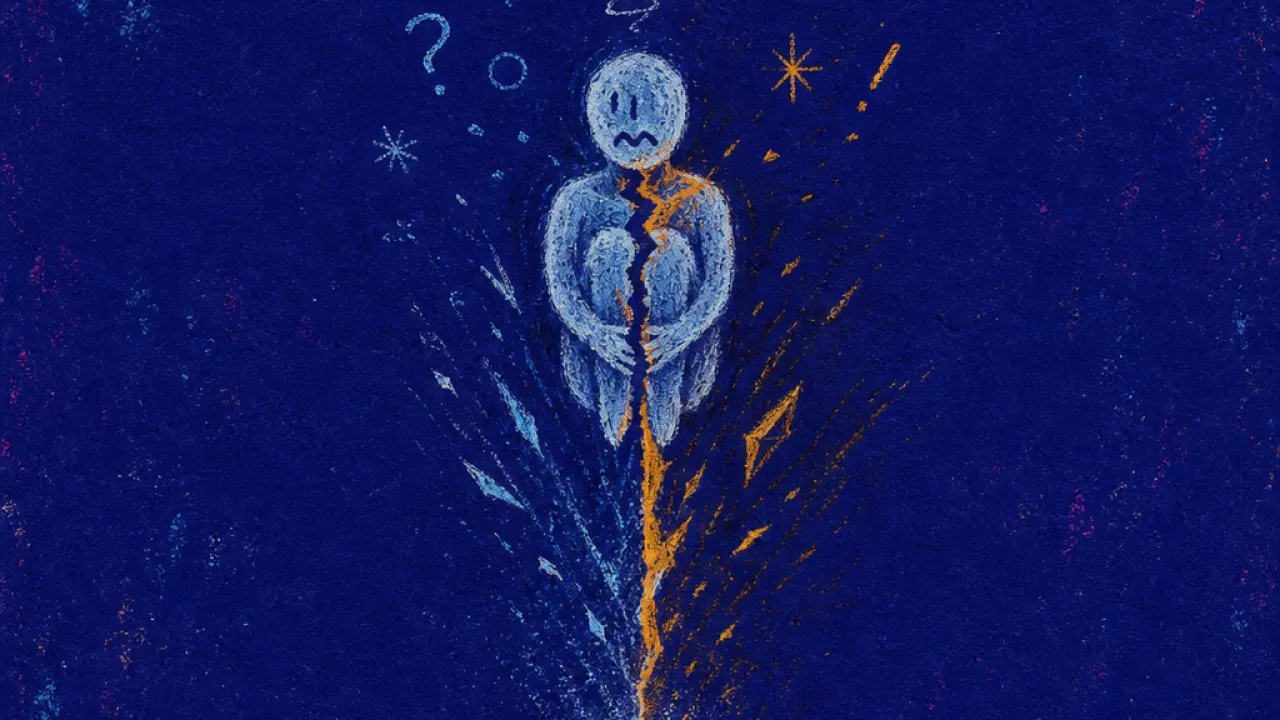
A suspended figure above a glowing phone and crossed drafts, amber lines looping through cold blue darkness

What does this feel like?

Repetitive Decision Loop is what it feels like when a choice keeps reopening inside you long after you thought you had already looked at every angle. You are standing in the kitchen with your phone in one hand, a half-written message glowing on the screen, and you can feel the whole day narrowing down to whether you send it, rewrite it, wait until morning, or say nothing at all. Nothing dramatic is happening from the outside, but inside your body every option has a cost: your throat tightens around the words you might regret, your stomach drops at the thought of choosing wrong, and your shoulders pull in as if you could make yourself smaller than the decision. You tell yourself you're just being careful, just checking one more detail, just making sure you haven't missed something obvious, but the checking starts to feel less like clarity and more like walking the same hallway with different lighting. You ask a friend, then ask another, then search the same question with slightly different wording, and each answer helps for about three minutes before the doubt finds a new doorway. The hardest part is that every version of the choice feels like it might reveal something permanent about you: whether you're brave or careless, loyal or avoidant, practical or trapped, the kind of person who knows what they want or the kind who needs permission to want anything. So you stay in the in-between, not because you have no preferences, but because choosing would collapse all the other possible selves you were still quietly keeping alive. Over time, the loop takes payment in attention, sleep, appetite, and the small private trust that you can move through your own life without cross-examining every step. It is a strangely silent kind of stuckness, much like the figure on the Two of Swords, seated under a pale sky with both blades crossed, holding still because lowering either one would finally make the choice real.

What's pulling at you?

You're not stuck because you don't know how to choose; you're stuck because you want a decision that comes with no future regret, no lost option, and no version of you that gets questioned later. The pull is between wanting freedom to move and wanting certainty strong enough to make movement feel safe. So the same choice keeps circling back, not as new information, but as the cost of trying to make an uncertain life behave like a clean answer key.

How It Shows Up?

  • You open the same comparison tab for the fifth time, even though you already know the prices, the reviews, the delivery dates, and the tiny downside hiding in each option. Your eyes start skimming instead of reading, your neck stiffens, and your thumb keeps flicking between pages as if one more scroll will make the right answer glow. The screen feels like a row of cups offering too many possible versions of your future, and for now, it is enough to close one tab without forcing the whole decision tonight.
  • A friend asks, "So what are you thinking?" and you hear yourself start explaining both sides again, carefully, like you're trying to prove you're being fair to every possible outcome. Your throat gets dry halfway through, your face warms, and you notice the small panic of taking up too much space while still not landing anywhere. You can answer with "I don't know yet" without turning the uncertainty into a performance.
  • At work or school, you draft the email, rewrite the first line, check the attachment, change the wording, then save it again instead of sending it. Your shoulders creep upward, your breath gets shallow, and your chest tightens at the exact second your cursor hovers over the button. The pause has the stillness of The Hanged Man, not peaceful, just held in midair, and you are allowed to step away from the screen before deciding what the next click means.
  • You lie in bed replaying a choice that should have been simple: which plan to accept, which message to send, which version of yourself you are about to become if you pick one path and not the other. Your jaw locks, your stomach turns over, and the room feels too quiet, as if the ceiling is waiting for your answer. You do not have to solve tomorrow from under a blanket in the dark.
  • In a group chat, someone asks where everyone wants to go, and you type three different replies, delete them all, then wait for someone else to decide so you can agree without being responsible for the outcome. Your fingers feel tense around the phone, your chest pulls inward, and your smile goes a little flat while the conversation keeps moving around you. Letting someone else choose one low-stakes thing can be neutral information, not a verdict on your ability to choose.

Repetitive Decision Loop in Tarot Cards

Repetitive Decision Loop lives in that exact moment when your cursor hovers over send and your chest tightens, because every option seems to create another version of the problem. From an existential perspective, the structural framework is the pull between wanting enough certainty to move cleanly and knowing that clarity often only arrives after movement. The cards below don't solve the choice for you; they make the shape of the loop visible. Here are the Tarot Cards that tend to mirror this kind of stuckness.

The Lovers
Reversed
Two exposed figures stand beneath an angel, with a mountain separating their ground and different trees rising behind them. Reversed, the relational scene cannot hold desire, values, vulnerability, and practical compatibility in one coherent choice, so the partnership is repeatedly evaluated under shifting criteria. You may keep asking whether love is enough, whether doubt proves misalignment, or whether leaving would betray something real. The loop does not simply reflect mixed feelings; it reflects a decision process that changes the standard each time one answer begins to feel final, preserving both the relationship and the imagined alternative self outside it.
The Chariot
Reversed
A crowned driver appears ready for command, but the black and white sphinxes below him embody drives that have not been integrated into one movement. Reversed, the image exposes a gap between performing control and possessing an internal decision process capable of coordinating contradiction. You may treat each choice as proof of which self is authentic, disciplined, brave, or responsible, making ordinary commitment carry the weight of identity certification. The loop protects multiple possible selves from exclusion, but it also weakens the lived evidence from which a more stable inner authority could develop.
Wheel of Fortune
Reversed
A large wheel dominates the card while figures descend, rise, and hold position around its rim, and four winged witnesses remain fixed in the corners. Reversed, the cyclical mechanism becomes more powerful than any single decision point, so each returning deadline feels familiar without producing accumulated confidence. You may wait for the right moment, panic when it arrives, defer, and then restart the same timing analysis at the next opening. The loop treats every cycle as a fresh trial rather than evidence about the pattern itself, allowing the calendar to change while the action threshold remains structurally identical.
The Hanged Man
Reversed
The suspended figure remains physically held between ground and sky, with a composed face and illuminated head suggesting that stillness once served perception. Reversed, the same stillness becomes a timing trap: the decision waits for a perfect internal signal while the external window continues to change around it. You may revisit whether to act now, tomorrow, or after one more piece of information because no moment feels safe enough to make consequences irreversible. The loop disguises itself as timing sensitivity, yet its operative threshold keeps moving, so waiting cannot produce the certainty it has been assigned to deliver.
Death
Reversed
An armoured skeleton advances on a white horse past a fallen ruler, while other figures meet the procession and sunlight appears between distant towers. Reversed, the irreversible transition is resisted at the threshold, as though prolonged deliberation could preserve the identity, status, and future that change would necessarily end. You may repeatedly reopen a developmental choice because becoming one version of yourself requires relinquishing other possible selves that still feel emotionally alive. The loop protects continuity by delaying the ending, but it also prevents transformation from acquiring a concrete before-and-after boundary through which a new identity could stabilise.
The Devil
Upright
Two figures stand chained to a central pedestal beneath a horned figure, yet the collars are visibly wider than the necks they encircle. The image captures a loop maintained less by physical impossibility than by a compelling belief that one more comparison, reassurance check, or mental bargain might finally provide release. You may recognise that the checking no longer produces clarity and still feel pulled back to it when uncertainty rises. The loop offers brief relief by postponing commitment, then uses the return of doubt as proof that another round is necessary, making reassurance function like a short-lived permission token rather than durable self-trust.
The Moon
Upright
Moonlight illuminates the path unevenly, while the domesticated dog, the wild wolf, and the creature rising from the water register different layers of alarm. The image holds perception, instinct, and uncertainty in the same field without giving any one of them final interpretive authority. You may replay a choice most intensely when external noise recedes and every feeling can be interrogated as either intuition or fear. The loop forms when your inner state is required to deliver a clean verdict, causing each fluctuation in mood to reopen evidence that had already been considered.
Judgement
Reversed
Figures rise from rigid containers in response to a trumpet that calls them into a changed state. Reversed, the threshold remains cognitively active but behaviourally unanswered because the decision has been burdened with proving which version of the self is finally legitimate. You may repeatedly audit motives, values, and future consequences in the hope of producing an identity verdict that cannot later be challenged. That standard prevents development from being iterative; instead of learning who you become through action, the loop requires a completed self-definition before action may begin.
Seven of Cups
Upright
Seven cups hover in a cloud before a figure who can inspect every possible reward and danger but cannot occupy any of them from where he stands. The scene resembles a career comparison conducted entirely through projections: title, security, status, creative identity, and hidden cost remain simultaneously compelling. You may cycle through job listings, training routes, or stay-versus-leave calculations because each path is carrying more than a practical function; it is also carrying a possible identity. Repeated research can refine the fantasy without testing the work itself, leaving career movement blocked by an option set that grows more symbolic each time it is reviewed.
Eight of Cups
Reversed
The cloaked traveller faces away from a structured row of cups, yet the moon darkens the path and the arrangement retains a conspicuous opening. Reversed, the attempted departure folds back toward the relationship, converting goodbye into another round of interpretation, contact, or conditional hope. You may decide to leave, miss the bond, and then re-litigate whether the relationship was truly unworkable or merely unfinished. The loop preserves attachment and possible repair at the cost of closure, making each return feel like new evidence even when the underlying relational conditions have not changed.
Two of Pentacles
Reversed
Two pentacles travel around the juggler's hands inside a closed figure-eight while distant ships rise and fall with the waves. Reversed, the loop no longer depicts responsive balance; it exposes a study system in which every deadline, assignment, and revision can be moved, but none can be granted decisive priority. You may reopen the same planning document, switch subjects, or check completed work once more because starting or submitting one task makes the neglected alternatives feel newly dangerous. The resulting motion is real, yet it does not reliably produce learning or output, and the loop takes payment through shallow concentration and deadline pressure.
Two of Swords
Upright
Two blades cross directly over the figure's chest while a blindfold prevents her from checking the relational landscape behind her. The posture turns stillness into active containment: neither the message nor the silence can be allowed to expose the friendship to an irreversible response. You may draft, delete, ask another friend, and reopen the question because speaking could alter the bond while saying nothing also carries a cost. The loop maintains an imagined version of the friendship in which every response remains possible, but it prevents the relationship from producing the reciprocal information needed for a grounded decision.
Eight of Swords
Upright
The bound figure cannot see the full spacing between the swords, and the distant stronghold offers no immediate correction to her narrowed field. Her body carries a cognitive system in which threat assumptions have become the architecture through which every possible move is interpreted. You may cross-examine a decision until preferences are no longer distinguishable from fear, obligation, or anticipated criticism. The loop is sustained by self-protective rules that present themselves as neutral analysis, leaving your internal authority surrounded by arguments it created but no longer recognises as revisable.
Nine of Swords
Upright
A figure sits upright in bed with both hands covering the face while nine swords form an unbroken row across the dark wall. The horizontal blades resemble thoughts given identical visual weight, allowing regret, prediction, and self-accusation to crowd the same sleepless field. You may replay a choice at night because the absence of action and feedback lets every feared future present itself as evidence. The loop converts rest into retrospective prosecution: each imagined mistake demands another review, but the review occurs in conditions least able to produce proportionate judgment or new information.

Repetitive Decision Loop in Tarot Card Reading Insights

When Repetitive Decision Loop turns one choice into a nightly replay, other people have brought that same stuck feeling into readings too. The shift from the cards to the readings shows how this loop can appear when someone asks for clarity without handing over the decision itself. Tarot Reading Insights connected to this pattern are gathered below.
Psychological Struggles Related to Repetitive Decision Loop