Practical or Obedient? Tarot Separates Family Support from Authority

The Draft That Would Not Become a Door
I have seen this before: you keep a course application in draft while asking which route your family will fund, then call the delay research as Comparison Fatigue tightens your chest and clenches your jaw. That is career pivot anxiety at a Toronto career crossroads, where family-funded education and authorship begin sharing the same spreadsheet.
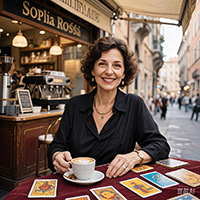
Maya (name changed for privacy) was 26, working an entry-level role linked to a degree her family had helped finance. She sat across from me at my Toronto table, where the warm aroma of coffee met the rain on her coat.
She told me that at 9:12 p.m. on Tuesday, she had switched between a Google Sheets budget, a course page, and a family message thread in her apartment kitchen. The kettle clicked off, the laptop fan hummed, and she closed the application without submitting it; the relief of making no decision sat beside a jaw ache and a resentment she did not want to call by its name.
“I can cover ordinary life, but not the risk of making one wrong choice,” she said. “I cannot tell whether I am being practical or just obedient. If the money disappears, will the choice still feel like mine?” Her question sounded financial but reached identity: “What am I giving up by letting family resources decide my path?”
I could see the conflict moving through her like someone trying to hold two TTC train doors open with one shoulder while the warning chime kept sounding: one side said choose my own path, and the other said do not give up family resources. Gratitude pressed against resentment; fear sat in the pause before every money conversation.
“You are allowed to want support and still want authorship,” I told her. “You call it practical, but your body registers a negotiation. We will not ask the cards to predict your family’s reaction or choose your future. We will use them as a clear map of facts, assumptions, values, and experiments. This Journey to Clarity is about finding a next step that keeps you materially safe and in the driver’s seat.”

The Six-Position Four-Layer Insight Ladder at the Locked Gate
I asked Maya to put both feet on the floor, take three unhurried breaths, and state the question in one sentence. I shuffled slowly while she focused on the difference between wanting to test a path and needing to preserve a resource. The pause was psychological, not supernatural: a clean transition from scrolling and calculating to looking carefully.
For this question, I chose the Four-Layer Insight Ladder · Context Edition, a six-position tarot spread designed to move from a visible behavior to the hidden bargain beneath it, then toward integration and a practical experiment. I chose it because Maya was not asking me to rank two named careers. She was asking what gets surrendered when family resources gate a path.
If you are wondering how tarot works in a reading like this, I use card meanings in context as a cognitive map, not a verdict. A broad Celtic Cross would have added more situational detail than the question needed. This smaller ladder kept the useful arc visible: the first position would show the presenting suspension, the second the external resource gate, and the third the binding shadow pattern. The lower row would identify the psychological cost, the values-based bridge, and one grounded next step.
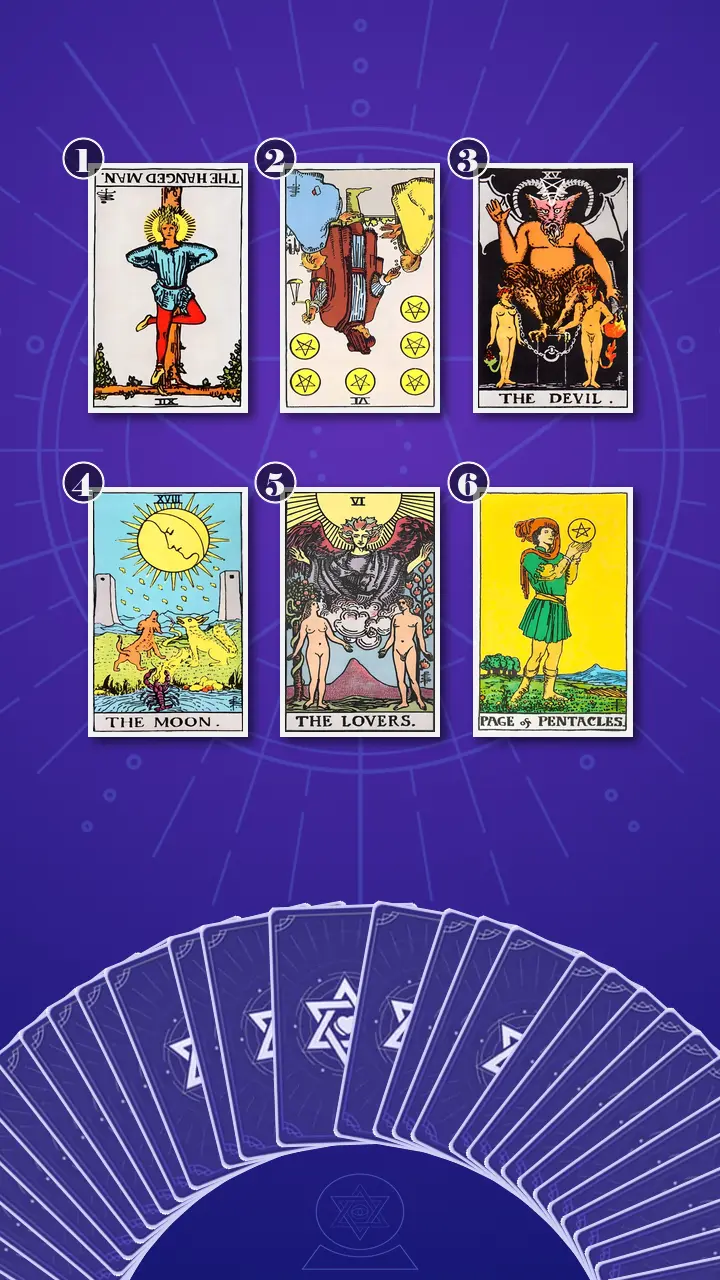
I placed the six cards in two rows of three. The upper row moved from observable waiting through practical support to the internal bargain. The lower row moved from fog toward a deliberate choice and then a modest, reversible test. Position five sat in the visual center because the reading needed a bridge, not a command to choose family connection or independence as an absolute identity.
Reading the Fine Print in Six Cards
The Suspended Draft: Presenting Suspension
Position 1 uses the present condition or conscious experience being examined. Its role here was presenting suspension: revealing the observable habit of keeping career and education plans provisional, delaying applications, and waiting for enough family approval or financial certainty to act.
I turned over The Hanged Man, in reversed position.
The bound leg and inverted posture made the problem visible: Maya’s preference was present, but movement felt attached to someone else’s permission. In the present, she had a budget spreadsheet, three course tabs, and a draft application open after work, yet she kept waiting for a family conversation to make one desire financially legitimate. The familiar language of drafts made the image painfully current: the life decision existed, but never became sendable.
Reversed, the Hanged Man showed a blockage and an excess of suspension. Reflection had stopped producing perspective and started protecting Maya from the first real test. Each postponed application gave immediate relief from conflict, which taught her nervous system that waiting was safer than learning. I also noted the overcorrection risk: autonomy did not require a sudden announcement or the rejection of viable help before she had priced the consequences.
This is where I use a lens I call Analysis Paralysis Deconstruction. I strip away the abstract what-ifs and focus strictly on grounded realities and immediate constraints. What was the next fee, conversation, or hour of work? What had to be true before she could test one option? A 30-minute comparison limit could give the pause a job and an ending.
Maya gave a short, bitter laugh instead of nodding. “That’s too accurate. Almost cruel.” I did not rush to turn it into a compliment. Her breath paused high in her chest, and her index finger hovered over the edge of the card. Then her gaze went past me, unfocused, as if replaying the unsent application and the family thread. Finally, she released a long breath, and her shoulders dropped a fraction.
“Maybe I am waiting for permission and calling it research,” she said. I wrote that sentence beside the card. It was not a verdict about her character; it was a useful description of the loop. “Let’s give the pause a boundary,” I replied. “Compare for 30 minutes, record the preference that remains, and take one practical information-gathering step before asking anyone else whether the preference makes sense.”
The Offer with Missing Fine Print: The External Resource Gate
Position 2 uses the surrounding influence, practical context, or external condition shaping the available room to move. Its role was the external resource gate: showing how family support could shape access to tuition, rent, housing, or professional contacts, and how unclear terms could affect perceived choice.
I turned over The Six of Pentacles, in reversed position.
The raised hand, the scales, and the two kneeling recipients translated into a family text, transfer, or housing offer whose generosity could also shape the route that felt available. A relative had offered to help with rent or tuition if Maya stayed close to a secure professional path. The offer might be caring and still create an uneven structure. The missing pieces were amount, duration, and condition.
Reversed, the Six of Pentacles showed imbalance and a blocked exchange. Material support moved downward, but the terms remained above Maya, so she filled the silence with obedience. The card did not accuse anyone of being malicious. It asked a more practical question: who controlled access to the resource, and had Maya mistaken access for authority?
I asked her to picture the message arriving again. Her chest tightened, her thumb hovered over the careful reply “Thank you, I’m still thinking,” and the sentence forming underneath was, “I am grateful, but what exactly am I agreeing to?” Her eyes stayed on the elevated giver in the card, then flicked back to the phone on the table.
“Would this support still be available if you chose a different course or role, and for how long?” I said. “Ask the question before you reorganize your identity around the answer.” Maya copied it into Notes without sending it. Her shoulders were still high, but her gaze had moved from the family text to the scales. That was the first practical opening: clarification before rejection, and information before appeasement.
“Name the terms before you negotiate your identity around them,” I told her. Support could remain genuine without being neutral. Asking what it required did not make her ungrateful; it made the exchange visible enough for her to choose how much influence she was willing to accept.
The Chain That Looked Like Common Sense
Position 3 uses the underlying pattern, hidden root, or unconscious influence organizing the visible situation. Its role was the binding shadow pattern: uncovering the Inner Conflict and Shadow Integration Strain that could turn dependence into an internal rule equating support with obedience, gratitude, or belonging.
I turned over The Devil, in upright position.
The loose chains around the two figures were the important detail. They were visible and not pulled tight, yet the shared pedestal made leaving feel like losing a whole identity. Maya had described the family-backed option as the only responsible choice because challenging it felt more dangerous than admitting how much influence the support carried. This was not proof that her family was malicious. It was the psychological contract she had started enforcing on herself: support equals belonging, and belonging must be repaid with obedience.
Upright, The Devil showed attachment, material fixation, and a binding bargain. Its energy was not a supernatural warning; it was a concentration of practical need and emotional meaning so tight that choice began to feel impossible. A family resource had become like a shared subscription or login she kept renewing because cancellation seemed to mean losing her entire identity, even though the actual terms had never been reviewed.
After twenty years of listening over coffee, I have learned to handle The Devil without inventing a villain. It often points to the sentence beneath the spreadsheet: “If I choose myself, I lose the right to be supported.” I asked Maya which part was a real financial limit and which part was a rule she had never tested.
She pressed her thumbnail into the cardboard edge, then stopped. Her eyes lowered to her hands; when she opened them, the movement was small but deliberate. “The money is a constraint,” she said. “The idea that it gets to define me is something else.”
I named the balanced alternative: she did not have to pretend dependence was harmless, and she did not have to prove autonomy through self-punishment. The next card would show what this bargain had already made quiet.
The Fog Between Fact and Fear
Position 4 uses the cost, trade-off, or capacity being surrendered or protected by the current arrangement. Its role was the psychological cost of the bargain: identifying what became muted when family resources began deciding the path, especially self-trust, clarity, authentic desire, and permission to learn through personal choice.
I turned over The Moon, in upright position.
The Moon between the two towers, the dog and wolf facing the path, and the crayfish emerging from the pool showed competing signals rising together. In the quiet-cost position, Maya could not tell whether declining the secure route felt wrong because it was unaffordable or because she expected to be judged. On the subway home, she had scrolled past a friend’s Instagram Story about moving cities for a new job while the fluorescent lights buzzed and her phone warmed her palm. She kept scrolling instead of writing down the one fact she could verify.
Upright, The Moon showed projection and uncertainty, a Water-like fog rather than a prophecy. The blockage was in categorization: an anticipated family reaction was being filed as a confirmed financial condition. Like a group chat’s typing bubble making imagined anger feel factual, repeated predictions had become evidence in Maya’s mind. What was being surrendered was not necessarily a guaranteed external resource; it was the ability to hear her own signals clearly enough to investigate them.
“Take one fear and label it confirmed, estimated, or unknown,” I said. Maya stared at the pool on the card. Her breath went shallow, then steadied; her eyes moved from the Moon to the two towers as though a route had appeared between them. “I have a lot of unknowns disguised as rules,” she said. The sentence did not solve the fog, but it gave the fog edges.
When the Lovers Made Room for Both Truths
When I reached the lower-center card, the coffee grinder behind the counter stopped, and the streetcar hiss outside fell into the background. Position 5 used the integrating perspective or transformative resource. Its role was the values-based bridge: showing how Maya could hold material limits, family connection, and self-authorship without turning any one of them into an identity test.
I turned over The Lovers, in upright position.
The two exposed figures beneath the angel were not a command to choose romance, rebellion, or a dramatic break. They stood openly beneath a wider perspective, with distinct trees behind them, each reality visible. The Lovers brought values clarity, honest discernment, and the capacity to hold financial support alongside personal choice. It asked Maya to say, “This support matters, and this preference is mine,” before deciding what she wanted to learn next.
To make the insight usable, I reached for my Complexity Reduction lens. I reduced the crowded decision to a clean, practical binary: what do I want to test versus what does support actually require? This was not the false binary of obeying family or cutting them off. It was a way to keep values, facts, and conditions visible. Support can be real without becoming the author of your future.
It was Tuesday night in Toronto: Maya had a budget, a course page, and a family message thread open, but the application stayed in drafts while she waited to know which desire would remain financially acceptable. The cards had not removed the cost; they had made the waiting visible.
“Financial support can be part of your reality without becoming the author of your future. The next honest choice may be less about proving independence and more about testing what your values can build under clearly named conditions.”
You do not have to call surrendering your values gratitude; name your values, clarify the actual terms of support, and choose one honest experiment like the two figures standing openly beneath the angel.
At first, Maya did not look relieved. Her pupils widened; her breath stopped high in her chest, and her fingers held the card’s edge as if it might slide away. Her gaze went unfocused, replaying the rent offer, the secure-route phrase, and the application she had kept in drafts. Then her mouth tightened. “But if I need the money, doesn’t that mean I don’t really have a choice?” she asked, with a brief flash of anger. I let the question stand instead of covering it with reassurance. I set a ten-minute timer and placed two headings beside the spread: “What I want to test” and “What support actually requires.” On her next breath, her grip loosened. Her shoulders lowered, her jaw unclenched, and her eyes reddened. “I can acknowledge the cost without letting guilt make the choice for me,” she said. The exhale that followed brought relief and a small, unsteady dizziness, as if responsibility had changed hands and landed with her. I asked her to keep both truths: the support mattered, and the preference was hers.
“Now use this new view to revisit last week,” I said. “Was there a moment when separating what you wanted to test from what support actually required might have changed what you asked, or how you felt?”
I named the crossing plainly: this was the first movement from permission-seeking, guilt, and comparison paralysis toward self-authored learning grounded in clear values and practical information. The Lovers did not promise that family support would stay unchanged. It gave Maya a way to make a conscious choice without surrendering the right to know what the choice belonged to.
The Single Pentacle: A Grounded Beginning
Position 6 uses the practical application or next step through which insight becomes embodied learning. Its role was the grounded next step: translating the consultation into one small, reversible, budgeted experiment that tested a self-directed preference without requiring a total break or a final life decision.
I turned over The Page of Pentacles, in upright position.
The Page holding one pentacle at eye level, the cultivated field, and the distant mountains made a modest kind of courage visible. Upright, the card restored balanced Earth energy through study, diligence, and practical learning. It did not ask Maya to announce a new identity. It asked her to choose one course information session, informational interview, paid trial, or application that fit a defined budget and timeline, then let direct experience teach her more than another comparison spreadsheet.
The Page was the Apprentice Builder, not the person who had solved an entire life in one night. Its single pentacle could be a two-week path experiment, small enough to stop and concrete enough to provide evidence. “You do not need a final answer to gather honest evidence,” I said. “You need one defined budget, one time limit, and permission to revise.”
Maya moved her hand from the six-card grid to her notebook and wrote “two weeks” beneath the question about support. The writing was uneven, and she still kept one finger on the edge of the page as if ready to close it. But she had moved from researching a possible future to giving one option a date, a cost, and a way to be evaluated.
A Budget Can Price the Experiment
Once the six cards were in a row, I could tell a coherent story. The Hanged Man showed how waiting had become a form of safety. The reversed Six of Pentacles showed the material gate, The Devil showed how the gate had become a psychological chain, and The Moon showed the fog that followed. The Lovers opened a bridge between connection and authorship, while the Page of Pentacles placed one small path marker beyond the threshold.
Maya had been standing at a locked gate whose key seemed to be held by her family. What she risked giving up was not simply one course, job, or move. It was curiosity, self-trust, authentic desire, and the right to learn through a choice that belonged to her. That did not mean every resource had to be refused. It meant accepting support with clear terms was different from handing support authority over her future.
The cognitive blind spot was treating “support may disappear” as “my family owns the decision,” and treating a predicted reaction as a confirmed condition. The key shift was to separate what Maya wanted to test from the actual conditions attached to family resources, then run one small, budgeted path experiment before making an irreversible commitment. That is materially honest independence, not a performance of fearlessness.
Because Maya’s instinct was to build a larger spreadsheet, I gave her my Coffee Bean Filter Protocol, a 24-hour pragmatic sorting exercise. She would physically write every decision variable on paper or sticky notes, then place each under “Absolute Must-Haves” or “Emotional Noise.” Emotional Noise did not mean fake or unworthy; it meant a fear, imagined reaction, or guilt signal that needed to be separated from a confirmed condition. After ten minutes, she would add “confirmed condition,” “assumption,” and “question to verify,” leave the page alone for the rest of the day, and return with fresh eyes. The filter was meant to restore decisiveness, not force a yes.
I offered three next steps. Each was deliberately small, because the goal was not to make Maya prove independence. The goal was to give her enough contact with reality to make the next choice her own.
- Run the Coffee Bean Filter ProtocolWithin the next 24 hours, choose one self-directed course, role, move, or project and spend ten minutes sorting its variables in a notes app or on paper into “Absolute Must-Haves” and “Emotional Noise.” Add three separate lines: confirmed condition, assumption, and question to verify.If the exercise overloads you, stop at ten minutes. Emotional Noise is a prediction to label, not a feeling to shame; you do not need to build a complete financial model.
- Clarify one support termChoose one family resource, such as partial rent, tuition, housing, or a professional introduction. Write what was actually offered and then ask, in writing if possible, “Would this support still be available if I chose a different course or role, and for how long?” Summarize the answer afterward without committing to a path.Start with one resource. If the answer stays vague, mark it as unknown and check one non-family source, such as a university financial-aid office, OSAP resource, tenant service, career adviser, or professional association.
- Run a Page-sized path experimentBefore asking anyone else whether the idea makes sense, write “I want to test ___ because ___.” Set a 30-minute comparison limit, create a simple two-week budget with a stop point and maximum spend, then choose one information session, LinkedIn informational interview, application, or paid trial task.A budget can price the experiment; it cannot decide who the experiment belongs to. Record what gave you energy, what felt costly, and what new fact you learned. You can pause without turning the result into a verdict on your worth.

A Week Later, One Small Pentacle
Five days later, I received a text from Maya: “I ran the Coffee Bean Filter. The support question is still uncomfortable, but now I know which part is written down and which part I was predicting. I registered for the information session and sent one application. I’m not calling it my forever path.”
She submitted the registration and a modest application fee, then spent an afternoon alone in a coffee shop, pleased and a little hollow. The family-backed route still looked safer on paper; this time, she had a date on her own calendar.
I did not read that as proof that the career question was solved. I read it as the Page of Pentacles doing its quiet work: direct evidence had replaced another round of permission-seeking. The fear had not vanished, but it was no longer the only voice in the room.
For me, Journey to Clarity ended where self-authorship began: with Maya naming the terms, acknowledging the grief of questioned security, and choosing a reversible experiment she could evaluate. The cards had organized reality; Maya remained the author of what happened next.
When support comes with an invisible pause before every choice, I know how your chest can tighten around the fear that choosing yourself will make you both ungrateful and unsafe. Noticing that pause means you are already closer to your own outline than you were at the locked gate.
If you let the next step be a small experiment rather than a final statement about your family or your worth, what would you be curious to test first, with one small pentacle of evidence in view?