A Deleted Library Reply Leads to a Bounded Co-Study Experiment

The 7:15 p.m. Reply That Disappeared
“If you’re a final-year student who knows you focus better beside other people but still leaves the library invite unread, you may be caught in the self-sufficiency trap,” I told Maya. She gave me the brief, crooked smile of someone who had just heard her private routine described aloud.
She unfolded the previous Tuesday evening for me in precise details. At 7:15 p.m., in her Toronto bedroom, the class group chat flashed: “Library at 7:45?” She typed “I’m coming,” deleted it, and placed the warm phone face down beside her laptop. The radiator ticked against the silence. Blue screen light caught the edge of the closed door as her shoulders lifted and her breath stayed held.
“I told myself I was staying home so I could focus,” she said. “Then I spent twenty minutes reorganizing folders, rebuilding my Notion plan, and checking my phone. I hadn’t read a page.”
I watched her restless fingers circle the handle of her coffee cup. Her apprehension seemed to sit beneath her ribs like a phone vibrating on a silent desk: small, relentless, and impossible not to check. She wanted the rhythm that came from studying with other people, but she also believed that needing that rhythm would expose something defective in her discipline.
“I know I get more done with people around,” she said. “I just don’t want them to see me struggling. I should be able to do this alone.”
“Relief after saying no is not the same as focus,” I said. “And I’m not going to tell you that solitude is bad or that you should accept every invitation. I want us to understand why the closed door feels safer even when it makes the work harder. Let’s give this fog a map, then let you decide which conditions actually support you.”

Choosing the Ladder Out of the Closed Room
I moved our coffee aside, invited Maya to take one unforced breath, and asked her to hold a single question in mind: “Why do I study better with others but keep isolating myself?” I shuffled slowly, using the movement as a transition from replaying the problem to observing it.
This is how tarot works in my practice: not as a prediction and not as an authority handing down a verdict, but as a structured way to place habits, beliefs, and options where we can inspect them. The cards can make a pattern visible. They cannot choose on Maya’s behalf.
I chose the Four-Layer Insight Ladder tarot spread because this was not really a choice between group study and solo study. Maya already had evidence that company often improved her concentration. The more useful inquiry was why she rejected a study condition she knew could help. A broader spread would have added more future possibilities, but not more clarity about that central mechanism.
I arranged four cards in a vertical line. The bottom position would show the observable withdrawal. Above it, the second would identify the hidden belief making support feel dangerous. The third, with slightly more space around it, would reveal the corrective perspective. The card at the top would turn that insight into one bounded experiment. The layout rose from a closed room toward a shared workspace, one practical rung at a time.
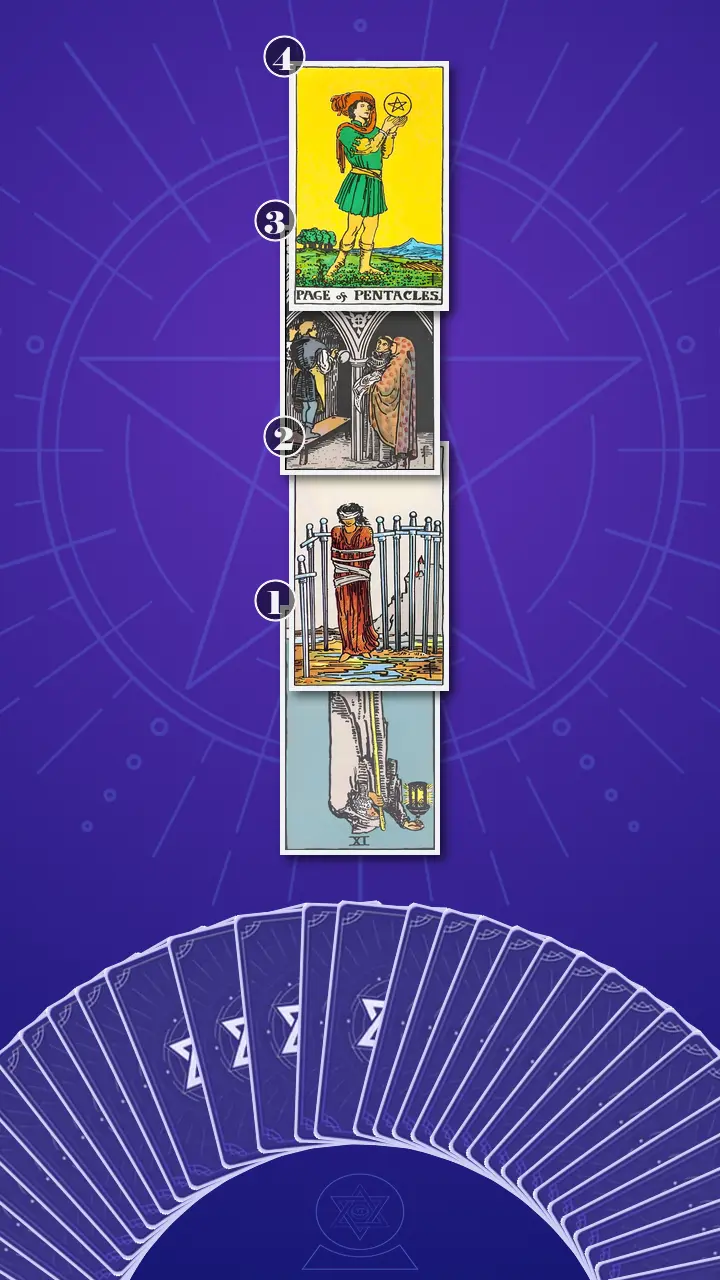
The Lantern Turned Toward the Wall
Position One: The Hermit Reversed and the Privacy Loop
Now I turned over the card representing Maya’s observable pattern: repeatedly withdrawing into solitary study even though shared sessions improved her focus. It was The Hermit, reversed.
I pointed to the solitary figure and the lantern illuminating only a narrow patch of ground. Upright, the Hermit can represent purposeful retreat, reflection, and restorative solitude. Reversed here, that inward energy had become blocked and overextended. Maya was not always choosing privacy because the task needed quiet. She was sometimes using privacy to avoid having unfinished effort witnessed.
“This is your 7:15 p.m. scene,” I said. “You read the invitation, type and delete the reply, close the door to protect your concentration, and then spend twenty minutes reorganizing folders, checking your phone, and perfecting a solo schedule before reading one page. The relief of not being observed is real. But the solitude is no longer doing the job you assigned to it.”
I made the distinction carefully. I did not want to turn every closed door into a symptom. Chosen solitude can restore attention. The Hermit reversed was asking whether this particular solitude produced reflection and progress, or whether it narrowed Maya’s world until the laptop’s blue light became the only lantern she would permit herself.
“Think about the last study invitation you declined,” I said. “What did you actually do during the first twenty minutes after deciding to work alone?”
Her fingers stopped against the cup. Her gaze moved from the card to the table, and then she let out a short laugh with a bitter edge. “That’s a little too accurate. Almost brutal.”
“Accurate doesn’t have to mean condemning,” I replied. “This card is describing a sequence, not your character. Once we can see the sequence, you can interrupt it without giving up your right to study alone when quiet genuinely helps.”
Position Two: The Eight of Swords and the Rule That Looked Like a Locked Door
Now I turned over the card representing the psychological mechanism beneath the withdrawal, especially the belief that needing shared structure meant personal inadequacy. It was the Eight of Swords, upright.
The figure appeared bound and blindfolded, but I showed Maya that the bindings were loose and the swords did not form a complete enclosure. The energy of Air, thought and interpretation, was in excess here. Self-monitoring had become so loud that a prediction was being treated as evidence.
“A classmate texts, ‘Quiet library block at 8?’” I said. “No one has asked to inspect your notes, compare progress, or turn the evening into a group project. But you imagine the moment they notice how slowly you’re reading. Then the thought ‘needing them proves I’m not capable’ makes an available seat feel like a locked door.”
I asked her to finish one sentence without polishing it: “If they see how I study when I’m behind, they’ll think...”
Her shoulders rose before any words came. Her thumb rubbed the cup’s rim, her eyes lost focus as if she were replaying several abandoned replies, and then her hand went still. “They’ll think I’ve been faking it,” she said quietly. “My grades are solid. People assume I’m on top of things. If they see how long chapter three takes me, they’ll realize I’m not as capable as they thought.”
I looked again at the incomplete ring of swords. In my mind, it resembled a permissions screen that appeared final until someone noticed the settings had been self-selected. Maya’s fear deserved respect because the exposure felt real in her body. It still did not deserve to be promoted into an unquestionable fact.
“The observable evidence is that they invited you,” I said. “The imagined evidence is that they’ll interpret your unfinished work as fraud. Those are not the same category. You do not have to catch up before you are allowed to study beside people.”
When Three Figures Shared One Visible Plan
Position Three: The Three of Pentacles and Collaborative Competence
The room grew quieter as I reached the card representing the transformation: understanding collaboration as a legitimate learning method rather than a verdict on independence. Outside the window, the cloud cover shifted, and a wider rectangle of afternoon light crossed the table until it touched all three figures on the card. I turned it upright. It was the Three of Pentacles.
I showed Maya the craftsperson working from the bench while two other figures consulted a plan. Nobody in the image surrendered a role. Nobody disappeared into the group. The shared structure made each contribution visible and usable. This was balanced Earth energy: practical cooperation, clear roles, and skill strengthened through conditions that support it.
“In your life, this can be much quieter than the word ‘collaboration’ makes it sound,” I said. “You sit beside one trusted classmate, say, ‘I’m finishing section two,’ set a 45-minute timer, and work on separate assignments. Nobody inspects your pace. Nobody does the reading for you. Their presence supplies a start time and a rhythm, while the work stays yours.”
I used one of my most practical lenses, Study Environment Auditing. I asked Maya to stop evaluating concentration as a personality trait and audit the inputs instead: visual clutter, start cues, phone access, task size, time boundary, and social rhythm. A library desk, a Pomodoro timer, a Spotify playlist, or another student’s quiet presence could all function as scaffolds. None carried a moral meaning.
Looking at the three figures, I remembered the café tables I had watched over twenty years: separate books, separate decisions, one shared surface and a steady human hum. I had never seen a charger accused of weakening a laptop because it helped the machine keep running. Yet Maya had been treating the condition that sustained her attention as evidence that her attention was defective.
I brought her back to the familiar loop in plain terms. At 7:15, the invitation appeared. Maya typed a reply, deleted it, closed her bedroom door, and spent twenty minutes preparing to focus instead of beginning. The loop then offered its usual verdict: if she needed a shared rhythm, she must not be capable.
The room that helps your focus is part of your study method, not evidence against your ability.
I let the sentence settle before connecting it directly to the scene on the card.
You do not have to prove independence by building alone; let shared structure strengthen your skill, just as the three figures create from one visible plan.
At first, Maya did not exhale. Her fingers hovered above the table as if she had been about to defend the old rule and had lost her place. Her pupils widened, then her gaze drifted past me, replaying some earlier library session. Her jaw tightened.
“But doesn’t that mean I’ve been wrong this whole semester?” she asked, with a sudden flash of anger. “I’ve wasted so many evenings trying to prove something that nobody even asked me to prove.”
“It means you were protecting yourself with the information you had,” I said. “Clarity isn’t a punishment for not seeing sooner. It simply gives you a new responsibility: you can test a different condition now.”
Her clenched hand opened one finger at a time. Her shoulders lowered, her eyes reddened, and a long breath left her with a slight tremor. Relief arrived first, followed by the exposed, almost dizzy stillness of realizing that a workable option had been available. “That’s better,” she whispered, “and somehow scarier, because now I can’t pretend the only problem is discipline.”
“Now, with this new perspective, think back to last week,” I said. “Was there a moment when this insight might have changed how you felt?”
She remembered forty minutes beside a classmate before a seminar. They had barely spoken, but she had read more than she usually managed in two hours at home. “I thought it only counted because I should have been able to recreate it alone,” she said. “Maybe their presence didn’t do the work. Maybe it gave the work a rhythm.”
I named the movement I was witnessing: a first step from apprehensive self-isolation and shame about needing structure toward grounded self-trust in choosing collaborative study support. Shared rhythm did not cancel individual ownership. Maya could accept the scaffold and still remain responsible for every page she read, every boundary she set, and every decision to stay or leave.
While the insight was still immediate, I asked her to open her calendar and choose one 45-minute block within the coming week. She selected Thursday evening and wrote down one task. Then she drafted: “Want to do a quiet 45-minute study block on Thursday? I’m working on one chapter, and I’m planning to leave when the timer ends.”
“Sending it is optional,” I reminded her. “Drafting it counts as the smallest version. You can keep conversation, camera use, progress comparison, and work-sharing off the table. You can also leave when the timer ends without apologizing.”
The Page Who Collected Evidence Instead of Verdicts
Position Four: The Page of Pentacles and the One-Session Experiment
Now I turned over the card representing practical integration: one bounded study session with a defined task, followed by an honest observation of its effect. It was the Page of Pentacles, upright.
The Page held one pentacle at eye level with patient attention. Behind the figure, cultivated ground suggested work repeated in manageable units rather than transformed through one heroic effort. The second Pentacles card stabilized the spread in Earth energy. Maya did not need a dramatic personality change or a promise to become a permanent group-study person. She needed one specific experiment.
“After the 45-minute block, open your Notes app and record something plain,” I said. “‘Pages 42 to 52, three annotations, focus four out of five, shoulders less tense.’ Don’t use the result to decide whether you’re independent enough. Treat the session as data, not a test of your worth.”
I described it as a one-session A/B test for study conditions, not a personality quiz. The Page’s energy was balanced curiosity: define the task, run the block, observe what happened, and adjust one variable next time. If shared study did not help on a particular day, that result would also be useful. The goal was not to manufacture evidence for my reading. The goal was to help Maya collect evidence she could trust.
She looked down at the unsent message on her phone. Instead of hiding the screen, she added “camera off is fine if we switch to virtual” and saved the draft. Her mouth softened into a small, uncertain smile.
“I can do one session,” she said. “One session isn’t a new identity.”
“Exactly,” I said. “The Page is an apprentice, not a finished product. Your next step is allowed to be information.”
From a Sealed Room to a Workable Study Method
I drew the four cards together as one story. The reversed Hermit showed the visible habit: Maya closed the door to preserve a competent image, but her narrow circle of privacy also removed the rhythm that helped her begin. The Eight of Swords revealed why the habit persisted: she had mistaken the thought “capable students focus alone” for a locked condition. The Three of Pentacles supplied the corrective experience, shared structure with separate ownership. The Page of Pentacles returned the method to her hands through a small experiment.
I described the old pattern as trying to start a fire in a sealed room. Maya kept containing the flame to prove she could generate momentum alone, then blamed herself when the oxygen ran thin. The cards did not tell her to tear down every wall. They showed her that opening one controlled window could be part of tending the fire.
Her cognitive blind spot was not simply “I avoid people.” It was the assumption that unsupported performance was the only valid evidence of competence, coupled with the assumption that relief after declining an invitation proved solitude was the better study condition. In reality, that relief often came from escaping imagined scrutiny. The concentration data told a different story.
I also noted what the spread did not demand. With no Cups and little Fire, it was not asking Maya to disclose her feelings to a whole group or wait for spontaneous motivation. The double Earth of the final cards pointed toward conditions: one task, one person, one place, one timer, and one record. The Four-Layer Insight Ladder had moved us from visible habit to hidden fear, then from corrective perspective to a bounded experiment.
The Three Small Moves
- Run the 15-minute Desktop Reset and deconstruct one task.Before the next study block, clear only the physical desk surface, place the phone out of reach, and use my Syllabus Deconstruction method to convert “catch up on chapter three” into one mechanical target, such as “read pages 42 to 52 and mark three key points.” Stop the reset when the timer ends and open the reading immediately.If the reset starts becoming another #StudyTok makeover, clear only enough space for the laptop, book, drink, and one index card.
- Draft one bounded co-study invitation.Within the next ten minutes, choose one 45-minute block this week and draft a message to one trusted classmate: “Want to do a quiet 45-minute study block on Thursday? I’m working on one chapter, and I’m planning to leave when the timer ends.” Name separate tasks, keep conversation optional, and decide camera use in advance if the session is virtual.Sending is optional; drafting counts. If 45 minutes feels too exposing, try ten minutes or a camera-optional Focusmate or Study Together room.
- Record evidence within two minutes.Immediately after the block, note the minutes worked, the observable task completed, a focus rating from one to five, and one body cue such as “shoulders lower” or “kept reaching for phone.” Later, compare it with one solo block of the same length.Keep the log private and factual. Do not add labels such as disciplined, lazy, capable, or dependent.
“These are options, not obligations,” I told her. “You can decline a group, keep your camera off, protect unfinished work, or choose restorative quiet. The change is that fear no longer gets to disguise itself as the only respectable study method.”
I turned the cards slightly toward Maya. Tarot had not granted permission that she lacked before, and it had not predicted that every shared session would work. It had helped us tidy the evidence. She remained the person who would choose the room, set the boundaries, do the reading, and decide what happened next.

A Week Later, the Quiet Proof
Six days later, I received a message from Maya. She had sent the invitation, met one classmate at a long library table, and left when the 45-minute timer ended. They had worked on different assignments with almost no conversation. Her note read: “Pages 42 to 52. Three annotations. Focus 4/5. Shoulders lower. Finished the section myself.”
She had also noticed the scratch of pencils and the low ventilation hum replacing her usual phone checks. The change was modest, which was exactly why I trusted it. She had not solved every deadline or stopped feeling exposed. She had produced one piece of evidence that support and ownership could occupy the same table.
That night, she slept through. Her first thought the next morning was, “What if it only worked once?” This time, she smiled and added two words to her log: “Useful data.”
I think of that as the real Journey to Clarity. Maya did not become certain. She became more accurate. She could distinguish restorative solitude from apprehensive withdrawal, and she had begun choosing study conditions from grounded self-trust rather than shame.
If the group chat lights up tonight and your breath catches, I hope you remember what I watched Maya learn: choosing the closed door can protect you from being seen for a moment, but noticing that reflex already means the door is no longer making the whole decision.
I’ll leave you with the question I would place beside the Three of Pentacles: if shared focus could be a tool rather than a verdict, what is the smallest version of company you might be curious to try, one trusted person, one muted video tile, or one 25-minute timer at the same table?