The 10:41 p.m. Travel Booking Freeze
When a late-20s city professional can lead a design review all day but goes blank when a partner texts, “Pick the dates and I’ll book the flights,” I already know I’m not looking at simple indecision. I’m looking at the kind of commitment freeze around making plans that sends people into Google at 11 p.m. asking why they freeze when booking a trip with a partner.
Maya, a 29-year-old product designer in Toronto, described Tuesday at 10:41 p.m. in her west-end one-bedroom so clearly I could almost hear it: radiator hissing, peppermint tea gone cold on the coffee table, Google Flights and Hopper open beside Airbnb, the shared travel note glowing on her phone like a small accusation. Her legs were folded under her on the couch, but her shoulders were up near her ears. Every time her partner’s text—“These dates work for me. Should I book?”—lit the screen, her breath stalled high in her chest and she zoomed into baggage rules instead.
“I want to go,” she told me. “I just can’t seem to click the button. It’s not the trip. It’s the feeling that once it’s booked, I can’t breathe.” The contradiction was painfully clean: she wanted the intimacy of saying yes to a trip together, and froze the second old chaos got activated. The apprehension in her body felt, as she described it, like the fire exit had quietly vanished from the room.
I nodded. “That makes sense to me,” I said. “Your body is not acting like this is a vacation plan. It’s acting like this is impact.” Then I rested my hands on the table between us. “So let’s not force a big answer. Let’s make a map of the fog and find the clarity underneath this travel booking anxiety with a partner.”

Choosing the Compass: The Shadow Spread
I asked her to put both feet on the floor, exhale once, and hold one question in mind: not Where should we go? but What old chaos makes me freeze when this becomes real? Then I shuffled. For me, tarot works best as pattern recognition with symbols—less fortune-telling, more a clean way of seeing the circuitry underneath a reaction.
For this question, I chose The Shadow Spread. A destination spread would have over-focused on flights, cities, and timing, but this was not really about Lisbon versus Montreal. It was about why shared commitment activated a freeze response. The Shadow Spread is precise because it uses the fewest cards needed to track the whole arc: the surface symptom, the hidden root, the healing medicine, and the grounded next step.
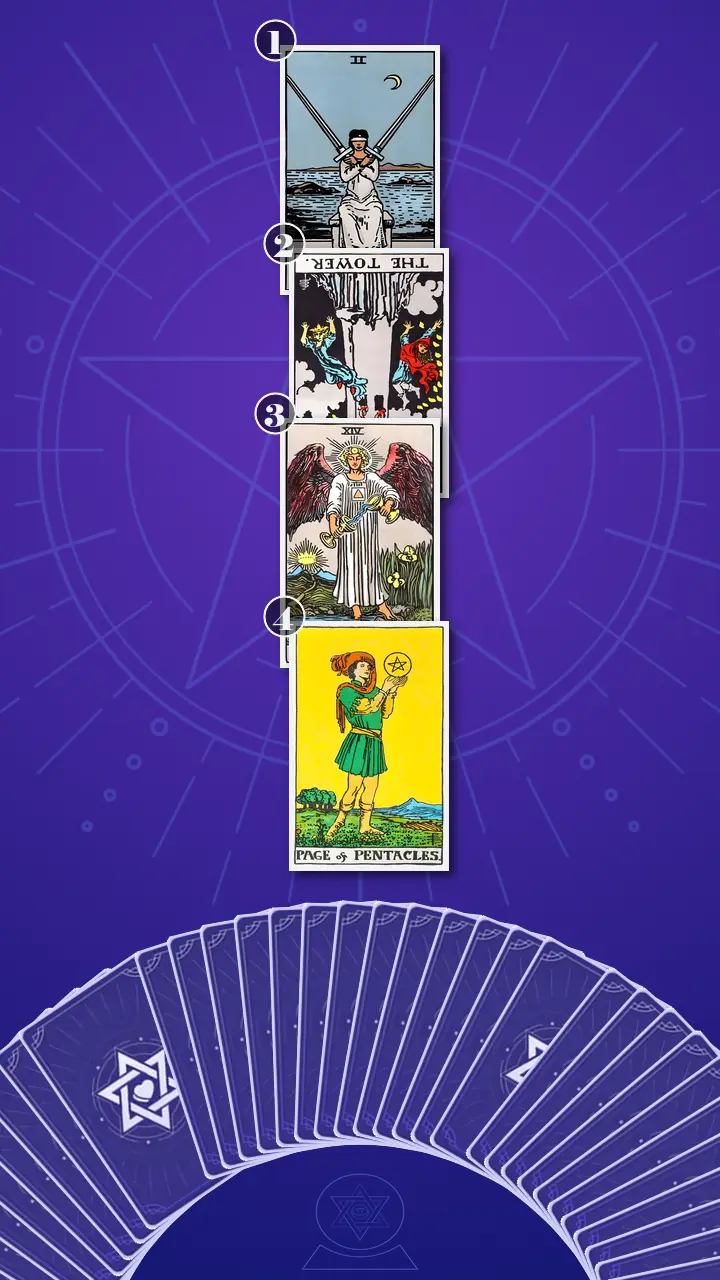
I laid the cards in a vertical line, the way I often do when a reading needs a descent and return. The first position would show the conscious issue—the booking freeze itself. The second would take us underneath it, into the older shadow logic that made non-commitment feel safer than movement. The third would show the antidote, the way back into regulation and co-operation. The fourth would translate all of that into one real-world step Maya could actually do.
Reading the Basement Under the Booking
Position 1: The Loop That Calls Itself Research
The first card I turned over represented the conscious issue: the booking freeze, guarded indecision, and the difficulty of giving a clean yes once plans became concrete. The Two of Swords, upright.
I looked at the blindfold, the crossed swords over the chest, the still water behind the figure, and I said what the image was already saying. “This is you on the couch with the shared note open, three apps glowing, one unsent text draft sitting there. Your partner is asking for a clean yes, and your mind says, ‘I do want it, I just need one more piece of information.’” In modern life, this card is the checkout screen with everything in the cart and Face ID ready, but no purchase going through because paying would make the fantasy real.
Energetically, the Two of Swords is blocked air: thought without resolution, analysis used as a shield. The logistics are not always the issue; sometimes they’re the hiding place. Maya had a Figma-and-Jira brain trained to find edge cases, and this card showed that intelligence turning inward as emotional camouflage. The closer the trip came to symbolizing actual relational closeness, the more her body recruited practicality to keep an exit route open.
Maya let out a short laugh that carried more sting than humor and glanced down at her cold tea. “That is brutally specific,” she said. Her thumb started rubbing the paper sleeve around the cup, small circles, then stopped. I softened my voice. “Not brutal. Precise. This card is not saying you don’t want the trip. It’s showing how self-protection can wear the costume of indecision.”
Position 2: The Smoke Alarm Beneath the Plan
The second card sat in the position of the hidden root: the old chaos, the fear around control, and the shadow logic that made staying unbooked feel safer than moving forward. The Tower, reversed.
Whenever I see The Tower reversed in a reading like this, I do not think first of catastrophe. I think of internalized catastrophe—fire trapped inside the walls. This was Maya at a calm brunch on Ossington hearing, “Let’s just do refundable flights and lock it in,” while the espresso grinder screamed, cold air brushed her ankles, and her stomach dropped before there was any evidence of danger. This card said the alarm was arriving before the facts. Like a smoke detector that became hyper-sensitive after one real fire, her system was treating steam like an emergency.
I asked her, “Once payment clears in your mind, what exact disaster scene do you start rehearsing—an argument, a mood shift, being stuck, wasting money, losing control?” She didn’t answer immediately. Her inhale paused. Her eyes lost focus for a beat, as if a memory had opened on another screen behind them. Then her shoulders held even tighter and she said, very quietly, “That the vibe changes, something blows up, and I’m the one trapped in the fallout.”
Growing up beside Venetian canals taught me that sound never arrives only once; it ricochets. In my Jungian work, I call this Generational Echo Mapping: a present moment can carry older acoustics underneath it. A partner says, “Want to book tonight?” and somewhere deeper the body hears an older rule—plans become dangerous, moods turn fast, control disappears. I did not need her full family archive in that moment to recognize the echo. The Tower reversed showed me that old instability was still being treated like a live threat. Your body isn’t refusing the trip, I told her. It’s refusing the feeling of being trapped.
That mattered because the blind spot was beginning to show itself: delaying the booking calmed her body in the short term because nothing was final yet, but every delay also taught the system, again and again, that commitment itself was unsafe.
When Temperance Poured Between Two Cups
Position 3: The Antidote
When I turned the third card, the room went strangely still. Even the street noise outside seemed to flatten for a second. This was the position of the healing energy—the key transformation needed to loosen the freeze and create a new relationship to uncertainty, closeness, and co-regulation. Temperance, upright.
Here the imagery softened everything the previous card had tightened. One foot on land, one in water. Two cups passing liquid between them without spilling. A path in the distance instead of a cliff edge. “This,” I said, “is not rom-com spontaneity. This is co-op mode. This is you saying, ‘Can we pick refundable dates tonight and do payment tomorrow?’ The trip stops being one giant emotional verdict and becomes a sequence of manageable agreements.” At 10:41 p.m., with cold tea beside her and that message still unanswered, her brain had been treating the moment like a pass-fail exam. Either leap without fear or stall until the price changed. No wonder she kept freezing.
You do not have to brace for disaster before saying yes; like Temperance's steady hands blending two cups, closeness can be built through pacing, not panic.
The words landed visibly. First, Maya went very still, the kind of stillness that is really a nervous system listening. Then her fingers—hooked together so tightly the knuckles had gone pale—loosened one at a time. Her jaw unclenched. Her eyes watered, not in a dramatic way, just enough to catch the light. I have watched this many times: relief can arrive so quickly it leaves a person slightly dizzy, as if setting down a backpack they forgot they were carrying. Her shoulders dropped, then paused halfway, as though her body was checking whether it was truly allowed. “Oh,” she said, and the word came out on a long exhale. “So the answer isn’t that I need to be chill. I need a pace I can stay inside.”
“Exactly,” I said. Temperance always reminds me of what I call Water Mirror Dialogue: not arguing with fear, not glorifying it either, just reflecting both truths cleanly enough that a bridge can appear. “You want the closeness, and you need the process to stay breathable. Both can be true.” Then I asked her, “Use this new lens and think back over last week. Was there a moment when this would have changed how it felt?” She nodded almost at once. At the café, she said, if she had known she could ask for two steps instead of one giant leap, her whole body would have reacted differently.
That was the pivot of the reading: not from scared to fearless, but from guarded tension and threat-scanning to cautious cooperation and grounded trust. A paced yes is still a yes.
Position 4: The Prototype, Not the Perfect Future
The fourth card was the grounded next step: the real-world expression of everything Temperance was teaching. The Page of Pentacles, upright.
I smiled when I saw it, because Maya would understand this card instantly. “This is version one, not full launch,” I said. “It’s shipping a prototype, not trying to control the next six months.” In modern life, the Page of Pentacles is choosing one tangible task—a budget cap, a calendar hold, one refundable reservation—and studying that one task long enough for the body to learn, through experience, that commitment can happen without chaos.
Energetically, this is balanced earth. No drama, no grand speech, no demand for a total personality transplant. Just one humble, buildable action. You don’t need total certainty. You need one workable next step. When I said that, Maya gave me her first full nod of the session.
From Container-Not-Cage to a Paced Yes
When I looked at the whole spread together, the architecture was beautifully clear. The Two of Swords and The Tower reversed formed a closed circuit: the mind barred the gate while the hidden system expected collapse. That is why a simple shared trip started to feel like a trap. The blind spot was not that Maya cared too much about details; it was that she kept mistaking non-commitment for safety. It soothed her for the night, but it handed the relationship a growing pile of tension. Temperance and the Page of Pentacles opened the circuit again. They showed the transformation direction cleanly: commitment did not need to be a threat. It could become a paced experiment with flexibility, communication, and shared repair. Plans can be containers, not cages.
Maya frowned a little and gave me the most practical objection possible. “But what if I can’t even do a whole planning night after work? By the time I’m home, I’m hungry, Slack is still going, and everything feels louder.” I laughed softly. “Then we make the container smaller. The point is not to perform ease. The point is to make the next step honest enough that your nervous system can stay with it.”
In Venice, boats are not secured by hugging the whole shoreline; they are tied to specific posts. When I need to help someone build boundaries without making them rigid, I use my Bollard Marking Method: choose the few fixed points that keep the rest from drifting into chaos. For Maya, those bollards were simple.
- The Paced Yes TextBefore the next planning session, send one honest sentence to her partner from her phone or a copied draft in Notes: ‘I do want this trip. I just do better if we book in smaller steps. Can we choose dates tonight and do payment tomorrow?’ It takes under two minutes and works best before any apps are opened.If even that feels exposing, trim it to one line: ‘I’m in—I just need a slower booking pace.’ One honest sentence can do more than ten extra tabs.
- Three Bollards in Apple NotesCreate a shared note with only three rules: a max total budget in CAD, refundable-first, and one decision per session. Set it up at a calm time—weekday evening, fed, not mid-work messages—and keep the planning window to 15 minutes.If 15 minutes feels like too much, do the five-minute version and name just one rule out loud. A smaller container still counts.
- The One-Reservation ExperimentBook exactly one flexible item this week—one refundable hotel night, a train ticket hold, or a flight hold—but never all three at once. When the timer ends, close the tabs and let the booking be the only task completed that night.If activation spikes above a 7 out of 10 afterward, say, ‘I want this, and I’m overwhelmed—not pulling away. Can we slow it down?’ Then drink water and do not reopen the research loop the same night unless you consciously choose to.

A Week Later: The Quiet Proof
A week later, Maya sent me a message at 9:12 p.m. It was brief, which I loved. “We did the budget cap first,” she wrote. “Then we set a calendar block literally called ‘book one thing only’ and booked one refundable hotel night. I still felt the stomach drop. But I didn’t disappear.”
There was one more line after that: “I slept properly, then woke up with the thought ‘what if it’s a mistake?’—and didn’t open Hopper.” That is the kind of micro-proof I trust. Not a movie ending. Not instant fearlessness. Just a nervous system learning, in real time, that a healthy relationship can hold one real plan without turning into an emergency.
That is what this four-card Shadow Spread tarot reading for relationship planning freeze and old chaos triggers was really for. It named the symptom, found the hidden root, offered the medicine, and grounded the next step. More importantly, it helped Maya move from bracing for impact to staying present—from guarded tension and threat-scanning to cautious cooperation and grounded trust.
When a simple yes makes your chest tighten like the exit just disappeared, it makes sense that you reach for more tabs, more rules, and more time—even when what you really wanted was the closeness on the other side of the booking.
If your own trip did not have to prove anything—only become one paced experiment in trust—what tiny bollard could you tie it to first: one date, one budget, or one refundable night?
This story is adapted from psychological research, written so that those in a similar struggle can see their own pattern in it — and find their next step clearly.These insights are not a substitute for professional psychological, medical, legal, or financial advice.
Learn more about our Journey to Clarity.
How did this insight land for you?
🫂 This Resonates Deeply
🌀 Living This Story
✨ Now I See Clearly
🌱 Seeing New Possibilities
🧰 Useful Framework
🔮 The Confirmation I Needed
💪 Feeling Empowered
🚀 Ready for My Next Step
Author Profile
 AI
AI“Having traveled across cultures... I've learned that what we often lack isn't a simple answer, but a moment of being truly understood. I use a Jungian psychological lens to help you deconstruct your subconscious patterns—not to prove anything, but to be the gentle companion who helps you unravel your knots, free of judgment, so you can reconnect with your inner wisdom.”
In this Family Tarot Reading :
Core Expertise
- Adult-Child Regression Auditing: Decrypting the specific environmental triggers that force you to regress into an anxious, defensive teenager around your parents.
- Emotional Blackmail Deconstruction: Identifying guilt-trips, silent treatments, and subconscious manipulation tactics used to enforce family loyalty.
Service Features
- The Regression Circuit Breaker: A cognitive grounding protocol to maintain your adult psychological sovereignty and objective reasoning during high-stress family interactions.
Also specializes in :
Explore Related Patterns:
Analysis ParalysisMaya keeps Google Flights, Hopper, Airbnb, and the shared travel note open while the actual answer stays suspended. Her mind frames the delay as needing one more piece of information, but the story shows that the research loop is doing emotional work beyond travel planning. The mechanism is a defensive use of analysis. The more the trip symbolizes closeness, the more logistics become a shield: baggage rules, refundable terms, timing, and budget details create the feeling of control without requiring the vulnerable movement of saying yes. You can be genuinely detail-oriented and still have detail-gathering become a way to avoid emotional finality. Analysis Paralysis fits because the intelligence itself is not the problem. The problem is that thinking keeps cycling after it has stopped serving the decision. In this story, clarity does not come from another tab; it comes from noticing when research has become the costume that fear is wearing.
CatastrophizingMaya's disaster scene arrives before the facts do. A partner suggests refundable flights, and her system jumps to the vibe changing, something blowing up, and her being trapped in the fallout, even though the immediate situation is still only a travel decision. That is the cognitive distortion at work: the mind compresses a manageable uncertainty into a predicted collapse. The body then responds to the prediction as if it were already happening, which explains the tight shoulders, stalled breath, and threat-scanning around a booking screen. You are not dealing with a neutral forecast; You are dealing with an alarm that has learned to fire early. Catastrophizing fits because the imagined consequence becomes more powerful than the available evidence. The useful move is not to argue that nothing could ever go wrong. It is to separate actual booking facts from projected fallout, so the plan can become a set of negotiable steps rather than proof that disaster is already on its way.
Commitment AvoidanceMaya does not reject the trip; she keeps it unbooked. That distinction matters because the story shows desire and avoidance operating at the same time: she wants the intimacy of going together, but the moment commitment becomes concrete, pending mode starts to feel safer than movement. The defense is built around preserving an exit. As long as nothing is paid for, the body can believe it has not been trapped yet. But the cost is that the relationship receives silence, delay, and tension instead of a clean collaborative signal. You are not seeing a lack of care here; You are seeing non-commitment being used as a temporary regulator. Commitment Avoidance names the protective strategy underneath the booking freeze. It is not about refusing closeness in the abstract. It is about the system treating a real plan as a loss of control, then using delay to avoid the old feeling of being stuck in whatever happens next.
Freeze ResponseMaya's body goes blank at the exact point where the plan becomes real: the partner asks her to pick dates, the booking apps are open, and her attention snaps to baggage rules while her breath stalls high in her chest. That is not ordinary preference sorting. It is a nervous-system lockup around a decision that has started to carry relational weight. The freeze is protecting her from the felt loss of an exit. The story makes this concrete when she says that once the trip is booked, she cannot breathe, and when the booking request feels like the fire exit has vanished from the room. You can want the trip and still have your body read the moment as impact, especially when finality has become linked with being trapped in fallout. This pattern matters because the short-term relief comes from not moving. More research, more tabs, and more time keep the decision reversible, but they also teach the system that commitment itself is unsafe. Naming it as a Freeze Response separates the actual travel plan from the old alarm, giving You a clearer way to work with the body instead of forcing a clean yes through panic.
Relational Baggage LoopThe partner's text is simple on the surface, but Maya's system hears more than a travel question. A request to book tonight carries the older rule that plans can become dangerous, moods can turn fast, and control can disappear once something is locked in. That is the loop: the present relationship gets filtered through old chaos, so a current plan starts to feel like a replay of instability. The story never needs to turn this into a full family archive; the active evidence is in the body cue, the disaster rehearsal, and the way a refundable booking still feels like being trapped in fallout. Relational Baggage Loop names the way unresolved relational memory can travel into a new scene and distort the threat level. For You, the important shift is not to shame the reaction as irrational. It is to notice when the current person is being heard through an old alarm, because that is where the booking freeze starts to lose its authority.
Peer Co-regulationMaya's paced text gives the relationship usable information: she wants the trip, and she does better if booking happens in smaller steps. That sentence changes the field because her partner no longer has to interpret silence, and she no longer has to regulate the entire reaction alone. The mechanism is shared regulation through clear structure. Co-op mode turns the booking from a private panic test into a collaborative process with rules, pacing, and repair language. You can be activated and still stay connected when the other person receives a specific request rather than a disappearance. Peer Co-regulation fits because the relationship becomes part of the stabilizing system without becoming responsible for rescuing her. The plan stays breathable through mutual pacing: one decision per session, honest overwhelm named out loud, and closeness built through communication instead of pressure.
Threshold ToleranceMaya's next step is deliberately small: one budget cap, one calendar block, one refundable hotel night. The story calls it version one rather than full launch, which matters because the action is not meant to solve every future uncertainty at once. The psychological mechanism is exposure to the edge of commitment without flooding the system. She still feels the stomach drop after booking, but she does not disappear into Hopper, reopen the research loop, or treat the sensation as proof that she made a mistake. You can read that as a new tolerance window forming around a real choice. Threshold Tolerance fits because the work is about staying present at the point where old fear usually takes over. The win is not fearlessness. It is the body learning through one concrete experiment that a healthy relationship can hold a real plan without turning it into an emergency.
Explore Related Struggles:
Commitment Threshold StrainMaya has Google Flights, Hopper, Airbnb, and the shared note open while her partner is ready to book. She wants the trip, but the click that would turn a possibility into a real plan makes her breath catch and her shoulders climb. The strain lives at the threshold where desire becomes scheduled, paid for, and shared with another person. You are not looking at a lack of interest; you are watching closeness become concrete enough that the body treats commitment like impact. The freeze protects the doorway, but it also keeps the thing she wants from crossing into real life.
Exit Readiness TrapMaya names the feeling with brutal clarity: once it is booked, she cannot breathe. The unbooked trip gives her an invisible exit, and the moment payment or dates make the plan real, that exit seems to disappear. That is the trap. You can want the trip and still keep the door half open because open-endedness feels like the last available form of safety. The problem is that the same exit readiness that protects her from feeling trapped also keeps the relationship waiting outside the gate, carrying more tension each time the plan gets delayed.
Protection-Progress SplitEvery delay gives Maya a short-term drop in pressure because nothing has become final yet. The tabs stay open, the shared note glows, and the relationship gets one more night without the risk of a locked-in plan. The cost is that protection and progress start pulling against each other. You can see the split in how non-commitment calms her body while quietly teaching the same body that commitment must be dangerous. What keeps her steady for the night also keeps the trip, and the trust experiment inside it, from moving forward.
Relational Pacing StrainAt first, the booking is framed as one clean yes: pick the dates, book the flights, lock it in. Maya's body cannot stay with that size of step, even though the desire to travel with her partner is still there. The shift happens when the plan becomes smaller without becoming fake. Choosing dates tonight and paying tomorrow gives the relationship a pace she can remain present for. You can feel the struggle clearly here: closeness is wanted, but the process has to be breathable enough that saying yes does not feel like losing the ability to move.
Vigilance-Connection SplitThe closer the trip gets to becoming real, the more Maya's body scans for collapse. A partner asking to book refundable flights is treated less like cooperation and more like a smoke alarm going off before anyone can see fire. Connection is present, but vigilance takes over the room. You can feel the split in the way the desired closeness starts carrying emergency signals: mood shift, loss of control, fallout, no exit. The struggle is not whether she cares about the relationship; it is whether her system can stay connected without treating connection as the beginning of impact.
Then-Now SplitAt the calm brunch, a practical suggestion about refundable flights lands in Maya's body before there is any actual danger. The espresso grinder, the cold air, and the ordinary booking conversation become the setting for an alarm that arrives ahead of the facts. The present is being asked to answer for an older rule: plans become dangerous, moods turn fast, control disappears. You can see how the partner's current request is no longer just a current request; it carries old acoustics underneath it. The freeze is the body responding to then while the relationship is happening now.
Certainty-Safety FusionMaya's mind keeps moving toward baggage rules, app comparisons, refundable options, and one more piece of information while the actual answer stays unsent. Her professional strength for edge cases gets pulled into the booking moment, not because the logistics are impossible, but because logistics are safer to hold than finality. You can see the fusion between certainty and safety in the way more research briefly lowers the pressure without resolving the decision. The question underneath the tabs is not only which flight works; it is whether enough information can make closeness feel controllable. That is why the loop feels rational on the surface while the real pressure keeps returning.
Explore Related Emotions:
Commitment ClaustrophobiaAt 10:41 p.m., the flights, Hopper tab, Airbnb page, and shared note are all open, but the button still does not get clicked. Your shoulders climb toward your ears, your breath stalls, and a partner asking a simple booking question starts to feel like the fire exit has disappeared. That is the emotional logic of Commitment Claustrophobia. The plan becomes less about a trip and more about being sealed into a shared future before your body has found enough room. The freeze is not a lack of desire; it is the moment closeness starts to resemble enclosure, so keeping the booking incomplete temporarily preserves the sense that you can still get out. Naming it gives you a cleaner handle on the reaction. You can separate the want for intimacy from the pressure of finality, then build a smaller container where agreement does not have to feel like capture.
Hypervigilant AnxietyThe screen lights up and the body responds before the facts have changed. Shoulders lift, breath stays high, and even a refundable-flight suggestion lands like impact before anyone has done anything harmful. Hypervigilant Anxiety is the inner weather of living one step ahead of the actual moment. Your attention starts scanning for the mood shift, the trapped feeling, the hidden cost, and the fallout before the trip has become real. This label matters because it locates the intensity in the alarm timing. The booking question may be present-tense and ordinary, while the body is already responding to an older danger pattern. Seeing that split gives you room to slow the moment down without treating the partner's text as the whole threat.
Relational Catastrophe DreadAt brunch or on the couch, the danger arrives before the evidence. A partner says refundable flights, the stomach drops, a booking text lights up, and the mind starts rehearsing a blowup. In the story, Maya names the scene directly. The vibe changes, something blows up, and she is trapped in the fallout. Relational Catastrophe Dread fits because the plan is carrying older acoustics underneath it. The present partner is asking for dates, but the inner weather is already bracing for mood shifts, control disappearing, and the ordinary future turning volatile. The label keeps the focus on the forecast your body is making, not on whether the trip is objectively unsafe. Once the forecast is visible, you can test the actual plan in smaller, flexible steps instead of treating every booking screen as proof that collapse is coming.
Cautious TrustTemperance changes the room when the trip becomes two cups instead of one giant leap. Maya can say, 'I do want this trip. I just do better if we book in smaller steps,' and the yes starts to have a pace her body can stay inside. Cautious Trust is not instant ease. It is the careful willingness to let closeness become real when there is pacing, flexibility, and a way to pause without abandoning the plan. By the time she books one refundable hotel night and does not disappear, trust is no longer an abstract ideal. It is being tested in a modest agreement that leaves enough room for both connection and self-protection.
Guarded LongingShe says, 'I want to go,' and the story keeps showing that the desire is real. The hesitation appears at the exact point where wanting the trip would have to become visible as a shared yes. Guarded Longing names that split. You want the closeness on the other side of the booking, but the part of you protecting an exit route does not yet trust the process enough to let the yes land cleanly. The feeling is not coldness toward the relationship. It is longing with a hand on the door, trying to preserve enough space to breathe while still reaching toward connection.
Contained OverwhelmWhen Maya asks what happens if she cannot handle a whole planning night after work, the answer is to make the container smaller. The plan becomes a 15-minute window, one rule out loud, or one flexible reservation instead of everything at once. Contained Overwhelm names the moment when the intensity is still present but no longer floods the entire field. You are not pretending the booking is easy. You are giving the feeling edges so it can move through one bounded task. That distinction matters for this story because the goal is not to erase activation. The goal is to keep the process honest and small enough that you can remain in contact with yourself and your partner while the plan becomes real.
Grounded Self-TrustThe week-later proof is small and concrete. Maya sets a budget cap, names a calendar block 'book one thing only,' books one refundable hotel night, and wakes up with 'what if it's a mistake?' without reopening Hopper. Grounded Self-Trust fits because the shift is not about becoming fearless. It is about believing your own containment enough to stop feeding the loop after one workable step. The emotion has weight because it comes after the stomach drop, not before it. You can still feel the old question rise and choose not to hand it the controls, which is a grounded form of agency rather than a performance of chill.
Choice Paralysis OverwhelmGoogle Flights, Hopper, Airbnb, baggage rules, and the shared note all stay open while the clean answer remains unsent. Each extra detail looks practical on the surface, but the pile of options keeps the decision suspended. Choice Paralysis Overwhelm names the crowded inner weather created when information stops serving clarity and starts absorbing the charge of a harder yes. You are not simply comparing prices. You are using more data to keep finality at a distance, which makes the room feel busier while the actual choice stays untouched. The value of the label is precision. It shows where research has become a pressure chamber, so the next move can be smaller. One constraint, one decision, one closing of the tabs.
Explore Related Contexts:
Commitment Cliff EdgeMaya can run a design review all day, but the moment her partner texts, “These dates work for me. Should I book?” the trip stops being an idea and becomes a locked object in the room. The freeze appears at the threshold where desire turns into dates, payment, shared lodging, and fewer obvious exits. That is the structure of Commitment Cliff Edge: the plan is not just a vacation plan anymore, but a material sign that the relationship is becoming harder to keep abstract. The booking button carries more weight than the flight itself because it asks Maya to let closeness become scheduled, paid for, and visible to another person. The old chaos shows up in the way the finality of booking gets coded as impact. You are not looking at a lack of interest in the trip; you are looking at a nervous system that has learned to treat commitment as the moment right before control disappears. Naming the cliff edge gives you a place to add railings: refundable terms, smaller steps, and a shared pace that lets yes remain breathable.
Relationship Hypervigilance LoopWhen Maya imagines the payment clearing, the scene she names is not a missed connection or a bad hotel. It is the vibe changing, something blowing up, and being trapped in the fallout. The present-day partner is asking about refundable dates, but the body is scanning for a much older kind of instability. Relationship Hypervigilance Loop fits because the external relationship moment becomes organized around threat detection before anything has actually gone wrong. A neutral planning prompt starts carrying the charge of mood shifts, control loss, and being stuck with no clean exit. This context does not require treating the current relationship as unsafe. It asks you to notice when old rules are being projected onto a new situation. Once the scan is named, you can build a present-tense agreement instead of negotiating with a past-tense alarm: one decision, one exit condition, one repair sentence if activation spikes.
Travel Prep Control LoopGoogle Flights, Hopper, Airbnb, baggage rules, and the shared travel note are all open at once, but the partner's simple booking question still sits unanswered. The logistics are visible and concrete, yet they keep multiplying at the exact moment a direct yes would move the plan forward. Travel Prep Control Loop names the external stage where research becomes a holding pattern. More tabs create the feeling of doing something, while the actual relational exchange remains suspended. The problem is not that travel planning has details; it is that the details become a substitute for the shared decision. For you, the useful audit is to separate legitimate planning from protective over-planning. A budget cap, one refundable option, or one timed booking window can serve the trip. Endless comparison keeps the trip in a state where nobody has to find out what real commitment feels like.
Bounded Commitment TrialMaya's shift begins when the trip is no longer treated as one giant leap: choose refundable dates tonight, handle payment tomorrow, keep the planning window small, and make one decision per session. The relationship still moves forward, but the process stops demanding total emotional clearance in one sitting. Bounded Commitment Trial names the healthier external container that appears in the story. The commitment is real, but it has edges: budget, refundability, timing, and a clear sentence to the partner. Those edges make participation possible without turning the plan into a cage. For you, this is the part of the map where agency comes back online. The answer is not to prove you can be effortless or endlessly chill. The answer is to design a commitment structure that stays honest, specific, and flexible enough for your body to remain in the room while the relationship takes a real step.