A Calendar That Looked Like a Life: Toward a Self-Authored Path

The Calendar That Looked Like a Life
I recognized the pattern the moment Maya, twenty-nine and working in a stable mid-level product marketing role in Toronto, told me that a peer's LinkedIn promotion post could turn an ordinary commute into Comparison Fatigue before she reached her stop. I had learned that self-authorship paralysis rarely arrives looking dramatic; it often arrives with a sensible job, reliable friends, a functioning relationship, and a calendar that appears to prove everything is fine.
At 11:40 p.m. on a Tuesday in Maya's west-end apartment, a career-change course checkout page glowed beside six LinkedIn profiles and a salary spreadsheet. The laptop fan blew warm air against her wrists, the radiator ticked, and cold streetlight cut across the desk. I watched her close the course page, then add “streamline morning routine” to tomorrow's calendar, as though one more efficiency task could answer the question she had just avoided.
She told me, “My life looks coherent, but I cannot tell whether I chose the plot.” The problem was not that she had no options. She kept completing the next expected milestone, accepting commitments that fit the existing plan, and postponing experiments that might reveal what she actually wanted. She was trying to build a life that felt like hers while continuing to follow a life script that no longer felt like hers.
I could see the tight-chested loneliness beneath her polished explanations. It was like wearing a well-tailored outfit chosen for an earlier version of yourself: nothing pinched badly enough to justify taking it off, yet every movement reminded you that someone else had chosen the shape. Guilt sat beside longing. Her body reacted to an ordinary commitment as if she were signing it on someone else's behalf.
I said, “Nothing is obviously wrong does not mean nothing important is happening. You know how to optimize this life; the harder question is whether you still choose it. We do not need to force a five-year answer tonight. Let us use the cards to draw a map through the fog, and leave every decision in your hands.”
Choosing the Compass: The Shadow Spread
I asked Maya to place her phone face down, take one slow breath, and hold the question without trying to improve it. I shuffled gradually, treating the ritual as a psychological threshold: a few quiet minutes to move from comparison and performance into attention.
For anyone wondering how tarot works in a reading like this, I use the images as an objective reflection tool rather than a source of fixed predictions. The cards give us a structured language for noticing patterns that are easy to rationalize away in ordinary conversation. Maya remains the author of her choices; the spread simply makes the hidden rules easier to inspect.
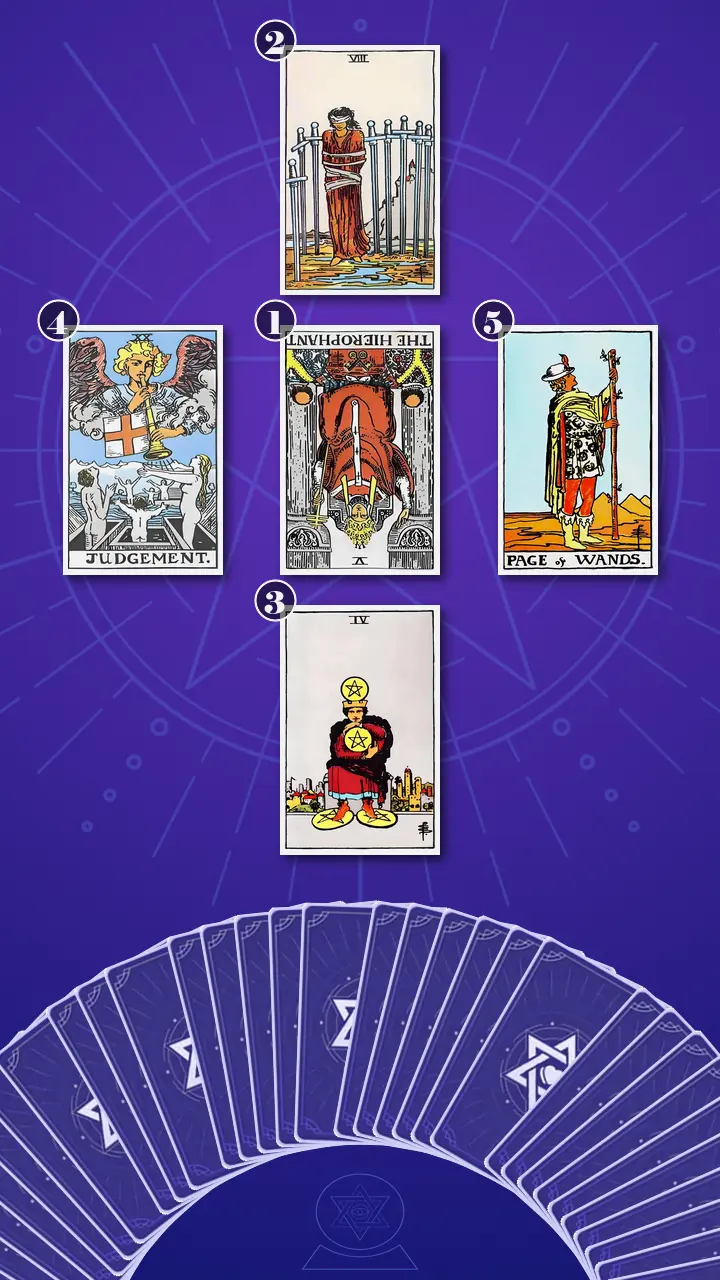
I chose The Shadow Spread because this was an inner-excavation question: why does an outdated script still govern behavior when its authority has weakened? This five-card cross is small enough to stay focused and broad enough to trace the whole chain. Its vertical axis shows what keeps Maya fixed, while its horizontal axis moves from recognition toward an empowering, testable action.
The first position would show the present adaptation, the visible way she continued performing a recognizable life. Above it, the second would reveal the disowned belief that made other paths seem unavailable. Below it, the third would expose the protective root: the stability and control she was gripping. To the left, Judgement would reveal the resource inside the shadow. To the right, the Page of Wands would point toward integration through one small, reversible experiment.
Reading the Script Without Calling It Destiny
I placed the cards in the cross and began at the center, keeping the sequence practical. I wanted Maya to recognize the machinery of the pattern without turning that recognition into another reason to blame herself.
Position 1: The Rules That Still Sounded Sensible
The first card I turned over represented the present adaptation: how Maya visibly continued following a script even as her identification with its rules weakened.
The card was The Hierophant, in reversed position. In its formal posture, raised hand, two followers, and crossed keys, I saw the career ladders, milestone checklists, competency frameworks, and approval systems Maya still consulted for permission. Reversed, the authority had begun to lose its personal force, but her behavior still looked like that of a student waiting for an approved alternative.
I brought her back to the performance review she had described. When someone asked, “Where do you see yourself in five years?”, she could fluently explain the next promotion, the competency matrix, and the salary path. Later, in a private note, she could not finish the sentence “What I prefer is...” without translating preference into credibility, résumé value, or strategic sense. I told her, “You can explain the next step. That does not automatically mean you want the destination.”
The reversed energy was blocked authority, not a command to reject every structure. An inherited definition of a good life was still operational after its authority had become personally questionable. The risk would be overcorrecting into rebellion for its own sake, abandoning useful routines or relationships simply to prove independence. I wanted discernment, not a dramatic escape. The Truman Show came to mind as a brief analogy: recognizing that a convincing environment was partly authored elsewhere does not require performing a spectacular exit for an audience. It requires learning which doors are real and which rules were never yours.
I used the inner sentence I had heard beneath Maya's polished answer: “I know how to make this look sensible; I do not know whether I want to keep making it look sensible.” She gave a small, bitter laugh instead of nodding. “That is almost cruel,” she said.
I did not soften the card into a diagnosis. I said, “I hear the cruelty in how long you have had to defend a life that already works. The card is not saying you were foolish to follow this path. It is showing that credibility has been answering a question that belongs to preference.” Her fingers paused over the rim of her glass, and I watched recognition arrive with a little resistance still attached to it.
Position 2: The Tab That Was Not Actually Locked
The second card represented the disowned belief: the assumption that choices outside the familiar script were not genuinely available or safe to consider.
I turned over The Eight of Swords, in upright position. I asked Maya to look first at the blindfold and the loose bindings, not only at the swords. The image did not show an airtight prison. It showed a person whose perception had narrowed until the open ground was difficult to see.
Her modern version was a browser with eight viable tabs open: adjacent roles, short courses, different neighbourhoods, and creative projects. Yet only the tab with a familiar title, reliable salary, and peer-approved explanation felt genuinely clickable. She researched every downside until a reversible conversation or trial class felt as consequential as leaving her job. Then she treated her lack of action as evidence that she had no options.
I asked, “Which part is materially unavailable, and which part only feels unavailable because you cannot yet explain it cleanly?” I made room for rent, visas, care responsibilities, debt, health, and other real constraints. The card was not asking her to pretend those limits did not exist. It was asking her to separate a fixed condition from a rule she had never tested.
Her breathing shortened. She looked at the open space around the figure, then down at her own phone. “Technically I could try some of these things,” she said. “But realistically I cannot because I do not know what they would lead to.” I replied, “Not knowing the final destination is information about the size of the experiment, not proof that the experiment is impossible.”
Position 3: The Grip That Was Trying to Keep Everything Safe
The third card represented the protective root: the need to preserve control, stability, and a coherent identity that kept the shadow pattern in place.
The card was The Four of Pentacles, in upright position. I focused on the pentacle pressed against the figure's chest and the coins pinned beneath both feet. The image showed a legitimate desire for security becoming over-fixed. Maya was not following the script because she lacked imagination. She was protecting her salary, apartment, competent identity, five-year narrative, and other people's trust as one bundled package.
When she checked Toronto rent listings, salary bands, and her savings buffer, I watched her press her phone briefly to her chest. She said, “If I loosen one thing, what if everything starts moving?” That sentence explained why the smallest experiment could feel like a threat to her entire life. The earth energy was excessive: stability had stopped being a floor from which she could explore and had become a structure she had to keep reenacting.
First, her breath paused and her fingers tightened around the phone. Next, her eyes moved from the salary figures to the card, as if replaying the moment a four-week class had become equivalent to resigning. Finally, she exhaled and lowered her shoulders. “I have been treating one small experiment like a threat to my whole life,” she said.
I answered, “Stability is a floor to stand on, not a verdict you must keep reenacting. We can identify the minimum stability you genuinely need and protect that baseline while testing one preference.” I did not ask her to become reckless, less responsible, or less attached to a life that had supported her. I asked her to stop making every existing commitment defend every other one.
When Judgement Asked for Present-Tense Consent
The room seemed to quiet as I reached for the fourth card. The radiator still ticked, but the sound had moved into the background, and a streetcar bell sounded once beyond the window. This was the resource inside the shadow, the part of Maya's dissatisfaction that could become useful rather than merely painful.
The card was Judgement, in upright position. Its trumpet, open sky, rising figures, and lifted arms did not suggest an external command or a fixed fate. I read them as the capacity to bring an old choice back into conscious review. Judgement does not erase the past. It asks whether a former decision remains alive under present values.
I told Maya, “You can review an old choice without putting your entire past on trial. You can ask whether the choice was honest then and whether it remains honest now.” I then used my signature Limiting Belief Deconstruction lens. I asked her to audit the mechanism that appeared whenever she approached a new level of authorship: What triggered the fear? What rule did the fear state? What short-term relief did obedience provide, and what did that relief cost over time?
The trigger was a peer milestone, a five-year-plan question, or a recurring commitment that had never been reconsidered. The rule was that a valid life had to remain coherent and recognizable. The payoff was immediate relief from scrutiny and regret. The cost was a growing stack of commitments that felt impersonal. I also used my Imposter Syndrome Decoding lens to separate her actual potential from the fear that choosing differently would expose her as irresponsible or unworthy of the competence people already trusted.
At 11:40 p.m. in a Toronto apartment, the career-course checkout page glows beside LinkedIn salary tabs. Maya closes it, adds “optimize morning routine” to tomorrow, and feels her chest tighten even though her life still looks completely sensible.
You do not need to keep obeying an old script to prove that you are responsible; review it by your present values and answer Judgement's trumpet with one choice you can consciously renew or revise.
I let the sentence settle before I gave her the shorter version I wanted her to remember.
You can review an old choice without putting your entire past on trial. Consistency is not proof that a decision still fits; your present values are allowed to provide new evidence.
For a second, Maya's breath stopped. Her fingers stayed suspended above her phone, and her eyes fixed on the centre of Judgement as if the image had moved closer. I watched her pupils widen, then lose focus; I could almost see the Sunday calendar, the course tab, and the promotion post replaying without the usual demand to explain them. Her right hand closed around the phone, not to reopen LinkedIn but to hold the old reflex in place. Then her jaw released. Her shoulders dropped in a small, involuntary descent, and her fist opened one finger at a time. A sound came from deep in her chest, more exhale than word. Her eyes shone, and she said, “That choice was honest then. Does it remain honest now?” The question carried grief for time already spent and relief that the time was not wasted. I asked her to set a seven-minute timer and choose one recurring commitment, writing: “I would renew this because...,” “I would revise this by...,” and “I would let this expire if....” No cancellation or announcement was required. I asked, “Now, use this new perspective to remember last week: was there a moment when this insight could have made you feel different?”
I named the crossing clearly: this was a first move from contracted alienation and fear-driven overanalysis toward grounded self-recognition. It was not a final answer. It was the moment Maya allowed a present-tense response to count as evidence, even before she had a polished replacement story.
Position 5: The Beta Test Instead of the Rebrand
The fifth card represented the integration step: a small, reversible experiment that would let personal preference generate evidence through lived experience.
I turned over The Page of Wands, in upright position. The Page studied a sprouting wand in an open landscape, attentive but not certain. The figure did not hold a finished map or announce a permanent identity. I read the fire as balanced curiosity: enough energy to begin, not so much that the beginning had to become a life-changing declaration.
I asked Maya to choose one interest from the tabs she repeatedly reopened and give it a boundary. That could mean one twenty-minute informational conversation, one Saturday workshop, or one forty-five-minute prototype block at a library or café. “Run a beta test, not a rebrand of your entire life,” I said. “You are testing whether this interests you, not proving who you are.”
She opened her calendar and saved a private Saturday block before she could research another comparison table. Her posture softened. “I do not need the replacement story yet,” she said. “I only need an honest review.” The Page of Wands had turned insight into a contained act: curiosity could now produce lived evidence, while Maya retained the right to stop, dislike the result, or learn that her current path still fit.
A Floor to Stand On
The cards gave me one coherent story. The Hierophant reversed showed Maya continuing to perform an inherited definition of success after privately withdrawing belief from it. The Eight of Swords showed the defensibility rule narrowing her field of vision until only familiar options looked real. The Four of Pentacles showed why the rule persisted: salary, housing, competence, identity, and other people's trust had become one package she felt responsible for protecting. Judgement returned those old choices to present-values review, and the Page of Wands offered the missing bridge between insight and experience.
The cognitive blind spot was not that Maya lacked a plan. It was that she had mistaken coherence for consent. She had been asking what made sense before asking what she wanted, then interpreting the silence around her own preference as evidence that no preference existed. I told her, “Your life is an editable practice, not a contract that must remain perfectly consistent. A change can be a review, not a verdict on your past judgment.”
I also pointed out that no Cups card appeared in the spread. I did not take that absence to mean Maya had no feelings. I took it as a useful mirror: she had been treating felt preference as unreliable noise unless it could first be converted into a credible plan. The work ahead was to name the bodily response, respect the practical constraint, and then test one possibility rather than asking emotion to produce a complete strategy.
To make the next steps manageable, I gave Maya my Cognitive Reframing Protocol: a structured journaling exercise that translates a vague fear of failure into actionable, logical risk-management data. The protocol protects the stability she actually needs while refusing to let fear pretend that every small experiment is an irreversible choice.
- Run the seven-minute Present-Values ReviewOn Sunday evening, open one week of your phone calendar and choose one recurring work, social, or fitness commitment. Set a seven-minute timer and write: “I would renew this because...,” “I would revise this by...,” and “I would let this expire if....” Circle the line that creates the clearest bodily response.Keep the event unchanged during the review. No cancellation, disclosure, or financial commitment is required; the smallest version is one honest sentence.
- Separate What I Prefer from What Sounds AcceptableBefore accepting the next optional project, or after a peer announcement sends you into comparison, close the app and write for three minutes under two headings: “What I Prefer” and “What Sounds Acceptable.” Take one reversible action from the first column before replying.A preference does not have to become a plan, and it does not need to sound mature, strategic, or monetizable on the first pass.
- Run a Page of Wands beta testWithin seven days, choose one interest you have researched repeatedly and send one 80-word message to someone in an adjacent field asking for a twenty-minute informational conversation. Set a clear time limit and a zero-dollar spending limit, then schedule a ten-minute review afterward.Do not announce a reinvention or ask for a referral. The test only needs to answer whether it produced curiosity, useful information, energy, neither, or both.

The First Small Yes
A week later, I received a message from Maya while I was walking past a bright Toronto storefront: “I sent the message. They said yes. It is only a twenty-minute call.” She had not quit her job, changed cities, or solved her whole future. She had allowed direct experience to enter a decision that comparison research had kept sealed.
That evening, she slept through the night, but her first thought the next morning was still, “What if I am wrong?” She smiled at the question, opened her calendar, and kept the experiment small. The relief was real, and so was the vulnerability that arrived with having fewer excuses between herself and what she might want.
I told Maya that this was the quiet proof of the Journey to Clarity. The Shadow Spread had not handed her a destiny; it had helped her hear her own present values beneath the old instructions. She had moved from contracted alienation toward grounded self-recognition, then taken the first step into flexible commitment.
When a life still looks coherent from the outside, I know the tight-chested loneliness of wondering whether changing one honest detail will expose you as less capable than everyone thought. Maya's reading reminded me that an old choice can be reviewed without putting the past self on trial, and that a life can work on paper while still waiting for present-tense consent.
If one preference in your life did not have to become a permanent decision or a public explanation, what tiny experiment would you be curious to let it choose?