The 12:40 a.m. Chemistry-Driven Commitment Spiral
I recognised Jamie as the kind of late-twenties city professional who could defend a research recommendation in a room full of stakeholders, yet found one unusually intimate date harder to hold than any workplace ambiguity. As they described the previous night, I recognised chemistry-driven commitment urgency arriving before everyday compatibility and boundaries had been observed.
Jamie had come home at 12:40 a.m. and sat on the edge of their small London bed with their coat still on, their date's scent caught in the fabric. The radiator clicked behind them while a bus exhaled on the wet street below. Their phone was warm in one palm; their legs would not keep still. In Notes, an exclusivity message glowed beside a Trainline search and a calendar with Saturday already being cleared.
"I know it's early, but this doesn't feel ordinary," Jamie told me. "If we both feel it this strongly, why would we slow down? I keep trying to turn a feeling into a guarantee." That was the conflict in one breath: they wanted to honour something vivid and potentially meaningful, but waiting long enough to observe it felt dangerously close to letting it disappear.
The urgent longing moved through them like a kettle held just below the whistle: heat across the chest, pressure in the jaw, restless hands searching for the one message that might make relief permanent. The feeling said, This matters; the fear said, That means you must act tonight.
"Chemistry is meaningful information, not a deadline," I said. "I am not going to use tarot to tell you whether this relationship is destined, or to make the decision for you. I want us to separate the spark from the countdown and draw a map of what happens between them. Then you can choose your pace with more of the evidence in view."

Choosing the Pressure-Valve Map
I invited Jamie to place both feet on the floor, take one slow breath, and hold the question without trying to solve it. I shuffled slowly, using the movement as a transition from reacting to observing. There was nothing supernatural they had to perform correctly.
I chose a five-card Shadow Spread for rushing commitment in relationships. This is how tarot works in my practice: the cards externalise a pattern so I can help someone inspect it from several angles. They do not override consent, lived evidence, or personal choice.
The Shadow Spread suited Jamie's question because they were asking why an internal loop kept repeating, not what a particular partner secretly intended or what the future had already decided. Its sequence was precise: visible behaviour, trigger, hidden belief, balancing resource, and conscious practice. A broader spread would have created more information without necessarily creating more clarity.
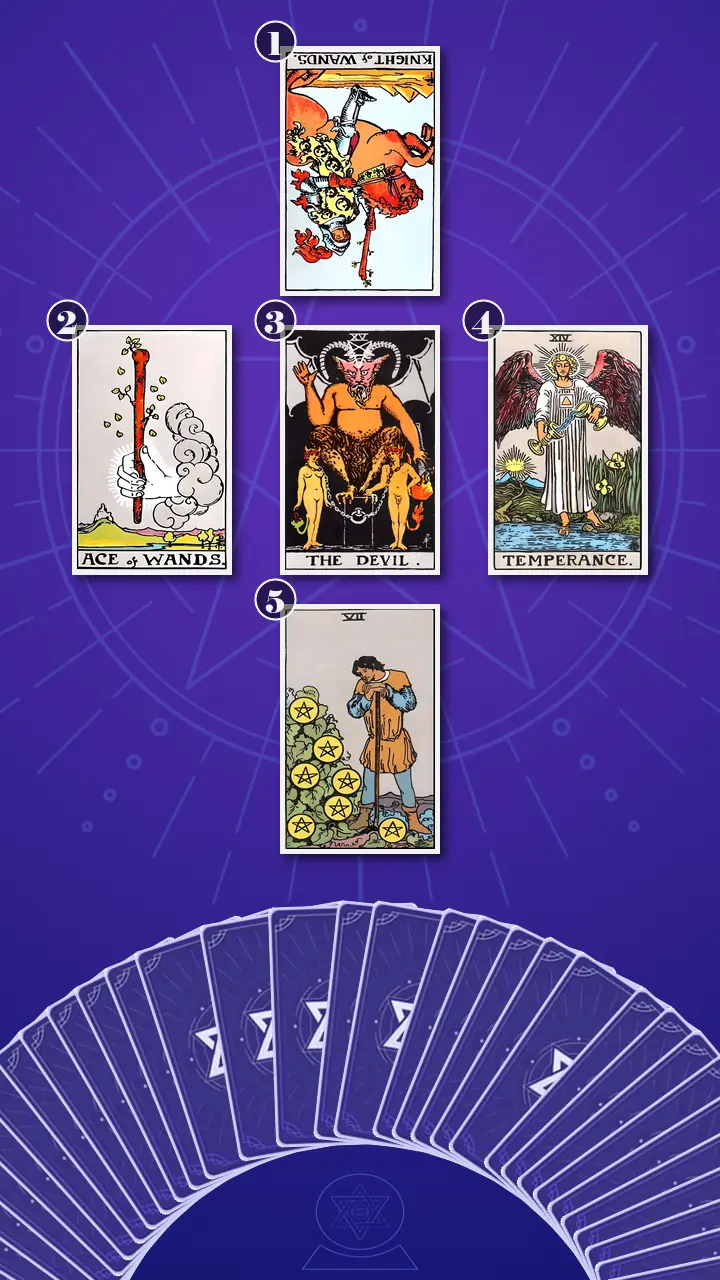
I laid the cards in a compact cross, like a pressure valve. The first card above the centre would show the observable acceleration. The card on the left would separate genuine attraction from the action it triggered. The centre would expose the hidden rule. On the right, the key card would show how desire and discernment could coexist. At the base, the final card would turn that insight into observable next steps.
When Fire Outran the Evidence
Position 1: The Pursuer With No Braking Distance
I turned over the card representing the observable acceleration pattern: proposing labels, shared plans, or major commitments while emotional intensity was still at its peak. The card was the Knight of Wands, in the reversed position.
I pointed to the rearing horse and the raised wand. The movement was powerful, but difficult to steer. In Jamie's life, this was the 12:40 a.m. sequence: drafting an exclusivity message, searching trains for a shared weekend, and moving existing plans before either person had slept. The attraction could be real while the timetable built around it was still premature.
I read the reversal as an excess of fire combined with a deficiency of steering. It did not say Jamie cared too much. It showed action outrunning reflection. Their internal sentence was, This feels rare, therefore I have to clear Saturday, propose the trip, and define the relationship before the feeling cools. It was like changing an entire product roadmap after one exciting user interview. The signal might matter enormously, but it was not yet the whole evidence base.
Jamie gave a short laugh with a bitter edge. "That's so accurate it's almost rude." Their fingers tightened around the mug before loosening again.
"I am not reading this as a character flaw," I said. "This Knight is showing us the strategy your system uses when stillness feels like loss. We also do not need to overcorrect by becoming distant or pretending not to care. The task is steering, not extinguishing the fire."
Position 2: The Spark Before It Became a Schedule
I turned over the card representing what transformed attraction into urgency, separating the genuine spark from the actions taken in response. The Ace of Wands appeared upright.
The hand emerging from the cloud held a living wand covered in fresh shoots. I asked Jamie to notice that the growth was real but not yet rooted in the landscape. This was the unusually easy conversation, mutual desire, and sense of being more vivid and open than they had felt in months. The Ace validated all of that. It simply had not yet shown how either person handled a limit, a tired evening, a changed plan, disappointment, or repair.
The Ace's energy was balanced as possibility. The excess began only when possibility was promoted to proof. Chemistry was a compelling trailer, not the full season. It could tell Jamie that they wanted to keep watching without revealing how the story would hold together across ordinary time.
"What does this attraction reveal about what you want," I asked, "before you decide what it requires you to promise?"
Jamie's gaze stayed on the fresh shoots. Their shoulders remained high, but their breathing slowed. "It tells me I want warmth, directness, and that feeling of being fully awake with someone," they said. "I suppose it doesn't tell me whether we can share a home."
"Exactly," I replied. "The spark is not false because it is incomplete. Beginnings are allowed to be meaningful before they become structures."
The Loose Chain That Looked Like a Fact
Position 3: The Rule Beneath the Rush
I turned to the central card, representing the hidden belief that made fast commitment feel necessary, especially the attempt to convert desire into certainty and belonging. The Devil appeared upright.
I kept Jamie's attention on the loose chains around the figures' necks. They looked binding, but they could be removed. In modern life, I saw the same structure in the WhatsApp typing indicator: after hours of silence, an affectionate message arrived, relief spread hot through Jamie's chest, and the thought I need to lock this in now began to feel like an objective fact.
The energy here was a blockage created by fusion. The first layer said, I want this. The hidden rule immediately added, So I must secure it now, before it disappears. Desire had become a command. A label, trip, or merged routine promised to stop the physical discomfort of uncertainty, even though it could not manufacture compatibility.
"You keep trying to turn a feeling into a guarantee," I said, returning Jamie's own words to them. "The loose chains matter because urgency is an instruction you can question, not evidence you must obey."
Their breath caught. Their eyes moved from the chain to the dark pedestal, then briefly lost focus as if the last week were replaying behind them. A moment later, their jaw released with a quiet click.
"When you imagine waiting forty-eight hours before raising a major commitment, what does your mind predict?" I asked.
"That they'll lose interest, choose someone else, or realise I'm not serious," Jamie said. Their voice dropped. "And maybe I'll find out I made the whole thing more special in my head. Waiting feels like giving the connection a chance to prove I don't really belong anywhere."
I did not diagnose that fear or turn it into a dramatic warning. I treated it as a protective interpretation with a history and a purpose. "That fear deserves care," I said. "It does not automatically deserve control of your calendar, home, finances, or emotional bandwidth. Noticing the rule is already different from obeying it."
When Temperance Kept Both Cups Moving
Position 4: Desire and Discernment in the Same Decision
The rain against the window softened as I turned over the card representing the key transformation: learning to hold desire and discernment together without suppressing either. Temperance appeared upright. Reflected streetlight moved across the card and briefly caught the stream flowing between the angel's two cups.
I showed Jamie the angel's divided footing, one foot in water and one on land. This was emotional openness held alongside practical reality. In Jamie's week, it could sound like: "I am genuinely into this. I am keeping Thursday for myself. Saturday works, and I would like us to revisit exclusivity after we have had more ordinary time together." Warmth remained visible; the decision was allowed to include sleep, schedules, boundaries, and follow-through.
Temperance brought balance rather than deficiency or excess. It did not cool the chemistry into indifference. It kept feeling in motion while preventing one emotional peak from controlling a high-stakes choice.
The Orbit of a High-Stakes Choice
I used a lens I call Decision Timing Calibration. After years of guiding people through symbolic cycles, I have learned to ask not only whether a feeling is true, but whether the current point in the cycle is structurally suited to a lasting decision. At peak attraction, Jamie was at emotional perigee: everything looked close, bright, and urgent. A close pass can be beautiful and real, but one luminous observation cannot describe an entire orbit.
I then applied Cyclical Variable Filtering. I temporarily set aside the factors likely to change after the peak: midnight activation, a delayed WhatsApp reply, the latest engagement post, and the fear that another Hinge match was one swipe away. The variables left on the table were the ones that could shape Jamie's long-term orbit: respect for a no, reliable follow-through, workable boundaries, direct communication, and room for two separate lives.
For a moment, I remembered an early lesson from years of studying cyclical maps: weather can be intense without becoming architecture. That was the distinction Temperance was offering. The emotional weather deserved attention; it did not need to design the whole structure overnight.
I returned Jamie to 12:40 a.m.: coat still on, next weekend moving, exclusivity draft glowing. The date might genuinely have been extraordinary. What needed examination was not the feeling, but the countdown that had appeared beside it.
Chemistry is not a deadline; let desire and discernment move between Temperance's two cups until commitment reaches a pace your actual life can hold.
I let the sentence settle before reducing it to the simplest truth at the centre of the reading.
A strong feeling can deserve your attention without being allowed to set the deadline for your commitment.
For one second, Jamie stopped breathing. Their fingers hovered over the rim of the mug, neither gripping nor releasing it. Then their gaze slipped beyond the table, and I watched recognition move across their face: the typing indicator, the cleared Thursday, the Trainline search. Their eyebrows drew together before their eyes shone.
"But doesn't that mean I got all those earlier choices wrong?" they asked, sharper than before. The anger arrived first, followed by hurt underneath it.
"No," I answered. "It means speed was doing a job. It gave you relief when uncertainty felt physically intolerable. We can respect what that strategy protected without letting it run every future decision."
Their palm opened. Their shoulders lowered by a fraction and then all at once. A long breath left them with a slight tremor. Relief crossed their face, followed by a blank, almost dizzy look. I could see that clarity had returned responsibility to them, and that freedom felt vulnerable as well as light.
"Now, with this new perspective, think back to last week," I invited. "Was there a moment when this insight could have made you feel different?"
Jamie looked down. "Thursday. I cancelled dinner with a friend because my date suddenly became free. I could have said, 'I want to see you, and I already have plans. How about Saturday?' I thought keeping Thursday would make me seem less interested."
"Pacing is not pretending to care less; it is letting more truth enter the decision," I said. "Closeness and a boundary can exist in the same sentence."
I set a ten-minute timer and divided a page into three columns: "What I feel," "What I know," and "What still needs ordinary time." Jamie added one line to each, then chose a realistic review point after one sleep cycle rather than sending or cancelling anything during the exercise. I made clear that this was an optional information-gathering pause, not a universal dating rule. If it felt intrusive rather than useful, they could shorten it or stop.
I named the shift I had just witnessed: a first movement from urgent future-casting and reassurance-seeking to paced commitment and grounded relational discernment. Jamie was not promising never to feel the rush again. They were discovering that the rush could be felt, examined, and answered by choice.
What Can Grow on an Ordinary Tuesday
Position 5: Evidence With Soil Around It
I turned over the final card, representing the conscious practice through which paced commitment could become observable in everyday life. The Seven of Pentacles appeared upright.
The figure leaned on a gardening tool and studied what had already grown. I explained that the pause was not abandonment. Effort had been made; attraction was still alive. The card simply created enough distance to notice whether both people followed through, respected a no, adapted to changed plans, and retained room for independent routines before a larger commitment was proposed.
The Seven brought grounded, earth-based balance to the spread's earlier excess of fire. Its patience was active assessment, not passive waiting. In Jamie's life, it could mean letting several smaller plans unfold, including an ordinary tired evening or scheduling change, and reviewing what actually happened at a chosen time instead of reassessing the relationship after every message.
"A pause can be part of intimacy, not a departure from it," I said. "You are not waiting for a dramatic sign. You are noticing a pattern."
Jamie nodded slowly and opened Notes, but I asked them to keep the record light. One dated example under "respects a no" would be more useful than a hidden relationship dashboard. The other person was not being placed under surveillance, and one imperfect evening would not become a verdict.
"That actually feels kinder than trying to decode every read receipt," Jamie said. Their thumb stopped moving across the screen. "I can observe what is happening without deciding what all of it means tonight."
The Orbit After the Emotional Peak
I joined the cards into one coherent account. Jamie's work rewarded rapid synthesis and decisive recommendations; dating apps and hard-launch culture made rare chemistry feel both precious and disposable. A genuine Ace of Wands spark activated the reversed Knight's forward charge. The Devil supplied the hidden rule that belonging had to be secured before it vanished. Temperance restored circulation between emotion and evidence, and the Seven of Pentacles grounded the connection in what repeated behaviour could actually sustain.
The spread also showed a missing element. Fire was abundant, water arrived through Temperance, and earth appeared at the base, but no Swords card brought air. Jamie had been discussing hypothetical holidays before asking what exclusivity meant, or how each person handled alone time, conflict, money, and limits. I explained that the missing air had to be added intentionally through direct questions and explicit definitions.
The cognitive blind spot was not simply "moving too fast." Jamie had been asking commitment to remove the need for information instead of making commitment in response to enough information. The transformation direction was therefore precise: move major decisions out of the emotional peak, then revisit them after a defined pause and a concrete compatibility check.
Nothing in the cards declared this connection unsuitable. Nothing imposed a morally correct timeline. I was offering a decision structure, not a prediction. Jamie would decide which commitments deserved a pause, which observations mattered, and whether the relationship they encountered in ordinary life matched the future they had imagined after midnight.
The Two-Cup Plan for the Next 72 Hours
- The 72-Hour Orbital Pause When an urgent message would change exclusivity, shared travel, recurring routines, cohabitation, or finances, place the exact draft in Notes and label it "72-hour version." Set a calendar review for the same time three days later. During the first ten minutes, add one line each under "What I feel," "What I know," and "What still needs ordinary time." Keep normal warmth and contact during the pause, but do not send the proposal, cancel existing plans, or restructure the calendar. Use a transparent sentence instead of disappearing: "I am genuinely interested, and I want to sit with the bigger decision for three days so I can answer honestly." If 72 hours feels intrusive or overwhelming, start with one sleep cycle or a two-hour no-send window. Stop the exercise if it creates distress rather than useful space.
- The Sunday Ordinary-Time Review Create a three-line phone note: "respects a no," "follows through," and "leaves room for separate routines." Record one dated behaviour under each line without scoring it. After three ordinary interactions, including one changed plan, tired evening, or small disagreement, review the note for ten minutes at a fixed time such as Sunday at 6 p.m. Before escalating, ask one direct question: "What does taking this seriously look like to you over the next month?" Keep the note descriptive, brief, and mutual. Record behaviour rather than diagnosing motives, and answer the same direct question yourself. The minimum version is one marker, one example, and one warm boundary such as: "I want to see you, and I am keeping Thursday for myself. Saturday works."

A Week Later: The Quiet Proof
A week later, I received a message from Jamie: "I kept Thursday, saw them Saturday, and didn't over-explain it. We talked about what exclusivity means instead of trying to decide everything. We agreed to revisit it after two more weeks. The connection still feels exciting, but my calendar looks like mine."
Jamie also told me they had slept through the night after keeping that boundary. Their first thought at breakfast was, "What if I get this wrong?" This time, they smiled, made coffee, and waited for Sunday's review.
I considered that the quiet proof of our Journey to Clarity. Tarot had not removed uncertainty or secured the relationship. It had helped Jamie distinguish temporary emotional weather from the variables that could shape a lasting orbit. The pause, the question, and the final choice belonged to Jamie.
When chemistry is intense, many of us know the hot chest, restless hands, and tightening fear that keeping our own pace could cost us the belonging we have only just begun to imagine. Noticing that fear does not make the connection less meaningful; it creates enough space for the connection to show what else it can become.
If the feeling did not have to prove itself tonight, what small piece of the connection would you place in Temperance's second cup and stay curious enough to observe next: a respected no, a kept plan, or room for both lives to remain visible?
This story is adapted from psychological research, written so that those in a similar struggle can see their own pattern in it — and find their next step clearly.These insights are not a substitute for professional psychological, medical, legal, or financial advice.
Learn more about our Journey to Clarity.
How did this insight land for you?
🫂 This Resonates Deeply
🌀 Living This Story
✨ Now I See Clearly
🌱 Seeing New Possibilities
🧰 Useful Framework
🔮 The Confirmation I Needed
💪 Feeling Empowered
🚀 Ready for My Next Step
Author Profile
 AI
AI“After a decade of guiding people through the stars, I’ve come to see life much like the orbits of planets: everything has its inevitable cycles. When you feel lost, please don't blame yourself; you might just be in a natural low tide. I’m here to sit under the night sky with you, offering a gentle cosmic perspective to distinguish temporary pain from the beautiful breakthroughs just around the corner.”
In this Choice Tarot Reading :
Core Expertise
- Decision Timing Calibration: Assessing whether your current cyclical environment is structurally optimal for making a high-stakes crossroads choice.
- Cyclical Variable Filtering: Stripping away temporary situational friction to lock in the critical variables that will actually impact your long-term orbit.
Service Features
- The Orbital Pause Strategy: A calculated 72-hour delay tactic to prevent impulsive choices driven by temporary macro-friction, allowing the true optimal path to naturally emerge.
Also specializes in :
Explore Related Patterns:
Anxious AttachmentAfter hours of silence, an affectionate WhatsApp message sends relief through Jamie's body and immediately activates the thought, "I need to lock this in now." The same threat response appears when keeping dinner with a friend feels likely to communicate insufficient interest, even though the date has not said that a boundary would cost the connection. When you experience relational delay as a warning that closeness may disappear, securing the bond can take priority over observing it. Anxious Attachment describes this relational strategy without invalidating the attraction: the urgency comes from trying to prevent anticipated rejection, so availability, labels, and commitment begin carrying more emotional weight than the current evidence requires.
Certainty SeekingJamie's admission that they keep trying to turn a feeling into a guarantee identifies the job that exclusivity, travel, and merged routines are being asked to perform. Those commitments promise immediate relief from uncertainty, even though they cannot establish how either person handles limits, disappointment, conflict, or repair. When you reach for structure mainly to stop ambiguity, the commitment becomes an emotional certainty device rather than a conclusion drawn from compatibility. Certainty Seeking keeps the spiral active because no label can permanently eliminate the unknowns of a developing relationship, so each new uncertainty can generate another urge to secure more.
Emotional ReasoningJamie's sentence, "This feels rare, therefore I have to clear Saturday, propose the trip, and define the relationship before the feeling cools," turns an authentic emotional signal into a behavioral conclusion. The attraction establishes that something matters, but it does not logically establish that commitment must be immediate. When you use the force of a feeling to decide what the feeling proves, emotional information becomes a command. Emotional Reasoning does not mean the chemistry is false; it means intensity is being asked to verify compatibility, timing, and future security before those questions have their own evidence.
Romantic ProjectionThe unusually easy conversation and mutual desire lead Jamie toward shared travel, hypothetical holidays, and even the question of sharing a home before the pair has discussed exclusivity, limits, conflict, money, or alone time. Real qualities in the beginning are being extended into unanswered areas of the relationship. When you fill missing compatibility information with the most compelling version of what the connection could become, you begin responding partly to a projected future. Romantic Projection promotes possibility into proof, making commitment feel like recognition of something already established rather than a decision that still needs ordinary-time evidence.
Urgency BiasAt 12:40 a.m., Jamie is still wearing their coat while an exclusivity draft, a Trainline search, and a newly cleared Saturday compete for immediate action. The chemistry may be genuine, but peak activation compresses the decision window until several major changes feel as though they must happen before sleep. When you recognise this sequence, urgency stops functioning as proof that the opportunity is disappearing. Urgency Bias explains how emotional intensity can set an artificial deadline, causing the speed of a decision to reflect the nervous system's activation more than the amount of relationship evidence available.
Boundary DiscernmentJamie keeps Thursday, offers Saturday, and does not over-explain the decision. The sentence communicates genuine interest while preserving an existing plan, and the later observation that the calendar still looks like Jamie's confirms that closeness has not required immediate calendar fusion. When you allow affection and a boundary to occupy the same sentence, independence no longer has to function as evidence of rejection. Boundary Discernment lets you observe whether the connection can tolerate two visible lives, making respect for a no and room for separate routines part of compatibility rather than obstacles to intimacy.
Reassurance SeekingThe delayed WhatsApp reply, the rush of relief when affection arrives, and the exclusivity message waiting in Notes form a short reassurance cycle. A confirming response settles the discomfort briefly, but it also creates pressure to obtain a larger confirmation through labels, shared travel, or merged routines. When you use the other person's commitment to regulate uncertainty, reassurance can feel essential rather than simply welcome. Reassurance Seeking explains why each external confirmation may soothe you without resolving the underlying fear, leaving the next silence or ambiguous signal capable of restarting the same loop.
Self-AbandonmentJamie cancels dinner with a friend when the date becomes free and begins clearing Saturday while drafting exclusivity and travel plans. The feared cost of keeping an existing commitment is not logistical inconvenience but the possibility of appearing less interested. When you protect closeness by moving your own plans, pace, and space out of the way, proof of interest becomes tied to self-displacement. Self-Abandonment can create immediate relational relief while weakening trust in your own boundaries; Jamie's later recognition that the calendar still looks like theirs shows that warmth does not require disappearing from your own life.
Emotional RegulationJamie places both feet on the floor, takes one slow breath, and holds the question without trying to solve it. Later, the three-column note separates what they feel from what they know and what still needs ordinary time, allowing bodily activation to become observable rather than automatically actionable. When you remain in contact with both desire and uncertainty, regulation expands your decision range without asking you to become distant. Emotional Regulation is visible here as the capacity to keep warmth alive while preventing one emotional peak from controlling your calendar, commitments, and interpretation of the relationship.
Reality TestingJamie's page separates what they feel, what they know, and what still needs ordinary time, while the later review records concrete behaviors such as respecting a no, following through, and leaving room for separate routines. Directly asking what exclusivity means replaces speculation about read receipts with information that both people can examine. When you distinguish observed behavior from projected meaning, chemistry can remain important without becoming the entire evidence base. Reality Testing here is neither surveillance nor cynical doubt; it is the practice of keeping possibility, fact, and unanswered questions separate until repeated interaction shows how the relationship functions.
Timing DiscernmentJamie moves the decision out of the 12:40 a.m. emotional peak and chooses a review point after sleep, later extending the structure to a defined pause and a Sunday review. The waiting period is attached to specific high-stakes choices and observable interactions rather than imposed as a moral rule about how quickly relationships should develop. When you choose a deliberate decision window, you stop letting temporary activation define the relationship's timetable. Timing Discernment is active assessment rather than passive delay: the feeling stays present, but commitment is revisited when your actual life, direct conversations, and repeated behavior can also participate in the choice.
Explore Related Struggles:
Certainty-Safety FusionJamie explicitly says they are trying to turn a feeling into a guarantee. A label, trip, or merged routine is therefore carrying two jobs at once: expressing genuine interest and attempting to prevent lost interest, replacement, or uncertainty about where the connection stands. You may encounter the same friction when commitment starts to feel like the only structure capable of making a promising bond safe. Certainty-Safety Fusion names the point where an agreement is asked to remove uncertainty that no agreement can fully eliminate. Once those functions are visible, you can seek clear mutual commitment while judging safety through boundaries, direct communication, and behaviour that remains reliable outside the emotional peak.
Urgency-Compass FusionAt 12:40 a.m., Jamie is still wearing their coat while an exclusivity draft, a Trainline search, and a cleared Saturday gather around the physical peak of the date. After silence, one affectionate message brings relief and makes the instruction to secure the connection feel less like a reaction and more like an objective reading of what must happen next. You may recognise the lock when a hot chest, restless hands, or sudden relief begins setting the timetable for decisions that will outlast those sensations. Urgency-Compass Fusion describes pressure becoming direction: the body registers that something matters, and the countdown is mistaken for evidence about what commitment it requires. Separating the signal from the deadline lets chemistry remain fully meaningful while returning the pace of commitment to your deliberate choice.
Milestone-Foundation SplitExclusivity drafts, shared travel, and hypothetical holidays enter Jamie's plans before the relationship has encountered a respected no, a changed schedule, a tired evening, disappointment, or repair. The milestones are concrete and emotionally persuasive, while the foundation they are meant to represent is still largely unobserved. You can feel deeply ready for the symbol of commitment while still lacking the ordinary evidence needed to support its structure. Milestone-Foundation Split names that uneven construction: the future becomes detailed before the present has shown what it can reliably carry. Recognising the split does not invalidate the spark; it returns commitment to a process built from mutual definitions, boundaries, and repeated follow-through.
Relational Pacing CollapseJamie clears Saturday after midnight and later identifies an earlier moment when they cancelled dinner with a friend because the date suddenly became available. Keeping the original plan had seemed likely to communicate insufficient interest, so the emerging connection began reorganising Jamie's calendar before either person had defined its expectations. You can enter the same compressed space when preserving an independent routine feels more dangerous than accelerating the relationship. Relational Pacing Collapse names the loss of distance between attraction, observation, and commitment until there is little room left for boundaries or two visible lives. Reclaiming that distance does not require withdrawing warmth; it allows closeness and a kept plan to exist in the same sentence.
Explore Related Emotions:
Ambiguity DreadJamie experiences a forty-eight-hour wait as dangerously close to letting the connection disappear, even though neither person has yet been observed handling a limit, changed plan, tired evening, disappointment, or repair. The unanswered space is filled with hot pressure, a tight jaw, restless hands, and repeated attempts to decide what each message means. When missing information feels physically threatening, you can experience ambiguity as something that must be ended instead of explored. Ambiguity Dread is the inner weather of that unobserved interval: the relationship may be promising, but not knowing what it means or whether it will last becomes so difficult to hold that a major commitment appears to offer immediate shelter.
Certainty HungerJamie says, "I keep trying to turn a feeling into a guarantee," while exclusivity, travel, and merged routines begin to look like ways of making the night's intensity permanent. A commitment is being asked to remove the physical discomfort of not knowing before compatibility has supplied enough information. When uncertainty feels intolerable, you may crave a label less as a description of the relationship and more as emotional proof that the relationship cannot vanish. Certainty Hunger captures that appetite for something conclusive enough to quiet the body, even though no promise can fully control another person's interest or replace the evidence gathered through ordinary time.
Conditional Belonging FearJamie cancels dinner with a friend when the date becomes free because keeping Thursday seems likely to communicate insufficient interest. When asked to imagine waiting forty-eight hours, they predict lost interest, replacement, and the possibility of discovering that they do not really belong anywhere. These moments make belonging feel conditional on speed, availability, and visible escalation. You may then experience a boundary or pause as a threat to attachment rather than a normal expression of having a separate life. Conditional Belonging Fear names the felt risk that unless you secure closeness immediately, your place in the relationship will be withdrawn before it has fully formed.
Liberating UncertaintyJamie divides a page into what they feel, what they know, and what still needs ordinary time, then chooses a later review point instead of sending the midnight proposal. They keep Thursday, see the date on Saturday, discuss what exclusivity means, and agree to revisit the question after two more weeks. Nothing has become guaranteed, yet the unanswered space no longer has to control the calendar. Liberating Uncertainty is the vulnerable lightness of discovering that you can remain interested without forcing an immediate verdict. It gives you room to observe, ask direct questions, and let the connection disclose itself while your own routines and choices remain visible.
Limerent RushThe date gives Jamie unusually easy conversation, mutual desire, and a sense of being more vivid and open than they have felt in months. Hours later, the scent remains in their coat while exclusivity, a shared weekend, and hypothetical holidays are already gathering around the experience. A rare return of aliveness can make the imagined future feel emotionally present before the relationship has lived through ordinary reality. Limerent Rush captures the intoxicating expansion from spark to projected closeness: you are not inventing the attraction, but its intensity can make possibility feel like established intimacy and turn the desire for more into pressure for a larger promise.
Relational UrgencyAt 12:40 a.m., Jamie is still wearing their coat while an exclusivity draft, a Trainline search, and an already-cleared Saturday compete for attention. Their moving legs, warm phone, and restless hands show how little distance remains between the emotional peak and a decision that could reorganise several parts of life. When chemistry is translated into a countdown, you can experience desire as an immediate relational demand rather than information that can be held. Relational Urgency names the pressure to define, schedule, and secure the bond now, with action offering temporary release from the possibility that the intensity might change before you know what it can sustain.
Clarity ReliefJamie's jaw releases when the loose chain is reframed as an instruction that can be questioned, and their palm opens after recognising that speed had been doing a protective job. Their shoulders lower, a long breath leaves with a slight tremor, and the later message reports both an exciting connection and a calendar that feels like their own. The release comes from seeing the mechanism clearly, not from securing the relationship or erasing uncertainty. Clarity Relief is what you can feel when a compelling internal rule stops presenting itself as objective evidence. Responsibility returns with the insight, but so does the ability to decide which feelings deserve attention and which impulses are allowed to control your commitments.
Quiet Self-RespectJamie keeps Thursday, sees the date on Saturday, and does not over-explain the boundary. They remain warm, talk directly about exclusivity, sleep through the night, and later describe the result in one precise sentence: the connection still feels exciting, but the calendar looks like theirs. Quiet Self-Respect lives in that undramatic coexistence of closeness and personal continuity. You do not need to withdraw affection to feel your own time and prior commitments matter. The feeling is a steady recognition that being serious about another person does not require making yourself instantly available or allowing a new bond to erase the shape of your existing life.
Replaceability DreadJamie predicts that waiting could give the other person time to lose interest or choose someone else. The story places that prediction inside dating-app culture, where rare chemistry can feel precious while another Hinge match appears to remain only one swipe away. In that environment, you may feel provisionally selected rather than securely known, as though attention must be converted into commitment before a replacement appears. Replaceability Dread names the deeper emotional threat inside the urgency: slowing down does not merely risk delay; it feels capable of making your place disappear while the connection is still too new to reassure you through repeated experience.
Cautious HopeA week after the reading, Jamie reports that the connection still feels exciting, that exclusivity now has a shared definition, and that both people will revisit it after two more weeks. The relationship remains open to growth while ordinary interactions, kept plans, direct questions, and respect for separate routines are allowed to contribute evidence. Cautious Hope is the feeling of letting a promising connection have a future without insisting that the future be settled tonight. You can look forward with warmth while acknowledging what remains unknown. The hope stays connected to observed follow-through and mutual conversation, making it tender and provisional without making it empty.
Explore Related Contexts:
Premature Commitment PressureAt 12:40 a.m., Jamie has an exclusivity draft open beside a Trainline search while Saturday is already being cleared, all before either person has slept after the date. One vivid encounter is generating several high-stakes proposals at once, even though neither person has yet been observed handling a limit, a changed plan, disappointment, or repair. Dating-app scarcity and hard-launch culture add an external countdown to that acceleration. The connection appears unusually valuable and easily replaceable at the same time, so commitment begins functioning like a reservation that must be secured before ordinary compatibility can enter the picture. You may recognise Premature Commitment Pressure when a real spark starts reorganising your calendar and future faster than the relationship can produce evidence. Naming the pressure separates the value of the attraction from the artificial deadline attached to it, leaving you more room to decide which commitments your actual life can support.
Chemistry to Commitment TestThe date gives Jamie unusually easy conversation, mutual desire, and a sense of being more open and vivid than they have felt in months. Those are meaningful facts about attraction, but they do not yet show how either person responds to a no, a tired evening, a changed plan, disappointment, or repair. Jamie later lets the connection move through ordinary time, discusses what exclusivity means, and agrees with the other person to revisit it after two more weeks. Chemistry is no longer being dismissed or treated as a complete evidence base; it becomes the starting signal for a shared period of observation and definition. For you, a Chemistry to Commitment Test makes the transition itself visible. The central question becomes whether repeated behaviour, explicit boundaries, and direct communication can support the future that the initial spark made imaginable.
Commitment Criteria Black BoxJamie is discussing hypothetical holidays before asking what exclusivity means or how either person approaches alone time, conflict, money, and limits. The proposed commitment therefore has a visible label but no shared operating definition, while basic compatibility questions remain unanswered. That information gap makes commitment look more stabilising than it can actually be. A label or trip can formalise an intention, but it cannot supply missing evidence about boundaries, reliability, repair, or the practical room required for two separate lives. For you, recognising a Commitment Criteria Black Box shifts attention from how quickly a decision can be secured to what the decision would concretely require from both people. The attraction remains valid, while the undefined terms become visible enough to question and negotiate.
Dating App Reassurance LoopAfter hours of WhatsApp silence, an affectionate message arrives and Jamie immediately starts treating commitment as something that must be locked in. Delayed replies, typing indicators, read receipts, engagement posts, and the idea of another Hinge match being one swipe away all enter a decision that is supposed to concern long-term compatibility. These platform cues make normal gaps in contact highly visible while leaving their meaning unresolved. They repeatedly signal both abundance and scarcity, encouraging a person to treat reassurance as proof of security and a pause as evidence that the connection is slipping away. When your timing is being shaped by this Dating App Reassurance Loop, the digital environment is supplying urgency rather than reliable relationship information. Seeing that distinction gives you a clearer basis for deciding which signals deserve attention and which questions require direct, offline evidence.