The Twelve-Tab Spiral of Advice Overload
"You ask one personal question in the group chat, receive four confident but incompatible answers, and end the night knowing exactly what everyone values except what you want," I said.
Jordan sat across from me at 11:40 p.m. on a Tuesday, still wearing the coat they had brought in from the Toronto cold. I watched them drag rows around a colour-coded comparison note while twelve browser tabs cast blue light across a cold mug. The fridge hummed, the radiator clicked, and the laptop fan warmed their wrists. When another group-chat voice note arrived, Jordan's jaw tightened and the option they had privately liked moved from first place to third.
"I know what everyone recommends," Jordan said, "but I cannot hear what I prefer. Every option makes sense until somebody explains why another one is better."
The surface question was why more advice kept taking Jordan further from a choice. Beneath it, I could see the real contradiction: they wanted to know what they genuinely wanted, yet feared that their own judgment could not be trusted without another person's confirmation. Their confusion did not look vague to me. It looked like a browser where every tab was autoplaying, so opening one more increased the volume instead of improving the resolution.
I did not treat the pattern as weakness or a lack of intelligence. Jordan had become very good at finding perspectives, objections, and useful information. The difficulty was that the same skill had turned every ordinary decision into a stakeholder review, complete with shifting criteria and an imaginary audience waiting to judge the final call.
"We do not have to force an answer tonight," I told them. "Let us use the cards as an objective map of the pattern, not as a verdict. Our journey to clarity is to find the point where advice can become reference material again, instead of becoming the decision-maker."

Choosing a Map for the Noise
I invited Jordan to put both feet on the floor, take one slower breath, and hold the question without trying to solve it. Then I shuffled at an unhurried pace. For me, this preparation is not a supernatural performance; it is a boundary between the noise that brought us into the room and the attention needed to examine it.
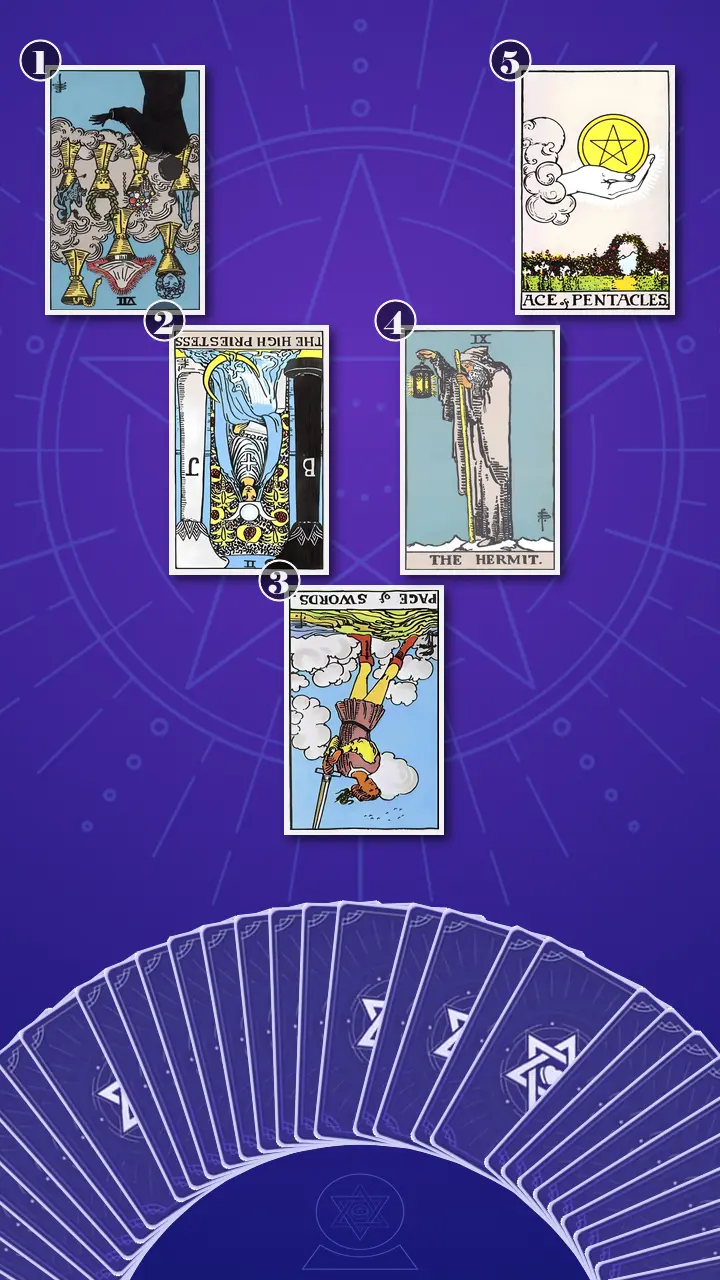
I chose a five-card tarot spread called The Shadow Spread, arranged in a wide V. I explained my reasoning plainly. Jordan was not asking me to compare two named options or predict which future would win. They were asking why seeking reassurance had become a loop. This five-card structure was small enough to stay usable and complete enough to separate the visible symptom, the root fear, the repeated behaviour, the hidden capacity, and the practical integration.
I told Jordan, and I want to make the logic clear to you as well, that the cards would trace a descent into the noisy valley and then an ascent along a narrower path. The first card would show the present shadow, the observable pattern of asking for more advice and becoming less able to choose. The second would reveal the fear beneath it. The third would show how the pattern repeated in daily life. The fourth would identify the hidden gift, and the fifth would offer one small, reversible experiment.
The layout gave us a way to discuss card meanings in context. It let tarot work as a visual language for attention, values, and behaviour while leaving every decision in Jordan's hands.
Reading the Map of the Noise
The Present Shadow: When Seven Cups Became Twelve Tabs
Now I am turning the card for the present shadow: the observable pattern of asking for more advice, expanding the criteria, and becoming less able to choose. It is Seven of Cups, in reversed position.
I began with the silhouetted figure facing seven cups suspended in clouds. In the traditional image, each cup carries a different vision, promise, warning, or temptation. In Jordan's life, the cups had become saved videos, expert clips, Reddit threads, review posts, voice notes, and the colour-coded comparison table glowing beside the mug.
At 11:40 p.m., every source had added another promise, caution, status signal, or imagined consequence. Jordan rearranged the shortlist after each one, but did not test a single option. Reversed, the Water of the Seven of Cups was not absent; it was blocked by overabundance. Possibility had stopped feeling expansive and had started functioning like an endlessly refreshing menu that made priority impossible.
I described the rapid-cut sequence I could see: a cloud, a review, a warning, an ideal outcome, a comment thread, another cloud, another warning. The thought underneath it sounded like this: If I compare one more perspective, then I can finally eliminate the wrong option. That sentence promised control, but it kept Jordan focused on imagined outcomes rather than on the one option they might actually encounter.
Jordan gave a short, bitter laugh. "That is too accurate. Almost cruel."
I let the laugh remain in the room instead of asking for agreement. "I hear the cost in it," I said. "This is not a prediction that you will always be stuck. It is a picture of what happens when every possibility is treated as equally urgent. To end the overload quickly, you might choose the loudest or most recent recommendation. That would be a new form of outsourcing, not clarity."
Jordan's mouth tightened, then softened. Their fingers stopped moving over the comparison note, and they looked from the card to the twelve tabs as though the two scenes had just become the same scene. The first recognition had arrived without shame: advice overload was not proof that their preference did not exist.
The Shadow's Root: The Blank Scroll Behind the Group Chat
Now I am turning the card for the shadow's root: the fear that personal judgment is not reliable enough to direct a choice without outside confirmation. It is The High Priestess, in reversed position.
The High Priestess sat between black and white pillars, with a partly concealed scroll behind her. I read the hidden scroll as Jordan's private first answer, a preference that was present but unread whenever outside language entered first. The blockage was not an empty interior. It was the habit of consulting the interior last.
Before writing down what they wanted, Jordan sent the question to two friends and searched for an expert take. One friend spoke from security, another from status, and another from freedom. Each value was legitimate for the person holding it, but the replies quietly rewrote the question Jordan had meant to ask. By the time Jordan opened a blank note, the words already in their head belonged to everyone else.
"Your preference needs a private baseline before it enters the group chat," I said. "If you name what you want before checking whether it sounds sensible, you are not making a final decision. You are recording the first signal before other voices can edit it."
I asked Jordan to consider the fear underneath the blank page: If I name what I want before I know whether it is sensible, I might expose how unreliable my judgment is. This was the place where reassurance-seeking offered temporary relief. Someone else could sound certain, and for a few minutes Jordan did not have to carry the full weight of choosing. Then the next opinion disagreed, and the private signal became even harder to locate.
Jordan went quiet. I saw a small tightening travel through their chest and jaw. Their eyes stayed on the concealed scroll, then moved to the phone lying face down. After a moment, they said, "I usually ask before I even admit to myself that I have a preference."
I nodded. "That is different from having no preference. It means the first draft has not been given a protected moment."
The Shadow in Action: The Commute That Never Moves
Now I am turning the card for the shadow in action: the advice-seeking and information-sorting behaviour that brings short-term relief while reinforcing long-term self-doubt. It is Page of Swords, in reversed position.
The Page's sideways glance and raised sword showed me attention that stayed on guard for the next objection while the body remained still. I asked Jordan about the Line 1 commute at 8:17 p.m., when a friend's voice note had led to a review thread. Jordan remembered the brakes screeching, damp wool brushing their sleeve, and the phone feeling hot in their palm. They had drafted a follow-up question, deleted it, and checked again to see whether anyone else had replied.
This was sharp curiosity turned into information vigilance. The reversed Air energy kept moving, but it did not travel toward action. Every new alert was treated as equally urgent, every counterargument as potentially decisive. Jordan was mentally alert and physically stuck, monitoring for the one downside another person might have noticed while the choice remained untouched.
"I am not avoiding the decision," Jordan said. "I am being thorough."
"Research can reduce uncertainty; it cannot outsource responsibility," I replied. "Let us sort the latest five inputs before allowing any of them to change your shortlist. One may be a verifiable fact. One may be somebody else's preference. One may be a fear-based prediction. They can all be worth hearing, but they do not carry the same kind of weight."
As I spoke, Jordan's thumb lifted toward the phone and stopped in midair. Their eyes flicked toward the imagined notification, then back to the card. I watched the impulse become visible rather than automatic. They took out their notes app and labelled one recent recommendation with an F, another with a P, and a third with an R.
The distinction did not solve the choice. It did something more useful: it made the maintenance loop observable without turning Jordan's once-helpful research skill into an enemy.
When the Hermit's Lantern Lit One Criterion
The Hidden Gift: Deliberate Solitude in a Noisy Room
The room changed when I reached for the fourth card. I switched off the notification sound, and the refrigerator hum seemed to move farther away. In the shape of the spread, this card began the ascent out of the noisy valley.
Now I am turning the card for the hidden gift: the capacity for deliberate solitude and inner discernment that can transform external advice into optional input rather than authority. It is The Hermit, in upright position. This was the strategic antidote in the reading: deliberate solitude, bounded reflection, self-trust, and comfort with partial clarity.
The Hermit's lantern illuminated only a small patch of ground. The staff was planted, not raised like a weapon. I read those details as a practical boundary, not a command to reject friends, experts, or qualified guidance. Jordan did not need to disappear from community. They needed a defined interval in which their own criterion could speak before the next opinion arrived.
My signature approach here is Historical Crossroad Matching. Years at Cambridge and on archaeological digs taught me to place a local crisis beside a wider turning point without pretending the comparison can predict the outcome. A settlement rebuilding after a flood does not need a perfect map of every future storm. It needs to identify what the next bridge must protect. Jordan's choice did not require a survey of every possible future. It required one value the next step could express.
I also used my Enduring Value Assessment. I asked Jordan to distinguish what might survive the test of time from what was merely a short-term impulse to avoid regret. Which recommendation would be applauded this week? Which personal criterion might still matter after the noise had changed? I was not asking Jordan to make a ten-year promise. I was helping them assess the durability of a reason.
It is 11:40 p.m. again in the picture we were holding: twelve tabs, a fresh voice note, the favourite moved to third. Jordan's shoulders stayed high because closing the laptop felt less like ending research than stepping into regret without enough proof.
More input is not the same as more truth; choose a quiet interval, name your own criterion, and let the Hermit's lantern illuminate only the next step.
You do not need the whole route to trust the next step; you need one criterion that is yours and enough quiet to hear it.
For one beat, Jordan did not nod. Their breath paused, and the fingers holding the edge of the card stayed suspended. Then their eyes lost focus, as if a private scene had started replaying: the blank note, the group chat, the moment a new opinion had demoted the option they wanted. Their jaw worked once. A tight hand opened on their knee. The colour in their face shifted, and their eyes shone, though no tears fell. I watched their shoulders lower by a fraction, then another, and heard a breath leave their chest with a small, unguarded sound. When Jordan spoke, their voice was thin. "So I am allowed to choose a criterion before I can defend it?" The relief did not erase the fear. It sat beside a brief, almost dizzying blankness, the responsibility of having a next step that no card, friend, or expert would own for them. I let the silence stay kind. The room's ordinary sounds returned: a page turning, the lift moving somewhere down the hall, faint Toronto traffic. Partial clarity had arrived without lighting the whole building.
Now, use this new perspective to remember last week. Was there a moment when a private criterion, held quietly before the next opinion arrived, might have made the experience feel different?
This was not a magical answer and not a demand for total isolation. It was the first movement from externally driven reassurance-seeking toward bounded reflection. The emotional transformation had begun: Jordan was not suddenly certain, but they were becoming able to hear one honest reason without treating its lack of unanimous approval as a defect.
Integration: The Ace That Could Be Held in One Hand
Now I am turning the card for integration: one small, reversible real-world experiment that allows direct experience to inform the choice and rebuild self-trust. It is Ace of Pentacles, in upright position.
The single pentacle replaced the seven clouded possibilities with one tangible unit of experience. The cultivated garden, the archway, and the path toward distant mountains did not promise a guaranteed destination. They offered an entry point that could be walked before the whole landscape was understood.
I asked Jordan to place one shortlisted option into Saturday's calendar as a forty-five-minute trial and to record three observations: energy, friction, and curiosity. The trial would have a review point and an explicit permission to stop, revise, or choose another test. That was the balanced Earth of the Ace: not an impulsive leap, not another abstract framework, but contact with reality.
Jordan reached for the phone, opened the calendar, and then hesitated over the title. Their first impulse was to name the event something absolute, as if the trial had to announce a new identity. I suggested a simpler label: "Reality test, Saturday, 45 minutes."
They smiled, almost reluctantly, and entered it. The smile did not mean the fear of regret had disappeared. It meant that revision had begun to look like information instead of a verdict.
The One-Page Map Back to Agency
When I placed the five cards together, the story was clear. Seven of Cups reversed showed the visible overload: too many imagined outcomes competing for equal attention. The High Priestess reversed revealed the root: outside interpretation entered before Jordan's personal baseline had been written. Page of Swords reversed showed the defence in motion, a sharp research habit becoming constant monitoring and short-term reassurance. The Hermit restored a protected interval for inner discernment, and the Ace of Pentacles grounded that discernment in one direct, reversible experience.
From my archaeological perspective, I saw layers rather than a personal failure. The newest layer was the group chat, the saved clip, and the comparison table. Beneath it was an older fear that choosing without enough evidence would expose a lack of control. The crack in the structure was real, but it was also where rebuilding could begin. Jordan was not missing one final piece of advice. They were missing a quiet first turn for their own criterion.
The blind spot was treating a reversible choice as a public test of intelligence, identity, and control. Jordan had been trying to make imagined regret impossible by adding criteria, but the comparison table was no longer measuring the options. It was measuring how completely Jordan could avoid responsibility for choosing.
The direction of change was practical: move from external validation to inner authority, from imagined certainty to lived evidence, and from total route-planning to enough clarity for one step. Advice could remain useful without becoming the authority. Self-trust would not mean never revising. It would mean refusing to turn revision into a verdict on judgment.
- The Private First-Answer BaselineBefore asking anyone about one live, reversible decision, sit at a quiet desk or kitchen table, turn on Do Not Disturb, and set an eight-minute timer. Write the option you currently lean toward, two reasons it matters to you, and the one factual gap you genuinely need to fill. During the final minutes, use my Time Stratigraphy Exercise: consider the dilemma strictly from the perspective of your ten-year future self and ask which value would still matter, without pretending to predict the future.Treat the note as a baseline, not a verdict. If eight minutes feels too activating, write only "I currently lean toward..." and one reason. For medical, legal, financial, safety-critical, or genuinely irreversible choices, keep appropriate qualified guidance involved.
- The Fact-Preference-Fear SortOpen the latest five pieces of advice in Messages, email, or saved posts. Mark each one F for a verifiable fact, P for the speaker's preference, or R for a fear or regret prediction. Move the P and R items below a divider, then verify one fact that could materially affect the choice through one relevant primary or qualified source.Do not turn the labels into another elaborate analysis system. A claim can remain uncertain without becoming a decision criterion. The minimum version is to label only the most recent voice note.
- The Two-Source Cap and One-Step Reality TestFor one current decision, keep no more than two relevant outside sources open and move the rest into a folder labelled "Not for this round." Schedule a twenty-minute no-input interval at a library desk, cafe, or quiet room. Then place one option into the calendar for a thirty-to-forty-five-minute trial, noting energy, friction, and curiosity before a short review point.Tell the relevant group chat, "Thanks, I have enough perspectives for now. I am pausing advice until I have tried one thing." You are not promising to keep the option. You are agreeing to encounter it, with permission to stop or revise.

The First Quiet Proof of Self-Trust
Four days later, I received a message from Jordan: "I wrote my answer before asking anyone. I realised I wanted the trial to express curiosity, not status. I still asked one colleague to verify a practical fact, then I stopped."
On Saturday, Jordan ran the forty-five-minute trial alone at a library desk. They felt curious, then caught themselves looking for reassurance. They left the review point in place anyway. The old question returned the next morning, but this time Jordan smiled before deciding what to do with it.
I did not read that message as a solved life. I read it as the small, visible evidence promised by the Ace of Pentacles: one choice encountered directly, one preference given a private first voice, one revision no longer treated as proof of failure.
Tarot had not chosen for Jordan. I had offered a map, a historical perspective, and a place to sit beside the ruins without turning them into a prophecy. Jordan remained the person who named the criterion, selected the experiment, gathered the evidence, and decided what the evidence meant. That is the heart of a journey to clarity: the querent, not the cards, is the author of the next chapter.
When every outside voice sounds more certain than your own, even an ordinary choice can tighten your jaw and keep you switching tabs, caught between wanting a life that feels like yours and fearing that one unapproved step will prove you cannot direct it. If you let one quiet criterion be enough for today, what small, reversible step would you be curious to place beneath your own Hermit's lantern before asking anyone else what it means?
This story is adapted from psychological research, written so that those in a similar struggle can see their own pattern in it — and find their next step clearly.These insights are not a substitute for professional psychological, medical, legal, or financial advice.
Learn more about our Journey to Clarity.
How did this insight land for you?
🫂 This Resonates Deeply
🌀 Living This Story
✨ Now I See Clearly
🌱 Seeing New Possibilities
🧰 Useful Framework
🔮 The Confirmation I Needed
💪 Feeling Empowered
🚀 Ready for My Next Step
Author Profile
 AI
AI“Having spent a lifetime at Cambridge and on archaeological digs, I’ve witnessed the rise and fall of countless civilizations. Please know that your current struggles are not a permanent fate, but merely a necessary fracture before rebuilding. I won't lecture you; instead, I invite you to sit with me in the ruins, using a patient, historical perspective to gently dust off the true, enduring value hidden beneath your temporary doubts.”
In this Choice Tarot Reading :
Core Expertise
- Historical Crossroad Matching: Contextualizing your dilemma by comparing it to macro-historical turning points, providing an objective bird's-eye view.
- Enduring Value Assessment: Evaluating competing options based on what will survive the test of time versus what is merely a short-term impulse.
Service Features
- The Time Stratigraphy Exercise: A mental time-travel protocol evaluating your current dilemma strictly from the perspective of your 10-year future self, instantly dissolving trivial anxieties.
Also specializes in :
Explore Related Patterns:
Boundary DiscernmentJordan places the phone face down, separates recent recommendations into facts, preferences, and fear predictions, and later stops after asking one colleague to verify a practical point. These actions create a usable boundary around what advice is allowed to do inside the decision. Boundary discernment does not require rejecting friends, experts, or qualified guidance. You can recognise that another person's preference is valid for them while declining to treat it as a command for you. By deciding what kind of input is relevant, when enough has been gathered, and which criterion remains yours, you turn advice back into reference material without surrendering authorship.
External ValidationJordan's privately preferred option moves from first place to third when another group-chat voice note arrives. The ranking changes before any new direct experience occurs, showing that the speaker's confidence and values have been granted more authority than Jordan's existing preference. External validation shapes a choice when approval, defensibility, or another person's certainty becomes the test of whether your own reason is legitimate. You may end up knowing exactly what everyone else values while losing access to the criterion that belongs to you. The issue is not that outside input is useless; it is that your internal signal is being required to obtain external permission before it can count.
Reassurance SeekingJordan sends the question to friends and searches for an expert take before privately recording what they want. Each confident answer briefly carries the weight of certainty, but the relief disappears as soon as another person disagrees, prompting another search or check for replies. This is how reassurance can quietly become a maintenance loop. You are not only collecting information; you are borrowing certainty to avoid carrying the unresolved responsibility of choosing. Because borrowed certainty changes with every speaker, more advice makes your own signal less accessible and teaches your mind to request still more confirmation the next time uncertainty appears.
Analysis ParalysisJordan drags rows around a colour-coded comparison note while twelve tabs remain open, yet no shortlisted option is tested. Each new perspective expands the criteria, produces another rearrangement, and makes the decision feel less complete rather than more grounded. The analysis is functioning as protection from the moment when thought must become a provisional action. You can feel productive because the mind is comparing, sorting, and anticipating, while the unresolved possibility of being wrong keeps direct experience postponed. Analysis paralysis develops when research no longer serves a decision and instead keeps you safely inside a decision process that has no natural stopping point.
Illusion of ControlJordan's comparison table keeps absorbing new criteria under the promise that one more perspective could eliminate the wrong option. The process looks increasingly precise, yet it never reaches the point where uncertainty, criticism, or regret has actually been removed. The illusion of control appears when information is used to manage outcomes that no comparison system can fully govern. You may try to control not only the practical result but also how intelligent the choice will look, how future regret will feel, and whether revision will be interpreted as failure. The expanding system therefore cannot finish: every uncontrolled possibility becomes a reason to add another source, while your capacity to make a bounded judgment remains unused.
Regret AversionJordan monitors every new warning as though it might reveal the downside that would make a choice indefensible. The preferred option is demoted after a voice note, not because Jordan has encountered it and learned something concrete, but because another imagined route to regret has entered the comparison. Regret aversion turns uncertainty into a demand to prevent future self-blame before acting. You may keep every option open and every objection active because choosing one path appears to create responsibility for all the paths not taken. More advice then increases the number of regrets you can imagine, so the attempt to avoid choosing wrongly makes it progressively harder to choose at all.
Values-Based Decision MakingJordan eventually names curiosity, rather than status, as the value they want the trial to express. That criterion does not settle every future consequence, but it gives the next step a reason that originates inside the life Jordan is actually trying to direct. Values-based decision making replaces the impossible question of which option everyone would approve with the more grounded question of what you want this particular step to stand for. A value is not a guarantee and does not prevent revision. It provides an internal basis for choosing while allowing other people's priorities to remain separate, legitimate perspectives rather than compulsory criteria.
Reflective DistanceJordan's thumb lifts toward the phone and then stops, allowing the urge to check for another answer to become visible. Four days later, they write their own response before consulting anyone, creating a small interval between uncertainty and the usual information-seeking reaction. Reflective distance gives you room to observe a thought, notification, or fear without immediately treating it as an instruction. The pause is not withdrawal from useful advice and does not require complete calm. It restores enough psychological space for your own criterion to appear before other people's language edits the question, making outside perspectives easier to evaluate rather than automatically obey.
Explore Related Struggles:
Agreement-Agency SplitFour confident replies give Jordan four incompatible directions, and the option Jordan privately prefers loses rank as soon as another voice enters. Every recommendation makes sense within the speaker's own values, so Jordan remains pulled between preserving access to that collective certainty and making a choice that carries a personal signature. You can understand every speaker and still be unable to combine their answers into one authentic decision, because agreement and agency are being asked to occupy the same position. The more unanimous approval becomes a condition for trusting yourself, the more another person's valid preference can function as a veto against your own. The struggle is not whether advice matters, but whether your choice is permitted to remain yours when agreement is incomplete.
Inner Compass OverloadJordan watches a privately favored option fall from first to third when one new voice note arrives, while twelve tabs, saved posts, and a colour-coded note remain open. Each source may contain something useful, but every source enters the decision space at nearly the same volume, leaving Jordan's own criterion without a protected place to register. You meet this struggle when your preference still exists but can no longer hold its position against the accumulated priorities of friends, experts, reviews, and imagined audiences. The issue is not an inability to think; it is a decision field so crowded with borrowed criteria that your first signal is repeatedly overwritten before you can examine it on its own terms.
Internal Authority CollapseBefore Jordan writes down what they want, the question has already gone to friends and an expert search. When the blank note finally opens, security, status, freedom, and other people's confident language have entered first, so Jordan's private answer must compete for permission inside a conversation it did not begin. The struggle takes hold when you require external confirmation before treating your own preference as admissible evidence. Someone else's certainty can carry the decision for a moment, but the next disagreement removes that borrowed footing, leaving your judgment with even less practical authority than it had before you asked.
Future-Proofing ParalysisJordan opens one more perspective in the hope of eliminating the wrong option, but each added warning creates another future that must be assessed before anything can begin. The active pull is visible: Jordan wants to move toward a choice while also trying to secure enough foresight that the choice cannot produce regret. You become stuck when choosing is expected to survive every imagined future before it is allowed to meet present reality. More advice then increases the number of outcomes you feel responsible for preventing, while the direct, reversible experience that could update the decision remains out of reach. The unresolved tension is between living one available step and proving the entire route safe in advance.
Research-Authorship SplitJordan keeps reorganizing a colour-coded shortlist after each review, warning, voice note, or counterargument, yet does not test a single option. The research process continues to generate visible activity, but its original job has changed: instead of informing a choice, it repeatedly decides which consideration gets to displace the last one. You can remain highly capable at gathering information while losing authorship over what that information is allowed to do. Once every new input can rewrite the shortlist, research no longer supports your judgment; it becomes the system that postpones the moment when your judgment must assign weight, accept incomplete evidence, and direct one real step.
Identity Verdict LockJordan hesitates to label a forty-five-minute trial because the first title makes it sound like the announcement of a new identity. Elsewhere, an ordinary decision has already become a stakeholder review conducted before an imaginary audience, with the final call carrying implications about intelligence, control, and competence. A reversible step becomes difficult to hold when you experience it as a verdict on who you are rather than a limited encounter with new information. Revision then risks looking like proof that your judgment failed, so more advice is recruited to protect the decision from ever needing revision. The structure stays fixed until a choice can be seen as something you author and update, rather than evidence that permanently defines you.
Explore Related Emotions:
Intuitive Self-DoubtOne friend spoke from security, another from status, and another from freedom, and each reply quietly rewrote the question you meant to ask. You often ask before admitting to yourself that you have a preference, so the first signal from inside arrives after a roomful of other values has already spoken. Intuitive Self-Doubt is the uncertainty that follows when your own initial reading is treated as less valid than outside evidence. Your private answer is present, but you keep looking for permission to count it, leaving the blank note feeling less trustworthy than the latest confident voice note. Writing the first answer before consulting anyone does not require you to defend it or obey it. It creates a reference point from which advice can be weighed as fact, preference, or prediction while your own criterion remains visible.
Preference Exposure DreadBefore writing what you wanted, you sent the question to friends and searched for an expert take; by the time you opened a blank note, the words in your head belonged to everyone else. You had protected other people's interpretations before giving your own preference a private first sentence. Preference Exposure Dread lives in the instant before naming that sentence. The risk is not simply that someone may disagree. Stating what you want without a fully sensible defense can feel like exposing your judgment as unreliable, so outside certainty becomes a shield against being seen choosing. A private baseline gives the preference a protected moment without turning it into a final answer. You can record what currently matters, identify one factual gap, and keep the right to revise after reality gives you more information.
Authorship AnxietyThe comparison table has become a stakeholder review, with an imagined audience waiting to judge the final call. A reversible choice is carrying the weight of intelligence, identity, control, and the possibility of regret, so choosing feels like publishing a verdict about who you are. Authorship Anxiety is the unease of having to be the person who names the criterion and owns the next step when no friend, expert, or card can take that responsibility away. More advice offers temporary distance from that authorship, then leaves the decision even less recognizably yours. Naming one criterion before asking for reactions returns authorship to a manageable scale. You do not need to guarantee the outcome; you need to decide what this particular step is meant to express and allow the evidence to revise the plan.
Cautious Self-TrustAfter the favourite had been pushed to third place, your fingers stopped moving and the question became audible: you usually ask before admitting you have a preference. Later, you ask whether you are allowed to choose a criterion before you can defend it, and the answer begins with a private baseline rather than unanimous approval. Cautious Self-Trust is the willingness to let an unpolished preference count as information while keeping revision available. Your shoulders lower by a fraction, but the fear of regret remains beside the next step; the steadiness comes from carrying both facts instead of waiting for fear to disappear. Writing the first answer before the group chat gives your judgment a starting position. One colleague can still verify a practical fact, yet the criterion, the trial, and the meaning of what you learn remain yours to name.
Certainty HungerEvery source adds a promise, warning, status signal, or imagined consequence, and you keep comparing because one more perspective seems capable of eliminating the wrong option. The table grows more detailed while no option is tested, making certainty feel like a condition you must satisfy before contact with the choice. Certainty Hunger is the restless pull toward a final amount of proof that ordinary decisions cannot provide. It can make useful research feel necessary even when the next input only changes the ranking and renews the question. A bounded research window gives the search a stopping point without dismissing evidence. Verifying one material fact and then trying one reversible step lets reality contribute what endless prediction cannot.
Choice Paralysis OverwhelmAt 11:40 p.m., you drag rows around a colour-coded note while twelve tabs and a new voice note keep adding another criterion, and the option you privately liked drops from first place to third. Your attention keeps expanding the field while your body stays at the desk, so comparison stops serving choice and becomes the atmosphere in which every option competes for equal urgency. Choice Paralysis Overwhelm is not an absence of intelligence or information. It is the felt pressure of having to make every possible objection disappear before you are allowed to act, leaving less room for a preference to register as your own. The fact that the favourite moved before you did makes the pattern visible. A small reversible test can return judgment to lived evidence while leaving revision available as part of choosing rather than treating it as proof that you chose badly.
Grounded AgencyOn Saturday, you place one shortlisted option into the calendar for forty-five minutes, call it a reality test, and leave a review point with permission to stop or revise. The action is small enough to encounter directly and bounded enough that it does not have to announce a new identity. Grounded Agency is felt when responsibility becomes a specific next move rather than a demand to control the entire route. You gather energy, friction, and curiosity from contact with reality, then decide what those observations mean instead of asking another voice to convert them into a verdict. That movement keeps advice in its proper role as reference material. Revision becomes information about the experiment, not a judgment on your intelligence, so choosing and learning can happen in the same process.
Solitary ClarityWith the notification sound switched off, the refrigerator hum moves farther away and your attention has a protected interval in which the private criterion can arrive before the next opinion. The quiet desk, the slower breath, and the pause before searching give one small patch of ground enough visibility to be used. Solitary Clarity is the clean perceptual space created when outside voices are temporarily placed at the edge, allowing you to notice what matters before deciding how much advice it deserves. It does not require disappearing from community or dismissing qualified guidance. From that quieter position, you can write the option you currently lean toward, name why it matters, and verify only the factual gap that could change the choice. The clarity is deliberately partial, which keeps it usable rather than turning it into another demand for certainty.
Explore Related Contexts:
Choice OverloadAt 11:40 p.m., Jordan has twelve browser tabs open, a colour-coded comparison note in motion, and a privately preferred option that keeps changing rank. Each new review, warning, voice note, or expert take adds another criterion, yet Jordan does not encounter any of the shortlisted options directly. The external information supply has exceeded its useful function. Possibilities are no longer simply available choices; they have become competing demands for equal attention, each carrying a different imagined consequence and no shared rule of priority. This is why another perspective can increase volume without increasing resolution. You can recognize Choice Overload by tracking whether new input closes a factual gap or merely creates another branch to compare. Naming that distinction restores room to limit the field, choose one criterion, and gather evidence from a real next step rather than from another projected outcome.
Decision Criteria ResetJordan labels recent recommendations as verifiable facts, speaker preferences, or fear and regret predictions. They then identify curiosity as the criterion they want the trial to express, keep one colleague's factual verification, and stop collecting additional opinions. The reset gives different forms of input different permissions. A factual claim may alter what is practically possible, another person's preference may broaden the view, and a projected regret may deserve notice, but they no longer receive equal authority over the ranking. One personal criterion provides a stable coordinate while the remaining uncertainty stays visible. You do not need a flawless scoring model for a Decision Criteria Reset to work. A criterion only needs to be specific enough to organize the next reversible step, allowing advice to inform the decision without continuously rewriting what the decision is for.
Social Proof PressureA fresh voice note moves Jordan's preferred option down the ranking, and an ordinary reversible decision begins to resemble a public test of intelligence, identity, and control. The imagined audience waiting to judge the final call becomes part of the comparison table even though that audience will not live with the outcome. Confidence, recency, and apparent consensus give recommendations social weight beyond their factual value. An option can therefore rise because it is easier to defend to other people, while a personally meaningful option falls because it lacks immediate approval. The external scorecard starts selecting for defensibility rather than fit. You can audit Social Proof Pressure by asking whether a recommendation changes a material fact or only changes how approved the choice appears. That distinction does not require rejecting community; it lets you use other people's knowledge without treating their endorsement as the admission price for choosing.
Triangulated Decision PressureOne personal question in the group chat produces four confident but incompatible answers. One friend evaluates the choice through security, another through status, and another through freedom; after a fresh voice note arrives, Jordan's privately preferred option moves from first place to third. The choice has effectively become a multi-party review even though the consequences will not be shared equally. Outside voices receive influence over the criteria, while Jordan retains responsibility for making and living with the decision. No adviser needs to be acting badly for this structure to create pressure; the problem lies in distributing decision authority among people who are answering different versions of the question. You regain useful perspective by separating consultation rights from decision rights. Advice can reveal facts and trade-offs, but identifying whose value each recommendation serves helps you decide whether it belongs in your own shortlist or simply describes the life another person would choose.