Decision Cross: From Protecting a Preferred Choice to Testing One Risk

The Decision Cross at 8:47 PM
I told Jordan (name changed for privacy), 'You are a 27-year-old early-career operations coordinator in Toronto, and you keep rebuilding the case for the option you want most whenever a warning appears.' I said it gently, because I could already feel how much effort had gone into making that choice feel defensible.
I knew the scene from the way Jordan described it. At 8:47 PM on a Tuesday, I pictured them on the TTC Line 1 train northbound from downtown, one hand wrapped around a warm phone while the brakes squealed through the carriage. An Apple Note titled 'Why this makes sense' held every benefit in neat order; when a new tab mentioned a serious drawback, Jordan's thumb closed it before the paragraph ended.
'I want an honest answer,' Jordan said, looking down at the note, 'as long as it does not change the answer I want.'
I heard the real question underneath: What risk do I keep missing in the option I want most? The contradiction was not between wanting and not wanting. It was between the bright pull of the preferred option and the risk Jordan kept leaving unnamed, untested, and just outside the frame.
I watched the feeling arrive in the body before the reasoning began. The chest tightened as if the train had suddenly lost air, breathing became shallow, and restless fingers searched for another confirming review. Hope was still there, warm and quick, but apprehension sat across it like a hand pressed against a locked door.
'I do not hear dishonesty in this,' I said. 'I hear a person trying to protect a meaningful possibility from the pain of finding out what it might cost. Wanting it is data, not proof. We can let the desire stay real while we give the risk a shape. Today, our Journey to Clarity is not about making the choice for you. It is about drawing the whole doorway so you can decide what you can consciously carry.'

Choosing a Compass, Not a Verdict
I asked Jordan to put both feet on the floor, take one slow breath, and focus on the exact question rather than the outcome they hoped I would confirm. I shuffled slowly while they listened to the cards move, using the small ritual as a psychological transition from rehearsing an argument to observing one.
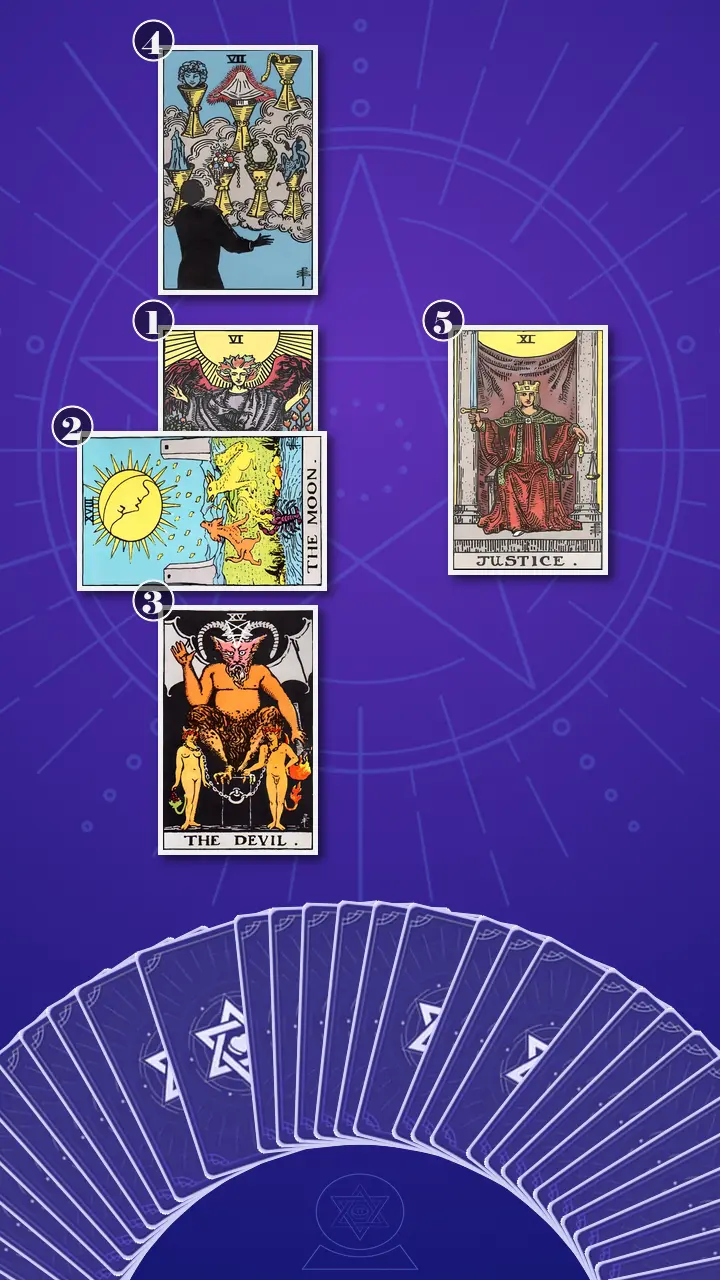
Today, I used a classic spread called the Decision Cross. In this reading, tarot is not a prediction machine or an outside authority. It is a structured way to place a preference, a blind spot, an attachment, an imagined promise, and a grounded choice in the same visible frame. That is how I explain how tarot works through a Jungian psychological lens: the images give shape to material the conscious mind has been editing.
I chose the Decision Cross because it is the smallest classic cross structure that can hold this exact tension. A Celtic Cross would have opened wider questions that Jordan had not asked. This spread keeps the focus on the preferred option, the risk crossing it, the fear underneath it, the future image keeping it compelling, and a self-authored practice for integration. It does not decide an outcome. It makes the reasoning easier to inspect.
The first position would show the present choice and visible pull. The second would reveal the crossing risk, the warning or cost Jordan kept outside the frame. Below the centre, the third would show the underlying attachment and fear. Above it, the fourth would reveal the conscious promise. The fifth would provide an integrating decision practice, a way to move from selective research toward evidence-based self-trust.
The Map Starts With the Pull
Position 1: The Choice That Feels Like Becoming
Now I am turning the card for Present choice and visible pull: the option Jordan wants most and the behaviour of repeatedly building its case. The card is The Lovers, in upright position.
I brought the card into a modern scene. At 9:05 AM in a Toronto coworking space, Jordan had described the preferred option to a colleague with unusual warmth. The language became more certain, the future sounded more like the person Jordan was becoming, and the choice felt aligned with their values. When the colleague asked about maintenance costs or the exit route, I could see the question land personally, as if doubt were criticism of Jordan's judgment rather than information about the option.
The open figures beneath the angel showed me a meaningful alignment, not a shallow impulse. The mountain between them was the real-world trade-off that could not be wished away simply because the decision felt like a career-pivot montage, the polished moment when a new direction seems to prove that life is finally moving into alignment. The energy here was balanced in its values connection but excessive in identification. The deficiency was distance between 'I want this' and 'this is workable.' When those two sentences fuse, a serious caveat can feel like an attack on the self who chose.
'Which part is genuine value alignment?' I asked. 'And which part is the relief of finally wanting one clear path? What specific future or version of yourself are you describing when you explain this option to someone else?'
Jordan did not nod. They gave a short laugh with a bitter edge, then rubbed one thumb along the phone case. 'That is almost rude,' they said. 'It is too accurate.'
I welcomed the resistance. 'Good. You do not have to agree with the card to make it useful, and you do not have to abandon the option because it matters to you. We are separating attraction from proof, not shaming attraction.'
Position 2: The Warning That Keeps Returning
Now I am turning the card for Crossing risk: the warning, assumption, or cost Jordan keeps leaving outside the frame. The card is The Moon, in reversed position.
At 10:16 PM, I imagined Jordan opening a Google search for the preferred option's downsides, reading three contradictory posts, and closing the comparison because no page offered a clean verdict. The vague warning stayed in the body as restless hands and shallow breathing, but it never became a sentence such as, 'This cost could make the option unworkable.' The Moon reversed is that half-formed concern emerging from the water and then being pushed back into ambiguity.
This is not a prophecy and it is not proof that the desired option is wrong. The energy is blocked uncertainty, with a deficiency of translation and an excess of atmosphere. Jordan senses that something matters, then treats the absence of perfect certainty as a reason to stop checking. The winding path disappears into more tabs, the caveat becomes an uncomfortable mood, and the question remains untested.
I said, 'Research becomes avoidance when every caveat closes the tab. What is the most credible downside you stop investigating when it appears in a review, a conversation, a spreadsheet, or a terms page? Write it in one plain sentence. Do not make the risk disappear; give it one honest sentence.'
Jordan's hand moved toward the phone, then stopped halfway. Their fingers tapped twice against the table before they looked at me. The warning had not become larger, but it had become more specific, and specificity made it possible to examine rather than merely fear.
The Loose Chain Beneath the Research
Position 3: The Bargain Beneath the Choice
Now I am turning the card for Underlying attachment and fear: the value threat that makes naming the risk feel like surrendering control. The card is The Devil, in upright position.
In the foundation of the choice, I saw a quiet bargain. Jordan believed that naming a serious downside could force them to give up the option they wanted most, so temporary certainty was purchased with an untested cost. The sentence beneath the research loop sounded like this: 'If I question this too hard, I may talk myself out of the only path that feels right.'
The Devil's energy was a structural blockage. The attachment was not necessarily to the option itself; it was also to the promise of control, relief, identity, or a clean new beginning. The loose chains around the figures mattered more to me than the horned figure above them. The restraint felt fixed because Jordan believed honest scrutiny had to end in surrender. The chain was real as a belief, but it was not sealed.
I pointed to the loose links. 'This is the difference between the option being desired and the option having to be defended. What do you believe you would have to give up if you wrote the serious risk in plain language? Is that loss evidenced, or has the fear been charging you for it in advance?'
Jordan's breath paused first, and the pen remained suspended above the blank cost column. Then their eyes lost focus, as if the closed caveat tab, the supportive messages, and the unfinished note were replaying together. Finally, a low 'Oh' left their throat; their shoulders dropped, and their fingers loosened around the pen.
'I keep calling it research,' Jordan said, 'when I am really looking for permission.'
I did not turn that sentence into a verdict. I let it stand as information. In Jungian terms, I was not treating the shadow as something bad that had to be defeated. I was helping Jordan bring the hidden bargain into consciousness so it could stop operating as an invisible rule.
Position 4: The Future With the Admin Edited Out
Now I am turning the card for Conscious promise: the imagined benefit or idealized outcome that keeps the preferred option emotionally compelling. The card is Seven of Cups, in upright position.
During a Sunday evening scroll, Jordan imagined the clean version of life that would follow the preferred option: the satisfying job title, calmer routine, better apartment, or clear feeling of momentum. The picture was vivid enough to overpower questions about workload, maintenance, timing, and opportunity cost. I could almost see the polished day-in-the-life video playing on one screen while the Google Sheet with unanswered cost questions sat minimized behind it.
Seven of Cups carried an excess of projection and a deficiency of practical comparison. The solitary figure faced seven emotionally charged futures, each one bright enough to become persuasive evidence. Jordan was comparing an imagined best case with the visible uncertainty of other paths, so ordinary maintenance began to look like a flaw in the alternatives rather than a normal part of any choice.
'Which image is doing the most persuasive work?' I asked. 'Are you looking at the option as it exists today, or at the most flattering future attached to it? What practical detail is missing from that picture?'
Jordan glanced at the Seven of Cups and then at the unfinished page. Their mouth tightened, not with rejection this time, but with the effort of holding two truths together: the future image was genuinely exciting, and it was still an image. I told them that hope did not need to be deleted. It only needed a seat beside the terms.
When Justice Put the Risk on the Same Page
Position 5: The Scale That Keeps the Door Open
Now I am turning the card for Integrating decision practice: the evidence-based self-check that lets Jordan examine desire without outsourcing the choice. The card is Justice, in upright position.
The room became quieter when I placed Justice to the right of the cross. I could hear the radiator click and, farther down the street, a single streetcar bell. The upright sword and balanced scales did not promise a painless answer. They offered proportion, accountability, and a way to hold attraction and consequence in the same frame.
Justice was the antidote to the whole pattern. Its energy was balanced discernment: a clear-eyed question in one hand, and a page that refused to let the benefit column erase the cost column in the other. The red robe and stone throne gave the card steadiness, while the double-edged sword separated verified facts from imagined outcomes. The message was practical: weigh appeal, credible risk, evidence, and reversibility before asking desire to prove the entire case.
I used one of my signature lenses here, Fear-Driven Logic Decoupling. I separated the authentic desire, 'I want this,' from the subconscious fear-driven conclusion, 'If I name the risk, I lose it.' That separation changed the decision matrix. It allowed the preference to remain meaningful without allowing fear to write the rules around it.
Then I used Hidden Cost Deconstruction. I asked Jordan to identify the emotional bill attached to each option: the fear of regret, the fear of losing control, the pressure to prove good judgment, and the practical cost that could actually be checked. A hidden cost is easier to work with once it stops arriving as one enormous feeling and becomes a few named questions.
The card was now ready for its central sentence. I could feel Jordan trying to solve the old problem by making the future look inevitable. They imagined the bright doorway, but their hand was still covering one side of the frame; the warm phone, closed caveat tab, and unfinished downside note were all asking for the same honest look.
You do not protect your preferred option by hiding its risk; you honor your agency by placing desire and consequence on Justice's balanced scales and choosing what you can consciously carry.
I let the silence remain for a moment, then gave the insight its more practical shape.
The option you want most deserves scrutiny, not protection. Wanting it can stay true while you check its cost, evidence, and reversibility; the choice is still yours after the risk has a name.
First, Jordan's thumb stopped over the phone. Their breath caught high in the chest, and the fingers that had been rubbing the case held perfectly still. Second, their eyes left my face and went soft, as if the closed caveat tab, the Apple Note, and every reassuring message were replaying at once; I saw the old sentence move through them: If I question this too hard, I may lose it. Third, a low 'Oh' came from the back of their throat. Their shoulders dropped a fraction, the fist around the pen opened, and a long breath moved all the way down. The release was real, but it carried a brief, dizzy blankness: if no one else could certify the choice, Jordan would have to meet the evidence as themself. A streetcar bell rang beyond my window, clean and ordinary. Jordan's eyes shone, not with a promised answer, but with the first space in which an answer could be made. I stayed quiet long enough for that space to belong to them.
'Now, use this new lens to revisit last week,' I said. 'Was there a moment when this insight could have made you feel different?'
Jordan thought of the colleague asking what would happen if the timeline slipped. They thought of the review they closed, the friend they asked to confirm that the choice still sounded sensible, and the moment temporary relief had masqueraded as evidence. This was the key shift from narrowing attention around a desired option to self-authored discernment grounded in evidence, consequences, and reversibility. It was not certainty. It was the first small movement from protecting a desired choice with confirming evidence to letting the whole doorway become visible.
The One-Page Justice Balance Check for Finding Clarity
I read the five cards as one connected story. The Lovers showed why the option mattered: it carried values, identity, and the hope of becoming someone more aligned. The Moon reversed showed the risk Jordan could sense but would not translate into a testable question. The Devil revealed the bargain beneath the selective research: temporary certainty in exchange for leaving the cost unnamed. Seven of Cups showed the polished future doing persuasive work above the decision. Justice supplied the practice that could bring all of it down to earth.
The cognitive blind spot was not simply that Jordan had missed a risk. I saw them treating the discomfort of scrutiny as evidence that scrutiny was dangerous or unhelpful. The deeper question was not, 'How do I make this option feel risk-free?' It was, 'What fact would genuinely change my view, and what can I test without locking myself into an outcome?'
The Decision Cross tarot spread had not told Jordan to choose the preferred path or abandon it. It had shown that a bounded decision could exist without perfect certainty. Self-trust is not never doubting yourself; it is knowing what you would check when doubt arrives. Desire can sit at the table with consequence.
The Next Ten Minutes, and the Next Forty-Eight Hours
I gave Jordan two pieces of actionable advice. I kept them deliberately small because clarity becomes less useful when it turns into another impossible performance.
- Write one honest downsideI asked Jordan to open a fresh Apple Note called 'One honest downside' this week and write one specific, credible risk of the preferred option in plain language. Then they would choose one directly relevant source or one person with direct experience, ask one narrow question, and record three lines: 'What I know,' 'What I am assuming,' and 'What would genuinely change my choice.' The full check would stop after ten minutes.If the first sentence feels too large, write only one sentence and set the timer. Use one relevant source, not five reassuring tabs. The choice remains Jordan's, and the check can be paused at any point.
- Run the Shadow Choice ExperimentI asked Jordan to use my 48-hour paper exercise, the Shadow Choice Experiment. For two days, they would write as if they had intentionally chosen the most feared alternative, without spending money, sending a resignation, moving, or making any irreversible commitment. They would note which defense mechanisms appeared, what loss the mind predicted, and which feared consequence belonged to the preferred option rather than the imagined alternative.Keep the experiment on paper and give it a clear boundary. If shallow breathing or restless hands become too strong, stop, put both feet on the floor, and return later. The aim is to reveal the defense beneath the paralysis, not to force a real-life decision.
'You are not trying to talk yourself out of the option,' I said. 'You are testing it as a hypothesis. A reversible step, one cancellation term, one informational conversation, or one narrow question can produce useful information without demanding a verdict. If the choice involves legal, financial, health, or immigration consequences, use this as an organizing exercise and verify the material facts with a qualified professional.'

A Small Proof, Not a Perfect Answer
Three days later, I received an iMessage from Jordan: 'I wrote the downside, asked the narrow question, and checked the exit terms. The cost is real, but it is not the catastrophe I was avoiding. I still want the option. I also know the boundary that would make me walk away.'
Jordan told me the next morning, 'The doubt was still there when I woke up. I asked, What if I am wrong? Then I looked at the note and started the reversible step anyway.' The choice had not become spotless. It had become more honest, and honesty gave Jordan something firmer than reassurance to stand on.
I did not remove the risk from Jordan's life, and I did not claim that the cards had solved the future. I helped Jordan place desire, cost, evidence, and reversibility on the same page. That was the Journey to Clarity: moving from selective research and outsourced permission toward a self-authored decision that could remain open to new information.
When you want one option so badly that your chest tightens at the first serious caveat, it can feel safer to protect the hope than to find out what the choice would actually cost you. You are not weak for feeling that pull. You may simply be standing at a bright doorway with one side of the frame still covered.
If you could let the option remain wanted while naming one credible thing that would change your view, what would you gently write down first on your own Justice page?