A Late-Night Ex Text, Three Drafts, and a Boundary Before Replying

The 11:38 p.m. Doorway: Why One Text From an Ex Pulls Me Back In
I recognized the particular pressure in Jordan (name changed for privacy): a 27-year-old hybrid marketing coordinator in Toronto who could handle a campaign launch, a packed calendar, and a full evening alone, then reread one late-night ex text until the wording had turned an ordinary evening into breakup relapse anxiety.
At 11:38 p.m. on a rainy Saturday, I watched Jordan stand in the kitchen beside a cooling mug. The phone was warm in their palm, the refrigerator hummed beneath rain on the window, and a short iMessage check-in from the ex glowed above the saved thread. Jordan reread it, checked the timestamp, opened Apple Photos Memories, looked at the ex's profile, and returned to Notes, where three versions of a reply waited.
They looked up at me. One message should not have this much power over me, they said. Then they asked, Why does one text from my ex pull me back in? They wanted to move forward and protect a present-day boundary, yet the familiar wording made old closeness feel one reply away.
I could see longing in the way their thumb kept moving before their judgment could catch up: it was like an Apple Photos Memory opening an entire emotional apartment in their chest before they had chosen to browse it. Uncertainty, grief, and hope crowded the same small screen.
I told Jordan I would not use the cards to guess what the ex secretly meant, predict the relationship, or turn their reaction into a character flaw. We would use the images as a structured mirror for the trigger, the need underneath it, the notification-to-reply loop, and the boundary still available. Our Journey to Clarity would move from notification-triggered longing, uncertainty, and relationship rumination toward compassionate self-nurture, present-day discernment, and a self-directed contact boundary. The choice would remain Jordan's.

Choosing a Map for the One-Touch Reentry
I asked Jordan to put the phone face down, take one slow breath, and focus on the question rather than the ex's possible intention. I shuffled slowly. The small ritual was not a test of belief; it was a psychological threshold between reacting to a notification and observing what the notification had activated.
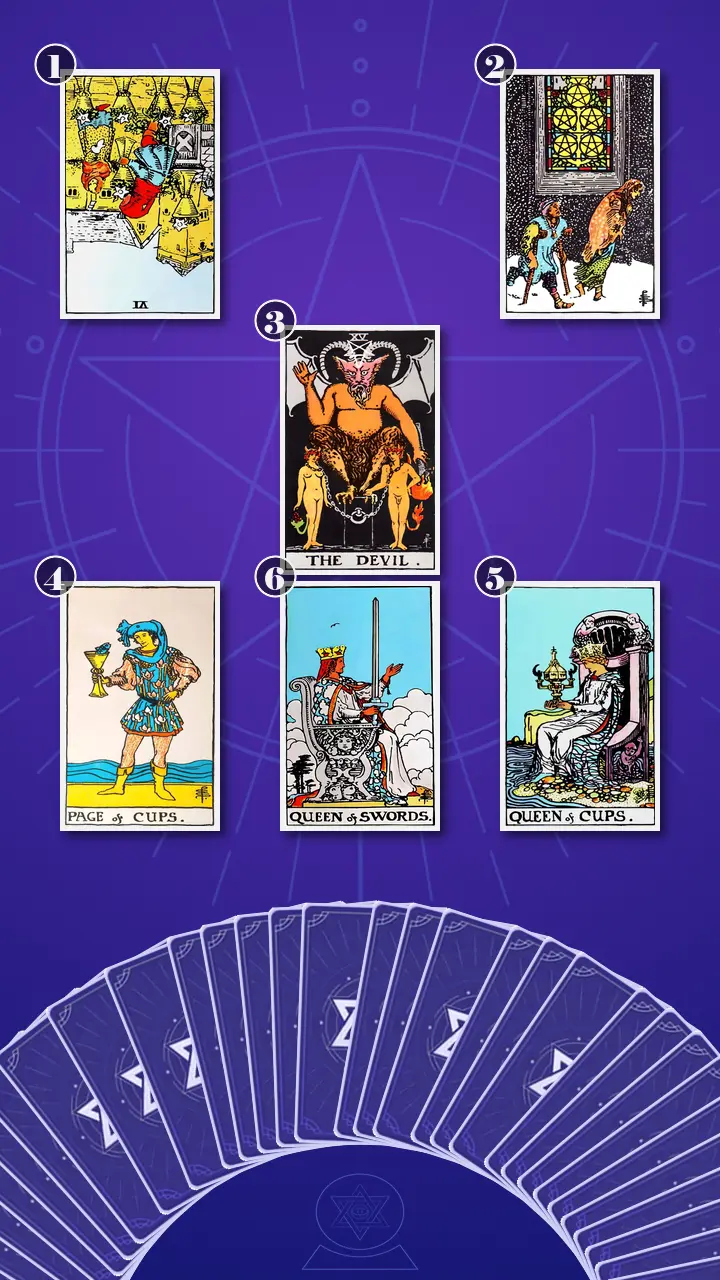
For this relationship question, I chose the Relationship Spread - Context Edition, a six-card cross. Its rationale is simple: this is a question about relational reentry and a boundary pull, so I needed a compact structure that could show the immediate response, the care the message appears to promise, the attachment dynamic in the center, the emotional hook, the missing inner resource, and a self-directed next step.
I also explained the limits of the method. The second position would translate the care Jordan perceived in the contact, not claim access to the ex's private thoughts. The final position would guide Jordan's own communication or non-communication choice, not predict the future of the relationship. For anyone wondering how tarot works in a reading like this, the cards provide visual prompts for observable behavior and inner patterns; facts, boundaries, and decisions still belong to the person holding the question.
The first card would show the immediate response before deliberate judgment arrived. The second would ask what warmth or belonging the message seemed to promise. The center would make the notification-to-reply loop visible, while the lower cards would show the emotional cue, the self-nurturing antidote, and the clear boundary that could follow.
Reading the Message Before It Becomes a Verdict
The Thumb That Went Backward
Now turned over is the card representing the immediate response to the ex's text, including the observable rereading, checking, and urge to reply identified in the presenting problem.
The card was the Six of Cups, in reversed position.
In the Rider-Waite-Smith image, one child offers another a flower-filled cup while the remaining cups hold their own small bouquets. Behind them, a snowy path leads toward a distant home. I held the card beside Jordan's phone and asked what it meant for an old emotional home to become visible again through one familiar sentence.
I translated the picture into a scene Jordan knew well: 8:47 p.m. on Line 1 heading north from a downtown Toronto office, the fluorescent carriage lights buzzing, the phone warm in their hand, and one check-in reopening the old thread. The thumb moved into Apple Photos Memories before Jordan had chosen to revisit the relationship. The flower-filled cups became old photos, saved voice notes, inside jokes, and the remembered tenderness that still looked warm on a screen.
Reversed here showed an excess of nostalgia and a blockage in present-day clarity. The emotional water was flowing backward, so familiarity briefly felt like current access to care. I said that the card was not calling Jordan childish or telling them to erase the past. It was asking what need had been activated before familiarity became a reason to re-enter. Familiar is not the same as reliable.
I used the Apple Photos scene as the central analogy. I asked Jordan to notice the difference between the message itself and the emotional room it opened. They answered quietly, I know this is one message, but my body is already back in that room.
Jordan did not nod. First, their breath stopped halfway and their thumb hovered above the old photo. Then their gaze went unfocused, as if a memory had begun replaying behind the screen. Finally, a short laugh escaped, sharp with bitterness rather than amusement. They looked at me and said, That sounds too accurate, maybe even a little cruel.
I answered that accuracy did not have to become another weapon. The Six of Cups was giving us recognition, not a verdict. A memory could be tender, and the longing could be honest, without either one proving that the present relationship context had changed. Jordan lowered the phone a few inches. That small movement was the first sign that remembered care could be observed without immediately being obeyed.
The Warmth Jordan Could See but Not Hold
Now turned over is the card representing the care, reassurance, or belonging the message appears to promise, revealing the Nurture Deficit and the underlying fear of being left without reliable care.
The card was the Five of Pentacles, in upright position.
The Rider-Waite-Smith image showed two figures moving through snow beneath a glowing stained-glass window. One leaned on a crutch; the other carried a bandaged foot. The window made warmth visible, but the figures remained outside in the cold. I told Jordan that this was not a reading of the ex's private energy. It was a picture of what a brief check-in could appear to offer to someone who had been standing too close to the need for dependable care.
Upright, the card carried the energy of deficiency and exposed lack. Jordan could be functioning well through hybrid work, campaign meetings, and ordinary Toronto evenings, yet a casual message could feel like a sudden patch of warmth. A patch of warmth can be real in the moment without being a structure that keeps someone warm. One notification can soothe the fear of being left without care for a few minutes while leaving the larger need untouched.
I asked, What form of care or belonging does this message seem to promise, and where does that promise exceed what the actual words clearly offer? Jordan looked down at the mug and said, Maybe I am missing the care more than I am missing the relationship.
I watched their fingers loosen around the cup. Their shoulders stayed raised, but the grip changed. I asked them to let the fear that being left without reliable care might say something about their worth be present as a fear, not treat it as evidence. The Five of Pentacles did not say Jordan was unworthy of belonging. It showed the emotional cold that made one small light seem like the only visible shelter.
The Chain Made of Small Clicks
Now turned over is the card representing the attachment dynamic created between one notification, old memories, longing, and the rapid-response loop described under Attachment Issues.
The card was The Devil, in upright position.
The central figure rose above two people with chains around their necks. The chains looked serious, but they were visibly loose. That detail mattered. The card showed bondage and repetition, not an unavoidable fate. A notification could feel like an external command even when a pause remained possible.
At this point, I brought in my signature Attachment Loop Diagnosis. The name sounds clinical, so I explained exactly how I was using it: not to assign Jordan an attachment style, diagnose the ex, or declare a deep insecurity as fact, but to logically examine whether the relationship friction was being driven by an anxious-avoidant trap or by an older fear of unreliable care. I wanted to map the mechanism before assigning it meaning.
The chain became specific: notification, rereading, timestamp check, profile check, friend consultation, draft, possible reply. One message behaved like an autoplay queue, serving the next memory, the next online clue, and the next imagined conversation before the original signal had settled. I heard Jordan say, If I decode this perfectly, I can finally calm down.
My Jungian lens treats an archetypal image as a way to bring a hidden pattern into observation, not turn it into destiny. Having traveled across cultures, I have learned how a familiar word can feel like a doorway when someone is far from home. Looking at the loose chains, I had the same thought: recognition can orient a person, but it cannot prove that the room beyond is dependable for their present life.
I pointed to the space between each link. The short-term relief of replying could lower loneliness and uncertainty, while the longer effect could be more rumination and a weaker boundary. The message was a trigger, not an external command. Jordan's index finger stopped above the profile icon. Their eyes moved from the card to the phone, and for the first time the sequence looked like a series of links rather than one unstoppable impulse.
The Fish Inside Three Words
Now turned over is the card representing the exact emotional cue that makes one text feel powerful, such as familiar wording, tenderness, or the imagined possibility of being seen again.
The card was the Page of Cups, in upright position.
A fish emerged from the Page's cup, surprising the figure who held it. The blue tunic patterned with water lilies and the open shoreline gave the image a receptive, imaginative quality. I translated the fish into the unexpected emotional payload inside an ordinary-looking message: a nickname, an inside joke, or a soft phrase that made three words feel like the opening scene of an entire future conversation.
Upright, the Page showed genuine emotional openness and sensitivity. Its energy became excessive only when imagination ran ahead of evidence. I told Jordan that the feeling could remain real without settling what kind of contact they wanted. Tenderness was information about what mattered to them; it was not proof that the old bond had become consistent.
I asked what exact detail had turned the check-in into a doorway. Jordan mentioned a familiar phrase and the punctuation the ex used to add when they once wanted comfort. I watched their mouth soften at the memory, then their jaw tighten as the imagined conversation expanded. The Page of Cups was the messenger between nostalgia and self-awareness: it preserved Jordan's capacity for tenderness while making room to ask whether the message offered anything clear beyond the feeling it stirred.
When the Queen Held the Cup
The room went quiet when I reached for the lower-right card. Even the rain seemed to thin, and I turned it over slowly.
The Covered Cup Before the Reply
Now turned over is the card representing the missing inner resource that can interrupt the loop: compassionate self-nurture, emotional containment, and the ability to meet the activated need before seeking relief through contact.
The card was the Queen of Cups, in upright position. This was the spread's catalyst and its Antidote.
The Queen sat beside moving water, holding an ornate covered cup with complete attention. She was not denying the contents, broadcasting them into an instant reply, or asking another person to prove their value. Her upright energy was balanced emotional receptivity: feel the longing, contain it long enough to hear it, and choose from awareness rather than urgency.
Here I used my Shadow Projection Analysis as a gentle question rather than a conclusion. Could an older unmet need for reliable care be projected onto this small contact, making the ex's words carry a promise the actual message did not contain? The question did not make Jordan's feeling imaginary. It separated the ex's observable behavior from the triggered internal narrative and left room for both tenderness and discernment.
I asked Jordan to complete the sentence frame, The message activated ____, and what I need tonight may be ____. They took a breath and said, The message activated reassurance and belonging, and what I need tonight may be steadiness that does not depend on an immediate answer.
Before the concentrated moment, I named the principle beneath the card: One text can reveal a real need for care without proving that returning to the old bond will meet it. Let the feeling be evidence of what matters to you, not evidence that the ex is the only place to find it.
For the setup, I brought us back to 11:38 p.m. in a Toronto apartment. The phone glowed beside a cooling mug while the fridge hummed. I watched Jordan read the same check-in again, their chest tighten, and open the old photo folder while wondering whether answering could bring back care.
You do not have to mistake a familiar cup for a reliable source of nourishment; hold the feeling with the Queen of Cups, name what you need, and choose contact only if it matches your present boundary.
For a second, Jordan's breath stopped halfway, and the hand holding the phone hovered above the table. Their eyes widened at the sentence, then lost focus as if the old thread had begun replaying behind the screen. I saw their jaw tighten; I heard a swallow, followed by a small, unsteady laugh that carried more grief than amusement. Their thumb turned the phone face down. The shoulders lifted toward their ears dropped a fraction. Their fingers released the mug one by one, and the skin around their eyes grew pink. I asked nothing while Jordan breathed. Then they said, So I can want reassurance without making this message my only route to it. Relief arrived, but it brought a brief, dizzying blankness: if the ex was not responsible for filling the space, Jordan would have to choose what care looked like now. They inhaled more slowly, and the blankness did not become an emergency. It became room. I watched their face hold tenderness, grief, and a careful new responsibility at once.
I asked, Now, using this new perspective, can you recall one moment last week when this insight might have made the evening feel different? Then I offered a ten-minute experiment: put the phone face down, set a timer, and write one sentence beginning with I need before choosing whether to continue, mute the thread, ask for support, or reply.
That was not a promise of closure. It was the first crossing from notification-triggered longing, uncertainty, and relationship rumination toward compassionate self-nurture, present-day discernment, and a self-directed contact boundary. The Queen of Cups did not ask Jordan to stop caring; she asked them to stop handing the first response to the notification.
The Raised Sword and the Plain Sentence
Now turned over is the card representing the self-directed integration step: translating the named need into a clear boundary or deliberate communication choice without predicting the ex's intentions or deciding the relationship's future.
The card was the Queen of Swords, in upright position.
The raised sword cut a clean line against an open sky. A butterfly appeared on the throne, a small reminder that discernment can grow out of lived experience without becoming emotional coldness. After the water, snow, and shadow of the earlier cards, the image introduced air: language, space, and the ability to separate the fact that a message arrived from the story that the old relationship had become dependable again.
I asked Jordan, What did the notification make hard to remember, and what do you know when you are not answering under pressure? In Notes, they wrote, I am open only to clear, consistent contact. They read the sentence twice, then added, I am not available for late-night check-ins.
Jordan did not send either sentence. They saved them. That was not avoidance or punishment; it was a deliberate choice not to improvise a boundary while the emotional temperature was high. I told them that a boundary could be drafted, muted, sent, or revised. The important change was that the notification no longer set the terms of the evening. Let the message be information, not an instruction.
Finding Clarity in the 30-Minute Pause
When I read the six cards as one story, the reason became less mysterious. The reversed Six of Cups showed the past arriving through a familiar phrase. The Five of Pentacles showed the cold beneath the nostalgia: the fear of being left without reliable care. The Devil exposed the notification-to-relief chain, while the Page of Cups showed the tender detail that kept the chain attractive. The Queen of Cups supplied a way to hold the need, and the Queen of Swords gave that need plain language.
The center of the spread was not the ex's hidden intention. It was the pattern: a small signal activated longing, longing searched for care, checking briefly lowered uncertainty, and immediate contact risked making the old bond vivid again. The cognitive blind spot was not that Jordan cared too much. It was treating the intensity of the body as evidence about the reliability of its source and treating more digital evidence as the route to calm. Familiarity and reliable care had become fused.
The key shift was practical: pause before replying, name the need the text activates, offer steady care in the present, and choose a reply or boundary without outsourcing emotional regulation to the ex. You can miss the care without reopening the relationship. This Six-card Relationship Spread - Context Edition for tracing an ex-text attachment loop gave us a way to see that sequence without predicting anyone's feelings or making a major decision for Jordan.
For the actionable advice and next steps, I brought in my Projection Detachment Exercise. It is a private, structured journaling practice for separating the ex's actual behavior from the triggered narrative, then checking what care is available now.
- The 30-Minute Reentry PauseWhen a message from the ex arrives, whether between campaign meetings or after midnight, set a 30-minute timer before reopening the thread. Put the phone face down, keep Apple Photos and the ex's profile closed, and write a one-sentence activated-need note beginning with The message activated ____. When the timer ends, ask whether replying would meet that need or only lower uncertainty for a few minutes. Reply, mute, ask a trusted friend for support, or keep waiting; each is a self-directed option.If thirty minutes feels too exposed, start with ten. A pause is not a promise of no contact; it is the space where your own boundary becomes audible.
- The Projection Detachment ExerciseAfter one triggering text, open a private Notes page and spend ten minutes writing four lines: What happened, using only the observable words and time; What do I feel in my body; What story or fear am I adding; and What do I need that is not yet a decision about contact? Do not decode the ex's motives. Finish with a two-source care check: one small act for the body, such as food or a shower, and one present-day source of connection, such as calling a trusted friend for ordinary company.Use one word for the feeling and one for the need if a long explanation feels overwhelming. The note can stay private; emotional honesty does not have to become a message.
- The Boundary Sentence TestBefore the next notification, write one Queen of Swords sentence in Notes: I am open only to clear, consistent contact, or I am not available for late-night check-ins. When the ex actually texts, compare the observable message with the sentence. If contact aligns, a clear reply is available; if it does not, muting, saving the draft, or not replying are equally deliberate choices. If Jordan replies, one clear sentence is enough.Write the boundary while calm, not while the phone is glowing at midnight. Keep it protective rather than punitive, and do not send a second message just to repair the discomfort created by waiting.

A Week Later, the Quiet Proof
Four days later, I received a message from Jordan: They texted at 10:12 p.m. I used the timer, wrote reassurance in the note, and took a shower with the phone face down. I decided not to answer that night. I did not decide the whole relationship.
Jordan slept through the night, but woke with the first thought, What if I am wrong? They smiled at the question, made coffee, and let it remain a question rather than an emergency. The clarity was small, a reply not sent and a need named, but it belonged to them.
That was the quiet proof of the Journey to Clarity. The cards did not remove longing or choose a future; they helped Jordan hold tenderness alongside discernment long enough to make a present-day contact choice. Jordan, not the spread, became the person steering the doorway.
When one familiar text makes your chest tighten, it can feel safer to chase the old warmth than to face the fear that being left without steady care says something about your belonging. The Queen of Cups gave that fear somewhere gentle to sit without letting it choose the next move.
If you let the longing sit beside you for ten minutes, with the phone face down and the Queen's covered cup in mind, what small form of steady care would you want to notice before deciding whether the conversation belongs in your evening?