Chasing a Slow Fade on Line 1—And a Saturday Plan of Their Own

Chasing a Slow Fade on Line 1
You know you are chasing, but you do not know what you are chasing anymore. I met Jordan, a 28-year-old early-career communications coordinator in Toronto who looked capable in every ordinary part of life except the one open message thread that had started to govern their evenings.
Jordan told me about 8:47 p.m. on a northbound TTC Line 1 train. The carriage rocked through the tunnel, brakes squealed at the station, and the phone in their palm had grown warm from being checked so often. They watched the other person’s Instagram activity, reopened a casual follow-up in drafts, and tried to read meaning into the silence between one shorter reply and the next.
They said, "Why do I keep chasing a slow fade instead of letting go? I know I am chasing, but I do not know what I am chasing anymore. Maybe they are just overwhelmed, and I should give it one more day. If I let go now, I will never know whether I quit too soon."
I could see longing as a small metal hook behind their sternum. Each quiet stretch tugged it forward, while their restless hands searched the phone for something solid to hold. The ache was followed by a heavy drop every time the screen showed no new notification.
I said, "You are not foolish for wanting the connection to matter, and you do not have to turn this into a verdict about either of you. Let’s look at the pattern carefully. Our goal today is not to force an ending or predict a return. It is to draw a map through the fog, so you can choose what your attention serves."

Choosing a Map Through the Slow Fade
I asked Jordan to place the phone face down, feel both feet on the floor, and take one unhurried breath. I shuffled the cards slowly. For me, this small ritual is a psychological threshold: it gathers attention from the scrolling mind and brings it into the room, without asking anyone to surrender their judgment to mystery.
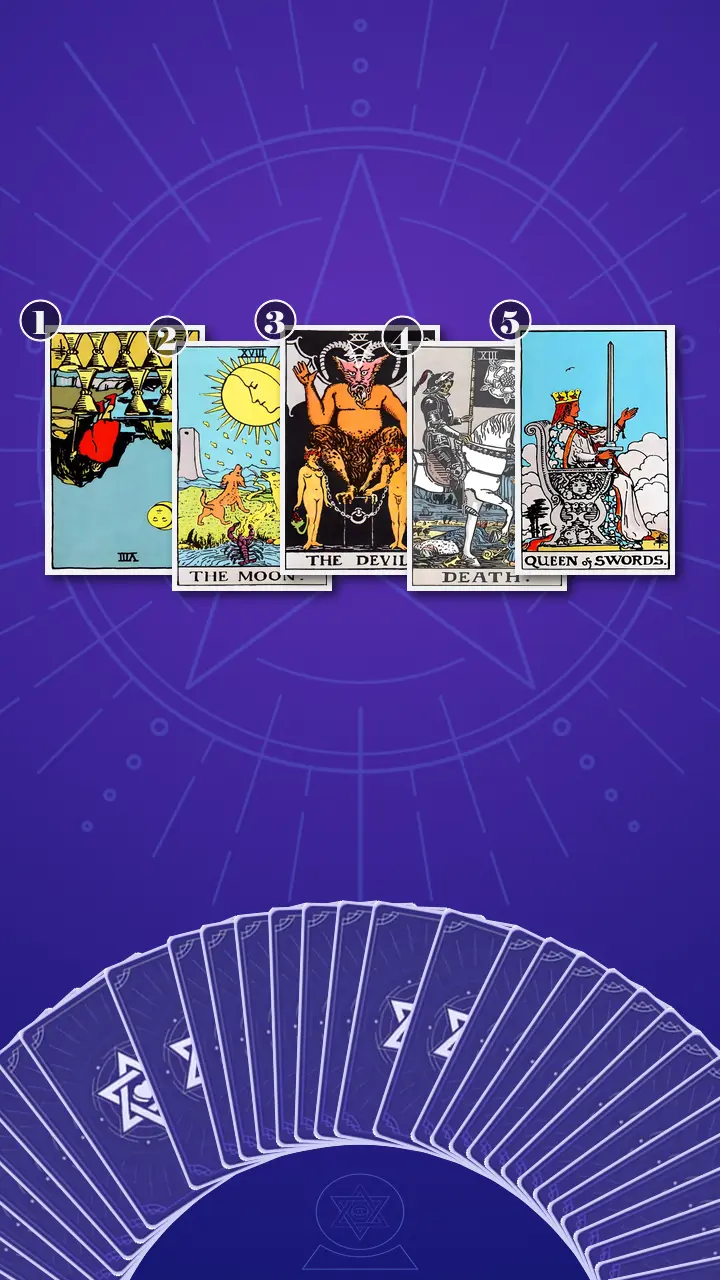
Today I used The Shadow Spread · Context Edition, a five-card Shadow Spread for relationship self-exploration. It fits this question because the problem is not simply what another person intends. The useful question is why repeated checking, rereading, and low-pressure follow-ups keep happening even when contact is thinning. The spread lets us examine the visible behavior, the hidden fear beneath it, the attachment bargain that keeps it running, the release available from that pattern, and one conscious practice for daily life.
I explained the path to Jordan and to anyone reading along: the first card would show the observable slow-fade behavior; the second would expose the inner conflict that makes letting go feel harder than chasing; the central card would name the existential drift and the belief hidden inside the loop. The fourth card would act as the transformation hinge, and the final card would turn insight into a bounded next step. This is how tarot works here: not as a forecast, but as an objective language for seeing card meanings in context.
Reading the Shoreline Path
The Reopened Chat: Eight of Cups Reversed
The first position asks me to reveal the observable slow-fade behavior: reopening messages, checking for signs of contact, and sending another low-pressure follow-up instead of letting go. Now I turn over the Eight of Cups, in reversed position.
I described the modern scene the card brought forward. Jordan closes the message thread after another short reply, places the phone face down, and returns to it before the kettle has finished boiling. The connection no longer feels emotionally full, but the uneven stack of old warmth and recent silence makes departure feel premature. The cloaked figure looking back becomes the person who walks three steps away from a chat, then reopens it to see whether the notification badge has changed.
The reversed energy is blocked movement. The natural impulse to leave an emotionally thin situation keeps turning back toward the cups. That return offers a quick lift because it creates the feeling of doing something, but it also keeps Jordan organized around a connection that is not currently offering clear reciprocity. A slow fade is still information, even when it is not a satisfying ending. It does not tell us the other person’s motive, but it does show us that the present pattern has changed.
Jordan gave a small, bitter laugh. "Damn, this is exactly what I do. I call it staying open, but my whole evening is waiting for their notification." Their fingers tightened around the edge of the chair, then loosened.
I nodded. "That distinction matters. Staying open leaves room for your life to continue. Chasing makes your life wait for evidence. Before the next message, ask what need you hope the contact will meet. Reassurance? A plan? Proof that the connection still matters? The answer will not decide what you must do, but it will make the action visible."
The Active Status in the Dark: The Moon Upright
The second position exposes the inner conflict that makes letting go feel harder than chasing, especially the need to preserve certainty, control, or a coherent meaning. I turn over The Moon, in upright position.
At night, Jordan sees the other person active online and builds several explanations before sending anything. Maybe they are overwhelmed, distracted, unsure, or quietly losing interest. The dog and wolf become competing explanations for the same active-status dot: one hopeful, one fearful, neither confirmed by the available facts. The two towers become competing interpretations, while the winding path becomes the mental effort of moving through contact whose meaning has not been stated clearly.
The Moon shows an excess of interpretation alongside a deficiency of usable evidence. Hope and fear illuminate the same incomplete signal differently. The mind tries to turn an online timestamp into a complete emotional explanation, much like an algorithm filling in missing context with whatever you have recently watched, feared, or hoped for. That does not make Jordan irrational. It shows how quickly longing tries to protect itself from the shock of not knowing.
I asked, "When you almost stop reaching out, what do you fear would become true if no definite explanation arrived?"
Jordan’s eyes moved from the card to the dark window. Their shoulders lowered by a fraction, as though the question had found a place underneath the screen checking. "I think I would have to trust my own reading of the silence," they said. "That feels harder than waiting."
"Then the next practice is not guessing better," I said. "It is separating what happened from what you are adding. The Moon does not ask you to distrust intuition. It asks you to stop treating every flickering streetlight as proof that one route is correct."
The Free Trial That Keeps Renewing: The Devil Upright
The third position names the existential drift and the belief that continued pursuit can supply an answer or identity when the connection itself is becoming less reciprocal. I turn over The Devil, in upright position.
Jordan tells themselves that one casual message is harmless. They send it, feel briefly more in control, and then arrange the rest of the evening around whether it receives a reply. Dinner stays half-planned. A paused episode of Severance waits on one side of the screen while the message thread stays open in another app. Friday night remains available in case a plan appears, even though no plan has actually been proposed.
The Devil is the attachment bargain: a small action exchanges freedom for temporary relief. Its chains are loose enough to examine, but the pattern can still feel compulsory because checking, rereading, drafting, and sending have become repeatable ways to regulate the unanswered space. I heard the thought beneath the behavior: "If I keep the door open, I am still choosing possibility. If I close it, I might lose the only proof that this mattered."
I said, "This is not a moral judgment about caring too much. Care and compulsion can occupy the same gesture. The question is whether the action is serving the relationship as it exists now, or only soothing the next ten minutes. One more message can be an action, not an answer."
Jordan’s thumb stopped above the phone. First, their breathing paused. Then their gaze unfocused as if the empty Saturday calendar, the active-status dot, and the half-written message had suddenly appeared in one frame. Finally, they exhaled through their nose and rubbed both hands over their knees. The recognition had not become relief yet, but the chain had become visible.
I added, "If a free trial renewed every time you checked for a reply, you would eventually notice the charge. This is similar: the action is small, but the whole evening gets billed to another person’s availability."
When Death Carried the White Rose
When I moved to the fourth card, the café noise seemed to recede. The espresso machine released one final hiss behind us, and the room settled into a quieter kind of attention.
The fourth position shows the key transformation that separates honoring the connection from remaining organized around it, so letting go becomes a self-directed choice rather than a verdict on worth. I turn over Death, in upright position.
Death in this position does not predict a literal event, and it does not decide whether the other person will return. It represents a conscious ending, a transition, and the release of an old form. The skeleton rider carries a black banner with a white rose, while the sun rises between distant towers. I read those symbols as two truths held together: the connection mattered, and the chasing pattern can still be allowed to end.
The modern version is practical. Jordan archives the conversation for a defined period, makes a Saturday plan that does not depend on contact, and stops treating each notification as a referendum on the relationship. The clarity comes from changing participation, not from forcing a final explanation.
This is where I use my signature Analysis Paralysis Deconstruction. I strip away the abstract what-ifs and bring the question down to grounded realities and immediate constraints: What contact has actually happened? Who has initiated? Has a plan been proposed? What choice about Jordan’s time can Jordan make today? Then I use Complexity Reduction to tidy the clutter into a clean binary: send from a clear need, or pause because the message is trying to regulate uncertainty. That does not erase tenderness. It gives tenderness a structure that does not consume the whole day.
I asked Jordan to return to the scene on the train: it is 8:47 p.m. on Line 1, the phone is warm in their hand, the other person’s active status is visible, and a casual follow-up is open in drafts. The question is not whether the connection had meaning. The question is what the next action is designed to preserve.
Jordan’s face tightened before the answer came. "But does that mean I was wrong?" they asked. "That I made all of this up?"
"No," I said. "You were responding to real warmth, real memories, and a real change in contact. You do not need to prove that the past was false in order to stop making the present carry it. A boundary is not a courtroom ruling. It is a decision about what gets your attention next."
You do not have to keep a fading pursuit alive to prove that it mattered; let Death's white rose mark a deliberate transition toward boundaries, self-trust, and a life that is not paused by ambiguous contact.
I let the sentence sit between us. Then I gave the deeper turn of the card its own space.
You do not get clarity by making a slow fade answer you. Clarity starts when you stop using repeated contact to keep the question alive and choose what your attention is allowed to serve.
For a few seconds, Jordan did not move. First, their finger froze above the draft, their breath caught, and their eyes widened slightly. Then their gaze lost focus; I could see them replaying the train, the empty weekend block, and the last message that had been polished as if perfect wording could restore reciprocity. Finally, their clenched hand opened against their thigh. Their shoulders dropped, their eyes grew wet without spilling over, and a low, uneven exhale left their chest. It carried relief, but also a faint dizziness, the vulnerable blankness that can arrive when a familiar burden is set down and responsibility becomes visible underneath it. I set a ten-minute timer and asked them to place the next message in Notes, then write two lines: "What I can observe" and "What I am hoping this means." When the timer ended, they did not have to send, delete, or decide anything.
I asked softly, "Now, using this new view, think back to last week. Was there a moment when this insight might have allowed you to feel different?"
Jordan breathed in carefully. "Maybe the night I left Saturday open," they said. "I could have made a plan without deciding the whole relationship."
That was the first meaningful crossing in the emotional journey: from longing-driven signal-scanning and attachment bargaining toward grief-aware self-trust, reciprocal boundaries, and attention returned to daily life. It was not a leap into certainty. It was a small separation between grief and chasing.
The Upright Sword: Queen of Swords
The fifth position translates insight into one bounded, observable next step that returns attention to self-trust, relationships, and daily life without deciding the other person’s intentions. I turn over the Queen of Swords, in upright position.
The Queen brings clear language, discernment, independence, and a boundary shaped by lived experience. I asked Jordan to write down the actual reply pattern, who had initiated the last few exchanges, and whether a plan had ever been proposed. Those were facts. "They are secretly testing me," "They will come back if I word this perfectly," and "I must stay available or I will lose the connection" belonged to interpretation.
I said, "The upright sword is not a weapon against the other person. It is a clean line between what happened and what you are inferring. The open hand is equally important. Your boundary can be firm without becoming punitive, and your communication can be direct without becoming a demand for emotional certainty."
Jordan folded their hands instead of reaching for the phone. They still looked sad, and I did not try to talk them out of that sadness. But their posture faced forward. The Queen of Swords does not require emotional hardness. She holds tenderness and discernment together, then lets observable reciprocity guide participation.
I closed the final card and said, "The cards have not told you what the other person feels. They have shown you what this pattern is doing to your time, attention, and trust in your own judgment. That is enough information to choose a next step."
The White-Rose Transition and the Next 24 Hours
When I placed the five cards in a line, I could see the shoreline path described by the spread. The reversed Eight of Cups showed Jordan turning back toward an emotionally thin connection for permission to leave. The Moon showed why incomplete signals became a landscape of competing stories. The Devil revealed the bargain that made another message feel like care when it was often only temporary relief. Death opened the crossing: the pursuit could end without the connection being declared meaningless. The Queen of Swords supplied the air of clear language, while the actions below would supply the grounded follow-through the spread did not contain.
The blind spot was not simply a lack of information. It was the belief that enough information from the other person would eventually make self-trust unnecessary. The transformation direction is therefore specific: move from repeated contact as an attempt to resolve ambiguity toward a time-limited pause, a facts-versus-interpretation check, and a boundary chosen without controlling the other person’s response.
- The 24-Hour Shoreline PauseWhen the next follow-up urge rises, put the draft in Notes instead of sending it. Write the exact need or hope beneath the message, then set a phone reminder for 24 hours later titled Observe, do not interpret. At the end, record whether the urge changed without using the pause as a test of whether the other person chases you.If 24 hours feels too large, begin with the next 30 minutes. You may extend, shorten, or stop the experiment at your discretion.
- The Coffee Bean Filter ProtocolWithin that pause, use a sheet of paper or a café napkin and write three recent contact facts under What I can observe. Then physically sort the decision variables into two columns: Absolute Must-Haves, such as reciprocal communication or an actual plan, and Emotional Noise, such as an active-status dot, an old affectionate message, or a guessed motive that cannot guide a fair decision.Keep each column to three concrete lines. Feelings are not bad or embarrassing; the filter simply separates what deserves a boundary from what cannot make the choice for you.
- One Weekend Block Off StandbyChoose one two-hour block this week that does not depend on contact. Put a specific plan in Google Calendar, such as coffee with a friend, a library visit, or a walk along the waterfront, and check messages only at the beginning and end unless you genuinely need your phone for safety or logistics.Choose something small and reversible, and do not post it to provoke a reaction. The point is to return your attention to an ordinary life that is already available.
I reminded Jordan that none of these steps was a test, a punishment, or a secret strategy to make the other person return. The 24-hour pause did not create a verdict. The coffee filter did not erase grief. The weekend plan did not close a door forever. Together, they made ambiguity less powerful by returning control over time and attention to the person actually living the day.
That is the practical meaning of finding clarity here. Jordan did not need to decide whether the connection was good, bad, real, or over in order to stop chasing its signals for one day. They only needed to choose what the next small action was serving.

A Saturday That Was Actually Theirs
Four days later, I received a message from Jordan: "I put the draft in Notes, set the 24 hours, and booked coffee with Sam on Saturday. I still checked once. I did not send another message."
On Saturday morning, they slept through the night, woke with the old question still present, and felt a soft dip when no message had arrived; they made coffee anyway and left for the waterfront plan.
That was not cinematic closure. It was the first small proof that a boundary could hold longing without handing the whole day back to it. Jordan had not decided what the other person intended. They had decided that their own life no longer needed to remain paused while waiting to find out.
As I look back on that Journey to Clarity, I do not see tarot as having solved the relationship. The cards gave shape to a pattern Jordan already knew in their body, and Jordan supplied the judgment, grief, and courage required to change participation. You can let the pattern end without declaring the connection meaningless.
When a connection fades without a clean goodbye, your chest can stay tight around the phone because letting go asks you to trust your own reading of the silence instead of waiting for someone else to make the ending legible.
If you could let the connection matter without keeping your attention on standby, what small, ordinary part of this week would you quietly allow yourself to notice again: the kettle finishing, a song that belongs to you, or a Saturday plan that was actually made?