Clean-Slate Fantasy: Seven Tabs, One Criterion, Seven Days of Evidence

Romanticizing Starting Over at 11:47 p.m.
If a frustrating client call sends you from LinkedIn to apartment listings in another city, you may recognize the clean-slate fantasy before you recognize the need underneath it. From the outside, it looks like career research. From the inside, it can feel like an emergency exit glowing on a screen.
Maya, a 29-year-old content designer in Toronto, appeared on my screen at 11:47 p.m. with tomorrow's unfinished presentation open on her laptop and a saved Montreal apartment glowing on her phone. Her radiator clicked behind her, the laptop fan kept up its thin metallic hum, and her thumb refreshed the listing even though the phone was already warm in her hand.
“I don't want another break because I want a different life,” she told me. “But every option looks better before it has admin. Then I close everything, do nothing, and feel ridiculous.”
I watched her shoulders remain lifted toward her ears. The restless dissatisfaction in her body looked like electrical static trapped beneath tired skin: too depleted to act, too charged to stop opening tabs. Beneath it sat a more painful thought, one she finally said aloud: “Maybe the better version of me only exists somewhere else.”
The contradiction was clear. Maya longed for the clean certainty of a new beginning, yet she was afraid to remain with the unfinished present long enough to discover what could actually change. She told herself she wanted a new city, but the feeling she kept returning to was the promise of becoming legible to herself.
“You are not romanticizing a city,” I said. “You are romanticizing the feeling you believe the city would give you. That does not make the longing fake, and it does not mean you have to stay. It means we should find out what information the longing is carrying before we let it make the decision.”
I told her I would not use tarot to issue a verdict about quitting, moving, or remaining loyal to a life that no longer fit. Our work was simpler and more useful: to draw a map through the fog, separate a temporary low tide from a structural need, and return the choice to her.

Choosing a Ladder Through the Fog
I invited Maya to put both feet on the floor and take one unforced breath. I shuffled slowly while she held the question, “What do I keep romanticizing about starting over?” The pause was not a mystical performance. It gave her nervous system a clean transition from researching possibilities to observing the pattern itself.
I chose the Four-Layer Insight Ladder tarot spread. This is how tarot works in my practice: not as prediction, but as a structured reflection tool that gives different parts of a problem separate places to speak. Maya's question was not yet a comparison between two defined options. It was an internal loop, so I needed a spread that could show the visible fantasy, the mechanism beneath it, the perspective capable of interrupting it, and an action that could be tested in real life.
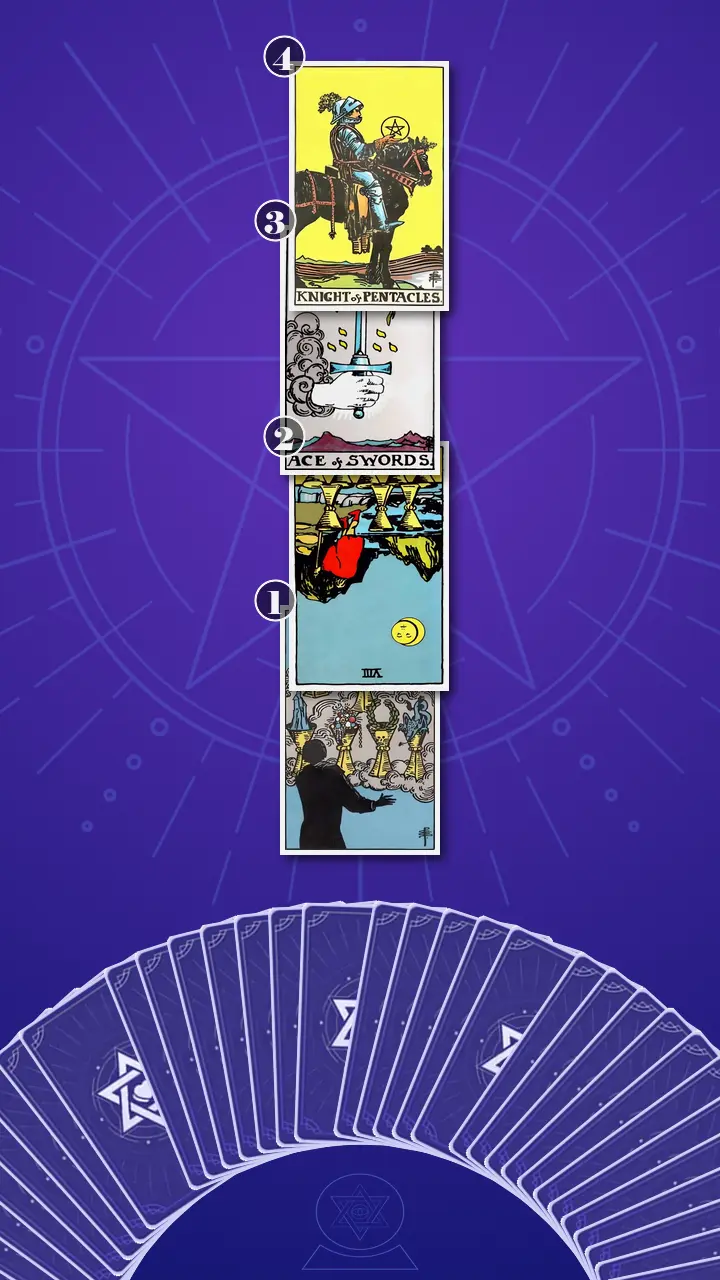
I arranged four cards in a narrow vertical line. The first position would identify what Maya romanticized about starting over. The second would reveal the fear and departure-based defense keeping the fantasy active. A wider gap led to the third position, where I would look for the key cognitive shift. The fourth would translate that insight into a bounded experiment. I read the layout upward, like a compact staircase rising from a clouded basement into practical daylight.
I chose four cards because a shorter reading could have confused the fantasy with its root, while a larger outcome-oriented spread might have implied that Maya needed a forecast. What she needed was causality: why this happened, what maintained it, and where her agency could re-enter.
Seven Polished Futures with the Friction Cropped Out
The Surface Layer: Seven of Cups, Upright
“The card I am turning over now represents what you romanticize about starting over and how those possibilities become edited versions of a future life,” I said.
I revealed the Seven of Cups, upright. A silhouetted figure faced seven visions suspended on clouds: a castle, jewels, a wreath, a veiled form, and other emotionally charged promises. The images were vivid, but there were no roads leading to them. No schedules, grocery bills, rent calculations, lonely evenings, difficult managers, or ordinary Tuesdays appeared anywhere in the frame.
In Maya's life, the seven cups were seven browser tabs for seven possible selves: Montreal apartment, Vancouver agency, New York course, sunlit studio, early-morning routine, more creative portfolio, more decisive identity. Each preview looked complete because the algorithm supplied the launch montage and quietly hid the maintenance.
I thought of the “somewhere over the rainbow” pull in The Wizard of Oz. Elsewhere can carry a real longing, but the projected promise of elsewhere is usually smoother than the life that must eventually be lived there. The lesson is not that home is always best. It is that longing needs translation before scenery can answer it.
I described the Seven of Cups as an excess of diffuse Water: imagination and emotion multiplying faster than discernment could sort them. That excess gave Maya short-term hope and control after a disappointing day, but it also granted every polished possibility equal authority. The rush in her hands felt like direction even when no option had met reality.
“When you picture the new life,” I asked, “what appears first: the city, the job title, the apartment, the routine, or the version of you standing inside it? And what does that image promise before the practical details arrive?”
Maya gave one short laugh, but there was no amusement in it. Her mouth tightened before she said, “That's too accurate. Honestly, it feels a little brutal. I can see the apartment light, the coffee shop, the version of me who somehow knows what she's doing. I never picture her doing taxes or getting bad feedback.”
“Accuracy does not have to become an accusation,” I replied. “The fantasy has been doing a job. It gives you possibility when the present feels narrow. We are only asking whether it is also hiding the specific thing you need.”
The Root Layer: Eight of Cups, Reversed
“The card I am turning over now represents the limiting belief, the fear of remaining with imperfection, and the departure-based defense that keeps the clean-slate fantasy recurring,” I said.
I revealed the Eight of Cups, reversed. In the upright image, a red-cloaked traveler leaves an incomplete arrangement of cups and walks toward a rugged mountain path beneath the moon. Reversed, that departure energy was blocked. Maya was not fully choosing to leave, but she was not fully re-engaging either. Emotion kept circulating around an exit scene.
I connected it to the TTC ride after a bad client message: shoulders raised, phone warm in her palm, three job listings and an apartment saved before she reached her stop. She could imagine handing in her notice, then return to the same desk without naming whether she needed a clearer scope, more creative ownership, a different manager, rest, or an actual career departure.
“A clean slate can feel like clarity when it is really distance from the evidence,” I said. “This is the emotional equivalent of refreshing an exit route in Google Maps without entering a destination. The thought says, I am leaving this life, while the unfinished sentence is, but I have not named what I need it to stop asking of me.”
The reversed Eight showed a blockage of Water. The feeling was real, but it could not complete its movement because neither direction had been made deliberate. The fantasy offered emotional departure without the mountain path of a real transition: budget, uncertainty, conversations, applications, loneliness, and repetitive work in a new postcode. At the same time, it postponed contact with the present issue.
Maya's breath stopped for a beat. Her thumb, which had been rubbing the edge of her phone case, went still. Then her gaze slipped away from the cards as though she were replaying a week of client messages, train rides, and late-night searches. She exhaled through her nose and said, more quietly, “I keep confusing relief with direction.”
I asked her to choose one recent exit fantasy and finish the sentence: “I need this new life to remove...”
“Having every idea revised until it doesn't feel like mine,” she said. After another pause, she added, “And the embarrassment of caring that much.”
That answer mattered. The fantasy was not yet proof that Toronto or her agency was wrong. It was evidence that creative ownership had become emotionally significant. Whether she could recover enough of it in her current role, or whether she would eventually need to leave, remained an open and legitimate question.
When the Ace's Single Blade Cut Through Seven Tabs
The Transformation Layer: Ace of Swords, Upright
The radiator stopped clicking as I reached for the third card, and the sudden quiet changed the pressure in the room. This was the focal point of the reading: the place where Maya's research loop could change mode.
“The card I am turning over now represents the cognitive transformation that can separate a genuine desire for change from projection and challenge the belief that clarity requires erasing the present,” I said.
I revealed the Ace of Swords, upright. One vertical blade emerged from a cloud, crowned above a jagged landscape. The mountains did not disappear. The card offered no frictionless world. It offered one precise instrument that could remain useful in difficult terrain.
Maya had been trying to solve her whole identity at once: the right city, the right role, the right routine, the right version of herself. Every possibility became urgent because none had been judged by a stable standard. In ordinary life, the Ace looked much less cinematic: one plain Notes sentence reading, “A meaningful change would give me more creative ownership.”
I use a diagnostic lens called Cyclical Variable Filtering when someone is making a high-stakes choice inside an emotionally loud period. I strip away temporary situational friction and look for the variables that keep affecting the person's longer orbit. One difficult client message, a former classmate's relocation post, and Tuesday-night exhaustion were temporary variables. Maya's repeated loss of ownership across months was potentially structural. The first group could amplify the urge to flee; the second deserved evidence.
I paired that with Decision Timing Calibration. A painful Tuesday could reveal useful information, but it was a poor sample from which to judge an entire career or city. Calibration did not invalidate Maya's desire to leave. It prevented a temporary peak of friction from pretending to be the whole climate.
“The reset fantasy is not proof that you need a blank life. It may be carrying one honest need in an oversized costume. You do not need to erase the present to become clearer; choose one criterion and let lived evidence tell you what it means.”
Stop treating a clean slate as clarity; choose one honest criterion, and let the Ace's single blade cut through the seven polished possibilities.
I let the sentence sit without rushing to soften it. Maya's inhale caught high in her chest, and her fingers froze halfway toward the phone. Her pupils widened slightly before her eyes lost focus; I could see her mentally reopening old plans and noticing that different cities, courses, and apartments had all contained the same promise of authorship. Then her jaw set.
“But doesn't that mean all those plans were wrong?” she asked. The question came out sharper than anything she had said earlier. “Did I waste all that time because I couldn't just deal with my job?”
“No,” I said. “Those plans helped you survive moments when your options felt too small. We are not putting them on trial. We are learning how to read them more accurately. Creative ownership may still lead you toward a different job or city. The difference is that you will know what you are moving toward, not only what you need relief from.”
Her lower eyelids reddened. The fist resting against her thigh slowly opened, then her shoulders dropped with a long, uneven breath. Relief arrived, but it left a brief, vulnerable blankness behind. A fantasy had carried the decision for her; a criterion returned the responsibility to her. She looked almost dizzy with the smaller scale of it.
“Now, using this new perspective, think back to last week,” I invited. “Was there a moment when this insight could have changed how the situation felt?”
Maya remembered the third revision of a client brief. Instead of naming her need for ownership, she had opened a career-change course and a Montreal rental page. “If I'd had the sentence then,” she said, “I could have asked to own one section before deciding the entire industry was wrong for me.”
She closed three tabs and left one plain document open. At the top, she typed: “A meaningful change would give me more creative ownership.” Under it, she added: “I do not have to decide my whole future to learn one true thing about this week.”
I named the transition I could see beginning: from restless clean-slate fantasy and repeated mental departure to criteria-led clarity and grounded self-trust. It was not a complete arrival. It was the first honest step from treating life as one unsolvable problem to examining one meaningful condition.
The Stationary Horse and the Seven-Day Reality Check
The Action Layer: Knight of Pentacles, Upright
“The card I am turning over now represents the small, reality-based experiment through which you can test that desired quality before considering a larger reset,” I said.
I revealed the Knight of Pentacles, upright. The Knight held one pentacle steadily at eye level while the dark horse remained still before cultivated fields. Nothing in the image resembled a dramatic launch. The stillness was deliberate assessment, and the fields showed what direction looks like after it meets time, effort, money, maintenance, and repetition.
For Maya, the card became a seven-day test. She could schedule two 25-minute sessions to create one self-directed design brief, ask to lead one defined section of a client project, or arrange an exploratory conversation with someone whose role offered more ownership. She would record what she did, what it cost, and whether the desired quality felt more present, absent, or still unclear.
The Knight expressed balanced Earth: enough structure to produce evidence without turning the experiment into a contract. I also pointed out that no Wands appeared in the spread. Maya did not need more ignition, a dramatic announcement, or another reinvention montage. She already had plenty of activation. She needed a clear criterion and sustained contact with reality.
“Ordinary repetition is not proof that nothing is happening,” I told her. “It is where the fantasy becomes testable. Let the new life pass a seven-day reality check before it gets to become a life decision.”
Maya looked at her calendar rather than her saved apartments. She booked 25 minutes at the Toronto Reference Library for Tuesday and Thursday after work. Her expression still held doubt, but her hands had stopped moving without purpose. “That feels almost too small,” she said.
“Good,” I replied. “Small means you can observe it without forcing it to carry your whole identity. The experiment may support staying, support leaving, or remain inconclusive. All three outcomes are information, and none of them is a moral verdict.”
One Honest Criterion, Then Evidence
When I placed the four cards together, their story was coherent. The Seven of Cups showed Maya granting emotional authority to edited futures. The reversed Eight revealed why: imagining departure created distance from resentment, shame, and an unfinished request for creative ownership. The Ace of Swords named the missing variable. The Knight of Pentacles brought that variable into a calendar where it could encounter ordinary conditions.
I described the pattern in the language that comes most naturally to me after years of watching people move through cycles. Maya had been treating every difficult workday like proof that she occupied the wrong planet. But one storm does not define an orbit, and an orbit is not a prison. My task was to help her distinguish passing weather from the forces that kept shaping the same return.
Her cognitive blind spot was not wanting change. It was comparing a fully imagined future with the least satisfying fragments of her present, then treating the emotional intensity of novelty as evidence of direction. She also dismissed modest changes because they lacked the drama of complete reinvention. The transformation was not “stay and be grateful.” It was: name the quality, test it fairly here, and use the evidence to evaluate both staying and leaving.
The Grounded Reset Experiment
I gave Maya three pieces of actionable advice. Each was deliberately small enough to begin while tired, and each preserved her right to make a larger change later.
- Use the Orbital Pause. After a bad client message, a Sunday-night scroll, or a comparison trigger, place a 72-hour hold on irreversible commitments such as resigning, signing a lease, or paying course tuition. During the first 10 minutes, open a plain phone note and complete: “I am noticing that I want more _____.” This pause does not block research, applications, or exploratory conversations; it calibrates the timing of a high-stakes choice. If 10 minutes feels heavy, write one word and stop. The goal is to let temporary friction settle enough for the structural variable to remain visible.
- Run the Departure Loop Check. Choose one saved reset fantasy before opening it again. Write the exact thing you hope it will remove, then spend 20 minutes addressing only that present-life item: revise one slide, outline one workload boundary, ask one colleague for an informational chat, or draft one request for clearer project ownership. Keep the boundary narrow: one message, one slide, or one conversation outline. Contact with the present is information, not a promise to stay.
- Give the Missing Quality Seven Days. Put two 25-minute sessions into Google Calendar at a fixed place and time. Maya chose Tuesday and Thursday at the Toronto Reference Library to complete one self-directed design brief. After each session, record three facts: what happened, what it cost in time or energy, and whether creative ownership felt more present, absent, or unclear. Prepare a five-minute backup version for low-energy days and review the notes on Sunday. The test is not a contract to stay, leave, quit, move, or continue.
I reminded Maya that the cards had not ruled out Montreal, a career pivot, or a different agency. They had only removed those possibilities from the role of instant emotional rescue. Her longing could now become evidence, a question, or a chosen direction. It no longer had to become an exit command every time the week hurt.

Seven Days Later, the Quiet Proof
A week later, I received a message from Maya. It began with the line, “Criterion: creative ownership.” She had asked her manager to let her lead one section of the next brief and completed the first page of a self-directed project during one library session. The manager had not transformed overnight, and the project had not answered her entire career question. Both actions had simply given her something the apartment tabs never had: evidence.
“I still looked at Montreal,” she wrote. “But I checked the role and the rent against the same criterion instead of letting the city mean everything. I haven't decided to leave. I also haven't decided that I have to stay.”
She told me she had slept through the night, then woke with the thought, “What if I still get it wrong?” The thought remained, but this time she smiled at it, made coffee, and opened the calendar instead of a new-life plan.
I saw that as the quiet proof of our Journey to Clarity. Clarity had not arrived as certainty or a flawless answer. It appeared as Maya's growing ability to distinguish relief from direction, temporary pain from a recurring need, and an imagined identity from a quality she could test.
The tarot did not create that change, and I did not choose her future. The cards made the pattern visible; Maya supplied the honesty, the experiment, and the decision-making power. She remained the author of whether the next chapter would be repaired, revised, or begun somewhere new.
I know that when the present feels so unfinished that your shoulders stay raised and your hands keep opening new tabs, it can seem safer to imagine becoming someone else somewhere else than to remain long enough to learn what can change here. The Ace offers a gentler form of clarity: not a verdict, but one clean criterion held steady against real life.
If you let the Ace's single blade choose one honest criterion for the next seven days, what small part of your current life would you be curious to examine before deciding whether it truly needs to be left behind?