Golden-Handcuff Career Drift: Trade the Verdict for One Small Test

The 10:47 p.m. Golden-Handcuff Career Spiral
I recognized Alex as the competent product-ops person who could untangle a launch dependency before lunch, then spend Sunday night in career pivot anxiety because a former colleague had announced the move Alex kept researching. Their career looked successful on LinkedIn, yet felt strangely absent from the inside.
Alex had told me about Tuesday at 10:47 p.m. in their one-bedroom Toronto apartment. A saved product role, an evening-course page, and a salary spreadsheet glowed side by side on the kitchen counter; the refrigerator hummed, the laptop base warmed their wrists, and the blue-white screen made the room feel colder. They edited the risk column for the third time, closed every tab, and started an episode they barely watched.
“I am not miserable enough to justify leaving,” Alex said. “Every practical reason says stay, but I keep disappearing inside the choice. I keep calling it stability when what I mean is delay. What am I giving up each time I choose this comfortable cage?”
From where I sat, the feeling was not a vague lack of gratitude. Restless dissatisfaction moved through them like a browser tab that kept the whole laptop warm after the screen had gone dark: difficult to see, impossible to stop draining power. Beneath it, I could hear longing, envy, and the guilt of questioning a life that paid the rent, supported TTC trips across the city, and came with genuinely useful benefits.
I did not treat that conflict as a sign that Alex had to quit, nor did I praise staying as automatically wise. I said, “Your stability is real, and so is the part of you that keeps looking toward a wider life. We are not going to force a verdict tonight. We are going to find out what the repeated retreat is costing you, then draw one careful route toward clarity.”
A comfortable cage rarely locks itself; it teaches you to stop testing the door. Our Journey to Clarity would begin by noticing exactly how that lesson had been learned.

Choosing the Compass: The Four-Layer Insight Ladder
I cleared a small space on the table, asked Alex to set their phone face down, and invited them to take three slow breaths while naming the question without trying to solve it. I shuffled slowly. To me, this was a psychological transition from the day's noise into focused observation, not a supernatural performance.
Today I used the Four-Layer Insight Ladder. For anyone wondering how tarot works in a career reading, I use the cards as an objective reflective tool: traditional images give us stable symbols, while the positions organize attention and help us compare those symbols with observable choices, body signals, and real constraints. A card cannot override rent, healthcare, a contract, or Alex's judgment. It can expose the decision structure that a familiar spreadsheet has been hiding.
I chose this spread because the phrase “each time I choose” pointed to a self-reinforcing comfort loop. The same sequence kept repeating: dissatisfaction sparked research, uncertainty activated control, retreat brought short-term relief, and the absence of firsthand evidence made the familiar life appear even safer. The ladder was the smallest structure that could show the visible cage, its hidden emotional root, the threshold that could interrupt it, and the action that could test a new response.
The lower-left card would show the surface layer, the observable behavior of protecting salary, benefits, routine, and competence. The card above it would reveal the root layer, including the fear and hidden exchange beneath each return to comfort. The third card would serve as the transformation layer, and the upper-right card would turn insight into one scheduled, reversible experiment.
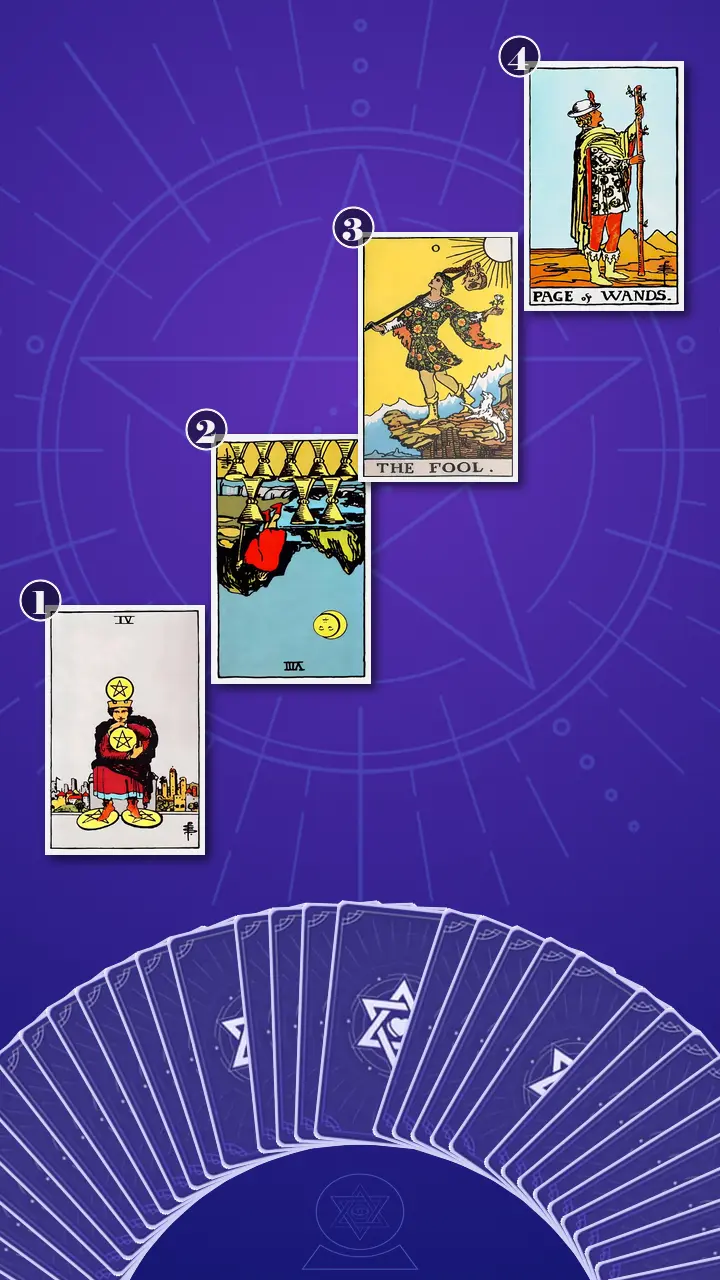
Reading the Map: The Cost of Holding Still
Position 1: The Pentacles Pinned to the Body
Now revealed was the card representing the surface layer: the observable golden-cage behavior of protecting salary, benefits, routine, and competence so tightly that exploration never received a real action. The card was the Four of Pentacles, in upright position.
I asked Alex to picture benefits-renewal morning. In the image, they were sitting beneath cool office LEDs in a glass meeting room, reading the employer contribution figure while Slack notifications stacked up through the laptop speakers. A promotion track was open beside a saved role at a smaller organization. Salary, health coverage, transit-friendly housing, six years of competence, and a predictable hybrid schedule were all real resources. Yet Alex had mentally pinned each one to their body as a reason not to schedule even a 20-minute conversation.
The figure on the card presses one pentacle to the chest, holds two more beneath the feet, and keeps a prosperous city at a distance. I read that as Earth in excess: security had stopped supporting movement and had become the condition that movement was never allowed to disturb. The card did not ask Alex to despise material comfort. It asked which parts of that comfort were consciously chosen and which were being preserved automatically because releasing their grip felt dangerous.
I offered the inner sentence I heard beneath the spreadsheet: “I am not saying never; I just need to get past the next review cycle.” The phrase sounded reasonable until I placed it beside the untouched course links and months of postponed conversations. A polished professional identity can create the same split I recognized from Severance: excellent functioning at work, and a private self that cannot explain why the work matters.
Alex let out a short, bitter laugh. Their lips tightened first, then their eyes flicked toward the phone where the benefits portal was still open. “That is accurate,” they said. “A little rude, honestly.”
I let the laugh stay in the room. “It is not a criticism of wanting a safe home or affordable healthcare,” I said. “It is a distinction between choosing stability and letting stability choose the limits of your life.” Alex's fingers, which had been gripping the edge of the chair, loosened without quite becoming relaxed.
Position 2: The Tab That Closes Itself
Now revealed was the card representing the root layer: the hidden exchange beneath each choice of comfort, where fear returns Alex to the familiar and the cost is lived evidence, emotional honesty, agency, and self-trust. The card was the Eight of Cups, in reversed position.
I brought the 10:47 p.m. kitchen-counter scene back into the reading. The carefully stacked cups became the life that worked on paper: salary, benefits, routine, and visible progress. The cloaked traveler, turned away but unable to complete the journey, became Alex opening a route toward a smaller organization, a course, or a side project, then turning back before the uncertain terrain could provide any real information.
This was Water in blockage. Dissatisfaction was present, but it could not flow into experience. Every alternative was treated as though one enquiry would automatically authorize a resignation, a pay cut, a relocation, or a new identity. Closing the tab brought immediate relief, but it also taught the nervous system that contact with possibility was dangerous and retreat was prudence.
I said, “You are not giving up a guaranteed better career. You are giving up firsthand evidence.”
Alex's chest tightened. Their hand paused above the imaginary course enquiry form, and I watched their shoulders drop in memory at the exact moment the browser went dark. “I know this is not enough,” they said quietly, “but what if leaving proves I misread everything?” The question held both longing and control: a wish for honest information, and a demand that the information arrive without exposure.
I answered, “Then we do not begin with leaving. Staying can be a choice, but only if curiosity is allowed to submit evidence too. The question is not whether you can guarantee the next life. It is whether you can meet one small part of it before deciding what it means.”
When The Fool Tested the Unlocked Door
Position 3: The Threshold That Is Not a Verdict
Now revealed was the card representing the transformation layer: the key shift from demanding certainty about a total escape to allowing one bounded encounter with the unknown. The card was The Fool, in upright position.
The room became quiet in a different way. The Fool stood at the edge of a cliff with one foot raised, a small bundle over one shoulder, and a white rose held lightly. I read the image as experimental courage, not reckless risk. Alex did not need to carry a finished career plan across the threshold. They needed enough preparation for one direct encounter with a possibility that had so far existed only as a saved link.
I use a diagnostic lens I call Decision Timing Calibration when someone is facing a high-stakes crossroads. I ask whether the current moment is structurally suitable for a permanent choice, or whether temporary friction is making every option feel more urgent than it is. A benefits-renewal email, a particularly empty workweek, or a former colleague's announcement might intensify the question without answering it. The timing of a reversible experiment, however, did not need to wait for perfect conditions.
The Fool was the bridge in this ladder. It did not ask Alex to abandon chosen stability; it challenged the all-or-nothing belief that only a total escape would count as movement. I slowed my hand before turning the card and named the distinction plainly: the cliff was not the space between employment and unemployment. It was the space between a saved link and firsthand contact.
The Light Bundle, Not the Finished Life
At 10:47 p.m., the course page, saved role, and salary sheet were still glowing on the kitchen counter. Alex adjusted the risk column again, closed every tab, and felt relief arrive seconds before the restless heaviness returned. The old reflex protected comfort by preventing contact, then treated the missing evidence as proof to stay.
Staying comfortable is not the same as choosing consciously; take one reversible step, carrying only The Fool's light bundle instead of demanding a finished life plan.
For one second, Alex froze. Their breath stopped halfway in, and their thumb, resting beside the card, stayed suspended. Then their eyes lost focus. I watched the kitchen-counter scene return across their face: the blue-white tabs, the warm laptop against the wrist, the relief that arrived when the browser went dark. Their jaw tightened. “But doesn't that mean I have been doing it wrong for years?” they asked. I answered carefully: “No. You have been protecting real things: rent, benefits, time, a home near the TTC. The pattern is understandable. We are only changing what the pattern is allowed to call evidence.” A long breath moved through their chest. Their fists loosened one finger at a time; their shoulders lowered, then lowered again. Their eyes shone, and a small, unsteady laugh escaped. The release carried a brief blankness too, the light dizziness of having a path without a script. “I don't need to know whether this becomes my next life,” Alex said. “I only need to learn what happens when I meet it.”
I asked, “Now, use this new perspective to recall whether there was a moment last week when this insight could have made you feel differently.” Alex reread the distinction between an experiment and an escape, then thought of the free community workshop they had nearly cancelled. “What if this is data, not destiny?” they said, testing the sentence like a new setting in a familiar app.
I asked Alex to take eight minutes and open one saved role, course, organization, or project link. The task was only to write one contact-sized experiment: a 20-minute conversation, an introductory session, or a tiny private sample, with a tentative calendar slot. No resignation, application, purchase, or identity change was required. If even that felt too exposed, a two-sentence draft was enough. Alex controlled the pace and could stop at any point.
This was the first visible step from numb restlessness toward nervous curiosity. The Fool did not supply an answer from outside Alex. The card made room for Alex to gather the kind of evidence that overthinking could never manufacture.
Position 4: The Wand with a Calendar Slot
Now revealed was the card representing the action layer: the concrete practice through which curiosity could become a scheduled, reversible test while the larger career decision remained open. The card was the Page of Wands, in upright position.
I asked Alex to imagine protecting one 45-minute block from Slack spillover and Netflix autoplay. In that block, they could send one informational-interview request, draft a rough sample for a private project, attend an introductory session, or write three questions for someone who worked in a field that kept returning to their thoughts. The Page does not study the sprouting wand because it already knows its full purpose. The Page studies it because something alive deserves contact before it is forced to produce a business case.
This was Fire in a beginner's form: active, curious, and small enough to repeat. It gave the Fool's openness a calendar, a finish line, and a way to notice what happened to attention and energy. The point was not to become impressive in 45 minutes. The point was to let curiosity become behavioral.
I said, “You are allowed to be interested before you are impressive.” Alex opened their calendar, hovered over a blank evening, and began typing a title: “Curiosity Test.” Their shoulders were still not fully loose, but their hand no longer moved toward the familiar cancellation button.
From Insight to Action: Finding Clarity in a Curiosity Block
When I placed the four cards together, the story became clear without becoming prescriptive. Six years of competence and real material needs had taught Alex to hold tightly to a workable life. The Four of Pentacles showed how that protection had become immobility. The reversed Eight of Cups showed the hidden exchange: every late-night retreat bought immediate relief with agency, emotional honesty, and firsthand knowledge. The Fool opened the unlocked door without demanding an escape, and the Page of Wands gave that opening a repeatable practice.
The cognitive blind spot was not a lack of information. Alex had plenty of salary comparisons, commute calculations, benefits research, and worst-case scenarios. The blind spot was a biased decision structure in which staying was coded as neutral while exploration had to defend itself like a permanent, high-stakes verdict. The spreadsheet measured money and risk precisely, but left energy, attention, curiosity, and felt meaning as blank cells. The familiar option won by design.
I used my Cyclical Variable Filtering lens to separate temporary situational friction from the variables that could actually shape Alex's long-term orbit. A bad week, a benefits email, a peer's announcement, and post-work exhaustion were real experiences, but they were not the whole decision. The critical variables were the stability Alex genuinely wanted to keep, the boundaries they could afford to test, the interests that returned repeatedly, and what happened to their energy during direct contact.
I also gave Alex my Orbital Pause Strategy as a guardrail. If a macro-friction event made them want to resign immediately or recommit forever, they would wait 72 hours before making a high-stakes choice. During that pause, they would not suppress curiosity or turn the delay into another year of avoidance. They would keep the experiment small, write down the temporary trigger, and revisit the decision after the emotional weather had changed. A pause could protect judgment without becoming another locked door.
These were the next steps I wrote with Alex:
- Separate chosen stability from automatic holdingTonight, spend 10 minutes in a phone note creating two columns called Stability I Choose and Stability I Protect Automatically. Place salary, benefits, TTC access, rent, schedule, status, and professional competence where they honestly belong, then set a one-week exploration boundary such as CAD 0 to 30, one evening, and no employment change.Tip: This is an inventory, not an argument for staying or leaving. The minimum version is naming one resource to keep and one resource you could risk for a week.
- Send one no-verdict invitationBefore Friday, choose one saved role, course, smaller organization, or project and send one email or LinkedIn message to a relevant person asking for a 20-minute informational conversation. Ask what an ordinary day in that field actually looks like, and make clear that no career decision is attached.Tip: If sending feels too exposed, draft two sentences without pressing send. The experiment authorizes no decision beyond itself.
- Protect a 45-minute Curiosity TestPlace one calendar block this week with the exact link, address, document, or contact included. Close Slack, set a visible timer, and use the block to attend an introduction, send the request, create a rough one-page sample, or write three interview questions. Finish by noting Energy before, Energy during, and What I want to test next.Tip: The minimum version is 10 minutes and one private rough artifact. You do not have to evaluate whether the interest could become a career.
I reminded Alex that these were actionable options, not orders from the cards. The Four-Layer Insight Ladder tarot spread for a comfortable career crossroads had done its job when the hidden exchange became visible. From there, the choice belonged to Alex. Stability could remain part of the plan while curiosity, agency, and meaning were allowed to gather evidence too.

A Week Later, the Door Was Still Open
Five days later, I received a message from Alex. They had sent a two-line LinkedIn note to someone working in product research at a smaller organization, booked a 20-minute conversation, and protected a 45-minute block for a free introductory session. Their message said, “I still don't know if I want a different career. But I finally have something real to learn from instead of another spreadsheet to edit.”
The next morning, after a full night's sleep, Alex still woke with the thought, “What if I am wrong?” This time they smiled, opened the calendar, and kept the appointment. The clarity was real, but it arrived as breathing room, not fireworks.
I told Alex that the cards had not chosen a destination. They had shown a movement from fear-driven, all-or-nothing evaluation toward experimental courage, lived evidence, renewed self-trust, and grounded clarity with chosen stability intact. Alex was not handing the steering wheel to tarot. Alex was testing the door and deciding what deserved to be carried forward.
When the life you built is secure enough to protect but too quiet to feel fully yours, the tightness in your chest need not be a verdict against your choices. It may be the first honest signal that an unlocked door deserves a gentle test.
If the door did not require an escape, what small encounter beyond your routine would you be curious to let yourself have, carrying only The Fool's light bundle for twenty minutes?