Open Tabs at 10:32 p.m.: From Research to a Twenty-Minute Draft

Comfortable but Unfulfilled at 10:32 p.m.
I recognized a particular kind of Sunday Scaries the moment Alex joined my screen. She was 29, competent in a stable Toronto tech role, and her dread was not about Monday being unbearable. It was about how easily another manageable week could outrun the future she kept meaning to start.
It was 10:32 on a Tuesday night in her apartment. A future-career document sat open beside LinkedIn and three course tabs. The radiator ticked behind her, cold coffee left her grimacing after each distracted sip, and her phone looked almost fixed to her palm by its own warmth. She saved another link, glanced at Instagram, then closed her eyes as if the light from both screens had become physically heavy.
“I have benefits, predictable income, a comfortable apartment,” she said. “I know how lucky that sounds. But every time someone posts one of those ‘thrilled to announce’ career updates, I feel like I missed a train I never even chose. I’m not unhappy enough to leave, but I’m not alive enough to feel like I’m moving.”
Her restlessness seemed to sit beneath her collarbones like one foot planted on a subway platform and the other caught aboard a train already gathering speed. Her shoulders carried the weight of staying; her chest carried the urge to move. Neither sensation cancelled the other.
“What if the life I built is the reason I never build the one I want?” she asked. Then, with a tired half-smile, she added, “I wish wanting more came with a calendar.”
I told her I did not see ingratitude, laziness, or a failure of imagination. I saw a functioning system: one life was being funded by routine, while the other was being asked to survive on whatever attention remained after work, errands, recovery, and comparison fatigue. A functioning system can still produce an unwanted result.
“Your current struggle is not a permanent fate,” I said. “Let’s treat it as a structure we can examine. We are not here to make the cards choose a career for you. We are here to draw a map of the fog, find where your attention keeps disappearing, and recover the part of the decision that still belongs to you.”

A Workbench for the Life Still in Draft
I asked Alex to place both feet on the floor, take one slower breath, and state the question without trying to make it sound reasonable: “Why does my comfortable life keep outrunning the future I want?” I shuffled while she held that sentence in mind. The small ritual was not an appeal to fate. It was a psychological threshold, a way to stop rehearsing every possible answer long enough to look closely at the actual pattern.
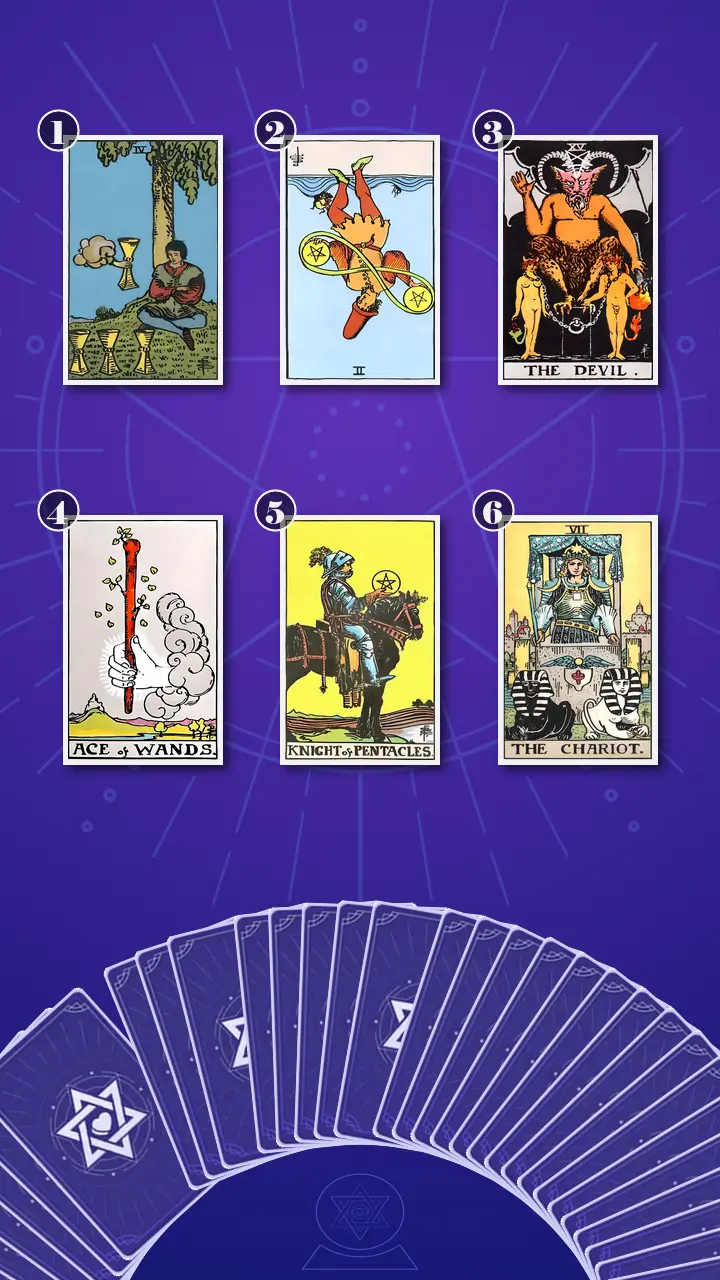
I chose the Transformation Path Grid (6) · Context Edition, arranging six cards in two rows of three. To me, the layout resembled an archaeological workbench: the top row would hold the visible pattern, the practical obstruction, and the belief buried beneath it; the bottom row would hold the spark, the repeatable method, and the direction Alex could consciously steer.
For anyone wondering how tarot works in a situation like this, I do not use a spread to predict whether someone must quit a job. I use card meanings in context to separate a complicated loop into observable parts. A Past-Present-Future spread would have made the issue look primarily chronological. A Celtic Cross would have offered breadth, but Alex did not need ten competing perspectives. She needed to see how a vivid vision became a delayed process, how delay protected her, and what small action could generate real evidence.
The first card would reveal the comfort-based behavior visible in ordinary life. The second and third would expose the Process-Vision Split and its protective payoff. The final three would show how desire could become a practical experiment, then a self-authored direction. This was not a verdict on her future. It was a reflective map she would remain free to question, test, and revise.
The Offered Cup Beside a Finished To-Do List
Position 1: The Future Observed from a Safe Distance
“Now turning over,” I said, “is the card representing your current surface pattern: the observable way you maintain the present while the future remains emotionally and practically distant.”
The card was the Four of Cups, upright.
I pointed to the seated figure’s crossed arms, the three cups already on the ground, and the fourth cup being offered from a cloud. The image did not condemn what Alex already had. The three cups could easily represent a stable salary, useful benefits, and a comfortable apartment. The difficulty was that these existing forms of security had become so familiar that the offered possibility could remain visible without receiving an answer.
I described a Sunday evening at 7:40: meals prepared, work calendar checked, errands organized, and the coming week made secure. A saved project brief glows on the laptop beside an advice video. The routine is not bad. That is precisely why the new possibility can be emotionally observed while remaining practically untouched.
“It’s a little like the split in Severance,” I said. “Your highly functional work self has a complete operating system. The part of you that wants more meaningful or self-directed work exists outside that system, so it appears mostly after hours, when the rest of you is already depleted.”
The Four of Cups carries legitimate contemplation, but here that water energy had become blocked. Reflection had hardened into withdrawal. Gratitude was not the problem; emotional non-participation was. Alex was evaluating the offered cup from a safe distance because touching it would turn a private desire into something measurable.
She gave one brief, bitter laugh instead of nodding. Her fingers stopped on the rim of her mug, her gaze drifted toward the open document as if replaying dozens of similar evenings, and then a breath left her chest in a long, quiet stream.
“That is so accurate it feels a little cruel,” she said. “Nothing is wrong enough to justify changing anything. So why does staying feel quietly disappointing?”
“Because gratitude and longing can occupy the same room,” I replied. “Recognizing the longing does not turn your stable life into a mistake. It only means stability is not the whole truth of what you need.”
Position 2: Busy Enough to Avoid Evidence
“Now turning over is the card representing the Process-Vision Split,” I said. “This position shows where the future you can imagine becomes disconnected from the process you actually sustain.”
The card was the Two of Pentacles, reversed.
In the Rider-Waite-Smith image, a figure tries to keep two pentacles moving inside an infinity loop while ships rise and fall on rough water behind him. Reversed, the loop resembled Alex’s browser-and-calendar cycle: compare options, respond to routine demands, move the future block, feel busy, and return a week later without one completed unit of future-facing work.
At 10:30 p.m., she would move between a course page, two job posts, Slack, groceries, a project document, and Instagram. Each switch had a practical explanation. Yet no paragraph, wireframe, portfolio caption, course exercise, or exploratory message reached completion. She was not inactive. She was distributing attention so widely that the meaningful future never received sustained contact.
The energy here was imbalanced in two directions: an excess of switching and a deficiency of protected attention. The card did not say Alex lacked discipline. It showed that everything with immediate consequences received a defined place, while the important but non-urgent future was given a vague label such as “career stuff” and placed after the day had spent her best energy.
“Your future is not losing to comfort,” I told her. “It is losing the calendar.”
As a project operations coordinator, Alex could turn everyone else’s ambiguity into milestones. Her own future, however, looked like a polished product backlog that never entered a sprint because routine maintenance kept claiming the team’s entire capacity. The vision was organized, tagged, and researched. It had no operating slot.
Her chest rose sharply. She looked across her tabs, counting them without moving her head.
“I keep calling research a plan,” she said.
“Research can protect a dream from failure by protecting it from evidence,” I replied. “That does not make research foolish. It means we need to ask what the research is protecting you from discovering.”
The Loose Chain Beneath the Benefits Package
Position 3: When Safety Becomes an Authority
“Now turning over is the card representing the underlying fear and protective payoff,” I said. “This position asks what you believe you might lose if the future became real enough to test.”
The card was The Devil, upright.
I watched Alex’s expression tighten at the name, so I clarified immediately that I did not read The Devil as an omen of punishment or an external force waiting to trap her. I directed her attention to the actual image: two figures attached to a pedestal, a raised torch above them, and chains loose enough to be removed. The card often exposes a bargain that feels compulsory because its benefits are real.
For Alex, the bargain appeared after a positive performance review. Predictable pay, benefits, manageable work, and a comfortable apartment became evidence that testing a self-directed direction would be reckless. A rough sample or exploratory conversation began to feel dangerous, not because either action could destroy her life, but because failure might seem to prove that she had poor judgment.
The Devil showed attachment energy in excess and conscious choice in blockage. Stability had moved from being a resource she used to being an authority that silently decided what she was allowed to explore. The loose chains mattered: the card was not saying, “You are trapped.” It was asking, “Which part of this bond is currently being renewed without your deliberate consent?”
This was the point at which I used what I call Cognitive Stratigraphy. On an excavation, the object visible at the surface is rarely the beginning of the story. A sudden trigger is a surface artifact. I do not smash it or worship it; I examine the layer in which it was found, then dig carefully toward the older structure that gave it meaning.
I asked Alex to take the last LinkedIn career announcement that had hollowed out her chest. The surface layer was comparison: someone else had made a visible move. Beneath it sat a practical layer: salary, rent, benefits, and the exhaustion of beginning again. Deeper still, we found the foundational belief: “If I run an experiment and it fails, I will have proved I cannot trust myself to protect the life I built.”
My mind briefly returned to one of my old excavation trenches, where a small fragment of pottery had changed meaning once we located the floor beneath it. Context did not make the fragment unreal; it stopped us from assigning it to the wrong century. Alex’s fear deserved the same precision. It belonged partly to the present, but its size came from an older equation between good judgment and never making a visible mistake.
She straightened abruptly. “I worked hard for this stability,” she said, with more heat than she had used before. “I don’t want the answer to be that I’m weak for caring about it.”
“That is not my answer,” I said. “The salary, benefits, and home are real achievements. You do not need to disrespect them to explore. I am asking whether they support your choices or make them for you. Comfort can be a resource without being allowed to vote on every decision.”
Her jaw remained set for a moment. Then her hands uncrossed. The defensiveness did not vanish into instant relief, but it became more specific, and therefore more workable. She was not afraid of desire itself. She was afraid that testing desire would put her identity as a careful, competent adult on trial.
The Spark That Did Not Need a Five-Year Plan
Position 4: The Idea That Still Had Heat
“Now turning over is the card representing catalytic reconnection,” I said. “This position locates the immediate desire that can bring the future into the present without demanding a total life overhaul.”
The card was the Ace of Wands, upright.
A hand emerges from a cloud holding a budding wand. New leaves fall through the air, while a castle waits in the distance. I placed it visually beside the Four of Cups. Both cards contained an offering from a cloud, but the emotional movement had changed. In the first image, possibility remained unreceived. In the Ace, desire arrived with heat, growth, and an impulse to make contact.
I asked Alex which idea from the previous month had made her sit forward before she had time to compare programs, salaries, or long-term outcomes. She immediately described a self-directed service concept she had typed into Notes while waiting for lunch near King Street West. She remembered the espresso hiss, the clatter behind the counter, and the quick lift under her ribs as the words appeared.
“Then I went home and opened six market-research articles,” she said. “Within an hour, it felt heavy again.”
“That is spark-to-blueprint inflation,” I said. “A live idea is being required to justify a permanent career identity before it is allowed to become a rough sample.”
The Ace carried fire in a healthy, available state. It was not a guarantee that this specific idea would become a business, career, or calling. It was information: this activity produced present-tense energy. Alex could use that energy to create a voice note, a rough page, or a fifteen-minute prototype before asking what it meant for the rest of her life.
“Do not ask the spark for a five-year plan,” I told her. “Ask it for one small sample.”
Her posture changed before she answered. Her shoulders lifted out of their collapsed curve, and she leaned toward the screen in the same way she had described leaning over her Notes app.
“I know exactly which sample I would make,” she said. The certainty in that sentence was small, local, and useful. It did not pretend to settle her career.
When the Knight Put the Future on the Calendar
Position 5: A Practice Small Enough to Survive Tuesday
The room seemed to narrow around the next card. Even through the video call, I could hear Alex’s radiator give one dry click and fall quiet. I turned over the card at the lower centre of the grid, the bridge between inspiration and direction.
“Now turning over is the card representing the repeatable process,” I said. “This position translates the future you want into one grounded practice that can coexist with your current life and leave observable evidence.”
The card was the Knight of Pentacles, upright.
The horse is still. The Knight holds one pentacle at eye level. Behind him, the field has been cultivated through work that would have looked unimpressive on any single day. This was earth energy in balance: patient self-trust, practical devotion, consistent effort, and a willingness to let evidence refine the larger vision.
In Alex’s life, the card looked like keeping her job while protecting one Saturday block before errands. During that time, she would work on one portfolio sample, one course exercise, or one exploratory message, then record what she completed and name the next small step. The point was not speed. The point was contact repeated often enough to become information.
At 10:30 p.m., the future was open in one tab while Instagram filled the next. Her coffee was cold, her shoulders were heavy, and another perfectly reasonable evening was about to leave the life she wanted untouched. She had been asking herself to find certainty at the exact time of day when she had the least energy available to tolerate uncertainty.
This was where I brought in Ruins Restoration Thinking. On a dig, I would never rebuild an entire settlement merely because one wall had fractured. I would first stabilize one reachable section, learn how the weight moved through it, and preserve what still carried value. Alex’s split between the competent professional and the underused creative self was not evidence that either identity was false. Her chronic evening exhaustion was not a moral failure. Both could be signs that an internal structure was in transition and needed one load-bearing practice, not a dramatic demolition.
“The future is not asking you to blow up your comfortable life; it is asking for a recurring appointment before comfort spends all your available attention.”
Then I gave her the sentence at the centre of the reading.
Do not wait for certainty or a dramatic exit from the golden cage; let the Knight of Pentacles turn the future you want into one modest practice repeated before comfort claims the day.
I let the silence remain.
Alex’s breath stopped first. Her thumb hovered above her phone without touching the screen. Then her pupils shifted slightly to one side, and I could see her replaying moved Saturday blocks, vague calendar labels, and late-night attempts that had begun after her usable attention was gone. Her jaw hardened before her face softened.
“But doesn’t that mean I’ve wasted all this time?” she asked. The words came out sharper than before. “I’ve spent months trying to find the right plan. If the answer is just one recurring block, then I was wrong about what I needed.”
“It means your old method protected something important until you were ready to see its cost,” I said. “That is not the same as being foolish. You were protecting stability, competence, and the right not to make a reckless decision. We are keeping those values. We are only retiring the rule that says they require complete certainty before a reversible experiment.”
Her eyes brightened, but she did not look simply relieved. Her shoulders descended by degrees, her clenched fingers opened against the table, and a trembling breath finally left the base of her chest. For a second she looked almost disoriented, as though setting down a heavy box had changed her sense of balance.
“If I can do one small block,” she said quietly, “then I can’t keep saying I have no way to start.”
There was relief in that recognition, and also responsibility. A vague future could not disappoint her because it could not answer back. A twenty-minute practice might produce an imperfect sample, boredom, stronger desire, or a change of mind. Clarity would no longer be a perfect feeling delivered before action. It would become evidence left by repetition.
“Now, using this new perspective, think back to last week,” I invited her. “Was there a moment when this insight could have made you feel different?”
She remembered Saturday morning, when she had moved a calendar block labelled “career stuff” to Sunday because the phrase felt too large to begin. With the Knight’s single pentacle in front of her, she renamed the missed task: “Draft 150 words describing the service idea.”
I asked her to open her calendar and set an eight-minute timer. Before it ended, she reserved one twenty-minute block for Saturday at 10:15 a.m., before errands, and gave it that exact title. I reminded her that she was scheduling an experiment, not promising a career change. If twenty minutes felt too heavy, she could do five and leave one visible mark. If the exercise raised more discomfort than she wanted to hold, she could close the calendar and return when she chose.
This was the first real crossing in the reading: from certainty-seeking and leftover-attention stagnation toward patient self-trust. Nothing external had changed yet. Alex had simply given the wanted future one ordinary place in the life she already owned.
The Chariot Left the City Standing
Position 6: Security and Aspiration Under Conscious Direction
“Now turning over is the card representing integrated direction,” I said. “This position shows what self-authored movement can look like when your need for security and your wish for a different future are both acknowledged.”
The final card was The Chariot, upright.
The armored charioteer stands between a black sphinx and a white one. The pair embody opposing pulls, but the figure does not eliminate either. He occupies the centre and gives their tension a chosen direction. Behind him, the city remains standing. Movement does not require him to declare his old environment worthless.
For Alex, the modern version was a four-week review. She would look at the samples she made, the calendar blocks she kept or missed, and which tasks increased or drained her energy. From that evidence, she could continue, adjust, pause, or test another idea. No outcome would function as a verdict on her worth, and no dramatic feeling would be permitted to make the whole decision for her.
The Chariot brought will into balance. The Devil had shown comfort and fear steering from outside awareness. The Chariot moved Alex into the driver’s position. It did not predict victory, resignation, or a perfect career pivot. It represented the ability to coordinate security and aspiration through decisions she could consciously review.
“So I don’t have to choose between blowing everything up and doing nothing,” she said.
“Exactly. You can keep what supports you and change what has been deciding for you.”
A streetcar bell sounded faintly through her window and disappeared down the line. Alex looked at the six cards, then back at the calendar block on her phone. Her shoulders loosened, though uncertainty remained visible around her mouth. I trusted that expression more than sudden confidence. It meant she was not replacing one fantasy of certainty with another.
Restoring One Reachable Room
When I drew the six cards together, they formed a coherent account of why Alex felt stuck in a stable job that was not objectively bad. The Four of Cups showed a tolerable present keeping desire at an emotional distance. The reversed Two of Pentacles revealed that the future received fragmented, leftover attention. The Devil uncovered the older bargain beneath that allocation: if she never made the future measurable, she could preserve her identity as a careful person whose judgment had not been disproved.
The Ace of Wands showed that desire was still alive, especially in the idea that made her sit forward before analysis took over. The Knight of Pentacles gave that spark a modest working routine. The Chariot made the final principle explicit: Alex did not need to erase her comfortable life. She needed to decide which parts would support her experiments and which parts would no longer be allowed to steer unconsciously.
Her cognitive blind spot had been treating a reversible experiment as though it carried the stakes of an irreversible identity decision. She believed she needed a complete process before committing, when the missing process could only be developed through contact, repetition, and review. Her shift was therefore not from caution to recklessness. It was from protecting comfort by keeping the vision abstract to using comfort as stable ground for one bounded test.
I told her that ruins are not empty places. They contain surviving walls, altered foundations, abandoned assumptions, and materials that can be used again. Her current life did not need to be demolished. It needed a small restoration plan based on what was still useful and what no longer fit the person doing the building.
Two Practices for the Next Seven Days
- The One-Unit Future Practice Before Sunday night, place one twenty- to thirty-minute block in your phone calendar before the week’s lowest-energy period. Give it one visible deliverable, such as “Draft 150 words,” “Make one rough slide,” or “Send one three-question exploratory message.” During the block, close research tabs and create only that unit. Afterwards, add one line to a note with three headings: Date, Visible Evidence, and Next Small Step. Treat the appointment as a trial with a clear stop time, not a promise to change careers. If the week is overloaded, do the five-minute version and leave one sentence, sketch, voice note, or message behind.
- The Trigger Excavation Exercise The next time a LinkedIn announcement, performance review, lease email, or practical objection produces a disproportionate reaction, take ten minutes in your notes app. Record the surface artifact: what happened, what your body did, and the first sentence in your mind. Dig one layer down to the specific feared loss, then one layer deeper to the old rule it seems to prove. Finish with two sentences: “Then, I needed to believe...” and “Now, the present facts allow me to...” Place one comfort in either “This supports my experiments” or “This silently decides for me.” No verdict about staying or leaving is required. Audit one resource only, keep private details private, and stop if the exercise exceeds the level of discomfort you choose to engage with today.
Neither practice was designed to force a particular future. Their purpose was to produce proportionate evidence. Alex could discover that the project deserved more time, that it needed adjustment, or that another direction fit better. Each outcome would be information she had authored through participation, not a sentence handed down by the cards.

A Week Later: Twenty Minutes of Evidence
A week later, I received a message from Alex. She had kept the Saturday appointment. She closed the salary reports, drafted 176 imperfect words, and sent one low-pressure message to a designer she trusted: “I’m testing an idea, not announcing a pivot. Could I ask you three questions about your work?”
Her report did not contain a revelation about the one correct career. It contained something more useful: “The twenty minutes made me want another twenty. I still don’t know what this becomes, but now I have something to react to besides my own research.”
She had not quit her job or solved her future. She sat alone with coffee after the timer ended, pleased and oddly exposed. On Sunday morning her first thought was, “What if this goes nowhere?” This time, she smiled and opened the next blank page.
I thought again of the Knight holding a single pentacle over a cultivated field. The proof was not that Alex had escaped uncertainty. The proof was that uncertainty no longer received sole authority over whether she began. Her Journey to Clarity had moved from a well-furnished waiting room into a modest weekly practice.
The cards had not created her courage, selected her direction, or guaranteed an outcome. They had made a hidden structure visible. Alex supplied the calendar block, the rough words, the message, and the willingness to review what happened next. The authorship remained where it belonged: with her.
When your future is still open in a tab at 10:30 p.m. and your shoulders have already gone heavy, it can feel safer to call the delay good judgment than to risk discovering whether the life you want can hold your weight. Simply recognizing that protective bargain means you are no longer standing at the untouched surface.
So I will leave you with the question I placed beside Alex’s single pentacle: if comfort could become the firm ground beneath one small experiment instead of the authority deciding its outcome, what visible task will you give twenty minutes this week before the rest of the day closes over it?