A Deck Left Open After Hours, Then Three Criteria for Shared Ownership
The Deck That Stayed Open After Everyone Logged Off
I recognized the pattern before Alex had finished sitting down: six months into a product operations lead role in Toronto, they were reopening work marked complete because a teammate had used a method they would not have chosen. I said it gently, because I knew how easily a professional habit can disguise a private fear. “You are the reliable person who earned a promotion by catching problems early, and now every unchecked detail feels like a public test of whether you deserved the role.”
At 6:40 p.m. on a Tuesday, Alex had been alone at the small desk in their condo while the team was offline. The blue-white Google Slides screen dried their eyes; the laptop fan whirred beneath a streetcar bell outside. They changed three headings in a deck marked Ready for review, tested every source link, and drafted a Slack message asking for figures already documented in the shared notes. Their jaw had tightened around the thought that leaving the file closed might be gambling with their credibility.
They wanted the team to own its work, yet a quiet Slack channel, an unfamiliar method, or a detail they could not immediately explain made ownership feel like risk. I could see the apprehension in the raised shoulders and shallow breathing, as if a small alarm system inside their chest marked every ordinary variation as a critical incident. “You call it quality assurance,” I said, “but underneath it is the thought that the one thing you do not check will be the one thing everyone notices.”
Alex looked down at their hands. I did not ask them to force trust or surrender useful safeguards. I said, “Let us make the loop visible first. We can find a way for quality and team ownership to exist in the same room. That is our Journey to Clarity today.”

Choosing a Ladder for the Question
I invited Alex to take one slow breath and name the question exactly as it had arrived: Why do I keep checking every detail when my team needs trust? Then I shuffled slowly, not as a performance of fate, but as a physical boundary between the workday they had been carrying and the inquiry we were about to examine.
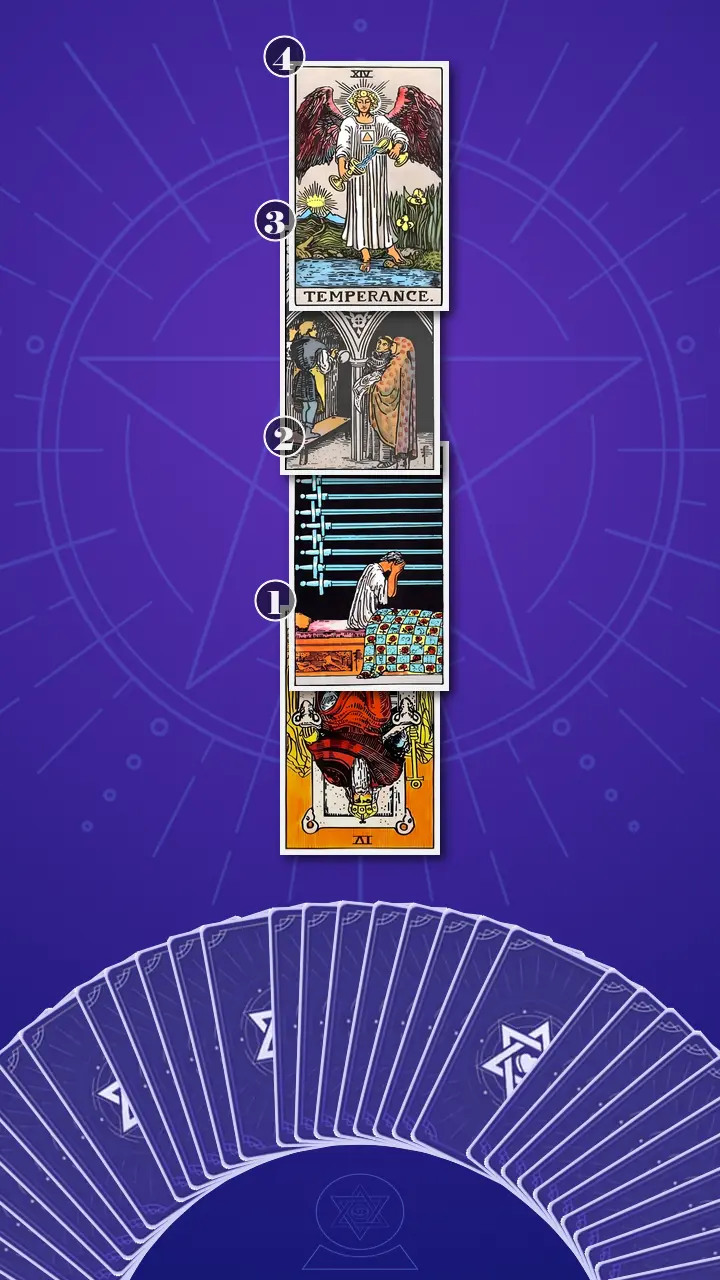
For this reading, I used the Four-Layer Insight Ladder. It is a focused tarot spread for a question that asks why a pattern persists. It does not predict whether Alex will fail, and it does not hand authority to the cards. It gives us four connected views: the visible behavior, the emotional root beneath it, the perspective capable of changing it, and the practical habit that can make the change tolerable.
The first position shows the diagnosis-level behavior: where responsible structure has hardened into personal inspection. The second reaches the fear that makes an unchecked detail feel dangerous. The third is the key transformation, where individual control can become shared expertise. The fourth translates that insight into bounded delegation, clear standards, and scheduled review points. The ladder rises from surveillance to stewardship, one observable rung at a time.
The Stone Throne After Everyone Logs Off
Now I turn over the card representing the diagnosis-level behavior: repeatedly reopening delegated work, retaining minor approvals, and treating personal inspection as the main safeguard for quality.
The card is The Emperor, in reversed position.
The image brought me straight back to Alex at 6:40 p.m., changing customer impact to user impact in the completed deck, comparing the shared board with a private Notion tracker, and asking a teammate to reconfirm figures that were already visible. The Emperor represents authority, order, boundaries, and responsible structure. Reversed, that structure is in excess and becomes rigid. Alex has not stopped leading; they have made themselves the only gate through which ordinary decisions can pass.
The stone throne in the card feels immovable, and the armor beneath the robe is still visible. I read that as a protective posture: prepared, competent, and too tense to let another person exercise judgment without first receiving personal approval. This is not a character flaw. It is a useful leadership instinct that has been applied everywhere, including places where a clear outcome and a named owner would be enough.
I said, “You call it quality control; your calendar experiences it as a second job. If every decision still needs your approval, the work was assigned, but authority was not.” Alex gave a brief, humorless laugh. Their jaw tightened before their shoulders lifted, and then they admitted, “I do make myself the final approval step.” I let the admission stand without turning it into a verdict. The short-term relief of checking was real, but so was the loneliness of being the only person allowed to finish.
The Nine Tabs Playing the Same Future Question
Now I turn over the card representing the mechanism beneath the checking: the fear that an overlooked detail could expose Alex as an inadequate leader and reduce their sense of professional worth.
The card is the Nine of Swords, in upright position.
I moved from the visible Google Docs edits to the private 11:26 p.m. loop. Rain tapped the condo window. A phone warmed Alex's palm, reheated coffee smelled faintly burnt, and one unanswered stakeholder question replayed long after the meeting had ended. The Nine of Swords is the mind rehearsing a threat in darkness until the rehearsal begins to feel like evidence.
I asked Alex to separate two sentences: “The evidence says the stakeholder question can be answered from the source notes tomorrow; my mind keeps rehearsing the moment someone asks for one figure I cannot recall and decides I was never ready to lead.” In that distinction, the card's energy was not a warning from outside. It was air trapped in a closed room, repeating imagined criticism without bringing in new information.
Alex went quiet. Their fingers stopped above the phone, their eyes lost focus as if replaying a real question from Thursday, and then they released a long breath through their nose. No failure had followed that meeting, but the fear had still returned to work as another checklist. I said, “The concern about visible quality is understandable. The part worth testing is the belief that more checking is the only valid response.” The team could not prove its judgment while the workflow kept overriding it.
When Three Figures Read One Plan
The Shared Architecture of the Three of Pentacles
The room became quieter as I placed the third card on the wider gap in the ladder. Now I turn over the card representing the key transformation: replacing solitary quality control with shared standards, distributed expertise, and observable team ownership.
The card is the Three of Pentacles, in upright position. In the image, three figures consult one plan beneath a carved arch. No one is pretending that skill does not matter. The work becomes stronger because the standard, the roles, and the conversation are visible to everyone involved.
I asked Alex to picture a Tuesday planning huddle rather than a Tuesday evening rescue mission. They would open the team's existing project board, write three observable success criteria before the analyst began, name the analyst as decision owner, and schedule one review point. The analyst might still choose a method Alex would not have chosen. The difference would be that Alex could ask how the method met the criteria instead of editing it back into familiar shape.
This is where I used my Workplace Typecasting Analysis. I told Alex that their office ecosystem had quietly cast them as the quality-control gatekeeper, the dependable supporting role who catches the problem before anyone else sees it. Their reliability had become part of the team's script, and even praise for being across every detail could reinforce the role. The task was not to become less capable. It was to stop performing competence as the person who must personally inspect every scene.
I could feel the card changing the temperature of the conversation. Alex's posture loosened as they imagined making the standard public before trying to enforce it privately. They said, “What if I made the standard public before I tried to enforce it privately?” That question was the first believable movement from fear-driven inspection toward curiosity about how another professional solved the problem.
The Sentence Beneath the Carved Arch
The room seemed to hold its breath. I could hear the small click of the radiator and the muted traffic beyond the window. At 6:40 p.m., the team would be offline, the deck would be marked complete, and Alex would feel the familiar pull to change three headings and check every link. Their jaw would tighten around one question: if an obvious error got through, would everyone assume they had never been ready to lead?
Trust is not the absence of standards. It is making the standard visible, naming the owner, and resisting the urge to become the only pair of eyes.
I waited. Alex's breath stopped first, and one finger remained suspended above the edge of the card. Then their gaze moved away from the carved arch and seemed to replay the last stakeholder question, the private tracker, the teammate waiting for approval. Their mouth tightened with a brief flash of resistance. “But does that mean I was wrong before?” they asked, and the question carried anger, grief, and the exhaustion of discovering that a habit had been protecting them while also limiting them.
I answered, “It means the strategy made sense for a while, and its cost has become visible. You do not need to punish the earlier version of yourself to choose a better structure now.” Alex's eyes grew bright. Their shoulders dropped a fraction, their hands opened from fists into loose palms, and a shaky breath rose from deep in their chest. The release did not look triumphant. It looked like the first moment after setting down a bag and realizing the body had forgotten what unburdened felt like.
I added the sentence that brought the image into practice: You do not protect quality by becoming the only pair of eyes; build it together, like the three figures reading one plan beneath the carved arch. Alex nodded, then reached for their phone and saved the line. I asked, “Now, use this new angle to remember last week. Was there a moment when visible criteria and a named owner could have let you support the work without taking it back?”
This was the key shift from contracted vigilance toward the discomfort of bounded autonomy. It was not certainty, and it was not a promise that every delegation experiment would feel easy. It was a change in the location of leadership: away from Alex's private inspection and toward a structure where the team could demonstrate competence in public, observable ways.
Temperance and the Review Point That Does Not Chase You Home
Now I turn over the card representing the practical integration: bounded delegation through clear criteria, named ownership, and proportionate review points.
The card is Temperance, in upright position.
Here the energy is balanced rather than excessive or deficient. Water moves between two cups, and one foot rests on solid ground while the other touches the pool. I read that as a direct answer to Alex's fear of choosing between total control and total absence. A clear brief can be solid ground. A scheduled midpoint conversation can be the water that keeps information moving. Neither requires Alex to live inside every decision.
I described a low-risk deliverable: one shared brief, one assigned owner, one 15-minute midpoint review, and a final check against the agreed outcomes. If the urge to reopen the file arrived early, Alex could write a one-line question under Questions for the review instead of entering the document. They could remain available for safety, compliance, privacy, or genuinely irreversible risks without treating every unfamiliar method as an emergency.
Alex released another small breath. Their foot had been tapping against the floor; it stopped. “I can stay available without staying inside every decision,” they said. I heard the middle path become speakable. Temperance did not ask them to disappear from the work. It asked them to make contact purposeful, proportionate, and emotionally survivable.
The One-Page Trust Brief
When I placed the four cards together, I could see the full story. Alex had been promoted because they were exceptionally good at catching problems before launch. The Emperor reversed showed that this strength had hardened into a private operating system: every task flowed through the same pair of eyes. The Nine of Swords revealed why the system was so difficult to interrupt: a small ambiguity could become a rehearsal of public exposure, and personal checking offered a few minutes of relief.
The Three of Pentacles supplied the missing structure. The solution was not vague faith in the team. It was a shared plan, visible outcomes, and genuine decision ownership. Temperance showed how to sustain it: review at an agreed moment, respond to material exceptions, and leave ordinary professional judgment with the person assigned to use it.
The cognitive blind spot was subtle. Alex had been reading the team's requests for approval as evidence that the team lacked judgment, when the workflow had trained everyone to return judgment to Alex. Trust could not become visible while the system kept removing the opportunity to show it. The transformation direction was from fear-driven personal inspection to collaborative trust built through shared standards and distributed expertise.
I also used my Leadership Narrative Construction lens. Alex's old professional script was: I am the leader who catches everything. The new script could be: I am the leader who makes important standards clear enough for capable people to meet them and who knows when a decision belongs elsewhere. That was not a softer identity. It was a more authoritative one because it gave leadership a design, not just a burden.
- Build the Three-Criteria Trust BriefFor one low-risk deliverable due this week, open the team's existing Jira or Asana board and write exactly three observable success criteria before assigning the task. Ask the assigned teammate, “Which decisions can you own without checking back with me?” Record the answer beside the task and let them own the method.Use an eight-minute timer. Keep legal, safety, privacy, and irreversible requirements explicit, but do not turn personal preferences into mandatory controls.
- Create a Scheduled Review ContainerSchedule one 15-minute midpoint review in Google Calendar for that same task and write the purpose in the invite: decisions needed, risks surfaced, and support requested. Until then, use the shared board as the source of truth and put any urge to reopen the file on a temporary Questions for the review list.Start with a two-hour no-check window if a full workday feels too sharp. Escalate earlier only for a defined material risk, not because ordinary uncertainty feels uncomfortable.
- Use the Protagonist Reframe DirectiveIn the next cross-departmental meeting, when someone asks for a status update, say, “I own the outcome; the named owner owns the method. We are measuring these three results, and our review point is at this time.” Then direct the method question to the teammate who owns the decision.Rehearse the sentence once before the meeting and do not add a hidden final-approval step afterward. Notice the discomfort as information about the old persona, not proof that the new one is unsafe.
These next steps were intentionally small. The cards did not tell Alex what fate required, and I did not ask them to abandon standards. The reading gave us an objective language for separating material requirements from personal preferences, evidence from imagined exposure, and support from surveillance. Alex remained the person choosing what to test.

A Quiet Proof in the Shared Board
A week later, I received a message from Alex: “I left the deck alone until the review. The analyst's method worked, and the three criteria made the conversation easier.” They had slept a full night, but the next morning still wondered, What if I missed something? This time they opened the shared board instead of the private tracker and let the question wait for the scheduled review.
The change was small, and that was why I trusted it. Alex had not solved leadership or eliminated apprehension. They had allowed one piece of work to remain owned by someone else while keeping the standard visible and the boundary clear. That was the first evidence of the emotional transformation: fear-driven inspection had made room for shared accountability.
I think of clarity this way: it is not the moment every possible risk disappears. It is the moment you can see which risk is real, which fear is rehearsing, and which next action belongs to you. In our Journey to Clarity, Alex did not hand the pen to the cards. They picked it up and rewrote the professional identity they had been performing.
When everyone else has logged off and you are still staring at a completed file with your jaw tight, it may be because trusting their work feels inseparable from risking the leadership credibility you worked so hard to earn. If your credibility did not have to be proven by one more check, which small piece of this week's work might you be curious to let a named teammate own within three visible criteria?