Exam Anxiety, One Difficult Question, and a Ten-Minute Attempt

The Practice Paper Notion Could Not Hide
I was looking at a Toronto undergrad with a part-time shift, and the minute an exam got real, they opened Notion to rebuild the plan instead of answering the practice paper: performance anxiety in a color-coded calendar. I met Alex (name changed for privacy) through a video call at 8:10 p.m. on a Wednesday, just after they had come home from work.
I could see the narrow kitchen table behind the laptop. A practice paper sat under Alex's wrist, its rough edge leaving a pale line on their skin. Their phone was face down beside it until a class-group ping lit the table blue against the warm lamp glow. The radiator clicked. Alex flipped the phone over, saw a classmate's immaculate revision tracker, and opened Notion almost automatically.
“I have spent more time planning how to study than actually studying,” they told me. “If this exam matters so much, why can't I make myself begin?”
I heard the deeper contradiction beneath the question. Alex genuinely wanted to prepare, but serious preparation would expose what they did not yet know. If sincere effort still led to a disappointing result, they feared the result might say something permanent about their intelligence, worth, or ability to trust themselves.
Their performance anxiety seemed less like ordinary nerves and more like a smoke alarm wired directly to the first blank line: one incomplete answer, and their whole nervous system prepared to evacuate. A perfect plan can be a very polished way to avoid one honest question.
“I don't think we're looking at laziness,” I said. “I think we're looking at a protective pattern that has become expensive. Let's give that pattern a shape, find out what it is protecting, and draw a map through the fog. The cards won't decide your exam result or tell you who you are. They can help us see where your choices are getting tangled.”
A Compass Beneath the Revision Noise
I invited Alex to place both feet on the floor, let one breath move all the way out, and hold a single question in mind: “Why do I avoid studying when the exam matters most?” I shuffled slowly. I use this pause as a transition for attention, not as a performance of mystery.
I chose a five-card layout called The Shadow Spread. In a Jungian sense, the shadow is not an evil or defective part of the personality. It often contains a strategy that learned to protect us before we understood its cost. My task was to help Alex meet that strategy without shame and decide whether it still deserved control.
For readers wondering how tarot works in this kind of consultation, I treat the spread as a structured pattern-recognition tool. Card meanings in context give us distinct questions to examine, so a vague feeling such as “I just can't study” can be separated into observable behaviour, underlying belief, protective response, available resource, and practical next step.
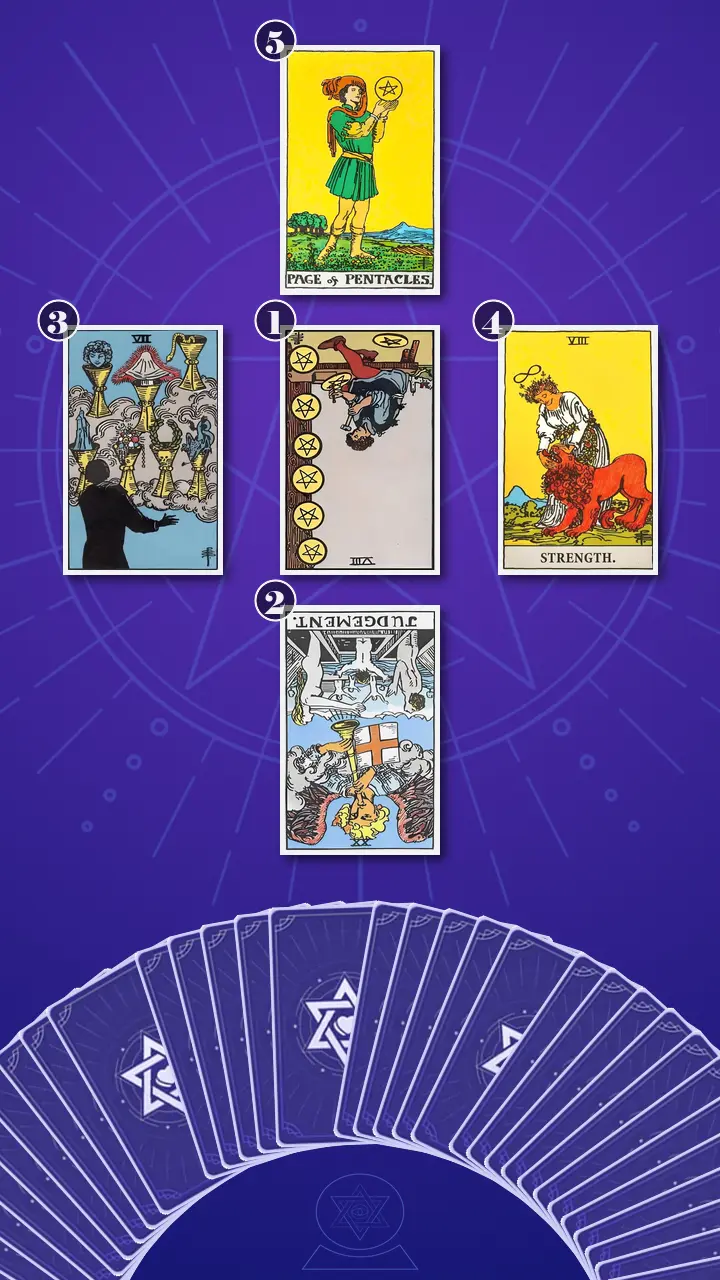
The centre card would show the visible study pattern. The card beneath it would reveal the fear anchoring that pattern. The left and right cards would place the protective distraction opposite the resource capable of regulating it, while the final card above the centre would translate insight into action. A three-card reading would not adequately separate Alex's fear from the behaviour protecting it; a Celtic Cross would add future and environmental positions that this focused question did not need. The five positions formed a compass emerging from a buried anchor.
The Busywork That Looked Like Revision
Position 1: The Craft Interrupted
I turned over the card representing the observable study behaviour: staying busy around the exam while postponing direct practice. It was the Eight of Pentacles, in the reversed position.
I pointed to the craftsperson and the repeated pentacles. Upright, this image speaks to apprenticeship, concentration, and skill built through repetition. Reversed, I read its Earth energy as a Blockage. Alex was working, but the work had become disconnected from the repetition that would build exam readiness.
I described the scene already visible on their table: an open practice paper beside a beautifully organized Notion dashboard, a reformatted timetable, familiar notes ready for another pass, and a search for the best active-recall method. The internal sequence sounded sensible: “I'm getting organized. I just need a system I can trust. I'll attempt the question when I feel ready.” The setup tasks multiplied; the retrieval attempt remained unfinished.
“So the card isn't accusing you of doing nothing,” I said. “It is asking which kind of activity creates evidence of learning. Right now, the craft is interrupted at exactly the point where an imperfect answer would appear.”
Alex gave a short, bitter laugh and pressed their tongue against the inside of their cheek. “That's so accurate it feels a little brutal.”
I did not rush to soften the recognition or turn it into criticism. “Accurate does not have to mean condemning,” I replied. “Your planning has been doing a job. It gives you a brief sense of control without asking you to risk a wrong answer. We can understand that job and still question the cost.”
I also named the reversal's overcorrection risk. Lost time could provoke Alex into designing a punitive six-hour cram session across five chapters, exhausting the very system they needed to bring back to the desk the following evening. The opposite of avoidance was not self-punishment. It was deliberate practice at a scale they could repeat.
Position 2: When Feedback Became a Courtroom
I turned over the lower card, representing the hidden fear that sincere effort followed by disappointment might feel like proof of insufficient worth or control. It was Judgement, in the reversed position.
I saw the angel's trumpet and the figures hesitating beneath it. Upright, Judgement invites honest review and a conscious response. Reversed, I read a Blockage in healthy self-evaluation, combined with an Excess of self-condemnation. The call to learn had been filtered through an internal courtroom.
I asked Alex about the last practice question they had abandoned. They described a Tuesday evening in a Robarts Library cubicle. After missing the first part of a closed-book question, they had felt heat rise into their face under the fluorescent lights. Nearby keyboards kept tapping. The HVAC hummed overhead. Alex opened a grade calculator before checking why the answer was wrong.
“The thought wasn't, ‘I need to review this topic,’” they said. “It was, ‘If I study properly and still can't do this, maybe I've been fooling myself.’”
I briefly remembered hearing different versions of that sentence in different cities and academic systems. The grading scales changed; the inner courtroom did not. Achievement had become a witness for the prosecution, while context, fatigue, learning time, and ordinary human limits were rarely allowed to testify.
“This practice question can measure whether you recalled a specific idea tonight, without notes, under these conditions,” I said. “It cannot measure your intelligence as a whole. It cannot measure whether you deserve good outcomes. It cannot close the case on your capacity to improve before the exam. A wrong answer is data with a loud voice, not a verdict.”
Alex's breath caught. Their thumb pressed into the rim of a mug, their eyes moved away from the screen as if replaying the library moment, and then their grip loosened by a fraction. “A wrong answer feels much bigger than a wrong answer,” they said quietly.
I agreed. “That is the actual problem we need to work with. Not whether you know the perfect study method, but how much authority one attempt has been given over your identity.”
Position 3: Seven Tabs and No Chosen Cup
I turned to the card representing the concrete protective strategy that maintained the cycle: multiplying low-risk study options whenever Alex's ability might be tested. It was the Seven of Cups, in the upright position.
I showed Alex the stationary figure facing seven cloud-borne cups. Each cup offered something compelling, but possibility could not become useful until one option was chosen. Here I read upright Water as an Excess: imagination and choice had expanded until they dispersed attention instead of supporting it.
I mapped the cups onto an 8:47 p.m. TTC ride after work: a TikTok study hack, an Anki settings thread, an AI-generated plan, a YouTube explainer, the course Discord, familiar lecture notes, and another revision calendar. Every option promised a more prepared future version of Alex. No option received ten uninterrupted minutes.
Their algorithm had learned exactly when to serve the fantasy of a perfect study routine: at the moment one difficult question required commitment. It was like endlessly browsing a streaming menu and calling it entertainment. Choosing one question felt dangerous because it closed the escape routes and created evidence.
“Which cup do you reach for first?” I asked.
“The group chat,” Alex answered immediately. I watched their hand move toward the phone and stop halfway. They looked at the dark screen, then placed the phone beyond the practice paper. “I tell myself I'm checking what everyone else is doing. Usually I just end up feeling further behind.”
“Then the chat is not random distraction,” I said. “It is reassurance-seeking mixed with comparison. The Seven of Cups is not asking you to ban every tool. It is asking you to notice when choosing a method becomes a substitute for contacting the material.”
When Strength Put a Hand on the Exit
Position 4: Courage Before Confidence
Before I turned the fourth card, the radiator went quiet and rain began tapping lightly against Alex's kitchen window. The group-chat light had disappeared from the table. I turned over the card representing the inner quality that could challenge the cycle: compassionate self-regulation while discomfort was still present.
It was Strength, in the upright position.
I drew Alex's attention to the figure's gentle hands at the lion's jaws. The figure does not attack the lion, flee from it, or pretend it is harmless. Strength is a relationship with intense energy. I read it as Balance: patient courage strong enough to contain an impulse without humiliating the part that produced it.
In Alex's life, this looked ordinary. They would draw a blank, feel dread surge through their chest, and notice their hand reaching for the phone. Instead of demanding a marathon session or an immediate correct answer, they could put both feet on the floor, name what was happening, set a ten-minute boundary, and remain with the question.
I watched Alex reach the familiar edge of their dilemma. They understood active recall and could explain why it worked, but they were still trying to negotiate with fear for permission to begin. Every negotiation carried the same impossible condition: fear had to leave first.
I used a lens I call Performance Anxiety Decoupling. I asked Alex to imagine two audio channels that had been accidentally fused. One carried limited information about tonight's performance: what they could retrieve, where the gap appeared, and what to review next. The other carried their core worth, intelligence, future, and right to take up space. The exam had legitimate access to the first channel. It had no jurisdiction over the second.
“The goal is not to mute useful feedback,” I explained. “It is to stop a specific result from broadcasting through your entire identity. Once we separate those channels, fear can be present without controlling the next click.”
You do not need to overpower your fear or wait for it to disappear; guide it into one measured action, as the figure in Strength gently guides the lion.
I let the words settle while rain traced narrow lines down the window.
You do not need to feel fearless before you begin; you only need to stop asking one imperfect answer to decide who you are.
I watched Alex go still first. Their inhale stopped halfway, one hand frozen above the phone; even the restless tapping of their heel disappeared. Then their gaze slipped past the card toward the dark window, and I could almost see the previous week replaying: the blank line, the blue ping, the four-color timetable. Their mouth tightened before they said, “But doesn't that mean I have been doing this wrong for years? That I wasted all that time?” The relief had arrived with anger attached. I told them, “It means a protective strategy kept you from feeling judged for a few minutes at a time. It also kept you from getting useful evidence. We can respect why it formed without letting it run the next session.” Their fingers lowered to the table and slowly opened. Their eyes shone; their shoulders dropped on a long, unsteady exhale. For a second, the new clarity looked almost disorienting, because it returned responsibility along with choice. Then they whispered, “Oh. I don't have to believe I'm good at this before I do the next ten minutes.”
“Now, using this new perspective, think back: was there a moment last week when this insight could have made you feel different?” I asked.
Alex looked at the half-finished question. “Right after the group-chat ping. I could have noticed that I wanted an exit. I didn't have to open it.”
I invited them to put a scrap sheet beside the paper. When the urge to switch appeared, they could write “urge to escape” and return to the question until a ten-minute timer ended. One gap and one next source would be enough. They would be free to stop after the timer; this was a bounded experiment, not a demand to push through distress.
“Try this sentence when your hand moves toward the phone,” I said. “I can feel the urge to leave without making it the boss of the next ten minutes. Like the Cowardly Lion in The Wizard of Oz, courage is demonstrated while fear is still there. It is not a prize awarded after fear disappears.”
This marked the first crossing from self-condemning avoidance and scattered planning toward patient, evidence-based confidence. Confidence was no longer the entry ticket to practice. It could become one of practice's receipts.
Position 5: The Apprentice Holds One Thing
I turned over the final card, representing the grounded behaviour through which shadow awareness could become conscious integration: one brief retrieval task, one observed gap, and one defined next step. It was the Page of Pentacles, in the upright position.
I pointed to the Page holding one pentacle at eye level while the field and mountain path remained in the background. The Page does not hold an entire kingdom or claim complete mastery. This is the apprentice archetype: curiosity made practical through sustained attention to one learnable unit.
I read the Page as a return to Balance in Earth energy. The Eight of Pentacles had shown many pieces of work disconnected from deliberate practice. The Page held only one pentacle, but held it honestly. Alex could close every extra tab, attempt one closed-book question, circle one specific gap, choose one source, and schedule a retry.
“The whole exam is not on your desk,” I said. “One question is.”
Alex looked down at the paper rather than toward the phone. Their jaw had not fully softened, but their hand rested flat beside question one. “What if ten minutes just proves how behind I am?”
“Then ten minutes may reveal a gap,” I replied. “It will not have proved the story wrapped around that gap. The Page asks what you can learn next, not whether you already deserve to call yourself capable.”
I asked which concrete question they were willing to meet. Alex circled one on enzyme inhibition and wrote “retry Friday” beside it. That was not a promise of a particular grade. It was evidence that they could choose contact over reassurance once.
The Ten-Minute Handrail
I read the spread as one coherent story. The Eight of Pentacles reversed showed work organized around avoiding evidence. Judgement reversed revealed why evidence felt dangerous: Alex had turned feedback into a total verdict. The Seven of Cups showed the protection mechanism, an expanding cloud of apps, plans, familiar material, and comparison. Strength supplied the missing resource, not more discipline or harsher self-talk, but the ability to stay kindly present with discomfort. The Page of Pentacles converted that courage into one observable act of learning.
The elemental movement mattered. Earth began blocked, Water dispersed into alternatives, and no Swords card appeared at all. Alex had been using enormous analytical effort, yet another productivity system was not the missing resource. Strength restored measured courage, and the Page returned that energy to the physical world through one question, one pen, and one retry.
I named the cognitive blind spot directly: Alex had treated confidence as a prerequisite for practice, even though practice was the process capable of producing trustworthy evidence. They had also compared the immediate pain of one wrong answer with the immediate relief of planning, while overlooking the longer cost of shallow preparation and rising time pressure.
The transformation was not from “lazy” to “productive.” It was from defendant to self-regulator to apprentice. Instead of circling the entrance to the exam room until they felt worthy to enter, Alex could walk through for ten bounded minutes, observe what happened, and choose the next step.
“But after a shift, I genuinely don't always have fifteen good minutes,” Alex said. Their eyebrows lifted as if they expected the plan to collapse on contact with real life.
“Then we give the plan a two-minute floor,” I replied. “A practical tool should bend without becoming meaningless. On a depleted evening, write the question number and attempt only the first step. Contact with the material is the requirement. A perfect answer and an all-night session are not.”
The Inner-Critic Mute Protocol
I organized the next actions around a pre-study exercise I call The Inner-Critic Mute Protocol. Muting does not mean suppressing fear or pretending confidence. It means reducing the critic's authority long enough for factual feedback to become audible.
- Mute the identity verdict for sixty seconds.At the kitchen table, before opening Notion, Discord, or the course group chat, write: “This question can measure what I recall tonight. It cannot measure my worth, my intelligence as a whole, or my ability to improve.” After the attempt, add one factual item under “What this measures” and one under “What this does not measure.”Keep the language factual rather than flattering. Alex did not need to feel convinced; they only needed to name the limits of one result.
- Make one-question contact.At the usual study spot, put the phone in another room or on Focus mode, close every unneeded tab, and attempt one closed-book question for fifteen minutes. If the urge to switch appears, write “urge to plan” on scrap paper and stay with the question until the timer ends.The timer is a handrail, not a punishment. Alex could stop when it rang. On a depleted evening, the two-minute version still counted.
- Record one gap and schedule one retry.When the timer ends, write one sentence in a plain note: “The gap I found is _____.” Choose one source, such as one lecture slide set or textbook section, then schedule a ten-minute retry of the same or a related question within forty-eight hours.Label the calendar event “retry,” not “test.” The purpose is repeatable learning, not another opportunity for self-judgment.
I asked Alex to choose the first tiny version before we ended the call. They switched on Focus mode, left the half-finished enzyme question visible, and set a ten-minute timer for the following evening. The cards had clarified the pattern, but the power to interrupt it remained entirely theirs.

Six Days Later, One Circled Gap
Six days later, I received a message from Alex. “I did the ten minutes. I got a lot wrong, but I wrote down one gap instead of opening the grade calculator. I reviewed one slide set and retried it on Friday. I remembered one part without notes. Also, I didn't check Discord until after.”
I looked at the attached photo: one practice question, several crossed-out lines, a circled knowledge gap, and a small note naming the next source. The image was not visually impressive in the way a color-coded revision tracker could be. It was better. It was evidence of contact.
I also read a less tidy line: “I slept properly, but my first thought this morning was still, ‘What if I fail?’ I made coffee and did the retry anyway.” I valued that line most; clarity had not erased fear, only changed its authority.
I had not predicted Alex's exam result, and the cards had not magically supplied discipline. Our Journey to Clarity had done something more grounded: it separated performance from identity, revealed avoidance as protection rather than a character flaw, and returned one meaningful choice to the person sitting at the desk.
When the practice paper is open and your chest tightens before the first blank answer, it can feel safer to keep planning forever than to risk discovering that full effort may not protect the capable version of yourself you are trying to prove. If that is where you find yourself tonight, noticing the hidden bargain already means you are no longer standing at the exact same starting point.
If you let one small mistake become information rather than a verdict tonight, which first question might you be willing to meet while the ten-minute handrail holds the edge?