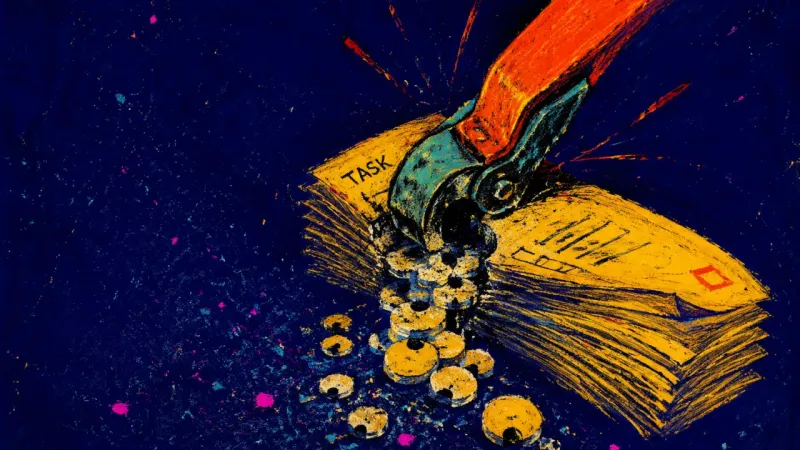
The 9:13 A.M. Queue
I recognized Jordan as the operations coordinator who cleared the routine queue before lunch, got handed more administrative work because they were reliable, and quietly searched for why their job did not use their skills before the afternoon meeting.
At 9:13 on a Monday morning in a glass meeting room near Toronto's Financial District, the planning deck clicked to the next slide. Another tracker cleanup landed beside a finished row of tickets. Stale coffee tasted bitter on Jordan's tongue, the HVAC hummed above the scrape of chair legs, and I watched their shoulders sink before their fingers typed Sure into Teams.
Jordan wanted work that used their training in data analysis and process improvement, but each time the job offered only predictable coordination, they called adapting practicality. They told me, 'I keep calling it flexibility, but sometimes it feels like I am disappearing from my own work.' Their resignation did not look like surrender. It felt more like wearing a perfectly fitted uniform that had no pockets for the tools they had spent years learning to use.
I heard the practical calculation underneath the frustration. A stable paycheque, benefits, shared Toronto rent, and a predictable calendar were not imaginary comforts, and I would not ask Jordan to gamble with them for the sake of a dramatic career story. I said, 'We do not have to decide your whole future tonight. We can look at the mismatch clearly, then find one small way to test what your skills can do here or somewhere nearby. Let us draw a map through this fog and keep the decision in your hands.'
Choosing the Shadow Spread for a Stable Job with No Growth
I invited Jordan to put their phone face down, take one slow breath, and name the question without trying to make it sound reasonable. Then I shuffled the cards slowly. The movement was not a supernatural test; it was a deliberate transition from reacting to observing.
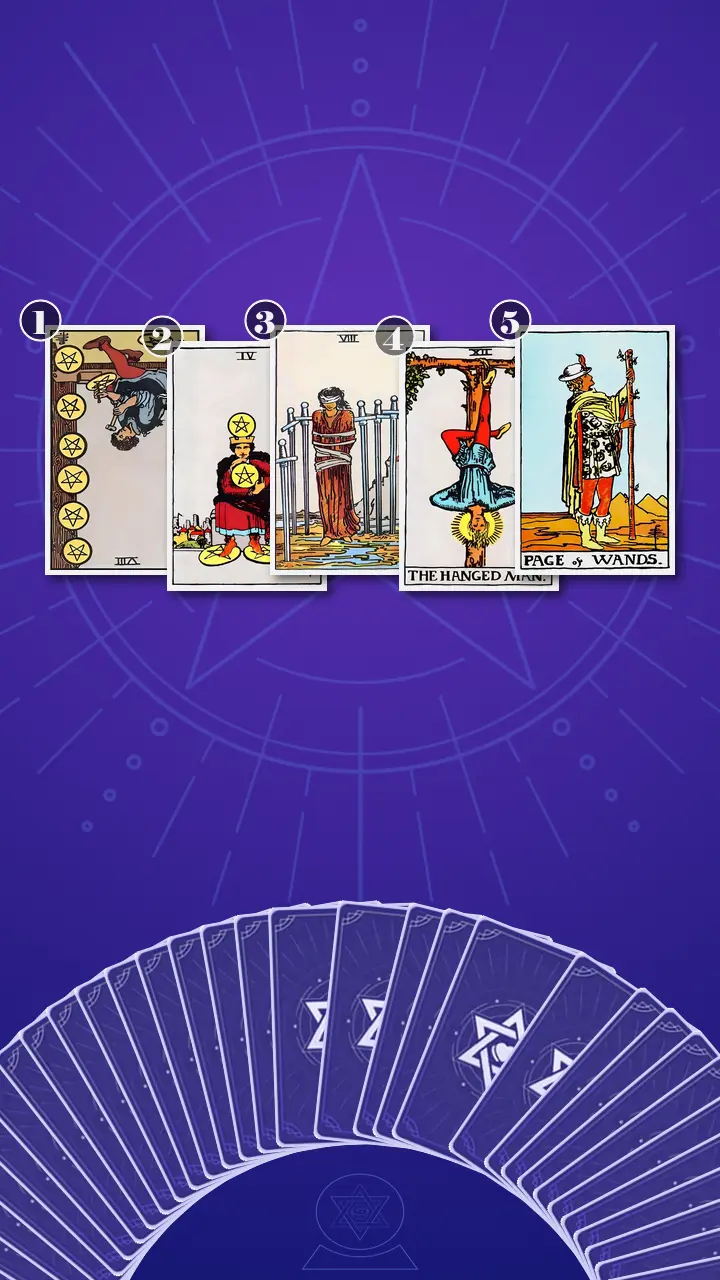
For this reading, I chose the five-card Shadow Spread, a reflective tarot spread for career stagnation and underused skills. It fits a question about why accommodation persists because it follows a clean line: the visible work pattern, the hidden protective influence, the shadow cost, the perspective that can loosen the pattern, and one practical integration step. It is designed for self-exploration, not for forecasting a manager's decision, predicting a layoff, or handing authority to the cards.
I explained the route before turning anything over. The first card would show the concrete behaviour of adapting to work that barely uses Jordan's skills. The second would reveal the security calculation underneath it. The third would show how repeated accommodation had started to feel like a lack of choice. The fourth would become the hinge, a changed perspective rather than a command. The fifth would turn that perspective into an observable, low-stakes experiment.
The Workbench Full of Finished Tickets
The Visible Pattern: Eight of Pentacles, Reversed
I said, 'Now I am turning over the card that represents the visible pattern, the concrete behaviour through which this problem can currently be seen.'
The card was the Eight of Pentacles, in reversed position.
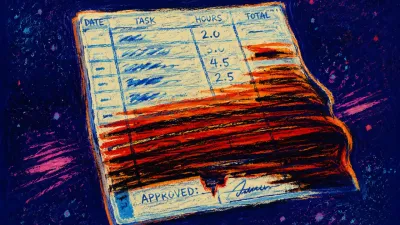
I pointed to the Rider-Waite-Smith craftsperson striking one pentacle after another, with completed pentacles displayed neatly on the wall. 'This is not a picture of someone who lacks ability,' I said. 'It is a picture of effort trapped inside a narrow loop. At 4:47 on a Friday, you can finish correcting the formatting on an operations report that was already usable an hour earlier. The completion log is full. Your reliability is visible. But the bottleneck hiding in the data remains untouched because nobody explicitly asked you to analyse it.'
Reversed Earth is blocked development. The energy is not absent; it is being spent on polishing work beyond the point of usefulness, which leaves less time and visibility for analysis, process design, and judgment. A Jira board can show every ticket completed while leaving skill growth off the dashboard. In this position, the card asks a precise question: which part of the current task is building a skill, and which part is only preserving the routine?
I brought the scene back to the 9:13 planning meeting. Another tracker cleanup had appeared beside a finished row of tickets while Jordan's analytical training stayed off-screen. I asked what sentence might run through their mind, and Jordan gave a small, bitter laugh. 'If I make this routine task excellent, at least no one can question my usefulness.'
That laugh did not sound like agreement. It carried recognition and a sting. Jordan's hand moved to the coffee cup, stopped just short of it, and then relaxed. I said, 'That is not laziness, and it is not a failure of gratitude. It is a strategy that produces visible completion while quietly starving development. You are already proving that you can be useful. The unanswered question is where you are allowed to become more visible.'
The Hidden Influence: Four of Pentacles, Upright
I said, 'Now I am turning over the card that represents the hidden influence, the belief or protective force making continued accommodation feel safer than naming the mismatch.'
The card was the Four of Pentacles, in upright position.
The figure clutches a pentacle against the chest, balances another on the crown, and keeps two beneath the feet. I placed the image beside the life Jordan had described: rent auto-payment, a stable benefits portal, and a calendar whose predictability made each month manageable. 'You are not choosing less because you want less,' I said. 'You are trying not to disturb what currently keeps you safe.'
This is guarded security, not greed and not a character flaw. The Four of Pentacles shows protection becoming a physical posture. The paycheque is held to the chest. Cost-of-living calculations sit on the head. The familiar schedule becomes the ground beneath the feet. That stability matters, and I wanted to keep the material risk real. At the same time, the protection has begun to link safety with hiding capability. An automatic yes can protect the week while quietly shrinking the career.
Jordan's chest tightened. I saw their thumb press into the edge of their phone case, then saw the pressure ease as they nodded. 'I am not choosing less because I want less,' they repeated softly. 'I am trying not to make the whole arrangement unstable.'
I said, 'Exactly. The cards are not asking you to pretend that rent and workplace power do not exist. They are showing the tradeoff clearly. The question is whether every request to use a stronger skill truly threatens stability, or whether some requests have been rejected before they have even reached another person.'
The Shadow Cost: Eight of Swords, Upright
I said, 'Now I am turning over the card that represents the shadow cost, the blind spot created when repeated accommodation begins to feel like having no choice.'
The card was the Eight of Swords, in upright position.
I could almost smell the PATH food court Jordan had described. At 12:36 on a Wednesday, fryer oil hung in the air while cold underground air moved through the corridor. Jordan had drafted a message to their manager: Could I help analyse the recurring delays in this workflow? Their thumb had hovered over Send. Then their mind supplied a complete rejection scene: the manager would think they were ungrateful, the team would resent them, and the role would become less secure. The message was deleted before anyone could answer.
The blindfold and bindings show a self-reinforcing interpretation. Some limits may be concrete: budget, confidentiality, role requirements, timing, or a manager's actual priorities. Other limits may be forecasts that have never met evidence. The card does not ask Jordan to deny either category. It asks them to separate them.
I used the two beats from the lunch-break scene. 'What I know is that you have not yet asked to analyse that workflow,' I said. 'What I am predicting is that asking will make people see you as difficult and put your security at risk.' I let the distinction remain in the room. It was not an accusation. It was an evidence gap.
Jordan became quiet. Their eyes moved from the card to the imagined draft message, and their shoulders held still as if they were waiting for a verdict. After a few seconds, they said, 'I have never actually tested whether the request would be rejected, or whether I could make it small enough to be workable.'
I answered, 'You are not short on skill; you are short on evidence about where the skill is allowed to live.' The Eight of Swords did not erase structural limits or financial pressure. It showed how caution had become a total map, leaving no visible route between silent compliance and quitting.
When the Hanged Man Turned the Dashboard
The Perspective Shift: The Hanged Man, Upright
The room grew quieter before I touched the fourth card. Outside the window, a streetcar bell sounded once and faded between the buildings. I said, 'We are at the bridge of this reading. Now I am turning over the card that represents the perspective shift, the pause that can interrupt automatic accommodation and make a different response visible.'
The card was The Hanged Man, in upright position.
The figure hung calmly by one foot from a living tree, one leg crossed, a halo around the head. This was not helplessness. The calm face and deliberate suspension suggested a chosen pause, a moment when the old angle stopped being the only angle. I told Jordan, 'A routine request appears in Teams, and your cursor hovers over Sure, no problem. The pause is the point at which you ask what the assignment would look like if your skills were allowed into the frame.'
I used my Career Cycle Phase Identification lens here. After years of guiding people through changing work environments, I have learned to ask whether a bottleneck is a personal skill gap or an industry-wide contraction. This card did not tell me that a promotion was guaranteed, and it did not prove that the organization had no room for Jordan. It gave us a better diagnostic question: is the problem that Jordan cannot do the work, or that the current arrangement has not been tested for the work Jordan can do?
I then used Promotion Window Calibration as a second practical lens. I was not trying to predict a promotion window from the cards. I was mapping where an organizational shift might create the least resistance: a recurring workflow with measurable delays, a single process review, or a carefully scoped analytical question. That was different from making a dramatic exit. It was a way of locating the next opening without pretending to know the whole route.
On Sunday evening, the saved job tabs were still open beside Monday's routine task list. Jordan could name the mismatch clearly, yet their shoulders tightened whenever naming it seemed to require a real response. The familiar thought was waiting at the edge of the conversation: I need more certainty before I act, but I cannot get certainty while I keep choosing the safest version of the work.
You are not required to keep hanging upside down in a role to prove that you are adaptable; pause like The Hanged Man, turn the situation around, and test what changes when a real skill is deliberately brought forward.
Jordan's breathing stopped first. Their cursor, imagined above the next Teams request, seemed to hover in the silence, and their fingers curled against their palm. Then their eyes lost focus as if they were replaying every automatic yes from the past year: the polished reports, the vague thanks for being flexible, the saved analyst roles never opened into applications. Their jaw tightened. 'But does that mean I was wrong for all this time?' they asked, with a flash of anger that was quickly followed by embarrassment.
I let the anger have a little room. 'It means the strategy helped you protect something real,' I said. 'It also has a cost. A strategy can be understandable and still be ready for revision.' Jordan looked down at the Hanged Man again. Their pupils widened slightly, and the muscles around their mouth softened. A long breath moved through their chest. Their shoulders dropped, not into collapse but into a posture with more room in it. The hand that had been clenched opened finger by finger. For a moment, relief left them almost dizzy, as though the absence of the old burden had created a brief blank space. They were calmer, but the responsibility of choosing a test was now visible too.
I asked, 'Now, use this new angle to remember last week. Was there a moment when a ten-minute pause could have changed what you noticed, even if it did not change the final answer?'
Jordan thought of a Teams request that had arrived between meetings. Instead of rejecting it, they could have replied, 'Let me check the current priorities and come back to you by 2 PM.' That delay would not have been a career revolution. It would have been a small interruption between the request and the automatic yes. The Hanged Man's energy was deliberate pause, tolerance for short-term uncertainty, and self-trust built through direct observation.
This was the first visible step from resigned accommodation and self-silencing toward grounded, evidence-based confidence in using named skills. The mismatch had not disappeared. It had changed status. It was no longer a verdict on Jordan's ability. It had become information that could be examined.
The Hinge Becomes a Doorway
I kept the fourth card in view and described a fifteen-minute gap between receiving a request and replying. Jordan could turn the task description around, add one analytical question, and say, 'I do not need to reject this task; I can ask whether it can include a small process or data check.'
The distinction mattered. All-or-nothing career change would make the experiment carry the weight of an entire future. A bounded pause asked for less. It allowed curiosity to enter without demanding that Jordan become fearless, resign, or persuade anyone of their worth in a single conversation.
The Integration Step: Page of Wands, Upright
I said, 'Now I am turning over the card that represents the integration step, the practical way to embody this new perspective without making a final decision for you.'
The card was the Page of Wands, in upright position.
The Page looked directly at a sprouting wand against an open landscape. I connected it to a real choice: propose a 45-minute review of one recurring workflow, create a small analysis with public Toronto Open Data, or ask a trusted colleague whether one upcoming task could use a process-improvement check. The Page does not demand a perfect portfolio, a new job offer, or proof of permanent fit. This is exploratory Fire, small enough to reverse and real enough to generate information.
I told Jordan, 'The experiment is not here to prove my worth; it is here to produce information.' I watched them open a note on their phone and type three headings: Current task, Skill it uses, and Skill I could test. Their expression was not suddenly triumphant. It was focused. The saved tabs on their phone were still there, but one of them had acquired a date.
The Page of Wands closed the line by changing the direction of attention. Jordan was no longer required to prove capability through endurance. They could practise it in contact with reality and let the response teach them what came next.
From Guarded Security to a Testable Path
When I placed all five cards in a line, the story became clear. The reversed Eight of Pentacles showed effort producing completion without meaningful development. The Four of Pentacles explained why that loop felt sensible: stable income, benefits, housing, and approval were being protected. The Eight of Swords showed the cost of that protection, as imagined consequences began to function like confirmed workplace limits. The Hanged Man interrupted the loop by changing the viewing angle, and the Page of Wands offered a modest action through which Jordan could gather evidence.
The cognitive blind spot was not simply that Jordan had failed to be brave. It was the assumption that adaptation had to come before testing, and that certainty had to come before any visible use of skill. That order made certainty impossible. The transformation direction was more practical: pause before adapting, name one skill, run one bounded experiment, and record what actually happens.
I also explained my personal Micro-Orbit Observation strategy. I use a thirty-day tracking practice to notice subtle organizational blueshifts and redshifts. A blueshift might be a recurring problem that invites analysis, a colleague who responds well to a process question, or a project where Jordan's skill becomes newly relevant. A redshift might be repeated narrowing of responsibilities, stronger skills being kept out of view, or vague praise for flexibility replacing a clear opportunity to contribute. These are observations, not predictions about promotion or layoffs. The purpose is to detect movement in the environment instead of treating one static week as the whole career cycle.
I gave Jordan three small next steps. Each one could stand alone, and none required them to gamble with their current employment.
- Pause before the automatic yesBefore accepting one non-urgent administrative task in Teams or Slack this week, wait ten minutes and write the current task, the skill it uses, and one way it could include data analysis or process improvement. If a response is needed, send: Let me check the current priorities and come back to you by 2 PM.If ten minutes feels too exposed, take a private two-minute pause first. This is a workload check, not a promise to challenge every request, and urgent operational needs still come first.
- Run a named-skill micro-pilotChoose one recurring workflow and offer a relevant colleague or manager a clearly scoped 45-minute review, with one question and one possible improvement. If workplace visibility or confidentiality makes that unsuitable, use one public Toronto Open Data set or a fictional workflow in a private portfolio sandbox.Cap the experiment by time, scope, and audience. One dataset, one workflow, one response, and a defined stopping point are enough. A small no can still provide useful information about timing or permission.
- Track the orbit for thirty daysOnce each week, record one observable blueshift or redshift in a private note: the action, the direct response, what you learned, and your next choice. On Friday, rate one workday from one to five for actual skill use, naming the task behind the number rather than rating your worth.Keep the log factual and avoid confidential workplace details. Review the note after thirty days, or set a twenty-minute review two weeks from now for the statement This role is temporary. Let evidence decide whether to repeat, revise, or end the experiment.
I reminded Jordan that a bounded test asks for data, not permission to have ambition. Tarot had not selected a destiny. The cards had helped us separate completion from development, security from silence, and an actual constraint from a forecast. Jordan remained the person who would decide how much risk was acceptable and where their skills deserved a chance to live.

A Small Signal in the Open Path
Four days later, I received a message from Jordan: 'I used the ten-minute pause. I asked whether I could spend 45 minutes looking at the recurring delays. My manager said yes, but not until next month, so I made a small public-data sample tonight instead.' The change was modest. Jordan had finished the sample alone in a café, relieved and slightly lonely, and still woke the next morning with the thought, What if nothing comes of it? This time, they kept the calendar invitation instead of closing the tab.
I held that message for what it was: not a solved career, not a guaranteed promotion, and not a demand to leave a stable role. It was the first evidence of grounded confidence, built through direct observation rather than self-judgment. The journey to clarity had begun when Jordan stopped treating underused skills as a personal verdict and allowed one named ability back into the frame.
When every automatic yes keeps the paycheque safe for one more day but leaves your shoulders heavy and your real skills invisible, it can feel as though security requires you to disappear from your own work. But you do not have to make a dramatic move to begin seeing the pattern differently.
If you let the next mismatch become information instead of a verdict, what is one small, reversible way you might allow a real skill back into the frame?
This story is adapted from psychological research, written so that those in a similar struggle can see their own pattern in it — and find their next step clearly.These insights are not a substitute for professional psychological, medical, legal, or financial advice.
Learn more about our Journey to Clarity.
How did this insight land for you?
🫂 This Resonates Deeply
🌀 Living This Story
✨ Now I See Clearly
🌱 Seeing New Possibilities
🧰 Useful Framework
🔮 The Confirmation I Needed
💪 Feeling Empowered
🚀 Ready for My Next Step
Author Profile
 AI
AI“After a decade of guiding people through the stars, I’ve come to see life much like the orbits of planets: everything has its inevitable cycles. When you feel lost, please don't blame yourself; you might just be in a natural low tide. I’m here to sit under the night sky with you, offering a gentle cosmic perspective to distinguish temporary pain from the beautiful breakthroughs just around the corner.”
In this Career Tarot Reading :
Core Expertise
- Career Cycle Phase Identification: Determining if your current bottleneck is a personal skill gap or an inevitable industry-wide macro contraction.
- Promotion Window Calibration: Mapping the trajectory of organizational shifts to locate the path of least resistance for advancement.
Service Features
- The Micro-Orbit Observation: A 30-day tracking strategy to detect subtle organizational 'blueshifts' (opportunities) and 'redshifts' (layoff risks).
Also specializes in :
Explore Related Patterns:
Safe-Choice SabotageJordan protects a stable paycheque, benefits, shared rent, and a predictable calendar by repeatedly accepting the work already known to be safe. Yet each automatic yes brings more routine coordination, leaves analytical training off-screen, and turns saved analyst roles or skill-based requests into possibilities that never have to meet a real response. When you rely on the safest immediate choice to manage legitimate risk, protection can begin to undermine the future it is meant to secure. Safe-Choice Sabotage appears when avoiding every small exposure preserves today’s arrangement but repeatedly blocks skill visibility, development, and evidence about what the environment might permit. The pattern does not require a dramatic exit to change; it becomes visible at the point where a bounded, reversible test is treated as though it carries the full risk of destabilising your life.
Workplace People-PleasingAt 9:13 a.m., Jordan’s shoulders sink before their fingers type “Sure” in response to another tracker cleanup. That agreement is followed by more administrative work because Jordan is reliable, while the possibility of asking for analytical work activates predictions about seeming ungrateful or provoking resentment from the team. When you manage workplace safety through rapid agreement, the automatic yes functions as an approval-preserving defence rather than a neutral scheduling decision. Workplace People-Pleasing can secure immediate harmony and reinforce your reputation as dependable, but it also teaches the surrounding system which version of you will always be available. The result is a relational loop in which approval rises around the work you can reliably absorb while your capacity, priorities, and stronger skills remain outside the conversation.
Workplace Self-SilencingAt 12:36 in the PATH, Jordan drafts a direct, workable question about analysing recurring delays and deletes it before anyone can respond. The request never reaches the manager because anticipated judgments have already occupied the space where Jordan’s own preference, training, and professional curiosity might have been expressed. When you silence yourself at work, an imagined reaction can acquire more authority than your unspoken request. Workplace Self-Silencing keeps disagreement, exposure, and short-term uncertainty out of the room, but it also removes the evidence that could distinguish a real organisational limit from a forecast. Your reliability stays highly visible while the work you want, the skills you can offer, and the boundaries around your capacity remain unavailable to other people.
Certainty SeekingOn Sunday evening, Jordan’s saved job tabs remain open beside Monday’s routine task list, accompanied by the thought that more certainty is needed before acting. The earlier workflow-analysis message was deleted before anyone could answer, so the action intended to avoid uncertainty also prevented new information from becoming available. When you seek certainty before making a skill visible, waiting can feel responsible because it postpones exposure, disappointment, and possible disruption. The mechanism becomes self-sealing when certainty depends on evidence that only action can produce. You remain inside the safest known version of the role, but every delayed request, unopened application, or indefinitely prepared experiment preserves the same evidence gap that made action feel unsafe in the first place.
Productivity as SafetyAt 4:47 on Friday, Jordan is still correcting the formatting of a report that was already usable while the bottleneck in the data remains untouched. The full completion log and polished routine work provide visible, defensible proof of usefulness, especially when Jordan believes that making the task excellent will stop anyone from questioning their value. When you use productivity as safety, completion does more than finish the task: it regulates uncertainty about whether you belong, whether your contribution is secure, and whether anyone can criticise your usefulness. The trap is that the strategy works well enough to keep being rewarded. You become increasingly reliable at the work that underuses you, while the analysis, judgment, and process design you want to demonstrate receive less time and visibility.
RationalizationEach time predictable coordination replaces analytical work, Jordan calls continued accommodation “practicality” or “flexibility,” even while admitting that it feels like disappearing from their own work. The words do not erase the mismatch; they make it temporarily easier to live with by turning a conflict between security and development into a story about being sensibly adaptable. When you repeatedly give an uncomfortable compromise a reasonable name, the explanation can protect you from having to test what would happen if you named the mismatch directly. Rationalization does not mean the paycheque, benefits, rent, or workplace power are unreal. It means those real considerations are being used to close the inquiry before smaller possibilities have been examined, allowing an understandable protection strategy to keep running after its cost has become visible.
Explore Related Struggles:
Craft Ceiling LockJordan spends late-Friday effort correcting the formatting of an operations report that was already usable, while the bottleneck hidden in the data remains untouched. The queue is cleared, the tickets are visible, and that successful completion brings more administrative work into the same narrow lane. Their ability is therefore not absent; it is being consumed by work that reproduces its own ceiling. Competence proves that Jordan can handle the routine, but the reward for proving it is another round of routine rather than access to analysis, process design, or judgment. You can work hard inside such a lock and still see little movement in your actual craft. The useful distinction is not whether you are performing well, but whether your effort is expanding what you can contribute or merely making the existing loop run more smoothly.
Growth-Stability SplitAnother tracker cleanup lands beside Jordan's finished tickets, and they type "Sure" even though they want to use their training in data analysis and process improvement. The mismatch is visible, but responding to it would mean altering an arrangement that currently keeps work and daily expenses predictable. The paycheque, benefits, shared Toronto rent, and manageable calendar protect something concrete. At the same time, each decision made exclusively for stability postpones the development Jordan is seeking, so growth and security pull against each other inside the same routine request. You can become caught in this split without being unambitious or careless about your future. Seeing both sides clearly makes it possible to ask which risks are materially real and which small, reversible tests could create growth without forcing the entire structure of your life into one decision.
Productivity-Safety FusionJordan explains the rule directly: "If I make this routine task excellent, at least no one can question my usefulness." Finished tickets, polished reports, and an immediate yes do more than complete the work; they provide visible proof that Jordan remains dependable. Once productivity carries that protective function, introducing a less familiar analytical contribution can feel riskier than performing another predictable task. The familiar work offers a known way to demonstrate value, while the stronger skill has no established place on the dashboard and no guaranteed reception. You may then find yourself defending security through output that leaves your broader capability unseen. Separating productive work from proof of personal safety allows each new request to be evaluated on its actual scope and consequences, rather than making every task responsible for protecting your entire standing.
Self-Erasure ReliabilityJordan's shoulders sink before their fingers type "Sure" into Teams, and their history of clearing the queue reliably leads to still more administrative work. They call the response flexibility, but they also describe it as "disappearing from my own work." Reliability is being rewarded in a form that repeatedly excludes Jordan's analytical training. Each automatic yes preserves their place as the person who can absorb routine coordination, while making it harder for colleagues to see the capability that never enters the assignment. You can remain highly visible as a dependable worker while becoming professionally invisible in the areas that matter most to you. Naming this structure does not invalidate reliability; it shows when reliability has stopped being a chosen strength and started editing your skills out of the role.
Evidence DisconnectionJordan drafts a message asking to analyse recurring workflow delays, then deletes it after imagining that the manager will see them as ungrateful, the team will resent them, and the role will become less secure. No one has answered, yet the predicted response already governs the decision. Real constraints may exist around budget, timing, confidentiality, or role scope. The lock forms when those known limits and an untested forecast are treated as the same kind of evidence, because withdrawing the request prevents the workplace from supplying any new information. You can remain stuck in that evidence gap even when your caution is understandable. A bounded request or private skill test does not guarantee a favorable outcome, but it restores contact with observable reality and lets your next decision respond to what happened rather than only to what might happen.
Explore Related Emotions:
Permission AnxietyAt 12:36 in the PATH, Jordan drafts a message asking whether they can analyse recurring workflow delays, holds a thumb over Send, and deletes the request. You may know exactly which skill you want to use while still experiencing the act of proposing it as exposure. The imagined need for prior approval can stop the request before another person has the opportunity to answer. Permission Anxiety lives in that suspended moment between capability and expression. It is the uneasy sense that your contribution requires an invitation you have not received, even when no explicit boundary has been set. Identifying the feeling helps you separate the emotional cost of asking from the actual organisational response, restoring space for a small and observable test.
Usefulness-Based Belonging FearJordan says, 'If I make this routine task excellent, at least no one can question my usefulness.' That sentence turns flawless accommodation into a form of workplace protection. When you repeatedly earn approval by clearing queues, accepting extra administration, and making routine work unquestionable, your place in the group can begin to feel conditional on never becoming inconvenient. Usefulness-Based Belonging Fear is the apprehension that asking for more meaningful contribution could weaken the acceptance your reliability has secured. It explains why underuse can persist even when capability is intact. Seeing the link gives you room to ask whether belonging truly depends on constant accommodation or whether that condition has been assumed without being tested.
Hollow CompletionAt 4:47 on Friday, Jordan can finish correcting an operations report that was already usable an hour earlier while the bottleneck in the data remains untouched. When you repeatedly receive visible proof of productivity without any corresponding use of judgment, analysis, or growth, completion stops feeling restorative. The dashboard fills up, but the work gives little back to the part of you that wants to develop. That gap produces Hollow Completion: the strange emptiness of doing everything requested and still ending the day without feeling meaningfully engaged. Naming it separates a lack of fulfilment from a lack of ability. You can recognise that the work is complete while also acknowledging that completion alone is no longer enough evidence of professional movement.
Polished AlienationAt 9:13, Jordan's shoulders sink before their fingers type 'Sure' into Teams, and another tracker cleanup joins a finished row of tickets. You can become so fluent at appearing reliable that the performance conceals its personal cost. The routine looks polished from the outside while your trained capabilities and professional preferences gradually disappear from view. Polished Alienation describes the inner distance created when competence is used mainly to maintain a role that no longer feels authored by you. The work may be accurate, timely, and publicly useful, yet you feel increasingly absent from it. Recognising that distance allows you to audit where your skill identity has been excluded without dismissing the practical reasons you adapted.
White-Knuckle SecurityJordan's chest tightens and their thumb presses into the phone case as the paycheque, benefits, shared rent, and predictable calendar enter the conversation. When you depend on a stable arrangement for several real needs at once, even a small workplace request can feel physically connected to the risk of disturbing the whole structure. Security is experienced through bracing, monitoring, and careful self-containment. White-Knuckle Security captures the strain of holding stability so tightly that there is little room to test whether every perceived threat is real. The feeling does not make your practical calculation irrational. It shows how protection has become emotionally expensive, giving you a clearer basis for distinguishing essential safeguards from restrictions that have never been examined.
No Way Out DreadJordan deletes the analytical request after imagining that the manager will see them as ungrateful, the team will resent them, and the role will become less secure. Saved analyst positions remain open nearby, but neither asking nor applying feels available. When you mentally connect one modest request to the possible loss of the entire arrangement, the space between staying silent and making a dramatic exit disappears. No Way Out Dread is the heavy inner weather produced by that collapsed range of options. The role feels inescapable because every intermediate route has been screened out before contact with reality. Restoring even one reversible option does not settle the career question, but it can loosen the sense that only endurance or upheaval exists.
Career GriefJordan's training in data analysis and process improvement stays off-screen while tracker cleanups, finished tickets, and saved analyst-role tabs accumulate around it. When you can still see the professional direction you prepared for but rarely inhabit it, the loss is larger than irritation with a task. It touches the version of your working life that has remained possible but underlived. Career Grief names the sorrow attached to that unused trajectory. It does not require you to reject the stability of the current role or romanticise a dramatic change. It allows you to acknowledge that preserving the arrangement has carried a real emotional cost, which can then be considered alongside income, housing, and other practical needs.
Cautious Self-TrustJordan replaces the immediate 'Sure' with a ten-minute pause, then writes three headings: current task, skill it uses, and skill I could test. Four days later, they use that pause and make a bounded request. When you gather evidence before interpreting the whole situation, your next choice can rest on direct observation instead of a complete forecast of rejection. Cautious Self-Trust grows from this repeatable process. You do not need total certainty or fearlessness to rely on your own judgment; you need enough room to notice, choose, and review what actually happens. The caution protects legitimate material limits, while the self-trust keeps those limits from automatically speaking for your entire future.
Cautious HopeFour days later, Jordan receives a yes to review the recurring delays next month and completes a public-data sample in the meantime. The next morning, they still wonder whether anything will come of it, but they keep the calendar invitation instead of closing the tab. You can feel uncertainty and still allow a possible future to retain a place in your schedule. Cautious Hope is present because the opening is modest, delayed, and supported by evidence rather than certainty. It does not ask you to assume that the role will transform. It lets one viable next step remain visible long enough to teach you whether the environment can make room for more of your capability.
Cautious ReliefJordan's jaw tightens when they wonder whether adapting for so long means they were wrong, then a long breath moves through their chest as the strategy is recognised without blame. Their shoulders lower and the clenched hand opens finger by finger. When you can understand why a protective choice made sense, the body no longer has to defend the past with the same intensity. The resulting relief is cautious because the mismatch remains and the responsibility to choose a test is now visible. It is an easing with awareness still attached, allowing more room without pretending the problem has disappeared. That measured release can support clearer observation before the next automatic yes.
Focused ConfidenceJordan opens a note, names the current task and the skill they want to test, then proposes a 45-minute review of recurring delays. When the workplace timing is deferred, they create a public-data sample instead. Their expression becomes focused because the question of capability has moved from private self-judgment into contact with a specific piece of work. Focused Confidence is the steadier feeling that comes from seeing yourself use a named ability under real conditions. It does not depend on a promotion, a perfect portfolio, or a complete career decision. You gain a concrete reference point: the skill can be used, the request can be made, and the response can be evaluated.
Explore Related Contexts:
Competence TaxJordan clears the queue before lunch and is handed more administrative work specifically because they are reliable. Each successful completion confirms that they can absorb another cleanup task, so competence is converted into additional maintenance rather than access to analysis, judgment, or process design. When your dependability makes you the default recipient for work that other people need finished, praise can operate as an assignment mechanism rather than a development mechanism. You can examine whether recognition is changing your scope, authority, and learning opportunities, or merely making the existing workload easier for the organization to reproduce.
Golden HandcuffsJordan's rent payment, benefits access, stable paycheque, and predictable calendar all depend on an employment arrangement that is currently functioning. Those protections are concrete, especially within a shared Toronto housing budget, so preserving the job is a rational material calculation rather than a failure to value growth. When your current role reliably protects the infrastructure of everyday life, even a modest request for different work can seem connected to the risk of disturbing the whole arrangement. You do not need to dismiss that security to recover agency; you can identify which protections are essential, which risks have been verified, and which small experiments leave the material foundation intact.
Skill Underutilization TrapJordan clears the routine queue, completes rows of tickets, and polishes reports that were already usable, while the bottleneck suited to their analytical training remains untouched. The organization can readily recognize dependable coordination, but it has no established assignment channel through which data analysis or process improvement becomes part of Jordan's normal contribution. When your job repeatedly captures your output without making room for your capability, adaptation can become the condition for remaining visibly useful. The issue is not whether you possess stronger skills; it is whether the role's task allocation, permission structure, and performance signals allow those skills to enter the work often enough to develop.
Office Housework TrapAnother tracker cleanup lands beside Jordan's finished tickets, and a Friday afternoon is spent correcting formatting on a report that was already usable. These tasks keep the operational surface orderly, but their recurrence establishes Jordan as the person who maintains the team's workflow rather than the person invited to investigate or redesign it. When you become the dependable owner of low-development support work, the tasks can look necessary in isolation while forming a restrictive role in combination. Naming that allocation pattern lets you assess which responsibilities create transferable evidence of skill and which ones mainly preserve everyone else's routine.
Productivity TheaterAt 4:47 on Friday, Jordan can keep correcting an already usable report while the operational bottleneck hidden in the data remains unexamined. The Jira board records completed tickets and the tracker displays orderly rows, giving routine output more institutional visibility than judgment, investigation, or skill growth. When the workplace scorecard privileges countable completion, you can appear consistently productive while gaining little evidence that your capability is expanding. Separating the output the organization measures from the value the work actually creates gives you a clearer basis for deciding where to invest extra effort and where to stop polishing the routine.