A Tense Meeting, One Named Owner, and the Boundary That Held

Finding Clarity After the 6:47 p.m. Slack Spiral
If you're the calm person on a hybrid creative team, and one clipped message can make you rewrite the entire recap before naming the decision, Slack anxiety may be consuming more of your day than the conflict itself.
At 6:47 p.m. on a Tuesday, Jordan joined my video room from a nearly empty King West coworking space in Toronto. The HVAC hum came through their microphone while three private Slack chats glowed beside our call. They lifted the last of a burnt coffee, grimaced, and set it beside the afternoon deliverable that was still untouched. The laptop had left a warm red line beneath their wrists, and their shoulders seemed to be trying to meet their ears.
“I can handle the task,” Jordan told me, “but I'm tired of being the person who always handles the tension too. By the time I realize I'm resentful, I've already said yes.”
I heard the contradiction clearly: Jordan wanted to set a boundary, but their body treated every unresolved reaction as an incoming alarm. Their apprehension felt like a fire detector wired directly to punctuation; one clipped full stop could tighten their chest before anyone had actually asked them to intervene. They wanted ownership clarified, yet an awkward pause was often enough to make them carry the loose end home.
“I don't think your care is the problem,” I said. “Let's look at the moment care turns into responsibility without your consent. We aren't asking the cards to predict what your coworkers will do. We're using them to draw a map through the fog, so you can see where your choice begins.”

Choosing a Map for the Conflict Nobody Owns
I invited Jordan to put both feet on the floor, take one slower breath, and hold the question in plain language: “Why do I keep absorbing team conflict instead of setting boundaries?” I shuffled while they let the workday stop moving for a moment. The ritual was simply a transition from reacting to observing.
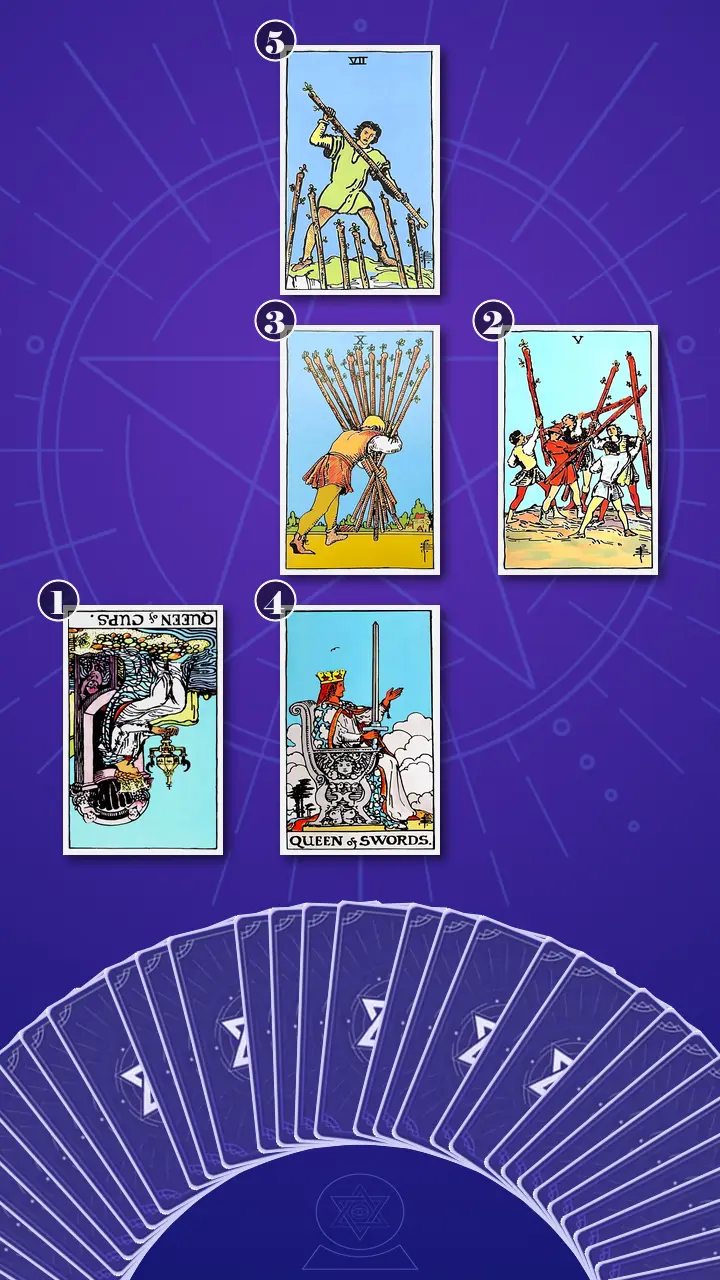
I chose the Relationship Spread · Context Edition, a five-card relationship tarot spread adapted for a team rather than a one-to-one relationship. For anyone wondering how tarot works in my practice, I use a spread like this as a structured sequence of questions. It separates the querent's stance, the surrounding environment, the exchange that keeps repeating, the resource already available, and the next developmental task.
This was the smallest map that could show the whole workplace boundary pattern without burying Jordan under irrelevant detail. The first position would reveal how conflict absorption begins inside them. The center would show how shared friction becomes private labour. The lower bridge card would identify the boundary resource they already possessed, while the final card would test whether that boundary could survive another request.
Reading the Team's Hidden Workload
Position 1: The Emotional Inbox That Never Closes
I began with the position representing the observable pattern and physical signature behind Jordan's habit of absorbing conflict, including the urge to monitor reactions before stating a limit. The card was the Queen of Cups, reversed.
I drew Jordan's attention to the Queen's ornate closed cup and her fixed gaze upon it. Upright, her Water can hold empathy with steadiness. Reversed, that receptivity had moved into excess and blockage: Jordan was receiving emotional information faster than they could distinguish observation from obligation.
In card meanings applied to real life, this looked exactly like 6:47 p.m. Jordan was studying three coworkers' private messages as if the correct interpretation of every tone could prevent the team from breaking apart. They validated each person, edited away every sharp edge, and overlooked that their own deadline and availability were also real information. Their care had started operating like a Slack workspace with no channel permissions. Every emotional notification reached them, and every alert appeared actionable.
“Think of the last thread where someone's wording turned clipped,” I said. “What did you do before anyone directly asked you to mediate?”
Jordan's mouth curved into a brief, bitter laugh. Their fingers tightened around the paper cup, then released it. “That is so accurate it feels a little brutal. I started drafting a compromise before either person had even explained what they wanted.”
“Then the card is describing a pattern, not passing judgment on your character,” I replied. “Being perceptive is a strength. The boundary question is whether noticing distress automatically gives that distress ownership of your time. You can be kind without becoming the routing system.”
Position 2: Five Cursors, No Final Version
I next turned over the card representing the collective team climate that triggered Jordan's response: competing priorities, crossed communication, and unclear decision ownership. It was the Five of Wands, upright.
The figures raised their staffs in different directions, with no single opponent and no shared target. I read this as Fire in excess but dispersed rather than coordinated. The disagreement was real, but real disagreement was not automatically a crisis. It was five cursors moving through the same Figma file while nobody confirmed which version was final.
I connected the image to Jordan's fast-moving video meetings, where several teammates spoke over one another about scope, timing, and creative priorities. The atmosphere could have the overlapping-kitchen intensity of The Bear, but volume still did not establish an owner. Jordan had been building a compromise before the team defined the question, turning a coordination problem into a personal assignment to restore calm.
“What were they concretely disagreeing about last time?” I asked. “And who actually had authority to decide?”
Jordan looked away from Slack and rested both palms on the desk. “Launch scope. Two creative leads had the authority, technically. Nobody said that out loud, so I jumped in.” I watched their breathing slow as the conflict became a process problem rather than a verdict on their ability to keep the room under control.
Position 3: When Shared Friction Becomes a Private Load
I turned to the center, the position representing the self-reinforcing exchange through which team disagreement became Jordan's personal emotional and practical workload. The card was the Ten of Wands, upright.
The figure carried ten staffs in one bundle, bent forward with their view obstructed. The Fire that had been scattered across five people was now excessive and concentrated in one carrier. That was the blockage: Jordan gathered a collective problem into a private load because doing so produced immediate quiet.
One unresolved meeting became their diplomatic recap, three private debriefs, a rewritten timeline, and two tasks that had not previously belonged to anyone. Saying “I can handle it” let the meeting move on, but the load then blocked the simpler options from view: leave the decision visibly unresolved, ask for an owner, or allow the people involved to speak directly.
“Quiet is not the same as resolved; sometimes the work has only moved into your inbox,” I said. “Your competence does not make every loose end yours.”
Looking at the bundled staffs, I thought of orbital capture. Once loose work entered Jordan's orbit, its repeated presence began to make the burden look inevitable, as if anything circling them must naturally belong to them. In reality, each task had arrived through a small moment of choice, usually the moment when silence became uncomfortable.
Jordan's breathing paused. Their gaze dropped to the unfinished document beside our call, and their thumb rubbed once across the warm laptop edge. Then a long breath moved through their chest. “I know it isn't technically mine,” they said, “but leaving it there feels irresponsible.”
“That sentence is the reinforcement loop,” I said. “You take the work, the room becomes quieter, and the quiet rewards you. The resentment arrives later, when nobody can see where the shared responsibility went.”
When the Queen of Swords Kept One Hand Open
As I reached for the bridge card, the coworking floor's HVAC clicked off. The sudden stillness made the next Slack chime sound unusually sharp, and then even the typing indicator beside Jordan's screen disappeared.
Position 4: The Sentence That Returns Responsibility
I turned over the position representing Jordan's existing inner resource for separating empathy from ownership while remaining collaborative. The card was the Queen of Swords, upright.
Her sword stood vertically, making a clean distinction, while her other hand remained open. I saw balanced Air: discernment without withdrawal, precise language without punishment. The card did not ask Jordan to become colder. It showed them how to let sensitivity inform communication without allowing sensitivity to assign unlimited responsibility.
In Jordan's workday, the Queen's sword became two clear sentences: “I can document the final decision. The decision and any direct concerns need to stay with the people who own them.” The open hand preserved support. The blade separated supporting from deciding, and listening from carrying.
This was where I used a lens I call Career Cycle Phase Identification. After a decade of reading career patterns alongside larger cycles, I have learned to separate a personal skill gap from an organization-wide or industry-wide contraction. Jordan did have a boundary skill to practise, but compressed timelines, informal authority, and recurring ambiguity across several projects were not private failures. The team was moving through a low-clarity organizational cycle, and Jordan's nervous system had been treating that macro weather as a personal performance review. The Queen of Swords gave us two different questions: “What is mine to improve?” and “What belongs to the system around me?”
At 6:47 p.m., with the coworking floor nearly empty, Jordan's own task was still untouched and three coworkers were effectively waiting for them to make conflict feel safe enough to disappear. I could see the old equation tightening again: useful meant responsible; discomfort meant act.
Empathy can acknowledge the weather in the room; it does not make you responsible for carrying it home. Clarity is what returns the work and the reactions to their actual owners.
You do not have to become the room's emotional container to be collaborative; name what is yours and what is not, as the Queen of Swords keeps one hand open while holding the blade upright.
For one beat, Jordan did not move. Their breath stopped high in their chest, and their index finger froze above the trackpad. Then their gaze slipped past my face on the screen and went unfocused, as if last week's meeting were replaying frame by frame. Their pupils widened. Their mouth tightened. A flush rose over their cheeks before their eyes shone. “But doesn't that mean I've been doing this wrong the whole time?” they said, sharper than before. I let the anger have room. “It means the strategy worked in the short term,” I said. “You made rooms quieter. It also charged your evenings for that quiet. Seeing the cost now does not make your earlier self foolish.” Their fist slowly opened. Their shoulders dropped, first one and then the other, and a breath left them with a small, unsteady laugh. Relief arrived, but so did a brief blankness, the dizziness of realizing that clarity would now ask them to let other people stay uncomfortable.
“Now, with this new perspective, think back to last week,” I said. “Was there a moment when this insight could have made the experience feel different?”
Jordan remembered Friday beside the agency kitchen sink. A coworker had asked what another teammate was “actually getting at,” and Jordan had agreed to translate even while their body leaned toward the exit. “I could have said I didn't want to interpret it,” they told me. “I could have asked them to speak directly in the project channel.” Their reaction would have remained information; it would not have become a task assignment.
I asked Jordan to open a note titled Mine / Theirs / Shared. Under Mine, they wrote, “Document the final decision.” Under Theirs: “Make the decision and address concerns directly.” Under Shared: “Keep the question in the project channel.” Then they drafted, without committing to send, “I can support the documentation. The decision and direct conversation need to stay with their owners.” I reminded them that if a situation carried real professional risk or their body felt too activated, they could stop at naming one item that was not theirs. A reflective tool should widen choice, never pressure someone into a confrontation.
I named the shift plainly. This was the first movement from apprehensive conflict absorption and guilt-driven over-functioning toward discerning empathy, clear ownership, and confidence in tolerating disagreement. It was not certainty. It was differentiation.
The Boundary After the Boundary
Position 5: Holding the Line When the Next DM Arrives
I turned over the final card, representing the developmental task of maintaining a stated limit when requests, reactions, or pressure made over-functioning feel easier. It was the Seven of Wands, upright.
The figure held one staff from higher ground while six others rose from below. I read the card as disciplined Fire moving toward balance. Jordan's blockage did not happen only before a boundary. It also appeared after the first pushback, when a clear sentence suddenly expanded into apologies, exceptions, and a new offer to help.
I gave Jordan the familiar scenario. They return a disagreement to its actual owners. Two coworkers ask for “one more quick chat,” and another asks whether they can make an exception. Jordan's jaw tightens. The cursor hovers. The old thought appears: “If I explain more, they may approve of the boundary.”
“The Seven of Wands is not asking you to defeat anyone,” I said. “It asks whether the first accurate sentence can remain accurate after someone dislikes it. A boundary becomes real when you stop rewriting it under pressure.”
Jordan gave a small, rueful laugh and looked at the long Slack draft still open beside us. “So the goal isn't wording it so perfectly that nobody pushes back.”
“Right,” I said. “The goal is to communicate clearly, notice whether genuinely new information appears, and avoid mistaking ordinary disappointment for danger. You remain free to revise a boundary. You do not have to renegotiate it merely because it has been noticed.”
The Mine-Theirs-Shared Off-Ramp
The cards formed a concise causal story. In the past, Jordan's calm diplomacy had earned trust and produced immediate relief, so the strategy had become self-reinforcing. In the present, the reversed Queen of Cups absorbed every emotional signal, the Five of Wands supplied abundant team friction, and the Ten of Wands compressed that shared friction into Jordan's private workload. The Queen of Swords introduced the distinction that could break the loop. The Seven of Wands showed why that distinction would need repetition before it felt natural.
The central cognitive blind spot was the belief that discomfort after a boundary proved the boundary was irresponsible. It did not. Guilt could simply be the body noticing that Jordan had interrupted an old success strategy. The transformation direction was not from caring to detachment. It was from automatic mediation to naming what belonged to Jordan, what belonged to others, and what needed a shared process before the meeting ended.
I also pointed out the spread's missing Earth. Insight alone would not hold this change in place. Jordan needed practical containers: written ownership, meeting fields, response-time limits, and repeatable language. I gave them two deliberately small next steps.
Name the owner before you absorb the task.
- The Mine-Theirs-Shared SortBefore replying to one tense Slack thread this week, set a ten-minute timer and open a phone note with the headings Mine, Theirs, and Shared process. Add no more than one sentence under each. Then draft: “I can support X. Y needs to be decided or handled by its owner.” Send it only if the wording and situation are appropriate for your workplace.Tip: If ten minutes feels like too much, use the five-minute version and identify only one task with an owner other than you. No message has to be sent for the exercise to count.
- The 30-Day Micro-Orbit ObservationAt the next recurring meeting, add Decision owner and Next action owner to the shared notes. Ask, “Who owns the final decision, and by when?” For thirty days, spend two minutes after each tense meeting recording whether an owner was named, whether work migrated into your queue, and what happened after you held a limit. Mark a blueshift when ownership becomes clearer and direct communication increases; mark a redshift when ownerless work, scope creep, or broader capacity signals repeatedly accumulate.Tip: This log is evidence, not a forecast. Its minimum version is one Owner field in an existing document. At the end of thirty days, use the pattern to decide whether you need another boundary, a process conversation with your manager, or a broader review of team capacity.

A Week Later: Ownership, Not Certainty
A week later, I received a message from Jordan after their recurring launch meeting. When the conversation stalled, they had asked, “Who owns the final decision, and by when?” One creative lead frowned, another answered, and Jordan entered the name in the shared notes. The room did not become instantly comfortable, but the disputed task did not appear in Jordan's Asana queue.
They also used the two-sentence ownership return when a private debrief request arrived. The coworker replied with a terse “Okay.” Jordan felt their jaw lock, waited twenty minutes, and sent no extra paragraph. By 6:30 p.m., their assigned deliverable was finished, and they took Line 1 home without playing a voice note about the meeting.
That night, they slept through. Their first thought in the morning was, “What if I sounded rude?” I saw the complexity in their next line: “I noticed it, smiled once, and didn't send a reassurance message.”
I did not credit the cards with making that change. Tarot gave Jordan an objective map of a familiar loop; Jordan supplied the pause, the sentence, and the willingness to let responsibility remain visible. Their Journey to Clarity was not a perfect workplace or permanent confidence. It was one piece of evidence that empathy could stay while self-erasure began to leave.
When a work message turns sharp and your chest locks, it can still feel safer to carry everyone's reaction home than to risk discovering that the room may remain messy without you. But the moment you notice yourself becoming the routing system, you are no longer standing at the beginning of the pattern.
Over the next week, when the emotional inbox tries to forward one more loose end into your private orbit, which small piece of tension could you allow to remain with its actual owner, and what would you choose to keep as genuinely yours?