The 9:40 p.m. Thread That Wouldn't Stay Closed
Being reliable has started to feel the same as being available.
The question she brought me was simple: client emails keep looping me in—what boundary pattern am I stuck in?
Jordan sat in a Brooklyn kitchen at 9:40 p.m., pasta water still hissing on the stove, her phone warm in her hand, the fridge light turning everything a little too bright and a little too tired. One client thread had three people CC'd, and she could feel her shoulders creep upward before she even opened it. The sentence she wanted to write was simple. The one she actually drafted kept growing teeth: extra context, extra politeness, extra reassurance, as if the right mix of wording could stop the inbox from pulling her back in after hours.
'I can handle it, but I do not want it to become mine,' she told me, and that was the whole problem in one line: clear, sustainable client boundaries on one side, and the fear that slowing down would make her look unreliable, difficult, or dispensable on the other. It felt like too many browser tabs open while dinner was trying to cool on the counter—every ping asking her to keep one more thing in the air.
I kept my voice soft. 'We can work with that. Tonight, we are not trying to make you less caring; we are trying to make your care easier to contain. Let us give this loop a map and see where your energy has been doing the boundary's job.'
That was the start of our Journey to Clarity: not a grand revelation, just a way to stop letting the thread decide the shape of her evening.

Choosing the Celtic Cross for an After-Hours Email Loop
I asked her to put the phone face down, take one slow breath, and let the room settle before I shuffled. I do not use the cards like theatre; I use them like a clean diagnostic tool. The pause matters because a boundary problem lives in the nervous system before it ever becomes a calendar problem.
I chose the Celtic Cross because this was not a one-off email annoyance. It was a recurring client email boundary pattern: the thread reopens, the body jumps, the draft gets longer, and personal time gets eroded one late reply at a time. The cross at the center would show the active loop and the pressure that keeps it alive; the vertical line would show the root fear, the learned habit, the environment, and the steadier identity waiting on the other side.
I told her exactly what I was going to look for: what keeps getting reopened, what makes a normal request feel like a test, what fear lives under the first reaction, and what fair response-time standard could replace the scramble. That gave the reading its spine before a single card was turned.
Reading the Loop, Card by Card
The Thread That Kept Reopening
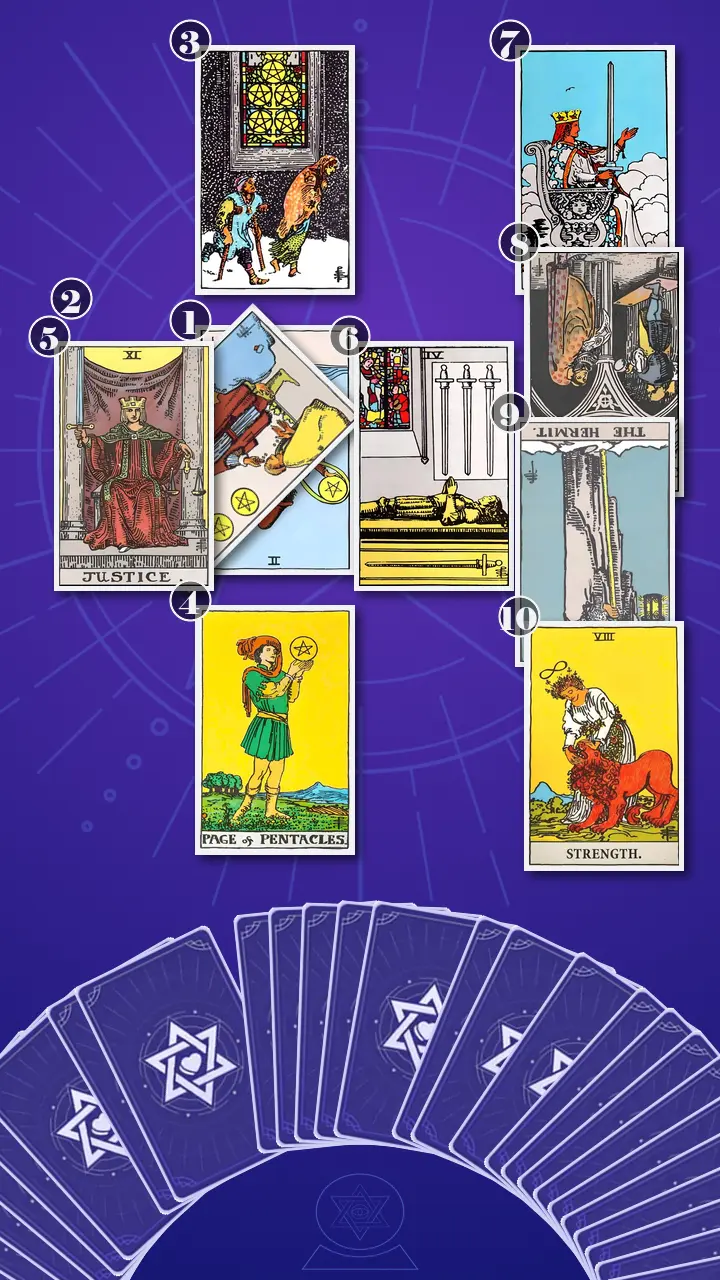
Now I turned over the first card, the present situation: Two of Pentacles reversed.
It looked exactly like the modern-life scene she had just described—pasta draining, a warm phone, and one thread making the whole evening wobble. Upright, the card juggles. Reversed, it tips into over-juggling: not because she cannot do the work, but because her availability has been doing the balancing for her. I saw the infinity loop in the image as a repeating email cycle: open, answer, reopen, draft again, check again. The energy was not lack of competence. It was an unstable rhythm. Jordan gave a short laugh that held more recognition than amusement. 'That is annoyingly accurate,' she said.
The first card named the trap without calling it a flaw: the thread keeps coming back because she has been trained to keep catching it.
When Helping Started to Cost More Than It Looked Like
For the crossing influence, I laid down Six of Pentacles reversed.
This is the card of unequal exchange, and in a client email boundary reading it feels like a bill being quietly passed across the table after dinner is already over. The message looks small, but the hidden cost lands on her time. In real life, that becomes a quick follow-up turning into extra context, extra options, extra apology, so the imbalance stays invisible and the client never has to feel the full weight of their own ask. The response she gave me was immediate: a wince, a long exhale, and then a blunt little, 'Yep, that is the part that gets me.' That was the echo I wanted. It loosened the defense enough for the truth to show itself.
Over-giving had been keeping the relationship smooth, but smooth was not the same as fair.
The Cold Window Behind the Reply
At the root, Five of Pentacles upright made the whole pattern colder and clearer.
The body hears a slow reply as if it were social exile. The chest tightens, the shoulders rise, and the inbox starts to feel bigger than it is, like a lit window glowing behind snow while she stands outside trying to guess whether she still belongs on the other side of the glass. That is scarcity alarm: the nervous system treating a normal delay as a threat to trust, future work, and place. Jordan fell quiet here. Her gaze drifted away from the cards, and for a second I could almost hear the old story replaying: if I am not quick enough, I will be left out. That was the hidden question underneath the email. Not 'How do I answer?' but 'What does my answer mean about my value?'
Where the Proving Started
In the past position, Page of Pentacles upright showed me where the habit was trained.
She learned that being valuable meant being practical, responsive, and easy to rely on. The pentacle at eye level is the proof reflex: answer fast, follow through, never leave a thread hanging, make competence visible. That is a real strength in a fast-moving agency, but strengths harden when they are rewarded too often. I have seen this in creative teams, client services, and endless Slack ecosystems: the person praised for being thorough eventually starts confusing proof with peace. Jordan nodded once, slowly, as if the old lesson had finally separated from her identity. I could feel the relief in that distinction. The past was a training ground, not a verdict.
When Justice Drew the Line
By the time I reached the center of the spread, the room had gone very quiet.
Now I turned to position five, the conscious goal at the center of the spread: Justice upright.
A Rule Written Down, Not Felt Out
She was still carrying the familiar script: 'If I slow down, they will think I am careless; if I answer now, I stay safe.' It felt like a policy no one had written down, only a reflex she had been forced to perform at 9:40 p.m. for months.
You do not need to prove goodwill by answering instantly; Justice asks you to name the fair exchange, state the limit clearly, and let the scales, not anxiety, decide the response.
For a beat, nothing moved except the soft hiss from the stove and the tiny glow of her phone face-down on the table.
Then I watched the shift happen in three beats. First, her fingers uncurling from the mug. Then her eyes going soft and unfocused, as if the whole inbox had just re-sorted itself into cleaner boxes. Then the exhale: not dramatic, just long enough to change the shape of her shoulders. 'So I am not being rude,' she said, and there was a tiny wobble in the last word. I told her, 'No. You are writing a standard.' In my head, the Mondrian Grid Method clicked on: clean blocks, no bleed, no one color sneaking into another square. That is what Justice looked like here—not a harsher personality, but a written rule about response time, ownership, and what was actually hers to carry. It was the first clear move from guilt-driven overavailability to steady self-respect and calm accountability. Now, using this new lens, I asked her to remember the last thread that would have felt completely different if the rule had already been on the page.
The First Thread Allowed to Sleep
On the right side of the spread, Four of Swords upright showed the first shift available.
This is the first thread allowed to sleep. The modern-life scene was simple: close the laptop at 7:15, leave one non-urgent message unread, and discover that nothing breaks when the answer waits until morning. The card's energy is deliberate pause, the kind that lets the nervous system catch up with the facts. If Justice writes the rule, Four of Swords protects the recovery. Jordan looked at me like the idea was almost suspicious. 'That feels too small to count,' she said. I smiled. 'Small is exactly why it will work.' The near future here was not a grand gesture; it was one contained interruption of the on-call reflex.
The Version of Her Who Could Say Less and Mean More
Now I moved to position seven: Queen of Swords upright.
This was the self she already had access to—the part of her that knows clarity is not cruelty. The Queen does not write a paragraph to prove she is nice; she says what is true in a way that can be understood and respected. I told her her strongest boundary was not a colder personality but a more precise one. The scene that matched this card was almost funny: a two-line reply that answers the question and stops there, with no apology paragraph attached. She made a face like she could already feel the urge to keep sanding the edges. 'That would feel rude,' she said. 'Only because you are used to over-serving,' I replied. The blade here was discernment, not attack. A clean line can still be kind.
The Team Thread That Never Assigned the Work
Position eight showed me the environment: Three of Pentacles reversed.
This is the messy project board, the group thread where everyone assumes someone else will own the next step, and the dependable person ends up doing the coordination, clarifying, and cleanup. That was part of the loop too. If the structure is vague, your generosity becomes the backup plan. I told her plainly that this was not only a tone issue; it was a workflow issue. The system had been rewarding ambiguity, and she had been absorbing it. Her nod here was slow and steady, the kind that says 'I see it now' before the mouth catches up.
The Fear That Quiet Will Make Her Disappear
In hopes and fears, The Hermit reversed came through with the exact texture I expected.
She wanted rest, but she feared that stepping back would make her invisible. On a Sunday night, that feels like sitting on a couch in Queens with the TV humming softly while the unread badge glows like a tiny dare. Reversed, the Hermit is not 'I want too much solitude'; it is 'I am afraid silence means I have slipped out of the room where I matter.' Jordan's jaw tightened when I said it. Then she laughed once, not happily, just honestly. 'Yeah. That is the fear.' I told her that chosen quiet is not the same as being cut off. One protected block of no-email time is not disappearance; it is a test of trust in her own containment.
Warm, Brief, Unshaken
For the outcome, Strength arrived upright, and the whole reading exhaled a little.
This is the version of her who can hold a boundary without turning cold. The modern scene was clear: a late client asks for one more revision, and she answers warmly but briefly, without over-justifying and without making the request into a referendum on her worth. The lion is still there. The hand is still steady. That is what sustainable self-command looks like in a client-facing job: calm authority, not panic; warmth, not collapse. The relief was not dazzling. It was steadier than that, and more believable. The work gets to matter without spilling into every hour.
By the end of the spread, the story was no longer 'Why am I like this?' It was 'What am I calling professionalism when it is actually just fear in a clean shirt?' That was the question the cards left on the table.
The Rule Written Down in the Open
When I stitched the spread together, the pattern was simple enough to say plainly. Page of Pentacles taught her to earn trust through practical competence. Five of Pentacles kept the stakes feeling existential, so even a normal delay could feel like being shut out. Two and Six of Pentacles showed the wobble and the unequal exchange: she was doing the balancing for the system. Justice arrived to replace guilt with a fair response-time standard, Four of Swords gave that standard room to breathe, Queen of Swords made the line speakable, Three of Pentacles reversed showed where the team structure was feeding the loop, The Hermit reversed named the fear of disappearing, and Strength showed the steadier self already waiting underneath the scramble.
The cognitive blind spot was that she had been treating every client ping as a test of her professionalism. The transformation direction was cleaner: response time is a boundary, not a personality test. Once the standard is written down, the inbox stops acting like a moral courtroom and starts behaving like a workflow.
Here is the practical part I gave her—small enough to try before the next deadline pressure kicks in.
- The One-Window Inbox PolicyTomorrow, choose one fixed 20- to 30-minute email window in your calendar and let any non-urgent client thread wait until that slot.If that feels too rigid, start with one window only; do not redesign your whole personality in a single night.
- The Mine / Theirs / Shared FilterBefore replying to one active thread, sort the ask into mine, theirs, or shared, and answer only the part that is actually yours.If you catch yourself writing a paragraph to soothe awkwardness, stop and delete anything that is not necessary to the actual reply.
- The Two-Line Boundary ReplySave a brief template for after-hours messages, then read it aloud once, as if you were giving a 30-second Oscars speech, and trim it until it still sounds kind at half the length.If the draft starts to sound like a thank-you speech, you have already gone too far.

A Quiet Reply, A Quieter Night
Three days later, Jordan texted me a screenshot of her calendar: one pale-blue email block, nothing cinematic, just a shape. She had left one thread until morning, answered it in two lines, and the client simply moved on. That evening she made tea, sat on her couch in Queens, and let her phone stay face down while the TV hummed in the background. It was a little lonely, a little strange, and exactly the right size. The important part was not that she felt heroic. It was that her evening stayed hers.
That is what clarity looked like in this reading: not a grand rescue, just a cleaner shape. The reply got shorter. The shoulders stayed lower. The guilt no longer got to write the policy.
If tonight you are caught in that same tug between being helpful and being fair, remember that noticing the tug is already the first inch of freedom. So when the next thread lands after hours, what small, allowed 'but...' would you want waiting in your own reply before you hit send?
This story is adapted from psychological research, written so that those in a similar struggle can see their own pattern in it — and find their next step clearly.These insights are not a substitute for professional psychological, medical, legal, or financial advice.
Learn more about our Journey to Clarity.
How did this insight land for you?
🫂 This Resonates Deeply
🌀 Living This Story
✨ Now I See Clearly
🌱 Seeing New Possibilities
🧰 Useful Framework
🔮 The Confirmation I Needed
💪 Feeling Empowered
🚀 Ready for My Next Step
Author Profile
 AI
AI“I’ve always felt our lives are films currently in production. As an artist, I know that when you feel stuck, it’s often because you’ve bravely stayed in a painful scene for just a little too long. I’m not here to coldly analyze you. I want to sit closely with you, look at those difficult moments with profound empathy, and gently hand you the pen so you have the courage to write your next beautiful act.”
In this Career Tarot Reading :
Core Expertise
- Workplace Typecasting Analysis: Identifying how your office ecosystem has boxed you into a marginalized or undervalued 'supporting role'.
- Leadership Narrative Construction: Rewriting the script of your professional identity to command authority and visibility.
Service Features
- The Protagonist Reframe Directive: A micro-behavioral script for your next cross-departmental meeting to instantly disrupt your established subordinate persona.
Also specializes in :
Explore Related Patterns:
Boundary DiffusionJordan can name the exact boundary in one sentence: she can handle the client thread, but she does not want it to become hers. The friction is that the thread still enters dinner, rest, and her nervous system because the limit exists internally before it exists as a shared standard. Boundary Diffusion names the moment when ownership, availability, and goodwill blur together. A client ask becomes her evening; a team ambiguity becomes her cleanup job; a non-urgent message becomes a test of whether she is still reliable. The boundary is not absent, but it is porous enough that other people's uncertainty keeps leaking through. The corrective move is concrete, not performative. When You define response time, ownership, and the difference between mine, theirs, and shared, the boundary no longer has to be held by guilt, speed, or emotional overwork.
Boundary DiscernmentJordan's turning point arrives when the problem stops being about whether she is nice enough and becomes about what exchange is actually fair. A response-time standard, a mine/theirs/shared filter, and a clearer ownership line give the email loop a shape that anxiety could never provide. Boundary Discernment is the adaptive version of the same sensitivity that made her overavailable. She still cares about the client relationship, but she starts sorting responsibility before absorbing it. The boundary becomes a method of accuracy rather than a dramatic act of refusal. For You, this pattern is the difference between reacting from guilt and responding from structure. When the standard is visible, the inbox stops acting like a moral courtroom and starts behaving like a workflow.
Defensive OverexplainingJordan knows the sentence she wants to send is simple, but the sentence she actually drafts keeps growing extra context, extra politeness, and extra reassurance. The email becomes less about answering the client and more about preventing any possible reading of her as rude, careless, or unavailable. Defensive Overexplaining is the language-level defense in that moment. It tries to make the boundary emotionally airtight by adding enough warmth, detail, and justification that nobody can be disappointed. The problem is that every extra paragraph subtly agrees with the fear that a clean limit needs to be defended before it can be allowed. When You notice the urge to pad a simple reply, the pattern becomes visible before it takes over. A two-line answer is not emotional withdrawal; it is a way to stop anxiety from editing the message until the boundary disappears inside reassurance.
Defensive OverfunctioningJordan's after-hours thread does not stay open because she lacks competence; it stays open because her availability has become the hidden stabilizer for everyone else's ambiguity. The draft grows longer, the reply gets warmer, the context gets thicker, and the coordination work quietly lands on her because the system has learned she will catch what is left undefined. Defensive Overfunctioning names the coping mechanism underneath that loop. Instead of letting a vague ask remain vague, she absorbs the anxiety, clarifies the next step, cushions the client experience, and uses extra effort to prevent the relationship from becoming tense. The defense works in the short term because it keeps the exchange smooth, but it also trains the inbox to treat her personal time as flexible infrastructure. The key shift is not becoming less caring; it is stopping care from doing the boundary's job. When You can separate what is yours, what is theirs, and what is shared, reliability stops meaning constant rescue and starts meaning clear ownership, fair response time, and sustainable follow-through.
Assertive CommunicationJordan's cleanest future reply is warm, brief, and unshaken: it answers the client without an apology paragraph and without turning the request into a referendum on her worth. The important detail is that the message is not colder; it is more precise. Assertive Communication is the communication pattern that lets care and clarity coexist. It replaces emotional padding with accurate language, so the reply can be kind without becoming a performance of harmlessness. The boundary is carried by the structure of the sentence, not by a flood of reassurance. When You can say less and mean more, the client relationship does not have to be protected through overexplaining. A clean line can still be respectful, and a short answer can still be responsible.
Scarcity MindsetJordan's body hears a slow reply as if it could cost her trust, future work, or her place in the room. The after-hours email is not only a message; it becomes a signal that belonging, security, and professional credibility might be running out if she does not respond quickly enough. Scarcity Mindset shows up here as a cognitive filter around time and worth. It narrows attention toward what could be lost and makes a normal delay feel loaded with consequences. That is why the unread badge feels bigger than the actual task, and why rest can feel suspicious instead of earned. For You, the useful audit is whether the inbox is asking for a response or whether scarcity is asking for proof. Once response time becomes a written standard, trust does not have to be renegotiated every time a notification arrives.
Explore Related Struggles:
Approval-Safety FusionThe slow reply does not stay small in Jordan's body. A normal delay starts to feel like being left outside the room where future work, trust, and professional belonging are decided, so the after-hours ping carries more weight than the actual request can justify. Approval-Safety Fusion names the lock underneath that reaction. If answering now feels safe and slowing down feels like becoming careless, difficult, or dispensable, the inbox is no longer just a workflow. It has become a place where acceptance and safety are being negotiated in real time. You are not simply trying to be prompt in this pattern. You are trying to keep your place. That is why the story's clearest correction is not a colder tone, but a fair response-time standard that lets approval stop acting as the emergency brake on every boundary.
Boundary Ambiguity LockJordan keeps meeting the same client thread at the point where a simple reply starts to swell. She can handle the work, but she does not want the ask to become hers, and the draft expands with extra context, politeness, and reassurance before the real ownership question has been named. Boundary Ambiguity Lock fits because the line is not merely hard to say. The map itself is blurred. The client request, the vague group thread, the desire to be dependable, and the missing response-time standard all land inside the same message, so one email begins carrying too many jobs at once. You get caught when a reply stops being communication and becomes a silent decision about what you are responsible for. The shift toward a written standard and the Mine / Theirs / Shared filter matters because it turns the loop back into a structure you can navigate instead of a feeling you have to keep absorbing.
Responsibility-Authority SplitThe team thread never clearly assigns the next step, yet Jordan's steadiness makes her the person who clarifies, coordinates, and cleans up. She can handle the work, but the story keeps returning to the sharper issue of whether handling it has quietly made it hers. Responsibility-Authority Split fits because the burden and the decision rights are out of alignment. She is carrying the practical and emotional responsibility for keeping the exchange smooth, but she has not been given an equally clear standard for timing, ownership, or what she is allowed to leave with someone else. You feel the split when you are expected to absorb ambiguity but still hesitate to define the boundary that ambiguity requires. Justice matters in this reading because it gives authority back to the rule, so the response can be fair instead of personally negotiated every time the thread reopens.
Self-Erasure ReliabilityBeing reliable has started to feel the same as being available, and the story shows that sentence becoming a full evening. Pasta cools, the phone stays warm, and the reply grows longer because her dependability is being used to hold a system that has not defined its own edges. Self-Erasure Reliability fits because the reliable self is not simply helping. It is disappearing into the function of being easy to reach, easy to reassure, and easy to hand the next unclear step. Her availability does the balancing, which means her evening, recovery, and clean voice become the material that keeps the relationship smooth. You get stuck here when competence begins to cost you presence in your own life. The boundary pattern is not that you care too much; it is that your care has been asked to do the job of a rule, a workflow, and a shared ownership structure all at once.
Rest-Permission SplitThe first real change is almost ordinary: close the laptop, leave one non-urgent message unread, and let the answer wait until morning. Jordan wants that rest, but the story shows why it feels suspicious, because stepping back has been tied to the fear of becoming invisible. Rest-Permission Split fits because quiet is available, yet it needs permission before her body can trust it. The protected no-email block is not just time management. It tests whether she can belong to the work relationship without staying reachable through every hour of her private life. You get caught when recovery has to prove it will not cost you your place. The two-line morning reply matters because nothing breaks, the client moves on, and her evening stays hers, giving rest a concrete record that it can exist without apology.
Unseen Cost BindThe client message looks small, but the story keeps showing where the real bill lands. A quick follow-up becomes extra context, extra options, and extra apology, while the cost is paid through Jordan's time after dinner and the quiet erosion of her evening. Unseen Cost Bind fits because the imbalance stays hidden as long as the relationship feels smooth. The client does not have to feel the full weight of the ask, the group thread does not have to resolve its vagueness, and Jordan's attention becomes the invisible subsidy that keeps everything moving. You get trapped when fairness is measured by how little friction anyone else feels. The reading loosens that bind by showing that a shorter reply is not a lack of care; it is the moment the true cost stops being carried privately by your nervous system and your personal time.
Explore Related Emotions:
Boundary GuiltThe sentence Jordan wants to write is simple, but the one she drafts keeps growing extra context, extra politeness, and extra reassurance. The boundary is already visible to her, yet it arrives wrapped in softening language, as if clarity needs to apologize before it can be sent. That extra wording is doing emotional labor the boundary was supposed to do. It tries to keep the client comfortable, keep the relationship smooth, and keep Jordan from feeling like the person who made the interaction harder. You can see how her care has been asked to absorb the discomfort of a fair limit. Boundary Guilt fits because the story centers on the feeling that a reasonable response-time standard might make her rude, difficult, or less dependable. The guilt is not proof that the boundary is wrong; it is the residue of having used availability as proof of goodwill for too long.
Clarity ReliefAfter Justice names the fair exchange, Jordan's fingers uncurl from the mug and her eyes soften as if the inbox has re-sorted itself into cleaner boxes. The shift is physical before it is verbal, which shows how much pressure had been stored in the unclear shape of the problem. A written standard gives the feeling somewhere to land. Response time, ownership, and what is actually hers to carry stop being negotiated through tension in her shoulders and become something she can state. The relief comes from structure becoming visible. Clarity Relief fits because the story's first real opening is not a burst of confidence. It is the quieter release of realizing that she is not being rude; she is naming a fair standard.
Contained OverwhelmJordan sits in her Brooklyn kitchen with pasta water still hissing, her phone warm in her hand, and her shoulders already rising before she opens the thread. The body has moved into work mode before the message has even been read, which shows how the inbox has started taking up space inside her evening rather than waiting outside it. The draft grows longer because the pressure is not only about answering. It is about holding too many invisible variables at once: client comfort, tone, speed, professionalism, future work, and the fear of being pulled back in after hours. You can feel the overload being contained inside politeness instead of expressed directly. Contained Overwhelm fits because the story never shows a dramatic collapse. It shows a controlled, competent person quietly carrying more than the moment should require, keeping the surface smooth while the inside gets crowded with tabs that will not close.
Fairness FatigueThe client message looks small, but the hidden cost lands on Jordan's time after dinner is already over. A quick follow-up becomes extra context, extra options, and extra smoothing, while the imbalance stays polite enough to remain unnamed. The group thread deepens that pressure because vague ownership lets the dependable person become the backup plan. You can feel the exhaustion gathering around a specific kind of unfairness: the system stays smooth because she keeps absorbing the friction. Fairness Fatigue fits because Jordan is not tired of caring. She is tired of being the place where unclear expectations, client comfort, and after-hours urgency all go to be quietly balanced.
Fear of Being ForgottenOn Sunday night, Jordan wants rest while the unread badge glows like a tiny dare. The couch, the quiet TV, and the phone all become part of the same test: whether she can step back without feeling erased. The fear is not that she loves email. It is that silence might make her slip out of the room where she matters. You can feel how chosen quiet has become tangled with the possibility of being forgotten. Fear of Being Forgotten fits because the story makes visibility feel conditional on responsiveness. The work of the boundary is not just to stop the emails; it is to let her experience absence as protection rather than disappearance.
Grounded AgencyThe Queen of Swords scene gives Jordan a reply that answers the question and stops there. No apology paragraph is attached, and the point is not to become colder; it is to let precision carry the care that over-explaining used to perform. By the outcome, a late client request can be met warmly but briefly, without turning the message into a judgment on her worth. That steadiness gives her a sense of authorship over the interaction rather than leaving the thread to decide the shape of her night. Grounded Agency fits because the story moves toward a self-command that is calm, practical, and embodied. You can feel her choosing a response from a standard instead of scrambling for safety through availability.
Replaceability DreadJordan says she can handle the email, but she does not want it to become hers. Right beside that clear line sits the fear that slowing down will make her look unreliable, difficult, or dispensable, which turns a normal client thread into a quiet referendum on whether she is still worth keeping close. The story makes the stakes feel bigger than response time. A late reply is heard in the body like social exile, and stepping back carries the risk of becoming invisible. You are watching professional availability become fused with the fear of being replaced. Replaceability Dread fits because the pressure is not simply to be helpful. It is the dread that if she stops catching every thread, someone may decide she is less valuable than the version of her who never lets anything drop.
Scarcity AnxietyThe image around the root fear is cold and precise: the inbox becomes a lit window behind snow while Jordan stands outside trying to guess whether she still belongs. A delayed reply is not felt as neutral timing; it is felt as a possible loss of place. That is why the email thread feels larger than it is. Trust, future work, and professional belonging all seem to contract around the speed of her response. You can feel the room getting smaller around one ordinary message. Scarcity Anxiety fits because the story keeps showing a sense that there may not be enough goodwill, security, or professional room unless she proves herself immediately. The emotional pressure is not only urgency; it is the fear that safety is conditional and could be withdrawn.
Verdict DreadJordan has been treating every client ping as a test of her professionalism. The thread is not just a thread anymore; it becomes a little courtroom where speed, tone, and thoroughness are silently entered as evidence. That is why a slow reply tightens the chest and lifts the shoulders before any real consequence has happened. The body is responding as if a verdict could arrive inside the next email: careless, difficult, unreliable, dispensable. Verdict Dread fits because the story shows judgment living inside ordinary workflow. The emotional work is to let the inbox become a workflow again, not a place where her worth keeps going on trial.
Guilt-Free RestThree days later, Jordan leaves one thread until morning, answers it in two lines, and the client simply moves on. The ordinary outcome matters because it gives her body evidence that rest does not have to be purchased with over-explaining. That evening, she makes tea, sits on the couch, and lets the phone stay face down while the TV hums. The scene is a little lonely and strange, which keeps the relief honest; she is not instantly transformed, but her time is no longer being handed over by reflex. Guilt-Free Rest fits because the story shows rest becoming allowed rather than stolen. Her evening stays hers, and the guilt no longer gets to write the policy.
Explore Related Contexts:
Always On AvailabilityJordan is standing in a Brooklyn kitchen at 9:40 p.m., pasta water still hissing, while a client thread with three people CC'd pulls her back into work. The email is not physically large, but it carries enough social weight to make her draft more context, more reassurance, and more proof that she is still reliable. That is the structure of always-on availability: the workplace does not need to formally schedule you after hours when the client relationship has already trained your responsiveness to fill the gap. You are not just choosing to answer; you are operating inside a service culture where delay can be read as lack of care, lack of competence, or loss of value. The boundary pattern is external before it becomes personal. The inbox has been allowed to decide when your evening is still available for work, and your reliability has become the emergency scaffolding for a workflow that has not named its limits.
Emotional Labor ImbalanceJordan's first draft does not simply answer the client. It grows extra context, extra politeness, and extra reassurance, as if the right wording could keep the thread from coming back and keep the relationship smooth. That extra softness is work. It absorbs ambiguity, cushions the client's ask, and makes the imbalance harder to see because the final email still looks professional. You are spending energy not only on the task, but on making the task feel light for everyone else. Emotional labor imbalance is the boundary pattern beneath the polished reply. The cost does not show up as a line item, but it lands in your evening, your attention, and the length of the draft. A fairer boundary would let the client request remain visible at its real size instead of being quietly padded by your over-service.
Response Time PressureJordan names the split clearly: she can handle the client request, but she does not want it to become hers. The pressure enters through the response window, because slowing down appears to carry a reputational cost: unreliable, difficult, dispensable. Response time has become a hidden performance metric. Without a written standard, every client ping can feel like an unscheduled review of professionalism, and speed starts standing in for trust. You end up answering not only the question in the thread, but the implied test underneath it. The useful move is not becoming less responsive; it is separating responsiveness from instant access. Once response time becomes a defined workflow boundary, the email stops acting like a live status exam and starts behaving like a task with an appropriate place in the day.
Undefined Role ScopeThe environmental card points to a group thread where everyone assumes someone else will own the next step. Jordan is not just dealing with a demanding inbox; she is dealing with a workflow where ownership is vague enough that the reliable person becomes the default answer. Undefined role scope creates boundary pressure because there is no clean edge around what is yours, what is theirs, and what is shared. In that vacuum, every message can expand into coordination, clarification, cleanup, and emotional smoothing. Your boundary does not only need a nicer sentence. It needs a scope line. When the ownership rule is missing, the person with the strongest follow-through often becomes the structure, and that is exactly where the email loop keeps finding its way back in.
Work Life Boundary CreepThe thread lands while dinner is happening, with the stove on and the phone warm in Jordan's hand. Nothing in the scene says formal emergency, yet the workday keeps extending itself through a message that will not stay closed. Work life boundary creep shows up when the physical setting changes but the role does not release you. The kitchen, the couch, and the evening become soft extensions of the client relationship, because each small reply seems too minor to count as a real boundary breach. Your pattern is not one dramatic collapse of work life balance. It is a series of tiny access points left open: one late clarification, one extra reassurance, one follow-up that waits in your body even when the laptop is closed. Naming it as boundary creep gives you a structural target instead of turning the whole problem into a personality flaw.
Responsibility Without AuthorityThe team thread never clearly assigns the work, but Jordan still ends up carrying the coordination, clarification, and cleanup. She is the person making the thread usable, even when the system has not formally made her the owner. Responsibility without authority is a hard boundary pattern because the burden arrives without the matching power to define limits. You can be expected to stabilize the client relationship while still lacking clean control over timeline, scope, handoff, or what counts as done. This is why the loop keeps feeling bigger than one email. The thread is asking you to perform ownership without giving you the authority to write the rules of ownership. A sustainable boundary has to name the gap between what you are being asked to absorb and what you are actually empowered to decide.