One Missed Checkbox Became a Verdict, Then Returning Became Evidence
The 11:48 p.m. Insight-to-Overhaul Loop
If you are a 28-year-old UX designer on a fast-moving Toronto product team, and a late-night realization has you rebuilding your entire Notion routine before your phone screen goes dark, you may recognize the insight-to-overhaul loop. I recognized it when Alex (name changed for privacy) sat across from me, still carrying the speed of that moment into my quiet consultation room.
Alex told me that at 11:48 p.m. on a Tuesday in their Toronto condo, they had opened Apple Notes after a difficult conversation and typed a realization about overcommitting. The desk lamp made a warm circle across the keyboard; their phone felt hot in their palm, the radiator clicked beside them, and their fingers kept tapping. Before the thought had reached the end of the page, they had created a new routine, rebuilt the calendar, and titled the Notion page The Sustainable Version of Me.
When I asked what brought them in, Alex looked down at the notes on their phone and said, “Why do I keep acting on insights before I can live them? I understand the pattern before I can tolerate practicing it. If I know what to do, why am I still doing it badly?” They could turn understanding into a plan within minutes, but living that plan required tired Wednesdays, awkward conversations, stakeholder requests, and ordinary repetition.
Their frustration moved through their chest and hands like an invisible phone vibrating in a pocket they could never reach: a bright, restless lift when everything suddenly made sense, followed by heaviness and deflation when real life interrupted the new system. I knew that particular weight from my years on Wall Street, where uncertainty could sit beside a person long after the trading floor went quiet. I told Alex I was not there to predict a fate or grade their character. A clear insight is not a completed change. “Let’s put the cards to work as a structured mirror,” I said. “We’ll draw a map through the fog, then leave the decisions and the authorship with you.”

Choosing a Grid for the Knowing-Doing Gap
I asked Alex to take three unforced breaths and notice the first physical signal that arrived when they imagined waiting before changing anything: the pressure in the chest, the movement in the hands, the urge to reach for a new framework. Then I shuffled slowly. The preparation was not a supernatural test; it was a clean boundary between reacting to an insight and observing it.
Today I used the Transformation Path Grid · Context Edition, a six-card insight-to-action tarot spread designed for this exact kind of inner loop. This is how tarot works in my room: the images give a complex experience a visible structure, while the querent supplies the lived evidence. The cards do not make decisions, promise outcomes, or replace therapy, reflection, or practical judgment. They help us examine the pattern without letting urgency write the entire story.
I chose this spread because Alex’s problem was a self-reinforcing knowledge-action cycle, not a simple question about the past or future. A realization created urgency; urgency produced an oversized action; ordinary friction collapsed the action; the collapse sent Alex searching for more insight. A Celtic Cross could offer more breadth, but it would add positions that were not necessary for this narrow mechanism. A Past-Present-Future spread might imply a neat linear progression, while this six-card grid could show the loop and the bridge out of it.
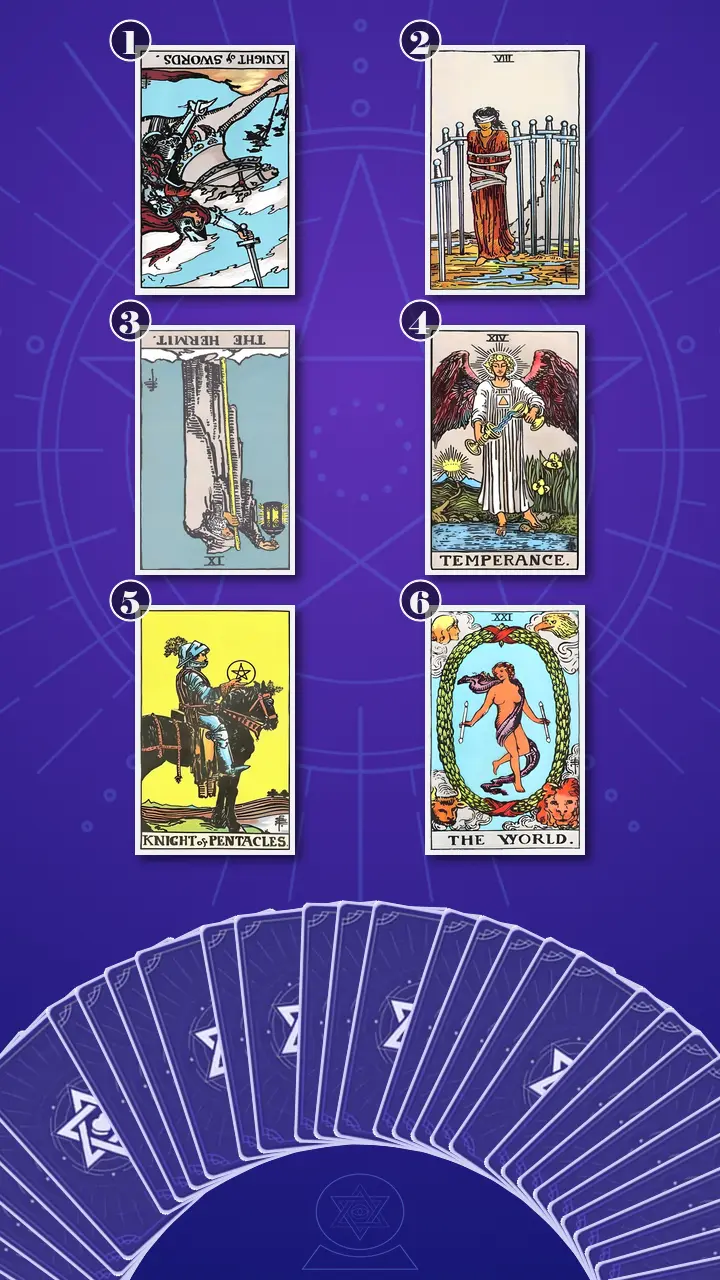
I placed the cards in a 2-by-3 staircase across the table. Position one would show the Current state / surface expression, the visible behavior of turning insight into immediate action. Position two would reveal the Blockage / what interrupts progress, the all-or-nothing rule making gradual embodiment feel insufficient. The middle row would move from the Root / underlying source to the Key trigger / catalytic shift. The bottom row would translate that shift into the Action plan / practical response and the Integration / lived learning. We would read the grid as a staircase: speed, enclosure, source, bridge, practice, and a flexible cycle.
The First Cards That Turned Speed Into Evidence
Position 1: The Cursor Moves Before the Workday
I turned over the card representing the Current state / surface expression: the observable pattern of converting a fresh insight into immediate action before it can be lived. It was The Knight of Swords, in reversed position.
After a late-night journal entry or difficult conversation, Alex treats the realization like an urgent Slack message from the future. Before bed, they rebuild the weekly calendar, create a stricter Notion dashboard, draft a new boundary text, and decide that Monday will be different. The raised sword becomes the cursor already moving before the idea has been tested, and the charging gray horse becomes that familiar rush from clarity to total action. When the first workday interruption arrives, Alex revises the entire system instead of asking which one part could continue.
The reversed energy is an excess of air and speed: rapid interpretation, scattered force, and action launched before discernment has caught up. It is not that Alex lacks motivation. The problem is that the insight is treated as a command, and the command quickly becomes a full behavioral overhaul. One missed step then feels like evidence that the whole realization was false. I asked, “What single action could honor the insight without turning it into a new identity by midnight?”
Alex gave a short, bitter laugh rather than nodding. “That’s almost cruelly accurate.” I watched their thumb stop over the phone screen, then saw their mouth tighten around a smile that held recognition and embarrassment together. I told them that the card was describing momentum, not condemning it. Their intelligence was not the enemy; it simply needed a slower hand on the controls.
Position 2: The Checkbox Becomes a Verdict
I turned over the card representing the Blockage / what interrupts progress: the all-or-nothing mental rule that makes gradual embodiment feel insufficient and keeps the action cycle unstable. It was The Eight of Swords, in upright position.
The card brought me to a Sunday night scene Alex had described. At 9:18 p.m., one empty checkbox showed that they had skipped the five-minute reflection promised on Saturday. The radiator clicked on in the quiet apartment, blue screen light stretched across the floor, and Alex moved from a half-finished journal entry to Reddit, TikTok, and a search for a more precise method. The blindfold was the conclusion formed before the whole situation had been observed. The surrounding swords were rules such as, “A missed day means I am back at zero.”
Alex read the private binary aloud: “Either I do this perfectly now, or the insight was meaningless.” That is the mental enclosure this card revealed. The smaller options were still present outside the frame: return for two minutes, change the cue, record what interrupted the practice, or simply try again on a different kind of day. The upright Eight of Swords does not predict permanent entrapment. It shows a blockage created when a thought-based verdict is mistaken for the complete picture.
I asked, “What option becomes visible when you stop requiring this insight to transform you today?” First, Alex’s breath paused and their fingers hovered over the phone as if even closing the search might be dangerous. Next, their gaze lost focus; I could see them replaying the empty checkbox, the deleted tracker, and the familiar Sunday decision to start over. Finally, a long breath came from somewhere deep in their chest, their jaw loosened, and their hands flattened on the table. “I have been treating one missed step like a verdict,” they said. The room grew quieter, not because the problem had vanished, but because the binary had been seen.
Position 3: The Lantern That Never Reaches the Path
I turned over the card representing the Root / underlying source: why Alex seeks another insight rather than staying with the ordinary repetition needed to embody the current one. It was The Hermit, in reversed position.
Late at night, Alex keeps the lantern pointed at the inner world: six saved articles open, an unfinished Apple Notes entry, and a self-improvement podcast paused halfway through. The laptop fan hums while their hands move between tabs. They reread the same realization about overthinking and highlight another sentence about consistency, but the small behavior that could test the idea on a tired Wednesday remains untouched. The lantern is illuminating the pattern, yet the mountain path is not being walked.
The reversed energy here is a deficiency of embodied contact. Reflection has become more private and more elaborate without becoming practical learning. Another explanation feels safer than letting one imperfect behavior be visible to a friend, tested in a design review, or repeated when the body is tired. I asked, “When you consume another podcast or framework, what ordinary action would you have to try if you stopped searching for a more complete explanation?”
Alex closed two browser tabs, then reopened one before catching themselves. “I keep thinking the next framework will make the behavior feel natural,” they said. Their shoulders lifted and fell in a small, tired motion. I answered gently, “The next framework cannot practice for you.”
That sentence carried a little of my own history. Years ago, on a Wall Street desk, I learned that a beautiful thesis was not the same as a position supported by evidence. I had watched intelligent people reopen a model again and again because a cleaner spreadsheet felt safer than making one small, observable decision. I did not interpret the Hermit reversed as a failure of reflection. I saw it as a sign that insight had reached the edge of private understanding and needed contact with life.
When Temperance Poured Between Two Cups
At this point, the insight-to-overhaul loop was visible without blame: thought became urgency, urgency became an oversized plan, and an ordinary interruption was misread as proof that the thinker needed a better explanation. I slid the middle-right card toward the lamp. The radiator clicked once and stopped; outside, a streetcar bell sounded through the glass, and the room seemed to make space around the next image.
I turned over the card representing the Key trigger / catalytic shift: the quality that can interrupt the rush and blend insight with actual daily limits, directly challenging the fear that delayed change proves a lack of capability. It was Temperance, in upright position.
Temperance brought balance rather than another burst of motivation. The angel stood with one foot on land and one in water, pouring between two cups with patient precision. The water did not erase either element; it created an exchange. In Alex’s life, that meant keeping the underlying insight while scaling the behavior down until a real workday could hold it. Instead of rebuilding the whole day after a product-launch week, Alex might write one sentence before a difficult Slack reply, pause for two minutes after closing the laptop, or return to one boundary on two ordinary evenings.
I told Alex that Temperance was responsive design for personal change. The practice could adapt to the actual screen size of the day instead of requiring their life to become a different device. “I am adjusting the practice to reality, not abandoning the insight,” they repeated softly. The central energy was balance: thought meeting emotion, intention meeting limits, and motivation becoming regulated enough to remain available tomorrow.
This was where I used my signature Potential Actionability Assessment. I translated the abstract upgrade into four practical questions: What is the smallest repeatable behavior? In which real setting will it happen? How long will it take? What evidence will show whether it needs adjustment? I was not trying to make Alex ruthless with themselves. I was trying to make the plan precise enough that it could stop demanding heroics.
I also put the proposed routine through my Pseudo-Growth Eradication lens. That means stripping away the self-help fluff and auditing the actual return on effort: does the plan produce contact with daily life, and what is its execution rate after the first inconvenient interruption? A detailed schedule can create a powerful emotional lift while producing almost no lived evidence. That is a design problem, not a verdict about someone’s worth. Temperance asked us to reduce the plan until its practical ROI became visible.
To make the hinge concrete, I asked Alex to picture Tuesday at 11:48 p.m. again. The phone was warm, Apple Notes was open, and a fresh realization was already becoming a new routine. Their chest was bright with urgency, even though tomorrow’s tired workday had not agreed to the plan.
You do not need to turn every insight into an immediate overhaul; let it blend into one repeated practice, like Temperance pouring between two cups until understanding and daily life can share one measure.
Alex’s fingers froze above the phone. For one beat, their breath stopped and their eyes stayed on the two cups; then their gaze went unfocused, as if replaying Reset v2, the empty checkbox, and the moment they had deleted an entire plan. Their jaw tightened. “But doesn’t that mean I was wrong before?” they asked, irritation flashing through the fear. I let the question stand. Their eyes widened slightly as the older verdict underneath it came into view: if I cannot live what I know, I cannot trust myself. Then their clenched hands slowly opened on the table. Their shoulders lowered by a fraction, and a thin shine gathered at the edges of their eyes. When they breathed out, the sound was unsteady, almost a laugh, but it carried less pressure. “Maybe adjusting isn’t abandoning it,” they said. The radiator clicked again, and this time the silence did not feel like a test. It felt like room.
“No,” I said. “It means the insight has entered the part of the process where evidence, not intensity, gets to teach you.”
Now, use this new perspective to think back over last week: was there a moment when this insight might have let you feel different?
Then I gave the insight a small physical test. I suggested setting a ten-minute timer, writing down one realization, naming the smallest action it could produce in five minutes or less, scheduling one ordinary moment for it, and recording one observation instead of a self-rating. Alex could stop, close the note, and choose whether or when to return. Choice remained part of the practice.
This was the first bridge from frustrated urgency and all-or-nothing self-monitoring toward patient integration and self-trust built through repetition. The smallest repeatable behavior was not an insult to the breakthrough; it was the vessel that could carry it. “Let the insight get ordinary,” I said.
The One Pentacle That Could Survive a Tired Wednesday
Position 5: The Practice Held at Chest Level
I turned over the card representing the Action plan / practical response: the shift translated into one small repeatable behavior that can be practiced this week without making a new identity promise. It was The Knight of Pentacles, in upright position.
This knight did not charge. He sat on a still black horse and held one pentacle carefully at chest level, with a dark ploughed field stretching toward low hills. The modern translation was simple: Alex chooses one five-minute action and repeats it three times this week without changing the plan halfway through. The single pentacle is one observable behavior. The cultivated field is the preparation that makes returning possible. Progress is opening the same note after a long day, not feeling newly transformed.
The energy is grounded and balanced. What may look like a deficiency of novelty is actually protection from the old excess of speed. The knight’s stillness is not stalled ambition; it is deliberate pacing. I asked, “Which one behavior could you repeat three times in three different real contexts, including one awkward or inconvenient day, without making a new promise about who you are?”
Alex glanced at their calendar. “I could write one sentence before replying to a difficult Slack message,” they said. “But five minutes feels so small that part of me wants to make it a whole communication system.” I smiled because the temptation had arrived exactly on schedule. “Then five minutes is doing important work,” I said. “It is small enough to expose what the day is actually like.” Alex wrote the sentence down and did not open Notion.
Position 6: The Wreath That Kept the Missed Day
I turned over the card representing the Integration / lived learning: what it means for understanding and behavior to become one flexible cycle rather than predicting an external result. It was The World, in upright position.
The World framed the lesson with a green wreath around a dancing central figure, two crossed wands held in balance, and four surrounding figures giving the scene a sense of inclusion. Its modern translation was version history. When the familiar pattern returned, Alex would not delete the tracker or declare the transformation over. They would note what happened, return to the practiced response, and let the lapse remain part of the same learning cycle. Insight, action, feedback, and repetition could belong to one project.
The World’s energy is integration, not permanent perfection. It does not promise that Alex will never need to adjust. It shows a flexible identity that can hold understanding and imperfection without forcing one to erase the other. I asked, “After a lapse, what would it look like to record the return instead of restarting the entire system, and what might that teach you about the practice?”
Alex drew a line at the top of the page and wrote, Return over reset. Their eyes were still cautious, but their hand no longer moved as if it had to solve the entire future before the appointment ended.
Finding Clarity Without a New Reset
When I laid all six cards together, I could see the complete story. The reversed Hermit showed the root: Alex had been using private analysis to postpone the ordinary evidence that could complete an insight. The reversed Knight of Swords showed the visible expression: a realization became a new schedule, declaration, or dashboard before it had reached the body. The Eight of Swords supplied the blockage: one imperfect repetition became a verdict about capability. Temperance offered the bridge, the Knight of Pentacles gave it a physical pace, and The World showed how a lapse and a return could remain inside one learning cycle.
The core contradiction was not simply acting on insights versus living them. It was the belief that immediate action could prove an insight was real, while gradual practice might expose Alex as incapable of consistency. The Figma metaphor helped: a clear insight is a prototype, not a shipped feature. It needs a small release, contact with production conditions, feedback, and revision. Rebuilding the entire product after every user interaction does not create a better product; it prevents the team from learning what actually works.
The cognitive blind spot was assuming that the discomfort of waiting meant the insight was fading, and that the discomfort of imperfection meant the person was failing. In reality, both sensations were information about the conditions required for practice. The transformation direction was clear: wait long enough to translate one insight into the smallest repeatable behavior, then measure progress by returning to it rather than generating a stronger insight. The knowing-doing gap would not be closed by a louder plan. It would be narrowed by lived evidence.
I offered Alex the following actionable advice as a field test, not a new identity to perform. Each step had a clear beginning, a modest size, and permission to stop.
- The 24-hour Insight BufferWhenever a new realization arrives after a therapy session, journal entry, podcast, or difficult conversation, write it in the Apple Notes Realizations folder and wait 24 hours before changing the whole routine. After the pause, choose one action that takes five minutes or less, such as writing one sentence before replying to a Slack message or setting one calendar boundary. Schedule it for two ordinary moments this week, including one tired or busy day, and record only whether you returned and what you noticed.If five minutes feels too small or too pressuring, use a two-minute version. Keep the insight visible without adding more rules, and do not announce the experiment unless sharing genuinely supports you.
- The Three-Ordinary-Days TestChoose one existing insight from Reset or Realizations and define its smallest observable behavior in one sentence. Practice it three times this week in three different contexts: before a design review, after closing your laptop, or while riding the TTC home. Use one plain note with three checkboxes and one short observation after each attempt. Do not revise the behavior until all three attempts are complete.Expect boredom, forgetfulness, or the urge to improve the method after the first attempt. Put the note beside an existing cue, reduce the behavior to its first physical step, and count a partial return as useful data.
- The Evolution KPI Framework: Return Over ResetFor the next 30 days, keep one practice rather than opening a new framework. Log each attempt and, after a missed attempt, write the exact time you returned instead of deleting the tracker. Once a week, spend ten minutes reviewing what made returning easier, what made it harder, and what should remain small. The KPI is the number of returns and one piece of learning, not a perfect streak.I designed this as a strict execution challenge around the experiment’s boundaries, not around Alex’s worth. A trusted friend may check in once if that feels supportive, but accountability is optional, specific, and revocable. If the process creates pressure, Alex can pause it.
I reminded Alex that the cards had not performed the repetition. I had not performed it either. The spread had made the mechanism visible, but Alex would decide which practice to test, what evidence to trust, and when the experiment had done enough. That is the point of an objective cognitive tool: it returns the steering wheel to the person who has to live with the road.

A Week Later, the Quiet Proof
One week later, I received a message from Alex: “I waited 24 hours. Then I wrote one sentence before a difficult Slack reply. I missed Tuesday, logged the time I returned on Wednesday, and didn’t delete the note.” It was not a dramatic transformation, and I was glad. It was a small piece of evidence that had survived an ordinary workweek.
That Thursday morning, the old thought—What if I fall back?—still arrived. Alex smiled, opened the same note, did two minutes before work, and left for a crowded Toronto day. The change was quiet and vulnerable: no new identity, just a return.
I saw the Journey to Clarity as a change in measurement rather than a promise of permanent ease. Alex had moved from performing a breakthrough to inhabiting a practice, from all-or-nothing monitoring to patient integration. The cards offered a map; Alex chose the pace, tested the route, and kept the right to revise it.
The Transformation Path Grid remains a reflective map, not a verdict. When a clear realization lights up your mind while your chest tightens at the thought of living it imperfectly, launching a new Notion plan can feel safer than letting that insight meet one tired Tuesday.
If you let one insight stay small enough for a tired Tuesday, what tiny return would you be curious to notice—the first quiet pour between understanding and the life your day can actually hold?